Category: Accelerating

  • Accelerating the frontiers of scientific discovery: Google’s $40M commitment to the Genesis Mission

    Accelerating the frontiers of scientific discovery: Google’s $40M commitment to the Genesis Mission

    Scientists today face challenges of extraordinary scale and complexity. From shaping and simulating the intricate dynamics of fusion plasma, to exploring the vast search space of new materials, to making sense of the exabytes of data pouring out of the world’s most advanced experimental facilities. The demands on modern research are unprecedented. Frontier AI can help address these challenges, while accelerating groundbreaking scientific discoveries.

    In December, we shared our commitment to the White House’s Genesis Mission — the national effort to harness AI and double the pace of American scientific discovery within a decade. Since then, Google DeepMind (GDM) announced an early access program that provides AI for science tools to all 17 Department of Energy (DOE) National Laboratories, and Google Public Sector shared how Gemini for Government could serve as an AI backbone for the DOE.

    Today, at the DOE Genesis Mission Summit 2026, we are expanding this by committing $40 million of AI tokens and cloud credits for researchers in support of the Genesis Mission.

    Frontier AI tools for scientific discovery

    Under this expanded commitment, we will first provide DOE’s Genesis Mission awardees in-kind access to GDM’s frontier AI for science portfolio, including:

    • AlphaEvolve — a Gemini-powered coding and discovery agent, for designing advanced algorithms.
    • AlphaFold 3 — a model for predicting the structure and interactions of proteins and other biomolecules.
    • AlphaGenome — a tool for understanding how variation in DNA, including the non-coding genome, shapes biology and disease.
    • WeatherNext — a state-of-the-art family of AI weather forecasting models for mapping weather conditions.
    • AlphaEarth Foundations — a foundational AI model for mapping and understanding our planet in unprecedented detail.

    Second, we will provide Gemini for Government seats and tokens for one year to tens of thousands of users across the DOE National Laboratories’ operations, research, and management teams. This secure platform supports the full breadth of work from the research bench to the administration of specialized user facilities serving the entire scientific community, providing a single secure foundation that the DOE mission can depend on.

    AI for science tools in action across the laboratory ecosystem

    While we have a lot of work still to do, the practical impact of the Genesis Mission is already coming to life across the laboratory ecosystem.

    At Pacific Northwest National Laboratory (PNNL), senior scientist Dr. Henry Kvinge is using AlphaEvolve to map out massive mathematical systems that are far too complex for humans to explore by hand. The AI uncovers hidden connections automatically, fast-tracking discoveries that would normally take researchers years to find.

    “Modern math relies on abstraction, but combinatorics offers concrete models that make complex geometry and algebra easier to grasp. We’ve found that systems like AlphaEvolve are perfect for this search,” said Dr. Kvinge. “By leveraging the broad mathematical knowledge of LLMs, we can automate the exploration of countless angles. We’re still experimenting, but the discoveries are already shaping our future research.”

    At the National Laboratory of the Rockies (NLR), researchers are utilizing Gemini to fundamentally change how they interact with physical laboratory hardware. Dr. Steven R. Spurgeon, a senior materials data scientist at NLR, leads a pioneering program in autonomous materials discovery.

    “Our collaboration has allowed us to build an autonomous experimentation capability,” said Dr. Spurgeon. “By deploying Gemini in our instruments, we cut microscope calibration time from over 90 minutes to about 13 minutes (eight times faster) and reduced the manual steps needed to focus an image from as many as 50 down to two. That’s time and attention we’ve given back to the science itself, enabling genuinely autonomous workflows that observe, reason, and decide in real time. This has helped us explore parts of the material design space we simply could not have reached through manual operation alone.”

    Driving American innovation

    The Genesis Mission represents an opportunity to transform research and science across America. By providing access to advanced AI tools, we aim to help scientists accelerate breakthroughs across critical energy, security, and scientific challenges. To learn more about how these AI capabilities can support your research initiatives, join us at the upcoming Google Public Sector Summit in October.

    Posted in

  • Accelerating discovery of liver disease mechanisms

    Accelerating discovery of liver disease mechanisms

    Biomedical research produces a flood of information that no scientist can realistically absorb. At the University of Edinburgh, bioengineer Filippo Menolascina is using Co-Scientist to comb the literature for overlooked links and generate new hypotheses.

    His team focused on a common liver disease called metabolic dysfunction‑associated steatohepatitis (MASH). Developing treatments is challenging because MASH involves intertwined biological processes, including liver inflammation and metabolism, meaning single‑target drugs fall short. That pushes researchers toward combination treatments, but the number of potential drug pairings is overwhelming.

    Faced with that combinatorial explosion, Menolascina used Co‑Scientist to narrow the search. In his hands, Co‑Scientist synthesised evidence across liver biology and pharmacology, highlighted mechanisms worth focusing on, and flagged candidate combination therapies that his team could test.

    In one emblematic case, Co‑Scientist tackled a live, practical question: Why does the drug resmetirom – a recently approved treatment prescribed for a specific stage of MASH – only help a narrow slice of those eligible patients? The system produced a hypothesis pinpointing the NLRP3 inflammasome as the specific molecular bridge coupling inflammation and metabolism in the disease — a connection never previously pulled together into a single, actionable explanation. The hypothesis, later experimentally verified, could pave the way for targeted dual-therapies.

  • Accelerating discovery in India through AI-powered science and education

    Accelerating discovery in India through AI-powered science and education

    February 18, 2026 Responsibility & Safety

    Demis Hassabis, Lila Ibrahim and Pushmeet Kohli

    Introducing our National Partnerships for AI and collaboration in India

    We believe AI will be the most transformative technology in human history and that it should be deployed in ways that benefit all of humanity. This requires deep, strategic collaboration between frontier AI labs, governments, academia, and civil society.

    To fully realise AI’s potential, Google DeepMind is working with governments through our National Partnerships for AI initiative to broaden access to our frontier AI capabilities, helping ensure they are deployed to serve citizens and meet national priorities in science, education, resilience, and public services.

    Building on our collaborations with the US and UK governments, we are establishing a new partnership with Indian government bodies and local institutions. In the global AI transformation, India is showing exceptional leadership in applying the technology to tackle its own biggest challenges. But India is going even further, playing a critical international role by convening this week the fourth global AI summit of governments, companies and civil society. International dialogue and collaboration will guide positive impacts and create the global frameworks required to prepare society for a future with AI.

    Partnership in India to broaden AI access

    Our partnerships are designed to accelerate the pace of progress across India. Here are a few ways we are working together to unlock new possibilities in science and education.

    Advancing scientific breakthroughs

    Google DeepMind, Google Research and Google.org are partnering with the Anusandhan National Research Foundation (ANRF) to facilitate the adoption of AI models to advance science. We’re providing access to our frontier AI for Science models, supporting hackathons and community contests, and enabling training and mentorship to students, researchers, and those in the early stages of their careers.

    Researchers and engineers in India will be able to use our AI tools, including:

    • AlphaGenome: An AI model to help scientists better understand how mutations in human DNA sequences impact a wide range of gene functions
    • AI Co-scientist: A multi-agent AI system that acts as a virtual scientific collaborator
    • Earth AI: A collection of models built on Gemini’s advanced reasoning that are helping enterprises, nonprofits, and cities with everything from environmental monitoring to disaster response

    Scientists around the world are already using AlphaFold – our AI system capable of accurately predicting the structure and interactions of proteins, DNA, RNA, ligands and more – to accelerate discoveries. India stands as the fourth largest adopter of AlphaFold globally, with over 180,000 researchers using it today. We hope to see Indian scientists benefit even more from using AlphaGenome and the other AI systems we are now providing.

    We’re also working to support AI for science at a global level. This is why, today at the India Summit, we announced the $30 million Google.org Impact Challenge: AI for Science, an open call for researchers, nonprofits, and social enterprises in India, and around the world, using AI to achieve scientific breakthroughs. Selected awardees will also have the opportunity to participate in a Google.org Accelerator, receiving engineering support, expert mentorship, and infrastructure from Google DeepMind and Google Research to turn their concepts into scalable discoveries.

    Empowering India’s Students and Teachers with an AI-powered Future

    Our recent survey with Ipsos has shown that learning is the top motivation for using AI globally. This is especially true in India, which now leads the world in daily Gemini usage by students. We’re seeing AI can drive profound comprehension and critical thinking when it is purpose-built for learning and implemented as a supportive partner to educators.

    At City Montessori School in Lucknow, teachers are integrating Guided Learning into math classes for Grade 8-9 students and seeing a positive response. An early analysis of a randomized control study conducted by Fab AI shows that students are demonstrating a desire for deeper learning, not just quick answers: in almost three out of every four conversations on Gemini, students sought to develop their understanding rather than a quick answer or shortcut.

    That’s why we’re expanding efforts with additional partners to supercharge the potential of learning for more Indian students and teachers:

    • Powering innovation hubs with GenAI assistants: Together with Atal Tinkering Labs, which serves more than 10,000 Indian schools and 11 million students, we will help incorporate robotics and coding into local curricula, integrate Gemini thoughtfully into teacher workflows, and build a safely guardrailed AI assistant for students grounded in national curriculum standards that can act as an educational partner. Teachers can access real-time tips to help students fix a robot missing a part with readily available materials or mend a broken circuit design by simply pointing a camera to it or asking Gemini in chat.
    • Transforming textbooks into interactive digital journeys: In a first-of-its-kind partnership with PM Publishers Pvt. Ltd., a K-12 textbook publisher in India, Gemini will be used to transform two million static textbooks into AI-powered interactive journeys across more than 250 titles and 2,000 schools. Each book features a QR code that can be scanned by students to access a custom Gem (specialized versions of the Gemini AI model), that acts as an expert assistant on the subject, providing summaries and responses on the contents of the respective book.
    • Serving India’s linguistic diversity: There is incredible potential for AI to make a positive impact on education when built in close partnership with experts and grounded in local language and culture. Building on Google.org’s recent $2 million founding contribution to establish the new Indic Language Technologies Research Hub at IIT Bombay, we’ll help incorporate India’s linguistic diversity into AI as it advances globally.

    These efforts build on the global success of existing AI literacy programs like Experience AI, a joint partnership developed by Google DeepMind with Raspberry Pi Foundation, which has already reached up to 300,000 students and 8,000 teachers in India.

    AI solutions for India’s agriculture and energy sectors

    Our new partnerships in science and education build on our ongoing collaboration with local Indian organizations to tackle global challenges in agriculture and energy security. Working with Indian startups, institutions like Council on Energy, Environment and Water (CEEW), and Indian state and central government entities are using the APIs of our freely available Agri AI models to enhance agricultural resilience, crop productivity and farmer incomes. TerraStack is also using Google AI to combine satellite, crop, and weather data, into hyper-local insights that help farmers make better agricultural decisions.

    We also recently announced a growing collaboration with Open Climate Fix to integrate our WeatherNext AI models into India’s electricity grid operations. We’re aiming to significantly improve the accuracy of renewable energy forecasts in India, help grid operators manage volatility, and support the country’s ambitious clean energy targets. When we tested the integration of WeatherNext into OCF’s wind generation forecast, results showed up to 8% accuracy improvement in forecast performance.

    This partnership comes as India rapidly scales its renewable capacity, becoming the third largest generator of solar energy globally in 2023, with an ambitious target of installing 500 GW of renewable capacity by 2030. Working together on energy solutions has never been more important – we remain committed to working with experts in India to progress this effort together to prepare for the future.

    Preparing for the future together

    AI’s global impact is inevitable, but its success is not. To turn potential into prosperity, we are committing to deep, local collaboration with India’s government bodies and institutions to ensure AI delivers tangible results across the subcontinent–and the world.

  • Accelerating Mathematical and Scientific Discovery with Gemini Deep Think

    Accelerating Mathematical and Scientific Discovery with Gemini Deep Think

    February 11, 2026 Research

    Thang Luong and Vahab Mirrokni

    Listen to article 10 minutes

    Under direction from expert mathematicians and scientists, Gemini Deep Think is solving professional research problems across mathematics, physics, and computer science

    In the summer of 2025, an advanced version of Gemini Deep Think achieved Gold-medal standard at the International Mathematics Olympiad (IMO) and later, an updated version, obtained similar results at the International Collegiate Programming Contest. These results demonstrated the model could reason through some of the most challenging math and programming problems designed for students. Since then, Gemini Deep Think mode has moved into science, engineering and enterprise workflows to tackle more complex, open-ended challenges.

    In the last week, our teams published two papers (1, 2) detailing a cross-disciplinary effort to solve professional research problems using Gemini Deep Think mode. These results stem from deep collaboration between mathematicians, physicists, and computer scientists.

    The Frontier of Pure Mathematics

    Unlike IMO problems, research-level mathematics requires advanced techniques from vast literature. While foundation models have large knowledge bases, data scarcity often leads to superficial understanding and hallucinations in advanced subjects.

    To solve this, we built a math research agent (internally codenamed Aletheia), powered by Gemini Deep Think mode. It features a natural language verifier to identify flaws in candidate solutions and enable an iterative process of generating and revising solutions. Crucially, this agent can admit failure to solve a problem, a key feature that improved the efficiency for researchers.

    Additionally, the research agent uses Google Search and web browsing to navigate complex research, preventing spurious citations and computational inaccuracies when synthesizing published literature.

    Flowchart titled Flowchart titled

    Overview of Aletheia, a math research agent powered by Deep Think that can iteratively generate, verify, and revise for research-level math problems.

    Since achieving IMO Gold-medal standard in July 2025, Gemini Deep Think has progressed rapidly, scoring up to 90% on the IMO-ProofBench Advanced test as inference-time compute scales. We demonstrated that the scaling law continues to hold as we progress beyond Olympiad level into PhD-level exercises (per our internal FutureMath Basic benchmark). Notably, Aletheia demonstrated that higher reasoning quality can be achieved at a lower inference-time compute.

    For research-level math, Aletheia has already enabled several advancements, produced via varying levels of autonomous research:

    • Reliable autonomous research. A research paper (Feng26) generated by AI without any human intervention, which calculates certain structure constants in arithmetic geometry called eigenweights.
    • AI-guided collaboration. A research paper (LeeSeo26) demonstrating human-AI collaboration in proving bounds on systems of interacting particles called independent sets.
    • An extensive semi-autonomous evaluation (Feng et al., 2026b) of 700 open problems on Bloom’s Erdős Conjectures database, including autonomous solutions to four open questions listed there. On Erdős-1051, our model autonomously solved and helped lead to a generalization reported in a research paper (BKKKZ26).

    The agent also contributed intermediate propositions on two further papers, (FYZ26) and (ACGKMP26). It is also of note that there has been prior work using Gemini for research-level math at a smaller scale in terms of collaborations and the number of problems tackled.

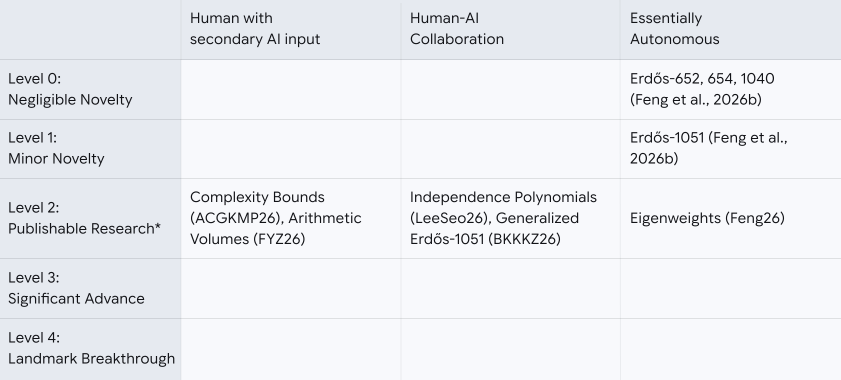
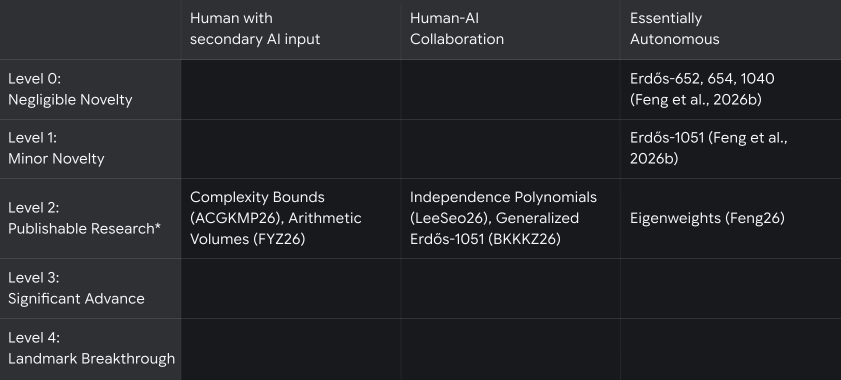
    Following extensive discussions with the mathematical community, we suggest a taxonomy to classify AI-assisted mathematics research by significance and degree of AI contribution – contributing to the wider discussion on responsible documentation, evaluation and communication of AI-generated results. Level 2 (“publishable quality”) works have been submitted to reputable journals. Currently, we do not claim any Level 3 (“Major Advance”) and Level 4 (“Landmark Breakthrough”) results.

    A table titled A table titled

    Classification of all AI-assisted mathematics results encompassed in this work. *Works listed as Level 2 in this table have been submitted for publications.

    Prompts and model outputs are available here. For discussions on AI contributions, our “Human-AI Interaction card”, and community impact, see our paper.

    Expanding to Physics and Computer Science

    Gemini Deep Think mode has also demonstrated promise in computer science and physics. The second paper builds on similar agentic reasoning ideas, and identifies effective “recipes” for collaboration, specifically the “Advisor” model, where humans guide AI through iterative “Vibe-Proving” cycles to validate intuition and refine proofs. We also detail tactical techniques like “balanced prompting” —requesting simultaneous proof or refutation to prevent confirmation bias—and code-assisted verification. These methods, combined with the model’s ability to bridge disparate scientific fields through deep structural connections, are transforming how theoretical research is conducted. This work builds upon our successful deployment of an advanced version of Gemini Deep Think to assist in reviewing CS theory papers for STOC’26 conference.

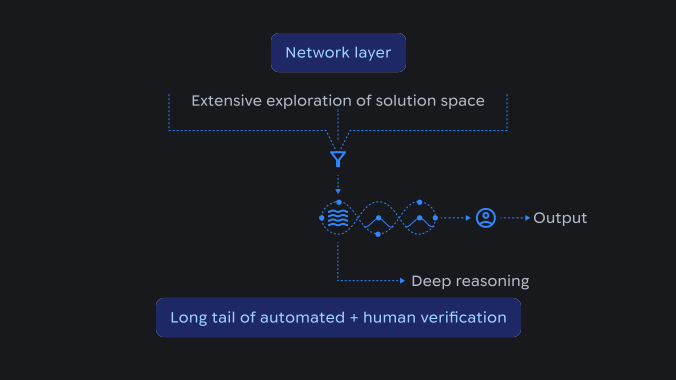
    A flow diagram titled A flow diagram titled

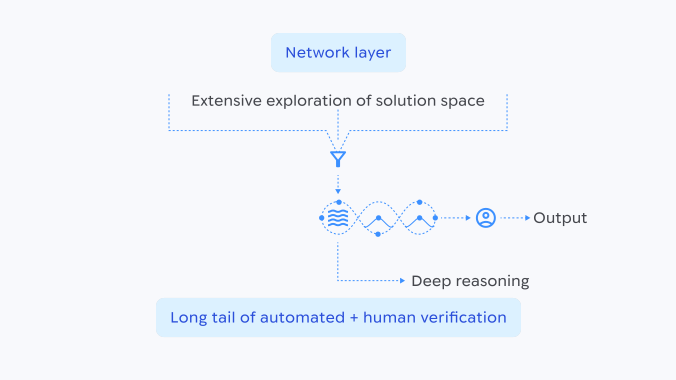
    A schematic overview of the AI reasoning pipeline, illustrating how extensive solution space exploration at the network layer is funneled into structured reasoning and validated by automated and human verification.

    Collaborating with experts on 18 research problems, an advanced version of Gemini Deep Think helped resolve long-standing bottlenecks across algorithms, ML and combinatorial optimization, information theory, and economics. Highlights from our “Accelerating Research with Gemini” paper include (corresponding section numbers in paper):

    1. Crossing mathematical borders for network puzzles: Progress on classic computer science problems like “Max-Cut” (efficiently splitting networks) and the “Steiner Tree” (connecting high-dimensional points) had slowed down. Gemini broke both deadlocks by thinking outside the box. It solved these discrete algorithmic puzzles by pulling advanced tools—like the Kirszbraun Theorem, measure theory, and the Stone-Weierstrass theorem—from entirely unrelated branches of continuous mathematics. See Sections 4.1 and 4.2.
    2. Settling a decade-old conjecture in online submodular optimization: A 2015 theory paper proposed a seemingly obvious rule for data streams: making a copy of an arriving item is always less valuable than simply moving the original. Experts struggled for a decade to prove this. Gemini engineered a highly specific three-item combinatorial counterexample, rigorously proving the long-standing human intuition false. See Section 3.1.
    3. Machine learning optimization: Training AI to filter out noise usually requires engineers to manually tune a mathematical “penalty.” Researchers created a new technique that did this automatically, but couldn’t mathematically explain why. Gemini analyzed the equations and proved the method succeeds by secretly generating its own “adaptive penalty” on the fly. See Section 8.3.
    4. Upgrading economic theory for AI: A recent ‘Revelation Principle’ for auctioning AI generation tokens only worked mathematically when bids were restricted to rational numbers. Extending the domain to continuous real numbers invalidated the original proof. Gemini employed advanced topology and order theory to extend the theorem, accommodating real-world, continuous auction dynamics. See Section 8.4.
    5. Physics of cosmic strings: Calculating gravitational radiation from cosmic strings requires finding analytical solutions to tricky integrals containing “singularities.” Gemini found a novel solution using Gegenbauer polynomials. This naturally absorbed the singularities, collapsing an infinite series into a closed form, finite sum. See Section 6.1.

    Spanning diverse fields—from information and complexity theory to cryptography and mechanism design—the results demonstrate how AI is fundamentally shifting research. For details, see our paper.

    Given computer science’s fluid, conference-driven publication pipeline, we describe these results by academic trajectory rather than a rigid taxonomy. About half target strong conferences—including an ICLR ’26 acceptance—while most remaining findings will form future journal submissions. Even when course-correcting the field by identifying errors (Section 3.2) or refuting conjectures (Section 3.1), these outcomes highlight AI’s value as a high-level scientific collaborator.

    The Future of Human-AI Collaboration

    Building on Google’s previous breakthroughs (1, 2, 3, 4, 5), this work demonstrates that general foundation models – leveraged with agentic reasoning workflows – can act as a powerful scientific companion.

    Under direction from expert mathematicians, physicists, and computer scientists, Gemini Deep Think mode is proving its utility across fields where complex math, logic and reasoning are core.

    We are witnessing a fundamental shift in the scientific workflow. As Gemini evolves, it acts as “force multiplier” for human intellect, handling knowledge retrieval and rigorous verification so scientists can focus on conceptual depth and creative direction. Whether refining proofs, hunting for counterexamples, or linking disconnected fields, AI is becoming a valuable collaborator in the next chapter of scientific progress.

    Acknowledgements

    We thank the community of expert mathematicians, physicists, and computer scientists for their help and advice on this project

    This project was a large-scale collaboration across Google and its success is due to the combined efforts of many individuals and teams. Thang Luong and Vahab Mirrokni led the overall research directions with deep technical expertises from Tony Feng and David Woodruff.

    Authors of the first paper “Towards Autonomous Mathematics Research” include: Tony Feng, Trieu H. Trinh, Garrett Bingham, Dawsen Hwang, Yuri Chervonyi, Junehyuk Jung, Joonkyung Lee, Carlo Pagano, Sang-hyun Kim, Federico Pasqualotto, Sergei Gukov, Jonathan N. Lee, Junsu Kim, Kaiying Hou, Golnaz Ghiasi, Yi Tay, YaGuang Li, Chenkai Kuang, Yuan Liu, Hanzhao (Maggie) Lin, Evan Zheran Liu, Nigamaa Nayakanti, Xiaomeng Yang, Heng-Tze Cheng, Demis Hassabis, Koray Kavukcuoglu, Quoc V. Le, Thang Luong. We thank the following experts for feedback and discussions on the work: ​​Jarod Alper, Kevin Barreto, Thomas Bloom, Sourav Chatterjee, Otis Chodosh, Michael Hutchings, Seongbin Jeon, Youngbeom Jin, Aiden Yuchan Jung, Jiwon Kang, Jimin Kim, Vjekoslav Kovač, Daniel Litt, Ciprian Manolescu, Mona Merling, Agustin Moreno, Carl Schildkraut, Johannes Schmitt, Insuk Seo, Jaehyeon Seo, Terence Tao, Cheng-Chiang Tsai, Ravi Vakil, Zhiwei Yun, Shengtong Zhang, Wei Zhang, Yufei Zhao.

    Authors of the second paper “Accelerating Scientific Research with Gemini: Case Studies and Common Techniques” include David P. Woodruff, Vincent Cohen-Addad, Lalit Jain, Jieming Mao, Song Zuo, MohammadHossein Bateni, Simina Branzei, Michael P. Brenner, Lin Chen, Ying Feng, Lance Fortnow, Gang Fu, Ziyi Guan, Zahra Hadizadeh, Mohammad T. Hajiaghayi, Mahdi JafariRaviz, Adel Javanmard, Karthik C. S., Ken-ichi Kawarabayashi, Ravi Kumar, Silvio Lattanzi, Euiwoong Lee, Yi Li, Ioannis Panageas, Dimitris Paparas, Benjamin Przybocki, Bernardo Subercaseaux, Ola Svensson, Shayan Taherijam, Xuan Wu, Eylon Yogev, Morteza Zadimoghaddam, Samson Zhou, Yossi Matias, Jeff Dean, James Manyika, Vahab Mirrokni. This list includes Google researchers building the agentic reasoning on top of Gemini, and our academic expert collaborators verifying and collaborating with Gemini. We also thank Corinna Cortes for her careful review of the paper.

    We are grateful for the foundational support from the rest of the DeepThink team: Anirudh Baddepudi, Michael Brenner, Irene Cai, Kristen Chiafullo, Paul Covington, Rumen Dangovski, Chenjie Gu, Huan Gui, Vihan Jain, Rajesh Jayaram, Melvin Johnson, Rosemary Ke, Maciej Kula, Nate Kushman, Jane Labanowski, Steve Li, Pol Moreno, Sidharth Mudgal, William Nelson, ​​Ada Maksutaj Oflazer, Sahitya Potluri, Navneet Potti, Shubha Raghvendra, James Roggeveen, Siamak Shakeri, Archit Sharma, Xinying Song, Mukund Sundararajan, Qijun Tan, Zak Tsai, Erik Wang, Theophane Weber, Winnie Xu, Zicheng Xu, Junwen Yao, Shunyu Yao, Adams Yu, Lijun Yu, and Honglei Zhuang.

    We’d like to thank the Gemini Post-Training team for building the foundational model for Deep Think: Arash Ahmadian, Ankesh Anand, Charles Chen, Yong Cheng, Kedar Dhamdhere, Philipp Fränken, Justin Gilmer, Elena Gribovskaya, Luheng He, Yangsibo Huang, Rishabh Joshi, Ajay Kannan, Arvind Kannan, Guangda Lai, Robert Leland, Hanzhao (Maggie) Lin, Yingjie Miao, Bryce Petrini, Corbin Quick, Vikash Sehwag, Yue Song, Pranav Talluri, Ankur Taly, George Tucker, Michael Voznesensky, Manish Reddy Vuyyuru, Yiming Wang, Jinliang Wei, Qiao Zhang, Yuan Zhang, Zizhao Zhang.

    We thank Quoc Le, Koray Kavukcuoglu, Demis Hassabis, James Manyika, Yossi Matias, and Jeff Dean for sponsoring this project.

    Last but not least, we thank Divy Thakkar, Adam Brown, Vinay Ramasesh, Alex Davies, Thomas Hubert, Eugénie Rives, Pushmeet Kohli, Benoit Schillings for feedback and support of the project.


    Advanced version of Gemini with Deep Think officially achieves gold-medal standard at the International Mathematical Olympiad

    Gemini achieves gold-medal level at the International Collegiate Programming Contest World Finals