Category: Automation

  • Who Owns the Customer in the Age of AI Agents?

    Who Owns the Customer in the Age of AI Agents?

    Harvard Business Review Logo

    Illustration by Eliot Wyatt

    AI agents are changing the nature of customer relationships by taking on more of the discovery, comparison, negotiation, and purchasing decisions that companies once controlled through their own

    On September 8, 2026, Meta launched Muse, a personal AI agent designed to act on a user’s behalf: filling out forms, negotiating, booking travel, and making purchases. Twelve days later, Amazon blocked Muse from shopping on its site, arguing that third-party agents should identify themselves and obtain a retailer’s permission before transacting on behalf of its customers.

  • What Top Performers Do Differently with AI—and Why They See the Biggest Benefits

    What Top Performers Do Differently with AI—and Why They See the Biggest Benefits

    Harvard Business Review Logo

    Illustration by Jason Ford

    AI isn’t simply replacing sales work or automatically equalizing sales performance; it’s providing disproportionate lift to individuals and organizations that can build systems around

    Generative AI has produced two competing views about which workers will benefit most. One view is that AI will narrow performance gaps by giving lower performers templates, answers, and coaching directly in their workflow. The other is that AI will widen those gaps by eliminating routine but necessary work, which will allow top performers to spend more time on higher-value activities where they already have an advantage. At the individual task level, high and low performers may both benefit, but the more important question is which effect dominates on net in real jobs, where workers perform bundles of activities. The answer matters for how firms hire, train, organize teams, and adjust practices built for their current talent mix.

  • AI Is Making Verification the Bottleneck for Companies

    AI Is Making Verification the Bottleneck for Companies

    Harvard Business Review Logo

    Bernhard Lang/Getty Images

    Hierarchy does more than route information; it also verifies: deciding what information means, what deserves the firm’s attention, which outputs can be trusted, and which are worth

    Somewhere in your company today, an expert rejected a perfectly plausible answer. A controller caught a revenue figure that counted deferred bookings. A security engineer blocked a release that passed every test but would have handed an AI agent write access to the production database. That override, escalation, or reversal is the most valuable data your firm produces. If you record enough of those moments and use them, alongside everything else your firm knows and measures, to train an AI model that learns from each correction, you could, in theory, eliminate the need for managers to route information and coordinate action. In doing so, execution gets turbocharged by automation. You might even be able to eliminate hierarchy altogether.

  • Meta Muse automation: How to use the Zapier Muse integration (Muse Spark 1.3 and more)

    Meta Muse automation: How to use the Zapier Muse integration (Muse Spark 1.3 and more)

    The concept of “less is more” doesn’t seem to have made it to Silicon Valley. Every time I blink, it seems like there’s yet another AI agent available on the market. And right on cue, another AI bombshell has entered the villa: Muse is a personal AI agent from Meta (of Facebook fame) that can do things on your behalf, like opening a browser, filling out forms, and sending emails.

    But a personal agent is only as useful as what it can reach. Muse comes with roughly 40 native connectors, covering Google Workspace, Dropbox, Notion, and a handful of others. For everything else in your stack, Zapier is now a built-in connector inside Muse. That means Muse can search, create, and update records across 9,000+ apps without you ever leaving the chat window.

    There are two ways to bring Muse and Zapier together: add Muse Spark’s reasoning to workflows you already run on Zapier, or let Muse kick off Zapier actions directly from a conversation. Here’s how both work.

    Table of contents:

    Add Muse Spark’s brain to your existing workflows (AI by Zapier)

    Zapier already handles complex, multi-step workflows across your tech stack, and sometimes those workflows benefit from a burst of AI reasoning right in the middle. AI by Zapier lets you drop a Muse Spark step into any Zap, exactly where it’s useful, without setting up a separate Meta developer account.

    Adding Muse to your workflows is helpful because you usually don’t want AI running every step of a workflow—just the ones that actually need judgment. For example, routing a new lead from a form into your CRM doesn’t need any reasoning at all and can be handled by deterministic automation. But summarizing a support call, drafting a reply based on a customer’s order history, or deciding which of 200 inbound resumes deserve a second look is where Muse Spark could come in handy.

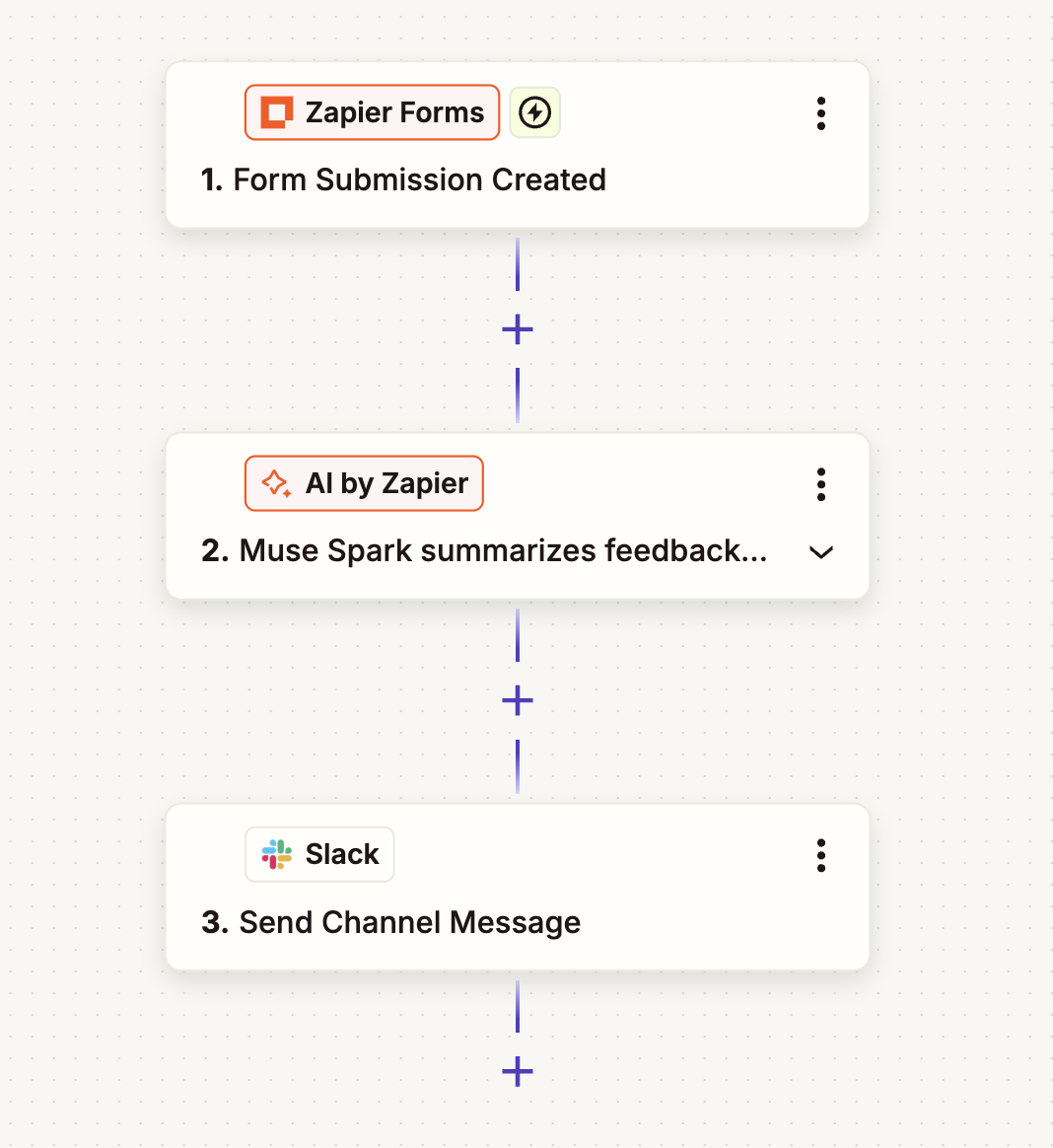
    Here’s an example: say your team collects product feedback through a form. Instead of reading every response by hand, you build a Zap that triggers on new submissions, sends the response to a Muse Spark step with a prompt like “Summarize this feedback and flag anything that mentions a bug,” then posts flagged items to your product team’s Slack channel. Muse Spark only fires when there’s a new response to process. Everything else runs the same way every time.

    An automated workflow using Muse Spark in AI by Zapier

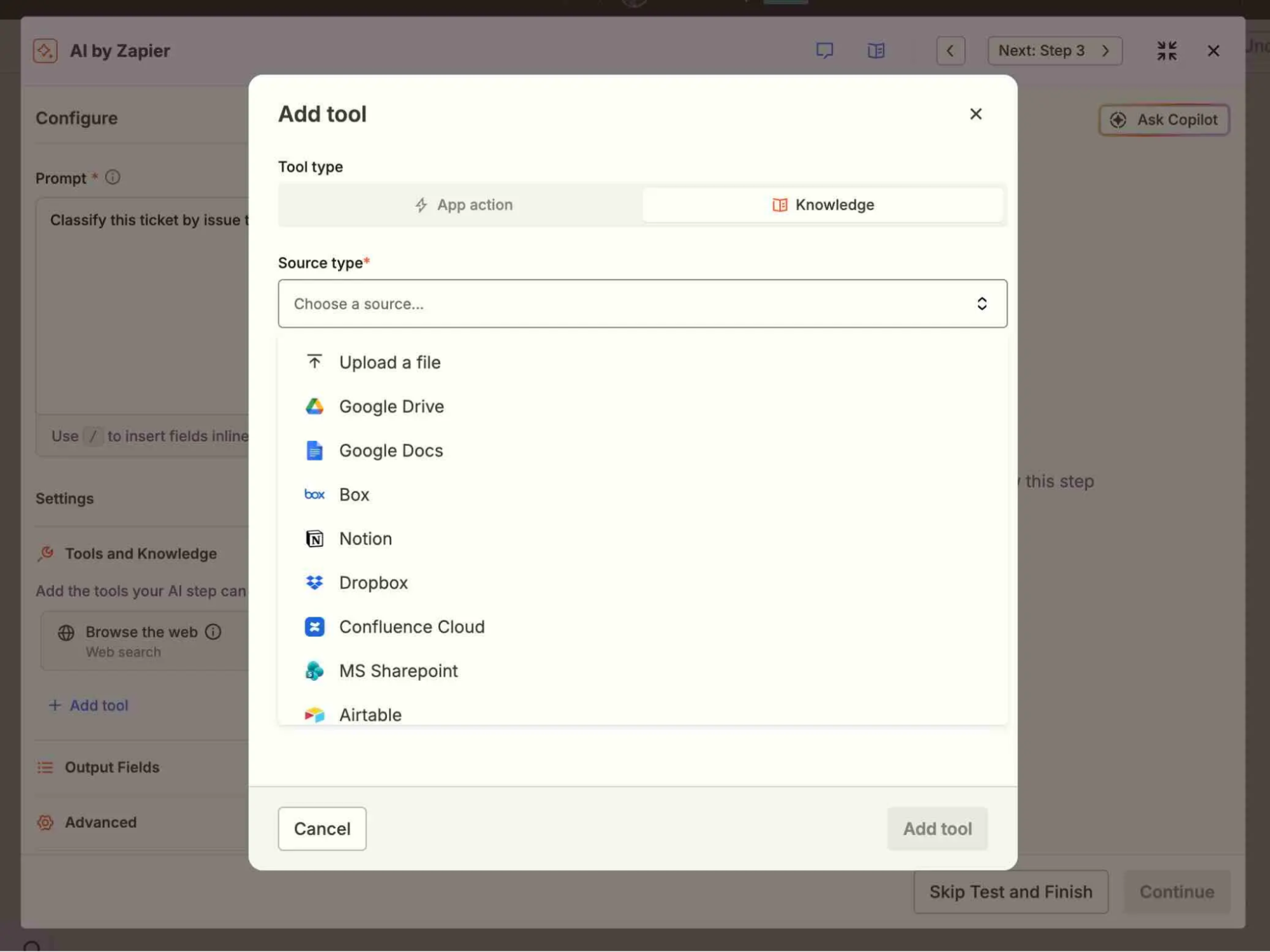
    You stay in control of the step itself: write and test your prompt, attach knowledge sources, and turn on agentic tool calling if the task calls for it.

    Adding tools in an AI by Zapier step

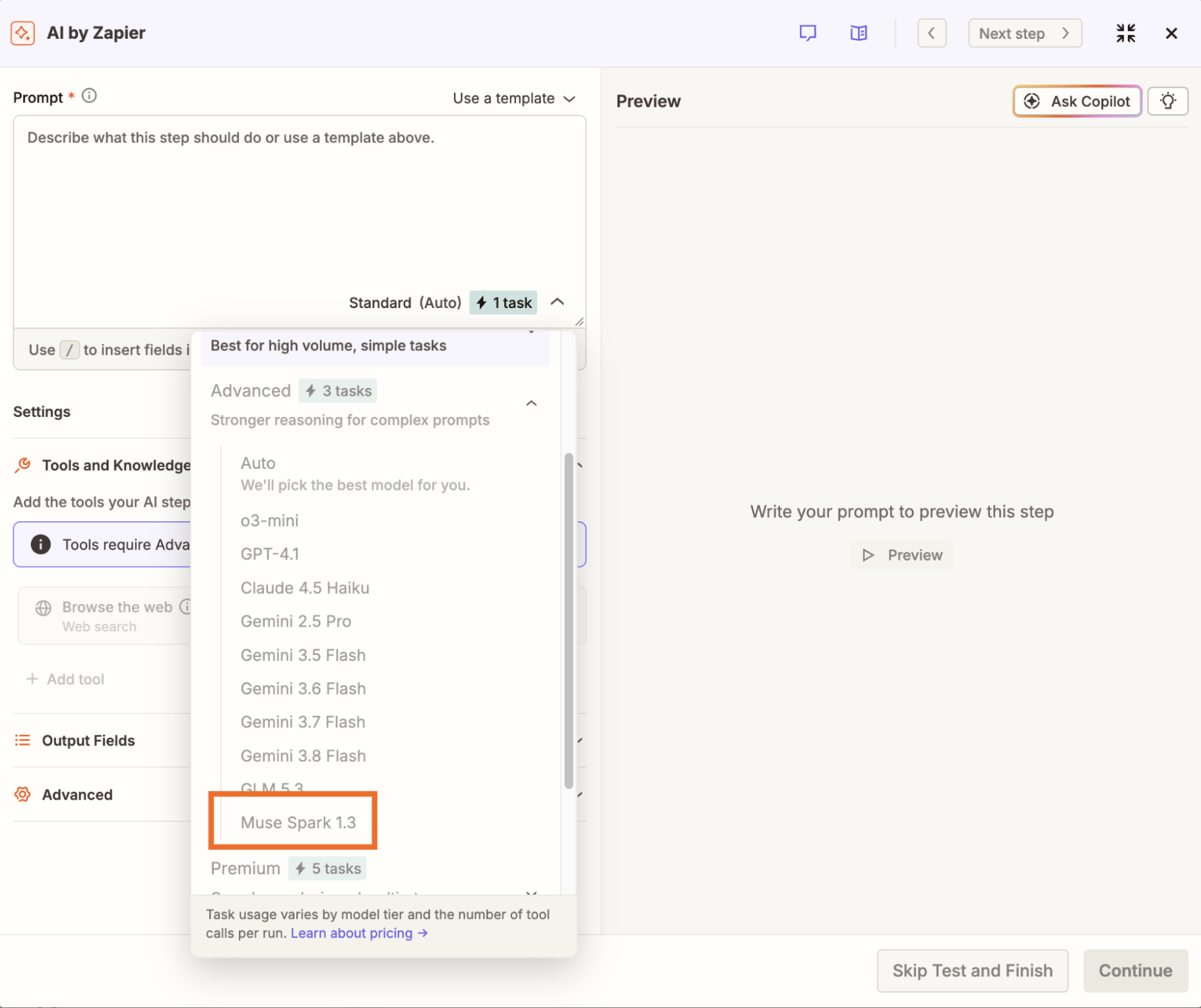
    You pick the Muse Spark model from a dropdown in the Zap editor, and the cost comes out of your Zapier task count instead of a separate Meta bill. Every time Meta ships a new Muse Spark version, it gets added to the AI by Zapier lineup, and you can swap models later without rebuilding the workflow around it.

    Choosing Muse Spark as the AI model in an AI by Zapier step

    Read more: Which AI models can you automate on Zapier?

    Muse Spark automation use cases

    Here are a few ways you might use AI by Zapier to bring Muse Spark into your workflows:

    • Draft follow-ups from call notes. When a sales call wraps in your meeting tool, send the transcript to Muse Spark to pull out commitments, objections, and next steps, then log the summary to your CRM.

    • Triage support tickets. Have Muse Spark read incoming tickets, assign a priority level, and route anything urgent to the right Slack channel before a human opens it.

    • Turn a blog post into social copy. Feed a new article to Muse Spark and get platform-ready drafts for LinkedIn and X, then send them straight to your social scheduler.

    • Score inbound leads. When a form submission comes in, have Muse Spark enrich and score it against your ideal customer profile, then route the strongest ones to sales.

    • Summarize what happened while you were out. Schedule a Zap that pulls yesterday’s Slack activity or support volume each morning and has Muse Spark write a short recap.

    Start building

    Automate workflows directly from Muse (Zapier MCP)

    If you’d rather work directly from Muse, that’s what the Zapier connector is for. It gives Muse governed access to all 9,000+ apps in Zapier’s library, and you decide exactly which apps and actions it’s allowed to touch.

    Setup happens entirely inside Muse. You don’t need to create anything on Zapier’s side first.

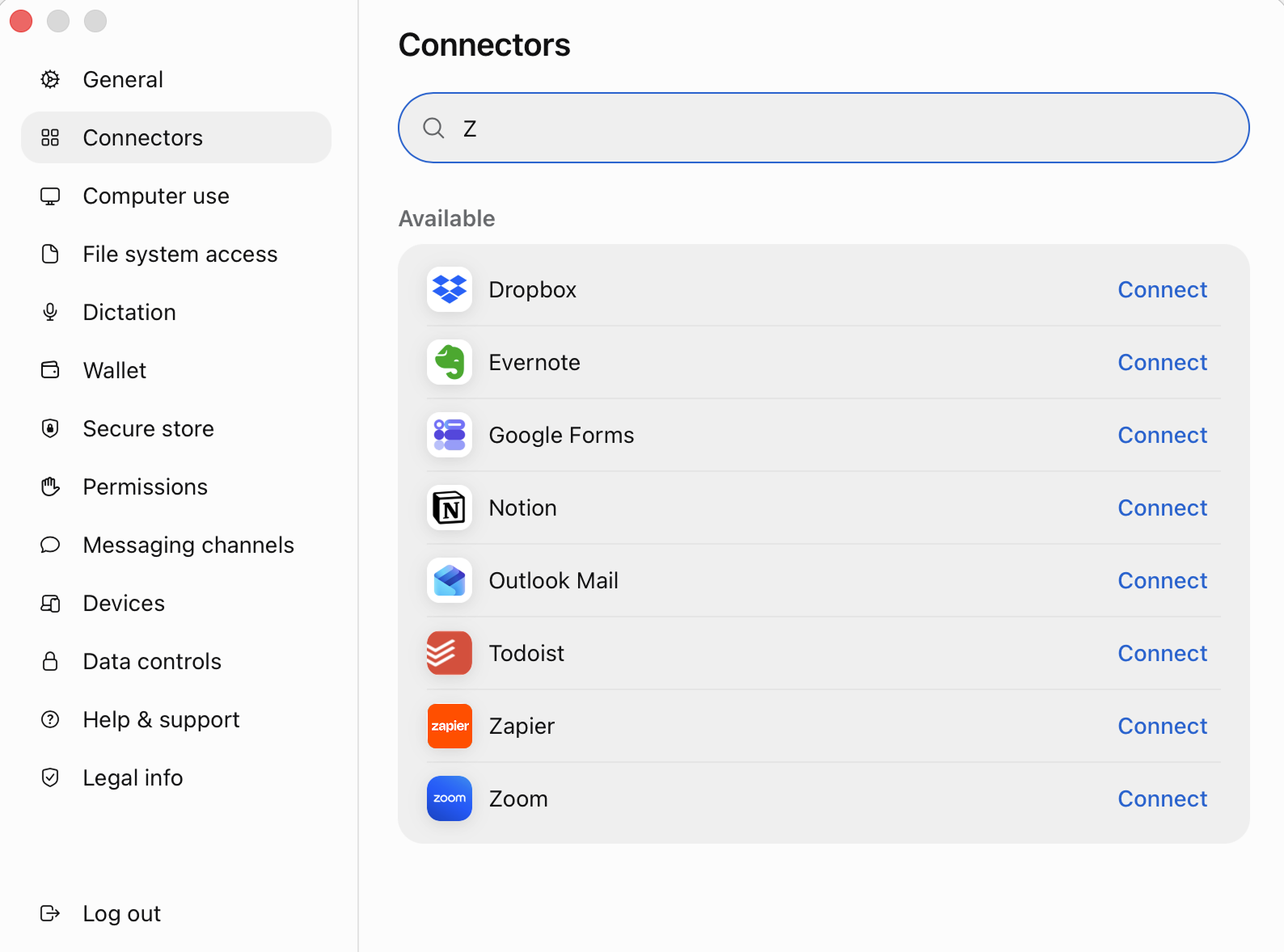
    1. Open Muse’s Settings, then Connectors, and search for Zapier.

      A dropdown list of connectors (including Zapier) in Meta Muse
    2. Click Connect, review the permissions card Muse shows you, and click Continue.

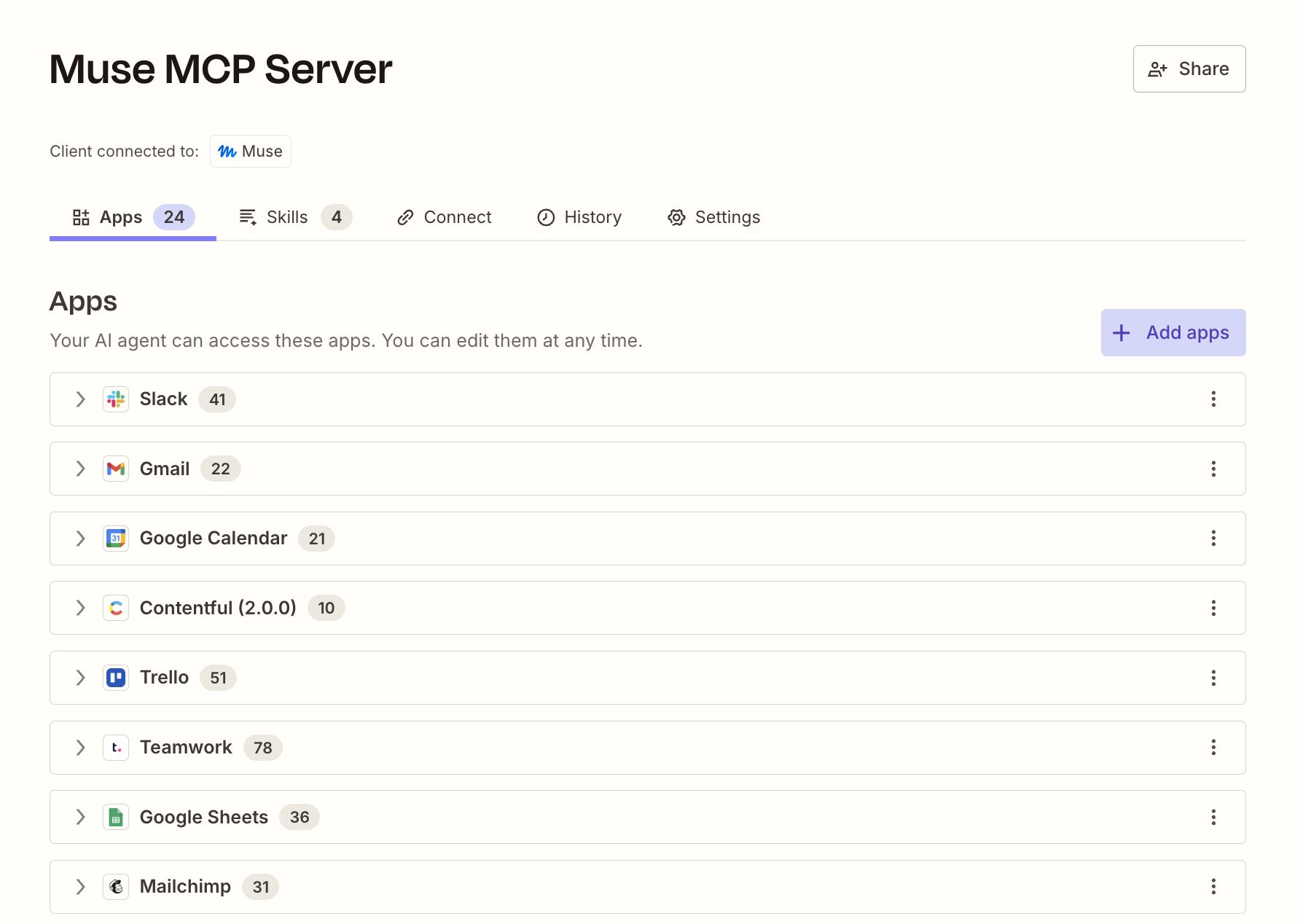
    3. Sign in to Zapier, or create a free account, and click Allow. Zapier automatically creates an MCP server for Muse and turns on actions for the apps you’ve already connected. You can adjust permissions for apps and actions in Zapier at any time.

      Muse MCP server settings in Zapier
    4. Back in Settings > Permissions, you control how often Muse checks in before acting. By default, Muse asks before it takes an action it flags as needing a second look.

    Once Zapier is installed, you can ask Muse to do things like:

    • “Find my last five HubSpot deals, calculate weighted pipeline, and post a summary to Slack.”

    • “When someone books me on Calendly, add them to my client list in Airtable.”

    • “Check my email for anything from a client this week and add the open items to my Todoist.”

    None of that requires opening another app. Muse runs the whole thing from the chat window, the same way it books a restaurant or fills out a form on your behalf.

    Each successful action draws from your existing Zapier task allowance, the same one your Zaps already use, so your Zapier bill stays simple. And because Zapier manages the credentials, Muse never has to ask you for an API key or password. Muse signs in once through Zapier, and every app connection it touches afterward stays governed the way it would in any other Zapier workflow.

    Try Zapier MCP

    Muse automation FAQ

    How do I connect Zapier to Meta Muse?

    Open Muse, go to Settings > Connectors, and search for Zapier. Click Connect, sign in to your Zapier account (or create a free one), and click Allow. Muse can then use any action you’ve turned on for the apps already connected to your Zapier account.

    What can Muse do with Zapier?

    Once connected, Muse can search, read, create, update, and send information across 9,000+ apps through Zapier, including apps it doesn’t natively support, like Zendesk, HubSpot, Airtable, and QuickBooks. You choose which actions Muse can run, and it asks before taking any it flags as needing review.

    Is Zapier free to use inside Muse?

    Connecting Zapier to Muse is free, and it works on every Zapier plan, including the free one. Each successful action uses a small number of tasks from your existing plan, the same allowance your Zaps already draw from.

    What’s the difference between using Muse Spark in AI by Zapier and using the Zapier connector in Muse?

    AI by Zapier lets you add a Muse Spark reasoning step inside a workflow, which is useful when AI needs to handle one part of an otherwise predictable process. The Zapier connector in Muse is for when you want your AI to handle everything, straight from the chat window. It lets Muse build automations and kick off actions across your apps directly from a chat.

    Automate Muse with Zapier

    Whether you want a workflow humming in the background or you’d rather just ask Muse to handle a task mid-conversation, Zapier gives Muse a governed way to reach the rest of your stack.

    Either path runs through Zapier’s managed authentication, so Muse never has to ask you for a password, your credentials stay in one place, and every action follows the same permissions you’d set for any other part of your workflow.

    Try Zapier

    Related reading:

  • How Leaders Talk About AI Predicts Adoption

    How Leaders Talk About AI Predicts Adoption

    Harvard Business Review Logo

    Illustration by Ana Moreno

    New research from BCG finds that how a company talks about AI is a material predictor of adoption results. The companies where leaders’ stories provide clarity, hope, and growth are seeing

    Stories are one way that leaders cement their legacy, inspire action, and define an era. The stories they tell about where a company is going can foreshadow opportunity or foment fear—sometimes unwittingly. Today, leaders are telling employees the story of what AI will mean for them. “No one knows,” some say, leaning into the 2010s-era virtue of transparency. “AI is coming for your job, but it’s coming for mine, too,” say others, in apprehensive solidarity. Still others position AI as a personal superpower, or the dawn of a heroic unknown. Each of these narratives is a choice. Each choice has consequences.

  • A Collection of HBR’s Most Insightful Research on AI at Work

    A Collection of HBR’s Most Insightful Research on AI at Work

    Illustration by Minjo Jung

    Summary.   

    Research on AI in the workplace can show us how the technology is really being used and what it does to the way we work. Recent studies offer lessons for leaders on how employees are actually

    There’s no shortage of assertions and predictions about AI’s impact on work. But what does the research say about what’s actually happening inside organizations—and how can you use it to make better decisions about how AI is implemented at your company?

  • Why Your Employees Override AI

    Why Your Employees Override AI

    HBR Executive delivers trusted insights and actionable strategies to guide leaders through consequential decisions. Practical tools, and forward-looking perspectives cut through the noise to equip you to navigate uncertainty, stay ahead of emerging trends, and plan for a stable future.

    Exclusive Benefits

    • Playbooks

      Concrete strategies, tactics, and solutions to real challenges from your peers and other experts. Published every 2 weeks. All Playbooks (Opens a new page)

    • Masterclasses
    • Agenda

      A weekly newsletter of timely insights that interpret today’s business climate and help you chart a path to what’s next. All Agenda (Opens a new page)

    • Live
    • The Strategy Lab
  • How AI Is Changing Communication: Weighing Efficiency with Efficacy

    How AI Is Changing Communication: Weighing Efficiency with Efficacy

    September 24, 2026

    AI is rapidly changing how top leaders communicate with employees, customers, boards, and each other. In episode 2 of a special four-part series on how AI is changing leadership, we explore how executives can use AI to improve communication without outsourcing the thinking, judgment, and empathy that make it effective. Stanford professor Matt Abrahams and Zapier CEO Wade Foster discuss how leaders are using AI to synthesize information, structure ideas, prepare for difficult conversations, and rehearse for high-stakes moments. They also explain why leaders should be wary of letting AI write everything for them, how overreliance on AI can create a “comprehension gap,” and why preserving a distinctive human voice may become even more important as AI-generated communication becomes ubiquitous. Abrahams is the author of Think Faster, Talk Smarter and host of the podcast Think Fast, Talk Smart. Foster is the cofounder and CEO of Zapier, a software automation company.

    Plus:

    • Why we need clear rules for when and how AI should be used in workplace communication
    • Why AI could make spontaneous, unscripted communication more valuable
    • Why you should use AI to challenge your assumptions, not just confirm them
    • How leaders can hold on to accountability and authenticity
  • The Hidden Costs of Monitoring Employees with AI

    The Hidden Costs of Monitoring Employees with AI

    Harvard Business Review Logo

    Colin Anderson/Stocksy

    AI is making employee monitoring cheaper, more granular, and continuous—but lower costs can encourage companies to overuse controls without considering their broader consequences. Research

    Linus Arauz operates 10 points of sale across two large airports and has responsibilities that extend to nearly 100 food and non-food retail locations across several airport programs. Some of those locations have no staff at all. Travelers simply walk up and take whatever they want off the shelf—a sandwich, a bottle of water. They’re supposed to pay, but no one is there to ensure that they do.