EmbeddingGemma 2 is the most capable model for on-device multimodal embeddings, natively mapping combinations of text, images, audio, and video into a unified embedding space.
Sahil Dua
Research Engineer, Google DeepMind
Henrique Schechter Vera
Research Engineer, Google DeepMind
Listen to article
[[duration]] minutes
This content is generated by Google AI. Generative AI is experimental
We introduced EmbeddingGemma last year to provide a lightweight option for high-quality text embeddings, to help your apps organize, search, and connect information directly on consumer hardware. The developer community’s response blew past our expectations. With more than 20 million downloads, builders have used it to power smarter on-device search tools and privacy-first retrieval augmented generation (RAG) pipelines.
Today, we’re launching EmbeddingGemma 2, expanding beyond text to unify code, images, video, and audio in a shared embedding space. Built on the Gemma 4 architecture and released under a commercially permissive Apache 2.0 license, EmbeddingGemma 2 has 740 million parameters, making it optimal for on-device inference. It can help find a specific video clip from a voice memo, or search through hours of audio recordings based on a text query, all processed by a single, natively multimodal model.
Built from the same technology as Gemini Embedding models, EmbeddingGemma 2 is:
Best-in-class for its size: Achieves leading scores among sub-1B multimodal embedders for its size across benchmarks like MTEB (Massive Text Embedding Benchmark) Code and MAEB (Massive Audio Embedding Benchmark), while matching or outperforming many larger models across text, vision, and audio tasks.
Modular by design: Requires as little as 270M parameters for text-only workloads with optional vision (170M) and audio (300M) encoders for full multimodal support.
Storage-efficient: Using Matryoshka Representation Learning (MRL), developers can dynamically truncate output vectors from 768 dimensions down to 512, 256, or 128 dimensions. This provides up to 6x storage reduction for local vector databases and memory usage.
Optimized for on-device performance: Runs efficiently within tight resource constraints. With quantization, on a Google Pixel 11 Pro, EmbeddingGemma 2 requires as little as ~191MB active RAM for text-only weights and ~567MB for the full multimodal model.
Extended context ready: Features an 8K token context window (4x larger than EmbeddingGemma 1), allowing it to process up to 5.5 minutes of audio, 29 images, 58 video frames, or interleaved combinations thereof directly on local hardware.
Achieving top-tier quality for code, vision, and audio
EmbeddingGemma 2 matches the strong multilingual text performance of EmbeddingGemma while delivering a significant 9.92-point improvement on code performance (in MTEB Code, from 68.76 to 78.68), making it well-suited for local codebase indexing, semantic code search, and coding agent retrieval. Across image, video, documents, and audio, it sets a new standard in quality-per-parameter for sub-1B models and even outperforms some specialist models more than twice its size.
Enabling semantic search, routing, and retrieval, fully on-device
EmbeddingGemma 2 brings robust capabilities directly to edge hardware. Generating embeddings locally helps ensure data privacy, reduces pipeline latency, and empowers developers to build cross-modal search and retrieval that works entirely offline.
When paired with generative models such as Gemma 4, EmbeddingGemma 2 enables on-device RAG pipelines that understand complex multimodal data. Because EmbeddingGemma 2 is built on Gemma 4 and shares its text tokenizer and audio encoder, developers can run both models together in a unified pipeline with a lower combined total memory footprint.
To learn how to build on-device search and RAG systems with LiteRT, read the Google AI Edge blog post.
Getting started with EmbeddingGemma 2
We worked closely with the following partners to ensure EmbeddingGemma 2 works immediately where you build:
Download the models: Find the model weights on Hugging Face and Kaggle, with Gemini Enterprise Agent Platform Model Garden availability coming soon. Visit LiteRT Community on Hugging Face for models optimized for on-device.
On-device deployment: Develop cross-platform apps with Google AI Edge MediaPipe for turnkey embedding, retrieval & decision tasks or LiteRT for custom model integration. Build for the browser with transformers.js or WebGPU.
Use your favorite development tools: Serve the model efficiently using transformers, sentence-transformers, MLX, vLLM, llama.cpp, SGLang, Ollama, and LMStudio. Store your embedding vectors with Qdrant.
Fine-tuning: Follow guidance by Unsloth for how to fine-tune EmbeddingGemma 2 for your use cases.
Gemini 4 Argon delivers frontier performance in complex workflows across real-world software engineering, enterprise knowledge work like legal and finance, and cybersecurity defense.
Today, we’re announcing our new frontier model, Gemini 4 Argon, which is rolling out to a set of trusted cyber defenders through our Fairwind Program. Built to sustain deep reasoning across complex, long-horizon workflows, Argon is fundamentally changing the way we work and build at Google. It delivers frontier performance in complex workflows across real-world software engineering, enterprise knowledge work like legal and finance, and cybersecurity defense.
Safely releasing frontier capabilities at this level requires a phased approach. We are actively engaged in the U.S. government’s voluntary process for pre-release model access while we gradually expand access. We’ll continue to gather feedback from early testers as we iterate on guardrails before making Argon available to developers, enterprises, and consumers as soon as possible.
Argon will launch at an introductory price 1 of $2 per million input tokens and $10 per million output tokens, with cached input tokens priced at 95% off input token price.
Changing how we work and build at Google
Gemini 4 Argon is already powering our internal workflows, with thousands of Googlers highlighting the model’s strengths in specialized coding tasks, conducting deeper research, and writing quality. It’s helping teams build faster and push the boundaries of engineering productivity and accelerating breakthroughs:
Quantum algorithmic optimization: Argon is helping our quantum computing researchers optimize the spacetime resources (qubits × gates) of subroutines that bottleneck important applications. In one example, it beat the published baseline by 40% in a matter of minutes.
Memory efficiency: A team of Argon agents analyzed fleet-wide profiling telemetry to autonomously identify and apply memory optimizations across Google’s data centers, freeing up over 300 TiB of memory once rolled out, with an estimated 500 TiB to 1 PiB in total savings.
Large Scale Codebase Migrations and Optimizations: Argon agents are working on migrating C/C++ codebases to Rust across Google — scaling from tens of thousands of lines in core libraries like re2, libgav1 up to 800K+ lines for the Fuchsia Zircon kernel. Given the criticality of many of these systems, such large-scale rewrites are undergoing rigorous automated and manual auditing, emulation testing, and review before rolling out to production.
For libgav1, Google’s open source software for decoding video, Argon agents took an existing Rust port and replaced 32K lines of SIMD code by running many rounds of profile-guided experiments, studying the compiler’s output, producing safe Rust so the compiler would vectorize it automatically. The end result is a memory-safe video decoder that runs 2.7x faster than the Rust port, with identical video output, bringing it closer to the optimized C++.
Working harder on your most complex problems
To support Gemini 4 Argon’s capabilities across longer, more complex use cases, we are significantly expanding the model’s output token limit to an industry-leading 1M tokens, up from the previous 64K tokens. When the model has the headroom to think deeply and generate hundreds of thousands of tokens in a single trajectory, it adds a new level of depth in reasoning to solve tough problems in one go.
Enabling coding and enterprise workflows across domains
Gemini 4 Argon’s capabilities across coding, reasoning, and multimodality and its ability to sustain long, multi-step tasks enable it to excel across a range of enterprise workflows.
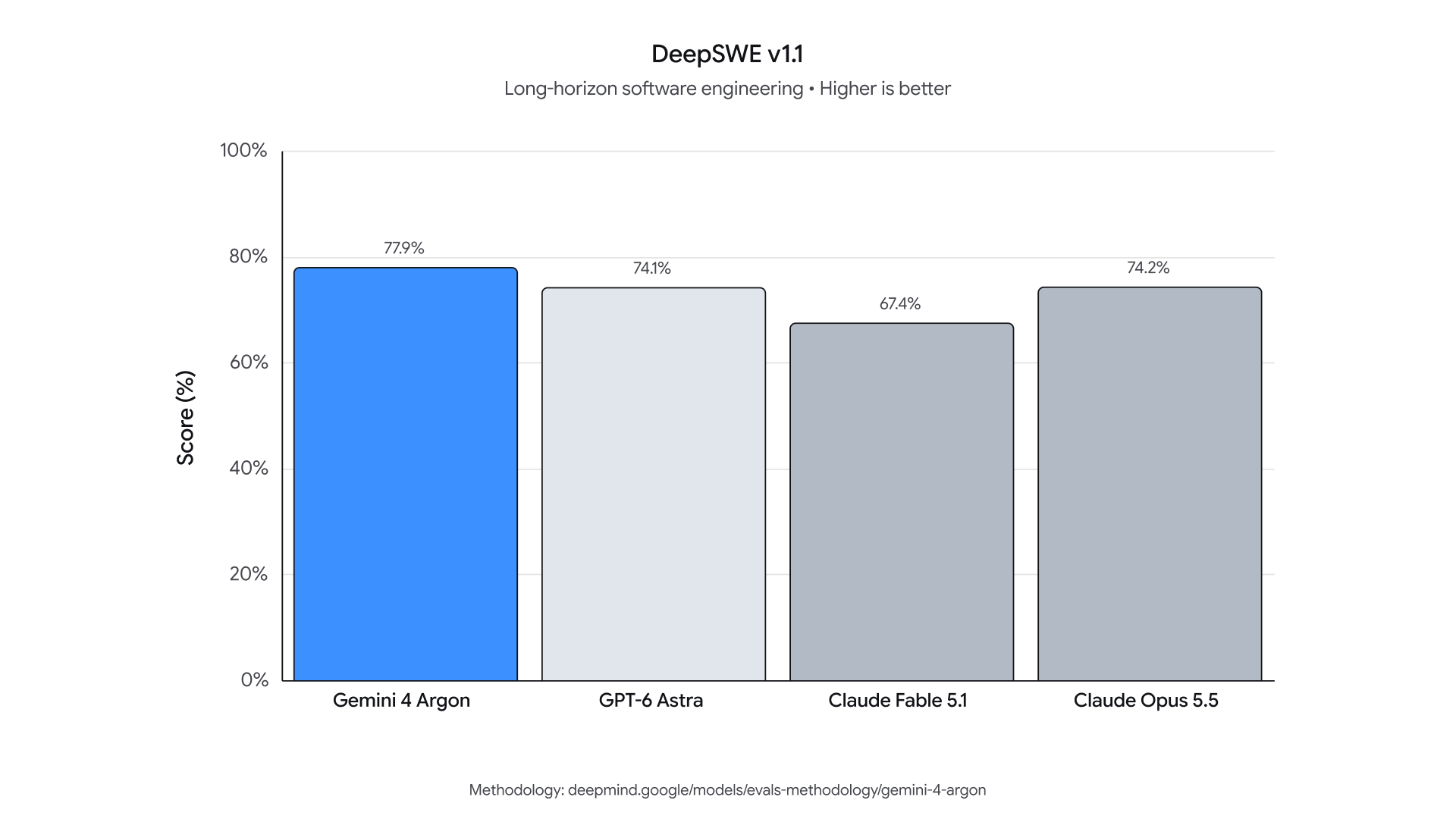
Google engineers have been using Argon for their daily tasks, from everyday debugging to large-scale codebase migrations and algorithm designs. It sets a new state of the art on DeepSWE v1.1 (77.9%), which measures a model’s performance in real-world long-horizon software engineering tasks.
Beyond coding, Argon is the leading model on the Vals Index, which measures economic impact across finance, coding, legal, and tax work, with every sector weighted by its contribution to U.S. GDP. We see similarly leading performance across other domain specific evaluations, like Vals Finance Agent v2 (multi-step financial research) and Harvey’s Legal Agent Benchmark (legal research and drafting). On AutomationBench, Zapier’s benchmark measuring end-to-end execution across core business functions, Argon ranks #1 with a score of 51.3%.
Argon is also uniquely strong when knowledge work requires visual understanding. It’s able to drive professional chart analysis, identify details from long videos, and take action based on a series of documents. For example, on LVBench, which measures long video understanding, Argon is state of the art with a score of 91.7%.
Leading in defensive cybersecurity
To better equip cyber defenders for the new era of cyberattacks, we trained Gemini 4 Argon to be highly capable at cybersecurity defense. Argon can autonomously find, validate, and patch critical software vulnerabilities. For trusted defenders and our own internal teams at Google, we’ll be releasing Argon without cyber guardrails so they can leverage its full frontier-level cybersecurity defense capabilities.
Wiz is already using Argon for cybersecurity defense through its Scan for Good initiative – a program dedicated to protecting critical public infrastructure for free by finding and remediating high-risk exposures. In an early demonstration of its impact, the model uncovered a critical vulnerability exposing sensitive personal information across healthcare software used by hospitals worldwide, identifying a severe risk that previous frontier models had missed.
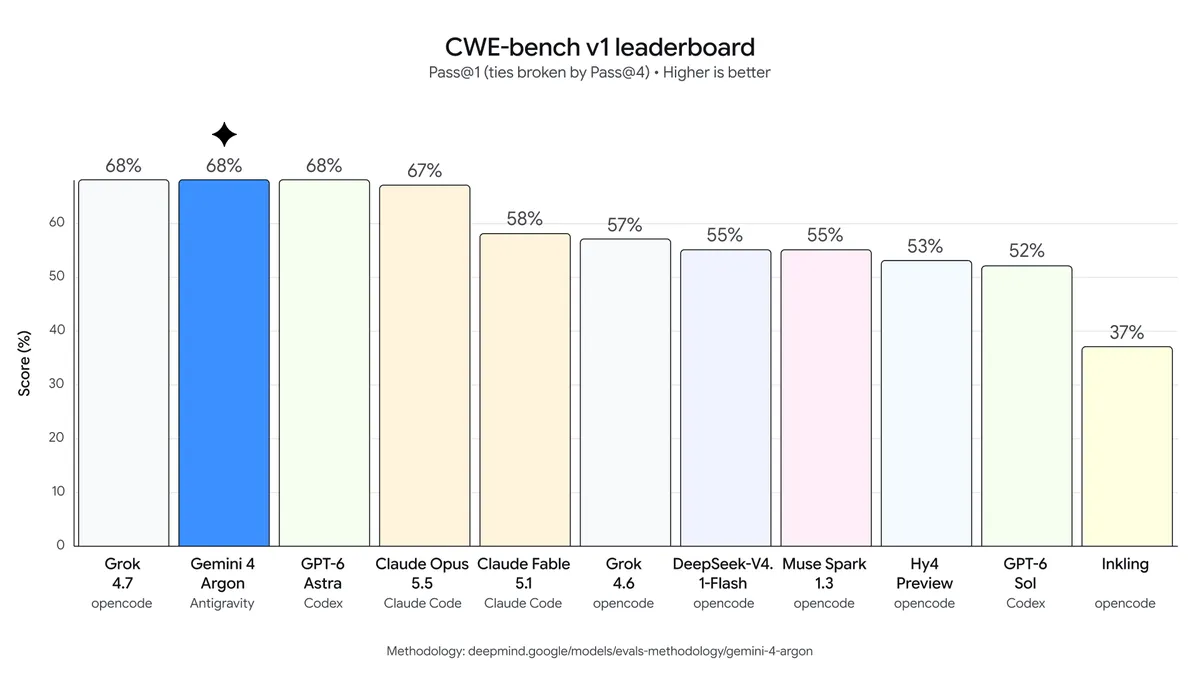
On CWE-bench v1, which evaluates the model’s ability to remediate security vulnerabilities, Argon ties for first place with a top score of 68%, building on 3.8 Flash Cyber’s frontier performance on CWE-bench v0.
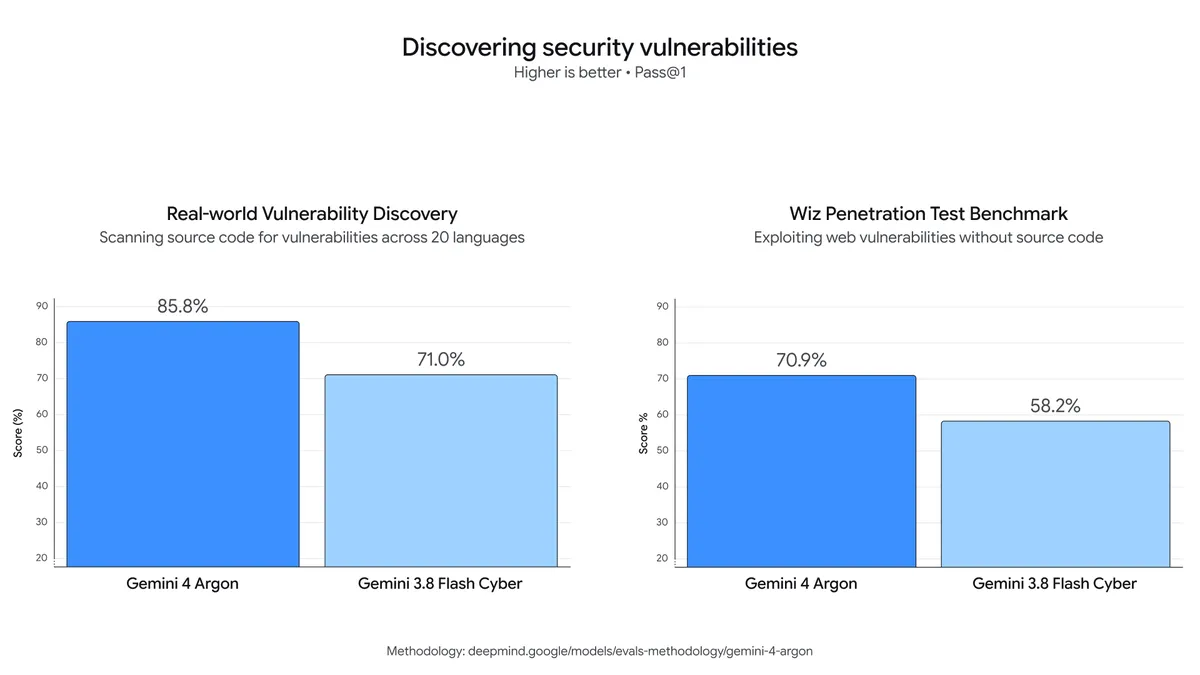
Gemini 4 Argon demonstrates impressive leaps in vulnerability discovery over 3.8 Flash Cyber. For example:
On Google’s internal comprehensive vulnerability benchmark, Argon uncovered a wide range of exposures across complex codebases spanning 20 programming languages.
On Wiz’s internal black-box penetration testing benchmark, which tests a model’s ability to analyze live web systems without source code, Argon outperforms 3.8 Flash Cyber in discovering the attack surface, identifying vulnerabilities, and producing proof-of-concept evidence to validate them.
Strengthening frontier safeguards before broad availability
Before rolling out Gemini 4 Argon broadly, we’re continuing to strengthen critical frontier safeguards across four main areas:
Defending against misuse: To prevent bad actors from using Argon for cyber or chemical, biological, radiological, and nuclear (CBRN) attacks, the model is designed to refuse harmful requests while preserving legitimate, dual-use scientific research, as per our Frontier Safety Framework. We are strengthening the robustness of our safeguards for this launch, including improving our techniques to monitor the model’s internal activations to spot misuse. These safeguards underwent robustness testing by internal and external red teams using a combination of manual and automated attack methods.
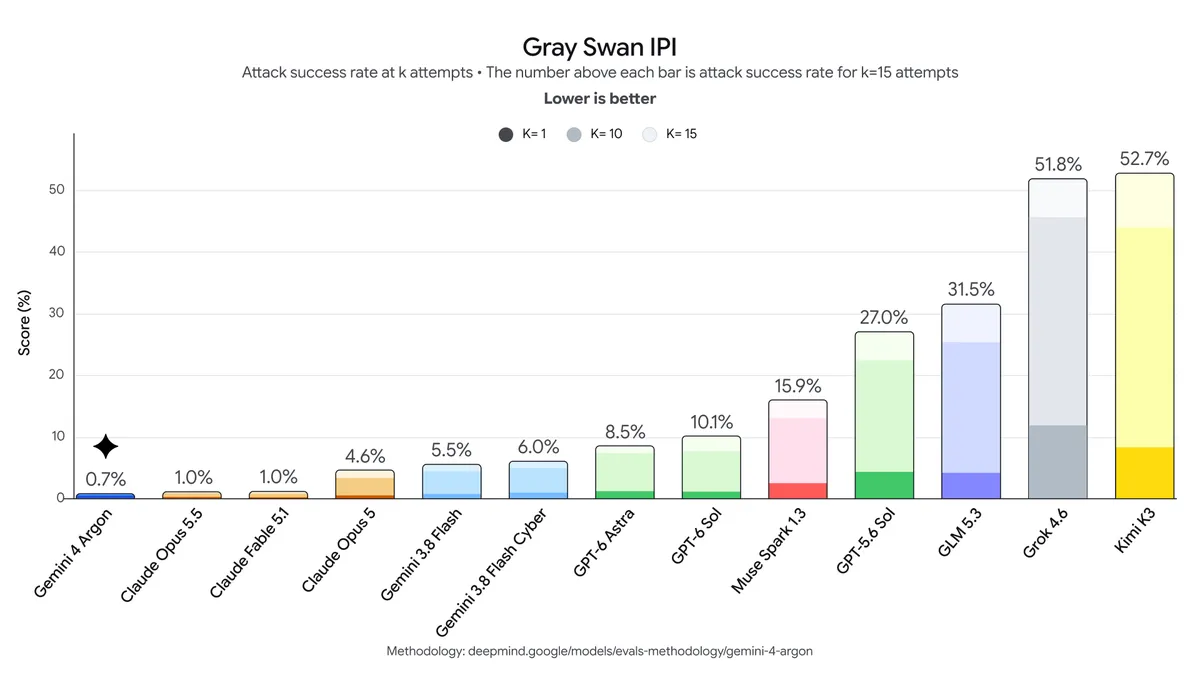
Defending against prompt injection attacks: Argon is also our most resilient model yet against indirect prompt injections, where malicious instructions or context are used to hijack a model’s behavior. These are complex attacks that require constant vigilance and multiple layers of defense. Through automated red teaming and adversarial training, Gemini 4 Argon is leading in prompt injection robustness on the Gray Swan’s Indirect Prompt Injection (IPI) benchmark.
Monitoring for misalignment: In order to prevent Argon from stepping out of bounds to try to accomplish a task in a way that goes beyond the user’s intentions, we are deploying misalignment mitigations that monitor Argon’s chain-of-thought and actions and stop execution when necessary.
We used a similar system to monitor our training runs and send alerts to a dedicated incident response team, taking careful precautions against feeding the findings back into training so as to not risk shaping Argon’s reasoning to evade our monitoring. We strongly encourage the rest of the industry to preserve reasoning transparency in these pivotal moments of increased capabilities while navigating alignment risks, so that model thoughts remain helpful in identifying and diagnosing misalignment.
Hardening systems: As frontier models grow increasingly capable, safely testing them requires secure environments that can keep up with the systems themselves. In line with our agent control roadmap, we are hardening our sandboxed environments by isolating and sealing them before high-risk training or evaluations begin. We’re committed to sharing these agent security best practices with our partners to improve security across the ecosystem.
Rolling out soon
We built Gemini 4 Argon with frontier-level capabilities on coding, knowledge work, cybersecurity defense, and creative writing to be a partner for developers, professionals, and enterprises while they tackle the most difficult problems. We’re grateful for the initial cohort of cyber defenders and trusted testers whose real-world evaluations and feedback will help us strengthen our systems before we release to developers, enterprises, and consumers, starting with paid API customers and Google AI Ultra subscribers.
Pushmeet Kohli, David Stutz, Ali Cowen-Rivers and Jeremy Ratcliff
Proof of concept for watermarking AI-generated proteins while preserving biological function.
Today, we’re introducing SynthID Bio to bring watermarking technology to synthetic biology. SynthID Bio embeds an imperceptible signature directly into the biological code, ensuring the watermark is verifiable not just on a digital model but on the synthesized, physical protein itself – all while preserving its biological function in laboratory testing.
Generative AI is helping scientists address critical biological challenges, from predicting the structure of proteins (AlphaFold) to designing entirely new proteins (AlphaProteo, and ProteinMPNN), and more recently, developing new bacteriophages, viruses that infect bacteria. Yet these tools also present new challenges: novel AI designs can bypass traditional DNA synthesis screening, while mislabeled synthetic 3D structures risk polluting public databases and misleading downstream research.
How SynthID Bio works
SynthID Bio is a family of watermarking methods developed specifically for synthetic biology to strengthen biosecurity and scientific integrity.
It adapts its approach depending on the type of data, subtly guiding the choice of amino acids for sequences and adjusting atomic coordinates for predicted 3D structures, creating a reliable signal for detection.
In experiments, these adjustments did not compromise the protein’s biological function, which is essential to effectively treat disease and advance scientific research.
Visualization of the predicted structure of our watermarked VEGF-A protein binder with watermark signal indicated by color for each amino acid.
We verified our approach for watermarking protein binders, i.e. molecules built to selectively latch onto other proteins, by using our binder design method AlphaProteo alongside a SynthID Bio-enabled version of ProteinMPNN, the commonly used protein sequence generation method.
In wet-lab testing across three target proteins (VEGF-A, the SARS-CoV-2 spike protein RBD, and PD-L1), our watermarked designs matched the hit rate, binding affinity, and natural sequence diversity of unwatermarked versions, successfully creating the first-ever watermarked and biologically functional protein binders.
Binding affinity, measured as KD, comparing non-watermarked and watermarked protein designs across three targets. Lower indicates stronger binders.
For protein folding, SynthID Bio fine-tunes a small part of AlphaFold 3’s diffusion network, building the ability to watermark directly into the model’s weights. This ensures that the predicted 3D coordinates inherently carry a detectable signature regardless of who runs the model. SynthID Bio preserves AlphaFold 3 prediction accuracy while offering near-perfect detectability, maintaining key structural feature distributions, and holding up against digital noise or minor coordinate changes.
On 7PPA, we show the AF3 predicted structure (left), the ground truth structure (middle), and the watermarked structure (right).
Strengthening biosecurity and information integrity
Biosecurity relies on layered defenses – think of it like a “Swiss cheese” defense model, where multiple independent safety measures work in tandem to cover each other’s blind spots. Safeguards like model-level mitigations and customer vetting each represent critical layers with potential gaps. As a part of our broader vision for bioresilience, SynthID Bio’s watermarking approach serves as an important, tangible verification layer embedded in the biological design itself.
“SynthID Bio is an important piece of the puzzle for tracking the provenance of biological designs,” said Sarah Carter, a biosecurity policy expert and Principal at Science Policy Consulting who reviewed the work. “By linking designs to the model developer, these watermarks empower developers to lead on safety and allow synthesis providers to streamline screening for customers who have used those models.”
That layer is especially vital to DNA synthesis screening, which sits on the frontlines of biosecurity. Converting digital protein designs into physical molecules requires placing an order with DNA synthesis providers, who screen requests against databases of known threats. For example, historically, an unfamiliar sequence may have been safely assumed to be an undiscovered natural organism. But because AI can create entirely new sequences with little resemblance to known hazards, screeners can no longer make that assumption. Verifying that an unfamiliar order isn’t an engineered threat requires exhaustive manual reviews that can stall vital research. Here, SynthID Bio can provide an automated verification signal, proving an order originated from a trusted model with built-in safeguards.
“AI is expanding what scientists can design, and DNA synthesis companies have an important role in helping that innovation scale responsibly,” said James Diggans, Vice President, Policy and Biosecurity at Twist Bioscience, who provided early feedback on the paper. “For Twist, watermarking offers a promising new addition to the biosecurity toolbox that could strengthen screening, focus resources on sequences that warrant closer review and make biosecurity more efficient as AI-designed biology continues to advance.”
Similarly, SynthID Bio could help maintain the integrity of databases such as the Protein Data Bank, UniProt, and GenBank. These databases, many of which are open to public submission, play a vital role in scientific advancements – but mislabeled entries can have an outsized negative impact in biosecurity decision-making, a challenge that may only grow with the addition of AI-generated biological data. As a part of the submission process, SynthID Bio could help ensure synthetic entries are properly labeled or flagged for further review.
Looking ahead
While no single biosecurity intervention is a silver bullet, SynthID Bio brings SynthID, our tried and tested watermarking tool, to synthetic biology. It’s an important first step toward reliably identifying and tracking AI-generated biological sequences and structures.
Moving forward, key challenges include making the watermark more robust against deliberate tampering. SynthID Bio can also be paired with provenance metadata approaches – similar to C2PA for digital media – or central repositories of AI-generated biological data to better identify and track AI-generated proteins.
To match the growing capabilities of frontier AI technology, we’re also researching how to apply watermarking to more complex biological objects. In ongoing work with the Hie lab at Stanford University and Arc Institute, we integrated SynthID Bio into Evo 2, an advanced genomic model, to watermark the genome of an Evo 2 designed bacteriophage. Early laboratory testing in bacteria cultures has confirmed these watermarked bacteriophages are functional. We believe this work has the potential to address some of the biosecurity risks associated with genome design and will share more details in a technical manuscript soon.
Realizing the full biosecurity benefits of this work will require community collaboration and further research. As part of our commitment to responsible innovation, we are publishing our methods paper and open-sourcing the code and in vitro data, and releasing the weights to the research community, so we can build on this work. By working openly with partners across biosecurity, gene synthesis, and policy, we can ensure safety and responsibility keeps pace with AI-driven discovery.
To reach out about partnering with us on this important topic, please contact us atsynthidbio@google.com with a high level proposal. Please do not disclose any confidential or proprietary information.
Acknowledgements
This project was initiated by Pushmeet Kohli. The research and technical development was led by Alexander I. Cowen-Rivers and David Stutz and was advised by Pushmeet Kohli. Key engineering and research contributions were made by Guillermo Ortiz-Jimenez, Jeremy Ratcliff, Vinicius Zambaldi, Lindsay Willmore, Josh Abramson, Harshnira Patani, Christina Kouridi, Florian Stimberg, Mel Vecerik, Alex Chu, Sukhdeep Singh, Sumanth Dathathri, Eliseo Papa, Valentin De Bortoli, Arnaud Doucet, Jue Wang, and Sven Gowal. We thank Adaptyv Bio for help with in vitro validation.
The extension of this work to watermark DNA of bacteriophages is a collaboration between Google DeepMind and the Hie lab at Stanford and Arc Institute with key contributions from Jeremy Ratcliff, Aleks Petrov, Alexander I. Cowen-Rivers, David Stutz, Elisa L. H. Wong, Victor Martin Palacios, Francesca Pietra, Alfred Piccioni, Tristan Oliver Kwan, Tor Lattimore, Sumanth Dathathri, and Pushmeet Kohli from Google DeepMind and Brian Hie, Samuel King, and Aditi Merchant from Arc Institute and Stanford.
We further thank Rudy Bunel, Anna Cupani, Rob Fergus, Thomas Frerix, Sahra Ghalebikesabi, John Jumper, Jacob Kelly, David La, Victor Martin, Sebastian Nowozin, Stig Petersen, Aleks Petrov, Uchechi Okereke, Sylvestre-Alvise Rebuffi, Rosalia Schneider, Armin Senoner, Richard Shuai, Ashok Thillaisundaram, Elisa L. H. Wong, Zachary Wu, and Augustin Žídek for their contributions to the research article, and Julien Bergeron for contributions to the 3D rendering. Finally, we thank Demis Hassabis for his encouragement and support of this project.
AlphaProteo generates novel proteins for biology and health research
Watermarking AI-generated text and video with SynthID
Identifying AI-generated images with SynthID
AlphaProteo generates novel proteins for biology and health research
Gemini 3.8 Live with Live Avatar brings real-time visual presence to Gemini’s conversational AI. By natively coupling our live dialogue capabilities with low-latency streaming video, Live Avatar enables a more natural and intuitive conversational experience for enterprises and their users.
Shuo-yiin Chang
Research Scientist
CJ Zheng
Software Engineer, on behalf of the Gemini Audio Team
Building on the momentum of last week’s Gemini 3.8 Live launch, today we are excited to introduce Gemini 3.8 Live with Live Avatar — bringing near real-time visual presence to our native live dialogue models. By pairing near real-time video generation with speech, the Live Avatar feature creates an experience that listens, sees, and speaks with a dynamic visual persona.
With precise lip-syncing, natural expressions, and fluid turn-taking, Live Avatar enables enterprises to expand their virtual offerings more interactively. Whether providing engaging customer service or delivering interactive walkthroughs, it transforms digital exchanges into richer, more accessible experiences.
Starting today, Gemini 3.8 Live with Live Avatar is available in Gemini Enterprise.
See how Gemini 3.8 Live with Live Avatar supports a wide range of characters, each with a distinct look, voice, and expressive presence.
More natural and multimodal conversations
Conversation is inherently multimodal: we listen, look, speak, and use facial expressions to communicate. Live Avatar brings these capabilities to enterprise agents. By processing visual and audio inputs simultaneously, it generates enriching conversations for a more comprehensive experience.
Watch how Gemini 3.8 Live with Live Avatar takes in what it sees and hears in near real time, responding with expressive audio and video for a more natural conversation.
Asynchronous tool execution with continuous presence
Beyond visual presence, the feature is backed by Gemini’s advanced reasoning. With asynchronous tool calling, Live Avatar can trigger tool calls and fetch data in the background while continuing active dialogue, handling complex tasks while ensuring an uninterrupted conversational flow.
See how Gemini 3.8 Live with Live Avatar handles complex tasks like checking in a guest at a hotel. Calling tools in the background while the dialogue continues uninterrupted.
Conversational experiences built for global scale
Conversational presence should feel natural and not be limited by languages. Live Avatar features native multilingual speech-to-speech synchronization. The feature dynamically adapts its lip-sync and expressions and can seamlessly transition across 97 languages without degrading video fidelity or introducing visual drift.
Watch how Gemini 3.8 Live Avatar switches between languages mid-conversation, with lip-sync and expressions adapting seamlessly across 97 languages.
A Live Avatar to fit your brand needs
Organizations often need distinct visual identities to fit their brand. In addition to a library of diverse, preset avatars, organizations can customize their Live Avatars. From a high-quality reference image, developers can generate a fully animated, responsive avatar while preserving reference likeness, brand styling, or character identity. Custom avatar creation is currently available only through enterprise allowlisting.
Trust and transparency at its core
We built Live Avatar with strict safeguards designed to respect identity, and keep AI-generated content transparent. All output generated by our AI products is watermarked with SynthID. This imperceptible watermark is woven directly into the audio and video output, helping to ensure AI-generated content remains detectable to help minimise misinformation and misattribution. To explore our comprehensive approach to safety and responsible deployment, read our model card.
A technical update on our Private AI Compute architecture, which will enable persistent, cross-device AI memory with on-device privacy standards.
AI is becoming more capable and intuitive — remembering what matters, understanding the world around you, and acting at your direction. Privacy and trust are core to making that possible, ensuring your data stays private and protected as AI systems evolve to provide more continuous assistance across your devices.
Today, we are sharing how we will bring private, server-side memory to our Private AI Compute platform. This breakthrough resolves a longstanding dilemma in modern AI: how to give an assistant long-term continuity across devices while upholding the strict privacy standards typically limited to on-device processing.
Bringing on-device privacy to cloud-scale memory
With this new technical capability, a new persistent memory layer will be able to function like a secure digital vault in the cloud. Under this model, the information needed to assist you is sealed within dedicated, encrypted storage, while the cryptographic keys required to unlock it are held exclusively on your personal devices — ensuring your data is inaccessible to anyone else, even Google.
The diagram below shows how this update to Private AI Compute will work. When an AI model needs to access information to assist you, an authenticated, end-to-end encrypted channel connects your device to a protected, isolated environment in the cloud. That space, or “secure enclave,” temporarily decrypts your data in isolated memory to handle the request, saves any new context, and immediately encrypts it, keeping your information private as if it never left your device.
By combining hardware-enforced secure enclaves, encrypted channels, and per-user databases shielded by device-derived encryption keys, this architecture ensures your data stays fully private and under your control.
This evolution is necessary to meet the computing needs of the AI era. Local, on-device processing has historically been the gold standard for privacy — but frontier AI models often require far more computing power than any one device can provide. Bringing advanced AI to personal assistants means solving how to tap into the power of the cloud while ensuring personal data can remain as protected as if it never left your device.
To that end, we previously introduced our Private AI Compute platform, allowing users to process complex tasks in hardware-isolated cloud enclaves. Until now, that technology — along with similar solutions across the industry — was strictly “stateless,” meaning it wiped all context the moment a task ended. Workarounds, like having AI save a list of personal facts and preferences, aren’t enough to support the rich, continuous experiences people expect from personal AI. Making that level of assistance possible means engineering a way for cloud-scale AI to securely retain context over time and across devices.
Building trust, looking ahead
Imagine pulling up assembly instructions on your laptop that you previously viewed through smart glasses, or resuming complex conversations between mobile and web. Private AI Compute is designed to make that kind of seamless assistance possible – keeping the pieces it needs to remember safely locked away. But the user’s trust in that system’s privacy is also important.
Building that trust starts with transparency. That’s why, alongside our updated technical whitepaper, we’re publishing a tamper-proof public record of our server software. Devices running Private AI Compute will be able to verify that our software is authentic and unaltered before sending any personal data. In addition, we’re providing an update on our technical methods, including the results of an independent audit by a leading cybersecurity firm. By sharing these resources, we invite the broader privacy community to verify Private AI Compute’s protections.
Adding private, persistent memory to Private AI Compute shows how deeply personal assistance can be private by design. We invite the community to review the updated Private AI Compute Technical Brief and our system architecture, security proofs, and verification protocols.
Acknowledgements
This research was co-developed by Google DeepMind, Platforms & Devices, Core and Cloud teams. We would also like to thank Four Flynn, Jay Yagnik, and David Kleidermacher for their executive sponsorship of this work.
Piloting the world’s first double-blind AI evaluations
Gemini 3.8 Flash TTS and Gemini 3.8 Flash-Lite TTS are our most expressive audio generation models yet. Generate custom character voices and direct scene dialogue across Google AI Studio, Gemini API, Gemini Enterprise, Gemini Notebook, and Google Vids.
Leland Rechis
Group Product Manager
Alan Cowen
Director, Research Science, on Behalf of the Gemini Audio Team
Today, we’re introducing two new text-to-speech models to the Gemini family, transforming voice generation from static presets into a dynamic creative studio. These models enable creators, developers, and enterprises to create richer, more expressive audio experiences, while enabling improved user experiences in products like Gemini Notebook and Google Vids.
Gemini 3.8 Flash TTS: Built for deep creative direction and character design. Create entirely new voices from scratch using natural language prompts to bring characters to life across gaming, immersive audiobooks, podcasts, and interactive media. Direct every performance line by line with granular control over acting cues, pacing, dialect shifts, and backchanneling.
Gemini 3.8 Flash-Lite TTS: Built for high-volume, cost-efficient scale. Optimized for high-volume dubbing, audio content creation, and expressive voice agents with fine-grained control over tone, pacing, and expressive nuance.
Scale up from 30 original voices to an infinite library. Whether you need an entirely original character voice or a consistent brand ambassador, our 3.8 Flash TTS model powers a full vocal studio. This enables you to create and use expressive, natural-sounding voices for every moment, while empowering developers and enterprises to easily build custom audio experiences.
Generative voice design: With Gemini 3.8 Flash TTS, create bespoke voices from scratch by customizing role, accent and voice characteristics across more than 100 languages and dialects using natural language prompting — whether you’re bringing a dramatic, fire-breathing dragon to life or crafting a charismatic narrator with a distinct regional cadence.
Expansive voice library: Access 2,000+ production-ready voices with broad language coverage — including regional varieties like Mexican Spanish, Quebec French, and Scots English.
Voice replication: Recreate consistent vocal profiles from just a 30-second audio sample of your voice or a voice you have the rights to use, backed by built-in consent verification, SynthID watermarking, and C2PA credentials to protect both developers and their vocal talent.
Save and scale: Save and manage the custom voices you designed to ensure consistent performance and minimal drift across ongoing projects.
Voice remixing: Coming soon, pick a voice from our voice library and fine-tune timbre, pitch, pace, and accent. Use prompts to dial in characteristics (e.g. “add subtle Southern US accent” or “soften the delivery”).
Direct the performance, line by line
Once you’ve selected your voices, both TTS models give you precise control over how each line is delivered.
Direct performance line by line: Write your own stage directions or let Gemini steer delivery with natural script cues — from a calm customer service agent to a whispered suspense scene.
Long-form generation: Maintain high voice quality, natural pacing, and character timbre across hours of continuous audio with minimal speaker drift — ideal for podcasts and audiobooks.
Native two-speaker scene staging: Direct multi-turn conversations seamlessly from a single script —whether for a podcast or dramatic storytelling—while keeping both voices distinctly separated with natural conversational turn-taking.
Scripted vocal bursts & backchanneling: Add realistic conversational texture using non verbal cues (like , , and active-listening interjections (like |mhm| or|yeah|) for precise comedic timing and reaction beats.
Get expressive high-quality speech generation built for global scale
Gemini 3.8 Flash TTS delivers leading voice customization capabilities, securing the #1 overall spot on Hume AI’s Voice Design Benchmark (71.4) and also leading in accent modeling (60.8).
Gemini 3.8 Flash TTS and Gemini 3.8 Flash-Lite TTS enable truly expressive performances without sacrificing reliability, also securing the #1 and #2 spots respectively on Hume AI’s Overall Quality Index. The model shows major improvements on a wide range of use cases such as long-form content and dual-speaker screenplay control compared to Gemini 3.1 Flash TTS.
In blind human preference evaluations on Voice Arena, Gemini 3.8 Flash and Flash-Lite TTS secure top positions amongst competitors in key global languages, including Japanese, Brazilian Portuguese, Vietnamese, Modern Standard Arabic (MSA), Mexican Spanish and Hindi. With support for over 100 languages, these models empower creators, developers, and enterprises to build high-quality, multilingual voice experiences worldwide.
Build with trust, consent, and transparency
We built our voice creation and replication capabilities with strict safeguards to help protect voice talent, respect identity, and ensure content transparency. For voice replication our system leverages consent verification: users must provide a verbal consent recording from the voice owner that matches the reference speaker before a voice can be created.
More broadly, every audio clip generated by our Gemini Audio models is watermarked with SynthID. This imperceptible watermark is woven directly into the audio output, ensuring AI-generated speech remains detectable to help prevent misinformation. For more details on our approach to safety and responsibility, review the model card.
Try our new Google AI Studio audio playground
Starting today, developers can experience these new speech generation capabilities in Google AI Studio. Built like a voice design workspace, you can prompt entirely new vocal identities from scratch or replicate your own voice 1 , then bring them directly into a dual-speaker screenplay editor to direct line-by-line delivery.
Try voice replication in Google AI Studio.
Deploy high-performance voice interfaces with ease
By using the Gemini API, developer platforms such as Agora, LiveKit, Pipecat, Vercel enable developers to build and deploy high-performance speech generation experiences with ease.
We’re partnering with companies like Figma, HeyGen, Linguana, Wondercraft, 99.co, and Ollang, who are integrating our latest TTS models to help accelerate global dubbing, localize media with nuanced regional accents, and power conversational voice agents at scale.
Start using our latest Gemini Audio models:
Gemini 3.8 Flash TTS is rolling out starting today:
Gemini 3.8 Live and Gemini 3.8 Live Extended Thinking are our most advanced live dialogue models yet. Major upgrades in intelligence and parallel reasoning make them more intuitive to collaborate with and use to execute complex tasks using your voice.
Tom Ouyang
Principal Engineer
Malini Jaganathan
Member of Technical Staff, on behalf of the Gemini Audio Team
Listen to article
[[duration]] minutes
This content is generated by Google AI. Generative AI is experimental
Updated September 17, 2026
Today, we’re introducing two new models that bring advancements in near real-time reasoning to more effectively enable voice agents and make conversing with AI feel more intuitive and intelligent.
Gemini 3.8 Live: Built for scale and cost efficiency, combining conversational intelligence with fluid dialogue and visual grounding.
Gemini 3.8 Live Extended Thinking: Built for high-complexity tasks, with increased intelligence and multi-step reasoning.
For developers and enterprises, these models deliver the building blocks for reliable, production-ready voice agents. They also make speaking with Gemini across the Gemini app, Google Workspace, and Search more fluid and collaborative — helping you tackle complex tasks using just your voice.
Experience more fluid, intelligent conversations
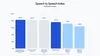
Gemini 3.8 Live Extended Thinking provides enterprise-grade task completion and intelligence, capturing the #1 overall spot on Artificial Analysis’ Speech to Speech Quality Index (82.6), and leads in agentic task completion with 68.6% on τ-Voice and 35.1% on Sierra’s τ-Voice-banking benchmark. It also provides strong reasoning capabilities, scoring 97.7% on Big Bench Audio, while maintaining a highly competitive price point compared to other frontier models.
Gemini 3.8 Live has shown a high preference among users, securing a second place in the Speech Agent Arena. In addition to this performance, it remains highly cost-effective — providing developers and enterprises with a capable and efficient model built for scale.
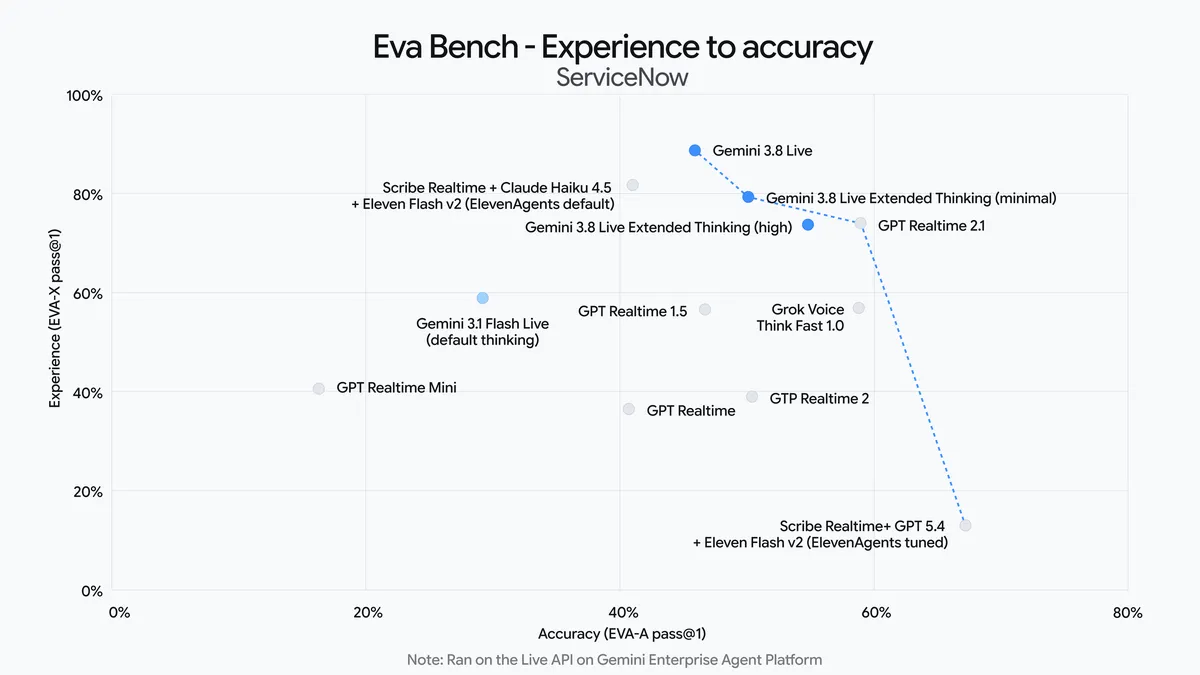
On ServiceNow’s EVA-Bench, a benchmark for evaluating voice agents, our models push the Pareto Frontier for complex workflows by successfully balancing accuracy with conversational quality.
Note: This was run on the Live API on Gemini Enterprise Agent Platform.
Gemini 3.8 Live processes visual inputs in near real-time, enriching conversations with context for more helpful responses. It automatically detects and transitions between 97 supported languages mid-conversation. It executes tools and API calls in the background while continuing the conversation, so the model can acknowledge requests and keep chatting while tasks finish in the background.
For tasks that require deeper reasoning, 3.8 Live Extended Thinking reasons and speaks simultaneously. It delivers increased intelligence for complex workflows while maintaining an uninterrupted conversational flow — using early verbal cues like “Let me check that…” to acknowledge prompts naturally, and live progress narration to walk users through multi-step background tasks as they progress.
Across Google Workspace, Search, and the Gemini app, our Live models deliver more intuitive, collaborative experiences — especially when tackling your most complex tasks.
Empowering the developer and enterprise voice ecosystem
By using the Gemini Live API, developer platforms such as Agora, Fishjam, LangChain, LiveKit, Pipecat, Vercel, and Vision Agents enable developers to build and deploy high-performance voice-driven interfaces with ease. These platforms manage complex real-time media streaming infrastructure behind the scenes, allowing developers to focus entirely on crafting the user experience.
We’re also partnering with companies like Salesforce, Genspark, and Lumeris who are excited about 3.8 Live and 3.8 Live Extended Thinking, highlighting its impressive latency, fluidity, and tool-calling capabilities.
Ensure transparency with SynthID watermarking
All audio generated by our AI products is watermarked with SynthID. This imperceptible watermark is woven directly into the audio output, ensuring AI-generated content remains detectable to help prevent misinformation. For details on our approach to safety and responsibility, review the model card.
How predicting the molecular impact of every possible single-letter DNA variant in the human genome will help accelerate our understanding of biology.
Today, we are introducing AlphaGenome Atlas: a platform (detailed in our paper) containing predictions for the effects of 9 billion single-nucleotide variants — every single-letter change possible — in the human genome. It is the most comprehensive catalogue of how genetic mutations affect molecular biology, and it is available for academic research through an intuitive and free-to-use website portal.
DNA is the language of life. Mastering it is a grand challenge that could transform our ability to understand biology and treat disease. But progress has been limited by a fundamental problem: interpreting how genetic variations impact biology at a molecular level. With roughly 9 billion possible single-letter mutations in the human genome, testing each one in the lab is practically impossible.
Google DeepMind has already made progress on this challenge with AlphaGenome, an artificial intelligence (AI) model that can predict how genetic variants impact biological processes. AlphaGenome is helpful for analyzing specific variants and has found widespread use in research, but we wanted to show researchers a big-picture view of variants across the entire genome.
By precomputing AlphaGenome’s predictions at scale, we have created an easily accessible resource that vastly expands the model’s reach. Just as an atlas is a collection of maps, linking together features of the land like altitude and location, AlphaGenome Atlas charts the molecular effects of DNA variants across the genome.
To help scientists quickly find the most impactful genetic changes, we are also releasing the AlphaGenome Variant Impact (AVI) score. The AVI combines the strengths of AlphaGenome and AlphaMissense — our model for predicting the impact of protein-altering DNA variants — condensing both models’ predictions into a single number. Now, researchers can rapidly rank variants and interpret their molecular effects at the same time.
Our trusted external collaborators have already used AlphaGenome Atlas to identify and experimentally verify key variants in unsolved rare disease research and find rare variants associated with common traits.
AlphaGenome Atlas is a massive 1-petabyte dataset, more than 30 times larger than the AlphaFold Database. When we expanded the AlphaFold Database in 2022, we grew the 3D structure information available from around 190K experimental structures to more than 200M structure predictions — covering nearly all catalogued proteins known to science. The database provided a portal that researchers with no coding experience could use, providing intuitive visualizations and making it easier to do large-scale protein structure analysis. It quickly became a crucial resource that drove discoveries across the life sciences and continues to accelerate researchers’ important work in countless fields.
In building AlphaGenome Atlas, we also aspire to make predictions more accessible and give scientists an intuitive way to explore a vast dataset.
AlphaGenome Atlas provides several powerful, interconnected resources, allowing researchers to link variants directly to the functional DNA sequences they disrupt.
Molecular effect predictions Atlas contains thousands of molecular effect predictions for each variant, across multiple important aspects of gene regulation, spanning hundreds of human and mouse cell types and tissues. This serves as the starting point for further resources.
AVI score A single number describing the impact for each genetic variant.
AVI feature attributions Each AVI score is also linked to distinct biological features driving it, such as the aspects of gene regulation predicted by AlphaGenome or the protein impact score from AlphaMissense.
DNA sequence motifs A comprehensive collection of over 2,500 recurrent DNA sequences — the “words” of the genome — and their locations.
Together, these resources support researchers for a wide range of genetic research tasks, from rapid variant ranking to deep dives into variant functions.
Extensive community collaboration guided the design of AlphaGenome Atlas. The AVI score helps researchers rapidly score and rank variants based on their potential impact. Crucially, it works for both coding regions (the 2% of the genome that codes for proteins) and non-coding regions (the remaining 98%), which orchestrates gene activity and houses most trait-associated variants.
Our testing shows that the AVI score provides best-in-class performance across many variant pathogenicity and rare disease benchmarks. To help interpret these scores, we also calculated AVI feature attributions that highlight which molecular processes — like RNA splicing or gene expression — are predicted to be most disrupted by each variant.
Overview of the AlphaGenome Atlas.(1) Precomputed effects are generated genome-wide for over 9 billion single-nucleotide variants. (2) From this, an allelic-resolution AlphaGenome Variant Impact (AVI) score is derived for each variant. To facilitate variant interpretation, AlphaGenome Atlas then decomposes the AVI score into additive feature contributions across interpretable categories such as chromatin accessibility, splicing, and conservation. (3) The precomputed variant effects, AVI score and the AVI feature attributions are linked, together with a compendium of genome-wide de novo motifs, which enables high-resolution mechanistic insights into variant function.
Real-world impact: From rare diseases to population genetics and molecular biology
AlphaGenome Atlas provides a high-resolution, global view of the genome. These large-scale predictions become most useful when applied to targeted research questions. By translating this data into actionable biological insights, our academic partners are already uncovering links between genetic variation and disease.
Understanding unsolved rare diseases. A major hurdle in understanding rare diseases is the daunting task of pinpointing the few causal variants hidden among thousands of candidates. In collaboration with the GREGoR Consortium, researchers applied the AVI score to prioritize these needle-in-a-haystack genetic variants for unsolved rare disease research. When Laura Covill and Anne O’Donnell-Luria from the Broad Institute and their colleagues used the AVI score to prioritize variants, driving a rare disease, that were overlooked in previous research, the team discovered a variant affecting a gene called DNM1, which is strongly linked to epileptic encephalopathy.
Crucially, the AlphaGenome predictions underlying the AVI score showed exactly how the variant functioned: it created an incorrect splice site (a mistake in the cell’s genetic instructions) that led to an abnormal extension of the resulting protein. Experimental screens validated the research prediction and found nearby variants with similar effects, showing that Atlas is a powerful tool for understanding impactful genomic variation.
Mapping rare variants associated with protein levels and complex traits. Moving beyond individual rare disease research, AlphaGenome Atlas can help uncover the genetic architecture of common traits in the general population. Identifying which rare, non-coding variants are associated with a specific trait or disease is notoriously difficult because the sheer volume of harmless genetic changes creates a statistical ‘background noise’.
To test how AlphaGenome Atlas can improve our ability to find non-coding variants affecting human traits, Gareth Hawkes, a Medical Research Council fellow at the University of Exeter, applied AlphaGenome Atlas to whole-genome data from over 54,000 UK Biobank participants, which made these elusive signals more obvious. By grouping rare variants based on their predicted molecular effects, Hawkes uncovered 22% more non-coding genetic associations, which would otherwise have not been detectable in the statistical noise. This let Hawkes pinpoint specific regulatory variants driving the abundance of critical proteins circulating in the human body, including PLA2G7 (linked to aging) and EGLN1 (a vital cellular oxygen sensor).
Taking this approach even further, Hawkes used AlphaGenome Atlas to look at how hundreds of millions of non-coding variants in the UK Biobank might be linked to body mass index. By focusing on the 1% of non-coding variants which Atlas predicts to be most impactful, he identified 19 genetic regions, which could help direct the next stage of targeted research into this trait.
Identifying the regulatory ‘words’ of the genome. Atlas can also be used to identify which recurring short sequences, or motifs, are driving different molecular processes in different cell types for different genes. These motifs can provide key clues, such as locating binding sites of transcription factors (proteins that turn genes on or off) and providing additional interpretation of non-coding variants. Julia Zeitlinger and Melanie Weilert at the Stowers Institute for Medical Research used this resource, for example, to categorize which transcription factors only affect the accessibility of DNA versus which ones are also able to turn genes on and off.
Accelerating genomic discovery
With AlphaGenome Atlas we are creating new layers of information that will help further our understanding of the human genetic code. We hope that this will be a valuable resource for scientists, but we also view it as a baseline rather than an endpoint. As our AI models like AlphaGenome improve, our maps of the entire human genome will become increasingly comprehensive and precise.
AlphaGenome Atlas is powerful in isolation, but it also represents a step towards our vision of a broad, unified solution for biologists. Its resources can be integrated into our broader agentic systems, like Google Antigravity, to help enhance end-to-end scientific workflows.
It is also important that AlphaGenome Atlas’ scientific knowledge is widely available, so we have made it accessible for non-commercial use through our website from today, as well as for commercial use on Google Cloud soon. (The AlphaGenome base model is already available for academic use on GitHub and via the AlphaGenome API, and also is available for commercial use on Cloud via Model Garden).
Together, these tools will enable researchers and industry partners to accelerate the pace of biological discovery: finding novel therapeutic targets, better understanding genetic disorders, and driving the next wave of targeted experimental validation.
Acknowledgements
We are grateful to our research collaborators at University of Exeter, Broad Institute, Boston Children’s Hospital, Stowers Institute for Medical Research, Harvard University, Memorial Sloan Kettering Cancer Center, Center for Genomic Medicine at Massachusetts General Hospital, and the University of Kansas Medical Center.
This work was done thanks to the contributions of Jun Cheng, Kyle R. Taylor, Lauren Nicolaisen, Joshua Pan, Clare Bycroft, Matteo Perino, Tom Ward, Raina W. Thomas, Natasha Latysheva, Gareth Hawkes, Laura E. Covill, Melanie Weilert, Maile J. Hirschmann, Xi Dawn Chen, Robin N Beaumont, V Kartik Chundru, Michael N Weedon, Simon Bourdareau, Hoyin Chu, Dhavi Hariharan, Thais Kagohara, Lucas Tenório, Yosuke Ushigome, Amanda Stafford, Courtney A. Shearer, Barbara Ikica, Ada Fang, Mouad Naciri, Victoria Johnston, Richard Green, Elisa Lai Hong Wong, Vincent Dutordoir, Anne Mottram, Adam Gayoso, Eirini Arvaniti, Guido Novati, Heidi L. Rehm, Fei Chen, Caleb A. Lareau, Caroline F Wright, Anne O’Donnell-Luria, Julia Zeitlinger, Pushmeet Kohli, Žiga Avsec.
We wish to thank our teammates and collaborators for their technical support, feedback, including Kathryn Tunyasuvunakool, Alexander Karollus, Risha Patel, Francesca Pietra, Alisha Eastep, Doga Fadillioglu, Charlie Taylor, Raphael Aboyeji, Uchechi Okereke, Gemma Gibbs, Olufemi Duduyemi, Juan Mateos-Garcia, Mariana Felix, Sahar Abdulrahman, Antonia Mould, Rachael Tremlett, Chang Yun, Salil Deshpande, Anshul Kundaje, Samantha Bryen, Greg Findlay, Phoebe Dace, Kinga Bujakowska, Emma Sherrill, Aubrie Soucy Verran, Boxun Zhao, Tim Yu, Francesca Pietra, Brendah Namugamba, Cassie Gray, Daniel MacArthur, Lingyi Wang, Marc Mansour, Mohamad Hajjari, Mounica Vallurupalli, Philip Montgomery, Phoebe Dace, Roisin Sullivan, Sam Bryen, Teresa Niccoli,
Finally we wish to thank Evie Gray, Adriana Fernandez Lara, Alex Wilkins, Danielle Breen, Mariana Montes, Inês Ayer, Ryan Smith, Ross West and Gaby Pearl for their expertise in communicating this work.
AlphaGenome
AlphaGenome: AI for better understanding the genome
Our flagship AI weather forecasting model now includes real-time satellite data, hourly refreshes, higher resolution, precise precipitation forecasting, and clean energy variables. It’s now integrated across Search, Gemini, Maps, Google Maps Platform, and Cloud.
Listen to article
[[duration]] minutes
This content is generated by Google AI. Generative AI is experimental
Every day, the weather influences billions of decisions. Some are as simple as grabbing an umbrella before heading out the door, but others are far more consequential. Wind, rain, and extreme weather events, like heatwaves and droughts, have cascading impacts across agriculture, global supply chains, clean energy production, and national economies.
In recent years, AI has revolutionized weather forecasting, using historical records to make faster and more accurate predictions than traditional methods. Yet predicting highly local and rapidly changing weather has remained a challenge. Previous models often lacked sufficient spatial resolution, and struggled to incorporate real-time weather data from sources like satellites.
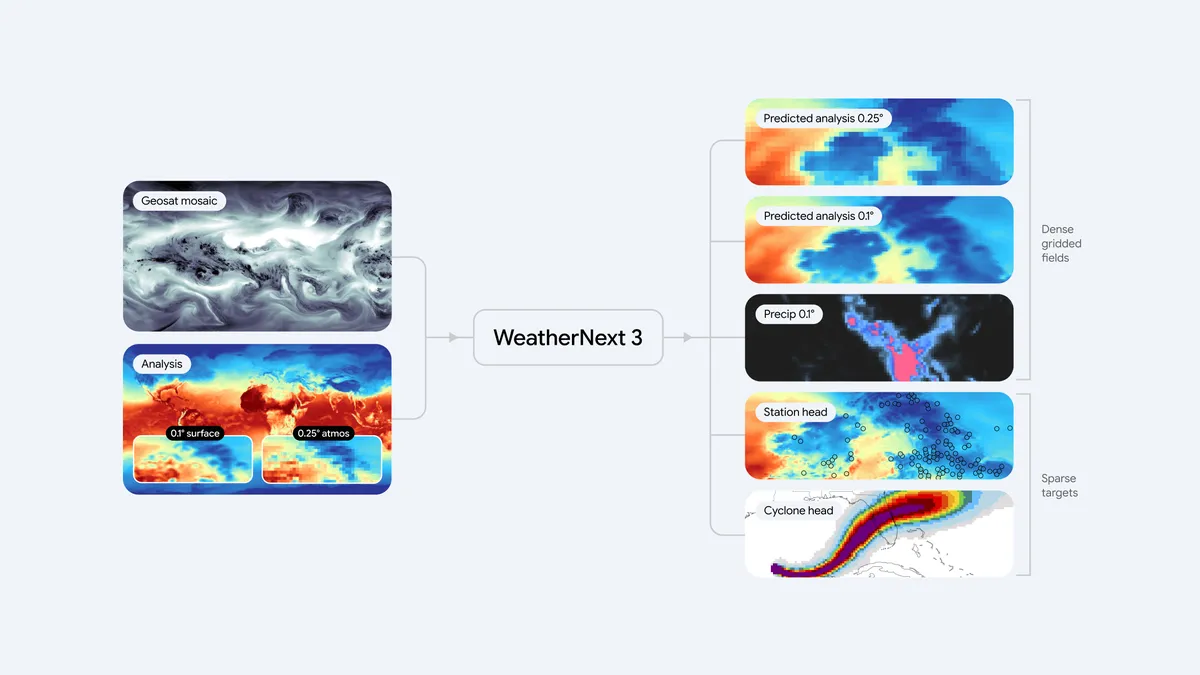
Today, Google DeepMind and Google Research are introducing WeatherNext 3, the most advanced and accurate global weather model to date, according to independent live evaluations by Brightband. Our model learns directly from real-time observations, enabling it to provide timely and more localized predictions for the weather events that impact people the most. By using raw satellite data to produce a forecast every hour in high resolution, our model makes reliable forecasts accessible across Google products worldwide.
Rapid weather prediction at unprecedented resolution
A forecast’s utility often comes down to detail and how finely it resolves both time and space. WeatherNext 3 generates hourly forecasts at multiple spatial resolutions, maintaining physical consistency from broad global wind patterns all the way down to local topography.
With WeatherNext 3, we can visualize key surface variables — like temperature and moisture — at a 5-kilometer resolution, other surface variables at 10 kilometers, and atmospheric variables, like wind speed, at 25 kilometers. Overall, this provides a global weather picture roughly five times sharper than our previous model, WeatherNext 2, which produced forecasts on a 25-kilometer grid in 6-hour increments.
Figure 1: The end-to-end WeatherNext 3 system architecture. The model ingests live 1-hour geostationary satellite mosaics alongside traditional historical analysis to feed a single, flexible Functional Generative Network (FGN) mesh transformer. It outputs dense gridded fields, discrete cyclone tracks, and predicts station-level sparse coordinates natively.
Figure 2: Comparison of 2-meter temperature forecasts over the UK. WeatherNext 2 (left) at 25-kilometer (0.25°) resolution vs. WeatherNext 3 (right) at a native 5-kilometer (0.05°) resolution. WeatherNext 3 resolves the intricate local topography, preventing the pixelated, over-smoothed thermal representations seen in older models.
Real-world data at continuous global scale
WeatherNext 3’s biggest leap forward is what it learns from. Most AI weather models, including WeatherNext 2, are trained on data from numerical weather prediction (NWP) models. Although useful, NWP models are complex, supercomputer-driven physics simulations that carry a six-hour data lag. This lag can lead to biases for fast-changing variables like rain or surface temperature.
By ingesting a mosaic of live, global geostationary satellite data, our new model gains a rich, continuously updating view of the atmosphere. This allows the model to generate a new forecast every hour, each one grounded in the most recent satellite observations available, at up to 5-kilometer resolution.
This is important because critical weather develops fast. When storms, fronts, or precipitation systems materialize suddenly, our rapid update cycle and higher resolution provides earlier, more detailed insights needed to help drive an effective response.
Some variables, like temperature and humidity, can fluctuate dramatically over just a few kilometers, which is particularly relevant for communities near coastlines, valleys, or mountain ranges. Traditional models struggle here because they train on representations of the atmosphere that lack detail and miss extreme local variations.
To address this, WeatherNext 3 instead trains directly on sparse weather station observation data. This allows us to make global forecasts on a 5-kilometer grid that account for regional details like topography.
This breakthrough is particularly vital for regions across Latin America, Africa, and Asia-Pacific that have historically been underserved by high-resolution forecasting due to the immense supercomputing costs of traditional regional models. It brings localized, high-fidelity forecasting to billions of people and local businesses in these areas.
Beyond improved resolution and forecast frequency, our model introduces predictions specifically engineered for renewable energy production. The model forecasts 100-meter wind speeds (roughly at turbine-height) for precise wind-energy output, alongside high-resolution cloud cover and sun radiation levels to help solar farms estimate how much light they will receive on the ground.
This data is crucial for global clean energy planning, allowing grid operators and renewables developers to accurately predict how much power their clean energy assets will generate and match it with consumer demand.
Precipitation forecasting at breakthrough accuracy
Global weather models notoriously struggle to accurately predict precipitation. Rain and snow systems are driven by fast-moving cloud processes on tiny scales that are hard to model accurately using traditional physics-based simulations. Consequently, AI forecasts often produce blurry estimates or miss the boundaries of severe storms entirely.
To solve this, we train our model on two exceptionally high-quality sources of precipitation data: NASA’s satellite-based Integrated Multi-satellite Retrievals for GPM (IMERG) and our own global precipitation reanalysis based on satellite radar.
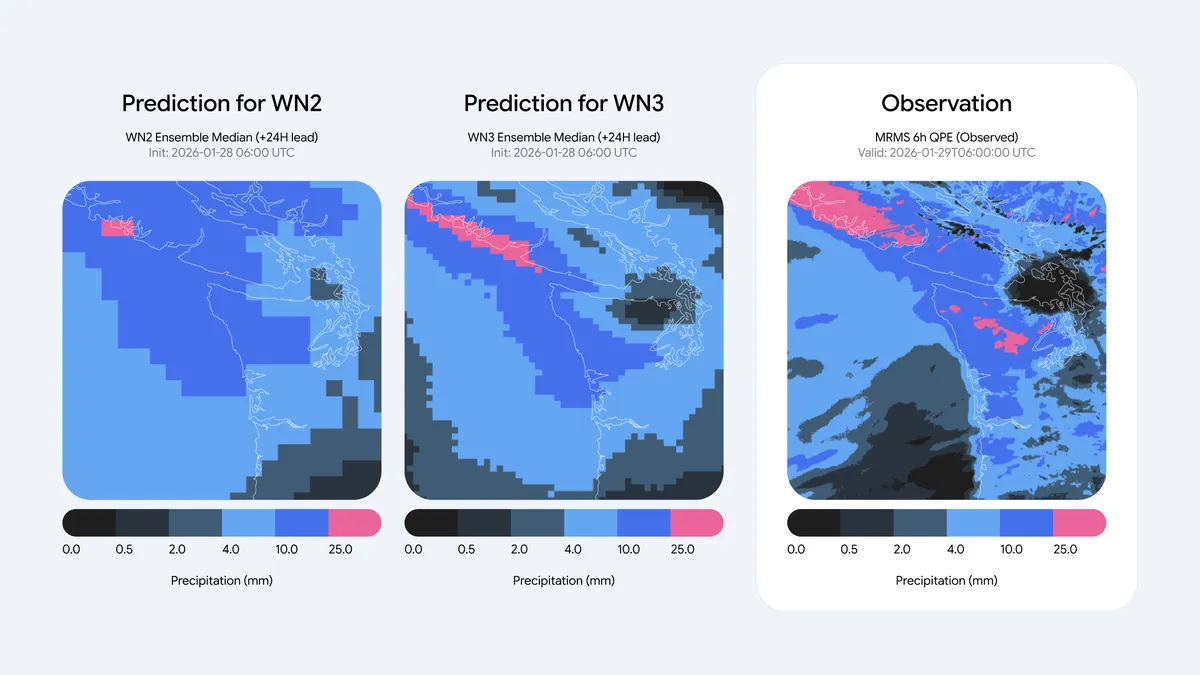
The result is a significant leap in precipitation forecasting accuracy. In medium-range global forecasts, evaluations against baselines show a Continuous Ranked Probability Score (CRPS) improvement of up to 60% against IMERG, 30% for MRMS, and 10% against rain gauge measurements for early lead times.
Figure 3: Medium-range probability of precipitation (PoP > 1mm) forecast comparison. WeatherNext 2 (left) at 25-kilometer resolution shows a highly diffused and pixelated precipitation footprint. WeatherNext 3 (middle) at 11-kilometer resolution closely mirrors the actual satellite ground truth (right), accurately capturing the sharp, convective bands of the weather systems.
Research applied across the ecosystem
Our primary goal is to advance weather intelligence to make it universally useful — whether for an emergency responder tracking sudden wind shifts, an air traffic controller planning flight paths, or a farmer managing crops.
To bring these breakthroughs out of the lab and into the real world, we’re integrating WeatherNext 3 across Google’s core ecosystem and beyond:
High-resolution forecast data: We’re making global weather predictions, updated hourly and ready to integrate into your workflows with no model setup required. This enables researchers, developers and businesses to query the data in BigQuery and Earth Engine, or bulk-download from Google Cloud Storage.
Available globally: WeatherNext 3 will begin powering weather experiences within Google Search, Gemini app, Google Maps, Google Maps Platform Weather API, and Google Earth Engine starting today. The update dramatically improves longer term forecasts. When planning a day or more ahead, people will see up to 50% more accurate precipitation forecasts — with the greatest improvements in regions where forecasts have historically been less reliable. So if you’re packing for a weekend trip or deciding the best day for an outdoor activity, you’ll now get more accurate predictions to help you plan.
The atmosphere will always retain a degree of unpredictability. However, by training on real-world observations and bypassing traditional modeling constraints, WeatherNext 3 brings us closer to a future where forecasts truly match what is happening on the ground.
Disclaimer: For official weather forecasts, severe weather warnings, and public safety advisories, please refer to your local meteorological agency or national weather service.
Today, we’re launching our Fairwind Program, a limited access program for governments and trusted partners to use our most advanced cyber defense capabilities.
Four Flynn
Vice President – Security and Privacy
Listen to article
[[duration]] minutes
This content is generated by Google AI. Generative AI is experimental
Defenders wanting to use advanced AI have faced a difficult dilemma: adopt enormous frontier models that could be expensive to deploy and difficult to control across enterprise codebases, or turn to smaller open-weight models that might struggle with complex vulnerability remediation and require teams to build their own tooling and infrastructure from scratch. Until now.
Today, we’re launching our Fairwind Program to bring the best of Google’s AI and cyber defense capabilities to a trusted group of Google Cloud customers, government agencies, and cybersecurity partners, to help them proactively solve cyber risks at scale. As a first step, the Fairwind Program will give defenders access to powerful and advanced Gemini models to help them autonomously find and fix vulnerabilities, protecting critical infrastructure, public services, and national security.
Finding and autonomously fixing vulnerabilities
The Fairwind Program offerings bring together our most advanced cyber model, Gemini 3.8 Flash Cyber, with our CodeMender harness, to help defenders find, verify, and fix vulnerabilities at agentic scale. Spotting weaknesses creates awareness and fear; autonomously finding and fixing vulnerabilities delivers security.
CodeMender with Gemini 3.8 Flash Cyber delivers the specialized reasoning to write and validate code fixes, at a fraction of the operating cost of traditional frontier models. Instead of taking weeks to manually fix vulnerabilities, defenders can now generate verified, deployment-ready patches in minutes — within an organization’s secure cloud environment.
Scaling frontline defense
Providing early access to these powerful cyber capabilities gives trusted defenders a vital adaptation window to harden their systems before bad actors have a chance to exploit new capabilities. We’re staging initial access to government and enterprise partners most critical to society’s resilience:
Governments and national cyber authorities: Hardening public-sector networks and citizen services against targeted intrusions.
Critical infrastructure operators: Protecting essential services across healthcare, telecommunications, energy, and financial networks from operational disruption.
Core technology platforms: Securing widespread software foundations to uplift digital security for millions of downstream users at once.
To ensure these powerful AI capabilities are used responsibly, participating organizations agree to strict operational standards, including limiting access to employees within their internal cybersecurity, incident response, or penetration testing teams and deploying protections like multi-factor authentication.
We have more than 650 participating partners globally, including:
What our Fairwind Program partners are saying
Trusted defenders and industry leaders are already putting Gemini 3.8 Flash Cyber into practice:
The Fairwind Program will evolve alongside our partners and users’ needs. We will adapt our product offerings and expand partner access, collaborating closely with industry, governments, and open-weight community leaders to strike the right balance between open access and robust security.
While we are prioritizing Gemini 3.8 Flash Cyber access for customers in the Fairwind Program, any Google Cloud customer can proactively secure their code by using CodeMender with publicly available models hosted on Gemini Enterprise Agent Platform, in combination with industry-leading solutions offered through AI Threat Defense.
Making an ecosystem-scale impact on cyber defense
Years of Google’s pioneering zero-trust architecture, advanced AI defenses, and built-in security allow us to protect billions of accounts daily – keeping more people and organizations safe online than anyone else. The Fairwind Program builds on this experience and is part of our broader commitment to global cyber resilience across the entire digital ecosystem, including helping to fortify grassroots cyber defense.
Through Google.org, our latest commitment brings our total cybersecurity funding to more than $100 million globally. We’re pleased to release our 2026 Google.org US Cybersecurity Impact Report, which details $36 million in funding for 35 cyber clinics to date, providing free, hands-on security support to over 1,250 hospitals, public school districts, and municipal utilities in the U.S.
Providing a security advantage
The defender’s edge comes from shrinking the time between detecting a flaw and patching it. Through Google’s Fairwind Program, government and enterprise partners gain autonomous tools to repair systems faster and at scale, keeping them one step ahead of agentic-speed threats.