Anyone Can Now Make A Video Worth Posting
Category: Introducing
-
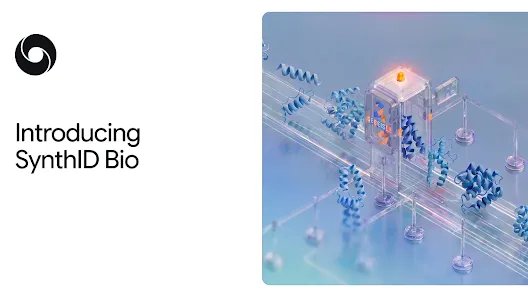
Introducing SynthID Bio
September 30, 2026 Science
Pushmeet Kohli, David Stutz, Ali Cowen-Rivers and Jeremy Ratcliff
Proof of concept for watermarking AI-generated proteins while preserving biological function.
Today, we’re introducing SynthID Bio to bring watermarking technology to synthetic biology. SynthID Bio embeds an imperceptible signature directly into the biological code, ensuring the watermark is verifiable not just on a digital model but on the synthesized, physical protein itself – all while preserving its biological function in laboratory testing.
Generative AI is helping scientists address critical biological challenges, from predicting the structure of proteins (AlphaFold) to designing entirely new proteins (AlphaProteo, and ProteinMPNN), and more recently, developing new bacteriophages, viruses that infect bacteria. Yet these tools also present new challenges: novel AI designs can bypass traditional DNA synthesis screening, while mislabeled synthetic 3D structures risk polluting public databases and misleading downstream research.
How SynthID Bio works
SynthID Bio is a family of watermarking methods developed specifically for synthetic biology to strengthen biosecurity and scientific integrity.
It adapts its approach depending on the type of data, subtly guiding the choice of amino acids for sequences and adjusting atomic coordinates for predicted 3D structures, creating a reliable signal for detection.
In experiments, these adjustments did not compromise the protein’s biological function, which is essential to effectively treat disease and advance scientific research.
Visualization of the predicted structure of our watermarked VEGF-A protein binder with watermark signal indicated by color for each amino acid.
We verified our approach for watermarking protein binders, i.e. molecules built to selectively latch onto other proteins, by using our binder design method AlphaProteo alongside a SynthID Bio-enabled version of ProteinMPNN, the commonly used protein sequence generation method.
In wet-lab testing across three target proteins (VEGF-A, the SARS-CoV-2 spike protein RBD, and PD-L1), our watermarked designs matched the hit rate, binding affinity, and natural sequence diversity of unwatermarked versions, successfully creating the first-ever watermarked and biologically functional protein binders.


Binding affinity, measured as KD, comparing non-watermarked and watermarked protein designs across three targets. Lower indicates stronger binders.
For protein folding, SynthID Bio fine-tunes a small part of AlphaFold 3’s diffusion network, building the ability to watermark directly into the model’s weights. This ensures that the predicted 3D coordinates inherently carry a detectable signature regardless of who runs the model. SynthID Bio preserves AlphaFold 3 prediction accuracy while offering near-perfect detectability, maintaining key structural feature distributions, and holding up against digital noise or minor coordinate changes.
On 7PPA, we show the AF3 predicted structure (left), the ground truth structure (middle), and the watermarked structure (right).
Strengthening biosecurity and information integrity
Biosecurity relies on layered defenses – think of it like a “Swiss cheese” defense model, where multiple independent safety measures work in tandem to cover each other’s blind spots. Safeguards like model-level mitigations and customer vetting each represent critical layers with potential gaps. As a part of our broader vision for bioresilience, SynthID Bio’s watermarking approach serves as an important, tangible verification layer embedded in the biological design itself.
“SynthID Bio is an important piece of the puzzle for tracking the provenance of biological designs,” said Sarah Carter, a biosecurity policy expert and Principal at Science Policy Consulting who reviewed the work. “By linking designs to the model developer, these watermarks empower developers to lead on safety and allow synthesis providers to streamline screening for customers who have used those models.”
That layer is especially vital to DNA synthesis screening, which sits on the frontlines of biosecurity. Converting digital protein designs into physical molecules requires placing an order with DNA synthesis providers, who screen requests against databases of known threats. For example, historically, an unfamiliar sequence may have been safely assumed to be an undiscovered natural organism. But because AI can create entirely new sequences with little resemblance to known hazards, screeners can no longer make that assumption. Verifying that an unfamiliar order isn’t an engineered threat requires exhaustive manual reviews that can stall vital research. Here, SynthID Bio can provide an automated verification signal, proving an order originated from a trusted model with built-in safeguards.
“AI is expanding what scientists can design, and DNA synthesis companies have an important role in helping that innovation scale responsibly,” said James Diggans, Vice President, Policy and Biosecurity at Twist Bioscience, who provided early feedback on the paper. “For Twist, watermarking offers a promising new addition to the biosecurity toolbox that could strengthen screening, focus resources on sequences that warrant closer review and make biosecurity more efficient as AI-designed biology continues to advance.”
Similarly, SynthID Bio could help maintain the integrity of databases such as the Protein Data Bank, UniProt, and GenBank. These databases, many of which are open to public submission, play a vital role in scientific advancements – but mislabeled entries can have an outsized negative impact in biosecurity decision-making, a challenge that may only grow with the addition of AI-generated biological data. As a part of the submission process, SynthID Bio could help ensure synthetic entries are properly labeled or flagged for further review.
Looking ahead
While no single biosecurity intervention is a silver bullet, SynthID Bio brings SynthID, our tried and tested watermarking tool, to synthetic biology. It’s an important first step toward reliably identifying and tracking AI-generated biological sequences and structures.
Moving forward, key challenges include making the watermark more robust against deliberate tampering. SynthID Bio can also be paired with provenance metadata approaches – similar to C2PA for digital media – or central repositories of AI-generated biological data to better identify and track AI-generated proteins.
To match the growing capabilities of frontier AI technology, we’re also researching how to apply watermarking to more complex biological objects. In ongoing work with the Hie lab at Stanford University and Arc Institute, we integrated SynthID Bio into Evo 2, an advanced genomic model, to watermark the genome of an Evo 2 designed bacteriophage. Early laboratory testing in bacteria cultures has confirmed these watermarked bacteriophages are functional. We believe this work has the potential to address some of the biosecurity risks associated with genome design and will share more details in a technical manuscript soon.
Realizing the full biosecurity benefits of this work will require community collaboration and further research. As part of our commitment to responsible innovation, we are publishing our methods paper and open-sourcing the code and in vitro data, and releasing the weights to the research community, so we can build on this work. By working openly with partners across biosecurity, gene synthesis, and policy, we can ensure safety and responsibility keeps pace with AI-driven discovery.
To reach out about partnering with us on this important topic, please contact us at synthidbio@google.com with a high level proposal. Please do not disclose any confidential or proprietary information.
Acknowledgements
This project was initiated by Pushmeet Kohli. The research and technical development was led by Alexander I. Cowen-Rivers and David Stutz and was advised by Pushmeet Kohli. Key engineering and research contributions were made by Guillermo Ortiz-Jimenez, Jeremy Ratcliff, Vinicius Zambaldi, Lindsay Willmore, Josh Abramson, Harshnira Patani, Christina Kouridi, Florian Stimberg, Mel Vecerik, Alex Chu, Sukhdeep Singh, Sumanth Dathathri, Eliseo Papa, Valentin De Bortoli, Arnaud Doucet, Jue Wang, and Sven Gowal. We thank Adaptyv Bio for help with in vitro validation.
The extension of this work to watermark DNA of bacteriophages is a collaboration between Google DeepMind and the Hie lab at Stanford and Arc Institute with key contributions from Jeremy Ratcliff, Aleks Petrov, Alexander I. Cowen-Rivers, David Stutz, Elisa L. H. Wong, Victor Martin Palacios, Francesca Pietra, Alfred Piccioni, Tristan Oliver Kwan, Tor Lattimore, Sumanth Dathathri, and Pushmeet Kohli from Google DeepMind and Brian Hie, Samuel King, and Aditi Merchant from Arc Institute and Stanford.
We further thank Rudy Bunel, Anna Cupani, Rob Fergus, Thomas Frerix, Sahra Ghalebikesabi, John Jumper, Jacob Kelly, David La, Victor Martin, Sebastian Nowozin, Stig Petersen, Aleks Petrov, Uchechi Okereke, Sylvestre-Alvise Rebuffi, Rosalia Schneider, Armin Senoner, Richard Shuai, Ashok Thillaisundaram, Elisa L. H. Wong, Zachary Wu, and Augustin Žídek for their contributions to the research article, and Julien Bergeron for contributions to the 3D rendering. Finally, we thank Demis Hassabis for his encouragement and support of this project.
AlphaProteo generates novel proteins for biology and health research
Watermarking AI-generated text and video with SynthID
Identifying AI-generated images with SynthID
AlphaProteo generates novel proteins for biology and health research
AlphaFold: Five years of impact
-
Introducing Gemini 3.8 Live with Live Avatar
Gemini 3.8 Live with Live Avatar brings real-time visual presence to Gemini’s conversational AI. By natively coupling our live dialogue capabilities with low-latency streaming video, Live Avatar enables a more natural and intuitive conversational experience for enterprises and their users.
Shuo-yiin Chang
Research Scientist
CJ Zheng
Software Engineer, on behalf of the Gemini Audio Team
Building on the momentum of last week’s Gemini 3.8 Live launch, today we are excited to introduce Gemini 3.8 Live with Live Avatar — bringing near real-time visual presence to our native live dialogue models. By pairing near real-time video generation with speech, the Live Avatar feature creates an experience that listens, sees, and speaks with a dynamic visual persona.
With precise lip-syncing, natural expressions, and fluid turn-taking, Live Avatar enables enterprises to expand their virtual offerings more interactively. Whether providing engaging customer service or delivering interactive walkthroughs, it transforms digital exchanges into richer, more accessible experiences.
Starting today, Gemini 3.8 Live with Live Avatar is available in Gemini Enterprise.
See how Gemini 3.8 Live with Live Avatar supports a wide range of characters, each with a distinct look, voice, and expressive presence.
More natural and multimodal conversations
Conversation is inherently multimodal: we listen, look, speak, and use facial expressions to communicate. Live Avatar brings these capabilities to enterprise agents. By processing visual and audio inputs simultaneously, it generates enriching conversations for a more comprehensive experience.
Watch how Gemini 3.8 Live with Live Avatar takes in what it sees and hears in near real time, responding with expressive audio and video for a more natural conversation.
Asynchronous tool execution with continuous presence
Beyond visual presence, the feature is backed by Gemini’s advanced reasoning. With asynchronous tool calling, Live Avatar can trigger tool calls and fetch data in the background while continuing active dialogue, handling complex tasks while ensuring an uninterrupted conversational flow.
See how Gemini 3.8 Live with Live Avatar handles complex tasks like checking in a guest at a hotel. Calling tools in the background while the dialogue continues uninterrupted.
Conversational experiences built for global scale
Conversational presence should feel natural and not be limited by languages. Live Avatar features native multilingual speech-to-speech synchronization. The feature dynamically adapts its lip-sync and expressions and can seamlessly transition across 97 languages without degrading video fidelity or introducing visual drift.
Watch how Gemini 3.8 Live Avatar switches between languages mid-conversation, with lip-sync and expressions adapting seamlessly across 97 languages.
A Live Avatar to fit your brand needs
Organizations often need distinct visual identities to fit their brand. In addition to a library of diverse, preset avatars, organizations can customize their Live Avatars. From a high-quality reference image, developers can generate a fully animated, responsive avatar while preserving reference likeness, brand styling, or character identity. Custom avatar creation is currently available only through enterprise allowlisting.
Trust and transparency at its core
We built Live Avatar with strict safeguards designed to respect identity, and keep AI-generated content transparent. All output generated by our AI products is watermarked with SynthID. This imperceptible watermark is woven directly into the audio and video output, helping to ensure AI-generated content remains detectable to help minimise misinformation and misattribution. To explore our comprehensive approach to safety and responsible deployment, read our model card.
Get started with Gemini 3.8 Live with Live Avatar
Gemini 3.8 Live with Live Avatar is available in Gemini Enterprise. Explore the API documentation to get started.
-
Introducing Gemini 3.8 Live and 3.8 Live Extended Thinking
Gemini 3.8 Live and Gemini 3.8 Live Extended Thinking are our most advanced live dialogue models yet. Major upgrades in intelligence and parallel reasoning make them more intuitive to collaborate with and use to execute complex tasks using your voice.
Tom Ouyang
Principal Engineer
Malini Jaganathan
Member of Technical Staff, on behalf of the Gemini Audio Team
Listen to article
[[duration]] minutes
This content is generated by Google AI. Generative AI is experimental
Updated September 17, 2026
Today, we’re introducing two new models that bring advancements in near real-time reasoning to more effectively enable voice agents and make conversing with AI feel more intuitive and intelligent.
- Gemini 3.8 Live: Built for scale and cost efficiency, combining conversational intelligence with fluid dialogue and visual grounding.
- Gemini 3.8 Live Extended Thinking: Built for high-complexity tasks, with increased intelligence and multi-step reasoning.
For developers and enterprises, these models deliver the building blocks for reliable, production-ready voice agents. They also make speaking with Gemini across the Gemini app, Google Workspace, and Search more fluid and collaborative — helping you tackle complex tasks using just your voice.
Experience more fluid, intelligent conversations
Gemini 3.8 Live Extended Thinking provides enterprise-grade task completion and intelligence, capturing the #1 overall spot on Artificial Analysis’ Speech to Speech Quality Index (82.6), and leads in agentic task completion with 68.6% on τ-Voice and 35.1% on Sierra’s τ-Voice-banking benchmark. It also provides strong reasoning capabilities, scoring 97.7% on Big Bench Audio, while maintaining a highly competitive price point compared to other frontier models.
Gemini 3.8 Live has shown a high preference among users, securing a second place in the Speech Agent Arena. In addition to this performance, it remains highly cost-effective — providing developers and enterprises with a capable and efficient model built for scale.
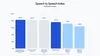
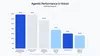

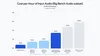
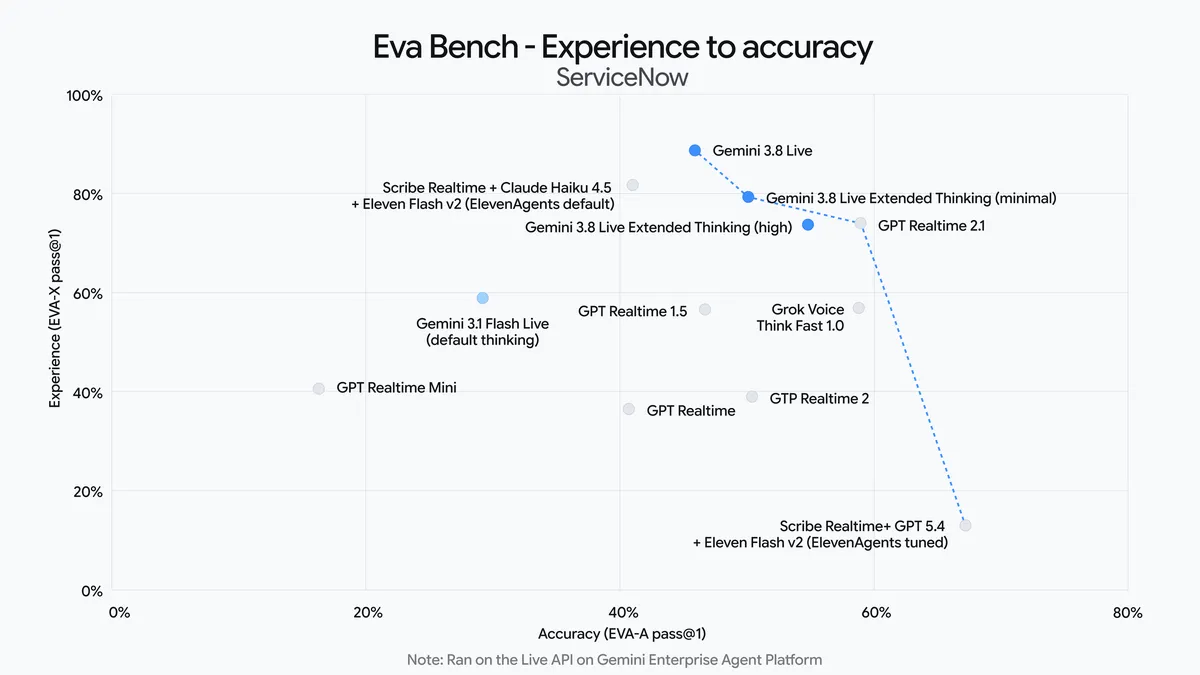
On ServiceNow’s EVA-Bench, a benchmark for evaluating voice agents, our models push the Pareto Frontier for complex workflows by successfully balancing accuracy with conversational quality.
Note: This was run on the Live API on Gemini Enterprise Agent Platform.
Gemini 3.8 Live processes visual inputs in near real-time, enriching conversations with context for more helpful responses. It automatically detects and transitions between 97 supported languages mid-conversation. It executes tools and API calls in the background while continuing the conversation, so the model can acknowledge requests and keep chatting while tasks finish in the background.
For tasks that require deeper reasoning, 3.8 Live Extended Thinking reasons and speaks simultaneously. It delivers increased intelligence for complex workflows while maintaining an uninterrupted conversational flow — using early verbal cues like “Let me check that…” to acknowledge prompts naturally, and live progress narration to walk users through multi-step background tasks as they progress.
Across Google Workspace, Search, and the Gemini app, our Live models deliver more intuitive, collaborative experiences — especially when tackling your most complex tasks.
Empowering the developer and enterprise voice ecosystem
By using the Gemini Live API, developer platforms such as Agora, Fishjam, LangChain, LiveKit, Pipecat, Vercel, and Vision Agents enable developers to build and deploy high-performance voice-driven interfaces with ease. These platforms manage complex real-time media streaming infrastructure behind the scenes, allowing developers to focus entirely on crafting the user experience.
We’re also partnering with companies like Salesforce, Genspark, and Lumeris who are excited about 3.8 Live and 3.8 Live Extended Thinking, highlighting its impressive latency, fluidity, and tool-calling capabilities.







Ensure transparency with SynthID watermarking
All audio generated by our AI products is watermarked with SynthID. This imperceptible watermark is woven directly into the audio output, ensuring AI-generated content remains detectable to help prevent misinformation. For details on our approach to safety and responsibility, review the model card.
Start using our latest Gemini Audio models:
3.8 Live is rolling out starting today:
- For developers: In the Gemini API and Google AI Studio
- For enterprises: In private preview in Gemini Enterprise and coming soon to Gemini Enterprise for Customer Experience
- For everyone: In Search Live
3.8 Live Extended Thinking is rolling out starting today:
- For developers: In the Gemini API and Google AI Studio
- For enterprises: In private preview in Gemini Enterprise and coming soon to Gemini Enterprise for Customer Experience and Google Workspace business customers
- For everyone: In Gemini Live and for Google AI Pro and Ultra subscribers in Workspace in Docs, and all Google AI subscribers in Gmail and Keep
Get the latest news from Google in your inbox
Sign up for our newsletters with product updates, event information, special offers, and more.
Your information will be used in accordance with Google’s privacy policy. You may opt out at any time.
-
Introducing WeatherNext 3, our most advanced and accurate global weather AI model
Our flagship AI weather forecasting model now includes real-time satellite data, hourly refreshes, higher resolution, precise precipitation forecasting, and clean energy variables. It’s now integrated across Search, Gemini, Maps, Google Maps Platform, and Cloud.

Listen to article
[[duration]] minutes
This content is generated by Google AI. Generative AI is experimental
Every day, the weather influences billions of decisions. Some are as simple as grabbing an umbrella before heading out the door, but others are far more consequential. Wind, rain, and extreme weather events, like heatwaves and droughts, have cascading impacts across agriculture, global supply chains, clean energy production, and national economies.
In recent years, AI has revolutionized weather forecasting, using historical records to make faster and more accurate predictions than traditional methods. Yet predicting highly local and rapidly changing weather has remained a challenge. Previous models often lacked sufficient spatial resolution, and struggled to incorporate real-time weather data from sources like satellites.
Today, Google DeepMind and Google Research are introducing WeatherNext 3, the most advanced and accurate global weather model to date, according to independent live evaluations by Brightband. Our model learns directly from real-time observations, enabling it to provide timely and more localized predictions for the weather events that impact people the most. By using raw satellite data to produce a forecast every hour in high resolution, our model makes reliable forecasts accessible across Google products worldwide.
Rapid weather prediction at unprecedented resolution
A forecast’s utility often comes down to detail and how finely it resolves both time and space. WeatherNext 3 generates hourly forecasts at multiple spatial resolutions, maintaining physical consistency from broad global wind patterns all the way down to local topography.
With WeatherNext 3, we can visualize key surface variables — like temperature and moisture — at a 5-kilometer resolution, other surface variables at 10 kilometers, and atmospheric variables, like wind speed, at 25 kilometers. Overall, this provides a global weather picture roughly five times sharper than our previous model, WeatherNext 2, which produced forecasts on a 25-kilometer grid in 6-hour increments.
Figure 1: The end-to-end WeatherNext 3 system architecture. The model ingests live 1-hour geostationary satellite mosaics alongside traditional historical analysis to feed a single, flexible Functional Generative Network (FGN) mesh transformer. It outputs dense gridded fields, discrete cyclone tracks, and predicts station-level sparse coordinates natively.
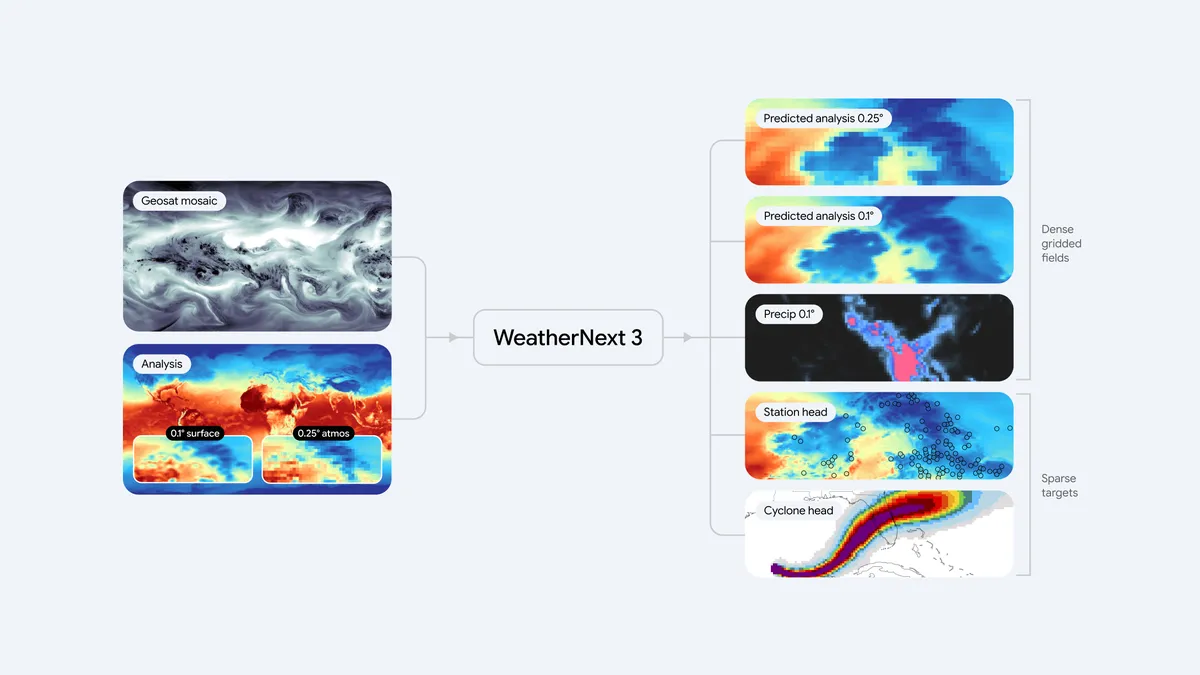
Figure 2: Comparison of 2-meter temperature forecasts over the UK. WeatherNext 2 (left) at 25-kilometer (0.25°) resolution vs. WeatherNext 3 (right) at a native 5-kilometer (0.05°) resolution. WeatherNext 3 resolves the intricate local topography, preventing the pixelated, over-smoothed thermal representations seen in older models.
Real-world data at continuous global scale
WeatherNext 3’s biggest leap forward is what it learns from. Most AI weather models, including WeatherNext 2, are trained on data from numerical weather prediction (NWP) models. Although useful, NWP models are complex, supercomputer-driven physics simulations that carry a six-hour data lag. This lag can lead to biases for fast-changing variables like rain or surface temperature.
By ingesting a mosaic of live, global geostationary satellite data, our new model gains a rich, continuously updating view of the atmosphere. This allows the model to generate a new forecast every hour, each one grounded in the most recent satellite observations available, at up to 5-kilometer resolution.
This is important because critical weather develops fast. When storms, fronts, or precipitation systems materialize suddenly, our rapid update cycle and higher resolution provides earlier, more detailed insights needed to help drive an effective response.
Some variables, like temperature and humidity, can fluctuate dramatically over just a few kilometers, which is particularly relevant for communities near coastlines, valleys, or mountain ranges. Traditional models struggle here because they train on representations of the atmosphere that lack detail and miss extreme local variations.
To address this, WeatherNext 3 instead trains directly on sparse weather station observation data. This allows us to make global forecasts on a 5-kilometer grid that account for regional details like topography.
This breakthrough is particularly vital for regions across Latin America, Africa, and Asia-Pacific that have historically been underserved by high-resolution forecasting due to the immense supercomputing costs of traditional regional models. It brings localized, high-fidelity forecasting to billions of people and local businesses in these areas.
Beyond improved resolution and forecast frequency, our model introduces predictions specifically engineered for renewable energy production. The model forecasts 100-meter wind speeds (roughly at turbine-height) for precise wind-energy output, alongside high-resolution cloud cover and sun radiation levels to help solar farms estimate how much light they will receive on the ground.
This data is crucial for global clean energy planning, allowing grid operators and renewables developers to accurately predict how much power their clean energy assets will generate and match it with consumer demand.
Precipitation forecasting at breakthrough accuracy
Global weather models notoriously struggle to accurately predict precipitation. Rain and snow systems are driven by fast-moving cloud processes on tiny scales that are hard to model accurately using traditional physics-based simulations. Consequently, AI forecasts often produce blurry estimates or miss the boundaries of severe storms entirely.
To solve this, we train our model on two exceptionally high-quality sources of precipitation data: NASA’s satellite-based Integrated Multi-satellite Retrievals for GPM (IMERG) and our own global precipitation reanalysis based on satellite radar.
The result is a significant leap in precipitation forecasting accuracy. In medium-range global forecasts, evaluations against baselines show a Continuous Ranked Probability Score (CRPS) improvement of up to 60% against IMERG, 30% for MRMS, and 10% against rain gauge measurements for early lead times.
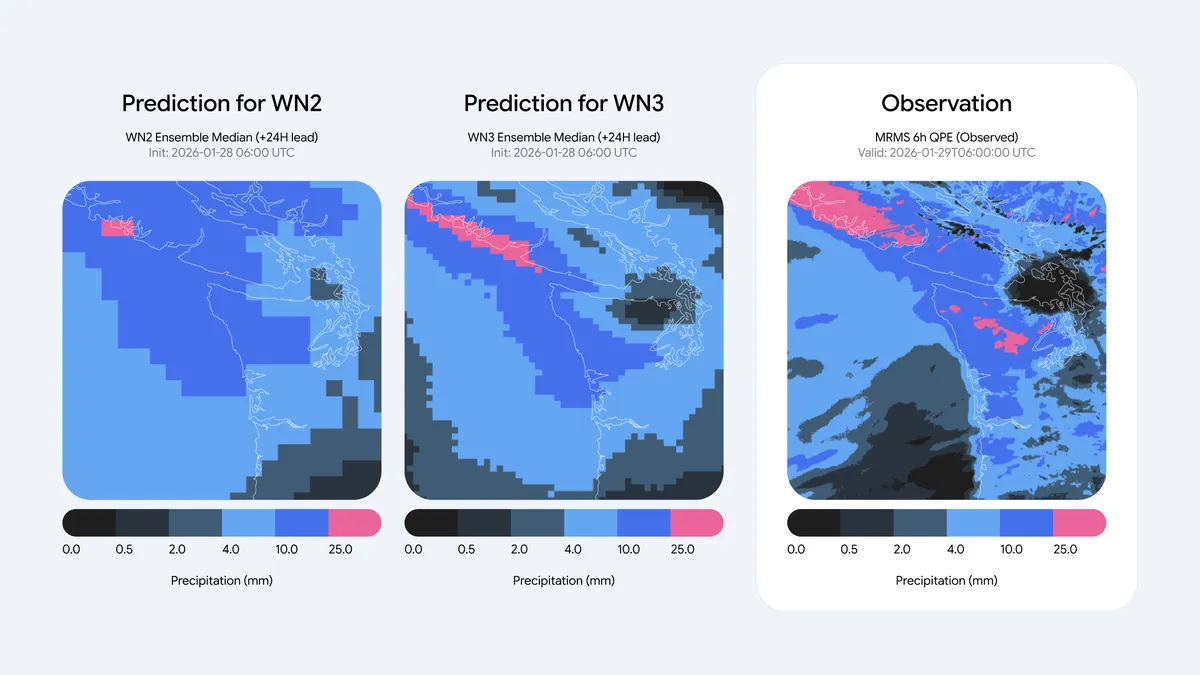
Figure 3: Medium-range probability of precipitation (PoP > 1mm) forecast comparison. WeatherNext 2 (left) at 25-kilometer resolution shows a highly diffused and pixelated precipitation footprint. WeatherNext 3 (middle) at 11-kilometer resolution closely mirrors the actual satellite ground truth (right), accurately capturing the sharp, convective bands of the weather systems.
Research applied across the ecosystem
Our primary goal is to advance weather intelligence to make it universally useful — whether for an emergency responder tracking sudden wind shifts, an air traffic controller planning flight paths, or a farmer managing crops.
To bring these breakthroughs out of the lab and into the real world, we’re integrating WeatherNext 3 across Google’s core ecosystem and beyond:
- High-resolution forecast data: We’re making global weather predictions, updated hourly and ready to integrate into your workflows with no model setup required. This enables researchers, developers and businesses to query the data in BigQuery and Earth Engine, or bulk-download from Google Cloud Storage.
- Available globally: WeatherNext 3 will begin powering weather experiences within Google Search, Gemini app, Google Maps, Google Maps Platform Weather API, and Google Earth Engine starting today. The update dramatically improves longer term forecasts. When planning a day or more ahead, people will see up to 50% more accurate precipitation forecasts — with the greatest improvements in regions where forecasts have historically been less reliable. So if you’re packing for a weekend trip or deciding the best day for an outdoor activity, you’ll now get more accurate predictions to help you plan.
The atmosphere will always retain a degree of unpredictability. However, by training on real-world observations and bypassing traditional modeling constraints, WeatherNext 3 brings us closer to a future where forecasts truly match what is happening on the ground.
To learn more about geospatial platforms and AI work at Google, check out Google Earth Engine, AlphaEarth Foundations, and Earth AI.
Disclaimer: For official weather forecasts, severe weather warnings, and public safety advisories, please refer to your local meteorological agency or national weather service.
Learn more about WeatherNext 3
- Read our paper
- Build with WeatherNext 3
- Explore Weather Lab to see WeatherNext 3 visualized in real-time
- See where WeatherNext 3 ranks on independent live leaderboards from Brightband.
Get the latest news from Google in your inbox
Sign up for our newsletters with product updates, event information, special offers, and more.
Your information will be used in accordance with Google’s privacy policy. You may opt out at any time.