Meta has shifted to a new family of flagship AI models called Muse and sent the Llama “herd” of models to the farm upstate. It’s a dramatic but understandable shift in AI strategy from the company that was once pioneering open models.
The newest models are Muse Wonder and Muse Spark, and they’re Meta’s first real attempt at top-tier frontier models. Unlike the Llama models, both are closed-weight proprietary models. You won’t be able to download them from Hugging Face or run them on your own machine for any reason.
There are several other AI products also under the Muse banner: Muse Glimmer is an open-weight model for running agents locally, Muse Code is Meta’s take on Claude Code and Codex, and Muse (with no other modifier) is its personal AI agent app. The company has also announced Muse Charm, a voice-based physical AI device.
As a fan of open models, I’m sad to see Meta pivot away from Llama, but it’s understandable given the rising competition from Chinese open models from DeepSeek and Moonshot AI, as well as the need to stay competitive with the other American AI labs. So, let’s look at how Muse Wonder, Muse Spark, Muse Glimmer, and the rest of Meta’s AI tools stack up.
Table of contents:
What is Muse Wonder?
Muse Wonder is Meta’s newest and most capable AI model. It’s really two models: Muse Wonder, which developers can use through the API and Muse Code, and Muse Wonder Full, a more capable version that’s only available in Muse Code.
Meta built the Wonder models for agents, and it’s highlighting two key features:
-
Active Memory is the ability to carry what matters to you across conversations and bring back the details relevant to the task at hand.
-
Active Focus is the ability to keep working toward a goal when a task gets hard: trying other approaches, recovering from errors, and checking in with you before doing anything important.
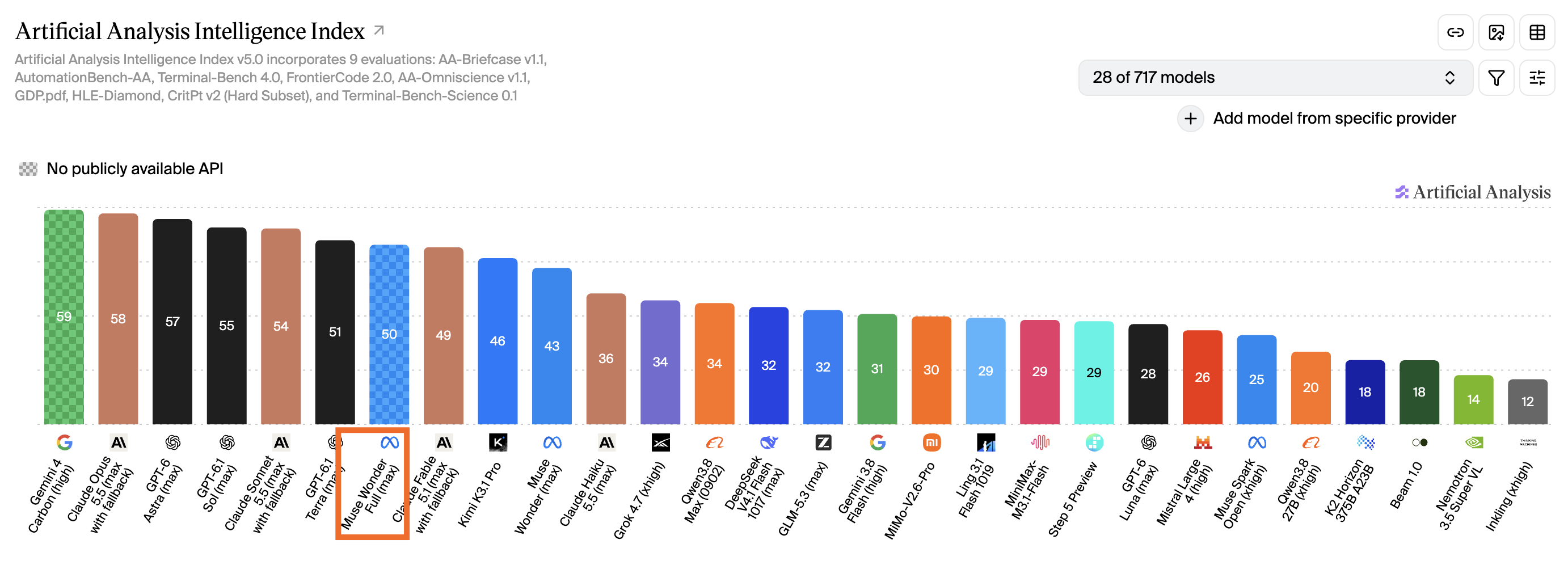
Artificial Analysis found that both models are a big step up from Muse Spark 1.3, which arrived just six weeks earlier, with the largest gains in agentic tasks.
On safety, Meta says Wonder has its strongest safeguards yet against chemical, biological, radiological, nuclear, and cyber misuse, while still allowing defensive security work.
Muse Wonder pricing
|
Where to get it |
API price per million tokens (input / output) |
|
|---|---|---|
|
Muse Wonder |
Meta Model API, Muse Code |
$4 / $20 |
|
Muse Wonder Full |
Muse Code, $50 and $200 plans |
Not available via API |
What is Muse Spark?
Muse Spark is the model that kicked off Meta Superintelligence Labs’ Muse family. Like other frontier models, Muse Spark is a multimodal reasoning model that supports tool use and agentic behaviors. In other words, it can analyze visuals as well as text, decide whether to generate an image in response to a question or search the web, and have sub-agents handle tasks. Right now, we’re at Muse Spark 1.3.
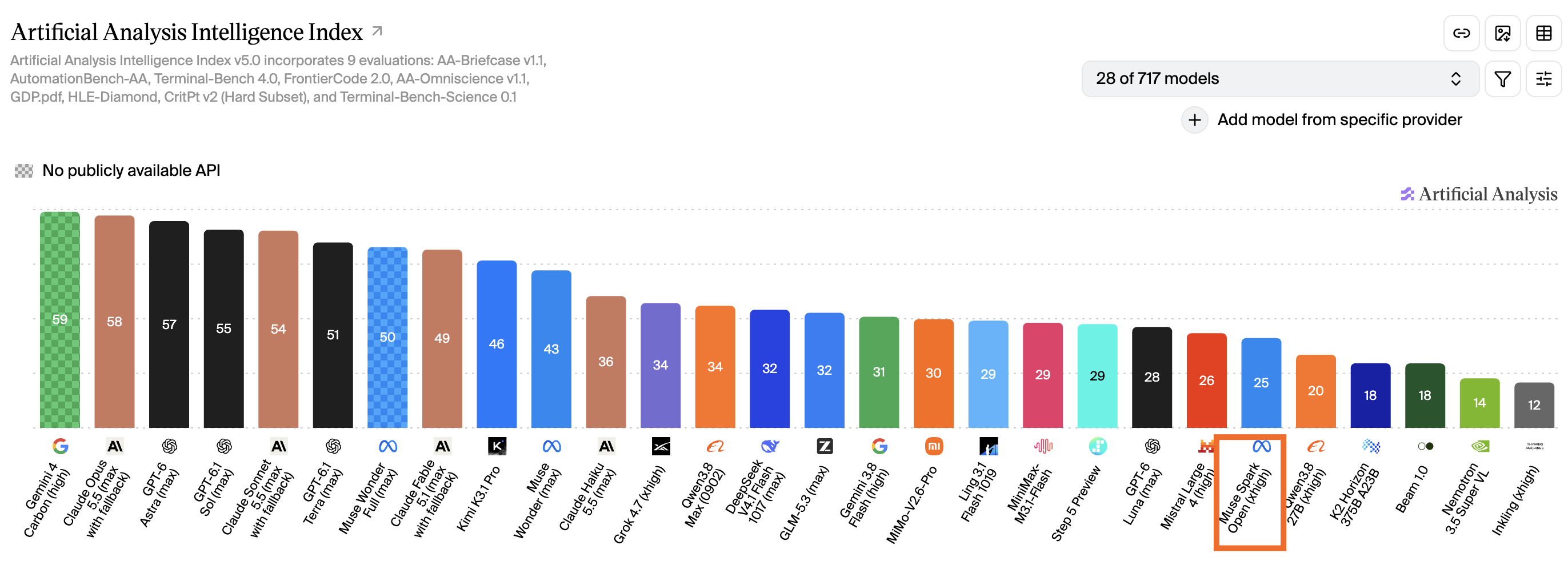
Muse Spark was a frontier model when it launched, and it’s still a capable one, but it’s no longer Meta’s best. On Artificial Analysis’s Intelligence Index, Spark trails Muse Wonder as well as the latest models from OpenAI, Google, and Anthropic. Where it still makes sense is price and speed: Spark is the lighter, cheaper option, at less than a third of Wonder’s API price.
Muse Spark was the first step on Meta’s scaling ladder and the first product of a ground-up overhaul of its AI program.
Muse Spark pricing
|
Where to get it |
API price per million tokens (input / output) |
|
|---|---|---|
|
Muse Spark 1.3 |
Meta AI, Muse, Muse Code, API |
$1.25 / $4.25 |
What is Muse Glimmer?
Muse Glimmer is an open-weight model from Meta Superintelligence Labs. It has 30 billion parameters and is designed to run AI agents locally. A Mac or PC with a powerful GPU is all that you need to get started: you can download it from Hugging Face right now.
Muse Glimmer is far from the most powerful AI model available, but then, it’s not meant to be. The whole point is that it is small enough to run on consumer hardware. When compared to similar models from the Gemma and Qwen families, for example, it performs well.
I’m glad that Meta hasn’t totally given up on open models, and I’m curious to see how Glimmer (and its successors) hold up over the next while.
What is Meta Muse?
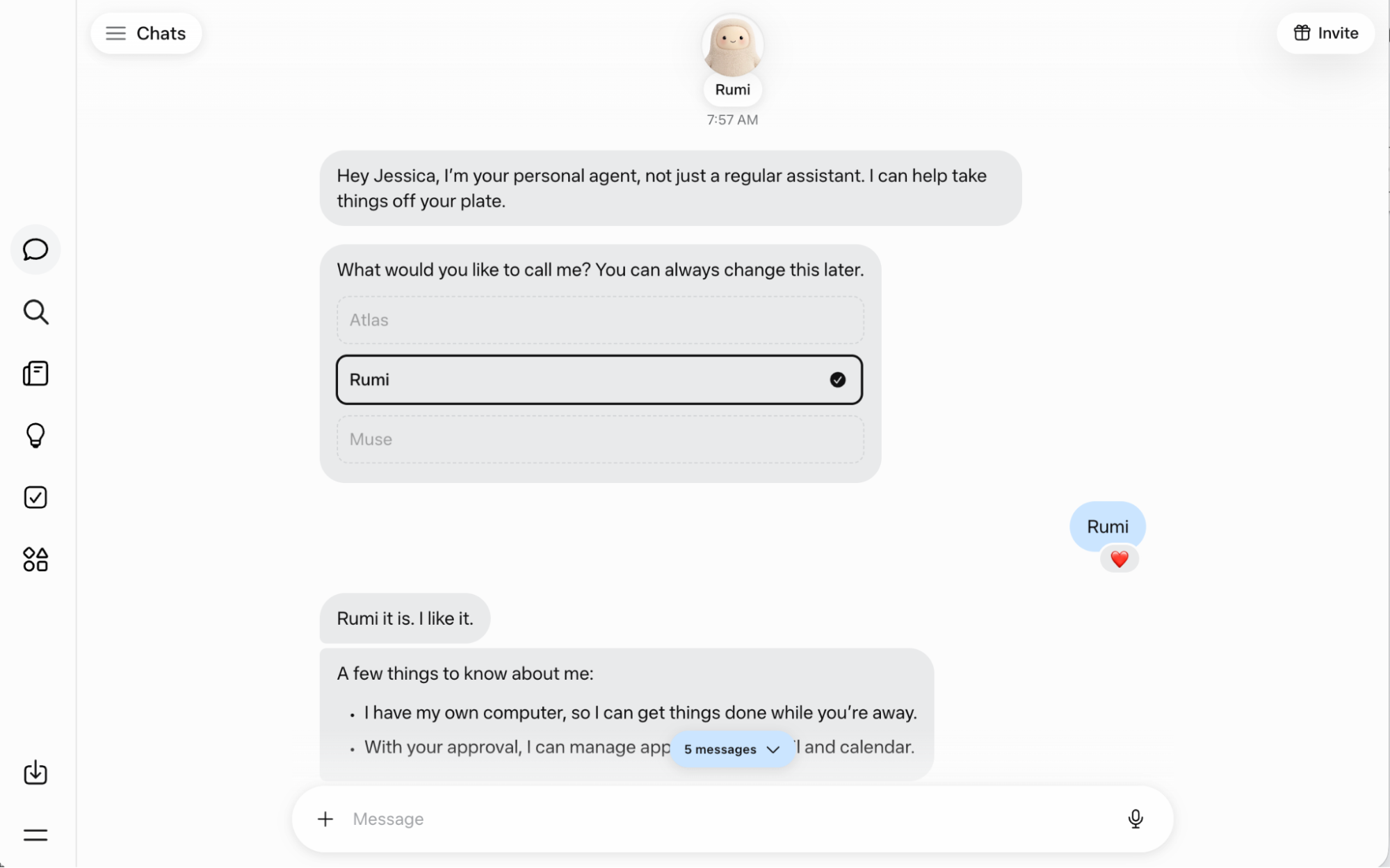
Muse (just Muse) is an agentic personal assistant app that uses the Muse Spark model. Mark Zuckerberg has talked about building “personal superintelligence,” and this seems like its first real step in that direction.
From an architecture standpoint, Muse is fascinating. While you talk to it in a chat window, every user actually gets their own virtual Linux cloud computer called Muse Secure VM. Your agent operates on it, but you can also step in and use it too. It’s configured so that the Muse agent can use your passwords and login credentials without seeing them (though there are still security concerns). It can browse the web, make purchases, and connect with third-party apps and tools. There’s a second agent, Sentinel, that’s meant to watch over every online action Muse takes to make sure it’s safe.
Since Muse is running on its own computer, it can keep working even when your phone is off. Use the Muse app to tell it to do something—like sell things on Facebook Marketplace or find a restaurant—and it will keep working until it’s done. It’ll check with you before certain actions like sending an email or making a purchase, but you don’t need to constantly watch it.
As you can imagine, with features like that, Muse has potential to cause chaos, especially as it currently tops the iOS and Android download charts.
What is Muse Code?
Agentic engineering has proven to be the killer AI feature for OpenAI and Anthropic, so Meta obviously wants in on the action. That’s why we have Muse Code. It’s a terminal-based coding agent available on macOS, Linux, and Windows that runs on Muse models.
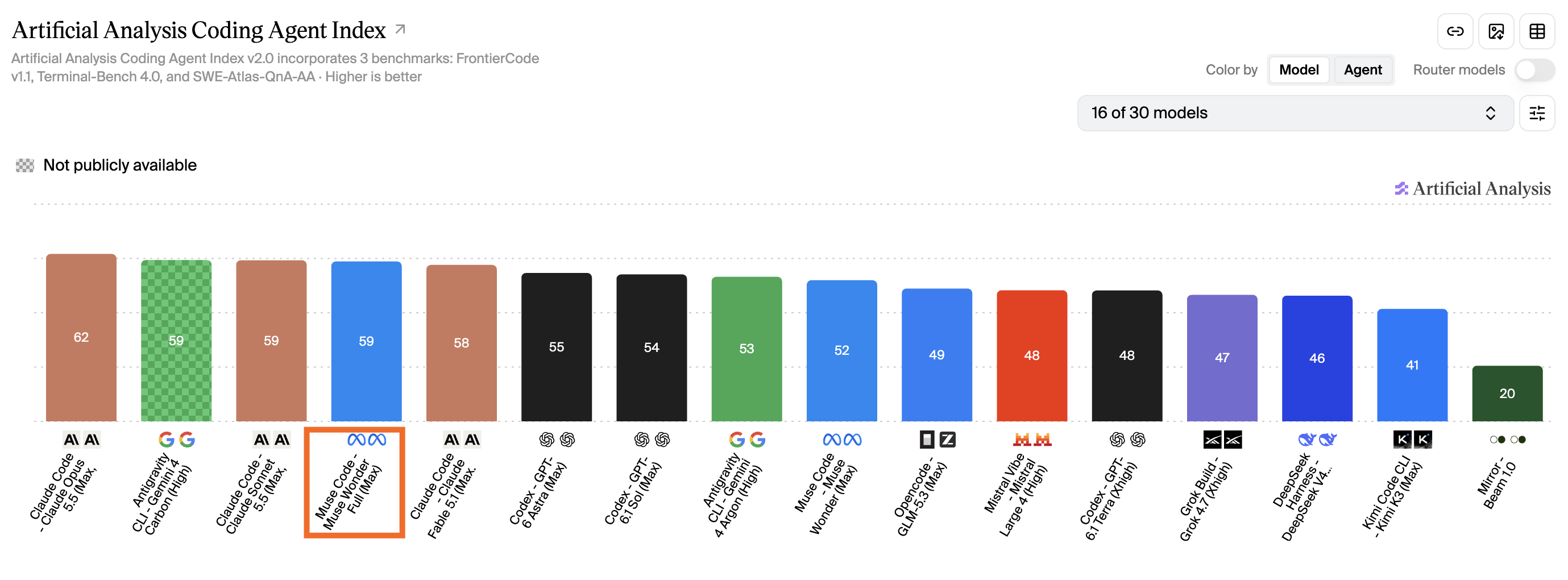
With Spark, Muse Code was respectable: not quite as strong as the top models, but comfortably in the same range as Grok, DeepSeek, Kimi, and cheaper models from OpenAI and Anthropic. Wonder changes that. On Artificial Analysis’s Coding Agents Index, Muse Code running Wonder Full ties Claude Code running Sonnet 5.5 and edges out Claude Code with Opus 5.5, while Muse Wonder lands a few points behind them and well ahead of Spark 1.3.
Meta’s models are also available as an API:
-
Muse Wonder costs $4 per million input tokens and $20 per million output tokens. Wonder Full isn’t available through the API.
-
Muse Spark 1.3 costs $1.25 per million input tokens and $4.25 per million output tokens.
-
Muse Spark 1.3 Contributor costs $0.10 per million input tokens and $0.20 per million output tokens. It’s the same model at more than a 90% discount if you let Meta train its models on your prompts and outputs.
How to try Muse Spark and Muse Wonder
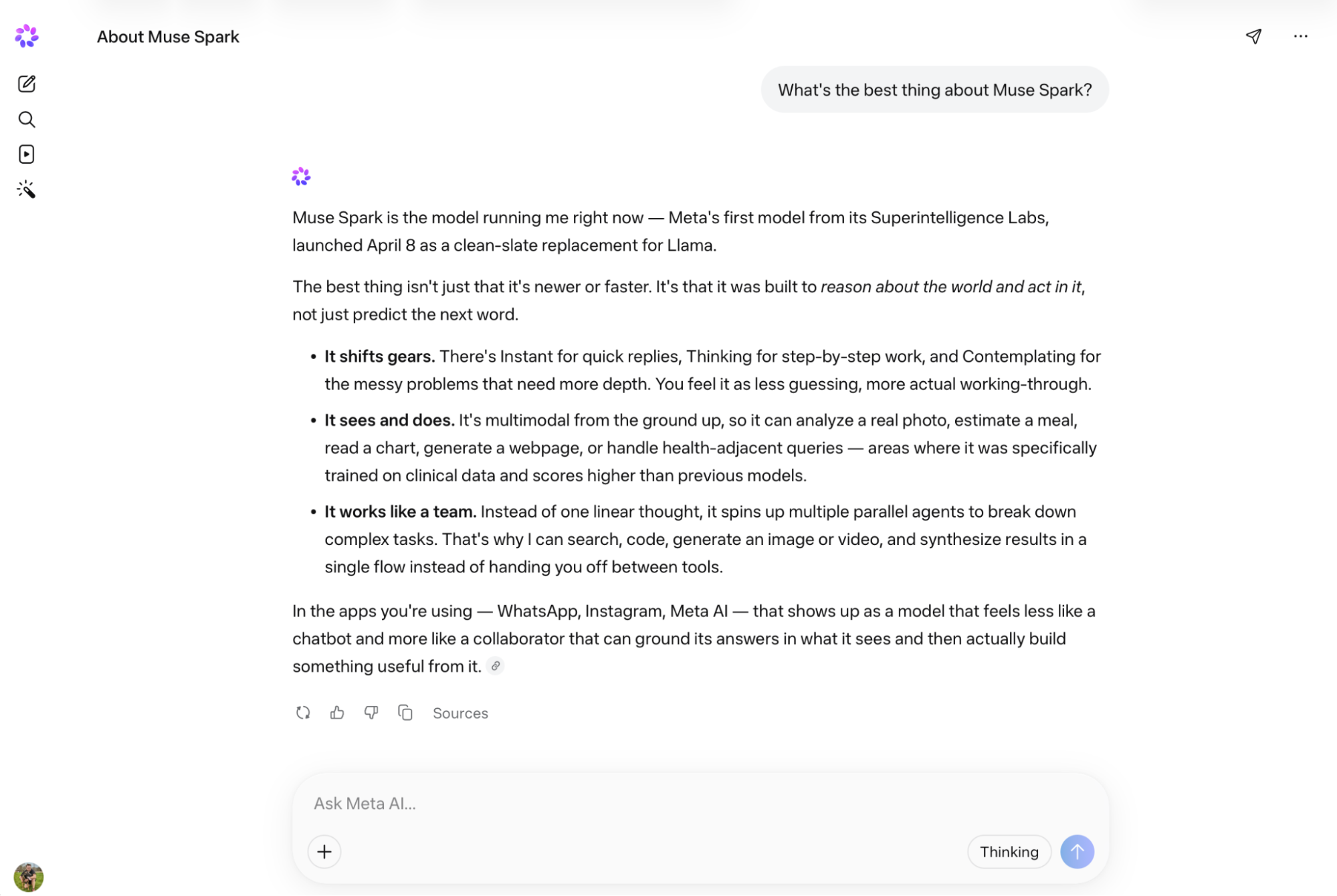
Meta AI, the AI assistant built into Facebook, Messenger, Instagram, and WhatsApp, now uses Muse Spark. The best place to check Spark out is the dedicated web app.
Muse Wonder takes a bit more effort, and a bit more money. It’s available through the Meta Model API and in Muse Code, while Wonder Full requires a Muse Code subscription on one of the higher-tier plans. Meta says Wonder is coming to the Muse app too. For developers, the API serves both Spark and Wonder.
You can also add Meta’s models to your workflows with Zapier. Build automations wherever you’re already working, whether that’s Muse or another AI assistant, and then let Muse Spark be the model doing the thinking inside it. Once it’s built, it runs on Zapier on a schedule or trigger, and can take action across 9,000+ apps. You decide what the AI can and can’t touch, and Zapier manages and governs your automations.
What happened to Llama?
In short, Llama was outcompeted by Chinese research labs like DeepSeek and Qwen. By the time Llama 4 shipped in April 2025, it was already trailing DeepSeek V3 and other top open models. The announced Behemoth and reasoning models that were meant to be competitive never shipped. Also, Llama 4’s benchmark performance was overstated as specifically tuned versions were used to inflate scores.
All told, Llama 4 never had the impact that Llama 3 did, and the AI landscape moves incredibly quickly.
By June 2025, Meta was reorganizing. They formed Meta Superintelligence Labs, hired talent from OpenAI, Anthropic, and Google with wild compensation packages, had a new Chief AI Officer, went through a round of layoffs, and otherwise fully restructured their approach to AI. It’s clear that, at this point, the company had decided that open source models were not its future.
Because they’re open, you can still download the various Llama models. They’re just out of date. Muse Glimmer is Meta’s latest open-weight model, and it competes directly with Google Gemma and OpenAI’s oss models.
What’s next for Meta?
Meta is still going through a massive AI shift. Muse Wonder, Muse Spark, Muse Glimmer, Muse, and Muse Code are the early results from Meta Superintelligence Labs and the pivot to Personal Superintelligence, and Wonder arriving only six weeks after Spark 1.3 suggests the pace isn’t slowing. Meta has also said it will use Wonder to develop specialized models for everyone using Muse. It’s unclear how many more models there will be in the family, whether Wonder will reach Muse’s free tier, and whether Muse Charm will finally bring voice-controlled AI devices to the masses.
Personally, it looks to me like Meta has made up much of the time it lost in this transition period. Over the past year, AI agents and particularly AI coding agents have become increasingly important. They’re what justify enterprise and high-value AI subscriptions. I wouldn’t be surprised if Meta ends up doubling down on being the personal AI embedded in the apps you use—which is exactly what Wonder’s Active Memory and Active Focus are aimed at—rather than another developer tool.
Either way, Meta is no longer a pioneering open source AI lab. It’s another large tech company duking it out with its proprietary models.
Related reading:
This article was originally published in August 2023. The most recent update was in October 2026.