Category: Business and Making Money

Complimentary Sponsor Content Webinar and Summary Report

Customer service is undergoing a profound transformation, driven by agentic AI. As consumers use AI in various aspects of their lives and have positive experiences, they become increasingly open to having AI agents perform tasks on their behalf, including as part of customer service.

For companies, the stakes to get agentic AI right are high. Negative experiences will devalue brands and hurt companies, while positive experiences can strengthen relationships and build.

Click here to watch the webinar and download the summary report.


Michael Zagorsek, Chief Operating Officer at SoundHound AI

  • What Is Customer Data Actually Telling You?

    What Is Customer Data Actually Telling You?

    October 13, 2026

    Juan Moyano/Stocksy

    Summary.   

    In this week’s Insider newsletter, managing editor Gretchen Gavett shares new articles on understanding what your customers really value and how to have more productive conflict on your

    The Insider is a weekly, subscriber-only newsletter, where our managing editor curates HBR stories, research, and ideas that senior leaders shouldn’t miss.

    Read more on Sales and marketing or related topics Customer experience, Consumer behavior, Collaboration and teams and Meeting management

  • What Sets Great Strategists Apart in the AI Era

    What Sets Great Strategists Apart in the AI Era

    Harvard Business Review Logo

    Illustration by Nathan St. John

    As AI gives competitors access to similar analytical tools and data, distinctive strategies will increasingly depend on “sticky knowledge”—insights that

    Competitive strategy is about being different. Michael Porter taught us that three decades ago, and the principle has not changed. What has changed is that AI is making that imperative harder to fulfill. Every competitor is now equipped with the same AI-powered analytics, the same strategic frameworks, the same scenario-modeling capabilities, and the same vast pools of market and competitive data. So they reach similar conclusions, make similar moves, and whatever advantage they identify evaporates quickly. Excellent analysis, available to everyone, is no longer a crucial source of competitive advantage.

  • Restructuring Mobile Game Giant Supercell for a Turnaround

    Restructuring Mobile Game Giant Supercell for a Turnaround

    October 13, 2026

    Founded in 2010, Supercell was a Finland-based mobile gaming company that had developed and launched five global hit mobile games: Clash of Clans, Clash Royale, Hay Day, Brawl Stars, and Boom Beach. The company’s early philosophy was that it could produce hits by designing the company with a structure and culture that would prove compelling to the industry’s top talent. Developers worked in small, autonomous groups called cells with little oversight. The formula was a success. Supercell had nearly $2 billion in annual revenues, and Clash of Clans alone had generated gross revenues of over $10 billion since inception. However, the company had not released a hit game in five years.

    In 2023, CEO Ilkka Paananen and the company’s leadership team decided to restructure the company into two divisions—New Games and Live Games. The New Game cells would retain the small team structures, which were largely flat and non-hierarchical, but the Live Game cells would add more traditional structure and hierarchy to exploit franchise hits. Now, Paananen wondered if Supercell could continue to attract top talent despite its shift to more traditional ways of managing the business.

    Senior Lecturer Jeffrey Rayport and host Brian Kenny discuss the case, “Supercell 2.0: Clash of Plans,” and the question at its crux: What would it take to restore the company’s winning streak?

  • Why Great Teams Don’t Need to Like Each Other

    Why Great Teams Don’t Need to Like Each Other

    October 13, 2026

    What makes a great team? It might have less to do with whether colleagues like one another and more to do with whether they’re aligned on a shared purpose. Organizational psychologist and Wharton professor Adam Grant says leaders can build stronger connections at work, foster productive conflict, and create cultures where people feel empowered to speak up. He explains why task cohesion matters more than social cohesion, how to turn differences into a competitive advantage, and why leaders should reward people who challenge the status quo; and also shares practical ways to rethink onboarding, encourage candid feedback, and help employees connect their work to a meaningful mission. Grant is the author of the new book Vibe: The Secrets of Strong Connection in a Lonely World.

  • How to use PowerPoint: A beginner’s guide

    How to use PowerPoint: A beginner’s guide

    By Jessica Lau · October 13, 2026

    Hero image with the PowerPoint logo

    My toxic trait is forcing my friends and family into having PowerPoint parties—which are really just an excuse for me to do a full-blown slideshow on why Samwise Gamgee is the best character in the Lord of the Rings trilogy. If you haven’t been roped into a PowerPoint party yet, trust me, it’s around the corner. 

    I can’t come up with a topic for you, but I can definitely help you with the whole creating a PowerPoint part. Even if you just need to use PowerPoint for work (which, while much less fun, is probably more likely), here’s everything you need to know about how to use PowerPoint.

    Table of contents:

    What is PowerPoint?

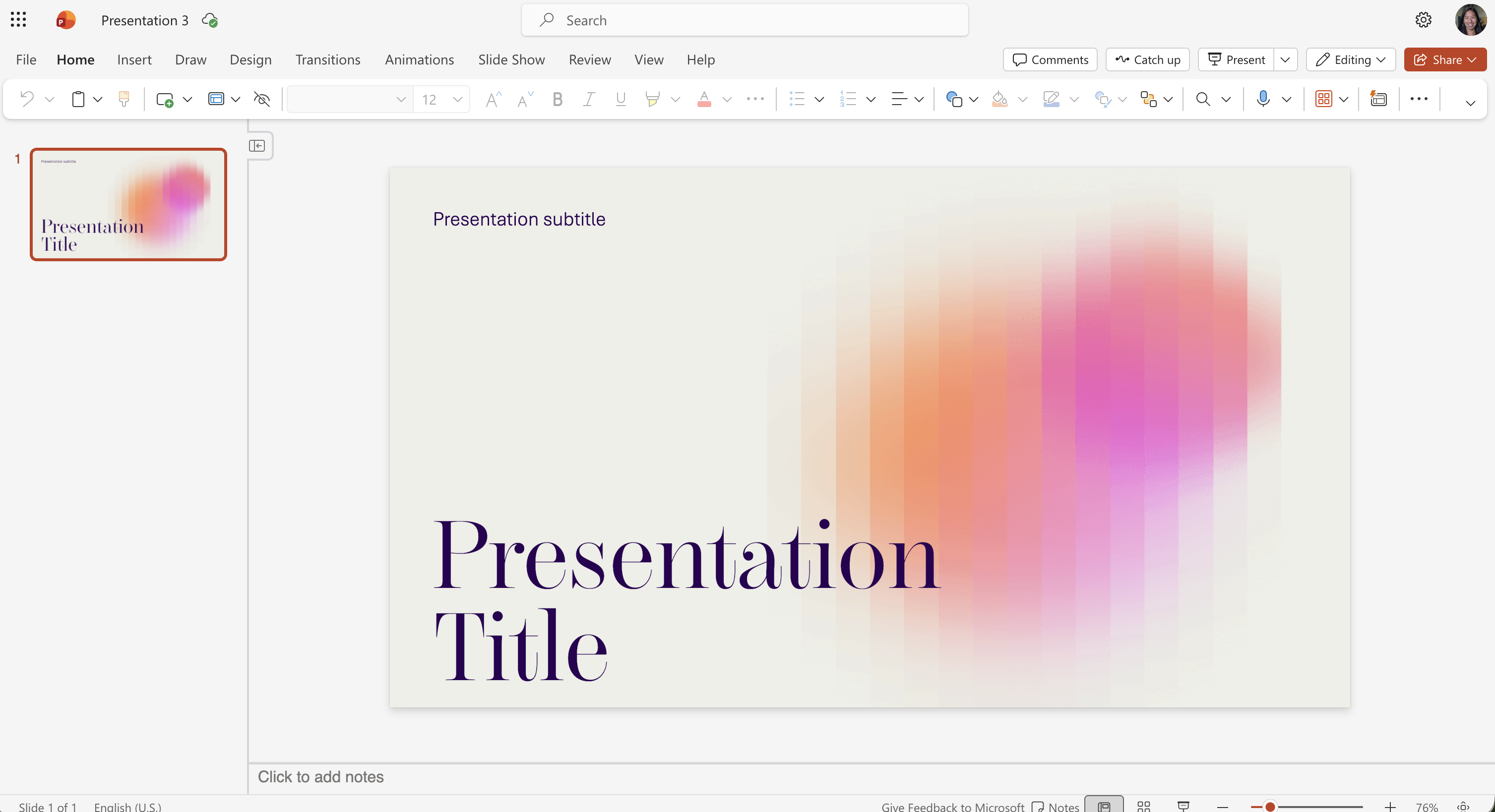
    Microsoft PowerPoint is a popular presentation app that lets users create slides from a template or from scratch, adding images, videos, transitions, and animations. 

    PowerPoint presentation editor.

    And we are firmly in the let-the-robots-handle-it era, so yes—you can use Microsoft’s built-in AI assistant, Copilot, to create and edit the presentation for you. 

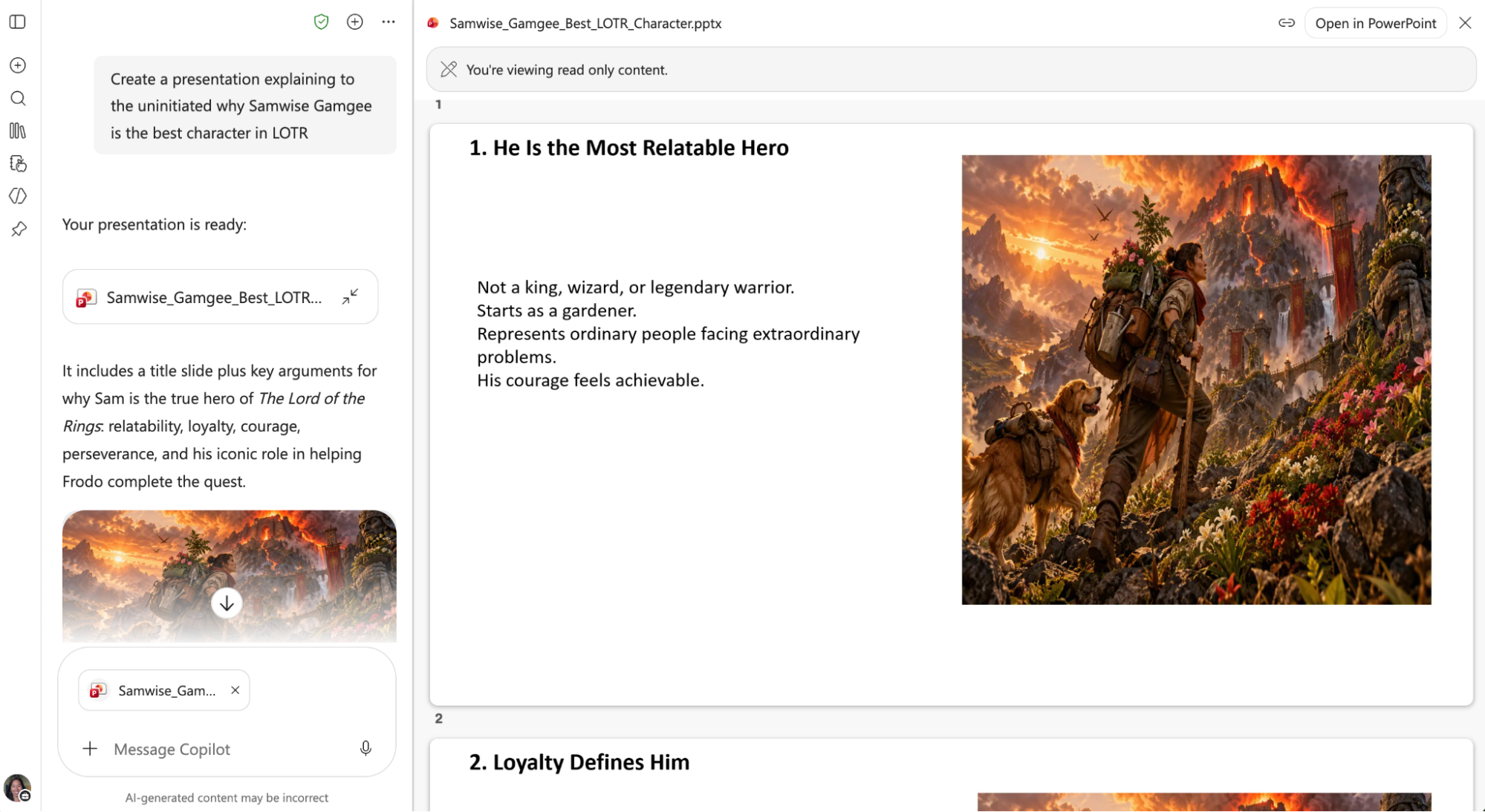
    Fair warning: If you’re creating an image-heavy presentation with images of real people, characters, or places, you’re better off inserting those manually. Copilot’s still got some accuracy work to do in that area (maybe a good thing given copyright issues). My AI-generated Samwise came out as a woman on a nature walk with her golden retriever, which is the type of creative license that would bring the wrath of the Tolkien estate down on me faster than I could say “second breakfast.”

    Side-by-side view of a Copilot chat and an AI-generated slideshow.

    How much is PowerPoint?

    If you have a paid Microsoft 365 subscription or you’ve bought a one-time version like PowerPoint 2024, you can use the desktop app. But anyone can use PowerPoint for the web (formerly “PowerPoint Online”)—which has a few key differences—for free.

    What is PowerPoint used for?

    PowerPoint can be used for anything from traditional meeting presentations to school reports and recreational nerd-outs (see: PowerPoint parties).

    Here are a handful of ways you can use PowerPoint:

    • Giving slide presentations

    • Creating basic animations and infographics

    • Creating digital portfolios

    • Displaying looping information on monitors or kiosks

    How to use PowerPoint

    If you’ve ever used other Microsoft tools like Word or Excel, PowerPoint’s layout will feel familiar. It includes several tabs across the top of your screen, each offering plenty of ways to add, edit, and collaborate on content with your team. 

    Once you create a new PowerPoint, there are all sorts of ways to add and edit content. Feel free to jump around if you just need a refresher on how to use certain tools, or keep scrolling for a step-by-step guide.  

    How to create a PowerPoint

    First, log in to Microsoft 365 or Copilot—they’ll take you to the same starting point. It’ll automatically open a new Copilot chat window. From there, you have a few options:  

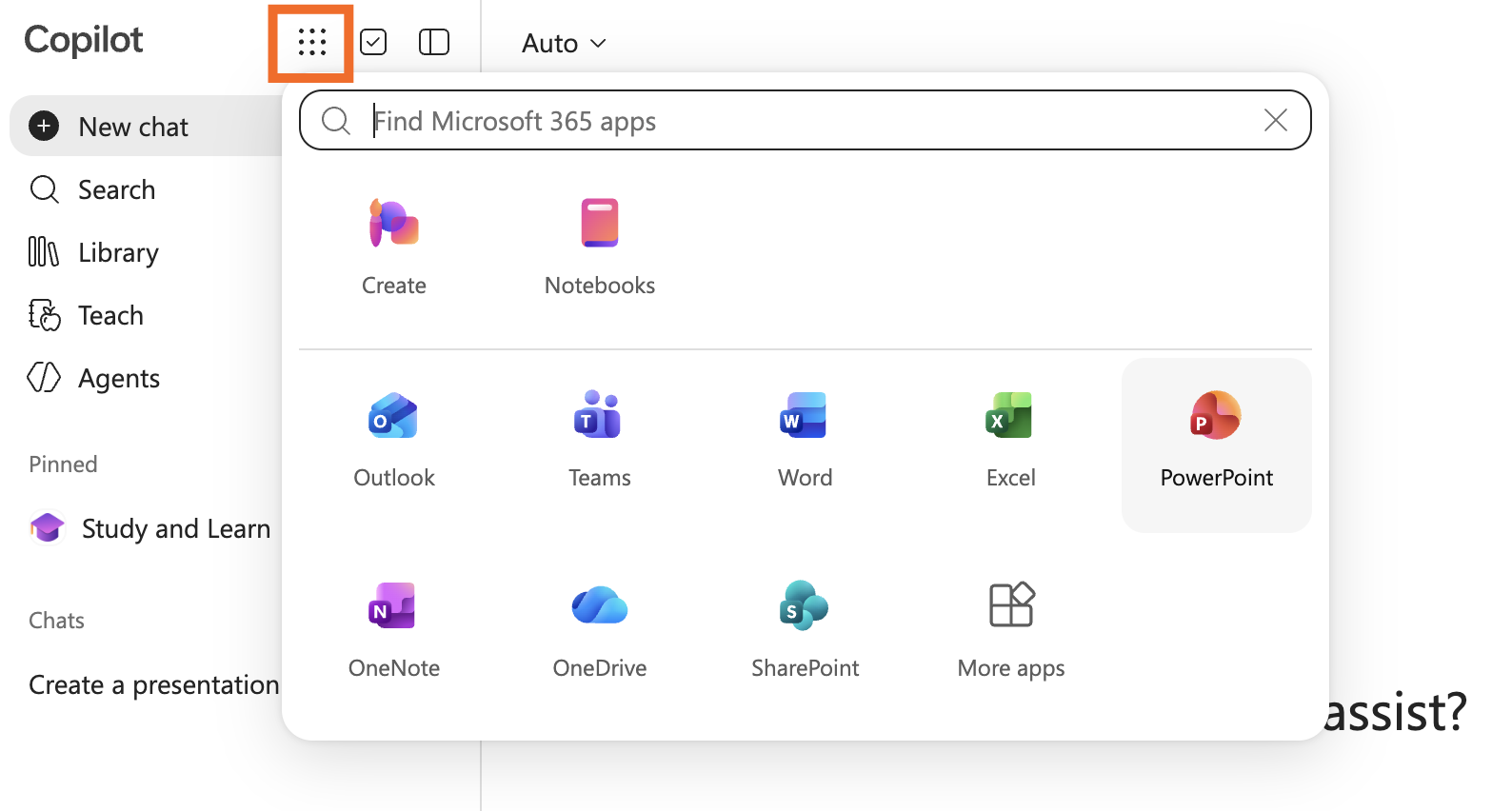
    • Build manually from Copilot. In the side panel, click Apps and more (it looks like a 3×3 dot grid), and select PowerPoint.

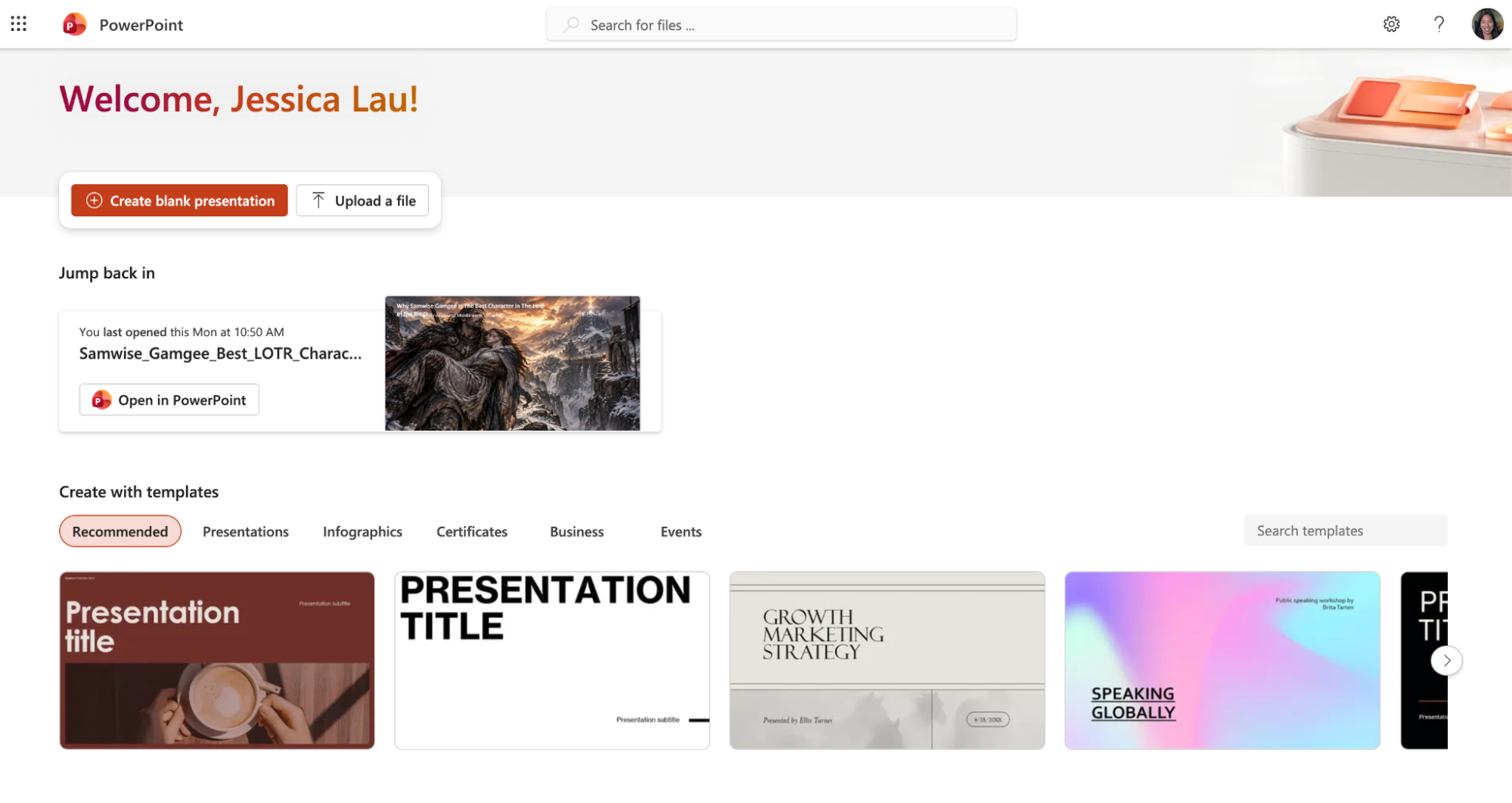
      Then click Create blank presentation or select one of the premade templates to jumpstart your build.

      PowerPoint for the web homepage with options to create a blank presentation or to create one from a template.
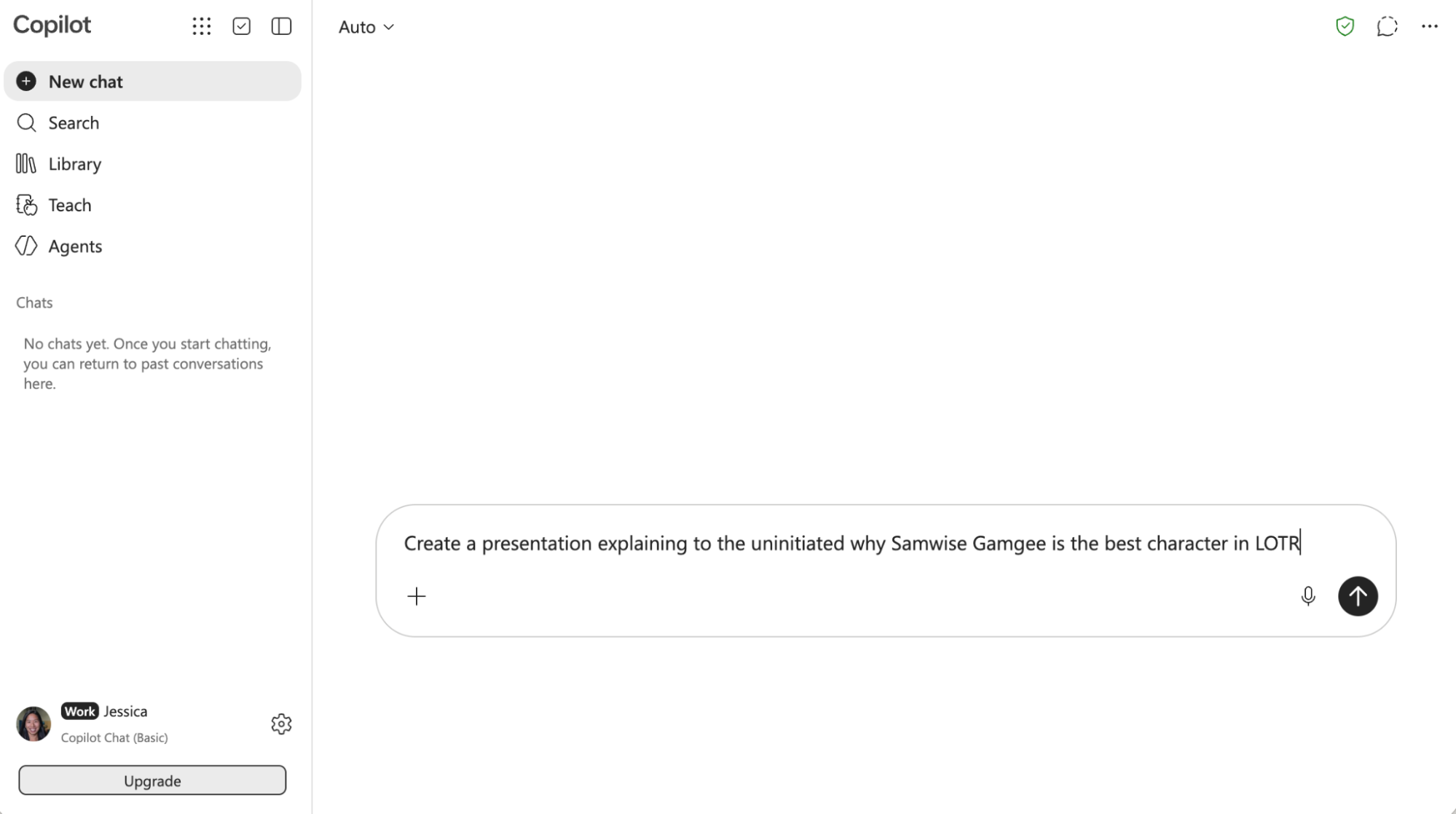
    • Use Copilot to create a deck. In the prompt box, describe the presentation you want to build (even just the topic will do) and let Copilot take care of the rest.

      Copilot conversation with a prompt to create a presentation about why Samwise Gamgee is the best character in the lord of the rings.

    Alternatively, you can go directly to PowerPoint for the web—it’ll save you a click or two. The remaining steps for editing your presentation are the same.

    How to add a slide in PowerPoint

    There are two ways to add a slide in PowerPoint: 

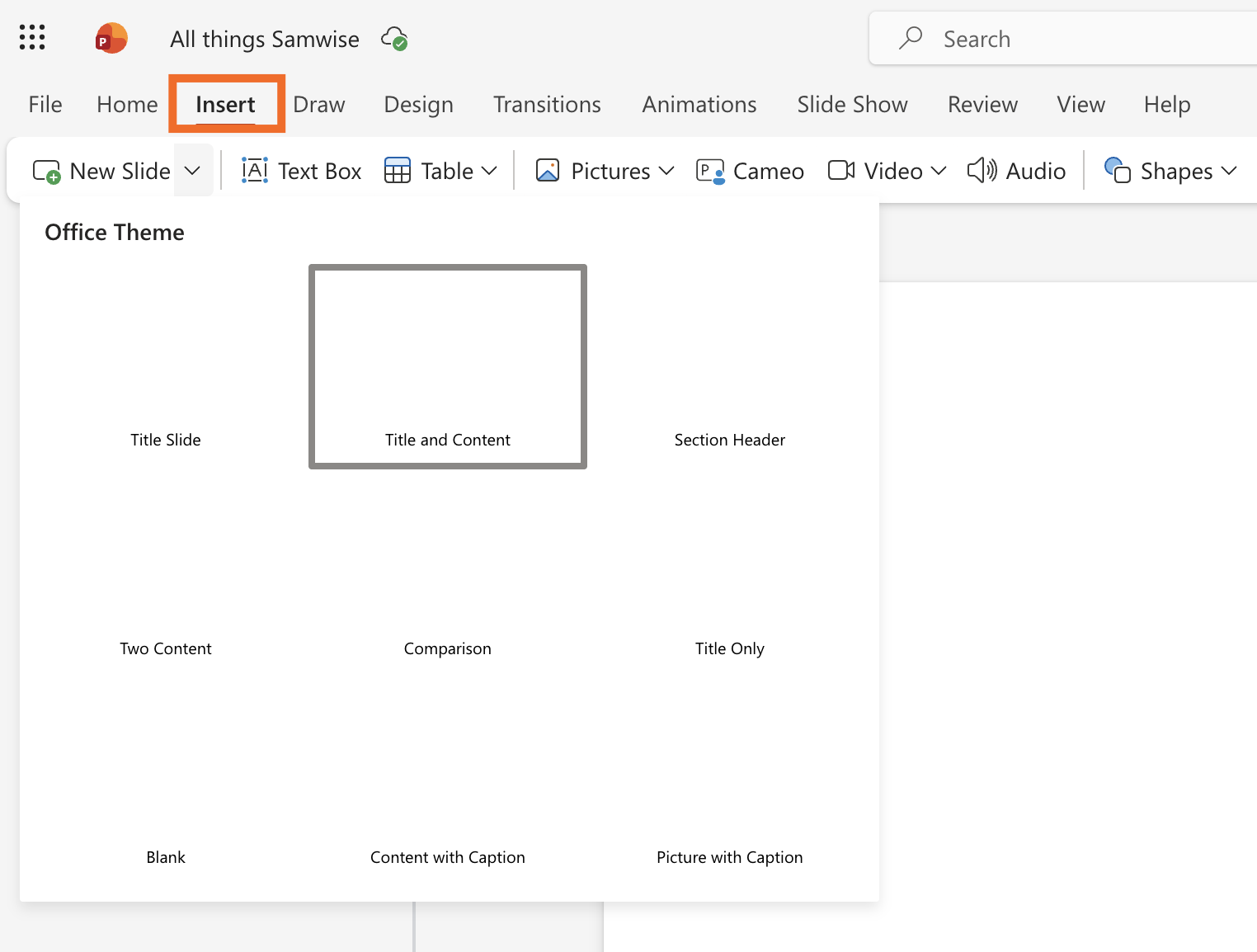
    • From the ribbon. Click Insert, and select New Slide to add a blank slide or click the down caret (⋁) next to it and select a slide style.

      Expanded view of the insert new slide dropdown in PowerPoint.
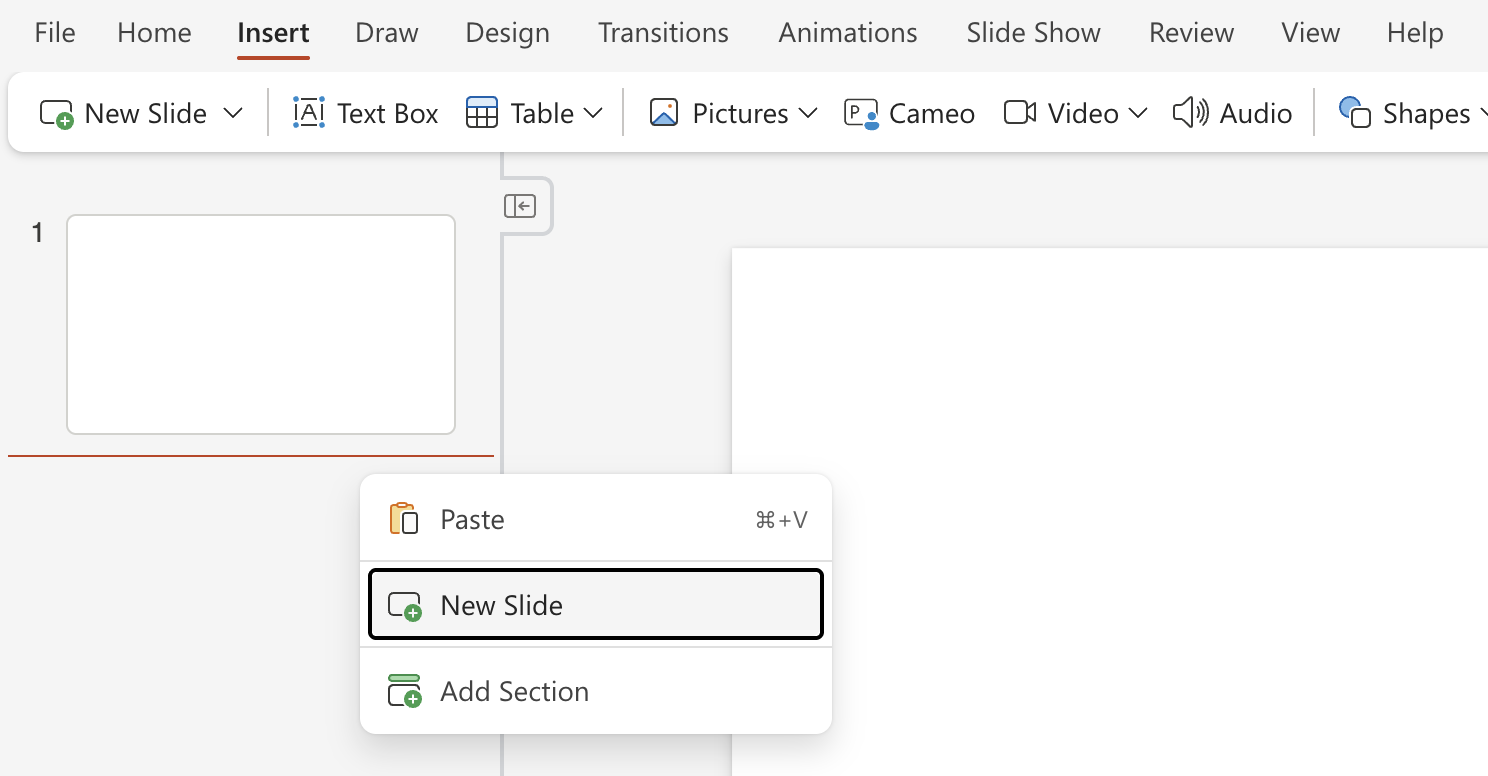
    • From the side panel. Right-click anywhere in the side panel, and select New Slide.

      Right-click menu in PowerPoint with the option to insert a new slide highlighted.

    How to add a text box in PowerPoint

    Once you’ve added slides, it’s time to fill them with content. Here’s how to add text to your slides (the process is similar for adding images, videos, and other art). 

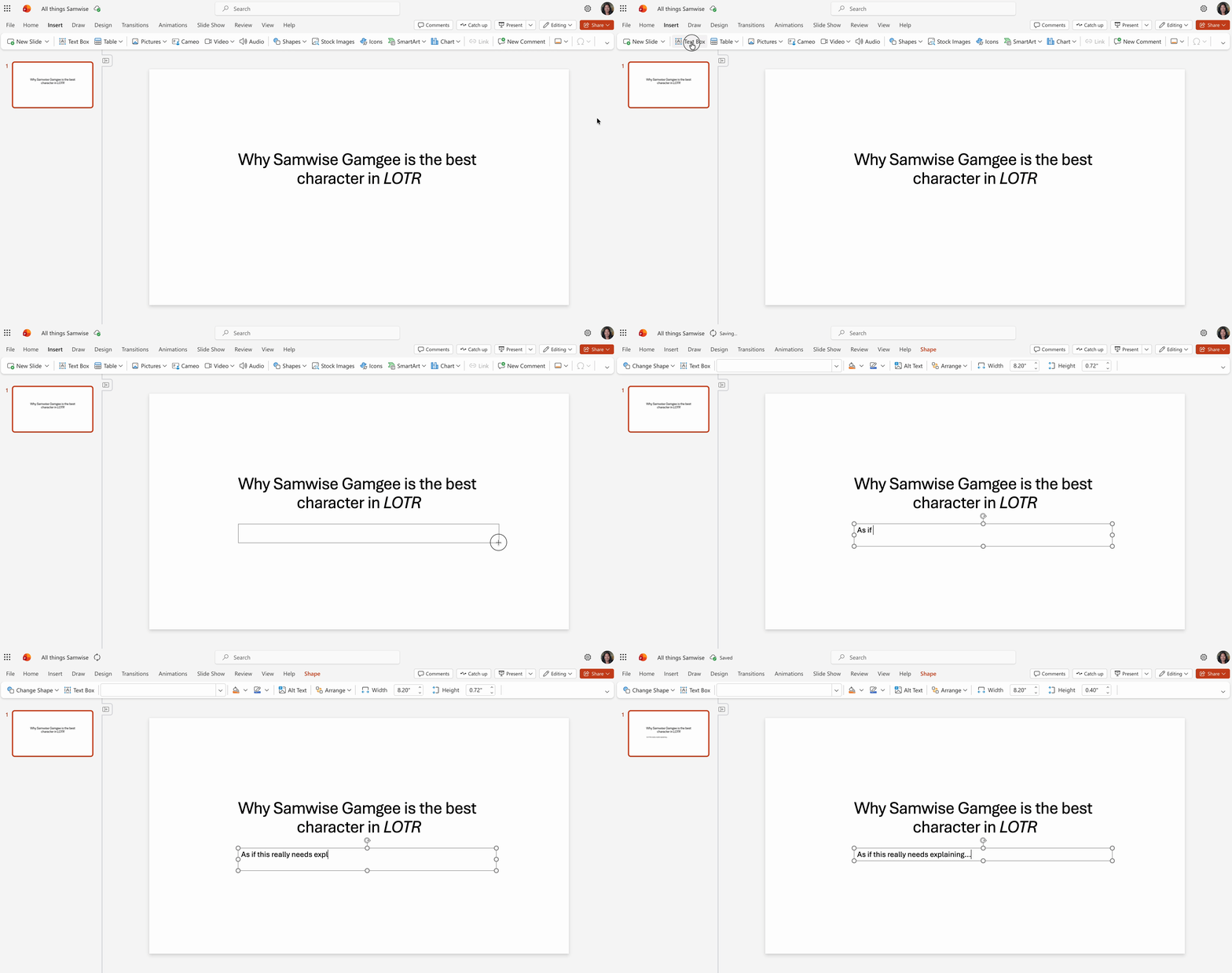
    1. Click Insert in the ribbon, and select Text Box. 

    2. Click anywhere on your slide and drag to create a text box (the exact dimensions don’t matter since you can adjust them after). 

      Demo of how to add a text box in PowerPoint.

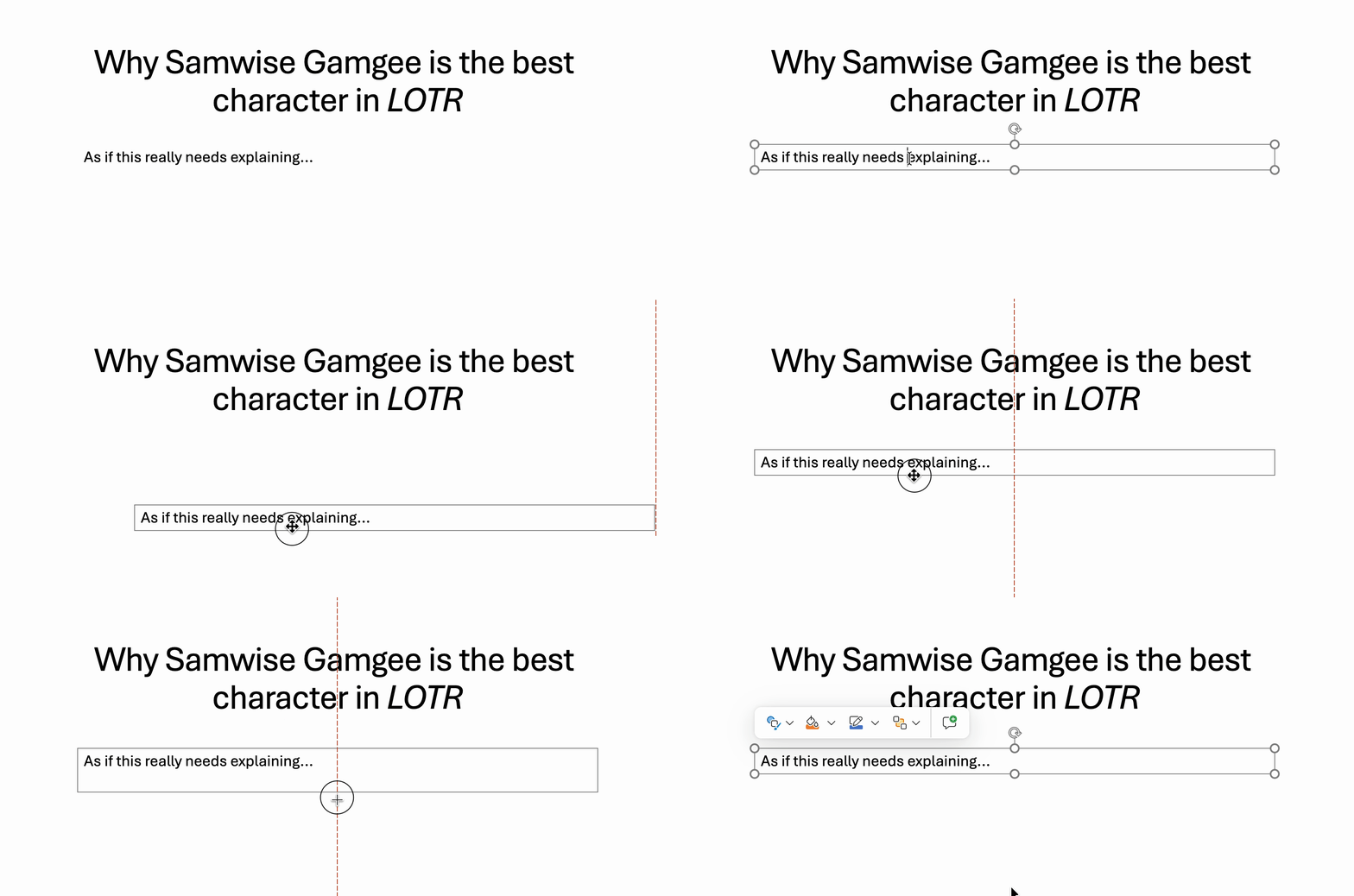
    To reposition the text box, click it and hover over any of the borders. Once your cursor turns into a four-way arrow, drag and drop the box wherever you want it.

    Demo of how to reposition and resize a text box in PowerPoint.

    You can also technically adjust the size of the text box. Click the text, and then drag and expand any of the dots along its border. It works fine for expanding the width of your box, but if you try to expand the height, PowerPoint automatically readjusts the box to fit the height of the existing text. So if your text runs across only one line, the box bounces back to be tall enough for that one line (as shown in the demo above). If it runs across two, it’ll automatically expand to fit the height of two lines. 

    How to add transitions in PowerPoint

    Why stick with a simple click from one slide to the next when you can razzle dazzle your audience with a gust of wind blowing in your slides? Or perhaps a literal pulling-back-the-curtains-type reveal? 

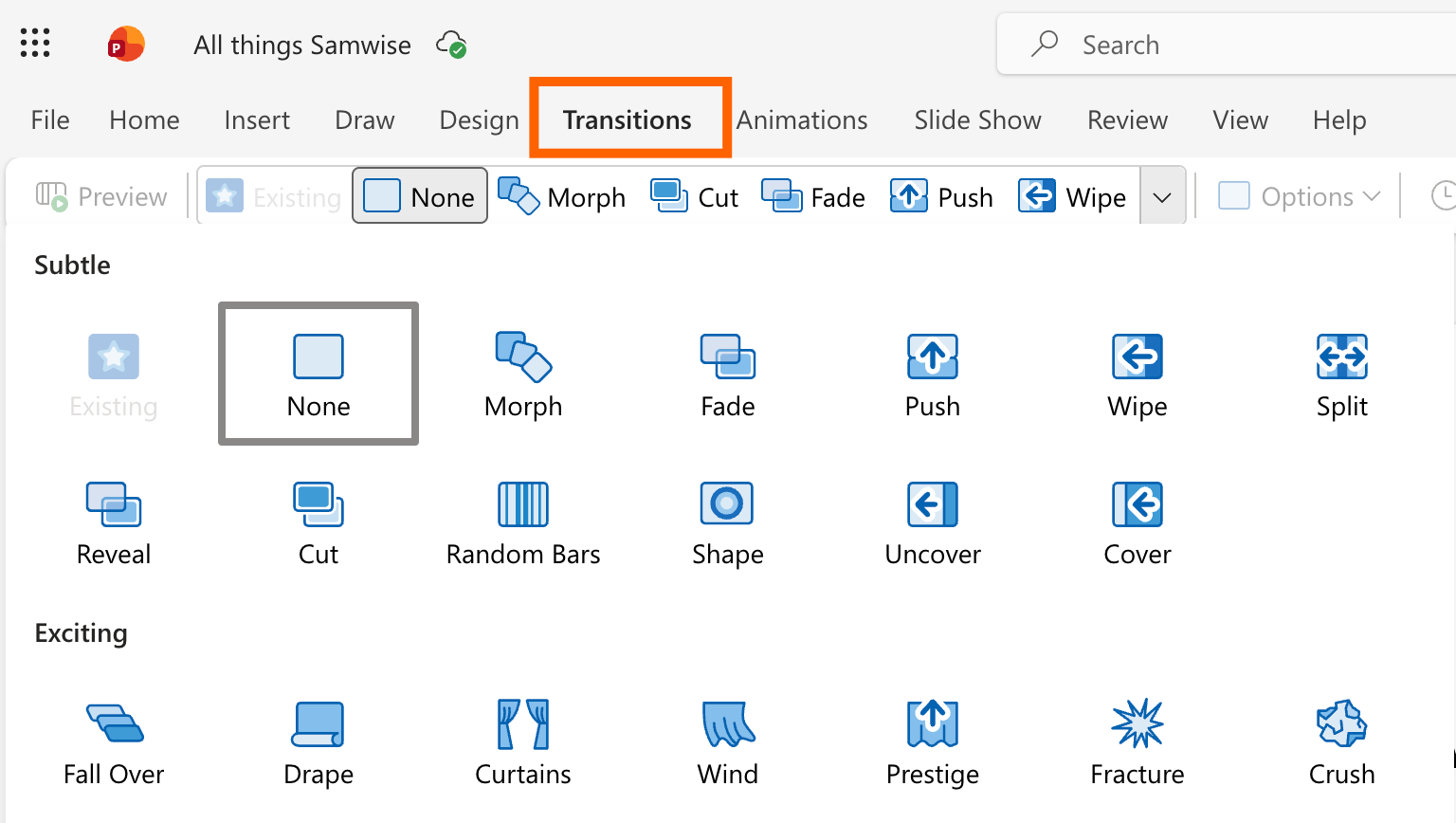
    1. Click the slide you want to modify the transition on, and select Transitions in the ribbon. 

    2. Choose any transition. You can also click the dropdown next to the transition icons for some more exciting options (as deemed by PowerPoint). 

      Expanded view of transition effects in PowerPoint.
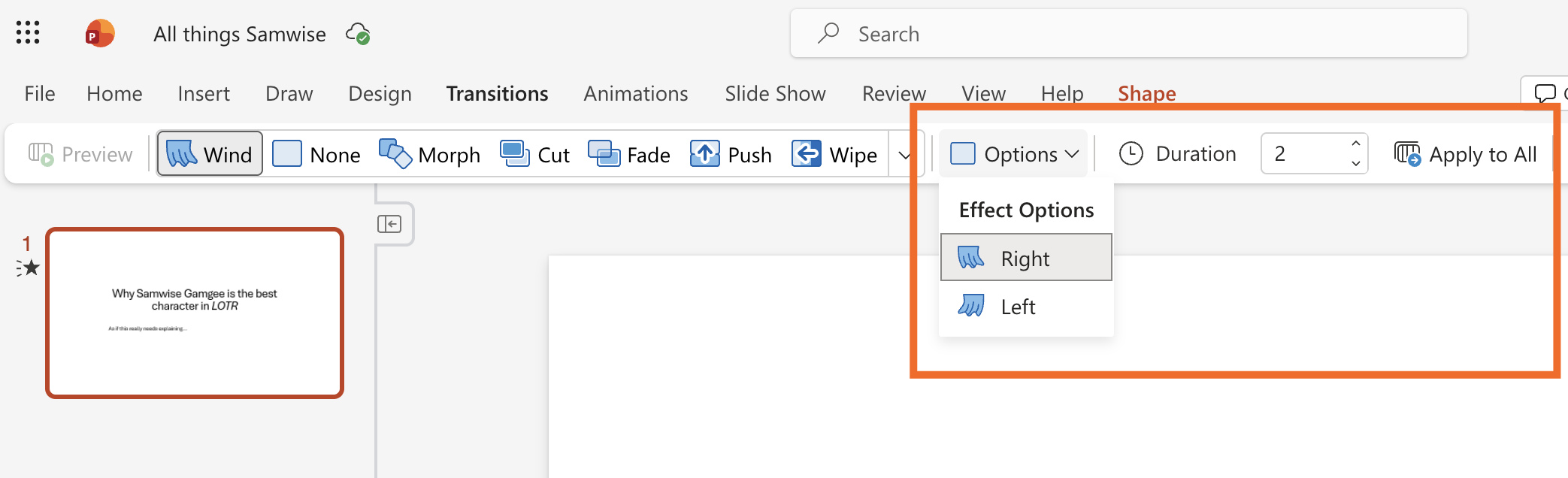
    3. Select the duration of the transition (how long it takes to go from one slide to the next). Depending on your transition, you may be able to modify other elements—for example, Wind lets you choose which direction the slide blows in/out from. 

    4. Optionally, click Apply to all to use the same transition settings for all your slides.

      Transitions ribbon in PowerPoint with options to modify transition settings highlighted.

    Changed your mind and want to return to the simple life? Click Transitions, and select None. 

    How to add animations in PowerPoint

    If you want to add even more pizzazz to your slides, animate your slide content. That includes text boxes, images, charts, or anything else on your slide.

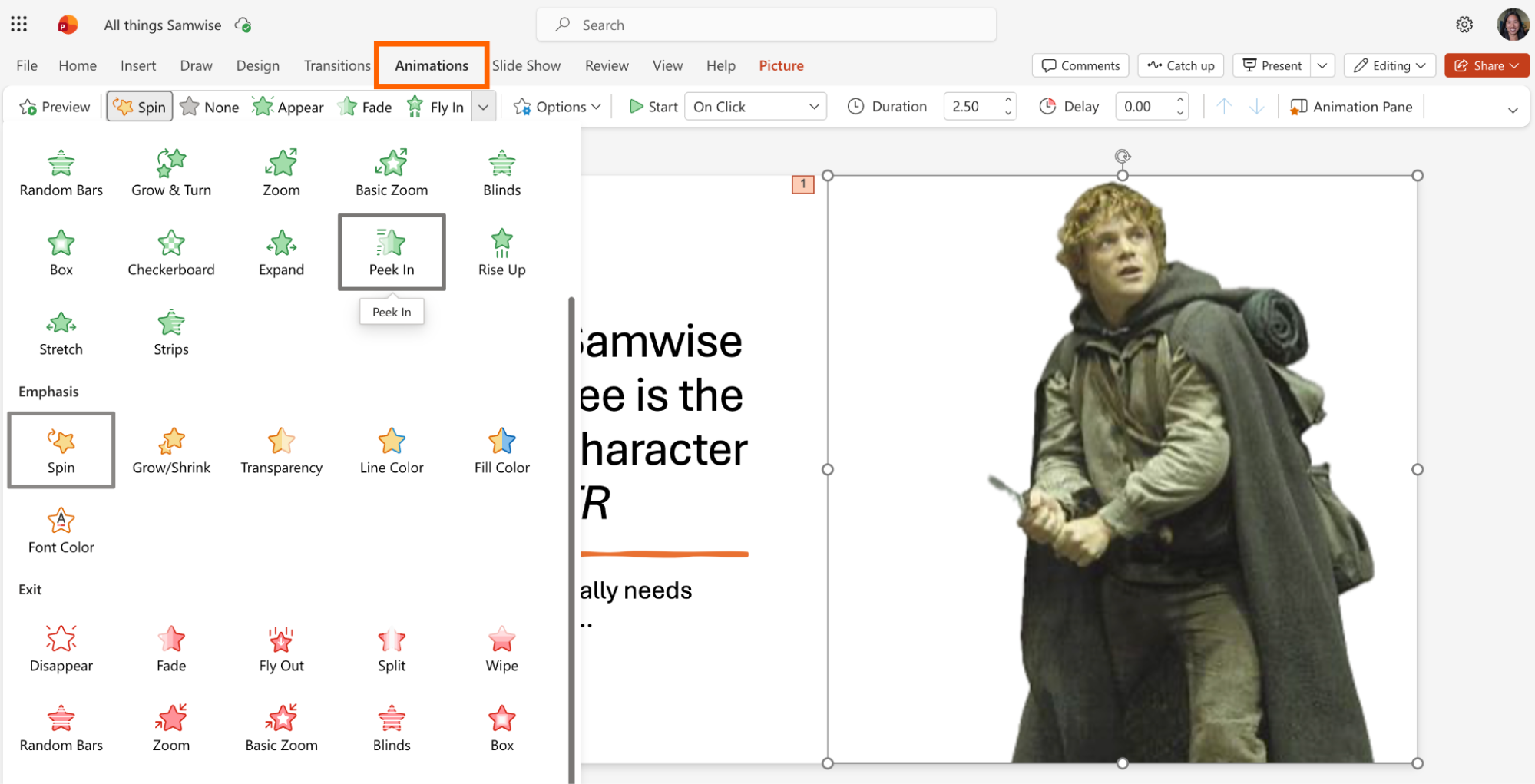
    1. Select the slide element that you want to animate. 

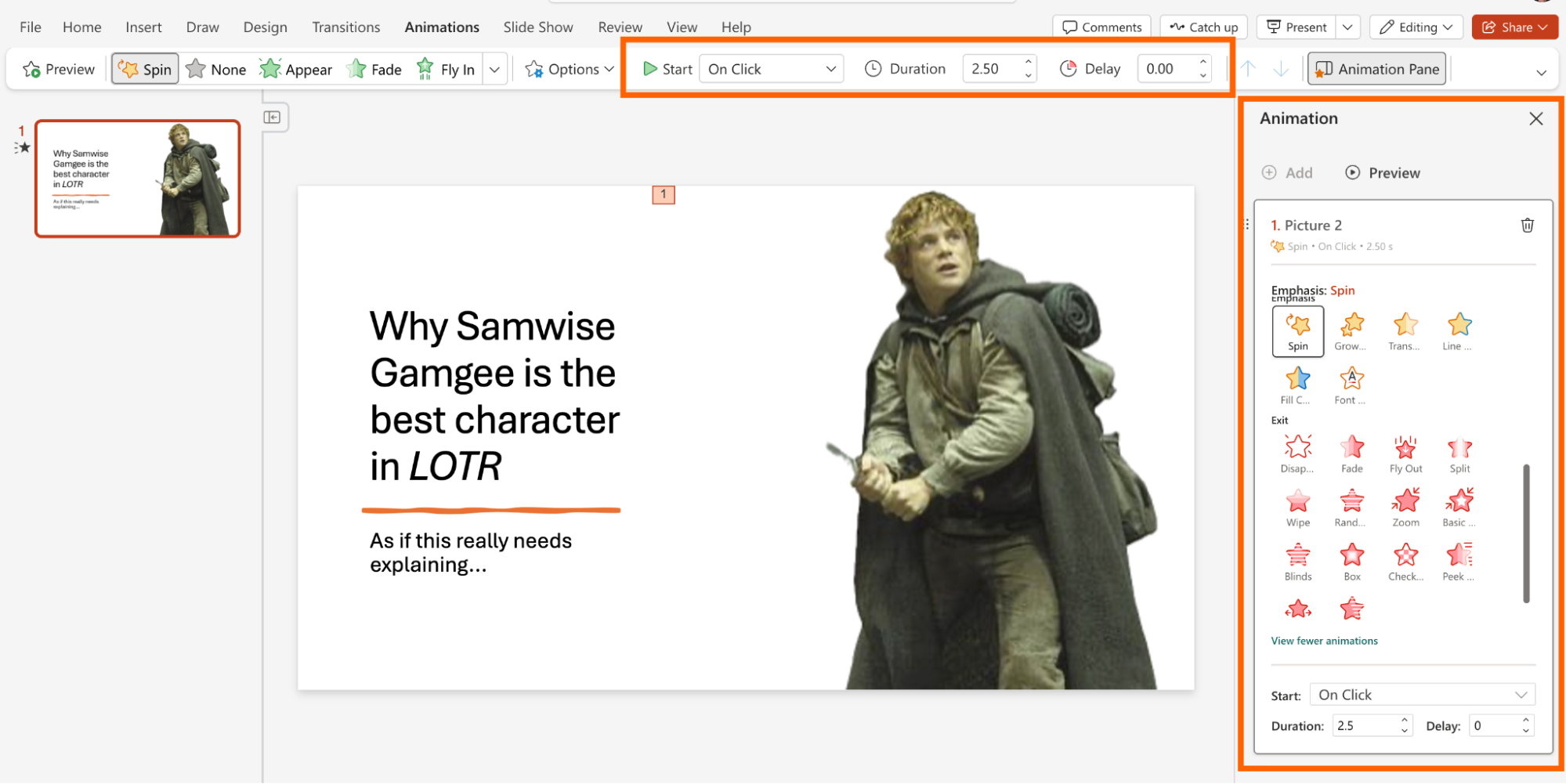
    2. Click Animations in the ribbon, and choose your effect (click the dropdown for more options).

      Expanded view of animations in PowerPoint.
    3. In the ribbon or the Animation pane that appears, you can modify when the animation plays (automatically or on click) and for how long. 

      PowerPoint editor with the animations ribbon and pane highlighted.

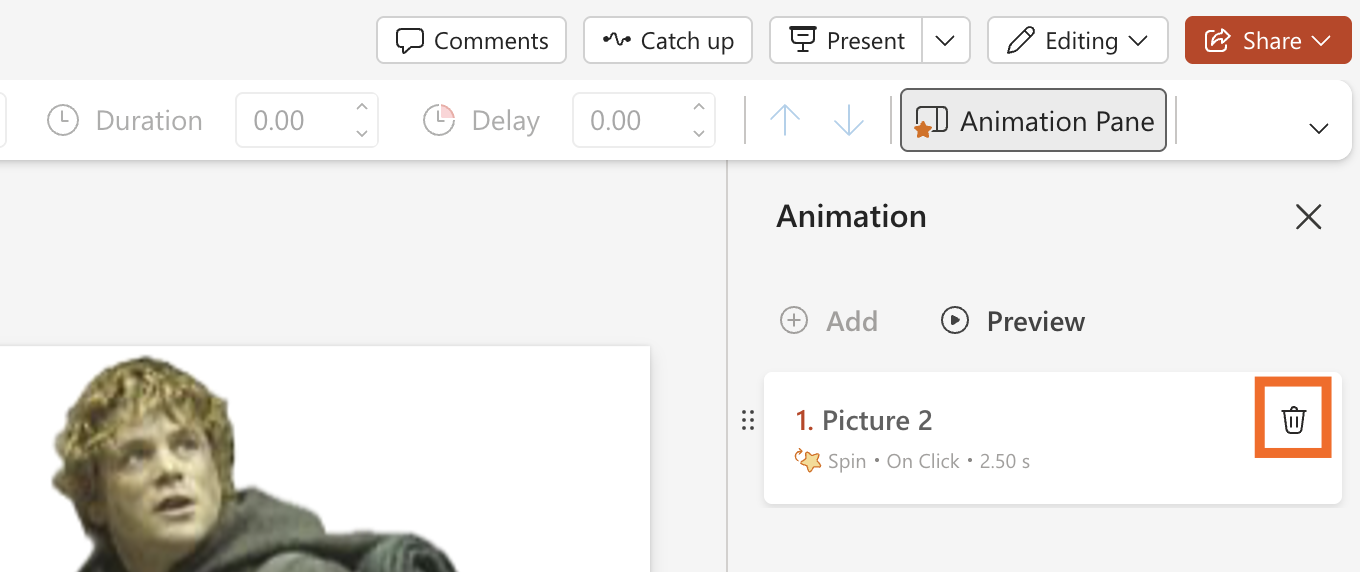
    To delete an animation, select the animated element. In the Animation pane, click the garbage can next to your selected element. 

    Portion of the PowerPoint editor with an expanded view of the animation pane. The garbage can icon is highlighted next to an animation effect.

    How to add presenter notes in PowerPoint

    The best slides are simple and uncluttered—but if you’re giving a presentation, odds are good that you need more in-depth notes than the few bullet points on the screen. That’s where presenter notes come in.

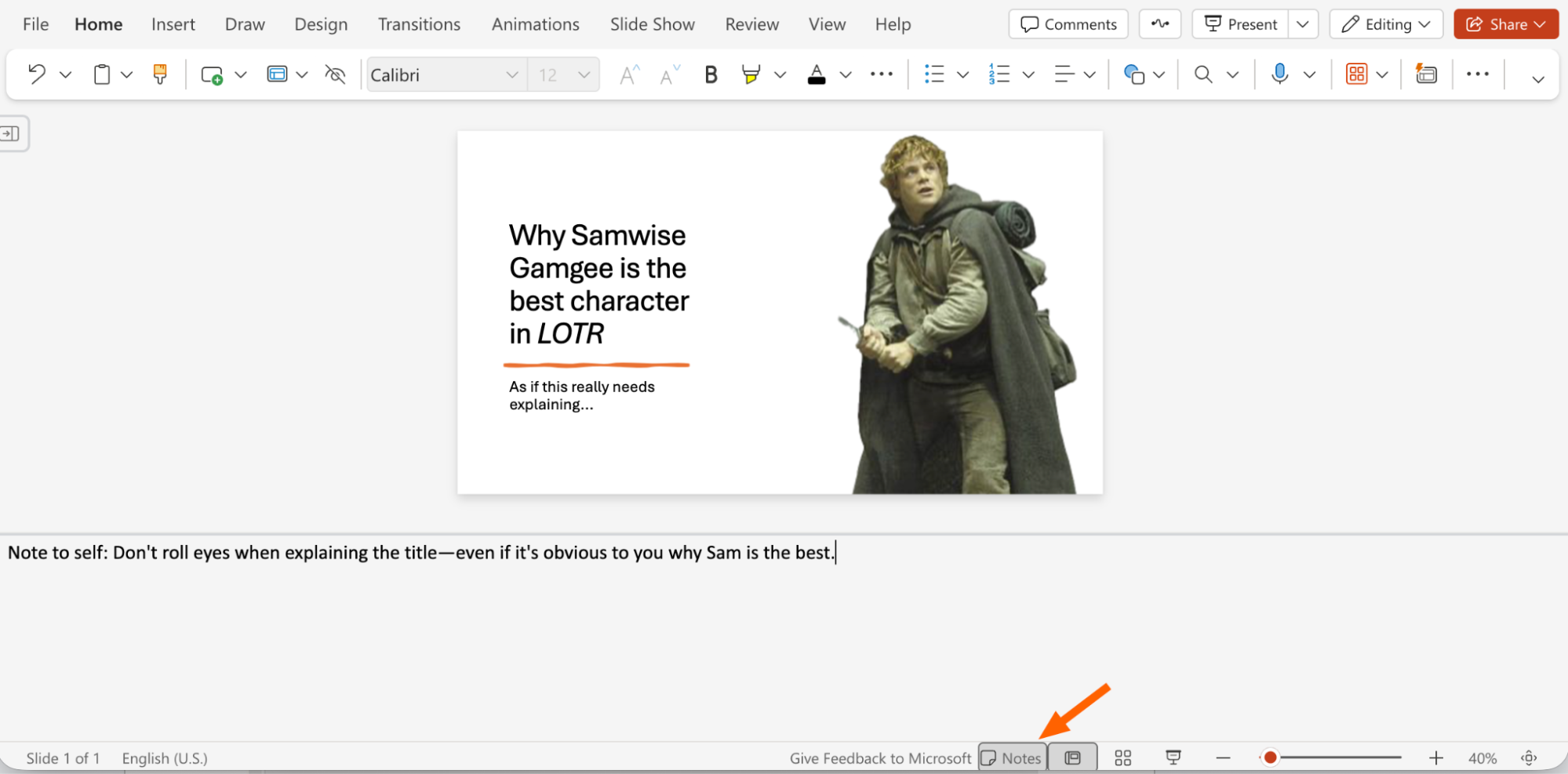
    Click Notes at the bottom of your screen (next to the zoom controls), and then enter your talking points in the Notes section. 

    PowerPoint editor with an arrow pointing to the notes tab.

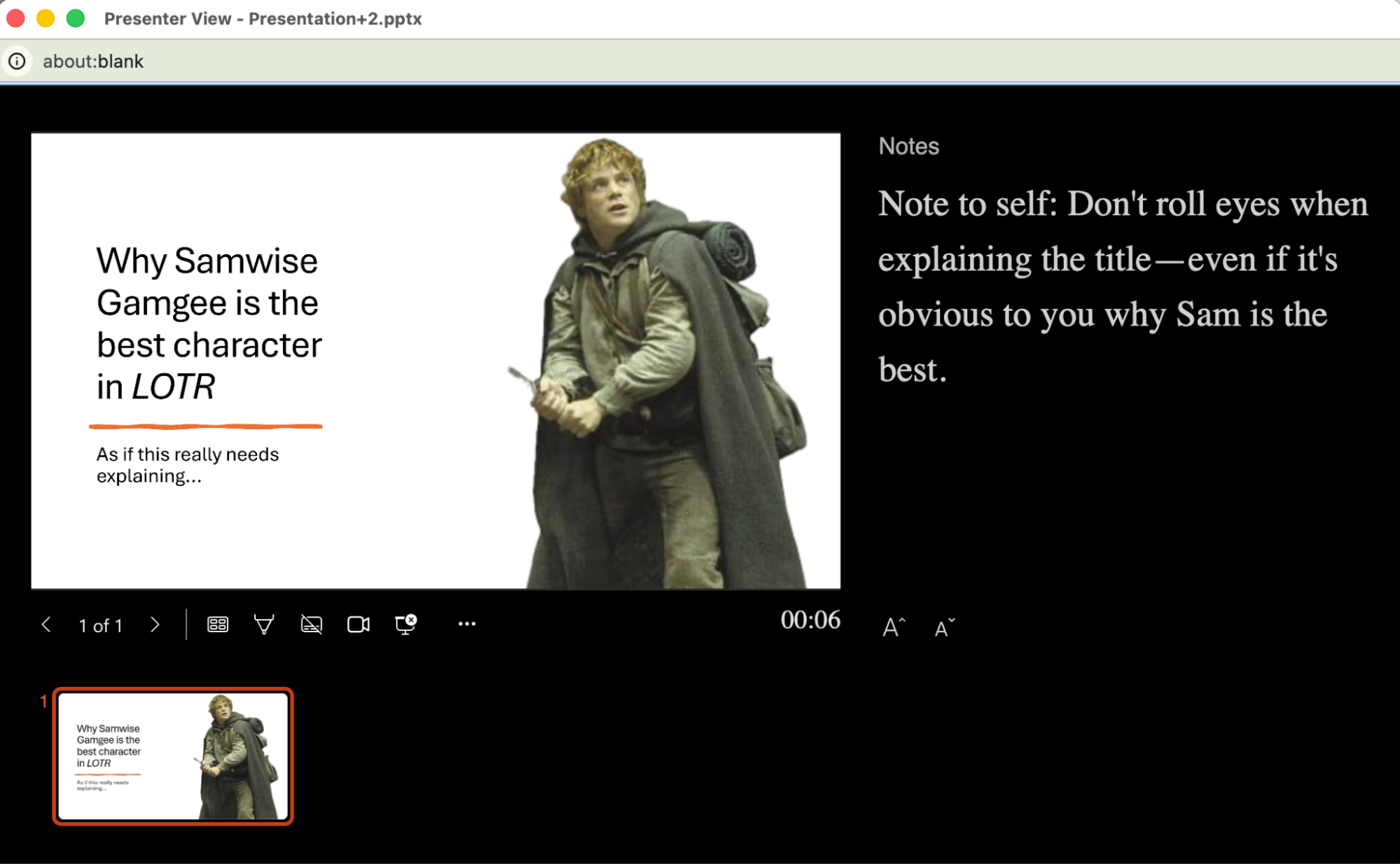
    When you give your presentation in presenter view (more on that below), you’ll be able to see your notes alongside the slide deck, while the audience will see only the slides in full-screen view.

    How to present PowerPoint with notes

    Now that you’ve created your deck and added your notes, you’re ready to present your PowerPoint. 

    Click Slide Show in the ribbon, and select how you want to present: 

    Side Slow ribbon in PowerPoint.
    • From Beginning or From Current Slide. Use either of these if you’re presenting without presenter notes. 

    • Presenter View. Use this option to present with a side-by-side view of your presentation and notes. 

    • Present in Teams. If you’re sharing your deck in a Teams meeting, the seamless connection should save you from the classic, “Can you see my screen?”

    Presenter view in PowerPoint with a side-by-side view of the presentation and notes.
    Presenting a PowerPoint using Presenter View.

    How to share PowerPoint on Zoom 

    The local college I teach at lives in the Microsoft ecosystem—very few folks venture into apps outside of this bubble unless absolutely necessary. To this day, I have colleagues who still ask how to share PowerPoint on Zoom. So this is for all my colleagues (please stop asking me to repeat it). 

    Heads-up: The steps below are for how to do this using a dual monitor setup. This is the ideal way, especially if you have presenter notes, because it allows you to share your deck on one screen and view the presenter version on another. If you have a single monitor, you can start the presentation From Beginning or From Current Slide, and then share your screen. But you won’t be able to see your presenter notes. 

    1. Share your PowerPoint using Presenter View. 

    2. A slideshow-only version of your PowerPoint will appear on top of your presenter view. Drag and drop the slideshow to one monitor; leave the presenter view on the other. 

    3. Join the Zoom meeting like you normally would. 

    4. Click Share in the Zoom control bar (bottom of your screen). 

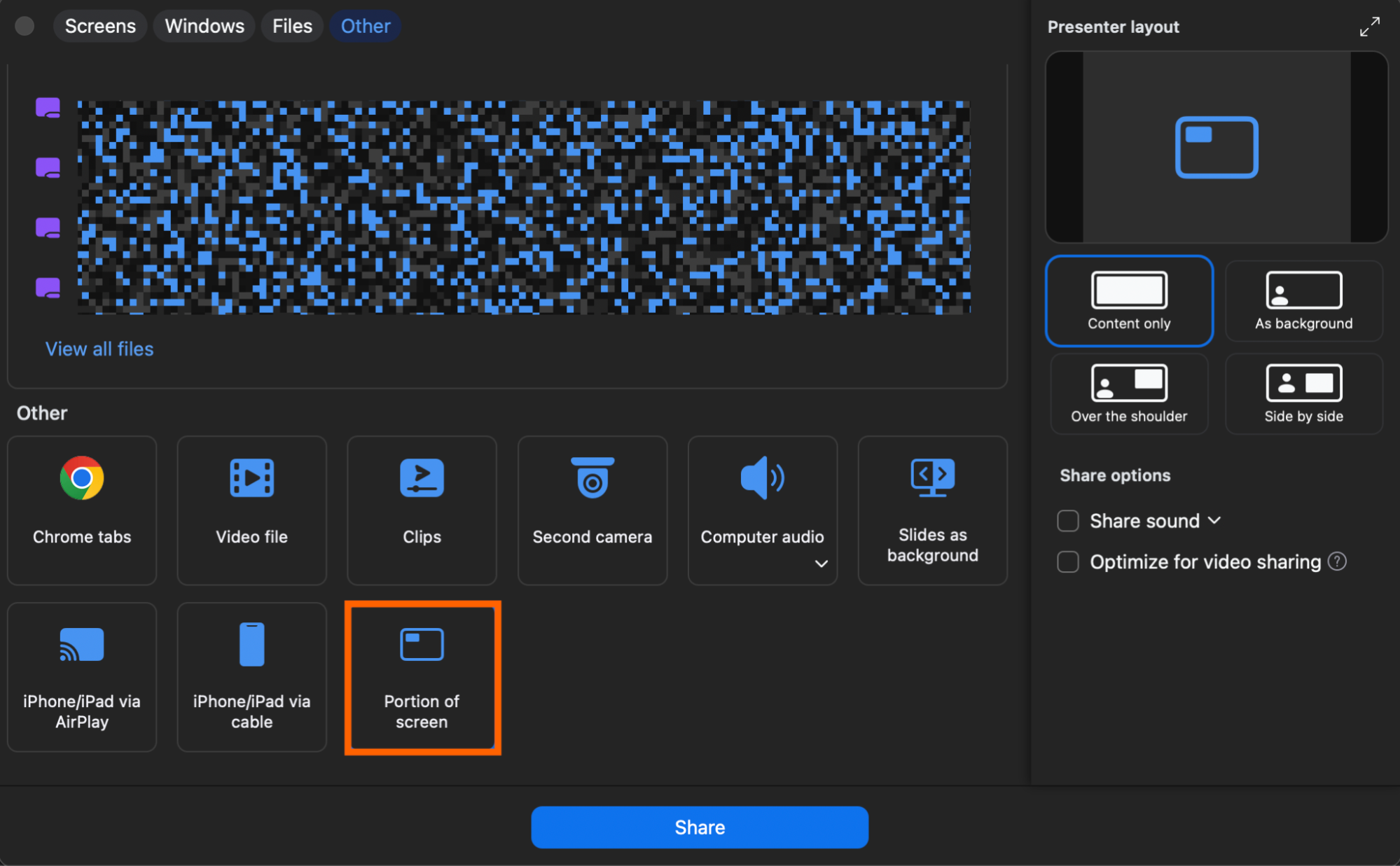
    5. Under More or Other (it varies depending on your version), click Portion of Screen.

      How to share a portion of your screen in Zoom share settings.
    6. Click Share. 

    7. Since the slideshow version shows your entire browser, drag the borders of the green box around only your slideshow to reduce distractions.

      PowerPoint presentation with a green box around the portion of the screen being shared via Zoom.

    Automate your presentation with Zapier 

    Creating a PowerPoint presentation from the ground up is all fine and good when you want to give your favorite Tolkien character the respect he deserves. But if you’re building presentations at scale, or incorporating lots of data and talking points from other apps, use Zapier. 

    Zapier works where you already work, including ChatGPT and Claude. This means you can securely connect your AI chatbot with 9,000+ apps, describe what you want to build, and let it take care of the rest. If you want to share a recap on last quarter’s sales, for example, ask your AI assistant to pull your pipeline data from Salesforce, summarize the key wins and misses, and generate a slide-ready outline. Every connection runs through Zapier, so your credentials stay secure and you stay in control of what your AI can access.

    Related reading:

    This article was originally published in August 2018 by Matthey Guay and has also had contributions from Nicole Replogle. The most recent update was in October 2026.

    Get productivity tips delivered straight to your inbox

    We’ll email you 1-3 times per week—and never share your information.

    Related articles

    • Hero image with the logos of the best AI presentation makers
    • Hero image with the logos of the best online whiteboards
    • Hero image with logos of the best presentation software
    • The Gamma logo connected to the Granola, Google Docs, and Salesforce logos against a lavender background
    • best-apps-share-presentation primary img
    • A hero image of the Claude logo
    • A hero image of the Claude logo
    • Hero image with the Google Gemini logo

    Improve your productivity automatically. Use Zapier to get your apps working together.

    A Zap with the trigger 'When I get a new lead from Facebook,' and the action 'Notify my team in Slack'

  • Research: When Being Authentic Undermines Your Leadership

    Research: When Being Authentic Undermines Your Leadership

    October 12, 2026

    VIDOK/Getty Images

    Summary.   

    Leaders often assume that revealing a painful setback makes them appear more authentic to their employees. New research suggests the more powerful signal is agency: people respond more positively

    Historically, being a strong leader meant being invulnerable and stoic—showing no signs of weakness. But in recent years, leaders have begun to embrace the idea that presenting an authentic version of themselves to their employees can have a host of benefits including strengthening employee performance and creativity.

    Read more on Authenticity or related topics Leadership, Managing yourself, Trustworthiness and Personal strategy and style

  • Your Company Needs a Plan for the First 72 Hours After a Cyberattack

    Your Company Needs a Plan for the First 72 Hours After a Cyberattack

    Harvard Business Review Logo

    Audshule/Stocksy

    Cyberattacks now move too quickly for companies to assume they can simply restore every system and resume normal operations. The organizations that recover fastest prepare to run the business

    Most companies operate with one of two assumptions about cyber disruption: that strong enough defenses will prevent it, or that a well-written business continuity plan will manage it when it happens. Our research, drawn from a global survey of 1,000 senior executives across 20 industries in 13 countries, suggests both assumptions are dangerously wrong.

  • Sustainability Reporting Isn’t the Same as Risk Preparedness

    Sustainability Reporting Isn’t the Same as Risk Preparedness

    Harvard Business Review Logo

    Henrik Sorensen/Getty Images

    Summary.   

    Sustainability reporting has become widespread among large firms, but strong disclosure does not necessarily translate into preparedness for climate-related risks. This research identifies a

    Sustainability reporting is now common among large companies. According to the OECD, firms representing 91% of global listed market capitalization disclose sustainability-related information.

  • Who Owns the Customer in the Age of AI Agents?

    Who Owns the Customer in the Age of AI Agents?

    Harvard Business Review Logo

    Illustration by Eliot Wyatt

    AI agents are changing the nature of customer relationships by taking on more of the discovery, comparison, negotiation, and purchasing decisions that companies once controlled through their own

    On September 8, 2026, Meta launched Muse, a personal AI agent designed to act on a user’s behalf: filling out forms, negotiating, booking travel, and making purchases. Twelve days later, Amazon blocked Muse from shopping on its site, arguing that third-party agents should identify themselves and obtain a retailer’s permission before transacting on behalf of its customers.