Author: admin

  • Accelerating Mathematical and Scientific Discovery with Gemini Deep Think

    Accelerating Mathematical and Scientific Discovery with Gemini Deep Think

    February 11, 2026 Research

    Thang Luong and Vahab Mirrokni

    Listen to article 10 minutes

    Under direction from expert mathematicians and scientists, Gemini Deep Think is solving professional research problems across mathematics, physics, and computer science

    In the summer of 2025, an advanced version of Gemini Deep Think achieved Gold-medal standard at the International Mathematics Olympiad (IMO) and later, an updated version, obtained similar results at the International Collegiate Programming Contest. These results demonstrated the model could reason through some of the most challenging math and programming problems designed for students. Since then, Gemini Deep Think mode has moved into science, engineering and enterprise workflows to tackle more complex, open-ended challenges.

    In the last week, our teams published two papers (1, 2) detailing a cross-disciplinary effort to solve professional research problems using Gemini Deep Think mode. These results stem from deep collaboration between mathematicians, physicists, and computer scientists.

    The Frontier of Pure Mathematics

    Unlike IMO problems, research-level mathematics requires advanced techniques from vast literature. While foundation models have large knowledge bases, data scarcity often leads to superficial understanding and hallucinations in advanced subjects.

    To solve this, we built a math research agent (internally codenamed Aletheia), powered by Gemini Deep Think mode. It features a natural language verifier to identify flaws in candidate solutions and enable an iterative process of generating and revising solutions. Crucially, this agent can admit failure to solve a problem, a key feature that improved the efficiency for researchers.

    Additionally, the research agent uses Google Search and web browsing to navigate complex research, preventing spurious citations and computational inaccuracies when synthesizing published literature.

    Flowchart titled Flowchart titled

    Overview of Aletheia, a math research agent powered by Deep Think that can iteratively generate, verify, and revise for research-level math problems.

    Since achieving IMO Gold-medal standard in July 2025, Gemini Deep Think has progressed rapidly, scoring up to 90% on the IMO-ProofBench Advanced test as inference-time compute scales. We demonstrated that the scaling law continues to hold as we progress beyond Olympiad level into PhD-level exercises (per our internal FutureMath Basic benchmark). Notably, Aletheia demonstrated that higher reasoning quality can be achieved at a lower inference-time compute.

    For research-level math, Aletheia has already enabled several advancements, produced via varying levels of autonomous research:

    • Reliable autonomous research. A research paper (Feng26) generated by AI without any human intervention, which calculates certain structure constants in arithmetic geometry called eigenweights.
    • AI-guided collaboration. A research paper (LeeSeo26) demonstrating human-AI collaboration in proving bounds on systems of interacting particles called independent sets.
    • An extensive semi-autonomous evaluation (Feng et al., 2026b) of 700 open problems on Bloom’s Erdős Conjectures database, including autonomous solutions to four open questions listed there. On Erdős-1051, our model autonomously solved and helped lead to a generalization reported in a research paper (BKKKZ26).

    The agent also contributed intermediate propositions on two further papers, (FYZ26) and (ACGKMP26). It is also of note that there has been prior work using Gemini for research-level math at a smaller scale in terms of collaborations and the number of problems tackled.

    Following extensive discussions with the mathematical community, we suggest a taxonomy to classify AI-assisted mathematics research by significance and degree of AI contribution – contributing to the wider discussion on responsible documentation, evaluation and communication of AI-generated results. Level 2 (“publishable quality”) works have been submitted to reputable journals. Currently, we do not claim any Level 3 (“Major Advance”) and Level 4 (“Landmark Breakthrough”) results.
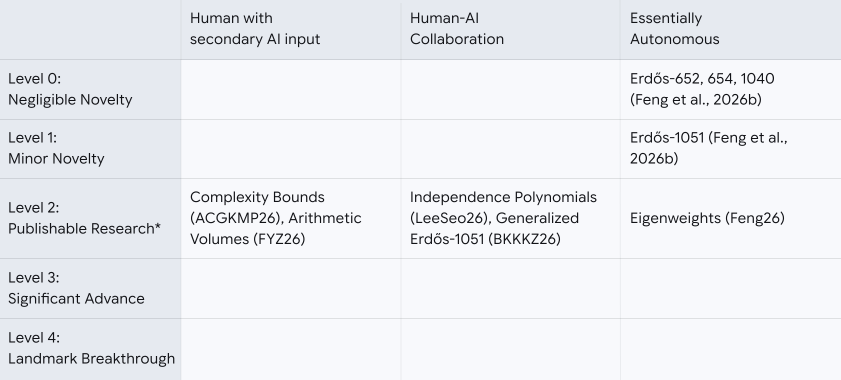
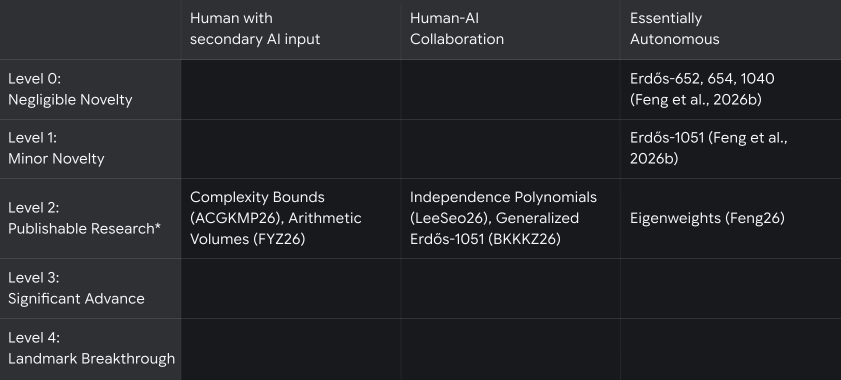
    A table titled A table titled

    Classification of all AI-assisted mathematics results encompassed in this work. *Works listed as Level 2 in this table have been submitted for publications.

    Prompts and model outputs are available here. For discussions on AI contributions, our “Human-AI Interaction card”, and community impact, see our paper.

    Expanding to Physics and Computer Science

    Gemini Deep Think mode has also demonstrated promise in computer science and physics. The second paper builds on similar agentic reasoning ideas, and identifies effective “recipes” for collaboration, specifically the “Advisor” model, where humans guide AI through iterative “Vibe-Proving” cycles to validate intuition and refine proofs. We also detail tactical techniques like “balanced prompting” —requesting simultaneous proof or refutation to prevent confirmation bias—and code-assisted verification. These methods, combined with the model’s ability to bridge disparate scientific fields through deep structural connections, are transforming how theoretical research is conducted. This work builds upon our successful deployment of an advanced version of Gemini Deep Think to assist in reviewing CS theory papers for STOC’26 conference.
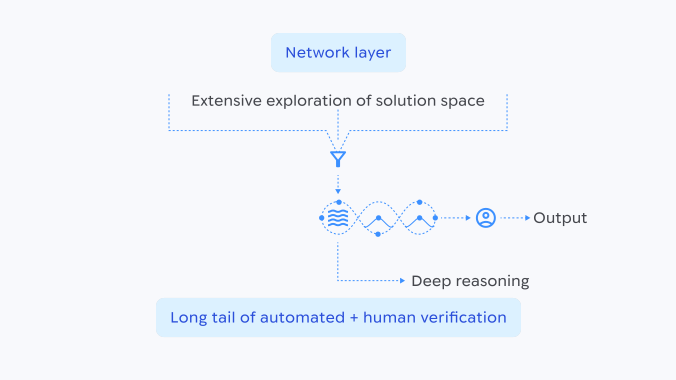
    A flow diagram titled A flow diagram titled

    A schematic overview of the AI reasoning pipeline, illustrating how extensive solution space exploration at the network layer is funneled into structured reasoning and validated by automated and human verification.

    Collaborating with experts on 18 research problems, an advanced version of Gemini Deep Think helped resolve long-standing bottlenecks across algorithms, ML and combinatorial optimization, information theory, and economics. Highlights from our “Accelerating Research with Gemini” paper include (corresponding section numbers in paper):

    1. Crossing mathematical borders for network puzzles: Progress on classic computer science problems like “Max-Cut” (efficiently splitting networks) and the “Steiner Tree” (connecting high-dimensional points) had slowed down. Gemini broke both deadlocks by thinking outside the box. It solved these discrete algorithmic puzzles by pulling advanced tools—like the Kirszbraun Theorem, measure theory, and the Stone-Weierstrass theorem—from entirely unrelated branches of continuous mathematics. See Sections 4.1 and 4.2.
    2. Settling a decade-old conjecture in online submodular optimization: A 2015 theory paper proposed a seemingly obvious rule for data streams: making a copy of an arriving item is always less valuable than simply moving the original. Experts struggled for a decade to prove this. Gemini engineered a highly specific three-item combinatorial counterexample, rigorously proving the long-standing human intuition false. See Section 3.1.
    3. Machine learning optimization: Training AI to filter out noise usually requires engineers to manually tune a mathematical “penalty.” Researchers created a new technique that did this automatically, but couldn’t mathematically explain why. Gemini analyzed the equations and proved the method succeeds by secretly generating its own “adaptive penalty” on the fly. See Section 8.3.
    4. Upgrading economic theory for AI: A recent ‘Revelation Principle’ for auctioning AI generation tokens only worked mathematically when bids were restricted to rational numbers. Extending the domain to continuous real numbers invalidated the original proof. Gemini employed advanced topology and order theory to extend the theorem, accommodating real-world, continuous auction dynamics. See Section 8.4.
    5. Physics of cosmic strings: Calculating gravitational radiation from cosmic strings requires finding analytical solutions to tricky integrals containing “singularities.” Gemini found a novel solution using Gegenbauer polynomials. This naturally absorbed the singularities, collapsing an infinite series into a closed form, finite sum. See Section 6.1.

    Spanning diverse fields—from information and complexity theory to cryptography and mechanism design—the results demonstrate how AI is fundamentally shifting research. For details, see our paper.

    Given computer science’s fluid, conference-driven publication pipeline, we describe these results by academic trajectory rather than a rigid taxonomy. About half target strong conferences—including an ICLR ’26 acceptance—while most remaining findings will form future journal submissions. Even when course-correcting the field by identifying errors (Section 3.2) or refuting conjectures (Section 3.1), these outcomes highlight AI’s value as a high-level scientific collaborator.

    The Future of Human-AI Collaboration

    Building on Google’s previous breakthroughs (1, 2, 3, 4, 5), this work demonstrates that general foundation models – leveraged with agentic reasoning workflows – can act as a powerful scientific companion.

    Under direction from expert mathematicians, physicists, and computer scientists, Gemini Deep Think mode is proving its utility across fields where complex math, logic and reasoning are core.

    We are witnessing a fundamental shift in the scientific workflow. As Gemini evolves, it acts as “force multiplier” for human intellect, handling knowledge retrieval and rigorous verification so scientists can focus on conceptual depth and creative direction. Whether refining proofs, hunting for counterexamples, or linking disconnected fields, AI is becoming a valuable collaborator in the next chapter of scientific progress.

    Acknowledgements

    We thank the community of expert mathematicians, physicists, and computer scientists for their help and advice on this project

    This project was a large-scale collaboration across Google and its success is due to the combined efforts of many individuals and teams. Thang Luong and Vahab Mirrokni led the overall research directions with deep technical expertises from Tony Feng and David Woodruff.

    Authors of the first paper “Towards Autonomous Mathematics Research” include: Tony Feng, Trieu H. Trinh, Garrett Bingham, Dawsen Hwang, Yuri Chervonyi, Junehyuk Jung, Joonkyung Lee, Carlo Pagano, Sang-hyun Kim, Federico Pasqualotto, Sergei Gukov, Jonathan N. Lee, Junsu Kim, Kaiying Hou, Golnaz Ghiasi, Yi Tay, YaGuang Li, Chenkai Kuang, Yuan Liu, Hanzhao (Maggie) Lin, Evan Zheran Liu, Nigamaa Nayakanti, Xiaomeng Yang, Heng-Tze Cheng, Demis Hassabis, Koray Kavukcuoglu, Quoc V. Le, Thang Luong. We thank the following experts for feedback and discussions on the work: ​​Jarod Alper, Kevin Barreto, Thomas Bloom, Sourav Chatterjee, Otis Chodosh, Michael Hutchings, Seongbin Jeon, Youngbeom Jin, Aiden Yuchan Jung, Jiwon Kang, Jimin Kim, Vjekoslav Kovač, Daniel Litt, Ciprian Manolescu, Mona Merling, Agustin Moreno, Carl Schildkraut, Johannes Schmitt, Insuk Seo, Jaehyeon Seo, Terence Tao, Cheng-Chiang Tsai, Ravi Vakil, Zhiwei Yun, Shengtong Zhang, Wei Zhang, Yufei Zhao.

    Authors of the second paper “Accelerating Scientific Research with Gemini: Case Studies and Common Techniques” include David P. Woodruff, Vincent Cohen-Addad, Lalit Jain, Jieming Mao, Song Zuo, MohammadHossein Bateni, Simina Branzei, Michael P. Brenner, Lin Chen, Ying Feng, Lance Fortnow, Gang Fu, Ziyi Guan, Zahra Hadizadeh, Mohammad T. Hajiaghayi, Mahdi JafariRaviz, Adel Javanmard, Karthik C. S., Ken-ichi Kawarabayashi, Ravi Kumar, Silvio Lattanzi, Euiwoong Lee, Yi Li, Ioannis Panageas, Dimitris Paparas, Benjamin Przybocki, Bernardo Subercaseaux, Ola Svensson, Shayan Taherijam, Xuan Wu, Eylon Yogev, Morteza Zadimoghaddam, Samson Zhou, Yossi Matias, Jeff Dean, James Manyika, Vahab Mirrokni. This list includes Google researchers building the agentic reasoning on top of Gemini, and our academic expert collaborators verifying and collaborating with Gemini. We also thank Corinna Cortes for her careful review of the paper.

    We are grateful for the foundational support from the rest of the DeepThink team: Anirudh Baddepudi, Michael Brenner, Irene Cai, Kristen Chiafullo, Paul Covington, Rumen Dangovski, Chenjie Gu, Huan Gui, Vihan Jain, Rajesh Jayaram, Melvin Johnson, Rosemary Ke, Maciej Kula, Nate Kushman, Jane Labanowski, Steve Li, Pol Moreno, Sidharth Mudgal, William Nelson, ​​Ada Maksutaj Oflazer, Sahitya Potluri, Navneet Potti, Shubha Raghvendra, James Roggeveen, Siamak Shakeri, Archit Sharma, Xinying Song, Mukund Sundararajan, Qijun Tan, Zak Tsai, Erik Wang, Theophane Weber, Winnie Xu, Zicheng Xu, Junwen Yao, Shunyu Yao, Adams Yu, Lijun Yu, and Honglei Zhuang.

    We’d like to thank the Gemini Post-Training team for building the foundational model for Deep Think: Arash Ahmadian, Ankesh Anand, Charles Chen, Yong Cheng, Kedar Dhamdhere, Philipp Fränken, Justin Gilmer, Elena Gribovskaya, Luheng He, Yangsibo Huang, Rishabh Joshi, Ajay Kannan, Arvind Kannan, Guangda Lai, Robert Leland, Hanzhao (Maggie) Lin, Yingjie Miao, Bryce Petrini, Corbin Quick, Vikash Sehwag, Yue Song, Pranav Talluri, Ankur Taly, George Tucker, Michael Voznesensky, Manish Reddy Vuyyuru, Yiming Wang, Jinliang Wei, Qiao Zhang, Yuan Zhang, Zizhao Zhang.

    We thank Quoc Le, Koray Kavukcuoglu, Demis Hassabis, James Manyika, Yossi Matias, and Jeff Dean for sponsoring this project.

    Last but not least, we thank Divy Thakkar, Adam Brown, Vinay Ramasesh, Alex Davies, Thomas Hubert, Eugénie Rives, Pushmeet Kohli, Benoit Schillings for feedback and support of the project.

    Advanced version of Gemini with Deep Think officially achieves gold-medal standard at the International Mathematical Olympiad

    Gemini achieves gold-medal level at the International Collegiate Programming Contest World Finals

  • Project Genie: Experimenting with infinite, interactive worlds

    Project Genie: Experimenting with infinite, interactive worlds

    Google AI Ultra subscribers in the U.S. can try out Project Genie, an experimental research prototype that lets you create and explore worlds.


    Diego Rivas

    Group Product Manager, Google DeepMind

    Elliott Breece

    Product Manager, Google Labs

    Suz Chambers

    Director, Google Creative Lab


    Your browser does not support the audio element.

    Listen to article

    [[duration]] minutes

    This content is generated by Google AI. Generative AI is experimental

    In August, we previewed Genie 3, a general-purpose world model capable of generating diverse, interactive environments. Even in this early form, trusted testers were able to create an impressive range of fascinating worlds and experiences, and uncovered entirely new ways to use it. The next step is to broaden access through a dedicated, interactive prototype focused on immersive world creation.

    Starting today, we’re rolling out access to Project Genie for Google AI Ultra subscribers in the U.S (18+). This experimental research prototype lets users create, explore and remix their own interactive worlds.

    How we’re advancing world models

    A world model simulates the dynamics of an environment, predicting how they evolve and how actions affect them. While Google DeepMind has a history of agents for specific environments like Chess or Go, building AGI requires systems that navigate the diversity of the real world.

    To meet this challenge and support our AGI mission, we developed Genie 3. Unlike explorable experiences in static 3D snapshots, Genie 3 generates the path ahead in real time as you move and interact with the world. It simulates physics and interactions for dynamic worlds, while its breakthrough consistency enables the simulation of any real-world scenario — from robotics and modelling animation and fiction, to exploring locations and historical settings.

    Building on our model research with trusted testers from across industries and domains, we are taking the next step with an experimental research prototype: Project Genie.

    How Project Genie works

    Project Genie is a prototype web app powered by Genie 3, Nano Banana Pro and Gemini, which allows users to experiment with the immersive experiences of our world model firsthand. The experience is centred on three core capabilities:

    1. World sketching

    Prompt with text and generated or uploaded images to create a living, expanding environment. Create your character, your world, and define how you want to explore it — from walking to riding, flying to driving, and anything beyond.

    For more precise control, we have integrated “World Sketching” with Nano Banana Pro. This allows you to preview what your world will look like and modify your image to fine tune your world prior to jumping in. You can also define your perspective for the character — such as first-person or third-person — giving you control over how you experience the scene before you enter.

    2. World exploration

    Your world is a navigable environment that’s waiting to be explored. As you move, Project Genie generates the path ahead in real time based on the actions you take. You can also adjust the camera as you traverse through the world.

    3. World remixing

    Remix existing worlds into new interpretations, by building on top of their prompts. You can also explore curated worlds in the gallery or by selecting the randomizer icon for inspiration, or build on top of them. And once you’re done, you can download videos of your worlds and your explorations.

    How we’re building responsibly

    Project Genie is an experimental research prototype in Google Labs, powered by Genie 3. As with all our work towards general AI systems, our mission is to build AI responsibly to benefit humanity. Since Genie 3 is an early research model, there are a few known areas for improvement:

    • Generated worlds might not look completely true-to-life or always adhere closely to prompts or images, or real-world physics
    • Characters can sometimes be less controllable, or experience higher latency in control
    • Limitations in generations to 60 seconds

    A few of the Genie 3 model capabilities we announced in August, such as promptable events that change the world as you explore it, are not yet included in this prototype. You can find more details on model limitations and future updates on how we’re improving the experience, here.

    Building on the work we have been doing with trusted testers, we are excited to share this prototype with users of our most advanced AI to better understand how people will use world models in many areas of both AI research and generative media.

    Access to Project Genie begins rolling out today to Google AI Ultra subscribers 1 in the U.S. (18+), expanding to more territories in due course. We look forward to seeing the infinitely diverse worlds they create, and in time, our goal is to make these experiences and technology accessible to more users.

  • D4RT: Teaching AI to see the world in four dimensions

    D4RT: Teaching AI to see the world in four dimensions

    January 22, 2026 Research

    Guillaume Le Moing and Mehdi S. M. Sajjadi

    Introducing D4RT, a unified AI model for 4D scene reconstruction and tracking across space and time.

    Anytime we look at the world, we perform an extraordinary feat of memory and prediction. We see and understand things as they are at a given moment in time, as they were a moment ago, and how they are going to be in the moment to follow. Our mental model of the world maintains a persistent representation of reality and we use that model to draw intuitive conclusions about the causal relationship between the past, present and future.

    To help machines see the world more like we do, we can equip them with cameras, but that only solves the problem of input. To make sense of this input, computers must solve a complex, inverse problem: taking a video — which is a sequence of flat 2D projections — and recovering or understanding the rich, volumetric 3D world, in motion.

    Today, we are introducing D4RT (Dynamic 4D Reconstruction and Tracking), a new AI model that unifies dynamic scene reconstruction into a single, efficient framework, bringing us closer to the next frontier of artificial intelligence: total perception of our dynamic reality.

    The Challenge of the Fourth Dimension

    In order for it to understand a dynamic scene captured on a 2D video, an AI model must track every pixel of every object as it moves through the three dimensions of space and the fourth dimension of time. In addition, it must disentangle this motion from the motion of the camera, maintaining a coherent representation even when objects move behind one another or leave the frame entirely. Traditionally, capturing this level of geometry and motion from 2D videos requires computationally intensive processes or a patchwork of specialized AI models — some for depth, others for movement or camera angles — resulting in AI reconstructions that are slow and fragmented.

    D4RT’s simplified architecture and novel query mechanism place it at the forefront of 4D reconstruction while being up to 300x more efficient than previous methods — fast enough for real-time applications in robotics, augmented reality, and more.

    How D4RT Works: A Query-Based Approach

    D4RT operates as a unified encoder-decoder Transformer architecture. The encoder first processes the input video into a compressed representation of the scene’s geometry and motion. Unlike older systems that employed separate modules for different tasks, D4RT calculates only what it needs using a flexible querying mechanism centered around a single, fundamental question:

    “Where is a given pixel from the video located in 3D space at an arbitrary time, as viewed from a chosen camera?”

    Building on our prior work, a lightweight decoder then queries this representation to answer specific instances of the posed question. Because queries are independent, they can be processed in parallel on modern AI hardware. This makes D4RT extremely fast and scalable, whether it’s tracking just a few points or reconstructing an entire scene.

    D4RT combines a powerful encoder that builds a rich, global understanding of the video, and a lightweight decoder that answers thousands of queries in parallel. By asking specific questions — identifying where a source pixel is located at a target time and camera view — the model efficiently solves diverse tasks like tracking, depth estimation, and pose estimation through a single, flexible interface.

    Capabilities: Fast, Accurate 4D Understanding

    With this flexible formulation, a wide variety of 4D tasks can now be solved by the model, including:

    • Point Tracking: By querying a pixel’s location across different time steps, D4RT can predict its 3D trajectory. Importantly, an object need not be visible on other frames of the video for the model to make a prediction.
    • Point Cloud Reconstruction: By freezing time and the camera viewpoint, D4RT can directly generate the complete 3D structure of a scene, eliminating extra steps such as separate camera estimation or per-video iterative optimization.
    • Camera Pose Estimation: By generating and aligning 3D snapshots of a single moment from different viewpoints, D4RT can easily recover the camera’s trajectory.

    As detailed in the underlying technical report, D4RT outperforms previous methods across a wide spectrum of 4D reconstruction tasks. Qualitative comparisons show that while other methods struggle with dynamic objects — often duplicating them or failing to reconstruct them entirely — D4RT maintains a solid, continuous understanding of the moving world.

    Crucially, D4RT’s precision does not come at the expense of efficiency. In testing, it performed 18x to 300x faster than the previous state of the art. For example, D4RT processed a one-minute video in roughly five seconds on a single TPU chip. Previous state-of-the-art methods could take up to ten minutes for the same task — an improvement of 120x.

    Downstream Applications

    D4RT demonstrates that we don’t need to choose between accuracy and efficiency in 4D reconstruction. Its flexible, query-based system can capture our dynamic world in real-time, paving the way for the next generation of spatial computing. This includes:

    • Robotics: Robots need to navigate dynamic environments populated by moving people and objects. D4RT can provide the spatial awareness required for safe navigation and dextrous manipulation.
    • Augmented Reality (AR): For AR glasses to overlay digital objects onto the real world, they need an instant, low-latency understanding of a scene’s geometry. D4RT’s efficiency contributes to making on-device deployment a tangible reality.
    • World Models: By effectively disentangling camera motion, object motion, and static geometry, D4RT brings us a step closer to AI that possesses a true “world model” of physical reality — a necessary step on the path to AGI.

    We’re continuing to explore the model’s capabilities and potential for applications across robotics, augmented reality, and beyond.

    Gemini Robotics 1.5 brings AI agents into the physical world

    Introducing Veo 3.1 and advanced creative capabilities

    Genie 3: A new frontier for world models

  • Veo 3.1 Ingredients to Video: More consistency, creativity and control

    Veo 3.1 Ingredients to Video: More consistency, creativity and control

    Our latest Veo update generates lively, dynamic clips that feel natural and engaging — and supports vertical video generation.


    Ricky Wong

    Lead Product Manager, Google DeepMind


    A collage of various generated images, including an astronaut on Mars, a raccoon barista, a person in a hallway, a fantasy cityscape, and a close-up of coffee art, with the text

    Your browser does not support the audio element.

    Listen to article

    [[duration]] minutes

    This content is generated by Google AI. Generative AI is experimental

    Today, Veo is getting more expressive, with improvements that help you create more fun, creative, high-quality videos based on ingredient images, built directly for the mobile format. We’re excited to bring new creative possibilities for everyone from casual storytellers to professional filmmakers.

    We’re releasing:

    1. Improvements to Veo 3.1 Ingredients to Video, our capability that lets you create videos based on reference images. This update makes videos more expressive and creative, even with simple prompts
    2. Native vertical outputs for Ingredients to Video (portrait mode) to power mobile-first, short-form video creation
    3. State-of-the-art upscaling to 1080p and 4K resolution 1 for high-fidelity production workflows

    Whether you are looking for livelier movement, better control over visual elements or broadcast-ready resolution, these updates give you the tools to bring your vision to life. These updates are launching in the Gemini app, YouTube, Flow, Google Vids, the Gemini API and Vertex AI.

    Improvements to Veo 3.1 Ingredients to Video

    Turn ingredient images into fun, shareable clips

    Even with short prompts, you can generate dynamic and engaging videos based on ingredient images. You’ll now see richer dialogue and storytelling, making your videos feel more alive and expressive.

    Maintain identity consistency for your characters

    Identity consistency is better than ever with Veo 3.1 Ingredients to Video. Keep your characters looking the same even as the setting changes, making it easier to tell a full narrative by having the same character appear across multiple scenes.

    Achieve background and object consistency

    Control the scene by maintaining the integrity of your setting and the objects within it. You can also reuse an object, backgrounds or textures across scenes.

    Seamlessly blend textures, characters and objects

    Combine disparate elements — like characters, objects, textures and stylized backgrounds — into a cohesive, high-impact clip.

    Pro tip: use the new Nano Banana Pro (Gemini 3 Pro Image) in the Gemini app or Flow to create your ingredient images, which you can then use to create stunning videos with Veo 3.1 Ingredients to Video.

    Create high-fidelity visuals with upgraded capabilities

    With Veo 3.1’s new capabilities, we are introducing mobile-optimized outputs and professional-grade quality options.

    Native vertical outputs for Ingredients to Video

    For the first time, “Ingredients to Video” supports generating videos in a native 9:16 aspect ratio. Whether you are creating for YouTube Shorts or other platforms, you can now produce high-quality, full-screen vertical storytelling without cropping or quality loss.

    State-of-the-art upscaling to 1080p and 4K resolution

    Generate videos 1080p and 4K with state-of-the-art upscaling. Our improved 1080p resolution offers a sharper, cleaner video perfect for editing. For even more detail, choose 4K to capture rich textures and stunning clarity — ideal for high-end productions and large screens.

    Try these updates today

    Across our products and services, you can now access these new capabilities tailored to your workflow:

    • Consumers and creators: We are bringing Veo 3.1 Ingredients to Video directly to YouTube Shorts and the YouTube Create app for the first time. You can also try the enhanced Veo 3.1 Ingredients to Video and portrait mode for Veo in the Gemini app starting today.
    • Professional and enterprise workflows: The enhanced Veo 3.1 Ingredients to Video and native vertical format support are rolling out to Flow, the Gemini API, Vertex AI, and Google Vids, with 1080p and 4K resolution options also available on Flow, the API, and Vertex AI.

    Verify videos in the Gemini app

    We’re committed to providing tools to make it easier to determine if content is AI-generated. This is why videos generated by Google’s tools are embedded with our imperceptible SynthID digital watermark.

    In December we expanded our powerful verification tool in the Gemini app to include video. You can now upload a video and simply ask if it was generated with Google AI. This builds on our existing image verification tools, helping to foster a more transparent ecosystem for everyone.

    You can find out more about how we’re increasing transparency in AI content with SynthID in our blog post.

  • Google’s year in review: 8 areas with research breakthroughs in 2025

    Google’s year in review: 8 areas with research breakthroughs in 2025

    This was a year of AI agents, reasoning and scientific discovery.


    The image depicts a visual collage or mosaic of multiple different images, with one image in the center that is black and displays the text

    Your browser does not support the audio element.

    Listen to article

    [[duration]] minutes

    This content is generated by Google AI. Generative AI is experimental

    2025 has been a year of extraordinary progress in research. With artificial intelligence, we can see its trajectory shifting from a tool to a utility: from something people use to something they can put to work. If 2024 was about laying the multimodal foundations for this era, 2025 was the year AI began to really think, act and explore the world alongside us. With quantum computing, we made progress towards real-world applications. And across the board, we helped turn research into reality, with more capable and useful products and tools making a positive impact on people’s lives today.

    Here’s a look back at some of the breakthroughs, products and scientific milestones that defined the work of Google, Google DeepMind and Google Research in a year of relentless progress.

    Delivering breakthroughs on world-class models

    This year, we significantly advanced our model capabilities with breakthroughs on reasoning, multimodal understanding, model efficiency, and generative capabilities, beginning with the release of Gemini 2.5 in March and culminating in the November launch of Gemini 3 and the December launch of Gemini 3 Flash.

    Built on a foundation of state-of-the-art reasoning, Gemini 3 Pro is our most powerful model to date, designed to help you bring any idea to life. It topped the LMArena Leaderboard and redefined multimodal reasoning with breakthrough scores on benchmarks like Humanity’s Last Exam — a fiendishly hard test for AI models to see if AI can truly think and reason like humans — and GPQA Diamond. It also set a new standard for frontier models in mathematics, achieving a new state-of-the-art of 23.4% on MathArena Apex. We followed shortly with Gemini 3 Flash, which combines Gemini 3’s Pro-grade reasoning with Flash-level latency, efficiency and cost, making it the most performant model for its size. Gemini 3 Flash’s quality surpasses our previous Gemini 2.5 Pro-scale model’s capabilities at a fraction of the price and substantially better latency, continuing our Gemini-era trend of ‘the next generation’s Flash model is better than the previous generation’s Pro model’.

    Learn more about our progress on our world-class AI models this year:

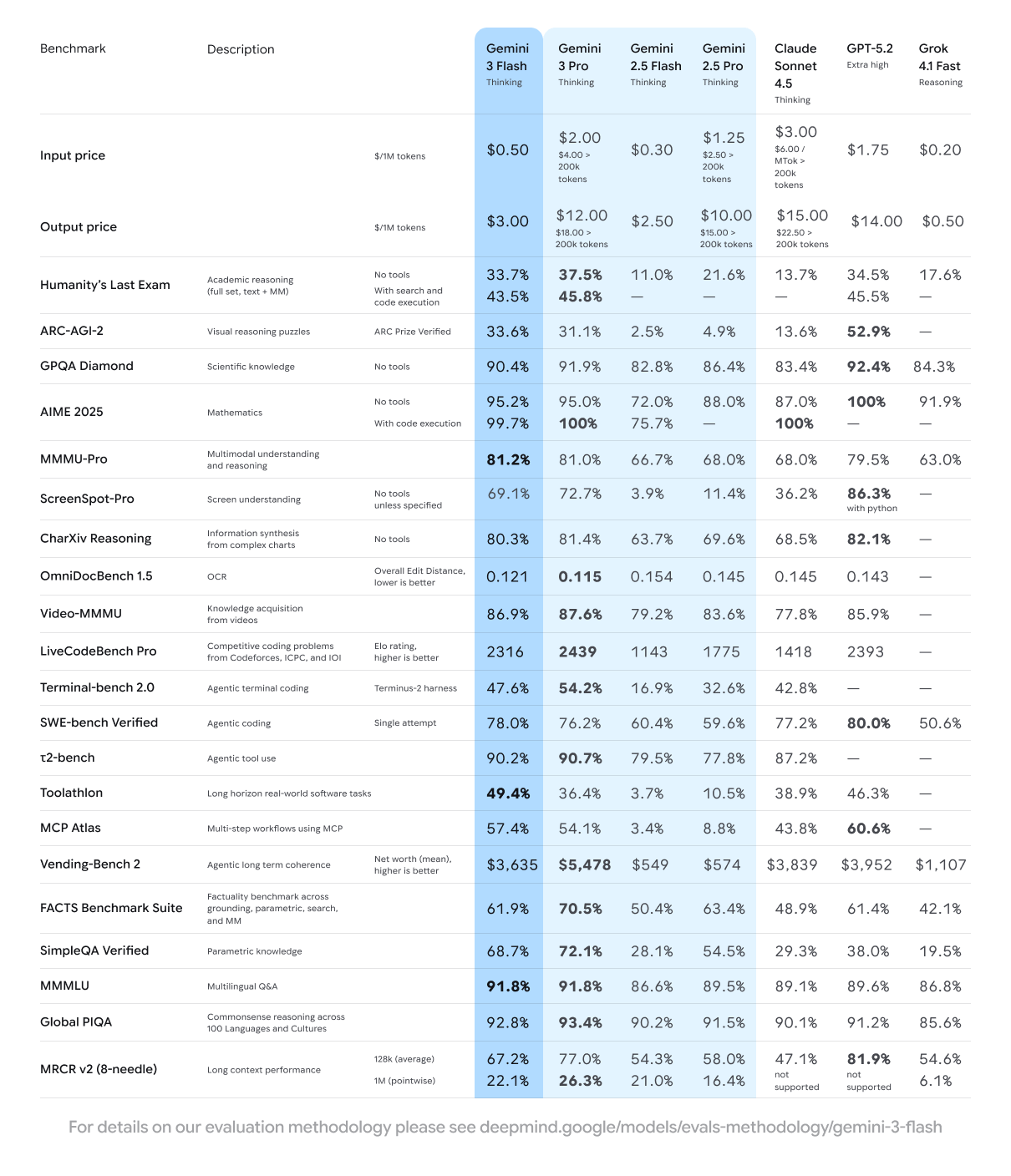
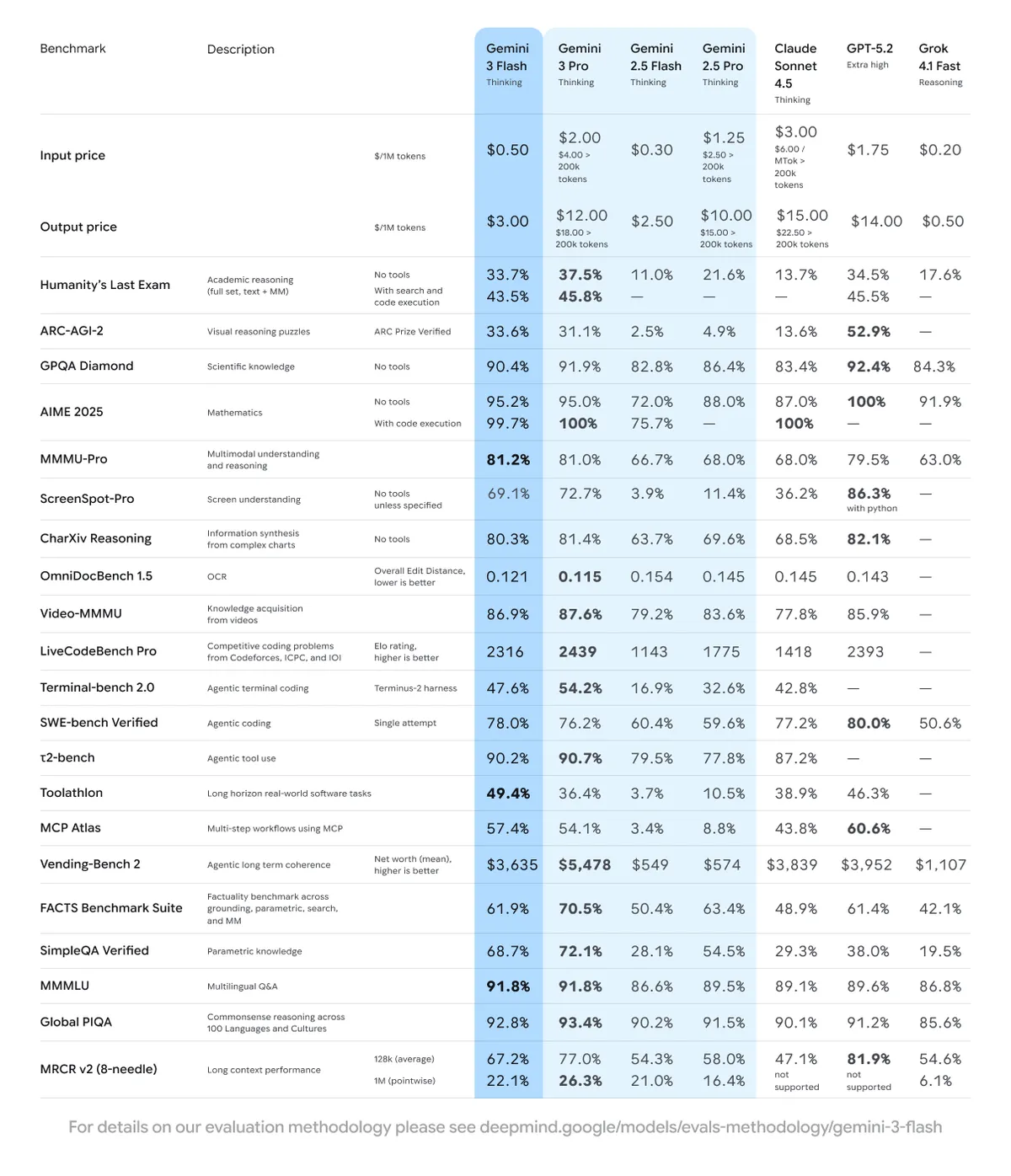
    Gemini 3 Flash price & benchmark table. 

    Gemini benchmarks table

    We’re committed to making useful AI technology accessible, with state-of-the-art open models. We built our Gemma family of models to be lightweight and open for public use; this year we were able to introduce multimodal capabilities, significantly increase the context window, expand multilingual capabilities, and improve efficiency and performance.

    Learn more about this year’s advances in Gemma models:

    Innovating and transforming our products with AI

    Throughout 2025, we continued to advance the trajectory of AI from tool to utility, transforming our portfolio of products with new, powerful agentic capabilities. We reimagined software development by moving beyond tools that assist coding to introducing powerful, agentic systems that collaborate with developers. Key advances, such as the impressive coding capabilities in Gemini 3 and the launch of Google Antigravity, mark a new era in AI-assisted software development.

    Learn more about this year’s advances building developer tools:

    This evolution was also clear across our core products, from AI-enabled features on the Pixel 10 and updates to AI Mode in Search like generative UI, to AI-first innovations like the Gemini app and NotebookLM, which gained advanced features like Deep Research.

    Learn more about how we’ve transformed our products with AI:

    Empowering creativity and co-creating with AI

    2025 was a transformative year for generative media, giving people new and unprecedented capabilities to realize their creative ambitions. Generative media models and tools for video, images, audio and worlds became more effective and broadly used, with breakouts Nano Banana and Nano Banana Pro offering unprecedented capabilities for native image generation and editing. We worked with people in creative industries to develop tools like Flow and Music AI Sandbox, making them more helpful for creative workflows, and we expanded creative possibilities for people with new, AI-powered experiences in the Google Arts & Culture lab, major upgrades to image editing within the Gemini app, and the introduction of powerful new generative media models like Veo 3.1, Imagen 4 and Flow.

    Learn more about how we’re building AI to enhance creativity:

    As research breakthroughs continue to expand AI’s capabilities, Google Labs is where we share AI experiments as we develop them – hearing from users and evolving as we learn. Some of this year’s most engaging experiments from Labs: Pomelli, an AI experiment for on-brand marketing content; Stitch, which introduced a way to turn prompt and image inputs into complex UI designs and frontend code in minutes; Jules, an asynchronous coding agent that acts as a collaborative partner for developers; and Google Beam, a 3D video communications platform that used AI to advance the possibilities of remote presence.

    Learn more about how we’re experimenting in Labs:

    Advancing science and mathematics

    2025 was also a banner year for scientific advances with AI, marked by breakthroughs in life sciences, health, natural sciences, and mathematics.

    In the space of a year, we made progress in building AI resources and tools that empower researchers and help them understand, identify, and develop treatments in healthcare. In genomics, where we’ve been applying advanced technology to research for 10 years, we moved beyond sequencing, using AI to interpret the most complex data. We also marked the 5-year anniversary of AlphaFold, the Nobel-winning AI system that solved the 50-year-old protein folding problem. AlphaFold has been used by over 3 million researchers in more than 190 countries, including over 1 million users in low- and middle-income countries.

    Learn more about how we’re using AI to advance life sciences and health:

    Gemini’s advanced thinking capabilities, including Deep Think, also enabled historic progress in mathematics and coding. Deep Think was able to solve problems that require deep abstract reasoning – achieving gold medal-standard in two international contests.

    Learn more about how we’re advancing natural sciences and mathematics:

    Shaping innovations in computing and the physical world

    We’re also leading major discoveries and shaping the future of science in areas like quantum computing, energy and moonshots. Research in this area drew new levels of public attention, with progress towards real-world applications of quantum computing as demonstrated by Quantum Echoes and, notably, Googler Michel Devoret becoming a 2025 Physics Nobel Laureate along with former Googler John Martinis and UC Berkeley’s John Clarke, for their foundational 1980s quantum research.

    Learn more about our work on space infrastructure and quantum computing:

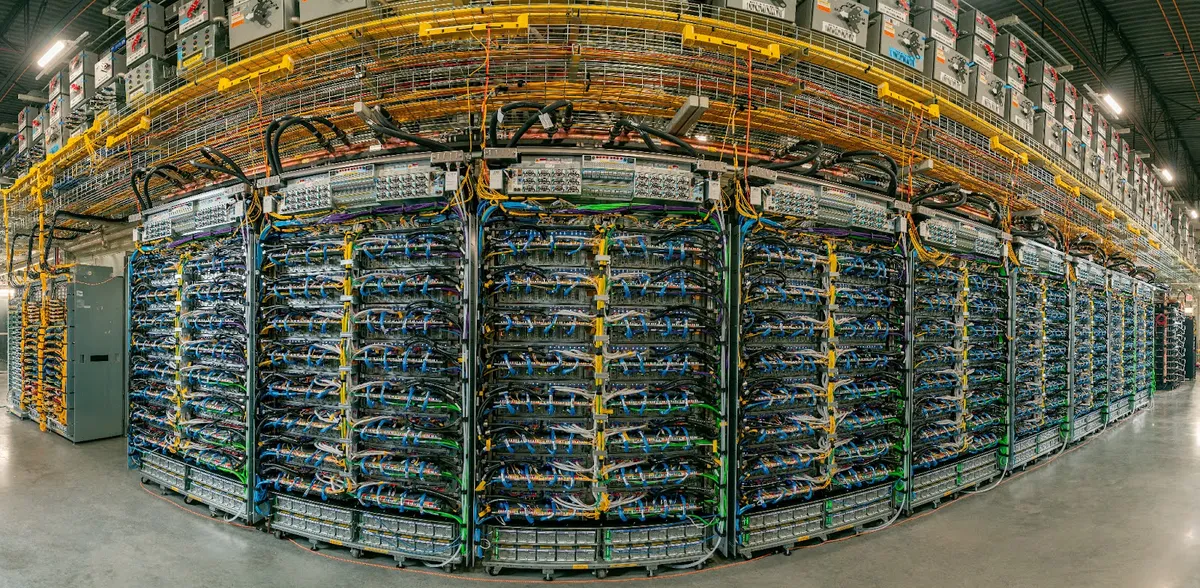
    In 2025, we continued to advance the core infrastructure that powers our AI, focusing on breakthroughs in hardware design and improving energy efficiency. This included the introduction of Ironwood, a new TPU built for the age of inference, which was designed using a method called AlphaChip, alongside a commitment to measuring the environmental impact of our technology.

    Learn more about how we’re using AI to develop chips, infrastructure and improve energy efficiency:

    Ironwood Superpod

    Our work in robotics and visual understanding brought AI agents into both the physical and virtual worlds, with advancements like the foundational Gemini Robotics models, the more sophisticated Gemini Robotics 1.5, and the introduction of Genie 3 as a new frontier for general-purpose world models.

    Learn more about our work with world models and robotics:

    Tackling global challenges and opportunities at scale

    Our work throughout 2025 demonstrates how AI-enabled scientific progress is being directly applied to address the world’s most critical and pervasive challenges. By leveraging state-of-the-art foundational models and agentic reasoning, we are significantly increasing our understanding of the planet and its systems, while also delivering impactful solutions in areas vital to human flourishing, including climate resilience, public health and education.

    For example, we are using state-of-the-art foundational models and agentic reasoning to help increase our understanding of the planet, helping enable work that is making a difference in people’s lives now from weather predictions to urban planning to public health. For example, our flood forecasting information now covers more than two billion people in 150 countries for severe riverine floods. And our most advanced and efficient forecasting model, WeatherNext 2 can generate forecasts 8x faster and with resolution up to 1-hour. Using this technology, we’ve supported weather agencies in making decisions based on a range of scenarios through our experimental cyclone predictions.

    Learn more about our work in weather, mapping and wildfires:

    We are working with partners to apply AI-enabled scientific progress closer to patients, opening up new avenues for disease management and therapeutic discovery.

    Learn more about our health-related work:

    AI is proving to be a powerful tool in education, enabling new forms of understanding and expanding curiosity through initiatives like LearnLM and Guided Learning in Gemini. We brought Gemini’s most powerful translation capabilities to Google Translate, enabling much smarter, more natural and accurate translations and piloting new speech to speech translation capabilities.

    Learn more about how we’re using AI to enable learning:

    Prioritizing responsibility and safety

    We couple our research breakthroughs with rigorous and forward-looking work on responsibility and safety. As our models grow more capable, we’re continuing to advance and evolve our tools, resources and safety frameworks to anticipate and mitigate risk. Gemini 3 demonstrated this approach in action: it’s our most secure model yet, and has undergone the most comprehensive set of safety evaluations of any Google AI model to date. And we’re looking further ahead, exploring a responsible path to AGI, prioritizing readiness, proactive risk assessment, and collaboration with the wider AI community.

    Learn more about our responsibility and safety work:

    Leading frontier collaborations with industry, academia and civil society

    Advancing the frontier of AI responsibly demands collaboration across all parts of society. In 2025, we worked with leading AI labs to help to form the Agentic AI Foundation and support open standards to ensure a responsible and interoperable future for agentic AI. In education, we’ve partnered with school districts like Miami Dade County and education groups like Raspberry Pi to equip students and educators with AI skills. Our research partnerships with universities like UC Berkeley, Yale, the University of Chicago and many more have been instrumental to some of this year’s most exciting frontier research, and we’re working with the US Department of Energy’s 17 national laboratories to transform how scientific research is conducted. And we’re working with filmmakers and other creative visionaries to put the best AI tools in their hands and explore storytelling in the age of AI.

    Learn more about our work on frontier collaboration:

    Looking ahead

    As we look towards 2026, we’re looking forward to continuing to advance the frontier, safely and responsibly, for the benefit of humanity.

    Collection

    2025 at Google

    Learn more about Google’s launches, milestones and more from 2025.

    See more

  • Gemini 3 Flash: frontier intelligence built for speed

    Gemini 3 Flash: frontier intelligence built for speed

    Gemini 3 Flash is our latest model with frontier intelligence built for speed that helps everyone learn, build, and plan anything — faster.


    Gemini 3 Flash text

    Your browser does not support the audio element.

    Listen to article

    [[duration]] minutes

    This content is generated by Google AI. Generative AI is experimental

    Today, we’re expanding the Gemini 3 model family with the release of Gemini 3 Flash, which offers frontier intelligence built for speed at a fraction of the cost. With this release, we’re making Gemini 3’s next-generation intelligence accessible to everyone across Google products.

    Last month, we kicked off Gemini 3 with Gemini 3 Pro and Gemini 3 Deep Think mode, and the response has been incredible. Since launch day, we have been processing over 1T tokens per day on our API. We’ve seen you use Gemini 3 to vibe code simulations to learn about complex topics, build and design interactive games and understand all types of multimodal content.

    With Gemini 3, we introduced frontier performance across complex reasoning, multimodal and vision understanding and agentic and vibe coding tasks. Gemini 3 Flash retains this foundation, combining Gemini 3’s Pro-grade reasoning with Flash-level latency, efficiency and cost. It not only enables everyday tasks with improved reasoning, but also is our most impressive model for agentic workflows.

    Starting today, Gemini 3 Flash is rolling out to millions of people globally:

    Gemini 3 Flash: frontier intelligence at scale

    Gemini 3 Flash demonstrates that speed and scale don’t have to come at the cost of intelligence. It delivers frontier performance on PhD-level reasoning and knowledge benchmarks like GPQA Diamond (90.4%) and Humanity’s Last Exam (33.7% without tools), rivaling larger frontier models, and significantly outperforming even the best 2.5 model, Gemini 2.5 Pro, across a number of benchmarks. It also reaches state-of-the-art performance with an impressive score of 81.2% on MMMU Pro, comparable to Gemini 3 Pro.

    A benchmark comparison table showing performance scores and prices for several language models including Gemini 3 Flash, Gemini 3 Pro Thinking, Gemini 2.5 Flash Thinking, Gemini 2.5 Pro Thinking, Claude Sonnet 4.5, GPT-5.2 Extra high, and Grok 4.1 Fast, across various tasks like academic reasoning, scientific knowledge, math, multi-modal understanding, coding, and long context performance.

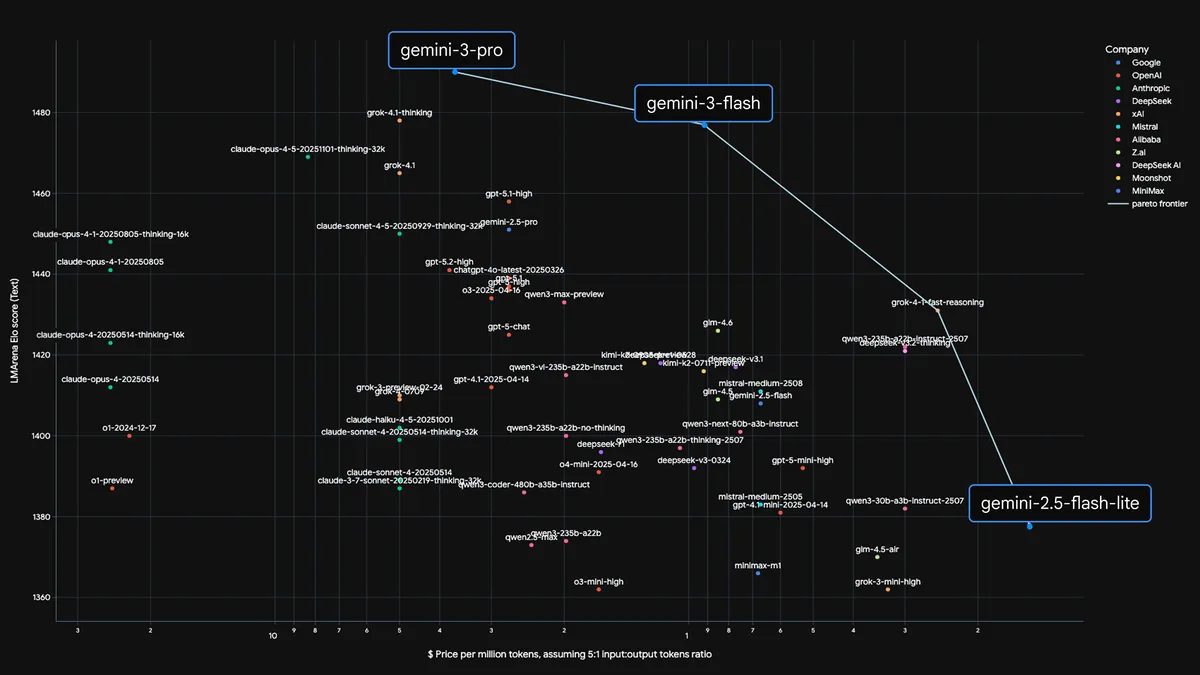
    In addition to its frontier-level reasoning and multimodal capabilities, Gemini 3 Flash was built to be highly efficient, pushing the Pareto frontier of quality vs. cost and speed. When processing at the highest thinking level, Gemini 3 Flash is able to modulate how much it thinks. It may think longer for more complex use cases, but it also uses 30% fewer tokens on average than 2.5 Pro, as measured on typical traffic, to accurately complete everyday tasks with higher performance.

    Gemini 3 Flash pushes the Pareto frontier on performance vs. cost and speed.

    Performance, here, is measured by LMArena Elo Score.

    A scatter plot showing LMArena Elo Score versus Price per million tokens for various language models, with a line highlighting the Pareto frontier through 'gemini-3-pro', 'gemini-3-flash', and 'gemini-3-flash-lite'.

    Gemini 3 Flash’s strength lies in its raw speed, building on the Flash series that developers and consumers already love. It outperforms 2.5 Pro while being 3x faster (based on Artificial Analysis benchmarking) at a fraction of the cost. Gemini 3 Flash is priced at $0.50/1M input tokens and $3/1M output tokens (audio input remains at $1/1M input tokens).

    For developers: intelligence that keeps up

    Gemini 3 Flash is made for iterative development, offering Gemini 3’s Pro-grade coding performance with low latency — it’s able to reason and solve tasks quickly in high-frequency workflows. On SWE-bench Verified, a benchmark for evaluating coding agent capabilities, Gemini 3 Flash achieves a score of 78%, outperforming not only the 2.5 series, but also Gemini 3 Pro. It strikes an ideal balance for agentic coding, production-ready systems and responsive interactive applications.

    Gemini 3 Flash in Google Antigravity works quickly to update production-ready applications.

    ” video-id=”MPkgMSWQMSU” video-type=”video”>

    Gemini 3 Flash’s strong performance in reasoning, tool use and multimodal capabilities is ideal for developers looking to do more complex video analysis, data extraction and visual Q&A, which means it can enable more intelligent applications — like in-game assistants or A/B test experiments — that demand both quick answers and deep reasoning.

    We’ve received a tremendous response from companies using Gemini 3 Flash. Companies like JetBrains, Bridgewater Associates, and Figma are already using it to transform their businesses, recognizing how its inference speed, efficiency and reasoning capabilities perform on par with larger models. Gemini 3 Flash is available today to enterprises via Vertex AI and Gemini Enterprise.

    JetBrains customer testimonial quote

    Bridgewater customer testimonial quote

    Figma customer testimonial quote

    Cursor customer testimonial quote

    Warp customer testimonial quote

    Harvey customer testimonial quote

    Astrocade customer testimonial quote

    Presentations.ai customer testimonial quote

    Replit customer testimonial quote

    Latitude customer testimonial quote

    For everyone: Gemini 3 Flash is rolling out globally

    Gemini 3 Flash is now the default model in the Gemini app, replacing 2.5 Flash. That means all of our Gemini users globally will get access to the Gemini 3 experience at no cost, giving their everyday tasks a major upgrade.

    Because of Gemini 3 Flash’s incredible multimodal reasoning capabilities, you can use it to help you see, hear and understand any type of information faster. For example, you can ask Gemini to understand your videos and images and turn that content into a helpful and actionable plan in just a few seconds.

    Or you can quickly build fun, useful apps from scratch using your voice without prior coding knowledge. Just dictate to Gemini on the go, and it can transform your unstructured thoughts into a functioning app in minutes.

    Describe an idea using Gemini 3 Flash and turn it into a working prototype in minutes.

    ” video-id=”8IYYMRdz2h4″ video-type=”video” image=”Gemini3_Flash_Food_Thumbnail” video-image-url-lazy=”https://storage.googleapis.com/gweb-uniblog-publish-prod/images/Gemini3_Flash_Food_Thumbnail.width-100.format-webp.webp” video-image-url-mobile=”https://storage.googleapis.com/gweb-uniblog-publish-prod/images/Gemini3_Flash_Food_Thumbnail.width-700.format-webp.webp” video-image-url-desktop=”https://storage.googleapis.com/gweb-uniblog-publish-prod/images/Gemini3_Flash_Food_Thumbnail.width-1000.format-webp.webp”>

    Gemini 3 Flash is also starting to roll out as the default model for AI Mode in Search with access to everyone around the world.

    Building on the reasoning capabilities of Gemini 3 Pro, AI Mode with Gemini 3 Flash is more powerful at parsing the nuances of your question. It considers each aspect of your query to serve thoughtful, comprehensive responses that are visually digestible — pulling real-time local information and helpful links from across the web. The result effectively combines research with immediate action: you get an intelligently organized breakdown alongside specific recommendations — at the speed of Search.

    This shines when tackling complex goals with multiple considerations like trying to plan a last-minute trip or learning complex educational concepts quickly.

    Gemini 3 Flash brings the incredible reasoning capabilities of Gemini 3 to Search, without compromising speed, so you can tackle your most complicated questions.

    ” video-id=”rPXBDSf-Hwg” video-type=”video”>

    Try Gemini 3 Flash today

    Gemini 3 Flash is available now in preview via the Gemini API in Google AI Studio, Google Antigravity, Vertex AI and Gemini Enterprise. You can also access it through other developer tools like Gemini CLI and Android Studio. It’s also starting to roll out to everyone in the Gemini app and AI Mode in Search, bringing fast access to next-generation intelligence at no cost.

    We’re looking forward to seeing what you bring to life with this expanded family of models: Gemini 3 Pro, Gemini 3 Deep Think and now, Gemini 3 Flash.

  • Gemma Scope 2: helping the AI safety community deepen understanding of complex language model behavior

    Gemma Scope 2: helping the AI safety community deepen understanding of complex language model behavior

    December 19, 2025 Responsibility & Safety

    Language Model Interpretability Team

    Announcing a new, open suite of tools for language model interpretability

    Large Language Models (LLMs) are capable of incredible feats of reasoning, yet their internal decision-making processes remain largely opaque. Should a system not behave as expected, a lack of visibility into its internal workings can make it difficult to pinpoint the exact reason for its behaviour. Last year, we advanced the science of interpretability with Gemma Scope, a toolkit designed to help researchers understand the inner workings of Gemma 2, our lightweight collection of open models.

    Today, we are releasing Gemma Scope 2: a comprehensive, open suite of interpretability tools for all Gemma 3 model sizes, from 270M to 27B parameters. These tools can enable us to trace potential risks across the entire “brain” of the model.

    To our knowledge, this is the largest ever open-source release of interpretability tools by an AI lab to date. Producing Gemma Scope 2 involved storing approximately 110 Petabytes of data, as well as training over 1 trillion total parameters.

    As AI continues to advance, we look forward to the AI research community using Gemma Scope 2 to debug emergent model behaviors, use these tools to better audit and debug AI agents, and ultimately, accelerate the development of practical and robust safety interventions against issues like jailbreaks, hallucinations and sycophancy.

    Our interactive Gemma Scope 2 demo is available to try, courtesy of Neuronpedia.

    What’s new in Gemma Scope 2

    Interpretability research aims to understand the internal workings and learned algorithms of AI models. As AI becomes increasingly more capable and complex, interpretability is crucial for building AI that is safe and reliable.

    Like its predecessor, Gemma Scope 2 acts as a microscope for the Gemma family of language models. By combining sparse autoencoders (SAEs) and transcoders, it allows researchers to look inside models, see what they’re thinking about, and how these thoughts are formed and connect to the model’s behaviour. In turn, this enables the richer study of jailbreaks or other AI behaviours relevant to safety, like discrepancies between a model’s communicated reasoning and its internal state.

    While the original Gemma Scope enabled research in key areas of safety, such as model hallucination, identifying secrets known by a model, and training safer models, Gemma Scope 2 supports even more ambitious research through significant upgrades:

    • Full coverage at scale: We provide a full suite of tools for the entire Gemma 3 family (up to 27B parameters), essential for studying emergent behaviors that only appear at scale, such as those previously uncovered by the 27b-size C2S Scale model that helped discover a new potential cancer therapy pathway. Although Gemma Scope 2 is not trained on this model, this is an example of the kind of emergent behavior that these tools might be able to understand.
    • More refined tools to decipher complex internal behaviors: Gemma Scope 2 includes SAEs and transcoders trained on every layer of our Gemma 3 family of models. Skip-transcoders and Cross-layer transcoders make it easier to decipher multi-step computations and algorithms spread throughout the model.
    • Advanced training techniques: We use state-of-the-art techniques, notably the Matryoshka training technique, which helps SAEs detect more useful concepts and resolves certain flaws discovered in Gemma Scope.
    • Chatbot behavior analysis tools: We also provide interpretability tools targeted at the versions of Gemma 3 tuned for chat use cases. These tools enable analysis of complex, multi-step behaviors, such as jailbreaks, refusal mechanisms, and chain-of-thought faithfulness.
  • Improved Gemini audio models for powerful voice experiences

    Improved Gemini audio models for powerful voice experiences


    Bibo Xu

    Director of Product Management

    Tara Sainath

    Distinguished Research Scientist


    Gemini Audio text logo

    Your browser does not support the audio element.

    Listen to article

    [[duration]] minutes

    This content is generated by Google AI. Generative AI is experimental

    Earlier this week, we introduced greater control over audio generation with an upgrade to our Gemini 2.5 Pro and Flash Text-to-Speech models.

    But generating expressive speech is only one side of the conversation. Today, we’re releasing an updated Gemini 2.5 Flash Native Audio for live voice agents. This update improves the model’s ability to handle complex workflows, navigate user instructions, and hold natural conversations.

    Gemini 2.5 Flash Native Audio is now available across Google products including Google AI Studio, Vertex AI, and has also started rolling out in Gemini Live and Search Live, bringing the naturalness of native audio to Search Live for the first time. This means you can more effectively brainstorm live with Gemini, get real-time help in Search Live, or build the next generation of enterprise-ready customer service agents.

    Beyond powering helpful agents, native audio unlocks new possibilities for global communication. We’re introducing live speech translation, a capability that enables streaming speech-to-speech translation for headphones. It preserves the speaker’s intonation, pacing and pitch. This beta experience is rolling out in the Google Translate app starting today.

    Live Voice Agents

    Gemini 2.5 Flash Native Audio is now enabling a wide spectrum of conversational experiences.

    ” video-id=”5eA5aZpVYbs” video-type=”video”>

    To enable the breadth of use cases across surfaces and products, we have improved Gemini 2.5 Native Audio in three key areas:

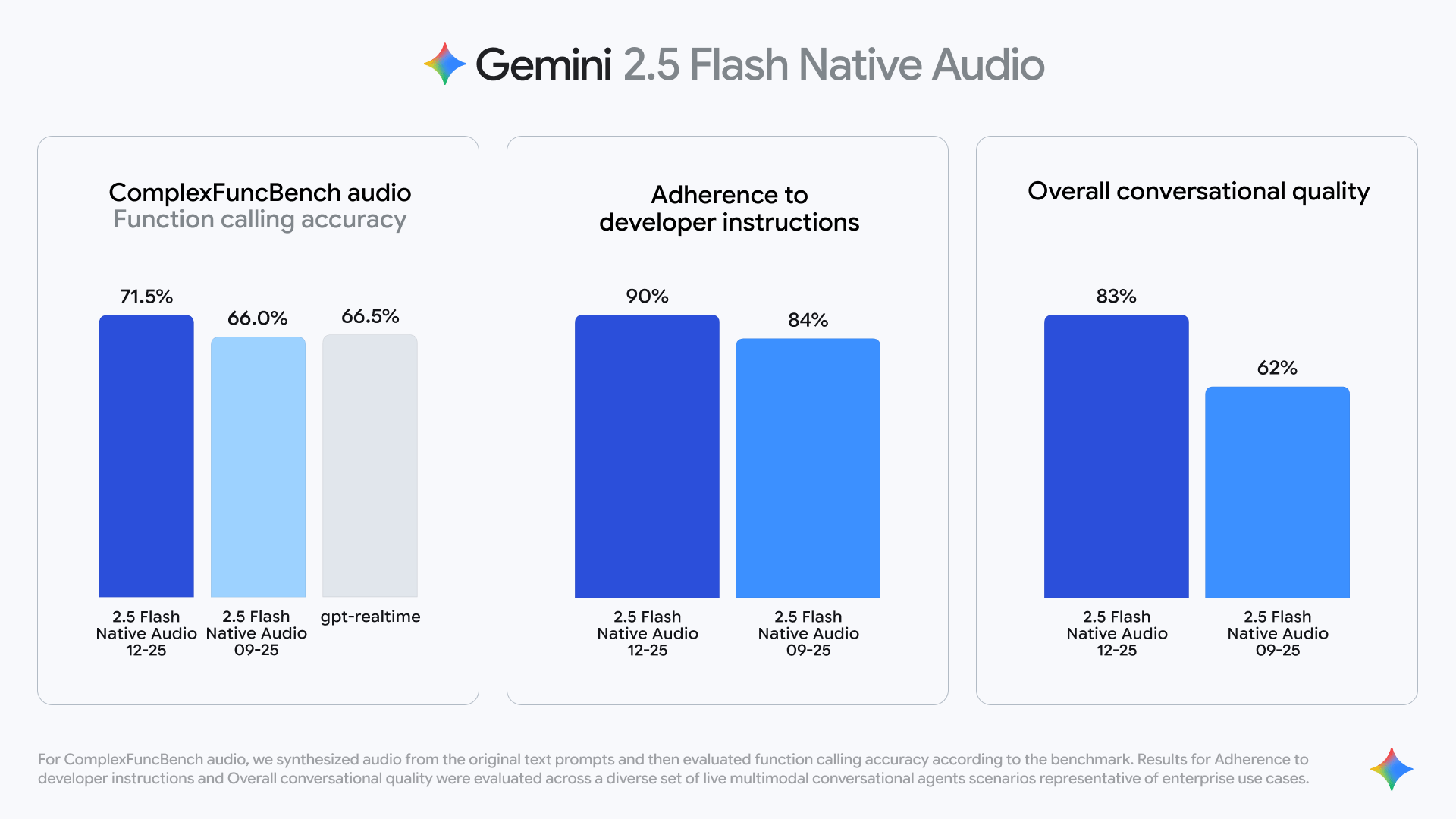
    • Sharper function calling: We’ve improved the model’s reliability when triggering external functions. It can now more accurately identify when to fetch real-time information during a conversation and seamlessly weave that data back into the audio response, without breaking the flow. On ComplexFuncBench Audio, an eval that captures multi-step function calling with various constraints, Gemini 2.5 Native Audio leads with a score of 71.5%.
    • Robust instruction following: The model is now better at handling complex instructions resulting in higher user satisfaction on content completeness. With a 90% adherence rate to developer instructions (up from 84%), it delivers more reliable outputs.
    • Smoother conversations: We’ve achieved significant gains in multi-turn conversation quality. Gemini 2.5 Flash Native Audio is able to retrieve context from previous turns more effectively, creating more cohesive conversations.

    The updated Gemini 2.5 Flash Native Audio’s performance against previous versions and industry competitors on ComplexFuncBench

    updated Gemini 2.5 Flash Native Audio’s performance against previous versions and industry competitors

    What customers are saying

    Google Cloud customers are already using Gemini’s native audio capabilities to drive real business results, from mortgage processing to customer calls.

    • “Users often forget they’re talking to AI within a minute of using Sidekick, and in some cases have thanked the bot after a long chat…New Live API AI capabilities offered through Gemini [2.5 Flash Native Audio] empower our merchants to win.” – David Wurtz, VP of Product, Shopify
    • “By integrating the Gemini 2.5 Flash Native Audio model…we’ve significantly enhanced Mia’s capabilities since launching in May 2025. This powerful combination has enabled us to generate over 14,000 loans for our broker partners.” – Jason Bressler, Chief Technology Officer, United Wholesale Mortgage (UWM)
    • “Working with the Gemini 2.5 Flash Native Audio model through Vertex AI allows Newo.ai AI Receptionists to achieve unmatched conversational intelligence … .They can identify the main speaker even in noisy settings, switch languages mid-conversation, and sound remarkably natural and emotionally expressive.” – David Yang, Co-founder, Newo.ai

    Live Speech Translation

    Gemini now natively supports new live speech-to-speech translation capabilities designed to handle both continuous listening and two-way conversation.

    With continuous listening, Gemini automatically translates speech in multiple languages into a single target language. This allows you to put headphones in and hear the world around you in your language.

    For two-way conversation, Gemini’s live speech translation handles translation between two languages in real-time, automatically switching the output language based on who is speaking. For example, if you speak English and want to chat with a Hindi speaker, you’ll hear English translations in real-time in your headphones, while your phone broadcasts Hindi when you’re done speaking.

    Gemini’s live speech translation has a number of key capabilities that help in the real world:

    • Language coverage: Translates speech in over 70 languages and 2000 language pairs by combining Gemini model’s world knowledge and multilingual capabilities with its native audio capabilities
    • Style transfer: Captures the nuance of human speech, preserving the speaker’s intonation, pacing and pitch so the translation sounds natural.
    • Multilingual input: Understands multiple languages simultaneously in a single session, helping you follow multilingual conversations without needing to fiddle around with language settings.
    • Auto detection: Identifies the spoken language and begins translation, so you don’t even need to know what language is being spoken to start translating.
    • Noise robustness: Filters out ambient noise so you can converse comfortably even in loud, outdoor environments.

    Starting today, you can try it in a new beta experience in the Google Translate app for real-time translation in your headphones by connecting them to your device and tapping “Live translate.” This experience is rolling out to all Android devices in the US, Mexico and India with support for iOS and more regions coming soon.

    Based on feedback, we will continue to iterate on this experience and bring it to more Google products including the Gemini API in 2026.

    Get started today

    Start building voice agents today with Gemini 2.5 Flash Native Audio, now generally available on Vertex AI and as preview in the Gemini API. Try it out in Google AI Studio.

    Gemini 2.5 Flash and 2.5 Pro text-to-speech models are also available via the Gemini API in Google AI Studio. Get started with the speech generation docs, explore the prompting guide, or check out the Gemini API Cookbook to get started.

  • Deepening our partnership with the UK AI Security Institute

    Deepening our partnership with the UK AI Security Institute

    December 11, 2025 Responsibility & Safety

    William Isaac and Owen Larter

    Today, we’re announcing an expanded partnership with the UK AI Security Institute (AISI) through a new Memorandum of Understanding focused on foundational security and safety research, to help ensure artificial intelligence is developed safely and benefits everyone.

    The research partnership with AISI is an important part of our broader collaboration with the UK government on accelerating safe and beneficial AI progress.

    Building on a foundation of collaboration

    AI holds immense potential to benefit humanity by helping treat disease, accelerate scientific discovery, create economic prosperity and tackle climate change. For these benefits to be realised, we must put safety and responsibility at the heart of development. Evaluating our models against a broad spectrum of potential risks remains a critical part of our safety strategy, and external partnerships are an important element of this work.

    This is why we have partnered with the UK AISI since its inception in November 2023 to test our most capable models. We are deeply committed to the UK AISI’s goal to equip governments, industry and wider society with a scientific understanding of the potential risks posed by advanced AI as well as potential solutions and mitigations.

    We are actively working with AISI to build more robust evaluations for AI models, and our teams have collaborated on safety research to move the field forward, including recent work on Chain of Thought Monitorability: A New and Fragile Opportunity for AI Safety. Building on this success, today we are broadening our partnership from testing to include wider, more foundational, research in a variety of areas.

    What the partnership involves

    Under this new research partnership, we’re broadening our collaboration to include:

    • Sharing access to our proprietary models, data and ideas to accelerate research progress
    • Joint reports and publications sharing findings with the research community
    • More collaborative security and safety research combining our teams’ expertise
    • Technical discussions to tackle complex safety challenges

    Key research areas

    Our joint research with AISI focuses on critical areas where Google DeepMind’s expertise, interdisciplinary teams, and years of pioneering responsible research can help make AI systems more safe and secure:

    Monitoring AI reasoning processes

    We will work on techniques to monitor an AI system’s “thinking”, also commonly referred to as its chain-of-thought (CoT). This work builds on previous Google DeepMind research as well, and our recent collaboration on this topic with AISI, OpenAI, Anthropic and other partners. CoT monitoring helps us understand how an AI system produces its answers, complementing interpretability research.

    Understanding social and emotional impacts

    We will work together to investigate the ethical implications of socioaffective misalignment; that is, the potential for AI models to behave in ways which do not align with human wellbeing, even when they’re technically following instructions correctly. This research will build on existing Google DeepMind work that has helped define this critical area of AI safety.

    Evaluating economic systems

    We will explore the potential impact of AI on economic systems by simulating real-world tasks across different environments. Experts will score and validate these tasks, after which they will be categorised along dimensions like complexity or representativeness, to help predict factors like long-term labour market impact.

    Working together to realise the benefits of AI

    Our partnership with AISI is one element of how we aim to realise the benefits of AI for humanity while mitigating potential risks. Our wider strategy includes foresight research, extensive safety training that goes hand-in-hand with capability development, rigorous testing of our models, and the development of better tools and frameworks to understand and mitigate risk.

    Strong internal governance processes are also essential for safe and responsible AI development, as is collaborating with independent external experts who bring fresh perspectives and diverse expertise to our work. Google DeepMind’s Responsibility and Safety Council works across teams to monitor emerging risk, review ethics and safety assessments and implement relevant technical and policy mitigations. We also partner with other external experts like Apollo Research, Vaultis, Dreadnode and more, to conduct extensive testing and evaluation of our models, including Gemini 3, our most intelligent and secure model to date.

    Additionally, Google DeepMind is a proud founding member of the Frontier Model Forum, as well as the Partnership on AI, where we focus on ensuring safe and responsible development of frontier AI models and increasing collaboration on important safety issues.

    We hope our expanded partnership with AISI will allow us to build more robust approaches to AI safety for the benefit not just of our own organisations, but also the wider industry and everyone who interacts with AI systems.

  • Strengthening our partnership with the UK government to support prosperity and security in the AI era

    Strengthening our partnership with the UK government to support prosperity and security in the AI era

    December 10, 2025 Responsibility & Safety

    Demis Hassabis, Lila Ibrahim, Pushmeet Kohli and Owen Larter

    Listen to article 7 minutes

    AI presents an opportunity to build a more prosperous and secure world.

    The UK has already laid a strong foundation to seize this moment and is uniquely positioned to translate AI innovation into public benefit. That’s why we are excited to deepen our collaboration with the UK government to accelerate this work and offer a blueprint for other countries.

    Together we will focus on using AI to speed up progress in science and education, modernize public services and advance national security and resilience.

    Accelerating access to frontier AI in key sectors: Science & Education

    Our partnership will center on providing access to frontier AI in two areas foundational to the UK’s long-term success: scientific discovery and education.

    The UK has a rich history of applying new technologies to drive scientific progress, from Hooke’s microscope to Faraday’s electrical experiments. We aim to build on this heritage, and empower the next generation of scientists with AI tools that can unlock breakthroughs, transform the economy, and solve some of the major challenges facing humanity. We will provide priority access to our “AI for Science” models to UK scientists, including:

    • AlphaEvolve – a Gemini-powered coding agent for designing advanced algorithms
    • AlphaGenome – an AI model to help scientists better understand our DNA
    • AI co-scientist – a multi-agent AI system that acts as a virtual scientific collaborator
    • WeatherNext – a family of state-of-the-art weather forecasting models

    Like the microscope or telescope, these AI tools are designed to enhance scientific capacity, enabling researchers to tackle problems of unprecedented complexity and scale. For example, AlphaFold – our AI system for predicting protein structures – has already enabled almost 190,000 researchers in the UK alone to deepen their understanding of areas such as crop resilience, antimicrobial resistance and other critical biological challenges.

    Establishing Google DeepMind’s first automated science laboratory in the UK

    To help turbocharge scientific discovery, we will establish Google DeepMind’s first automated laboratory in the UK in 2026, specifically focused on materials science research. A multidisciplinary team of researchers will oversee research in the lab, which will be built from the ground up to be fully integrated with Gemini. By directing world-class robotics to synthesize and characterize hundreds of materials per day, the team intends to significantly shorten the timeline for identifying transformative new materials.

    Discovering new materials is one of the most important pursuits in science, offering the potential to reduce costs and enable entirely new technologies. For example, superconductors that operate at ambient temperature and pressure could allow for low cost medical imaging and reduce power loss in electrical grids. Other novel materials could help us tackle critical energy challenges by unlocking advanced batteries, next-generation solar cells and more efficient computer chips.

    Rowendale Integrated Primary School participating in the Northern Ireland Education Authority’s C2k program where teachers were able to save up to 10 hours per week with their use of tools like Gemini for Education.

    Enhancing teaching and learning

    AI can augment the classroom experience, especially when grounded in learning science.

    This impact was made clear in a successful pilot program in Northern Ireland, where Gemini helped save teachers an average of 10 hours per week by streamlining administrative work and brainstorming engaging lesson content.

    Beyond time savings, Eedi’s recent exploratory randomized controlled trial (RCT) with UK students indicates that AI can help drive effective student learning. Students who received short AI tutoring sessions (under supervision by teachers) were 5.5 percentage points more likely to solve novel problems on subsequent topics than students who worked with human tutors alone.

    To help scale this impact further across the UK, we are supporting research to understand how AI tools impact teaching and learning through a rigorous scientific approach, and exploring how to tailor our Gemini model – leveraging our longstanding commitment to pedagogy, including our LearnLM efforts – to complement England’s national curriculum. Our goal is to deliver state of the art educational experiences while also helping reduce educator workloads, freeing them to reclaim more time to focus on what they do best: helping every learner thrive.

    Modernizing public services

    AI also has tremendous potential to help build more effective and efficient public services. We are working directly with government teams to ensure they have the technical expertise and access to frontier models required to reimagine these services to better serve citizens. The UK Government’s AI Incubator team (i.AI) is currently trialling Extract – a tool for council planners that uses Gemini to transform old planning documents into clear, digital data. Currently, converting a single planning document takes up to 2 hours. Extract will transform these into digital data in just 40 seconds, significantly speeding up decision-making timelines.

    Advancing national security and resilience

    Our partnership will involve deeper collaboration with the UK AI Security Institute on critical safety research in explainability, alignment and societal impact, so these risks may be better understood and mitigated. Read more about this work here.

    AI can also be a powerful defender against security risks. We will work with the UK government to advance AI-enhanced approaches to national cyber resilience, exploring using tools like Big Sleep and CodeMender to identify vulnerabilities and automatically fix code, enabling a more secure future.

    National partnerships on AI

    We believe AI will be humanity’s most transformational technology, and we are committed to partnering with governments globally to turn its potential into real progress for people everywhere. By building on our collaboration with the UK government and important initiatives like the US-UK Tech Prosperity Deal, we aim to advance innovation, scientific discovery, and security for all.

    Deepening our partnership with the UK AI Security Institute

    AlphaEvolve: A Gemini-powered coding agent for designing advanced algorithms

    AlphaGenome: AI for better understanding the genome

    WeatherNext 2: Our most advanced weather forecasting model

    How AI is giving Northern Ireland teachers time back

    Introducing CodeMender: an AI agent for code security