

Author: admin

  • My 60-year-old client asked me how to get stronger hips, so I recommended two things straight away (avoid this one thing)

    My 60-year-old client asked me how to get stronger hips, so I recommended two things straight away (avoid this one thing)

    a senior woman doing a stretch
    (Image credit: Getty Images/Silke Woweries)

    I wish all my clients would ask me how to build strong hips that feel open and free because the answer isn’t necessarily what you might think.

    Years ago, the gold standard was stretching. But now, the tide is turning in favor of weighted mobility routines, dynamic stretching and more controlled weight training. If you can, loading your mobility warm-ups will help you build strength, control and stability that carries over to all exercise.

    It’s hard to convince people to stick to a consistent mobility routine, but I’m hoping these quick tips will convince you to make more space in your week for low-impact movement.

    Recently, a 60-year-old client asked me for strong hips, and I gave her this advice. Just remember, this routine was designed with my client in mind. Seek medical advice personalized to you before starting a new regimen.

    I recommend thinking about two things in particular for strong hips.

    1. Planes of motion

    Young woman on yoga mat at home performing a glute exercise in tabletop position with left leg extended behind her

    (Image credit: Shutterstock)

    The planes of motion refer to sagittal, frontal and rotational movement, which means movements front-back, side-to-side, and rotation. To keep your hips truly strong and healthy, you must target as many of them as possible, which means moving in all directions.

    I’ve included a short video below to show you some examples of movements you can try, but as a general rule of thumb, think about lifting and lowering your legs (the job of the hip flexors), internally and externally rotating your hip joints, abducting your hips, which means moving your leg away from your midline, plus adducting, which means bringing the limbs closer.

    2. Loading the hips and force production
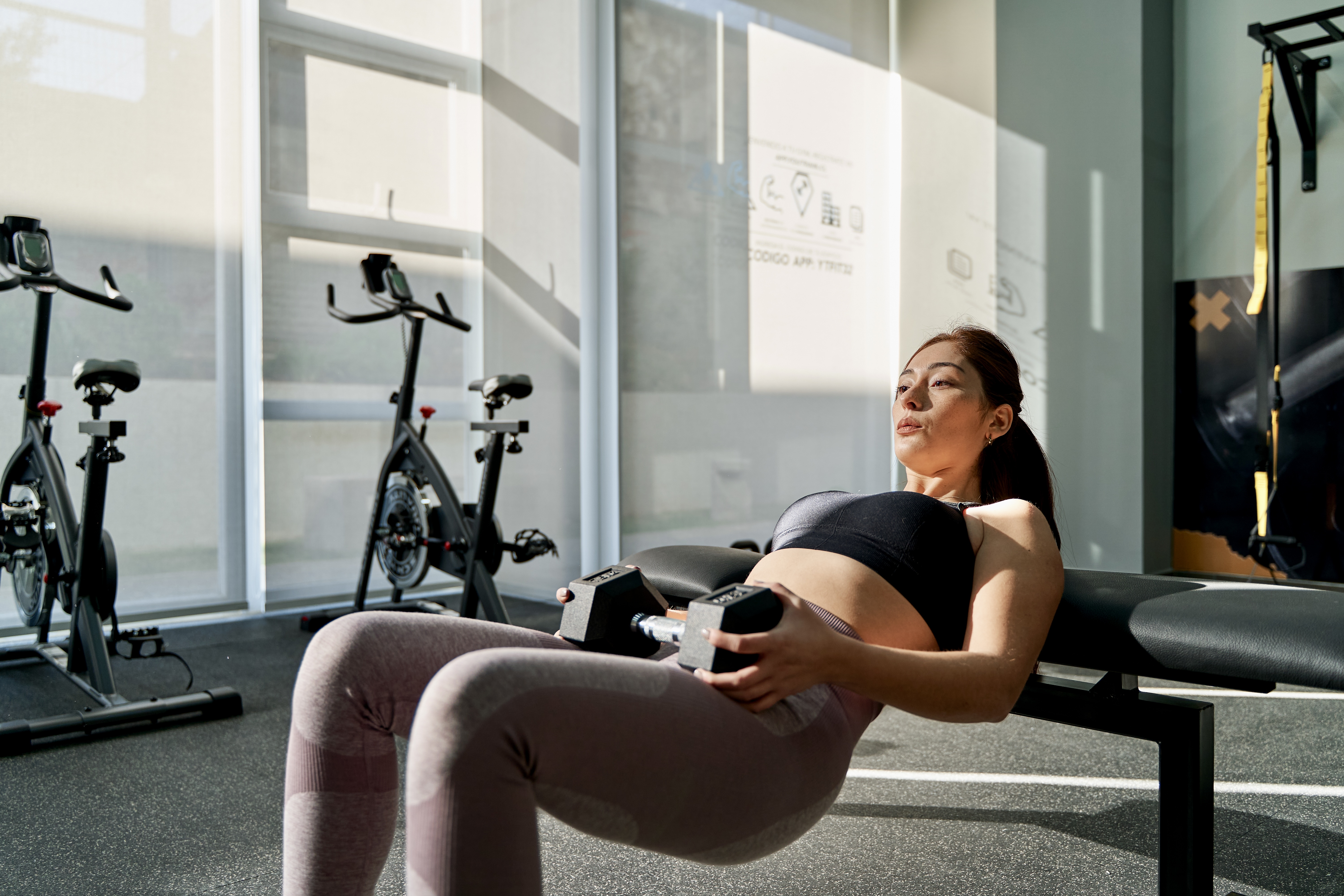
    Woman doing hip thrust with weight

    (Image credit: Shutterstock)

    Loading your movements with resistance bands, kettlebells, dumbbells, loop bands, barbells and props like Pilates balls will increase the intensity and resistance your joints and muscles work through, but the exercises themselves should remain low-impact.

    Get instant access to breaking news, the hottest reviews, great deals and helpful tips.

    Think about longevity and the ability of your hips to withstand impact. That is your key to injury prevention. You don’t need heavy weights, either; you just need to move slowly and with control, using rep ranges between 6-10 and sets between 2-4.

    Sometimes, you can feel an exercise more with a lighter weight, full control and range of motion. It doesn’t take away from the movement when the quality improves. I’ve included a short warm-up example below that you can use with just a loop band.

    I recently spoke with a bone loading expert (our chat will be published in the next few days, at the time of writing), who told me that the best way to build strong bones, ligaments, muscles and tendons is to produce high force using low-impact movement.

    That includes pushing hard against a stationary object or holding positions using heavy loads. Consider this the next time you turn to a HIIT routine!

    Avoid “just” stretching

    senior woman stretching

    (Image credit: Shutterstock)

    Your hips help you raise your knees. But they need to rotate, adduct, abduct, stabilize, protect, control and help produce force, too. So just sitting in a stretch for a few minutes, while beneficial for short-term flexibility, isn’t going to cut it if you want to build truly strong, mobile hips.

    Think about how long many of us sit during the day; our hips respond really well to movement, so when you take a break from your desk, use that opportunity wisely. I’m not saying don’t stretch at all, just don’t depend on it to fix all niggles and tightness. Staying stationary can cause weaknesses and underactive muscles, which in areas like the hips can lead to back pain.

    Also, much of the existing research on the stretch reflex indicates we need to sit in stretches for much longer than we realize to allow muscles to feel safe enough to relax. While your reflex prevents any sudden force or overstretching by inhibiting it, stretching for over 30 seconds gently signals to your muscles and nervous system that your body is safe, allowing you to benefit from the stretch properly and relax into it.

    So, if you do plan to stretch, give yourself enough time to settle into it. I recommend Yin yoga, which is a slow, static form of yoga that encompasses this.

    Verdict

    Overall, it really is as simple as choosing 3-6 low-impact exercises you enjoy, performing 6-10 reps and 2-4 sets of them, and loading them appropriately using equipment you like using. Use as much range of motion and slow, controlled movement as you can, and focus on producing force against resistance without high-impact joint work.

    Over time, progress movements accordingly or switch them out. Move your hips in all directions, and try to focus on the ones you don’t like or aren’t good at, as this is a sign your hips need it!

    Follow Tom’s Guide fitness on Instagram for more workouts, routines, tips, and tricks.


    Google News

    Follow Tom’s Guide on Google News and add us as a preferred source to get our up-to-date news, analysis, and reviews in your feeds. Alternatively, you can read our content on the Tom’s Guide app available now for iOS and Android. Subscribe to Tom’s Guide on YouTube and follow us on TikTok.


    More from Tom’s Guide

    Sam Hopes is a level 3 qualified trainer, a level 2 Reiki practitioner and fitness editor at Tom’s Guide. She is also currently undertaking her Yoga For Athletes training course.

    Sam has written for various fitness brands and websites over the years and has experience across brands at Future, such as Live Science, Fit&Well, Coach, and T3.

    Having coached at fitness studios like F45 and Virgin Active and taken on both 1:1 and group, Sam now primarily teaches outdoor bootcamps, bodyweight, and kettlebells.

    She also coaches mobility and flexibility classes several times a week.

    Sam has completed two mixed doubles Hyrox competitions in London and the Netherlands and finished her first doubles attempt in 1:11.

  • Learning by Compression: Risk Estimates Attain the Law-of-Large-Numbers Rate

    Learning by Compression: Risk Estimates Attain the Law-of-Large-Numbers Rate

    [Submitted on 9 Oct 2026]

    View PDF HTML (experimental)

    Abstract:Compression schemes provide a general framework for deriving data-dependent risk bounds for learning algorithms. For learning rules based on preferent compression, existing results upper-bound the risk in terms of a sample-dependent complexity $boldsymbol{k}$, defined as the cardinality of the compression augmented by the training examples on which the reconstructed hypothesis is inappropriate. These results, however, yield a margin of order $O(sqrt{ln N/N})$ above $boldsymbol{k}/N$. In this paper, we establish that the logarithmic factor is not intrinsic. We prove that, for every fixed confidence level $1-delta$, the risk is bounded with probability at least $1-delta$ by $$ frac{boldsymbol{k}}{N} + Oleft(frac{1}{sqrt{N}}right), $$ uniformly over all possible values of $boldsymbol{k}$. Thus, risk estimates for learning algorithms based on preferent compression attain the same law-of-large-numbers rate as the empirical estimate of the probability of a fixed event. We also show that the leading term $boldsymbol{k}/N$ is necessary and investigate its relation to the empirical risk. In particular, we identify regimes in which the empirical risk retains the $O(1/sqrt{N})$ convergence rate, as well as regimes in which it converges more slowly or ceases to be consistent, while the complexity-based estimator preserves the $O(1/sqrt{N})$ rate.

    Submission history

    From: Simone Garatti [view email]
    [v1] Fri, 9 Oct 2026 11:44:43 UTC (24 KB)

  • A Critical Look at Power Sampling when Test Time Sharpening LLMs

    A Critical Look at Power Sampling when Test Time Sharpening LLMs

    [Submitted on 9 Oct 2026]

    View PDF HTML (experimental)

    Abstract:Reinforcement learning with verifiable rewards (RLVR) has substantially improved LLM reasoning, yet growing evidence suggests it mainly performs distribution sharpening: concentrating probability mass on reasoning paths the base model already produces. Recent work therefore seeks RLVR’s gains without needing reward signals, by sampling from the power distribution $pi_alpha propto pi_{text{base}}^alpha$ via Markov chain Monte Carlo or sequential Monte Carlo. We show that these samplers fail to converge to $pi_alpha$ under realistic compute budgets, and that their gains are largely recreated via simple Best-of-$N$ with appropriate grading . This suggests they succeed by selecting high-probability sequences, not by approximating $pi_alpha$, raising a natural question: is the power distribution itself a worthwhile target? We test this hypothesis directly by fine-tuning the base model to match $pi_alpha$, sidestepping sampler convergence issues entirely. Despite approximating the target far more faithfully than existing samplers, this strategy yields gains that are noisy and specific to certain models and sampling tasks. Together, our results suggest that the value of power sampling lies not in faithfully targeting $pi_alpha$, but in the simpler goal of extracting sequences the base model already deems likely.

    Submission history

    From: Abiel Malkani Talwar [view email]
    [v1] Fri, 9 Oct 2026 14:29:28 UTC (235 KB)

  • Equality, Equity, and Causality in Fairness Research: A Commentary on Cheng (2026)

    Equality, Equity, and Causality in Fairness Research: A Commentary on Cheng (2026)

    [Submitted on 20 Jul 2026 (v1), last revised 9 Oct 2026 (this version, v2)]

    View PDF HTML (experimental)

    Abstract:This is an invited commentary on the Psychometrika focus article “Fairness Issues and Evaluation in Psychometrics and AI/ML: What Can We Learn from Each Field?” by Ying Cheng (2026, doi:https://doi.org/10.1017/psy.2026.10110). Cheng offers a systematic comparison between long-standing test fairness and modern algorithmic fairness. Her mapping of the entire testing workflow onto the AI/ML fairness paradigm, rather than only the final selection stage, is a crucial contribution to interdisciplinary fairness research. This commentary extends her discussion by examining two conceptual issues: the distinction between equality and equity, and the role of causality in fairness research. The focus article and this commentary point to directions for future fairness research across the psychometrics and AI/ML communities.

    Submission history

    From: Youmi Suk [view email]
    [v1] Mon, 20 Jul 2026 08:30:06 UTC (14 KB)
    [v2] Fri, 9 Oct 2026 12:26:26 UTC (14 KB)

  • The Predictability Bias of Joint-Embedding Predictive Learning in Medical Imaging

    The Predictability Bias of Joint-Embedding Predictive Learning in Medical Imaging

    [Submitted on 9 Oct 2026]

    View PDF HTML (experimental)

    Abstract:Joint-embedding predictive architectures (JEPAs) learn by predicting teacher representations of masked regions from visible context. Point prediction summarizes the conditional target distribution and cannot reproduce variation that the context does not resolve. We call this constraint predictability bias. In computed tomography (CT), recurrent anatomy is predictable from context, whereas the sporadic, localized pathology that determines clinical interpretation often is not. We introduce TAP-JEPA, a ViT-B/3D trained on 113,611 CT volumes that is competitive with state-of-the-art encoders (COLIPRI, Merlin, VoxelFM) in scan-level classification. We then audit the learned predictive pathway by replaying the exact masking, teacher, and predictor computations used during training. Prediction lowers the mean Skill (prevalence-normalized average precision) from 0.388 to 0.271 for pathology, but only from 0.921 to 0.873 for anatomy. Along the teacher direction, separating pathology from matched control regions in the same organ, prediction moves pathology 34.7% toward the controls and controls 13.6% toward pathology, with larger shifts farther from visible context. Replacing visible matched-control representations increases surrounding-target prediction loss more than fully replacing pathology representations across four pathology categories. Downstream, removing all final-layer pathology tokens reduces the decision margin by at most 0.45% in four of seven scan-level probes. Together, these results show that contextual predictability is not a sufficient proxy for clinical relevance in medical representation learning. Training objectives should therefore retain diagnostic features regardless of their predictability from surrounding anatomy.

    Submission history

    From: Fabian Drexel [view email]
    [v1] Fri, 9 Oct 2026 08:53:13 UTC (39,204 KB)

  • The Fourth Quadrant: A Stylized View of Benign Misfitting

    The Fourth Quadrant: A Stylized View of Benign Misfitting

    [Submitted on 2 Aug 2026 (v1), last revised 8 Oct 2026 (this version, v2)]

    View PDF HTML (experimental)

    Abstract:Training error is what we can observe on a training set; test error is the quantity we care about. We study squared-error linear regression in a deterministic $(d+1)$-dimensional single-spike model. Each training vector has spike coordinate $sqrt{gamma}$, $gamma>1$, and equal-norm, mutually orthogonal nuisance components. Training labels are $1$. Fresh test points are centered Gaussian with covariance $operatorname{diag}(gamma,1,ldots,1)$ and noise-free label $x[1]/sqrt{gamma}$. We compute the exact train–test tradeoff for linear predictors in the training span. When the spike direction is unknown, allowing all linear predictors does not improve this tradeoff, on average or in the worst case over directions consistent with the data. There is a range of training-set sizes where every span predictor that generalizes well must fit the training data worse than the zero predictor. We call this benign misfitting, or the fourth quadrant. At its sharpest, test error tends to zero while training error diverges, with both zero-predictor errors normalized to one. The best span predictor begins to generalize when $ngg d/gamma^2$, while interpolation needs $ngg d/gamma$. In the intervening window $d/gamma^2ll nll d/gamma$, useful span prediction lies beyond interpolation: training predictions overshoot the labels. One-pass stochastic gradient descent with a large constant learning rate attains small test error throughout this window, matching the best span predictor up to a logarithmic factor, while leaving large empirical training error. Finally, the nuisance component responsible for the training misfit also controls adversarial sensitivity.

    Submission history

    From: Anant Sahai [view email]
    [v1] Sun, 2 Aug 2026 06:27:55 UTC (136 KB)
    [v2] Thu, 8 Oct 2026 23:13:07 UTC (202 KB)

  • Infinitesimal Operator World Models: Finite-Sample Guarantees for Offline Reinforcement Learning

    Infinitesimal Operator World Models: Finite-Sample Guarantees for Offline Reinforcement Learning

    [Submitted on 13 Nov 2025 (v1), last revised 9 Oct 2026 (this version, v2)]

    View PDF HTML (experimental)

    Abstract:Continuous-time stochastic processes underlie many natural and engineered systems. In healthcare, autonomous driving, and industrial control, direct interaction with the environment is often unsafe or impractical, motivating offline reinforcement learning from historical data. However, there is limited statistical understanding of the approximation errors inherent in learning policies from offline datasets. We address this by linking reinforcement learning to the Hamilton-Jacobi-Bellman equation and proposing an operator-theoretic algorithm based on a simple dynamic programming recursion. Specifically, we represent our world model in terms of the infinitesimal generator of controlled diffusion processes learned in a reproducing kernel Hilbert space. By integrating statistical learning methods and operator theory, we establish global convergence of the value function under sufficiently small generator-approximation error and derive explicit finite-sample guarantees with bounds tied directly to system properties such as smoothness and stability. Our theoretical and proof-of-concept results indicate that operator-based approaches may hold promise for solving offline reinforcement learning using continuous-time optimal control.

    Submission history

    From: Nicolas Hoischen [view email]
    [v1] Thu, 13 Nov 2025 14:58:30 UTC (1,427 KB)
    [v2] Fri, 9 Oct 2026 13:08:08 UTC (2,717 KB)

  • Market Impact Estimation via Causal Foundation Models

    Market Impact Estimation via Causal Foundation Models

    [Submitted on 8 Oct 2026]

    View PDF HTML (experimental)

    Abstract:When a trader executes a large order, the relevant question is not emph{what will the price be?} but emph{what would the price have been had I not traded?} Market impact is thus a causal quantity, yet classical models (Almgren–Chriss, propagators) regress price on flow, which is biased whenever informed flow moves prices through information as well as trading. We present a proof-of-concept emph{Causal Market Simulator}: a continuous-time causal prior-data fitted network (PFN) trained on a synthetic market prior in which a hidden informational flow confounds the flow–price relation by construction, with confounding strength an exact per-episode knob. On this prior, the naive estimator’s bias follows a closed form we confirm empirically (up to 68% overestimation), while the PFN tracks the unbiased true-parameter oracle at high confounding. Its emph{do-ablated twin}, the same model with the intervention inputs removed, collapses onto the pre-window mean. Zero-shot, the model responds at the ground-truth scale to metaorders in an ABIDES limit-order book ($+0.38$ pre-onset standard deviations against seed-replay counterfactuals), and its intervention response replicates on about 2,300 detected flow bursts in BTC/ETH/SOL perpetuals and 3,800 on Nasdaq equities, evidence consistent with, though not proof of, causal transfer. Off-prior the response degrades gracefully, and split-conformal recalibration repairs interval calibration. Transfer hinges on encoding the metaorder as added flow rather than a clamped price level, not on more training. A recurrent state-space variant closes the remaining shape gap: its impact accrues over execution duration where the transformer’s stays flat, raising the correlation with measured metaorder impact from $+0.68$ to between $+0.92$ and $+0.96$, at the cost of weaker on-prior deconfounding that traces to the training recipe rather than to recurrence.

    Submission history

    From: Dennis Thumm [view email]
    [v1] Thu, 8 Oct 2026 13:29:39 UTC (182 KB)

  • On the Rate of Convergence of GD in Non-linear Neural Networks: An Adversarial Robustness Perspective

    On the Rate of Convergence of GD in Non-linear Neural Networks: An Adversarial Robustness Perspective

    [Submitted on 2 Mar 2026 (v1), last revised 8 Oct 2026 (this version, v2)]

    View PDF

    Abstract:We study the convergence dynamics of Gradient Descent (GD) in a minimal binary classification setting, consisting of a two-neuron ReLU network and two training instances. We prove that even under these strong simplifying assumptions, while GD successfully converges to an optimal robustness margin, effectively maximizing the distance between the decision boundary and the training points, this convergence occurs at a prohibitively slow rate, scaling strictly as $Theta(1/ln(t))$. To the best of our knowledge, this establishes the first explicit lower bound on the convergence rate of the robustness margin in a non-linear model. Through empirical simulations, we further demonstrate that this inherent failure mode is pervasive, exhibiting the exact same tight convergence rate across multiple natural network initializations. Our theoretical guarantees are derived via a rigorous analysis of the GD trajectories across the distinct activation patterns of the model. Specifically, we develop tight control over the system’s dynamics to bound the trajectory of the decision boundary, overcoming the primary technical challenge introduced by the non-linear nature of the architecture.

    Submission history

    From: Guy Smorodinsky [view email]
    [v1] Mon, 2 Mar 2026 17:13:33 UTC (38 KB)
    [v2] Thu, 8 Oct 2026 18:50:56 UTC (38 KB)

  • GlucoPRISM: Protocol-Supervised Pretraining for Cross-Cohort Glucose Transfer

    GlucoPRISM: Protocol-Supervised Pretraining for Cross-Cohort Glucose Transfer

    [Submitted on 8 Oct 2026]

    View PDF HTML (experimental)

    Abstract:Continuous glucose monitoring (CGM) foundation models encode each day as one vector that mixes who the person is, what happened that day and how the sensor measured it, so measurement differences travel with the representation into new cohorts. We ask whether pretraining can place the measurement component that harms transfer in known coordinates, so that deployment drops them with a fixed projection and no target data. GlucoPRISM supervises a GlucoFM backbone with response contracts, rules for how each part of the representation should change when only the day or only the sensor changes: a 64-dimensional Trait band should change with neither, a 48-dimensional State band only across days, and a 16-dimensional Sensor band should track the device. Synthetic sensor views calibrated on paired Dexcom and Libre recordings, different-day pairs and glucose-summary targets supply this supervision without clinical labels. Across twelve cross-cohort directions, dropping the Sensor band from the same frozen encoder raises mean transfer AUROC from 68.75 to 73.57, against 69.3 for GlucoFM. The gain has two parts. Into CGMacros, the one target cohort recorded with two sensor types, filtering adds 11 to 19 points, and this holds when the generator is recalibrated on half of the participants and scored on the other half. On the other eight directions filtering is neutral and the encoder itself exceeds GlucoFM by 3.5 points. The device remains linearly decodable after filtering, so the filter removes a device-related component that harms transfer rather than all measurement information. The retained bands improve window AUROC on thirteen of fourteen public task–cohort cells (Holm-adjusted p=0.031) and correlation on fourteen of fifteen clinical endpoints in an external cohort of 9,303 participants.

    Submission history

    From: Imran Razzak [view email]
    [v1] Thu, 8 Oct 2026 09:14:26 UTC (2,902 KB)