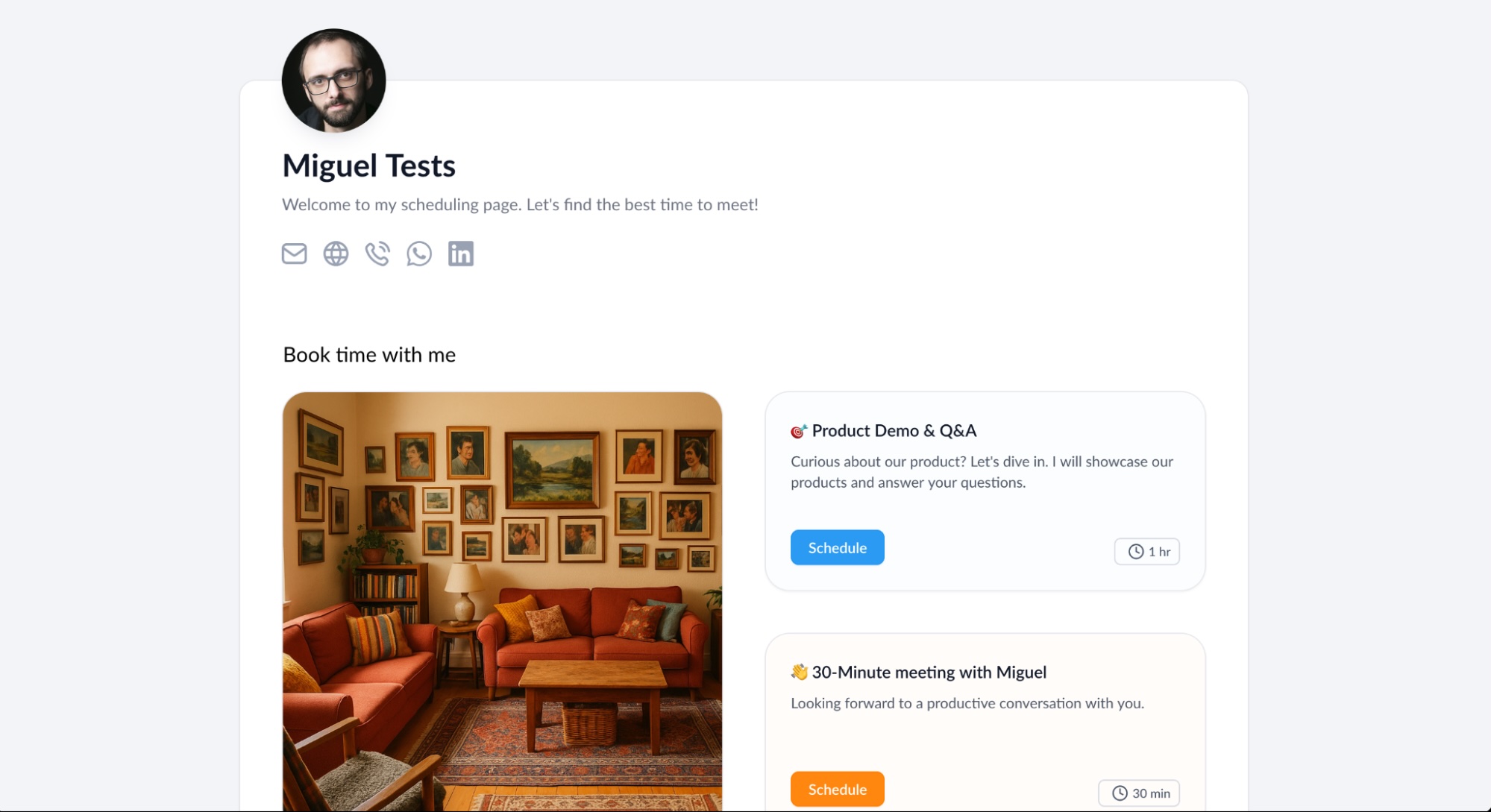
Author: admin

  • Meta Muse automation: How to use the Zapier Muse integration (Muse Spark 1.3 and more)

    Meta Muse automation: How to use the Zapier Muse integration (Muse Spark 1.3 and more)

    The concept of “less is more” doesn’t seem to have made it to Silicon Valley. Every time I blink, it seems like there’s yet another AI agent available on the market. And right on cue, another AI bombshell has entered the villa: Muse is a personal AI agent from Meta (of Facebook fame) that can do things on your behalf, like opening a browser, filling out forms, and sending emails.

    But a personal agent is only as useful as what it can reach. Muse comes with roughly 40 native connectors, covering Google Workspace, Dropbox, Notion, and a handful of others. For everything else in your stack, Zapier is now a built-in connector inside Muse. That means Muse can search, create, and update records across 9,000+ apps without you ever leaving the chat window.

    There are two ways to bring Muse and Zapier together: add Muse Spark’s reasoning to workflows you already run on Zapier, or let Muse kick off Zapier actions directly from a conversation. Here’s how both work.

    Table of contents:

    Add Muse Spark’s brain to your existing workflows (AI by Zapier)

    Zapier already handles complex, multi-step workflows across your tech stack, and sometimes those workflows benefit from a burst of AI reasoning right in the middle. AI by Zapier lets you drop a Muse Spark step into any Zap, exactly where it’s useful, without setting up a separate Meta developer account.

    Adding Muse to your workflows is helpful because you usually don’t want AI running every step of a workflow—just the ones that actually need judgment. For example, routing a new lead from a form into your CRM doesn’t need any reasoning at all and can be handled by deterministic automation. But summarizing a support call, drafting a reply based on a customer’s order history, or deciding which of 200 inbound resumes deserve a second look is where Muse Spark could come in handy.

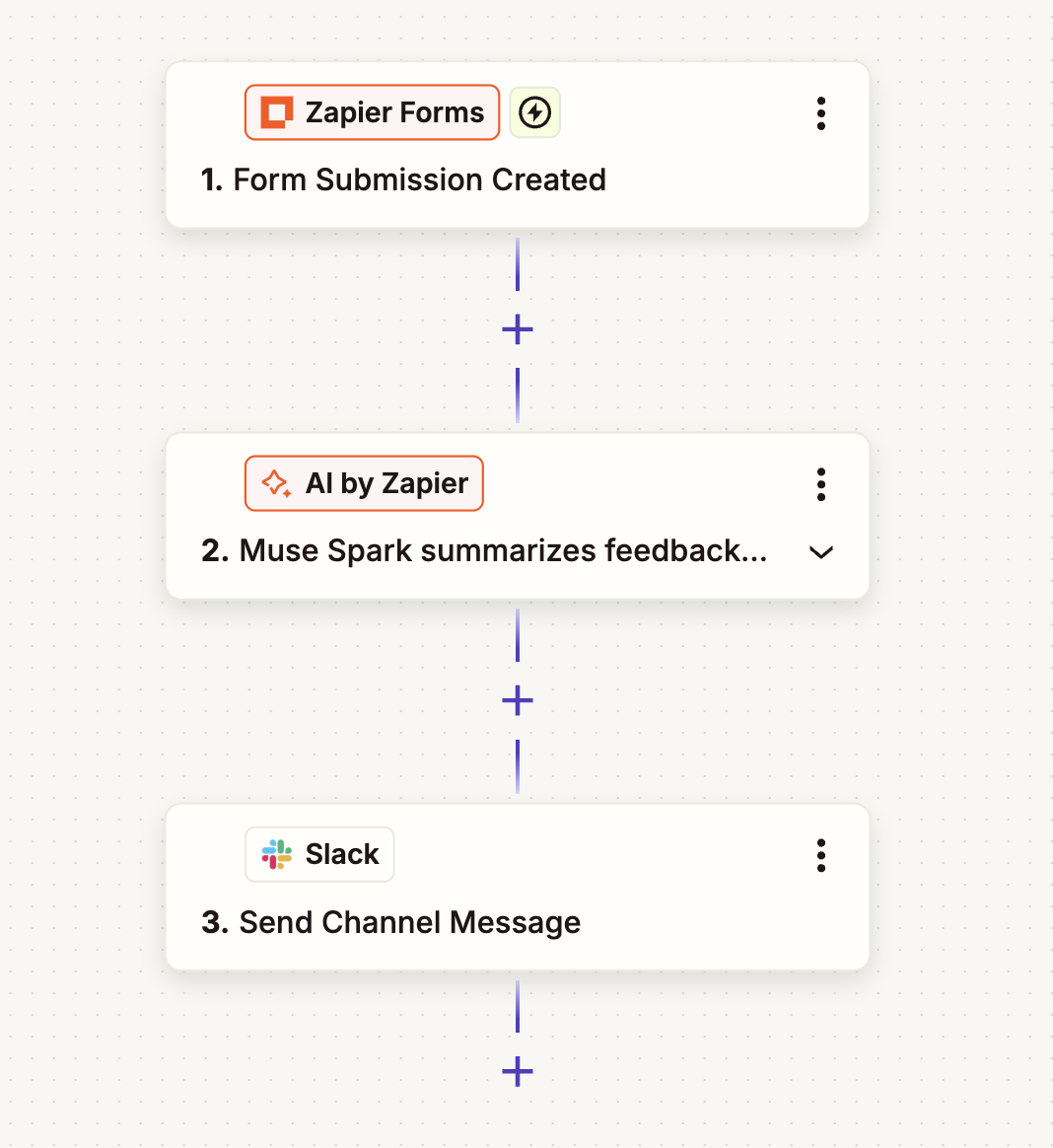
    Here’s an example: say your team collects product feedback through a form. Instead of reading every response by hand, you build a Zap that triggers on new submissions, sends the response to a Muse Spark step with a prompt like “Summarize this feedback and flag anything that mentions a bug,” then posts flagged items to your product team’s Slack channel. Muse Spark only fires when there’s a new response to process. Everything else runs the same way every time.

    An automated workflow using Muse Spark in AI by Zapier

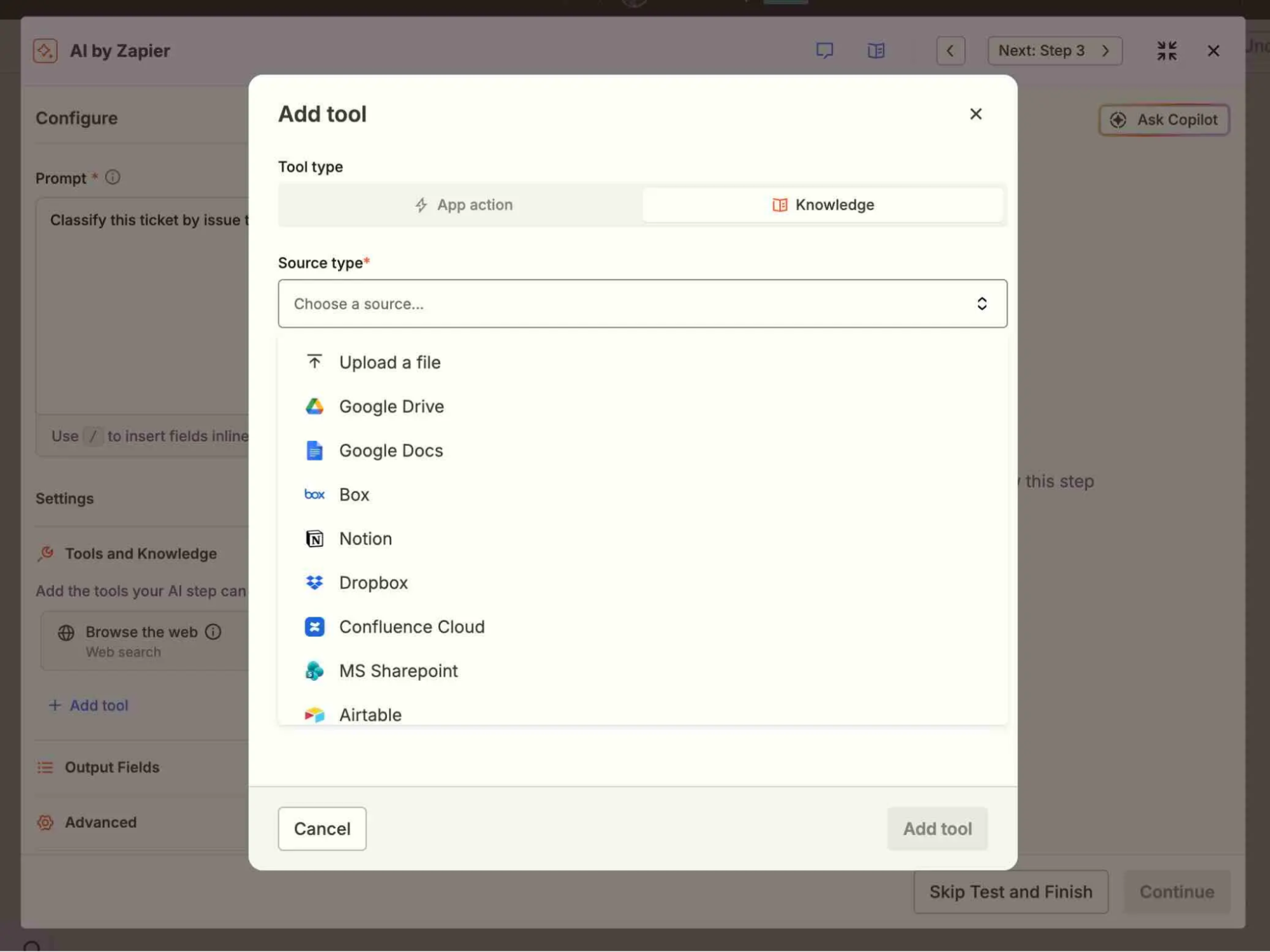
    You stay in control of the step itself: write and test your prompt, attach knowledge sources, and turn on agentic tool calling if the task calls for it.

    Adding tools in an AI by Zapier step

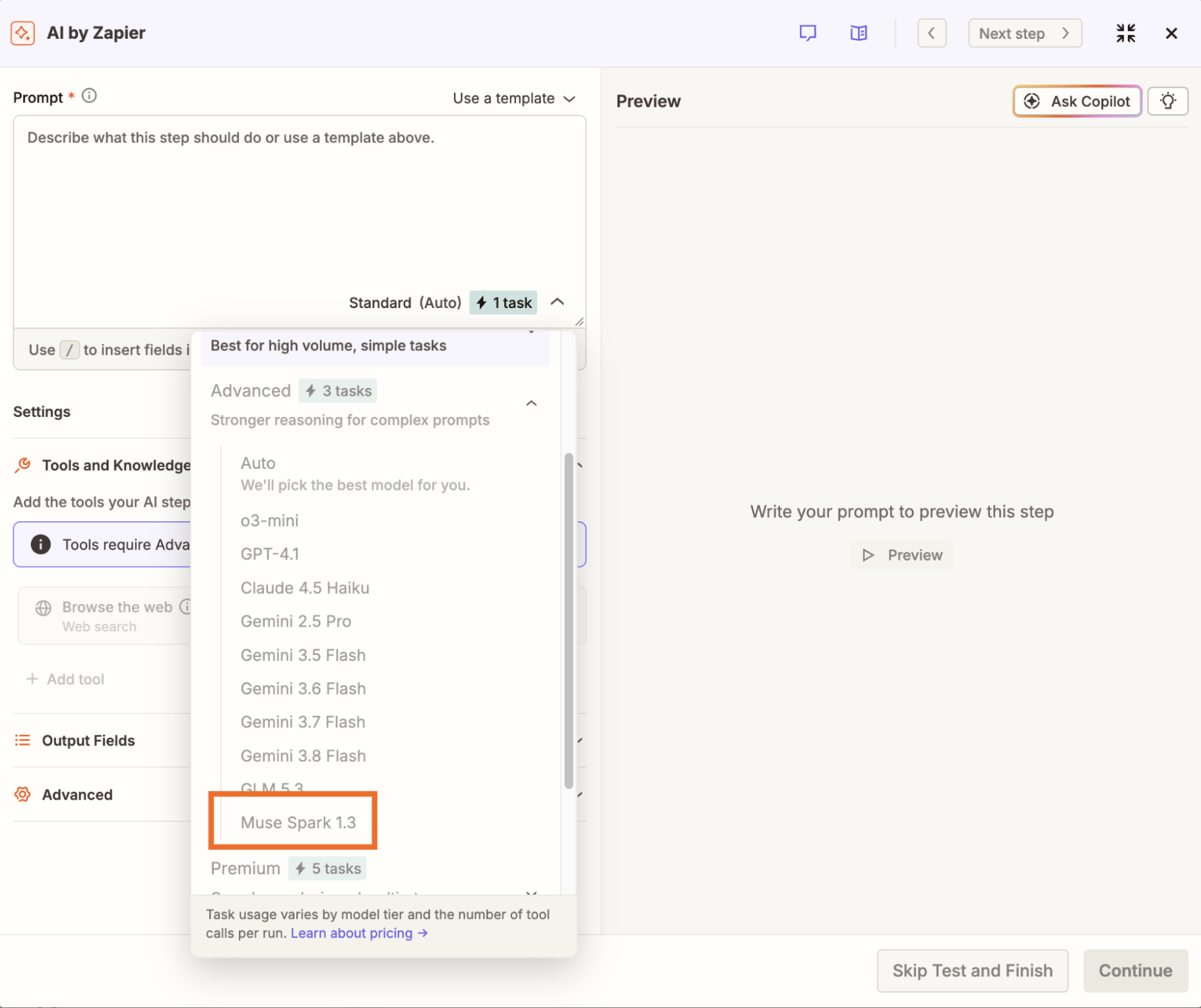
    You pick the Muse Spark model from a dropdown in the Zap editor, and the cost comes out of your Zapier task count instead of a separate Meta bill. Every time Meta ships a new Muse Spark version, it gets added to the AI by Zapier lineup, and you can swap models later without rebuilding the workflow around it.

    Choosing Muse Spark as the AI model in an AI by Zapier step

    Read more: Which AI models can you automate on Zapier?

    Muse Spark automation use cases

    Here are a few ways you might use AI by Zapier to bring Muse Spark into your workflows:

    • Draft follow-ups from call notes. When a sales call wraps in your meeting tool, send the transcript to Muse Spark to pull out commitments, objections, and next steps, then log the summary to your CRM.

    • Triage support tickets. Have Muse Spark read incoming tickets, assign a priority level, and route anything urgent to the right Slack channel before a human opens it.

    • Turn a blog post into social copy. Feed a new article to Muse Spark and get platform-ready drafts for LinkedIn and X, then send them straight to your social scheduler.

    • Score inbound leads. When a form submission comes in, have Muse Spark enrich and score it against your ideal customer profile, then route the strongest ones to sales.

    • Summarize what happened while you were out. Schedule a Zap that pulls yesterday’s Slack activity or support volume each morning and has Muse Spark write a short recap.

    Start building

    Automate workflows directly from Muse (Zapier MCP)

    If you’d rather work directly from Muse, that’s what the Zapier connector is for. It gives Muse governed access to all 9,000+ apps in Zapier’s library, and you decide exactly which apps and actions it’s allowed to touch.

    Setup happens entirely inside Muse. You don’t need to create anything on Zapier’s side first.

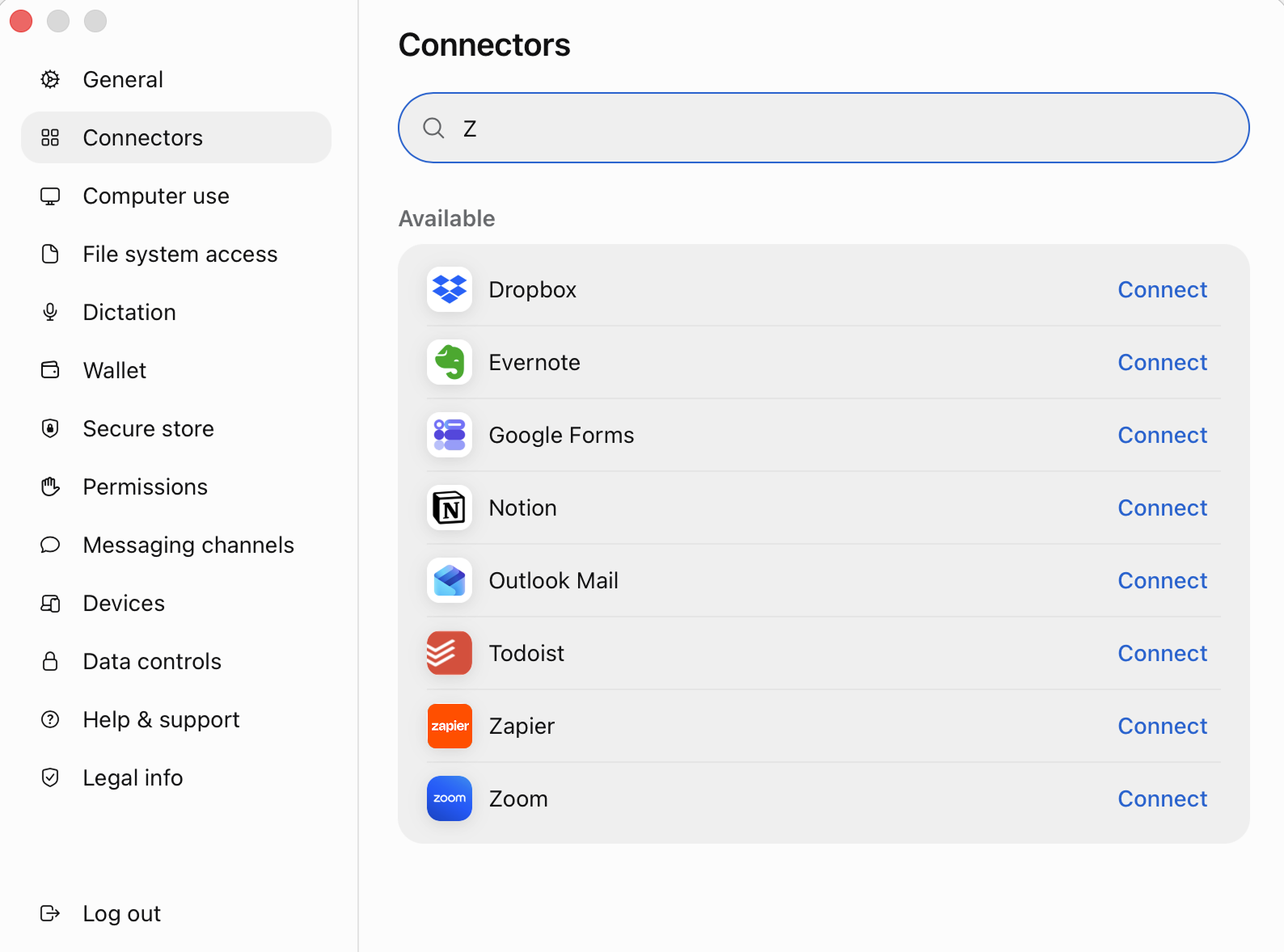
    1. Open Muse’s Settings, then Connectors, and search for Zapier.

      A dropdown list of connectors (including Zapier) in Meta Muse
    2. Click Connect, review the permissions card Muse shows you, and click Continue.

    3. Sign in to Zapier, or create a free account, and click Allow. Zapier automatically creates an MCP server for Muse and turns on actions for the apps you’ve already connected. You can adjust permissions for apps and actions in Zapier at any time.

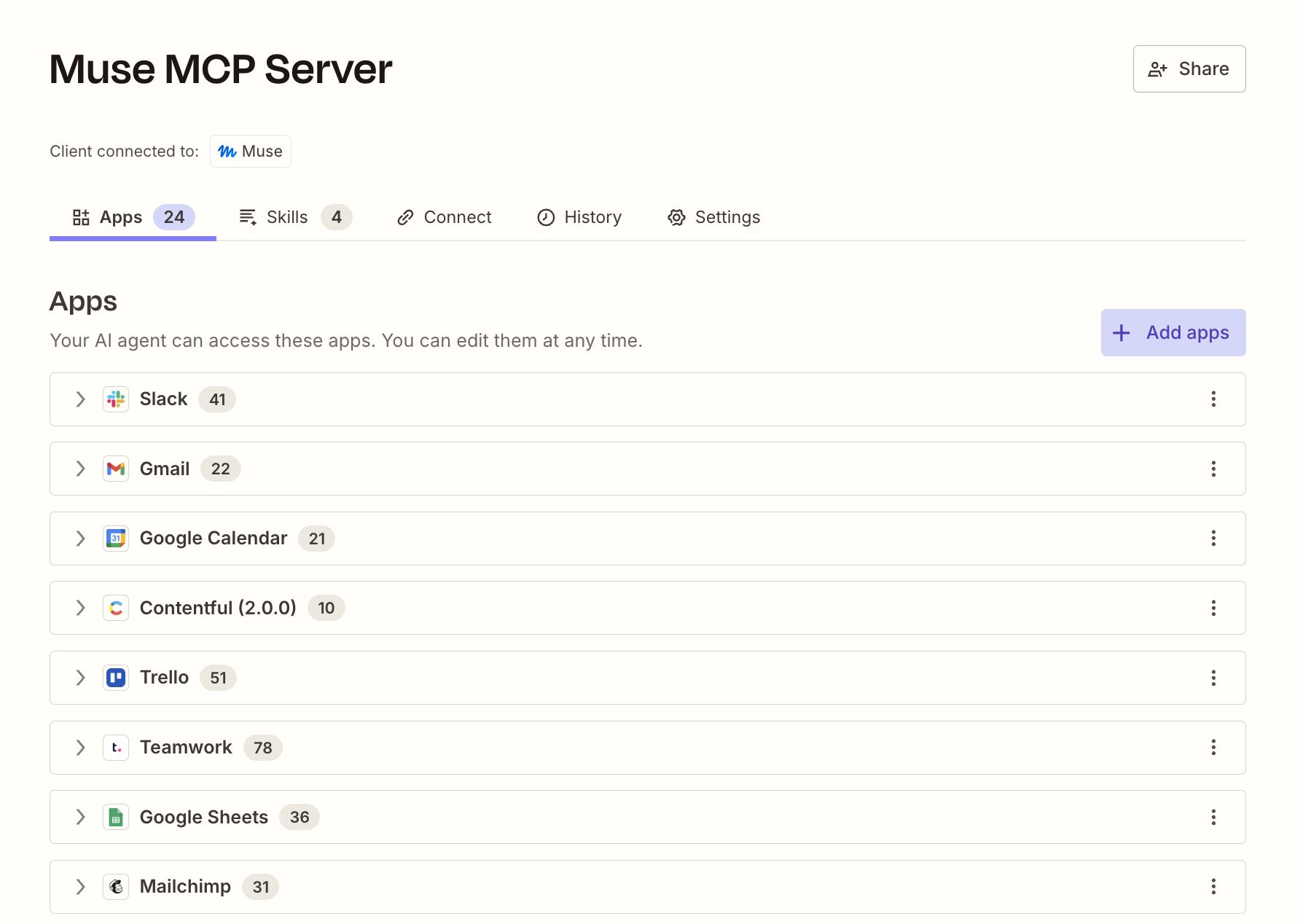
      Muse MCP server settings in Zapier
    4. Back in Settings > Permissions, you control how often Muse checks in before acting. By default, Muse asks before it takes an action it flags as needing a second look.

    Once Zapier is installed, you can ask Muse to do things like:

    • “Find my last five HubSpot deals, calculate weighted pipeline, and post a summary to Slack.”

    • “When someone books me on Calendly, add them to my client list in Airtable.”

    • “Check my email for anything from a client this week and add the open items to my Todoist.”

    None of that requires opening another app. Muse runs the whole thing from the chat window, the same way it books a restaurant or fills out a form on your behalf.

    Each successful action draws from your existing Zapier task allowance, the same one your Zaps already use, so your Zapier bill stays simple. And because Zapier manages the credentials, Muse never has to ask you for an API key or password. Muse signs in once through Zapier, and every app connection it touches afterward stays governed the way it would in any other Zapier workflow.

    Try Zapier MCP

    Muse automation FAQ

    How do I connect Zapier to Meta Muse?

    Open Muse, go to Settings > Connectors, and search for Zapier. Click Connect, sign in to your Zapier account (or create a free one), and click Allow. Muse can then use any action you’ve turned on for the apps already connected to your Zapier account.

    What can Muse do with Zapier?

    Once connected, Muse can search, read, create, update, and send information across 9,000+ apps through Zapier, including apps it doesn’t natively support, like Zendesk, HubSpot, Airtable, and QuickBooks. You choose which actions Muse can run, and it asks before taking any it flags as needing review.

    Is Zapier free to use inside Muse?

    Connecting Zapier to Muse is free, and it works on every Zapier plan, including the free one. Each successful action uses a small number of tasks from your existing plan, the same allowance your Zaps already draw from.

    What’s the difference between using Muse Spark in AI by Zapier and using the Zapier connector in Muse?

    AI by Zapier lets you add a Muse Spark reasoning step inside a workflow, which is useful when AI needs to handle one part of an otherwise predictable process. The Zapier connector in Muse is for when you want your AI to handle everything, straight from the chat window. It lets Muse build automations and kick off actions across your apps directly from a chat.

    Automate Muse with Zapier

    Whether you want a workflow humming in the background or you’d rather just ask Muse to handle a task mid-conversation, Zapier gives Muse a governed way to reach the rest of your stack.

    Either path runs through Zapier’s managed authentication, so Muse never has to ask you for a password, your credentials stay in one place, and every action follows the same permissions you’d set for any other part of your workflow.

    Try Zapier

    Related reading:

  • The 8 best Pipedrive alternatives in 2026

    The 8 best Pipedrive alternatives in 2026

    We independently review every app we recommend in our best apps lists. When you click some of the links on this page, we may earn a commission. Learn more.

    Keeping leads on a pile of index cards might work for a local and decidedly awkward paper salesman like Dwight Schrute, but the rest of us need an actual CRM to keep track of leads. Pipedrive is a great, sales-focused CRM that lets you build a seamless sales pipeline with robust dashboards and reporting. In fact, it’s such a powerful tool that it’s made Zapier’s lists of the best CRMs and the best CRMs for small businesses.

    But if Pipedrive isn’t helping you close deals with the ruthless efficiency of a Schrute, you have lots of other options. Zapier’s app testers have spent hundreds of hours testing CRMs, including head-to-head tests comparing Pipedrive to its competitors. Based on all that testing, here are the best Pipedrive alternatives to help you narrow down your options.

    The best Pipedrive alternative options

    The best Pipedrive alternatives at a glance

    Best for

    Standout features

    Pricing

    Website

    Salesforce Sales Cloud

    Scalability

    Custom workflows, automation, and AgentExchange marketplace for integrations

    From $25/user/month

    Visit Salesforce

    HubSpot CRM

    Versatility

    Modular tools for sales, marketing, and content management 

    Free plan available; paid plans from $7/month

    Visit HubSpot

    Zoho CRM

    All-in-one value

    Generous free plan; deep bench of 1,100+ native integrations plus Zoho’s 60-app suite

    Free plan for 3 users; paid plans from $14/user/month

    Visit Zoho

    Salesmate

    Small businesses

    Automation journeys for visual workflow customization

    From $23/user/month

    Visit Salesmate

    NetHunt CRM

    Gmail power users

    Seamless integration with Gmail for managing deals and automating workflows

    From $24/user/month

    Visit NetHunt

    Vtiger

    Free alternative

    Robust CRM features including sales tracking, marketing tools, and inventory management

    Free for up to 10 users; paid plans from $12/user/month

    Visit Vtiger

    Attio

    AI-native CRM

    Automatic contact enrichment; customizable pipeline with no-code builder

    Free for up to 3 users; paid plans from $35/user/month

    Visit Attio

    monday CRM

    Mixing pipeline and project management

    One board for deals and delivery; user-friendly; AI sales agents

    From $9/seat/month

    Visit monday

    Best Pipedrive alternative for scalability

    Salesforce Sales Cloud (Web, iOS, Android)

    Salesforce Sales Cloud, our pick for the best Pipedrive alternative for scalability

    Salesforce pros:

    • Heavily focused on rounding up customer data for increased clarity

    • Wide range of ambient AI features available in its Einstein Platform, plus agentic capabilities via Agentforce

    Salesforce cons:

    • If you ever want to, it can be hard to migrate out of Salesforce  

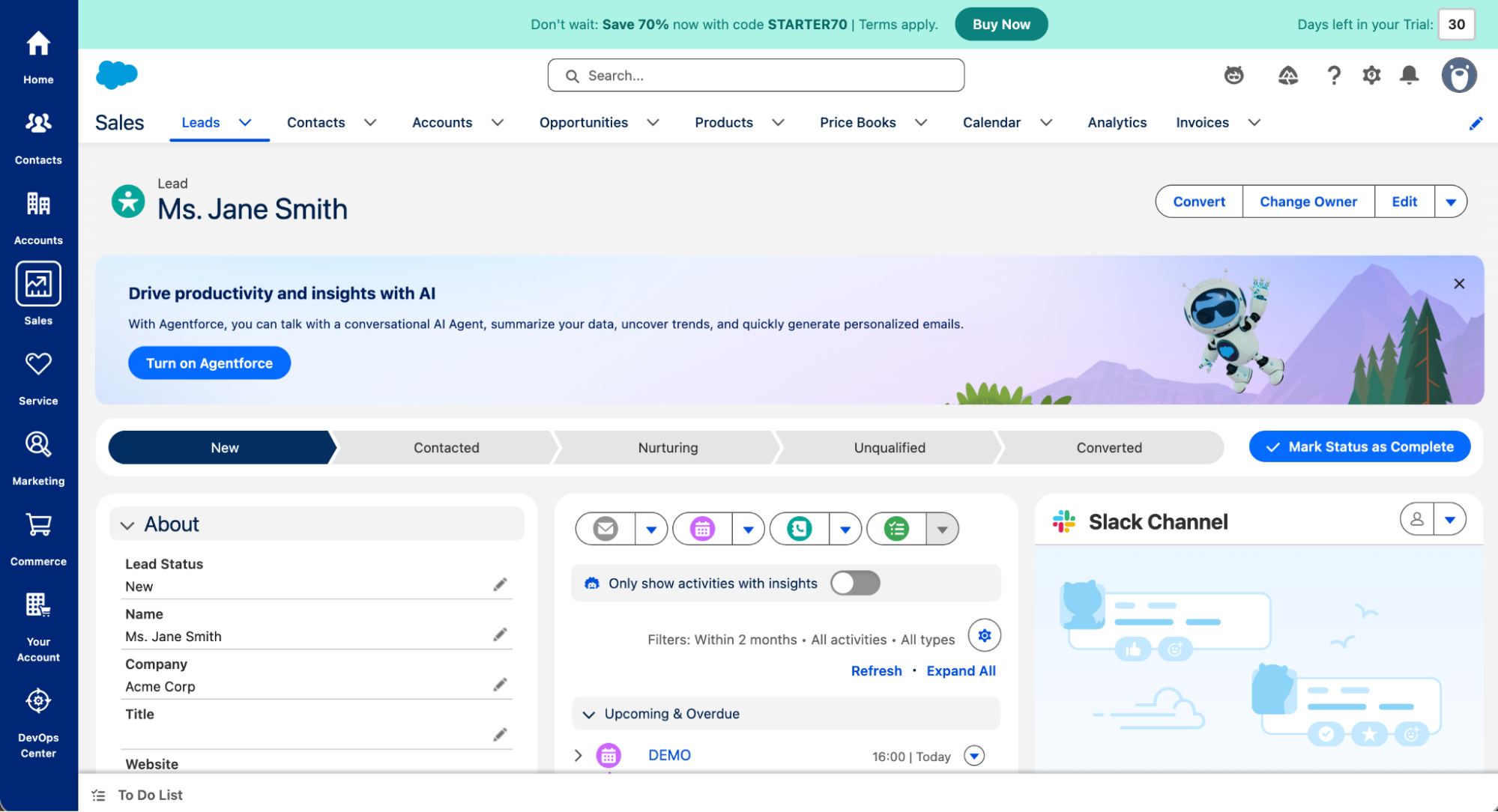
    If your business is growing fast and you need a CRM that can keep up, Salesforce will get the job done. It has a solid set of CRM features as a foundation, but it can evolve with you—with the option to layer on additional tools, automation, and even custom-built extensions. Need advanced marketing automation? More robust reporting? Custom workflows? Salesforce can handle it all.  

    Pipedrive is designed for a more straightforward sales process, but Salesforce gives you the ability to tailor nearly every aspect of the platform. You can set up custom fields, automate approval processes, and even add smart labels to guide newer sales reps through deals. For example, if a discount exceeds a certain percentage, Salesforce can flag it for manager approval—saving time and keeping your deals structured.

    And with Salesforce’s massive AgentExchange marketplace, you can connect to countless other tools, from marketing automation platforms to data visualization dashboards. Plus, as your business moves beyond the mid-market stage, there’s an entire ecosystem of agencies and developers ready to help you customize Salesforce into a specialized powerhouse for your unique workflows.

    If you don’t want to wait for that stage, you can use Salesforce’s Zapier integration to start customizing and automating right away. Do things like sending your team Slack notifications for new sales opportunities, or pulling leads from Facebook and Google Ads straight into Salesforce automatically. Learn more about automating Salesforce.

    Automate Salesforce

    Salesforce Sales Cloud price: From $25/user/month for Starter Suite up to $550/user/month for Max 

    Best Pipedrive alternative for versatility

    HubSpot CRM (Web, iOS, Android)

    HubSpot CRM, our pick for the best Pipedrive alternative for versatility

    HubSpot CRM pros:

    • Lots of well-designed features

    • Generous free plan

    HubSpot CRM cons:

    • When you need to upgrade, paid plans are confusing

    HubSpot is an all-in-one platform designed to grow with you—so if you’re juggling multiple tools and want to consolidate everything in one place, HubSpot is a great fit. It offers a full suite of tools that support not just sales, but also marketing, customer service, content management, and even business operations. 

    The magic of HubSpot is in its “Hubs,” which cover everything from CRM and sales automation to email marketing, blogging, customer service, and workflow automation. Unlike Pipedrive, which mainly enhances the sales pipeline, HubSpot helps you attract leads, nurture relationships, and manage customers all in one ecosystem. You can create landing pages, schedule social media posts, track email campaigns, and even build a blog—all without needing third-party tools.

    HubSpot’s AI-powered tools help you analyze customer interactions, optimize campaigns, and even generate content. Plus, the tool has deep automation capabilities. You can set up marketing sequences, automate sales outreach, and sync data across different departments effortlessly. 

    And if you don’t find the app you want in HubSpot’s huge marketplace, you can always open the door to thousands of other integrations by connecting HubSpot with Zapier. And if you’re working out of AI assistants like Claude or ChatGPT, you can even use Zapier to pull deal and contact data straight from HubSpot into the chat without switching tabs. Learn more about how to automate HubSpot.

    Automate HubSpot

    HubSpot price: Free plan available; paid plans start at $7/month.

    Check out the full comparison of HubSpot vs. Pipedrive.

    Best Pipedrive alternative for all-in-one value

    Zoho CRM (Web, iOS, Android)

    Zoho CRM, our pick for the best Pipedrive alternative for all-in-one value

    Zoho CRM pros:

    • Free plan available, with paid plans starting lower than most competitors

    • Deep bench of 1,100+ native integrations plus Zoho’s own 60-app suite

    Zoho CRM cons:

    • Interface feels more crowded than Pipedrive’s, especially once you bring in other Zoho apps

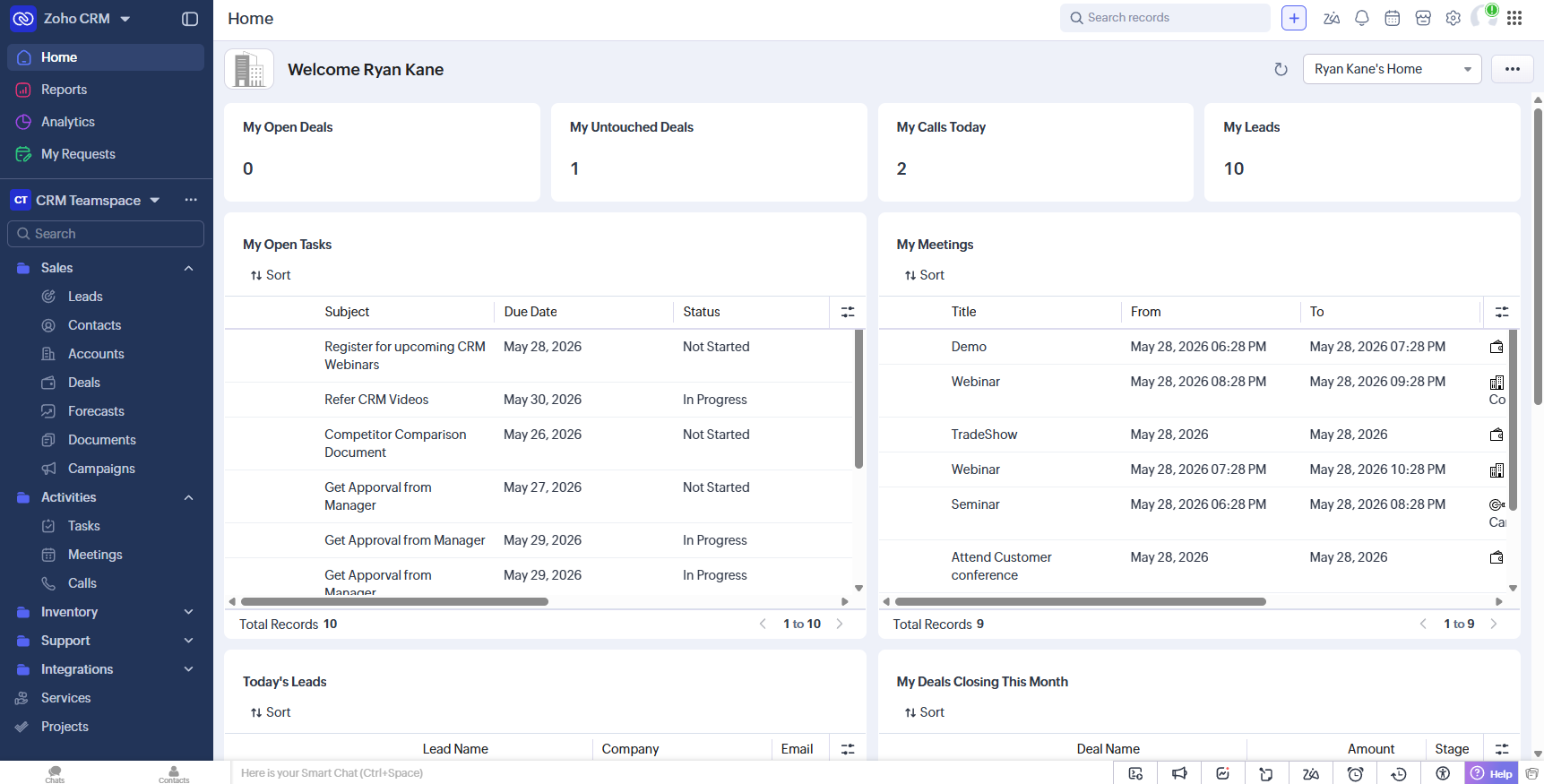
    Zoho CRM doesn’t ask you to choose between power and price. It handles the entire breadth of sales work—including leads, deals, multi-channel outreach, automation, and reporting. And because Zoho builds pricing to scale with you instead of punishing you for growing, you get forecasting and reporting depth that regularly beats what Pipedrive offers at the same tier.

    That value isn’t just about the CRM in isolation, either. Because Zoho makes over 60 business apps, the CRM is really an entry point into a much bigger suite with marketing, support, finance, and more, all under one subscription instead of stitching together a dozen different tools. The tradeoff is that Zoho can’t be best-in-class at all 60 of those things, and most people end up using a fraction of what they’re paying for. But if you want a CRM that keeps unlocking more value as your business grows, it’s hard to beat.

    Zoho’s AI assistant, Zia, backs that up with real substance: it cleans up your contact data, flags the leads most likely to convert, catches anomalies like unusual drops in closed deals, and figures out the best time to call a given prospect. Zia also offers an AI agent builder, where you can deploy pre-built agents or build your own from scratch—pick from a range of hosted LLMs, including Zoho’s own model and several Qwen options, or bring your own API key. Just know it’s not the smoothest AI experience on this list yet; some of the agent features are still buggy. Zoho also integrates with Zapier, so you can connect it to your broader tech stack without waiting on Zoho’s native roadmap to catch up.

    Automate Zoho CRM

    Zoho CRM price: Free plan available for 3 users and up to 5,000 records. Paid plans, which add features like sales forecasting, custom reports, and more marketing automation features, start at $14/user/month (billed annually).

    Check out the full comparison of Pipedrive vs. Zoho.

    Best Pipedrive alternative for small businesses

    Salesmate (Web, iOS, Android)

    Salesmate, our pick for the best Pipedrive alternative for small businesses

    Salesmate pros:

    • Wide range of features

    • Intuitive user interface

    Salesmate cons:

    • Building new modules comes with a learning curve

    Unlike Pipedrive, which gates many of its best features behind pricey add-ons, Salesmate includes essential tools like workflow automation, email sequences, meeting scheduling, and email tracking even at its lower-tier plans. Upgrade to Pro, and you also get built-in collaboration tools like a Team Inbox for seamless communication among sales reps, which Pipedrive reserves for its more expensive plans. For small businesses trying to maximize their budget, these built-in features can make a huge difference.

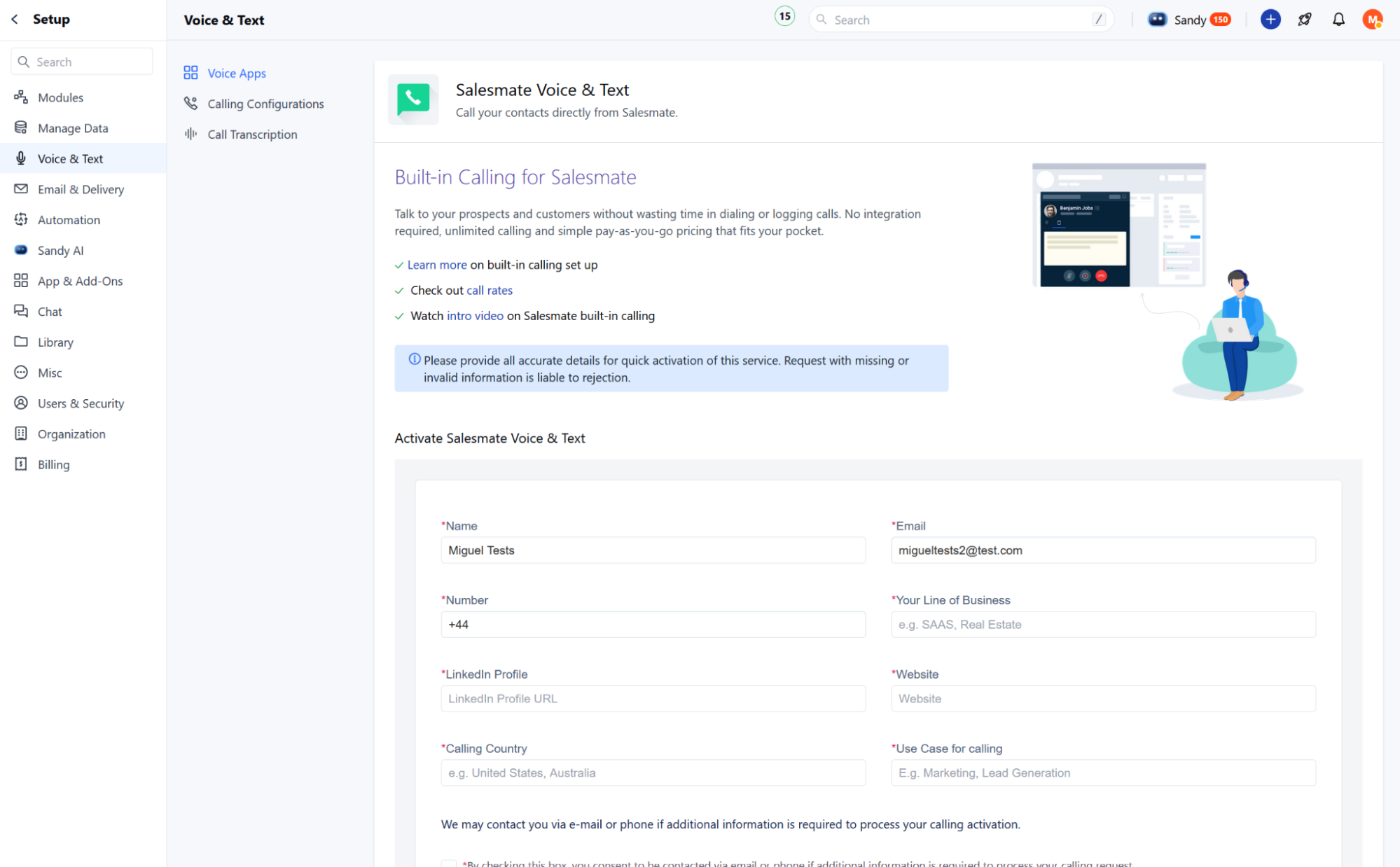
    Salesmate backs that up with real phone and SMS functionality, too. You’ll need to fill out a form and get your company approved first, and call rates apply on top of your subscription, but once that’s done, you can send and receive SMS directly inside the platform, with every message logged to the contact’s activity history. Calls can start right from the dashboard, or—more usefully—straight from a deal card in your pipeline, and when a call comes in, that contact’s page pulls up automatically so you’re never scrambling for context mid-conversation.

    Salesmate’s automation tools are also a big win. While Pipedrive requires an upgrade to unlock automation, Salesmate lets you set up workflows on any plan—though more advanced features like email scheduling and bulk messaging come with higher tiers. And if you want a more visual, flexible automation experience, Salesmate’s drag-and-drop automation journey builder is a game-changer, helping you build and refine your sales process with an intuitive, flowchart-like builder. If you upgrade to a Pro plan or above, you get access to Sandy AI, the AI assistant that can do things like book calls, draft emails, and create tasks. 

    You can also connect Salesmate to Zapier and integrate your CRM with the rest of your tech stack to automate all your CRM workflows.

    Automate Salesmate

    Salesmate price: From $23/user/month for contact, company, and deal management; the Pro plan is $39/user/month and adds email sequences, Team Inbox, and Sandy AI.

    Check out the full comparison of Pipedrive vs. Salesmate.

    Best Pipedrive alternative for Gmail power users

    NetHunt CRM (Gmail, Web, iOS, Android)

    Nethunt CRM, our pick for the best Pipedrive alternative for Gmail power users

    NetHunt CRM pros:

    • Easy Gmail integration

    • Keeps your CRM data clean with robust validation

    NetHunt CRM cons:

    • Has a bit of a learning curve

    If you live in Gmail and wish your inbox could double as a CRM, NetHunt is here to grant your wildest dreams. While Pipedrive is a standalone CRM built for managing sales pipelines, NetHunt takes a different approach—it seamlessly integrates right into your Gmail workspace, letting you manage leads, track deals, and automate workflows without ever leaving your inbox. It doesn’t stop at email, either: NetHunt connects to WhatsApp, Facebook Messenger, Instagram, Telegram, and Viber, funneling every one of those conversations into a single Chats section right alongside your inbox.

    Once you install the extension, your inbox gets an upgrade: deals, contacts, and companies are organized in folders, and your sales pipeline appears as a Kanban board. No more bouncing between tabs or copying data into another CRM—everything you need is right where you’re already working. And since most sales conversations start with an email, having a CRM built directly into Gmail just makes sense.

    NetHunt also helps automate your workflow. You can set up triggers to update lead statuses as emails come in or go out, saving you the hassle of manual data entry. And if you need even more automation, you can connect NetHunt to Zapier to sync data across your entire tech stack.

    Automate NetHunt

    NetHunt CRM Price: From $24/user/month (billed annually)

    Best free Pipedrive alternative 

    Vtiger (Web, iOS, Android)

    Vtiger, our pick for the best free Pipedrive alternative

    Vtiger pros:

    • Robust features across the board

    • Well-organized mega menu

    Vtiger cons:

    • Mobile apps are hard to use

    Good news for cash-strapped small businesses everywhere: you don’t actually have to pay to use an out-of-the-box CRM platform. While Pipedrive requires a paid subscription from the start, Vtiger offers a generous free plan that supports up to 10 users, 3,000 contacts, and 1,000 email sends per month. It’s an excellent choice for businesses that need a powerful CRM without the upfront cost.

    The platform offers a streamlined, easy-to-navigate interface that doesn’t overwhelm you with buttons and menus. But don’t let its clean design fool you—Vtiger packs in a full CRM suite, complete with contact management, sales tracking, marketing tools, and even inventory management. It also comes with built-in email marketing, letting you create campaigns, segment contacts, and track basic analytics without needing a separate tool.

    Another thing that sets Vtiger apart is its thoughtful onboarding. It walks you through a step-by-step onboarding checklist to help you get familiar with the platform, and every time you visit a new screen, a helpful video tutorial pops up. Whether you’re new to CRMs or just want a smooth transition from another tool, Vtiger makes the learning process effortless.

    And while the free plan is impressive, Vtiger’s paid plans are structured in a way that can save you money as your team grows. Instead of charging a flat rate per user like Pipedrive, Vtiger lets you assign different levels of access—users with full CRM privileges pay more, while those who only need limited access get a discount. It’s a cost-effective option for businesses with multiple departments that don’t all need the same level of CRM functionality.

    Connect Vtiger to Zapier so it can talk to all the other apps your team uses. Do things like automatically adding leads from Facebook ad clicks or updating your Google Ads contact lists from new leads in Vtiger. Learn more about how to automate Vtiger.

    Automate Vtiger

    Vtiger price: Generous free plan; One Growth plan starts at $12/user/month.

    Best Pipedrive alternative for an AI-native CRM

    Attio (Web, iOS, Android)

    Attio, our pick for the best Pipedrive alternative for an AI-native CRM

    Attio pros:

    • AI-native CRM

    • Flexible data model

    Attio cons:

    • AI and automation consume the same monthly credit pool; you’ll have to buy a credit package if you’re using both heavily

    Pipedrive is a solid pipeline tool, but it wasn’t built AI-first. Attio was, and that affects how fast you can get moving. Most CRMs take teams months to reach peak productivity, while Attio compresses that timeline into one to two weeks. Customize the data model, build your core AI workflows, and iterate as your sales process evolves.

    That AI focus pays off first in manual data entry. Attio automatically enriches the contacts and companies you add to your workspace, and you can set up AI autofill fields on any object to summarize information, reason on buying signals, or pull in web data. So instead of logging every activity by hand at the end of the day, you can get straight to work qualifying leads and working deals. 

    The data model itself breaks from CRM convention, too. You’re not locked into the standard contact-company-deal chain; you can define whatever object types actually matter to your business, whether that’s investors, partnerships, or hiring pipelines, and decide field by field whether the data is static or AI-generated. All of it is no-code, so you can have a custom-built pipeline ready in a few hours without filing an IT ticket. Connect Attio to Zapier, and those workflows extend across the rest of your stack, too.

    Automate Attio

    Attio price: Free plan for up to 3 seats. Plus plan starts at $35/user/month (billed annually).

    Best Pipedrive alternative for mixing pipeline and project management

    monday CRM (Web, iOS, Android)

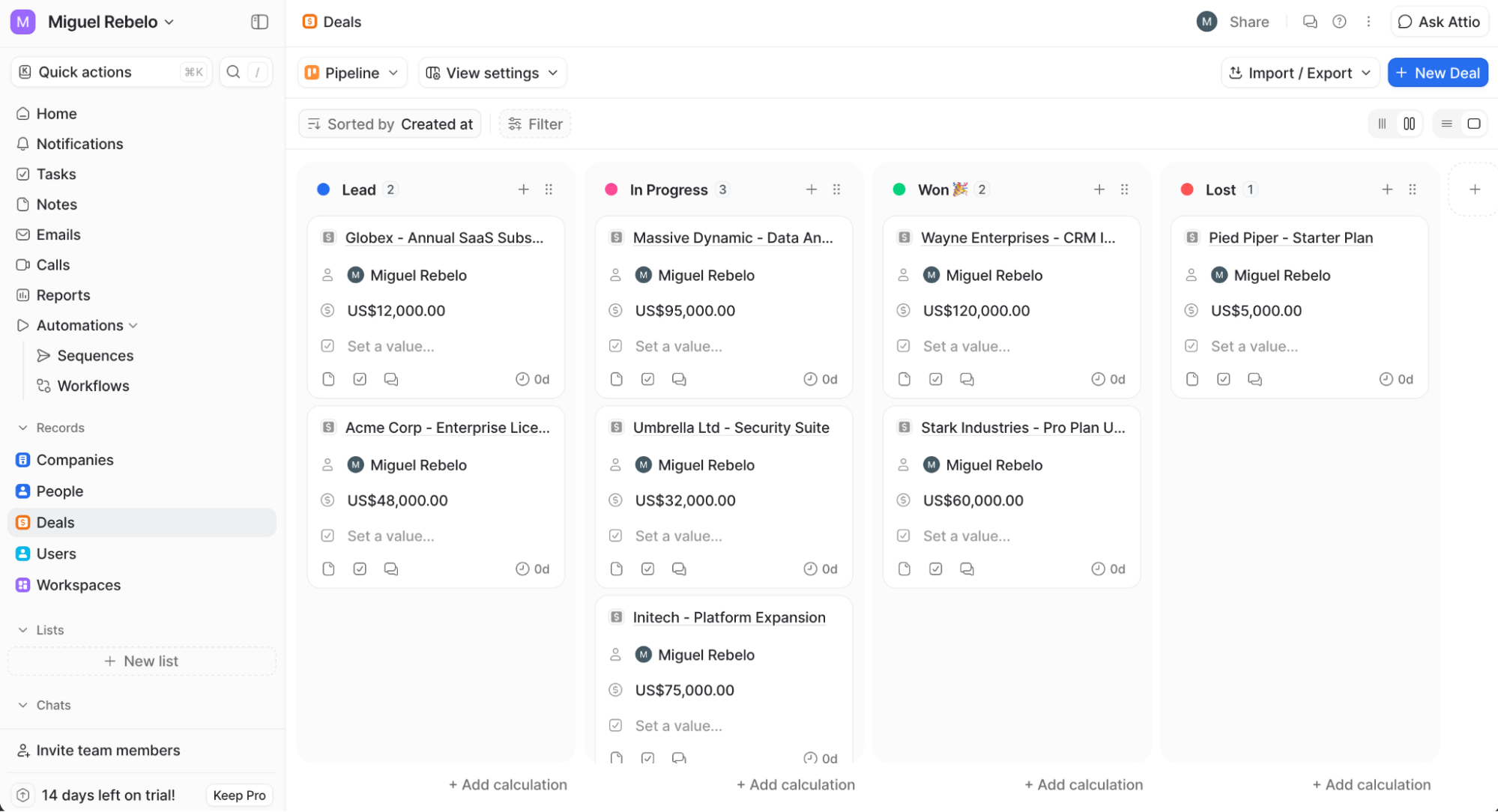
    monday CRM, our pick for the best Pipedrive alternative for mixing pipeline and project management

    monday CRM pros:

    • Same boards handle deals and delivery

    • Visual enough that reps actually use it

    • AI sales agents from the Standard plan

    monday CRM cons:

    • Less CRM depth than purpose-built tools

    • Automations capped on some plans

    No matter how hard a deal was to close, the work doesn’t end there. Somebody still has to onboard the client, deliver what you promised in the pitch, and hit every deadline along the way. Most CRMs expect you to export closed deals to a separate project management or customer service tool (and hope all the context survives the trip). But monday lets you track your deals beyond the traditional pipeline.  

    The pipeline itself is a board, with deals as “items,” stages as “groups,” and you drag between them. Columns hold whatever you want—like deal value, close date, owner, or even a formula—and the centralized comms hub pulls every email, call, and meeting for a contact into one timeline. You can send quotes and invoices from inside it too, capped at 50/month on the Standard plan and 250 on Pro.

    The AI is more built-out than you might expect at monday’s price point. The Standard plan includes an outreach caller agent that qualifies leads and logs call summaries back to the CRM, a lead sourcer agent that finds and enriches prospects matching your profile, and a meeting prep agent that briefs you before customer calls. You can build your own agents too, all running on AI credits included with each plan.

    Where monday mainly comes up short is depth. If your sales process needs territory rules or multi-rep credit splits, this isn’t the tool for you. Every plan also starts at three seats, so a two-person team pays for three. But if pipeline and delivery living together sounds appealing, monday is worth a look.

    Plus, you can connect monday.com with Zapier to pull leads from multiple sources, connect your pipeline with other sales and marketing tools, and access your CRM data straight from your AI chat window. Learn more about automating monday.com. 

    Automate monday

    monday CRM price: Basic starts at $12/seat/month, Standard is $17/seat/month, Pro is $28/seat/month, and Ultimate is custom-priced.

    Which Pipedrive alternative should you use?

    Picking a Pipedrive alternative is all about what matters most to you. Do you want a tool that’ll scale with your business? In that case, go with Salesforce. Are you looking for a versatile option? Pick HubSpot. If you need a free option with robust sales features, go with Vtiger.

    Once you’ve chosen the right tool for you, you’ll be ready to get to work (mustard-colored shirt optional) and say: “I am ready to face any challenges that might be foolish enough to face me.”

    Related reading:

    This article was originally published in March 2025. The most recent update was in October 2026.

  • AI in IT: How artificial intelligence is transforming IT operations

    AI in IT: How artificial intelligence is transforming IT operations

    A few months ago, a smoke detector started chirping while I was trying to sleep. I cursed a little too loudly, plodded out of bed, changed the battery, and… heard the beep again eight minutes later. It turned out to be a different smoke detector in another room that was the problem the whole time.

    That same kind of situation happens a lot in IT. An alert or notification fires, it tells you the basics (but never really enough about where or why), and someone has to dig around to find the solution. 

    AI in IT can help you find which smoke detector to fix and what kind of batteries you need so your team can go back to bed. It can decipher all the messy tickets, group the alerts that belong together, and hand a human the version of the problem they can act on.

    Here, I dive deeper into what AI in IT really does, plus seven use cases that you can bring to your team today. 

    Table of contents:

    What is AI in IT?

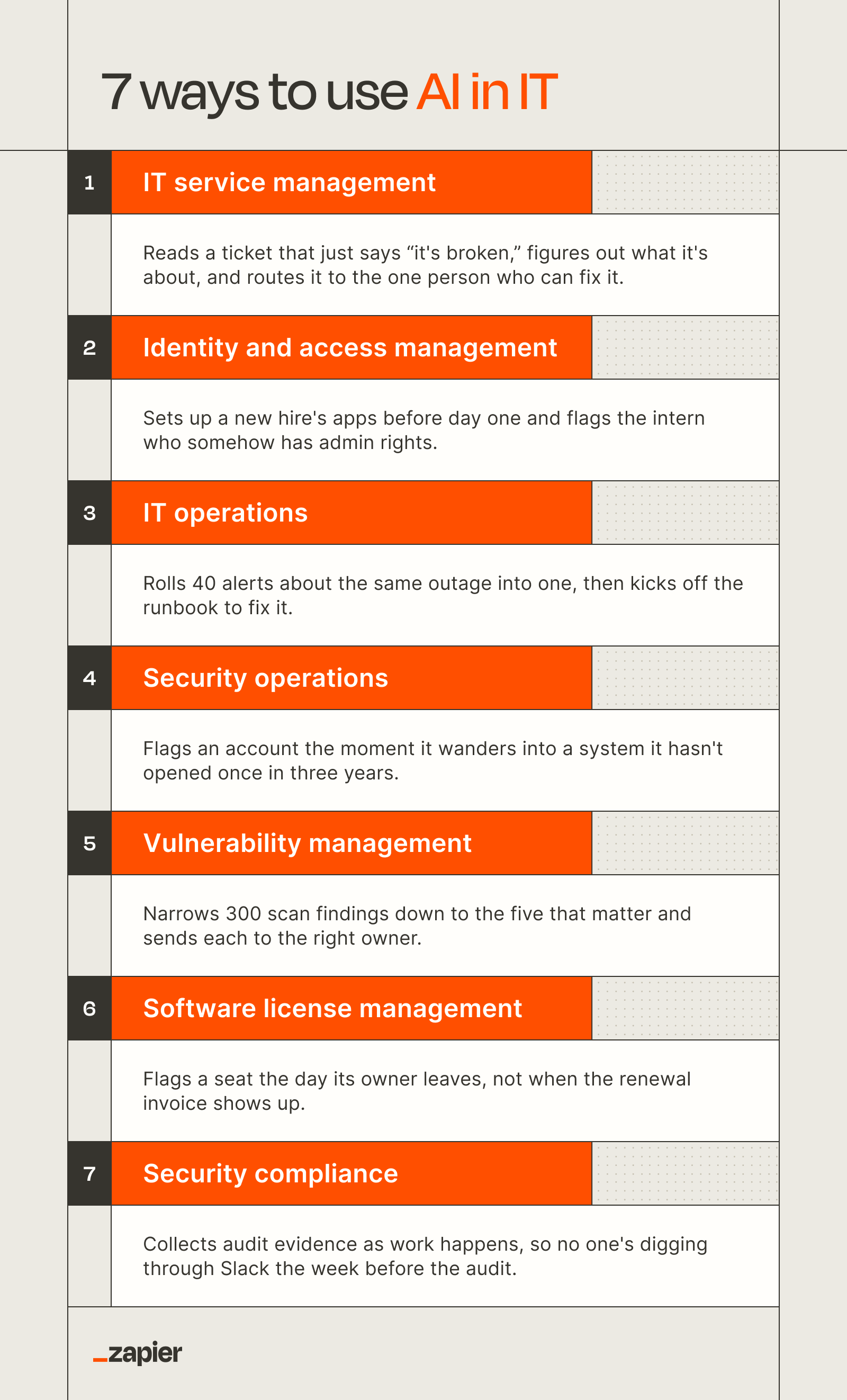
    A graphic showing seven ways to use AI in IT.

    AI in IT is the use of machine learning, language models, and autonomous agents to run and maintain technology. These systems can interpret unstructured input and decide what to do with it—sometimes even fixing the issue autonomously—rather than just passing the problem along to you.

    It’s not as vague as it sounds, though, and can show up in a few different ways. AI in IT could mean setting up a workflow that interprets IT help desk tickets, answers what it can, and then automatically routes anything it can’t handle to the right agent. Or it can mean getting an alert that tells you which service is down and what to do about it before you even start digging into the problem. Someone typically still has to do some work (annoying, I know), but it arrives closer to a solution than it used to.

    To see more examples, jump ahead to my roundup of the top use cases for AI in IT.

    What kind of AI is used in IT?

    Four technologies typically do most of the work:

    • Machine learning (ML): Trained on your historical data, ML finds patterns at a volume no person can track. So when someone logs in at 2 a.m. and starts poking around in places that the account never goes, ML is what notices.

    • Natural language processing (NLP): NLP reads the unstructured text your systems generate, from ticket descriptions to log lines. It’s what allows your intern to type in “my computer is being weird again” and get back an IT help desk ticket with a category and a queue.

    • Large language models and generative AI: LLMs produce text and code on demand, which, in IT, usually means writing what nobody wants to write. You can have a draft of both incident summaries and knowledge base articles, for example, before the incident is even closed.

    • AI agents: Agents take actions instead of only producing text. One can read an alert, decide it’s a real problem, and page the on-call engineer.

    Why IT teams are adopting AI 

    The modern IT team is like the gigantic oak tree in my backyard, each branch sprawling with new data, tickets, and problems. More tools in your tech stack don’t necessarily mean less work. Usually, it just means more chances for things to go wrong. 

    For a growing company, staying on top of IT issues used to mean increasing headcount. Now, AI can take a lot of that on, and your team gets to spend their day on something more interesting than password resets.

    Here are some of the top reasons IT teams are opting for AI:

    • Incident resolution: Correlated alerts and AI-drafted context remove the painful fact-finding stage of every incident, saving engineers countless hours and gray hairs. So they spend less time firing passive-aggressive Slack messages at each other and more time fixing the problem.

    • Data accuracy: AI catches duplicates, gaps, and anomalies as they happen instead of during a scheduled cleanup (which never seems to happen anyway). That beats learning your asset inventory was wrong when an auditor asks about a laptop that left the building two years ago.

    • Cost control: Ticket deflection and self-healing infrastructure reduce the ticket volume that would otherwise call for a hiring spree. AI agents and workflow automations can resolve basic inquiries, so your IT support team only needs to handle the tickets that need a human touch. 

    • Employee experience: An employee with a basic problem pings IT, waits, and eventually gets asked whether they’ve tried restarting it. Nobody in that exchange is happy. The same question to a chatbot gets an answer in seconds.

    Top 7 use cases for AI in IT

    How you’ll use AI in IT depends on everything from your industry to your company size to the product or service you’re selling. These use cases should give you a sense of how you can bring AI into your IT ops. 

    IT service management (ITSM)

    Most of ITSM is glorified routing work. A problem or incident comes in, somebody decides the best way to handle it, and it goes somewhere. An AI model can do all this: read an incoming request, determine what it is, assign a priority, and send it to where it belongs before a human has opened it. 

    Zapier’s AI Workflow Index found that 44% of IT teams’ AI workflows have AI writing for people, and 30% have it extracting information and updating records. Approvals and anything that grants access should still stop at a person, but a lot of the easy stuff can and should be automated. 

    Some examples:

    • Change approval workflows: Accelerate change decisions with automated approval routing, stakeholder alerts, and status updates, with AI reading adding reasoning to each decision along the way.

    • IT onboarding and offboarding: Automated account provisioning, ticket routing, and deprovisioning tasks can use AI to flag access anomalies and alert the right people at the right time.

    • IT ticketing: AI can respond to tickets automatically, route issues that require a human, and fix issues autonomously.

    Automate ITSM

    Identity and access management (IAM)

    A big chunk of any IT team’s week goes to the same few access questions, like why someone can’t log in to a crucial app or whether the new hire has everything they need. AI can sort those out without breaking a sweat, and when it can’t, it hands the situation to a person with a summary already attached.

    You’ll notice it right away. Per the AI Workflow Index, 76% of runs for AI decision steps land outside business hours. A lot of that is routing calls getting made at 2 a.m., so the access request waiting for your team in the morning is already sorted, and the person who filed it didn’t spend the night wondering whether anyone had seen it.

    Two places you could start:

    • User provisioning: When a new hire or role change hits your HR system, AI can read the record and work out which apps and permissions that role needs.

    • User access reviews: Nobody wants to comb through a spreadsheet of 400 permissions. AI can flag the ones that look off, like an intern with admin rights or a contractor who hasn’t logged in since spring, so reviewers only spend time on what matters.

    Automate IAM

    IT operations (AIOps)

    AIOps, short for artificial intelligence for IT operations, is the practice of applying machine learning and NLP to optimize your IT processes. The point is to turn the hundreds of IT alerts and signals you get every day into an action plan for your human staff—or fix the issues itself so your human staff is off the hook.

    In a roundabout way, AIOps is a broad enough umbrella that it kind of includes everything you’ve considered “AI in IT.” But a good way to think about it is by focusing on alert fatigue.

    Here’s where AI can help:

    • Server management: Instance alerts fire constantly, and most of them are just an annoyance. AI can read each one, group the alerts tied to the same issue, and route only what actually needs a human.

    • Runbook execution: When a known issue pops up, AI can match it to the right runbook and kick off the first steps on its own.

    • Backup management: A failed backup job is easy to miss in a sea of green checkmarks. AI can flag the failures that matter (like a critical system that’s missed two runs in a row) and open a follow-up task before anyone needs that backup.

    Automate IT ops

    Security operations

    A wave of early 2000s media depicting actors smashing a keyboard and loudly proclaiming “I’m in!” no doubt spawned a generation of cybercriminals, or so I’d like to think. Those cybercriminals are constantly looking for vulnerabilities in your systems, which means AI security is a real part of the job for every IT team.

    AI can watch log volume, incident timelines, and other detection measures that spotlight potential problems before you ever realize anything is wrong. 

    Here are a few you could start with:

    • Cloud security: A misconfigured storage bucket doesn’t announce itself. AI can review cloud risk findings as they come in, work out which ones are exposed, and send those to the right team first.

    • Data security management: When a file gets shared outside the company or a credential changes at an odd hour, AI can check whether that’s normal for the account and flag it if it isn’t.

    • Firewall management: A risky rule change can hide among dozens of routine edits. AI can read each change, spot the ones that open up more than they should, and send them for review.

    Automate security ops

    Vulnerability management

    Coding assistants are everywhere now: a Zapier survey found that 34% of people shipping software using AI tools have no formal programming background. And at least once a week, I’ll see a post on social media about how a senior dev has to clean up lines and lines of a junior’s AI coding slop (and yes, that’s true; I may have stumbled into a weird TikTok algorithm). 

    The code looks right, it compiles, and then it costs more to debug than writing it yourself would have. Worse, sometimes it ships with a vulnerability nobody caught—the simple fix is making sure every change gets scanned, and every finding gets tracked. 

    Here are two ways to do that:

    • Vulnerability scanning & reporting: Scanners are great at finding things and terrible at telling you which ones matter. AI can read each report, rank findings by actual risk, and send the critical ones to the right team instead of dumping 300 results into a Slack channel.

    • Remediation tracking: Finding a vulnerability is only half the job. AI can match each finding to the right owner, watch for fixes that stall, and escalate before a due date slips.

    Automate vulnerability management

    Software license management

    Bad data was expensive long before anyone put an AI agent on top of it. Now, every new agent you add to your workflows inherits whatever mess is already lurking inside your data sources, giving cheerful yet incorrect answers at every turn. 

    AI does the cleanup that even the most stringent IT manager wouldn’t wish on their worst enemy. Software licenses are a good place to see it because that’s typically where you’ll find seats still assigned to people who left months ago, or renewals that auto-charge before anyone checks usage.

    A few areas to get you started:

    • License provisioning: When someone requests a tool, AI can check whether you already pay for an unused seat and reassign it before anyone buys a new one.

    • License renewal tracking: Before a renewal hits, AI can pull usage data and flag licenses nobody’s touched in months.

    Automate software license management

    Security compliance

    According to Zapier’s AI Governance report, 85% of U.S. executives at companies with 500+ employees say AI is running critical or mission-critical workflows. And nearly 4 in 5 say their employees bypass governance processes to deploy those workflows faster. 

    Those two stats highlight the duality of AI: people are using it everywhere, and a lot of them are going around you to do it. AI systems don’t scan your employee handbook before processing requests, so ungoverned apps and shadow AI can cause serious data concerns. 

    Zapier sits between your agents and the apps they’re reaching into. Connections go through OAuth, so nobody’s pasting an API key into a chat window; you set permissions in one place instead of app by app; and every action an agent takes shows up in a log you can actually go read. That comes in handy when an auditor asks how your AI workflows are controlled.

    A few ways to make audit season less painful:

    • Compliance evidence collection: Audit prep usually means weeks of screenshots and approval messages. AI can pull evidence from tickets, logs, and docs as it’s created, match it to the right control, and flag what’s still missing.

    • SOC 2 compliance: Controls drift quietly between audits. AI can track which approvals are overdue, summarize what changed, and keep the audit record current, so SOC 2 prep isn’t a last-minute scramble.

    • ISO 27001 compliance: AI can remind owners when reviews come due and draft the update notes auditors will ask for, so no one has to reconstruct a year of decisions from memory.

    Automate security compliance

    Bring AI to your IT processes with Zapier

    AI in IT can mean letting the bots triage tickets, correlate alerts, review code, and clean data. That raises some valid concerns about governance and access control, because the more AI tools that have access to your data, the greater the potential for misuse and breaches. The teams getting value out of AI in IT are working on both at the same time.

    Zapier is built for that. Anyone in an organization can securely create workflows across 9,000+ apps, with IT in full control of what those workflows can reach, and who can reach them. Set the rules once, and everybody else can go build end-to-end processes without you having to watch over their shoulder.

    Try Zapier

    Related reading

  • Gemini connectors: How to connect Gemini Enterprise to the rest of your tech stack

    Gemini connectors: How to connect Gemini Enterprise to the rest of your tech stack

    Gemini is everywhere in Google apps: it can read your emails, pull in data from your calendar, and find that file you accidentally saved to your work Drive. But no matter how much of your work is in Google, there are always other apps you’ll need Gemini to access: things like your CRM, project management tool, marketing automation platform, and help desk, to name a few.

    Gemini connectors add a few of those apps into the mix, and with Zapier, you can securely extend that reach to 9,000+ apps across your tech stack. Here’s everything you need to know about Gemini connectors, including how to set them up, what they can do, and how to make the most of them.

    Note: Gemini Enterprise connectors are different from the connected apps in the personal Gemini app. If you’re a personal Google user looking to access your personal intelligence from gemini.google.com, here’s a guide to Gemini apps.

    Table of contents:

    What are Gemini connectors?

    Gemini connectors are integrations for Gemini Enterprise that pull from enterprise sources like Confluence, Jira, Salesforce, ServiceNow, Microsoft SharePoint, and dozens more. They’re designed for organizations that want Gemini grounded in their internal business data—not just public information or personal accounts.

    Gemini Enterprise is a paid product (separate from Google AI Pro or AI Ultra), administered by IT, and accessed through a different interface. If you’re a regular Gemini user at work via Google Workspace, this likely isn’t your product—unless your organization has explicitly licensed and deployed it.

    What can you do with Gemini connectors?

    The specifics depend on the app you’re connecting to, but you’re generally working in two modes:

    • Read (retrieve): Gemini can pull information from connected apps to give you more relevant, personalized answers. Ask it to summarize your unread emails, find a lead in your CRM, or update a ticket in your project management tool—and it’ll reach in and get it, rather than asking you to paste everything in yourself. Click Connectors in the chat box to toggle which sources Gemini can draw on, or let it figure out which connected service is relevant on its own.

    • Write (take action): Some connectors let Gemini do things, not just read. That means you can do things like create tasks, send messages, and update records. The range varies by app—each one has a defined set of supported actions.

    That means you could do something like ask Gemini to check your Gmail for a customer’s latest message, draft a reply, and add a follow-up task to your project management app—all from one conversation.

    How to set up Gemini connectors

    Gemini connectors are set up by admins, not individual users.

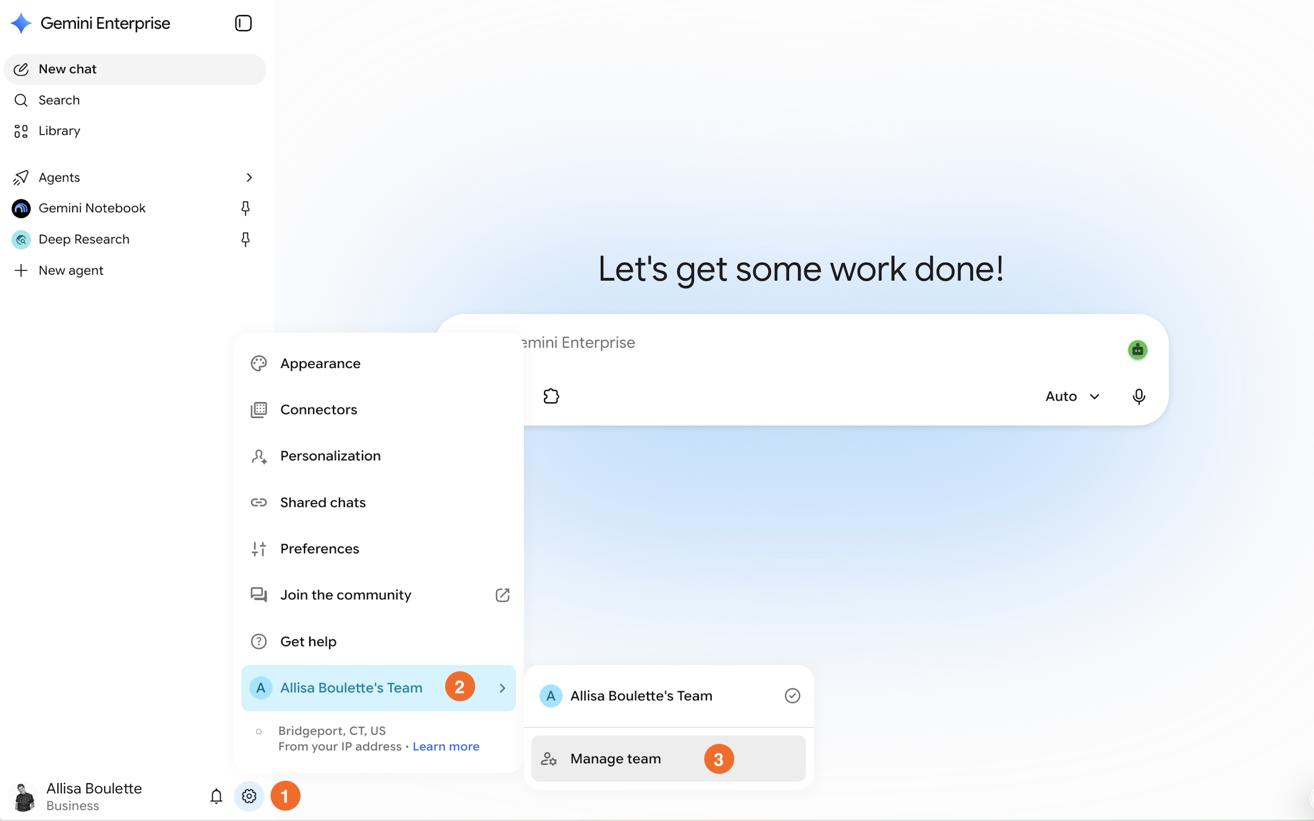
    1. In the Gemini Enterprise app admin console, click Settings & help (cog icon).

    2. Click your team name, then select Manage team. 

      Navigating to Manage team in Gemini Enterprise
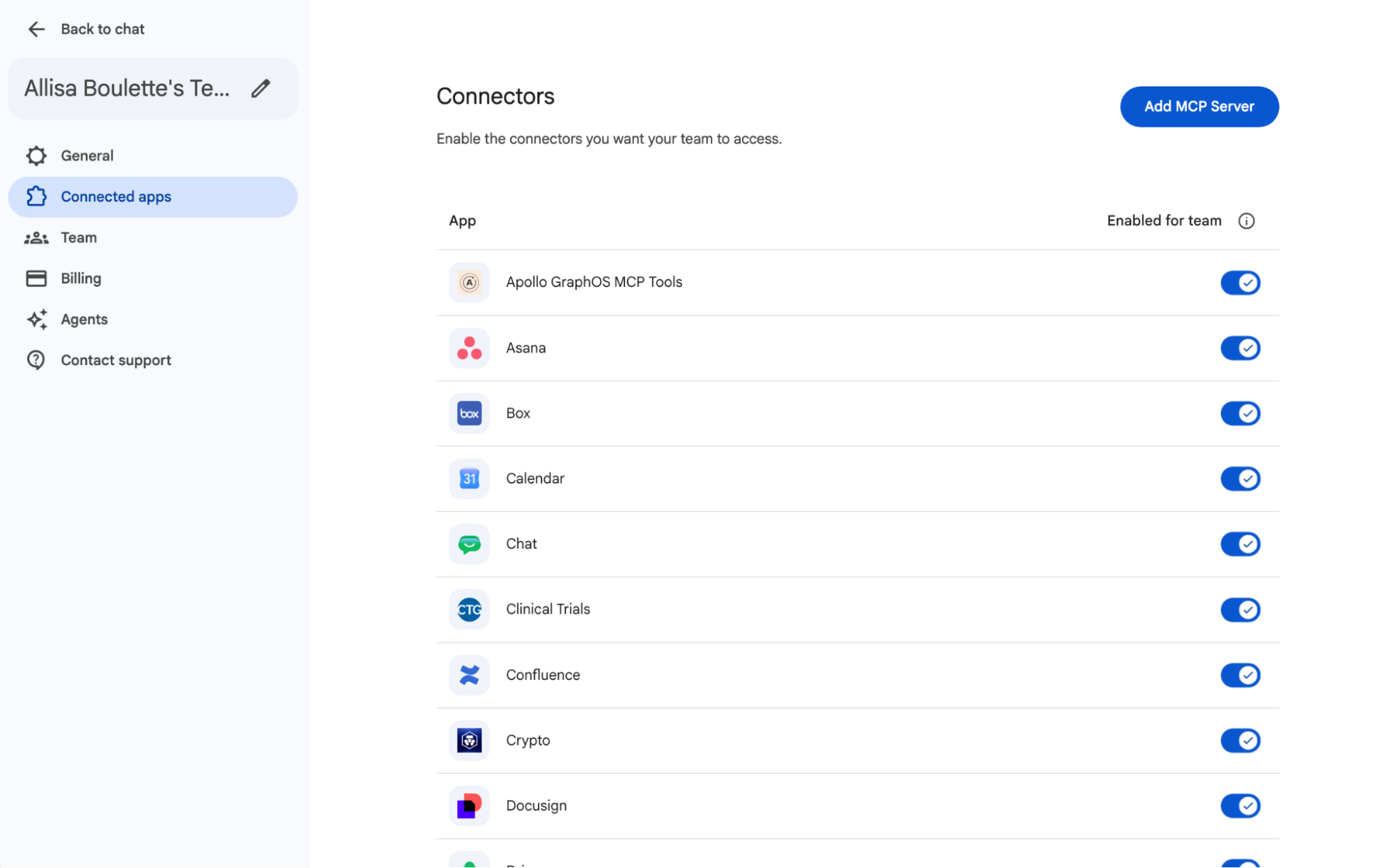
    3. Click Connected apps.

    4. Toggle the switch next to the app you want.

      The toggles to connect Gemini Connectors
    5. Authenticate with the source system and setting permissions when prompted.

    Once an admin has configured a connector, employees can search and interact with that data through the Gemini Enterprise app interface—asking natural-language questions that draw on the connected sources while respecting each user’s underlying permissions.

    Gemini Enterprise currently has over 100 connectors, covering Google Workspace, Microsoft 365 (SharePoint, OneDrive, Outlook, Teams), Atlassian (Jira, Confluence), Zapier, Salesforce, ServiceNow, Slack, Zendesk, GitHub, Dropbox, and more. It also supports custom connectors for data sources outside the catalog.

    If you’re evaluating whether Gemini Enterprise is right for your organization, the Gemini Enterprise connectors directory has the full list, broken down by edition (Business vs. Standard/Plus).

    How to add a custom connector or MCP server

    1. In the Gemini Enterprise app admin console, click Settings & help (cog icon).

    2. Click your team name, then select Manage team. 

    3. Click Connected apps.

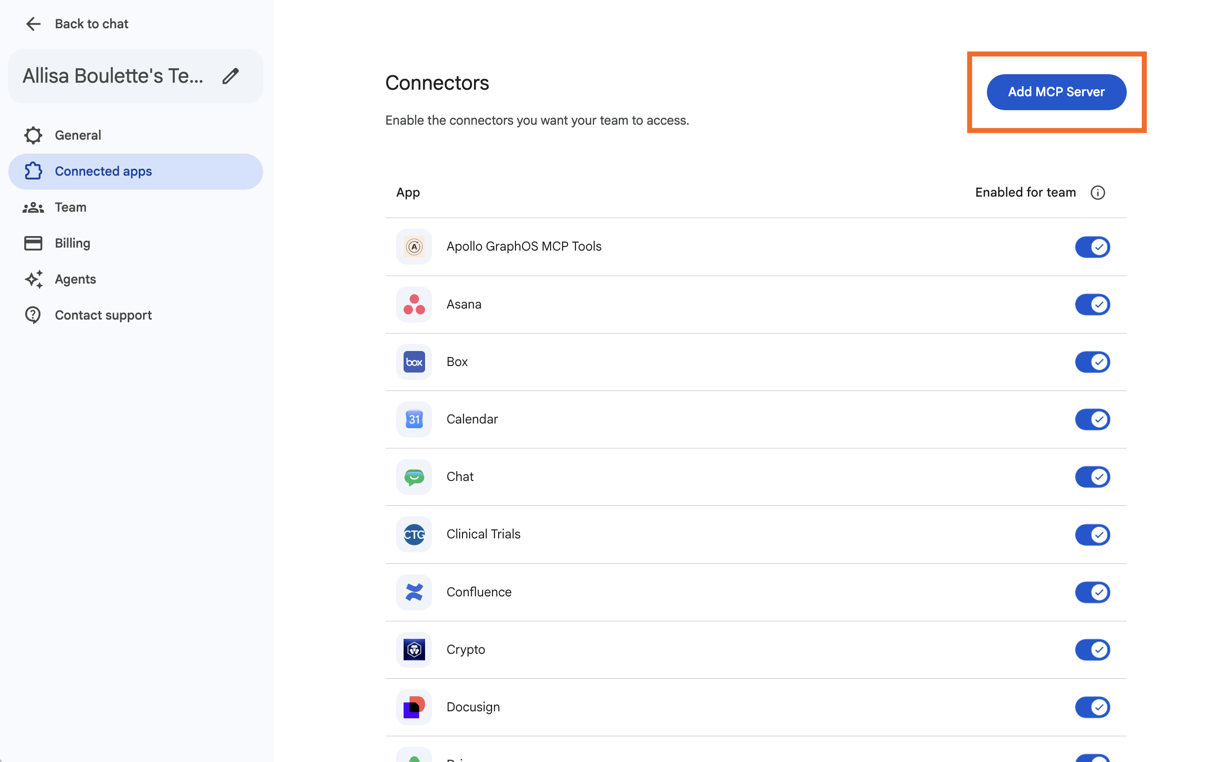
    4. Click Add MCP Server.

      The Add MCP Server button in Gemini Enterprise
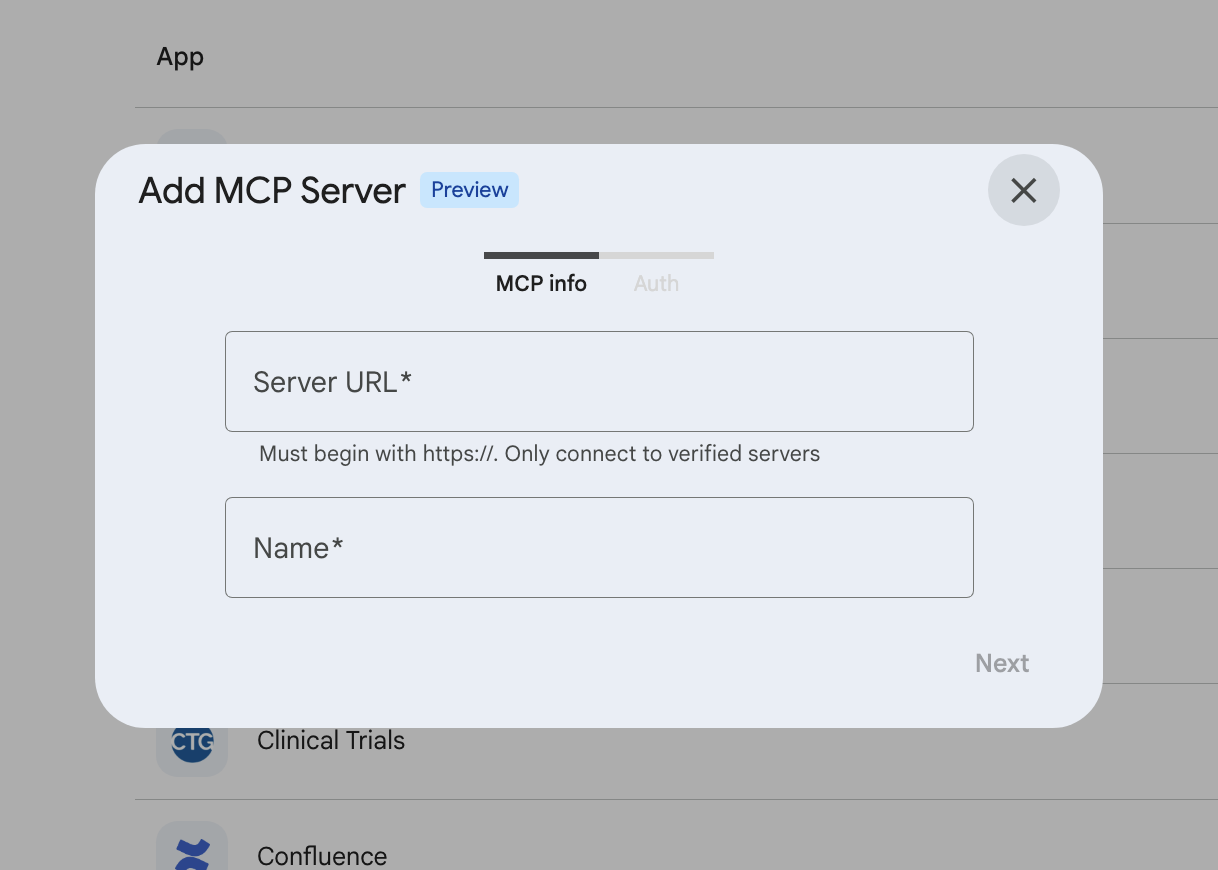
    5. Under MCP info, enter the MCP server URL and a name.

      Entering the server URL and name
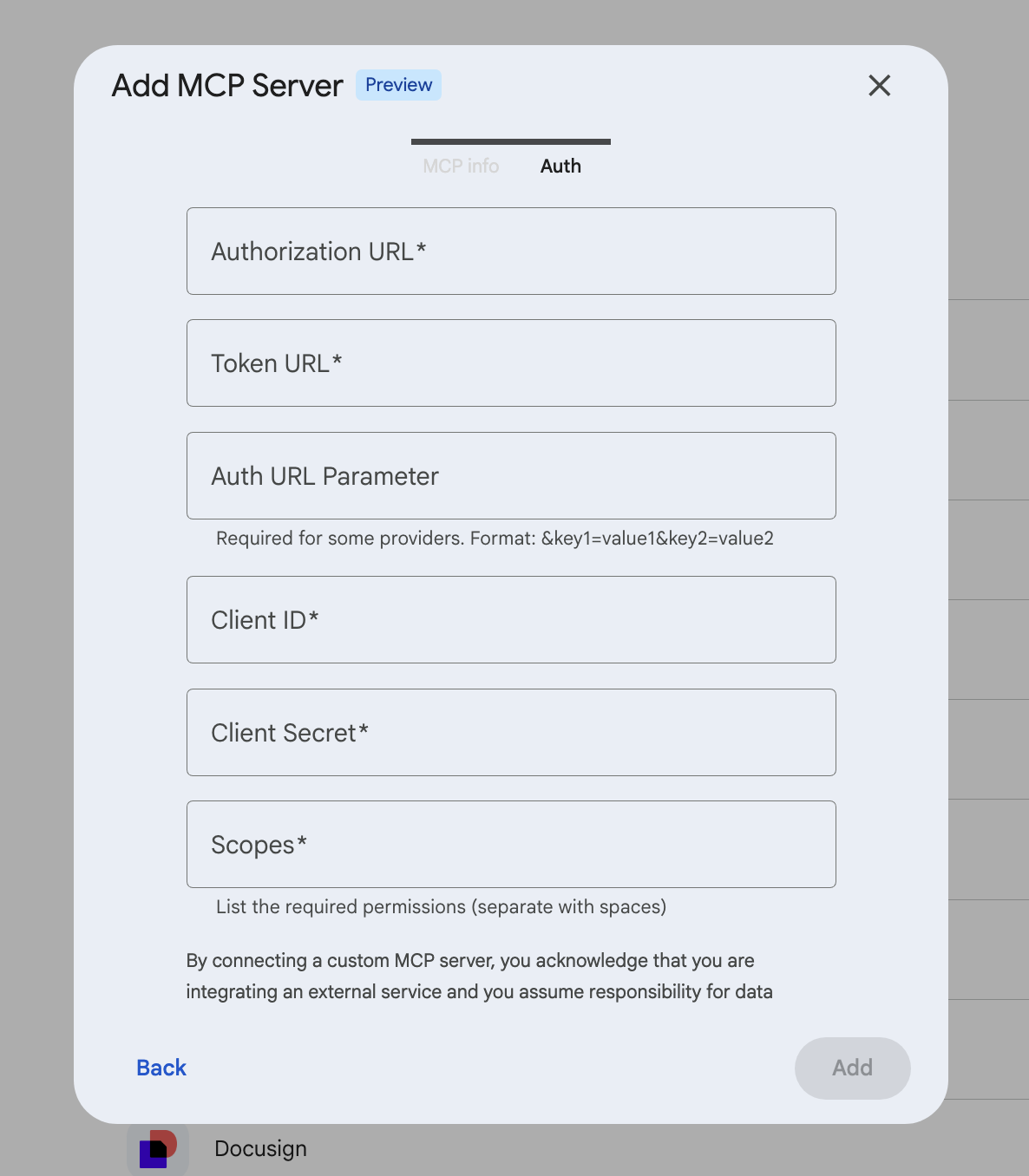
    6. Under Authentication settings, enter your Authorization URL, Token URL, Client ID, Client Secret, and Scopes. 

      Adding the other authorization details for a custom MCP server in Gemini Enterprise
    7. Click Add and enable the connection.

    Once configured, the custom connector is available to users just like any other connector. 

    Connect Gemini to 9,000+ apps with Zapier

    Native Gemini connectors cover a solid range of popular apps. But plenty of your stack won’t be in the catalog; and even for apps that are, native connectors have limits on what they can actually do. Zapier lets you securely connect Gemini Enterprise to 9,000+ apps—and you can bring the power of Gemini straight into your existing workflows.

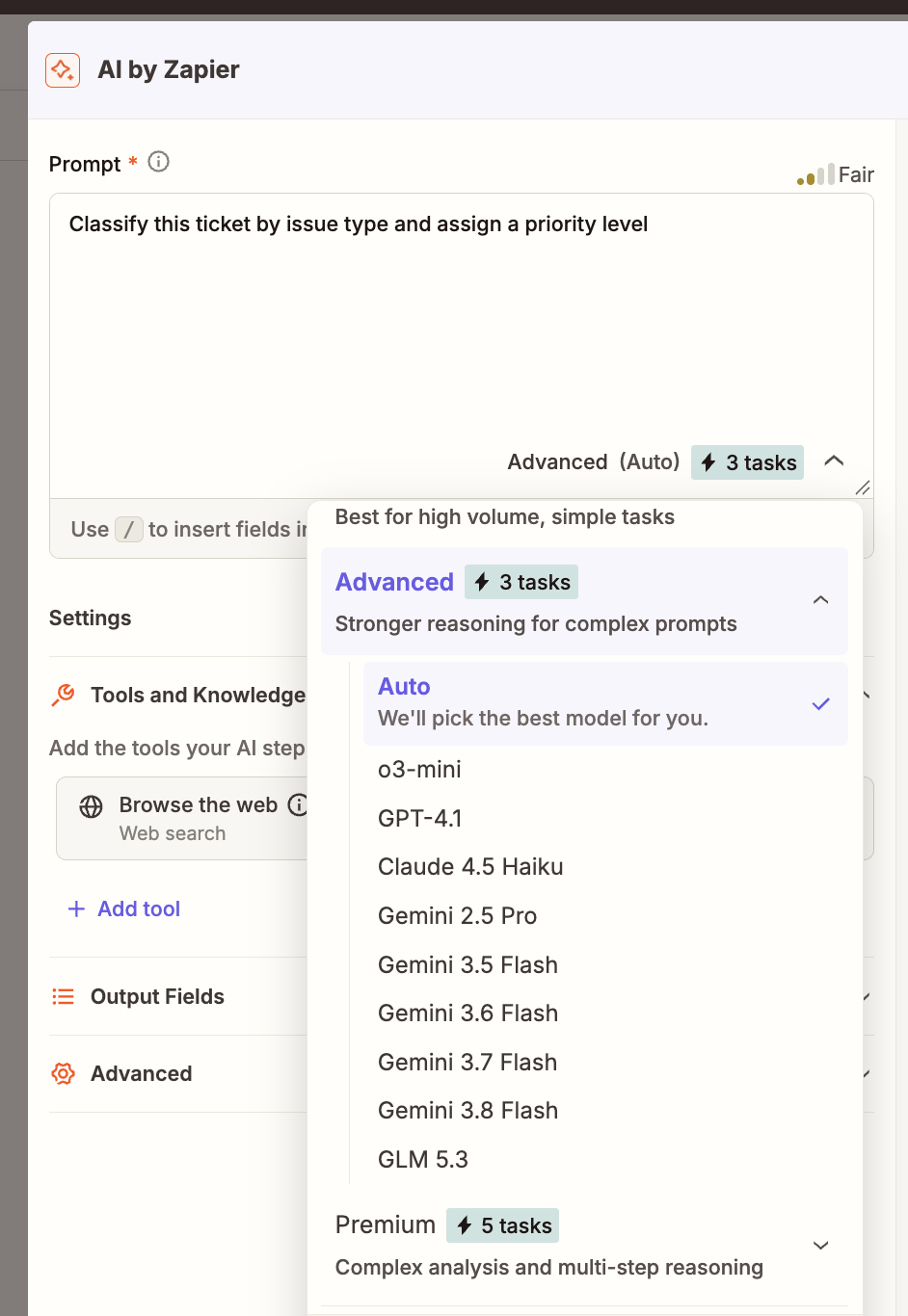
    Build deterministic workflows and add AI only when you need it

    Zapier’s automation platform lets you build workflows that run in the background: a trigger event happens in one app, and Zapier automatically takes action in another app as a result. But that’s the basic version. You can stack in filters, formatters, conditional paths, error handling, and other customizable nodes to build complex systems across your tech stack. 

    Wherever those workflows need reasoning, generation, or classification, you can use AI by Zapier to add Gemini steps to the automation—while the rest of the workflow runs without burning tokens on tasks that don’t need intelligence. You can choose from a variety of Gemini models (costing Zapier tasks, not tokens), or bring your own API key.

    AI by Zapier with Gemini models in the dropdown

    Zapier lets you blend AI with deterministic automation, giving you the kind of precision that isn’t possible with conversational connectors.

    Try Zapier

    Access 9,000+ apps directly in Gemini via Zapier’s Gemini connector

    If you add the Zapier connector to Gemini Enterprise, you’ll give your team governed access to 9,000+ apps directly from their Gemini chat window.

    Some examples of what this looks like in practice:

    • Pull data from your CRM, analyze pipeline health, and push a summary to a Slack channel—without leaving Gemini.

    • Ask Gemini to catch you up on what happened across your apps while you were out, surface action items, and draft replies.

    • Pull project notes and transcripts from tools across your stack, generate a status update, and drop it wherever your team expects it.

    You decide which apps and actions Gemini can access, so you stay in control the entire time. And you’re not tied to Gemini: If you want to run the same workflow through Claude or ChatGPT next quarter, Zapier works across all of them. 

    Try Zapier MCP

    Gemini connectors FAQ

    Are Gemini connectors free?

    No. Connected Apps (personal Gemini) are free to use with any Google account (though some third-party apps in the directory require their own paid subscription). But Gemini Enterprise connectors are part of the Gemini Enterprise plan, which is a paid enterprise product.

    What’s the difference between Connected Apps and Gemini Enterprise connectors?

    Connected Apps are for personal Gemini (gemini.google.com)—they connect your individual accounts to apps like Spotify, Gmail, GitHub, etc. Gemini Enterprise connectors are for the Gemini Enterprise app, an enterprise platform that connects Gemini to organizational data sources like Confluence, Salesforce, and SharePoint. It’s a completely different product.

    How many connectors does Gemini have?

    Gemini Enterprise has over 100 pre-built enterprise connectors and supports custom connectors for anything outside that list. For anything not natively covered on either side, Zapier gives you access to 9,000+ apps via a single connection.

    Are Gemini connectors safe?

    Yes. Gemini Enterprise enforces user-level access controls—Gemini can only surface data you’re permitted to see in the connected source. If you use Zapier, you get the same OAuth-managed, governed authentication model across 9,000+ apps.

    What happened to Google Agentspace?

    Google Agentspace was renamed Gemini Enterprise in mid-2026. It’s the same product with the same connector infrastructure—the rebrand brought it under the Gemini umbrella. Existing Agentspace customers can continue using their current setup without changes.
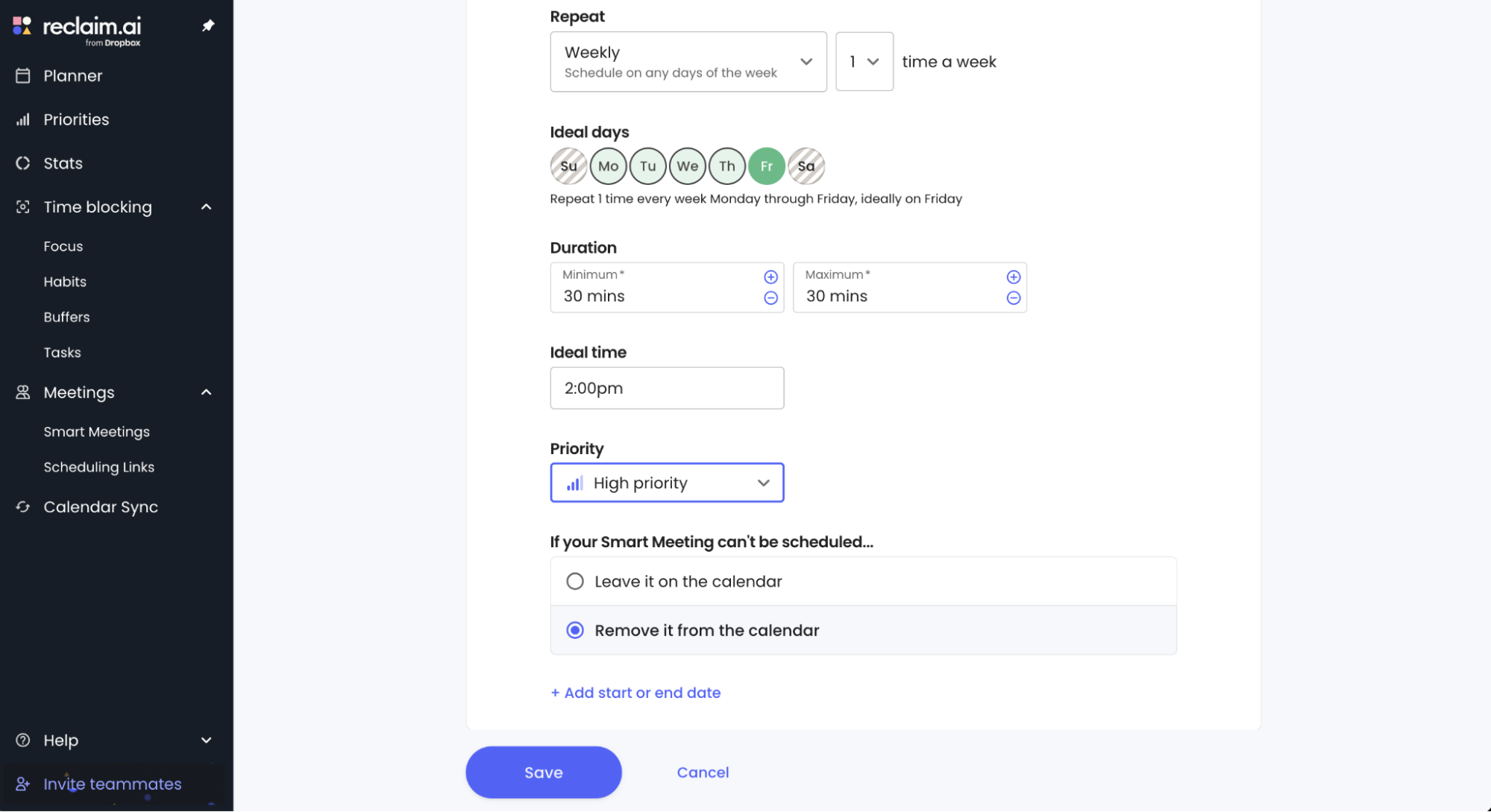
    Related reading:

  • AI for GTM: Benefits and 7 key use cases

    AI for GTM: Benefits and 7 key use cases

    Two years ago, I took my wife on a wine tour in Fredericksburg, which some people call the Napa Valley of Texas (a claim I find aggressive). After a few too many samples, I started reading the literature and realized I had no idea what white wine actually is. I thought it meant green or yellow grapes, when it really comes down to what the winemaker does with the skins.

    I learned that day that white wine slots into that group of “everyone knows what it is, but no one really knows what it is,” next to escrow, gluten, and go-to-market (GTM) teams. Good news for you: I understand one of those things, and it’s the one this article is about.

    There’s a lot of manual work attached to GTM. The information you need is spread across a CRM, a marketing automation platform, call recordings, and whatever’s buried in your internal docs. AI for GTM can synthesize, summarize, analyze, and take action across all of that—as long as you know how to set it up. And once AI is involved, your team can spend more of its time on revenue-generating work and, occasionally, wine sampling.

    Here’s everything you need to know about AI for GTM, and how you can bring the technology to your team.

    Table of contents:

    What is AI in GTM?

    GTM (go-to-market) is a cross-functional action plan that businesses use to identify product demand, launch products, and drive revenue—typically, it overlaps with marketing, sales, RevOps, and customer success, but lots of other teams can be involved. AI in GTM just means injecting AI and automation into that process.

    So instead of manually scouring your CRM, scoring and routing leads, or drafting follow-up messages, you can build AI workflows that handle all of that and more. That work still runs on your existing systems and processes, but it takes over the steps that previously needed somebody to read, decide, or write. A person only has to step in when a decision needs a brain instead of a motherboard.

    Types of AI that GTM teams use

    GTM AI covers a few different technologies, and in practice, they usually run together in the same workflow. Here’s what you can expect to see as you add AI to your GTM workflows:

    • Generative AI: Gen AI produces new content from a prompt and whatever context you hand it. In GTM, that covers a lot of ground, including account briefs, outbound drafts, campaign recaps, creative assets, and meeting notes turned into CRM fields.

    • Predictive models: Predictive models are trained on your own historical outcomes to estimate what happens next—think lead fit scores, deal risk flags, churn likelihood, and forecast ranges. These are only as good as your data. 

    • AI agents: Agents are technological helpers that can work autonomously to pursue a goal. They can take a series of steps on their own rather than answering a single prompt; you could, for example, use one to pull a lead record, search your docs, build a sales deck, and route it for approval.

    • Workflow automation: Automation is the rules-based part of things that handles repeatable tasks in the software you already use every day. 

    That’s all nice and vague, so let’s take a look at how AI in GTM actually looks in practice.

    7 ways GTM teams are using AI

    Here are some of the most common ways we’ve seen AI adopted in GTM processes—from the Zapier team, Zapier customers, and in the non-Zapier wild. 

    Sales intelligence

    Account research is mostly reading and writing. Someone opens a CRM record, a news page, three call transcripts, and a competitor battlecard, and writes two paragraphs summarizing the client. Then a sales rep skims that summary four minutes before the call.

    Research is a good place to start because the output is a draft, so a wrong detail doesn’t (usually) cause a cataclysmic chain of errors. In fact, per the Zapier AI Workflow Index, 37% of sales AI workflows have AI writing for people—so you’ll fit right in with some well-placed AI here. 

    Here are three areas you could start with:

    • Account research: AI collects the signals, enriches the account, and writes it all up in one summary. That’s a lot easier for a rep to get through than fifteen open tabs.

    • Buyer intent tracking: Capturing intent signals is the easy part. AI can monitor those signals and flag which spike is worth a set of human eyeballs. 

    • Competitive deal intelligence: Competitor names usually turn up in call notes and form fields, which aren’t exactly easy to search. AI can catch every time a prospect brings one up and update the right sales docs.

    Automate sales intelligence

    Outbound sales

    Outbound is a volume problem with teams trying their best to mix in personalization. Reps get asked to send a hundred emails, each written as if for one person, which never works. AI helps here because it can write a personalized draft for each of those hundred emails.

    Where to start:

    • Cold email outreach: Enrich the lead first, then let AI draft from that record instead of a template. That way, the first email actually mentions something specific about them, and you’re not sending another boilerplate message that reeks of desperation.

    • Sales sequencing: Every reply gets classified before a rep sees it, so genuine interest, a brush-off, and an out-of-office all route to different areas.

    • Account-based outreach: Most of this runs on enrichment and CRM updates. The AI’s role is to pull everything you know about the account into one place before anyone reaches out.

    Automate outbound sales

    Email marketing

    You can spend a week crafting email copy that would make Shakespeare weep, yet still fail because of a poorly segmented list. Most of the work in email marketing is deciding who gets which message, and when, based on what they did.

    In Zapier’s research, 35% of marketing AI workflows have AI extracting information and updating records, and 34% have it writing for people. That means as many marketers are using it to create content as they are for the less glamorous stuff, like keeping segments up to date and updating the records that decide who gets the next email.

    The workflows that do the most here:

    • Subscriber segmentation: Someone’s behavior changes, and their category or segment follows, because AI is reading clicks, purchases, and form fills as they happen, then making decisions based on all that aggregated data.

    • Drip marketing management: Instead of dropping every new lead into the same nurture track, AI can pick the sequence that fits the prospect’s source and product interest.

    • Email campaign management: Your automations can take care of scheduling and audience updates. Where AI helps is looking at your campaign results and telling you which ones are worth changing something about.

    Automate email marketing

    Lead management

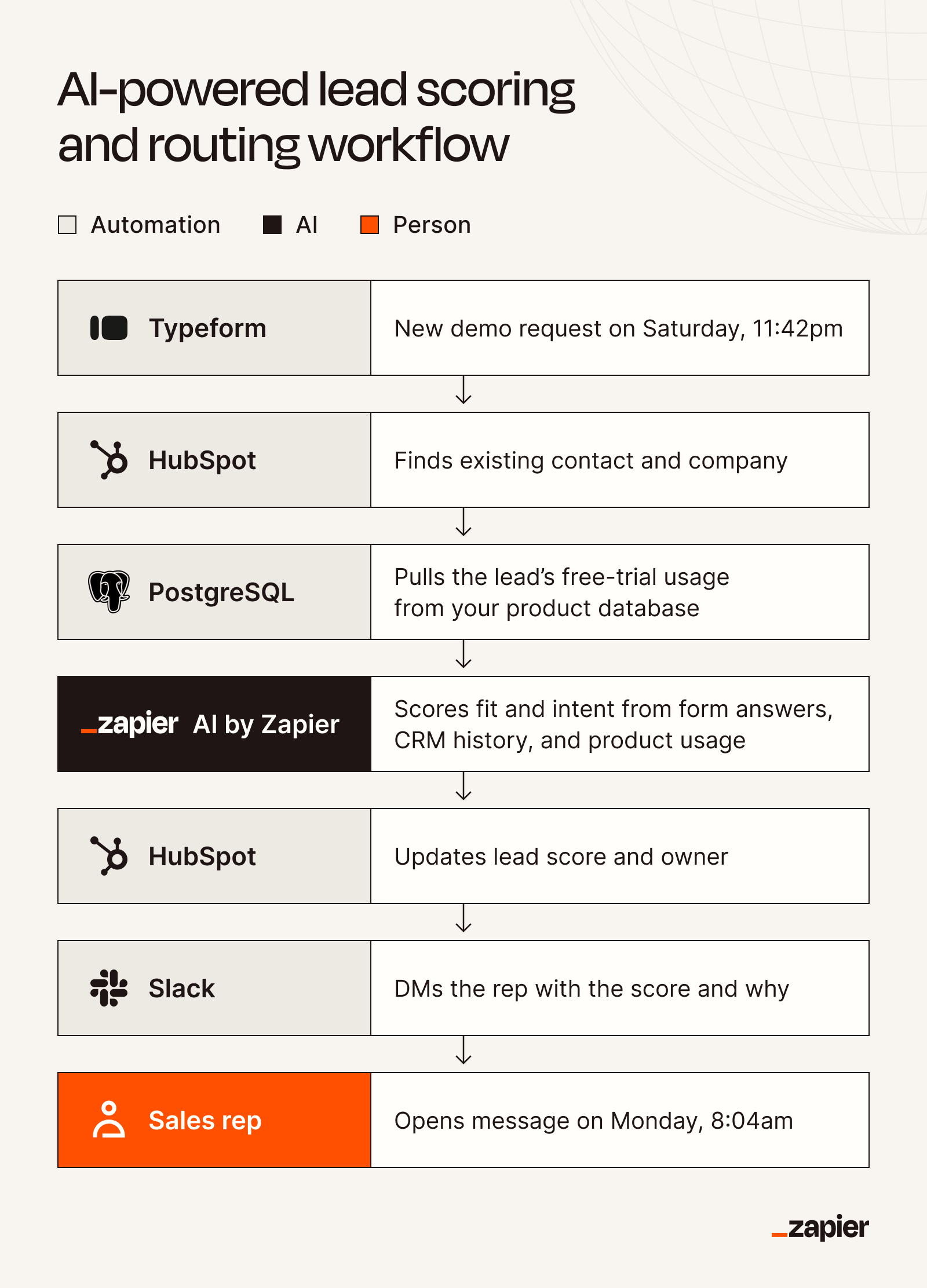
    A workflow design showing how teams can use AI in GTM for lead scoring and routing.

    Lead routing is the first place on this list where the AI has the freedom to make a judgment call. A lead arrives, the system determines fit and intent, and it’s swept off to the right rep at the right time. 

    These decision-making workflows can also run around the clock, and per the Zapier AI Workflow Index, 76% of those runs happen outside business hours. So, the lead that lands at 11 p.m. Saturday gets scored and assigned before Monday.

    What teams typically build:

    • Lead scoring: Your rules cover the obvious signals, like job title or company size. An AI model can weigh the ones that you haven’t written a rule for, and scores can get more accurate with more data.

    • Lead routing: A lot of lead routing is handled by your predefined rules. When it doesn’t, AI picks the owner and alerts them before the lead cools.

    • Lead qualification: With AI, a model can analyze the form text and call notes to determine whether a lead is sales-ready.

    Automate lead management

    Pipeline management

    If you have just a handful of deals in the pipeline, and one hasn’t moved in three weeks, that’s pretty easy to see on your own. It gets a lot harder when you have to keep track of hundreds every month. An AI model can keep a watchful eye on your pipeline, flag a stalled deal, and summarize why it looks stuck. 

    A few examples:

    • Deal tracking: If a deal goes a little quieter than you’d like, a workflow can flag it before the Monday pipeline review does, with a short AI summary of what’s been going on (or not going on) with it.

    • Sales forecasting: Pipeline shifts daily, so a model monitors value, stage, and close-date changes and flags any abnormalities.

    • Win-loss analysis: AI can read closed-lost notes in bulk to surface patterns nobody has time to tally by hand.

    Automate pipeline management

    Data hygiene

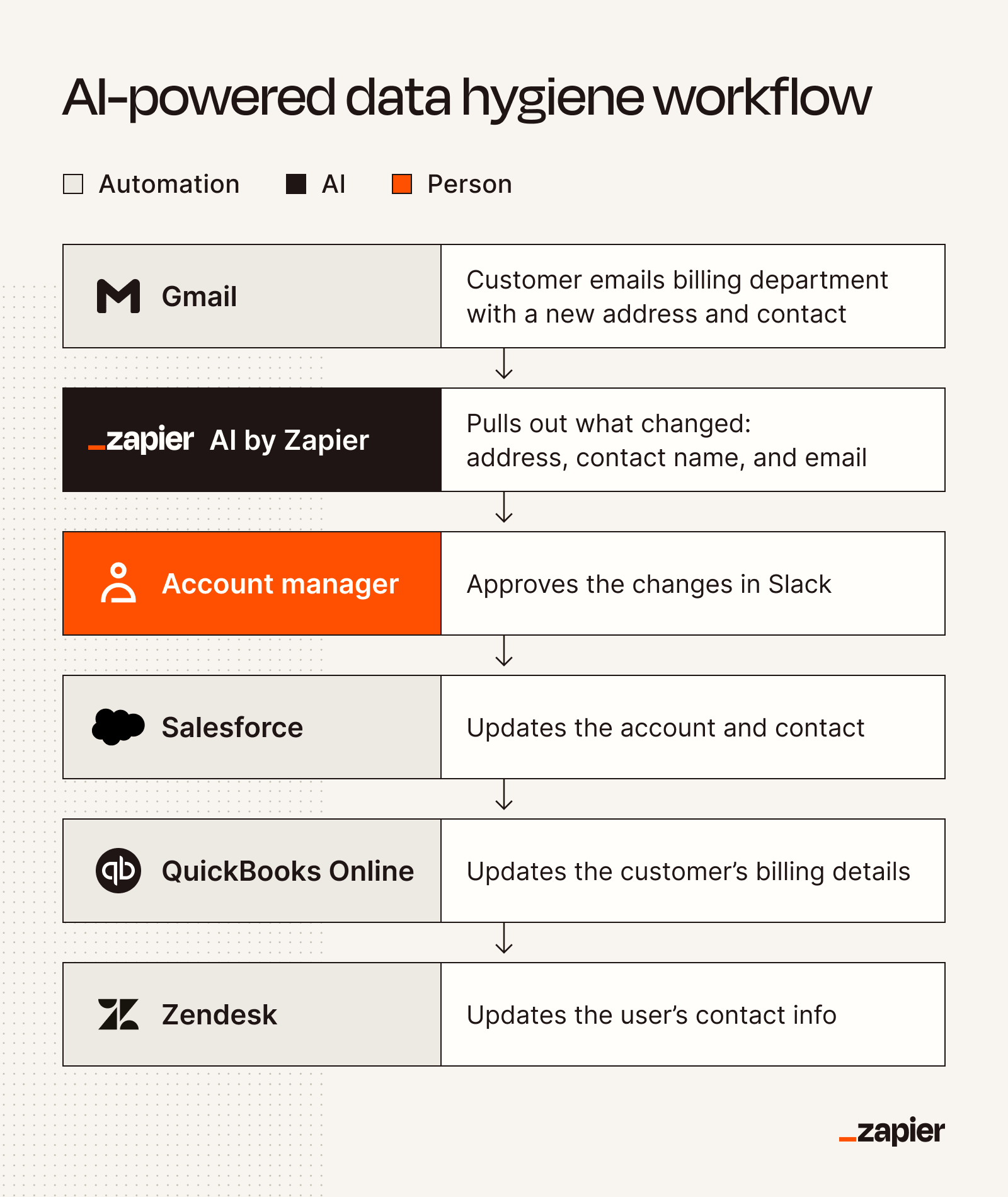
    A workflow design showing how teams can use AI in GTM for data hygiene.

    Duplicate contacts, six formats for phone numbers, and empty source fields happen to even the most careful sales teams, and your lead scoring and forecasting are working off that same messy data.

    This is arguably the most common job AI does in sales workflows. It’s boring work, but everything else on this list depends on it, which is why many RevOps tools emphasize data quality.

    Three jobs to hand over:

    • CRM hygiene and deduplication: An exact-match rule sees Bob’s Burgers and Bob’s Burgers Inc. as two companies. A model doesn’t, and it normalizes the fields around them.

    • CRM data enrichment: If a form asks for four fields but your reps need twelve, AI can fill the gaps and update your records.

    • CRM data entry: AI can summarize and log call notes and email threads, giving CRM fields additional context that would otherwise need a sales rep to hunt down.

    Automate CRM management

    RevOps reporting and forecasting

    It’s Thursday, and the forecast call is tomorrow morning. So somebody exports your current pipeline data, cross-checks it against last week, chases two reps about deals that look wrong, and rebuilds the same deck as last Thursday. By Monday, half of it is stale again.

    Reporting suits automation because it’s really never over. AI can keep writing up what’s changing in your numbers as it happens, so you’re not rebuilding the whole thing from scratch every Thursday.

    Here are a couple things you could try:

    • Pipeline reporting: AI turns stage and forecast changes into a single paragraph, so key decision-makers get a written summary rather than another dashboard link.

    • Sales performance tracking: Metrics change every day, and a lot of it is just noise. AI can flag the changes that you determine need an extra conversation.

    Automate sales reporting

    Benefits of AI in GTM

    Once you start implementing AI in GTM, you’ll find benefits everywhere you look. Sure, a few of your reps will save 30 minutes here and there that they can use for longer (wine-free) lunch breaks, but the bigger wins look more like this:

    • Faster response times: An AI workflow scores, routes, and enriches around the clock, weekends included. So a new lead doesn’t sit there untouched until someone’s back at their desk.

    • Steadier output: Every brief or piece of content comes out of the same prompt and the same sources, so the format doesn’t drift. A new rep’s first account summary reads like one from someone two years in.

    • Cleaner data: An AI model can fill in structured fields while it works, so nobody has to go back and do it later, which means your forecast is working off records that actually got filled in.

    • Higher capacity: With AI processes, research, enrichment, and record updates aren’t tied to headcount anymore, so you can do more work without dusting off the job posting script. 

    Bring AI to your GTM motion with Zapier

    AI for GTM covers a lot more ground than you’d think. From account research and lead routing to forecast reporting and CRM cleanup, you can always find an opportunity to slip some well-placed AI into your go-to-market functions. But in order to take full advantage of these processes, you need the right automation system in place.

    That’s where Zapier comes in: it’s an end-to-end AI automation platform that can help you sync 9,000+ apps across your tech stack. Start with a template, or build the exact GTM automation you need in plain English with Zapier Copilot. Or use Zapier MCP to run automations and do work across your GTM stack directly from Claude, ChatGPT, Cursor, or any other AI assistant. Get started with our GTM agent templates.

    Try Zapier

    Related reading

  • Chatham scales its capital markets expertise with OpenAI

    Chatham Financial uses Codex and GPT-5.6 to build technology and redesign workflows, cutting trade validation from 30 minutes to under 4.

  • The psychology of machine intelligence: evaluating the necessity of artificial intelligence in everyday smart devices and automated systems

    The psychology of machine intelligence: evaluating the necessity of artificial intelligence in everyday smart devices and automated systems

    Client Challenge
  • ngram 2.0

    Create explainers, screencasts, and AI avatar videos

    Discussion
    |
    Link

  • The eternal complement

    Advanced AI may matter most for the routine work behind breakthrough ideas. Explore why execution could shape the next economy and the pace of progress.

  • The 7 best meeting scheduler apps in 2026

    The 7 best meeting scheduler apps in 2026

    We independently review every app we recommend in our best apps lists. When you click some of the links on this page, we may earn a commission. Learn more.

    Scheduling a meeting is no biggie, right? You just have to trade a dozen emails while squinting at your calendar in a negotiating mode that’d make the UN jealous, all to end alone in a Zoom room, realizing that your invitee is actually now sleeping on the other side of the earth. And then the slot-picking gymnastics begin again.

    Meeting scheduler apps get rid of this back-and-forth, place the events in open slots in your calendar, and follow up with everyone with the conferencing links. Set it up once, share it with your invitees, and let them book time with you with four or five taps, tops.

    There are all sorts of meeting scheduler tools out there covering all kinds of use cases. I’ve used a few of them over the years, and after diving into every single one for writing this list for you, I think I’m going to switch again. So whether you’re here to grab your first one or looking to leave Calendly or Doodle behind, here are the best meeting schedulers.

    The best meeting schedulers

    • Calendly for end-to-end meeting management

    • Calendar for appointments in a calendar app

    • SavvyCal for ​​mixing polling with a standard scheduling tool

    • zcal for a free meeting scheduler

    • Reclaim for priority-based scheduling

    • Cal.com for follow-up automation with AI phone calls

    • Zeeg for a customizable link-in-bio page

    What makes the best meeting scheduler?

    How we evaluate and test apps

    Our best apps roundups are written by humans who’ve spent much of their careers using, testing, and writing about software. Unless explicitly stated, we spend dozens of hours researching and testing apps, using each app as it’s intended to be used and evaluating it against the criteria we set for the category. We’re never paid for placement in our articles from any app or for links to any site—we value the trust readers put in us to offer authentic evaluations of the categories and apps we review. For more details on our process, read the full rundown of how we select apps to feature on the Zapier blog.

    Meeting scheduling apps are in a race to reduce obstacles and friction, helping people book time with each other without the frustration. This means appealing user interfaces that are easier to read, fewer clicks from start to finish, and team features to smooth out internal coordination.

    Here’s what I specifically looked for when selecting the best meeting schedulers:

    • Ease of use. The meeting scheduler has to be user-friendly for both you as a booking page creator and your invitees.

    • External integrations. Beyond the core calendar and video conferencing, connecting your meeting scheduler app with your other apps can automate work related to your meetings. I kept an eye on those with a good list of integrations, as well as those that connect with Zapier.

    • Automatic video call setup. Creating a video conferencing link with one of the major platforms and delivering it to all participants is key to a smooth process when using a meeting scheduling app.

    • Reminders and follow-ups. Everyone is busy; nudging people to attend reduces no-shows. Follow-ups are great for nurturing and keeping the relationship growing. Having both in your meeting scheduler makes the experience easier and more hands-off for you.

    • Value for money. It’s a painful problem, sure, but not worth a $100/month commitment. Most of the meeting schedulers here have generous free plans; those that don’t compensate with extra features that help you with scheduling, team coordination, analytics, or extra automation.

    To test the meeting schedulers, I signed up for each one of the apps below (as well as 40 more that didn’t make the cut), created a booking link, and integrated a video conferencing app. Then, I played around with the extra features until I was satisfied with the booking pages, automation, or calendar setup. Lastly, I booked meetings with myself to understand the invitee experience. I’m happy to report I have hours of meetings booked with myself and am receiving an endless stream of notifications for “1-on-1 with Miguel.”

    Have a Zoom, Google, or Microsoft subscription?

    If you already have a subscription with a major software suite or video conferencing solution, run a quick search to see if they’ve implemented their own meeting scheduling tool. It may turn out to have all the features you need without you having to sign up for yet another platform.

    The best meeting schedulers at a glance

    Best for

    Standout feature

    Pricing

    Website

    Calendly

    End-to-end meeting management

    Scheduling handled entirely by cc’ing Callie in email threads

    Free plan available; paid plans start at $10/month

    Visit Calendly

    Calendar

    Appointments in a calendar app

    Multiple workspaces

    From $16/month

    Visit Calendar

    SavvyCal

    Mixing polling with a standard scheduling tool

    Option for invitees to automatically overlay their calendars within the polling page

    Free plan available; paid plans start at $10/user/month

    Visit SavvyCal

    zcal

    A free option

    Generous free tier with customization

    Free plain available; paid plans start at $7/user/month

    Visit zcal

    Reclaim

    Priority-based scheduling

    Great analytics and team features

    Free plan available; paid plans start at $10/user/month

    Visit Reclaim

    Cal.com

    Maximum flexibility

    Open source

    Free for individuals; paid plans start at $16/user/month

    Visit Cal.com

    Zeeg

    A customizable link-in-bio page

    Straightforward user experience

    Free basic plan; paid plans start at $10/user/month

    Visit Zeeg

    Best meeting scheduler for end-to-end meeting management

    Calendly (Web, iOS, Android)

    Calendly, our pick for the best meeting scheduler app for end-to-end meeting management.

    Calendly pros:

    • AI features handle the full meeting lifecycle (scheduling, meeting prep, note-taking, and follow-ups)

    • MCP server available for connecting Calendly to ChatGPT or Claude

    Calendly cons:

    • AI features (Notetaker and Callie) are currently English-only

    • Free plan only supports one meeting type

    Make way for the category standard: I regularly meet with people who casually say, “Let me send you my Calendly so we can find a time next week.” It’s the best all-around option because it’s a trusted platform, the user experience is polished, and it packs advanced features if you need them. I’ve been using it for two years, and it has never failed me.

    As you onboard, you can connect your calendar, no matter if it lives in Google, Outlook, or Microsoft Exchange. Create your first booking link by choosing the duration, location, and availability options, wrapping it up by connecting your video conferencing software of choice (or setting up a real-world location). You can add buffer time to wind-down and ramp-up for each meeting, as well as payment support with Stripe or PayPal. Comms around the meeting are automated, with Calendly delivering the meeting confirmation by default, and also offering email/SMS reminders and follow-ups once the meeting’s done.

    Once the booking page is live, you can share it with your invitees. They can browse your availability and pick a time on an intuitive interface. Calendly is always linked to your calendar (without ever sharing what you’re doing), so it knows how to remove slots when you have events already planned or keep them available if you’re free. The emails include cancellation and rescheduling links, which clean up your calendar and keep everyone on the same page.

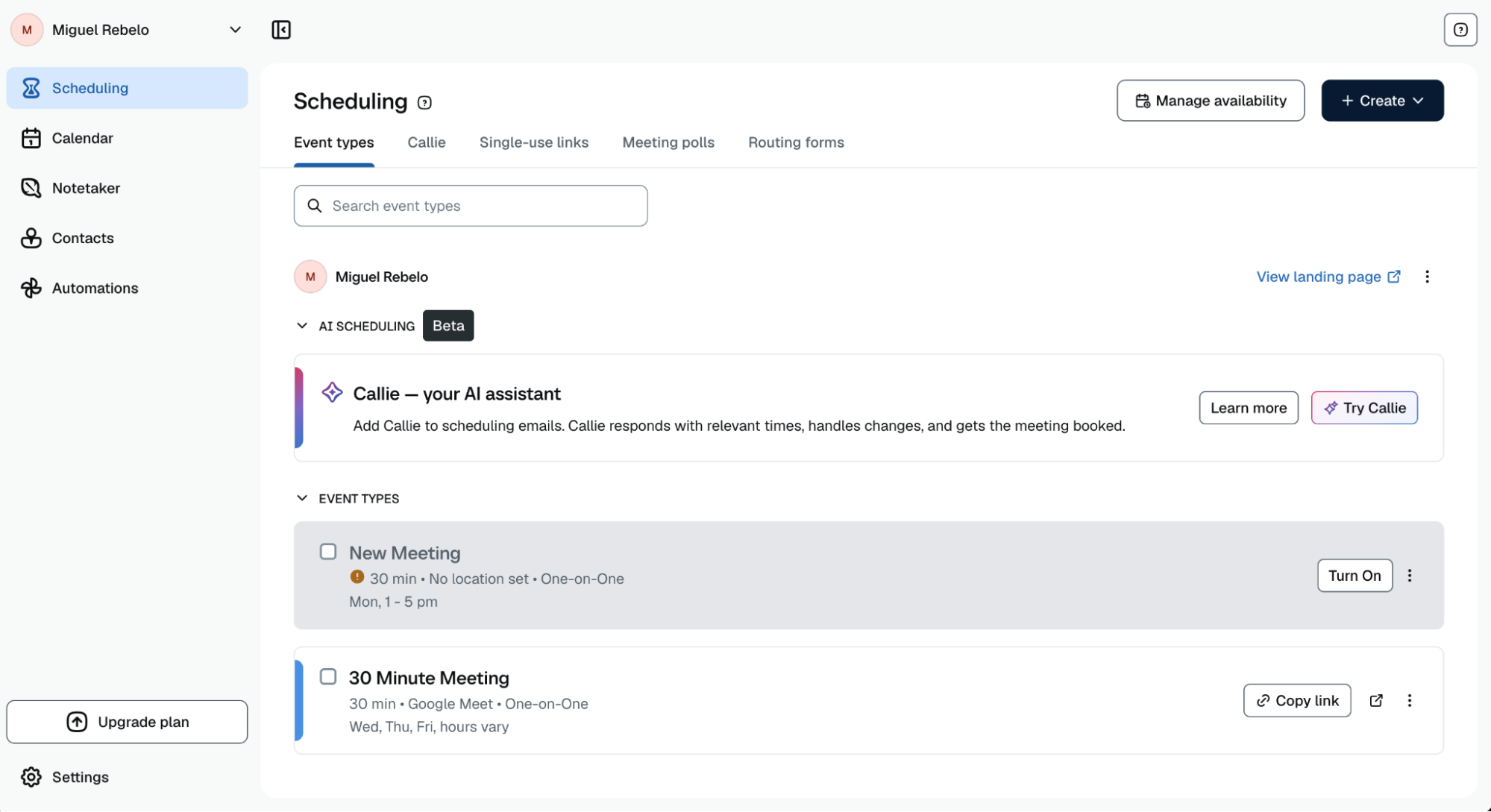
    The free plan isn’t as amazing as others below (though freelancers and small business owners will be fine with it), but when you hop on the paid plan, you get a range of smart features that save even more time and streamline your meetings. The biggest examples: Callie, an AI assistant you cc on an email thread to find and propose meeting times, and then book the meeting for you—no link-sharing required. Notetaker, meanwhile, joins your Zoom, Google Meet, or Teams calls to automatically record, transcribe, and surface action items. Both are available on Standard Plus and Teams Plus plans. 

    By connecting Calendly to Zapier, you can orchestrate intelligent, end-to-end meeting workflows. For example, once Notetaker wraps up a call and surfaces action items, Zapier can automatically add those tasks to your project management tool, complete with assignees and due dates, and notify your team in Slack. Learn more about how to automate Calendly.

    Automate Calendly

    Build automations from wherever you work. Describe the outcome you want, and Zapier connects your tools, runs the steps, and stays on the job after you close the chat. Combine AI with reliable, deterministic automation across 9,000+ apps. Get started for free.

    Calendly pricing: Free plan includes unlimited one-on-one meetings; paid plans start at $10/user/month (billed yearly), which includes unlimited multi-person meetings and more customization options. Notetaker and Callie available on Standard Plus and Teams Plus plans—$18/user/month (billed yearly) on top of your base plan.

    Best meeting scheduler built into a calendar app

    Calendar (Web, iOS, Android)

    Calendar, our pick for the best free meeting scheduler built into a calendar app

    Calendar pros:

    • Supports multiple workspaces, each with different calendars and booking links

    • Extensive meeting statistics

    Calendar cons:

    • User interface isn’t as polished as others on the list

    • Expensive entry-level plan

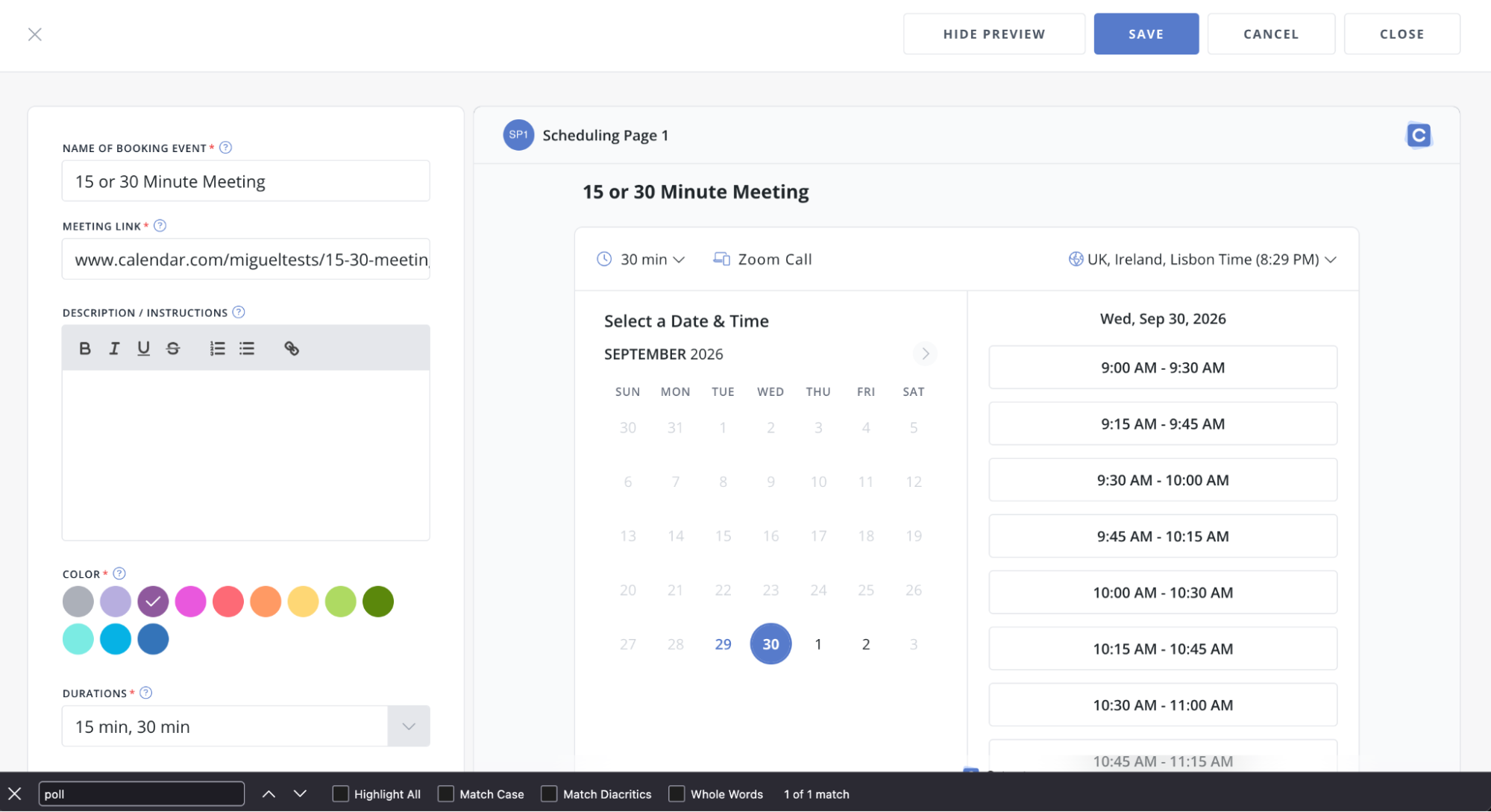
    Looking to upgrade your current calendar setup and streamline meeting booking at the same time? Calendar looks and feels like Google Calendar-lite, but adding  meeting links and mobile apps to run the show across your devices.

    You can create up to five scheduling links to keep your meeting invitations organized. These can range from quick 15-minute catch-ups to hour-long brainstorming sessions—and everything in between. When offering each booking link, the invitee will only be able to schedule that type of meeting in the available time slots, which you can change based on type, too. This makes it possible to, for example, schedule a single 30-minute slot per week for networking with new people.

    Calendar used to have a good free plan, but that’s history, unfortunately. On the paid plan, you can address team needs with multiple workspaces, each having its own separate calendar and booking links, keeping all events organized. The setup process is a bit long, but this extra customizability can be useful for companies that run a lot of different events with complex needs. The meeting statistics are quite deep, going beyond the basic time spent to cover attendance records, rejections, and who you’re more likely to meet again.

    The user interface is simple, with most of the meeting scheduling features tucked away on the left side profile link. You can learn almost everything there is to know about Calendar in under an hour, and either adopt it as your main calendar entry point or your control board to see meeting statistics.

    By connecting Calendar to Zapier, you can orchestrate end-to-end scheduling workflows that tie meetings directly into the rest of your tech stack. For example, when a new meeting is scheduled, Zapier can log the details in Google Sheets, notify you in Slack, and use AI to generate meeting prep notes or suggest follow-up tasks.

    Automate Calendar

    Calendar pricing: Free 14-day trial. Standard plan at $16/month (billed yearly) lets you connect 6 calendars and adds meeting polls and calendar analytics.

    Looking for a free alternative? Notion Calendar combines a clean calendar with simple scheduling features, with one-time availability and meeting links included.

    Best meeting scheduler for mixing polling with a standard scheduling tool

    SavvyCal (Web)

    SavvyCal, our pick for the best meeting scheduler for mixing polling with a standard scheduling tool

    SavvyCal pros:

    • Easy to use

    • Includes automation and time defense features on the paid plan

    SavvyCal cons:

    • Only polling on the free plan

    Group scheduling is a nightmare. I don’t even know how to get it done without a polling tool: do I just get everyone in an email thread, suggest dates, and get ready for cognitive overwhelm? Thanks to SavvyCal, you and I don’t have to get tangled up in this, as it combines polling with scheduling, streamlining both.

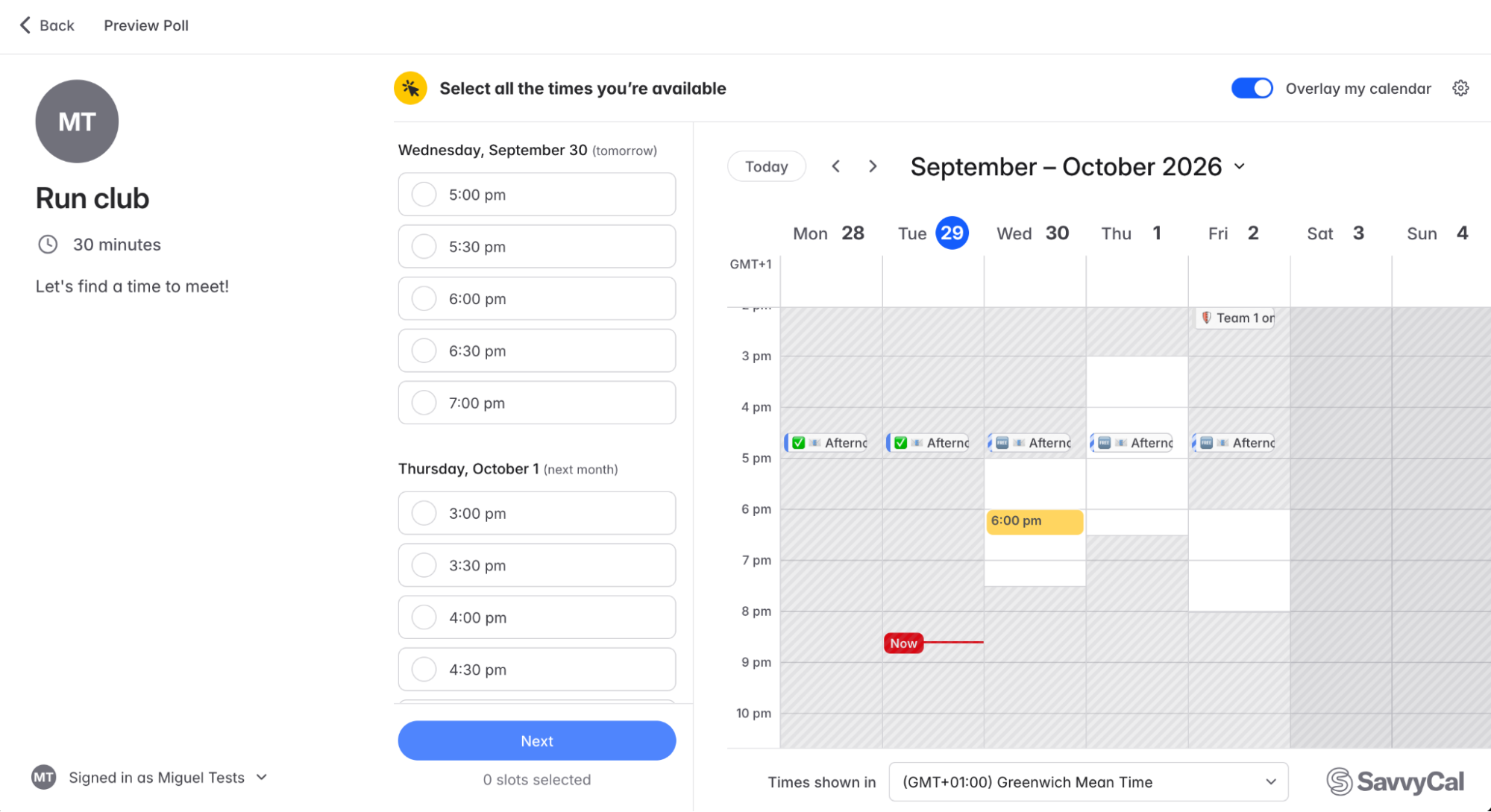
    You can start a new poll by naming it, as if this were a small scheduling project. In the next step, SavvyCal displays your connected calendar so you can highlight the dates and times you’re available. Click or drag to select, and you’ll see the options line up on the left side of the screen. You can adjust meeting details, such as description or location, and add an attendee to the poll so you can preview their availability along with yours.

    On the invitee side, they can see all the suggested slots both as a list and on a calendar view. Unique here is how you can connect your own calendar as an invitee, so you can overlay your events with the dates and times, making it easier to spot where you’ll be available. Vote by either clicking the calendar or the list, and remember that this is multi-choice.

    As the responses stream in, you can see which people voted for which slots, with a handy vote counter at the bottom of the page to help you lock in on the best. When you click the Schedule button, SavvyCal actually sends out all the meeting invites to everyone involved. Just show up at the agreed date and time, and you’re golden.

    You can enjoy this part of the tool for free. For creating a static booking link based on your calendar availability—like most other apps offer—you have to hop on a paid plan. This turns SavvyCal into a Calendly/Doodle minimalist child. If you love the polling experience and are interested in automation, team scheduling, and time defense tools, definitely try the basic paid plan.

    SavvyCal also integrates with Zapier. This means you can connect it with thousands of other apps and build dynamic scheduling workflows. For example, when someone schedules time with you in SavvyCal, you can automatically send an AI-generated confirmation email, tailored to the meeting type, attendee, or goal. Zapier can also add related pre- or post-meeting tasks to your project management app and update internal records.

    Automate SavvyCal

    SavvyCal pricing: Free plan available for polling features only. Basic at $12/user/month (billed monthly) unlocks nearly everything except custom domains, delegating to assistants, and paid bookings.

    Best free meeting scheduler

    zcal (Web)

    zcal, our pick for the best free meeting scheduler

    zcal pros:

    • Useful booking page customization settings

    • Good range of integrations available

    zcal cons:

    • Lacks advanced features, especially around sales automation

    “Free” is a powerful word, but it’s a relative term in the software world. In some apps, it means a little taste of the features with heavy limitations. zcal is in the opposite camp: it proudly advertises that 99% of its features are free and unlimited, giving individual users a lot of value for nothing.

    This means you can connect any number of calendars, generate unlimited meeting links, run meeting polls, and access a range of advanced features not usually seen on free plans. You can add screening questions during the scheduling process, include cover photos and welcome videos, and even embed it on your website.

    The app is easy to use in general, although there are some minor user experience quirks. The interface on the meeting creator side can be a bit too simple and not easy to digest at a glance. For example: when you navigate to set your availability, dive into events, or set up team features, you might be left wondering how to go back to the main screen with the booking links and upcoming events. (Just click the zcal logo and you’ll be back on that screen.)

    Don’t worry about the invitee side, though: the booking page is top-notch, really intuitive, with a nice detail as it separates morning slots from afternoon ones with a “noon” divider at 12 p.m. The customization features give a nice touch to make the page more memorable, with three layout controls in addition to the cover/video that I mentioned earlier.

    By connecting zcal to Zapier, you can orchestrate intelligent scheduling workflows that connect meetings to the rest of your systems. For example, you can automatically add new attendees in your CRM and email marketing list, use AI to send a personalized welcome or follow-up message, and update records with a meeting summary.

    Automate zcal

    zcal pricing: Generous free plan available. Pro plan at $7/month (billed yearly) unlocks team features, round robin, and SMS/email reminder messages.

    Best meeting scheduler for priority-based scheduling

    Reclaim (Web)

    Reclaim, our pick for the best meeting scheduler for priority-based scheduling

    Reclaim pros:

    • Good free plan

    • Great analytics and team features

    Reclaim cons:

    • Requires building a different mindset when approaching your day, which might take some time to fully adopt

    Not all meetings have the same importance. For example, meeting with an important new lead should dethrone your weekly team meeting. Setting this up in a conventional meeting scheduler app involves layering multiple calendars, which ends up being clunky. Reclaim, a Dropbox product, solves this problem: it handles meeting prioritization natively without workarounds.

    Reclaim can make this happen because it’s a little bit more than a meeting scheduling app—so much so that it’s almost out of scope for this list. It’s an AI calendar with an engine that tracks your habits and reprioritizes your days based on what you have to do. This prioritization engine is behind the smart meeting features, which I’ll walk through slowly because they’re a bit complex.

    There are four tiers of priority for any kind of event in Reclaim. The highest one, critical, can override all others and land on the calendar as soon as possible. The lowest one, low, is a pushover that can easily get bumped around. When creating a booking link, you can assign a priority for all bookings done from that interface. This means that you need to share the critical-labeled link for urgent meetings, or a low-labeled one for those that aren’t as key. (You need a paid plan to do this.)

    On the invitee side on the critical booking link, they can see all your slots as free, excluding those occupied by other critical tasks. They can book whichever time they need and, when it lands on your calendar, all the lower-priority events are shuffled around to make it work. This dynamic behavior is great if you use your calendar as your control center and interact with it frequently, but if you’re like me and it doesn’t move around much, it might take some getting used to seeing your time in flow as the day progresses.

    Recently acquired by Dropbox, Reclaim has a good free plan for all core features, offering a calendar app where you can plan your life and work, tunnel down into focus time, and protect your important habits. Coupled with the smart meeting, it makes it a really nice calendar co-pilot to help optimize your schedule without you having to work hard for it.

    You can also connect Reclaim with Zapier, so you can automate complex, multi-step workflows across the rest of your tools. For example, you can automatically turn flagged emails into Reclaim tasks, complete with due dates and recommended subtasks. Zapier can also schedule focused time on your calendar to complete those tasks and notify you when priorities shift.

    Automate Reclaim

    Reclaim price: Free plan available for 1 scheduling link and 2 calendar connections. Starter plan at $10/user/month (billed yearly) offers 3 scheduling links and 3 Smart Meetings.

    Best meeting scheduler for follow-up automation with AI phone calls

    Cal.com  (Web, macOS, Windows)

    Cal.com, our pick for the best meeting scheduler for maximum flexibility

    Cal.com pros:

    • Highly customizable on the backend

    • Free for individuals

    Cal.com cons:

    • You can’t customize the booking pages very much

    If your business depends on people showing up, like a clinic or a salon, you’re already sending reminders. The problem is that nobody reads reminder emails and texts. But do you know what people still do? They pick up the phone. Cal.com can place AI-powered calls around your appointments and meetings, so you’re not left hanging.

    All of this happens with an AI phone agent: it takes a system prompt that controls what it should say and how it must handle the call. To start configuring yours, click on Workflows and create a new one. Designate a trigger (such as an hour before a meeting starts) ,and then add a step to start an agent call.

    Opening the agent’s settings reveals a wealth of options. After you set up the starting greeting, you have a generous prompt window to set up system instructions. Add information on how the agent should handle the conversation, how to speak, and how to sign off.

    On the receiving end, the person gets a call on their phone after the trigger is met in your Cal.com workflow. They hear the greeting and, once they talk back, the agent proceeds with the instructions. This is better than emails and texts because of this two-way interaction: your AI agent delivers the meeting details, but can also answer questions or provide more information about you and your services.

    Beyond this fresh new feature, Cal.com is a strong meeting scheduler on its own. The free plan comes with around 100 native integrations, including bi-directional sync to HubSpot and SMS notifications without you having to pay a dime. Cal also connects with Zapier, allowing you to build flexible, multi-step scheduling workflows that adapt to how you work. For example, when a meeting is booked through Cal.com, AI can automatically classify the meeting, generate prep notes, and assign any necessary follow-up tasks in your project management app.

    Automate Cal.com

    Cal.com pricing: Generous free plan for 1 user, unlimited event types, and calendars. Teams at $16/user/month adds collaboration features such as round robin, shared availability, and routing forms.

    Where did Cal.com’s open-source project go? Cal.com published a version of its code under Cal.diy, free to self-host but without team features, a good match if you’re not afraid of doing some infrastructure setup.

    Best meeting scheduler for a customizable link-in-bio page

    Zeeg (Web)

    Zeeg, our pick for the best meeting scheduler for a customizable link-in-bio page

    Zeeg pros:

    • Good free plan

    • Includes AI voice agent features (billed separately)

    Zeeg cons:

    • Advanced integrations only available in the highest paid plan

    If you shared your link with an invitee via email, people will already be aware of who you are and what you do. But this page can also be part of a funnel: it can be offered after a landing page, in your social media profiles, or via email in a campaign. To turn this moment into an opportunity to showcase your brand, products, or services, you can customize a link-in-bio page with all your scheduling links in Zeeg.

    This page is called a Zeeg itself: click on the corresponding tab on the left-side menu after you log in. Despite the simple controls, the page is surprisingly customizable. You can align the header along the horizontal axis, adding a description, profile picture, and a collection of all your contact methods and social media channels for easy access.

    Below, you can add images, header/body text, and dividers for organization. These are great to structure your offers, your brand values, or who you are. You can rearrange the layout of these elements, stacking them in rows or in side-by-side columns. You can make them small or long rectangles or squares, and drag them to the sides of the page to position them along the grid.

    Finally, we get to the scheduling blocks. For a faster user experience, the largest square displays the calendar with your availability right off the bat. When someone clicks a date, they get taken to a separate page to start the booking process for that day. In smaller layouts, you can see the name of the meeting, duration, and a short CTA. This is useful if you have multiple booking links for different services or purposes, helping you articulate your offer easily.

    Another perk is Zapier’s Zeeg integration, which powers multi-step scheduling workflows. For example, when a new form submission comes through, Zapier can automatically schedule an event in Zeeg, use AI to enrich attendee data and add it to your CRM, and send a meeting brief to key stakeholders.

    Automate Zeeg

    Zeeg price: Free plan available for unlimited events and 2 active scheduling pages. Professional plan at $10/user/month (billed yearly) unlocks unlimited scheduling pages, payments, advanced integrations, and group event scheduling.

    Make meetings better with a meeting scheduler app

    The right meeting scheduler helps you get meetings onto your calendar quickly and efficiently. You can keep the productivity going by automating your scheduling workflows and even automating meeting action items. That way, it’s not just the scheduling that’s a breeze, but the entire process that follows.

    Related reading:

    This article was originally published in January 2019 by Jill Duffy and has had contributions from Jennifer Allen, Eric Ravenscraft, and Nicole Replogle. The most recent update was in October 2026.