Search everything you copy, even text inside screenshots
Author: admin
-
Measuring progress toward AGI: A cognitive framework
We’re introducing a framework to measure progress toward AGI, and launching a Kaggle hackathon to build the relevant evaluations.
Ryan Burnell
Research Scientist, Google DeepMind
Oran Kelly
Product Manager, Google DeepMind

Listen to article
[[duration]] minutes
This content is generated by Google AI. Generative AI is experimental
Artificial General Intelligence (AGI) has the potential to accelerate scientific discovery and help solve some of humanity’s most pressing problems. But it can be difficult to know how close we are to this key milestone, because there’s a lack of empirical tools for evaluating systems’ general intelligence. Tracking progress toward AGI will require a wide range of methods and approaches, and we believe cognitive science provides one important piece of the puzzle.
That’s why today, we’re releasing a new paper, “Measuring Progress Toward AGI: A Cognitive Taxonomy,” that presents a scientific foundation for understanding the cognitive capabilities of AI systems.
Alongside the paper, we are partnering with Kaggle to launch a hackathon, inviting the research community to help build the evaluations needed to put this framework into practice.
Deconstructing general intelligence
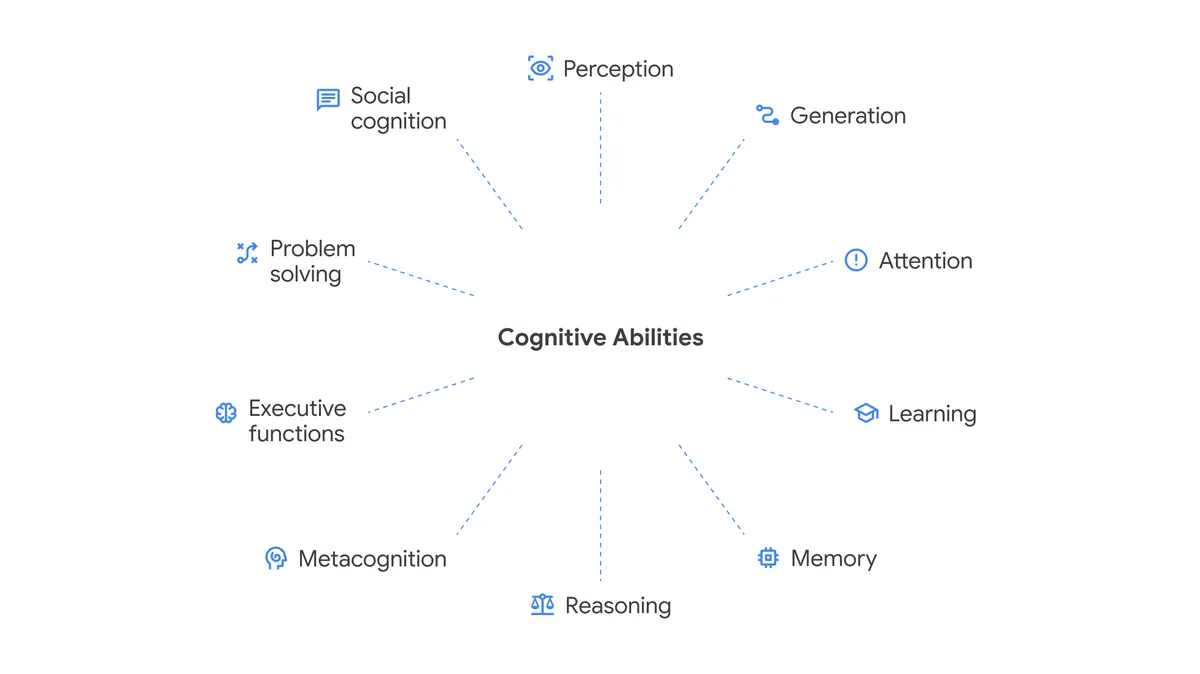
Our framework draws on decades of research from psychology, neuroscience and cognitive science to develop a cognitive taxonomy. It identifies 10 key cognitive abilities that we hypothesize will be important for general intelligence in AI systems:
- Perception: extracting and processing sensory information from the environment
- Generation: producing outputs such as text, speech and actions
- Attention: focusing cognitive resources on what matters
- Learning: acquiring new knowledge through experience and instruction
- Memory: storing and retrieving information over time
- Reasoning: drawing valid conclusions through logical inference
- Metacognition: knowledge and monitoring of one’s own cognitive processes
- Executive functions: planning, inhibition and cognitive flexibility
- Problem solving: finding effective solutions to domain-specific problems
- Social cognition: processing and interpreting social information and responding appropriately in social situations
To understand AI capabilities across these cognitive abilities, we propose a three-stage evaluation protocol that benchmarks system performance in relation to human capabilities:
- Evaluate AI systems across a broad suite of cognitive tasks covering each ability, using held-out test sets to prevent data contamination
- Collect human baselines for the same tasks from a demographically representative sample of adults
- Map each AI system’s performance relative to the distribution of human performance in each ability
Going from theory to practice
Defining these cognitive abilities is a crucial first step, but we need more than a framework to measure progress. To put this theory into practice, we are launching a new Kaggle hackathon — “Measuring progress toward AGI: Cognitive abilities”. The hackathon encourages the community to design evaluations for five cognitive abilities where the evaluation gap is the largest: learning, metacognition, attention, executive functions and social cognition.
Participants can use Kaggle’s newly launched Community Benchmarks platform to build and test their evaluations against a lineup of frontier models.
We are offering a total prize pool of $200,000: $10,000 awards for the top two submissions in each of the five tracks, and $25,000 grand prizes for the four absolute best overall submissions. Submissions are open March 17 through April 16, and we’ll announce the results June 1. Head over to the Kaggle website to start building.
Get the latest news from Google in your inbox
Sign up for our newsletters with product updates, event information, special offers, and more.
Your information will be used in accordance with Google’s privacy policy. You may opt out at any time.
Related stories
-
From games to biology and beyond: 10 years of AlphaGo’s impact
March 10, 2026 Research
Demis Hassabis
Ten years ago, our AI system AlphaGo became the first program to defeat a world champion at the complex game of Go – reaching a milestone in the field a decade before many experts thought possible.
The achievement heralded the beginning of what is now recognized as the modern era in artificial intelligence (AI). With a single creative play, the famous ‘Move 37,’ AlphaGo demonstrated the potential of AI and signaled that we now had the techniques to begin tackling real-world scientific problems.
Today, this breakthrough continues to inform our work building systems on the path to artificial general intelligence (AGI). We believe AGI will be the most profound technology ever invented and potentially the ultimate tool to advance science, medicine, and productivity.
A creative spark
In 2016, over 200 million people watched AlphaGo face world-champion Go player Lee Sae Dol in Seoul. The match was defined by ‘Move 37’ in Game 2, a play so unconventional that professional commentators initially thought it was a mistake. But it proved to be decisive. One hundred or so moves later, the stone was in exactly the right position for AlphaGo to win the game. It was a display of incredible foresight and the AI system’s ability to go beyond mimicking human experts and find entirely new strategies.
Go has long been a proving ground for AI research because of the game’s sheer complexity. There are 10170 possible positions on the board—far more than the number of atoms in the observable universe.
To make the game tractable, AlphaGo used deep neural networks combined with advanced search and reinforcement learning – an AI approach DeepMind pioneered.
AlphaGo learned a model of plausible Go moves by first learning from games played by human experts, and then playing hundreds of thousands of games against itself, improving as the strongest winning strategies were reinforced. The system then considered only the most potentially fruitful paths and from that smaller subset of moves, found the one most likely to lead it to win.
After AlphaGo, we built AlphaGo Zero, which learned the game from completely random play and became arguably the strongest player in history. Then we generalized the system further with AlphaZero, which taught itself from scratch to master any 2-player perfect information game, including Go, chess, and shogi. Beginning with no prior knowledge other than the rules of the game, AlphaZero was able to learn to master chess in a matter of hours, and beat not only the top human players but the best specialised chess programs at the time, like Stockfish. And even though chess had been so heavily analysed with the aid of these programs, just as with Go, AlphaZero was still able to come up with interesting new strategies.
It was further proof of what I knew the moment we won the match in Seoul – the technology was ready to be applied to our real goal of accelerating scientific breakthroughs.
I believe the greatest lesson AlphaGo offered was a definitive preview of the AI era—proving it wasn’t some distant, vague future, but a reality arriving on our doorstep. It served as a “roadmap from the future,” sending a clear signal to humanity about how the world was about to change.
Go Master Lee Sae Dol
Adjunct Professor at UNIST
Catalyzing breakthroughs in science
By proving it could navigate the massive search space of a Go board, AlphaGo demonstrated the potential for AI to help us better understand the vast complexities of the physical world. We started by attempting to solve the protein folding problem, a 50-year grand challenge of predicting the 3D structure of proteins – information that is crucial for understanding diseases and developing new drugs.
In 2020, we finally cracked this longstanding scientific problem with our AlphaFold 2 system. From there, we folded the structures for all 200 million proteins known to science and made them freely available to scientists in an open-source database. Today, over 3 million researchers around the world use the AlphaFold database to accelerate their important work on everything from malaria vaccines to plastic-eating enzymes. And in 2024, it was the honor of a lifetime for John Jumper and I to be awarded the Nobel Prize in Chemistry for leading this project, on behalf of the entire AlphaFold team.
Since AlphaGo’s win, we’ve applied its groundbreaking approach to many other areas of science and mathematics, including:
Mathematical reasoning: The most direct descendant of AlphaGo’s architecture, AlphaProof learned to prove formal mathematical statements using a combination of language models and AlphaZero’s reinforcement learning and search algorithms. Alongside AlphaGeometry 2, it became the first system to achieve a medal-standard (silver) at the International Mathematical Olympiad (IMO), proving AlphaGo’s methods could unlock advanced mathematical reasoning and laying the foundation for our most capable general models.
Gemini, our largest and most capable model, recently went even further. An advanced version of its Deep Think mode achieved gold-medal level performance at the 2025 IMO using an approach inspired by AlphaGo. Since then, Deep Think has been applied to even more complex, open-ended challenges across science and engineering.
Algorithm discovery: Just as AlphaGo searched for the best move in a game, our coding agent AlphaEvolve explores the space of computer code to discover more efficient algorithms. It had its own Move 37 moment when it found a novel way to multiply matrices, a fundamental mathematical operation powering nearly all modern neural networks. AlphaEvolve is now being tested on problems ranging from data center optimization to quantum computing.
Scientific collaboration: We are integrating the search and reasoning principles pioneered with AlphaGo into an AI co-scientist. By having agents ‘debate’ scientific ideas and hypotheses, this system acts as a collaborator capable of performing the rigorous thinking necessary to identify patterns in data and solve sophisticated problems. In validation studies at Imperial College London, it analyzed decades of literature and independently arrived at the same hypothesis about antimicrobial resistance that researchers had spent years developing and validating experimentally.
We’ve also used AI to better understand the genome, advance fusion energy research, improve weather prediction and more.
As impressive as our scientific models are, they are highly specialized. To achieve fundamental breakthroughs like creating limitless clean energy or solving diseases that we don’t understand today, we need general AI systems that can find underlying structure and connections between different subject areas, and help us to come up with new hypotheses like the best scientists do.
Future of intelligence
For an AI to be truly general, it needs to understand the physical world. We built Gemini to be multimodal from the beginning so it could understand not just language, but also audio, video, images and code to build a model of the world.
To think and reason across these modalities, the latest Gemini models use some of the techniques we pioneered with AlphaGo and AlphaZero.
The next generation of AI systems will also need to be able to call upon specialized tools. For example, if a model needed to know the structure of a protein it could use AlphaFold for that.
We think the combination of Gemini’s world models, AlphaGo’s search and planning techniques, and specialized AI tool use will prove to be critical for AGI.
True creativity is a key capability that such an AGI system would need to exhibit. Move 37 was a glimpse of AI’s potential to think outside the box, but true original invention will require something more. It would need to not only come up with a novel Go strategy, as AlphaGo impressively did, but actually invent a game as deep and elegant, and as worthy of study as Go.
Ten years after AlphaGo’s legendary victory, our ultimate goal is on the horizon. The creative spark first seen in Move 37 catalyzed breakthroughs that are now converging to pave the path towards AGI – and usher in a new golden age of scientific discovery.
Exactly one decade later, we look back at the match that sparked the modern AI revolution.
AlphaGo
Exploring the mysteries of Go with AlphaGo and China’s top players
Innovations of AlphaGo
AlphaGo’s next move