Native essay writing app for Mac and iPad
Author: admin
-
Gemini Robotics ER 2: powering robotics with video understanding, task orchestration, and multi-robot collaboration
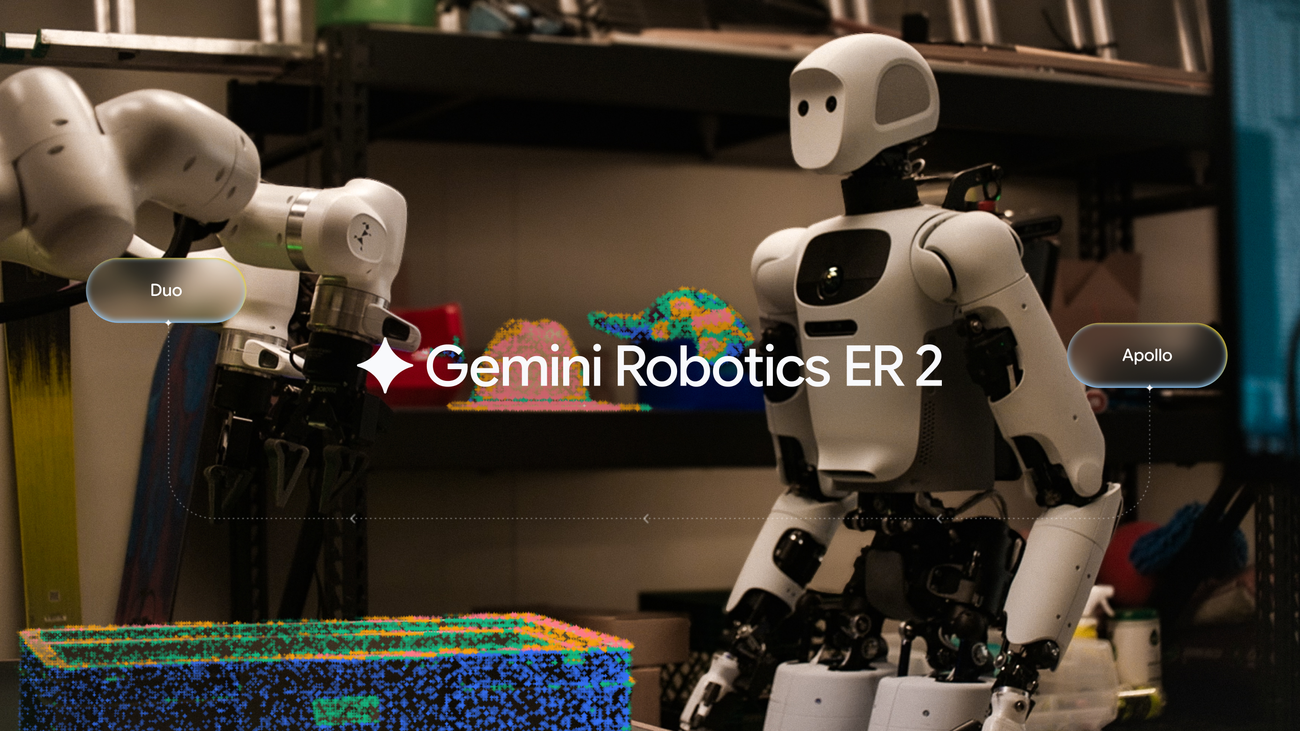
Gemini Robotics ER 2 represents a step change in powering robots with video understanding, task orchestration, and multi-robot collaboration — making it possible for robots to be more helpful in the physical world.
Steven Hansen
Senior Staff Software Engineer
Peng Xu
Staff Software Engineer
For robots to assist humans in everyday environments, accurate spatial reasoning is not enough. Robots must also think fast, timing their decisions and reasoning with the real-time speed of the physical world.
That’s why today we’re launching Gemini Robotics ER 2, our most capable “embodied reasoning” model for robotics. Think of Gemini Robotics ER 2 as a high-level brain for robots. It allows robots to chat with humans, understand the physical world, and plan multi-step tasks. It then hands off motor execution to any given lower level vision-language-action (VLA) model. Gemini Robotics ER 2 can also natively call tools like Google Search to find information, or any other user-defined function. The design of Gemini Robotics ER 2 allows the robot to “think” about what comes next while simultaneously performing its actions.
Gemini Robotics ER 2 represents a significant upgrade over Gemini Robotics ER 1.6. By watching continuous video feeds, robots can now track their own progress, adapt if something goes wrong, and know exactly when to move on to the next step. We are also introducing multi-robot collaboration, enabling robots to work together in shared spaces and complete complex workflows a single robot could not do alone.
Gemini Robotics ER 2 is now publicly available to developers via the Gemini API, Google AI Studio, and in private preview on Gemini Enterprise Agent Platform. To help you get started, we’re sharing examples of how to configure the model and prompt it to power more useful physical AI tasks.
Advancing physical agentic capabilities
Most tasks in the physical world are complex and require multiple steps to complete. Gemini Robotics ER 2 is a physical agent, orchestrating steps for the robot and enabling it to self-correct, and generalize to more novel situations. To build an agentic setup, developers can declare low-level control interfaces — like Vision-Language-Action (VLA) models or navigation APIs — as tools, and stream multimodal video, audio, or text directly into the model.
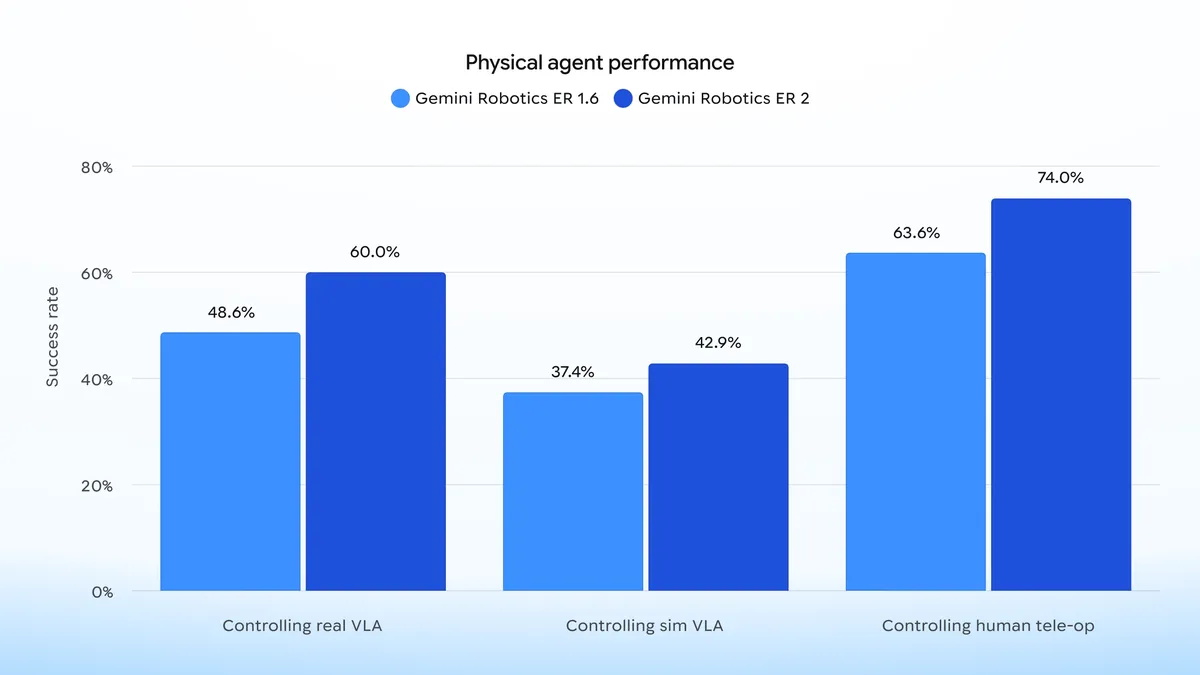
Gemini Robotics ER 2 improves this tool orchestration workflow. We can evaluate its performance with robots in simulation, using real-world robot control, and even pair it with a human controlling the robot remotely.
Gemini Robotics ER 2 consistently outperforms ER 1.6 for tool orchestration across three control modes: real VLA, sim VLA, and human tele-op.
In robotics, high-level reasoning depends on execution speed. Gemini Robotics ER 2 integrates into the Gemini Live API, using a bidirectional streaming endpoint optimized for latency-sensitive tasks. The result is fluid orchestration: Gemini Robotics ER 2 commands action models and robotics APIs to complete multi-step tasks without the jarring “stop-and-think” pauses.
To illustrate this, we’ve built a demo with Spot from our partners at Boston Dynamics. We use Gemini Robotics ER 2 to orchestrate Spot APIs, such as navigation and manipulator movement, creating an interactive robot that fetches objects for you.
Gemini Robotics ER 2 powered Boston Dynamic Spot fetches a popcorn snack up on a natural language command.
The code is available on Github with other examples.
Unlocking temporal intelligence for robust task completion
One of robotics’ hardest challenges is knowing when a task is done. Gemini Robotics ER 2 brings a step-change in video understanding and progress tracking to verify that complex tasks — such as tightening a light bulb or tying a trash bag — are complete to specification before switching to the next task.
In this update, we’ve made progress on two foundational capabilities for task progress understanding: progress classification and moment finding.
Continuous progress classification
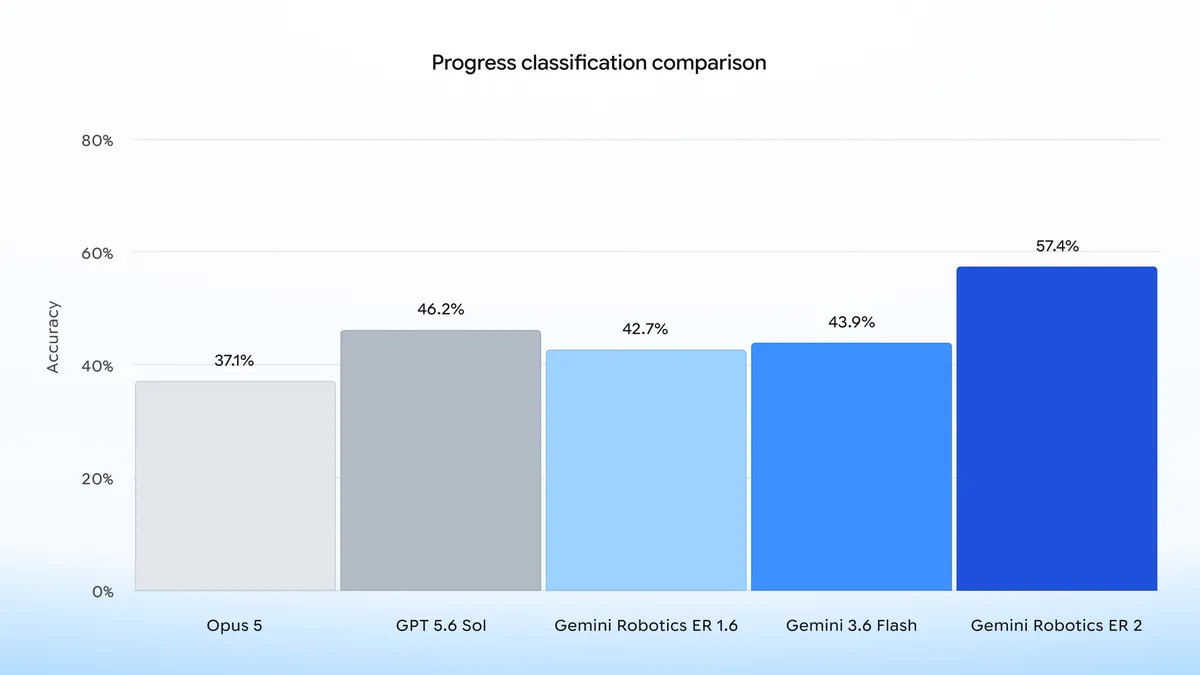
Progress classification refers to a robot’s ability to track progress towards task completion. In our evaluations, we assign each frame in a video feed into five levels of progress (0-20%, 20-40%, 40-60%, 60-80%, 80-100%). By quantifying task progress, Gemini Robotics ER 2 provides robots with real-time situational awareness, and allows them to adjust actions on the fly or retry failed steps without restarting an entire workflow.
Gemini Robotics ER 2 achieves 57.4% accuracy on progress classification tasks, outperforming previous generation models and competing frontier models.
Precision moment-finding
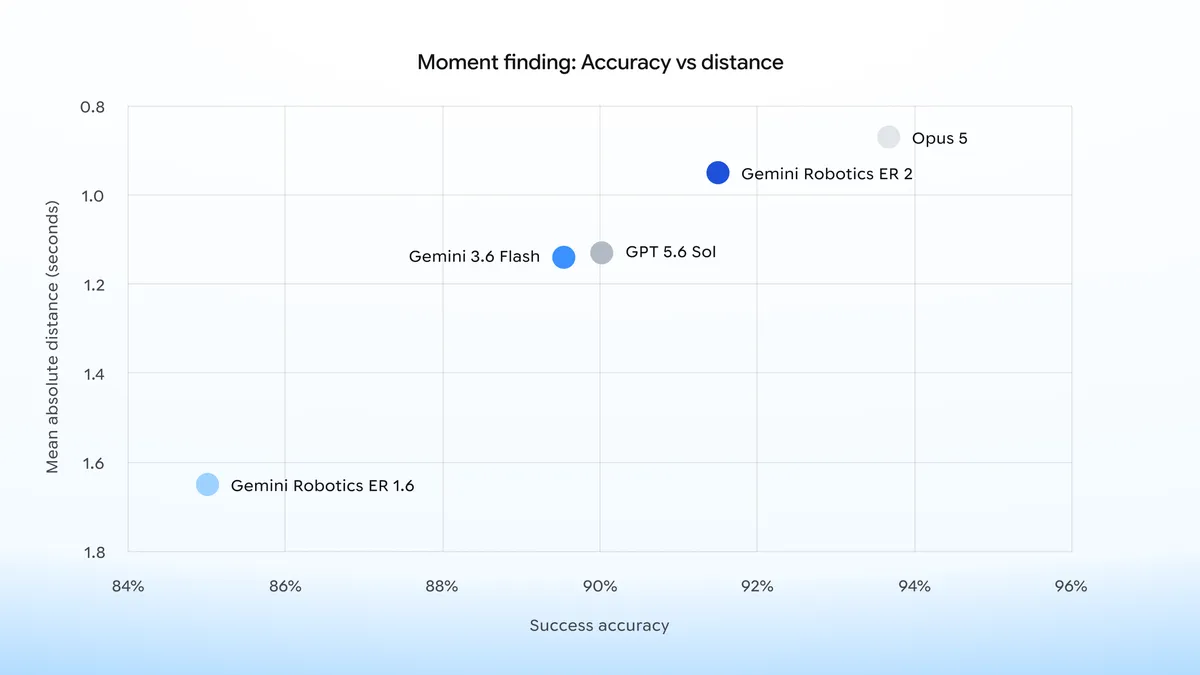
Moment-finding measures a model’s ability to identify the exact video frame where a critical event takes place (i.e. when to stop pouring coffee into a cup). Gemini Robotics ER 2 achieves significant gains in performance on moment finding, enabling robots to precisely switch between tasks, verify success and suggest corrections.
For moment-finding tasks, Gemini Robotics ER 2 achieves 91.3% accuracy and a 0.96s mean absolute distance. It competes closely with much larger model categories, but delivers this precision at a fraction of the compute cost and 4x the execution speed—the sub-second latency actually required to safely operate physical robotics in the real world.
Multi-robot collaboration
No single robot fits every task — a wheeled rover excels indoors, while a humanoid robot may excel at uneven terrain. Gemini Robotics 2 enables multi-robot collaboration, allowing diverse machines to communicate via a shared semantic understanding to handoff and complete complex tasks. See how Gemini Robotics ER 2 enables Apptronik’s Apollo 2 and Franka F3 Duo to collaborate here.
Improving general spatial intelligence
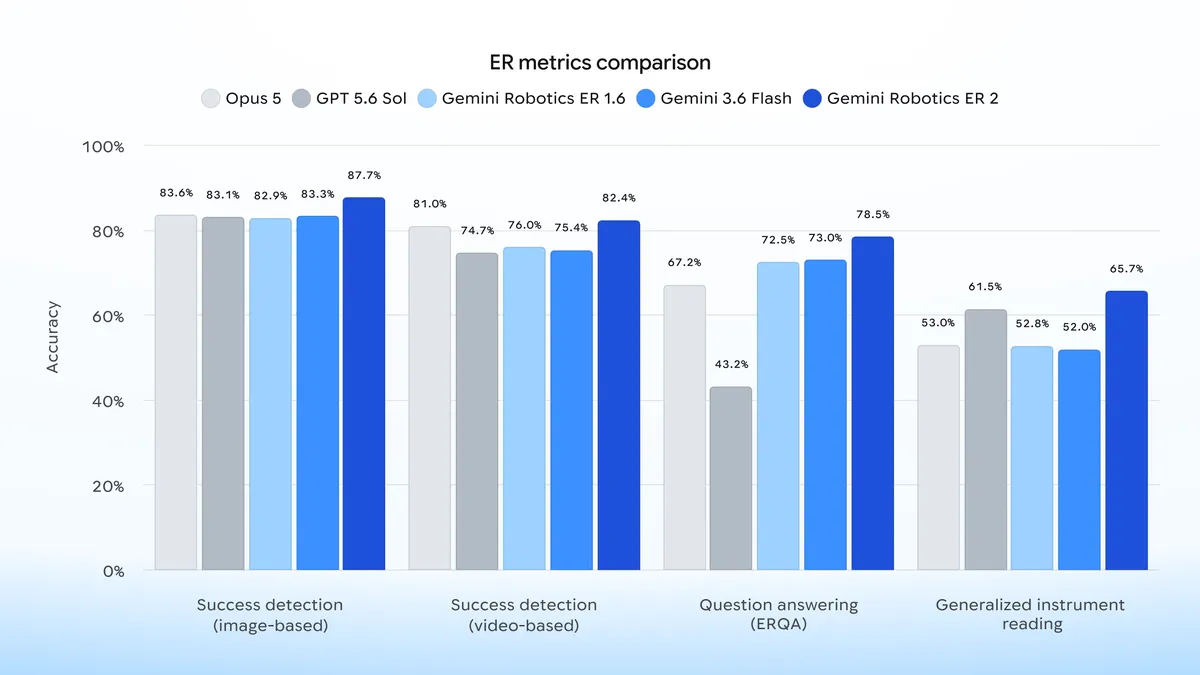
Gemini Robotics ER 2 advances our core spatial reasoning capability, as measured by three benchmarks:
- Success/failure detection: Now operates on raw video feeds rather than static snapshots to catch mid-execution failures like spills, slips, or misalignments.
- General instrument reading: Extends beyond circular dials and sight glasses to include digital displays, linear scales, rulers, and liquid thermometers. We tested it across 10 different types of instruments.
- Enhanced spatial VQA: Improves Visual Question Answering throughGemini’s advancements in multi-modal understanding.
Gemini Robotics ER 2 consistently achieves the highest accuracy across all core capabilities, with highlights including success detection (image/video), Question Answering (ERQA), and generalized instrument reading.
Advancing safety for embodied intelligence
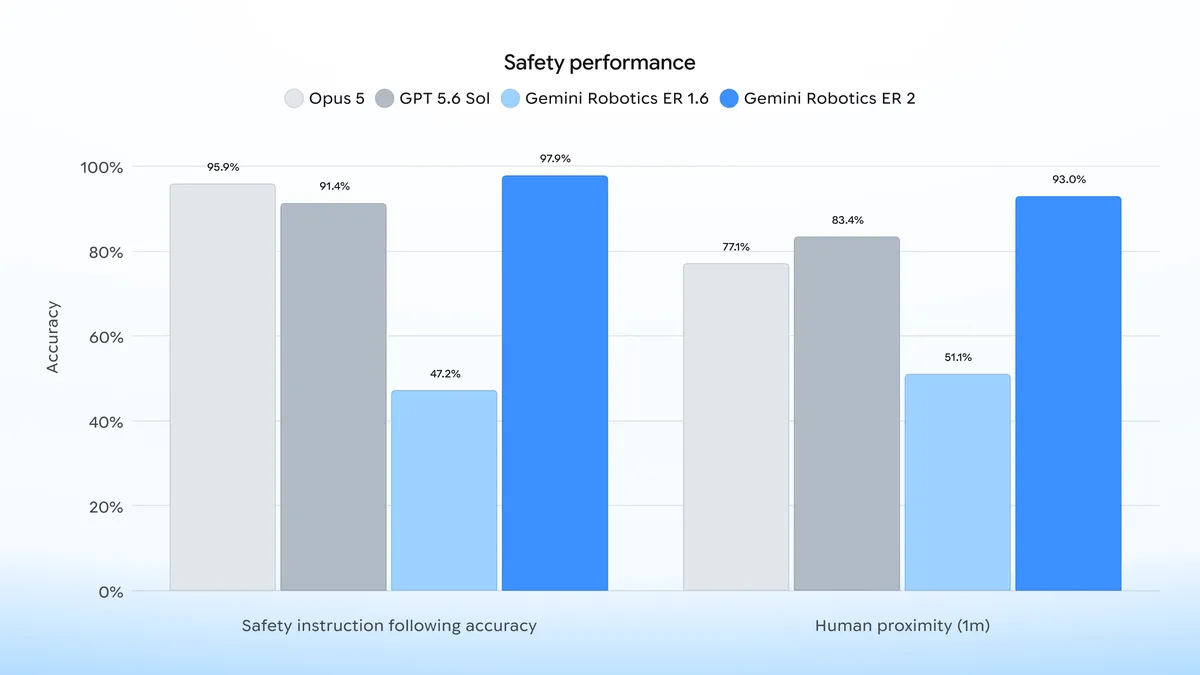
Gemini Robotics ER 2 is our safest model, achieving significant gains on Safety Instruction Following and Human Proximity benchmarks, which evaluate how a model adheres to physical constraints during reasoning tasks and spatial awareness for detecting humans. We found that Gemini Robotics ER 2 successfully halts a humanoid robot when a person is nearby and autonomously resumes work only once the area is clear. To advance safety for physical agents, we’re introducing a benchmark that evaluates a foundation model’s ability to act as a safe VLA orchestrator by testing its capacity to enforce safety constraints, monitor the environment, assess physical feasibility, and seek human clarification. For details, see our safety technical report.
Gemini Robotics ER 2 outperforms ER 1.6 and other frontier models on Safety Instruction Following and Human Proximity benchmarks.
Looking ahead, our plans are to push these models towards even more complex tasks to accelerate the development of helpful robots and support the robotics community.
Get the latest news from Google in your inbox
Sign up for our newsletters with product updates, event information, special offers, and more.
Your information will be used in accordance with Google’s privacy policy. You may opt out at any time.
-
We’re launching Lyria 3.5 in Google Flow Music, with advances across musicality, lyrics, vocals, and creative control
Our newest music generation model, Lyria 3.5, delivers significant advancements across musicality, lyrics, and vocal quality, empowering you to craft richer tracks. We’re rolling it out today in Google Flow Music, where we want to help you create songs you love, with creative control.
Here’s what’s new:
- Improved musicality: Create richer, more complex melodic structures that sound more natural.
- Enhanced lyrics: Generate higher quality lyrics with improved prompt adherence and structural awareness.
- Improved vocals: Bring more expression and emotion to your songs with more realistic and emotionally nuanced vocals, plus improved pronunciation.
- Creative control: More easily control the tempo and duration of your outputs.
Try it today in Flow Music.
Related stories
-
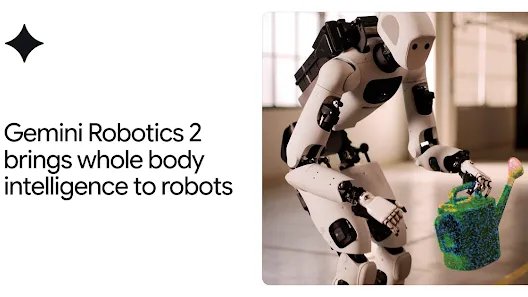
Gemini Robotics 2 brings whole body intelligence to robots
July 30, 2026 Models
Carolina Parada
From feet to fingertips — we are teaching robots intelligent whole-body control, fine dexterity, and teamwork to complete a broad range of complex tasks
For decades, we’ve dreamed of robots that can seamlessly step into our world and lend a hand. Now, that vision takes a significant stride forward.
Most robots are pre-programmed or teleoperated for narrow, repetitive task sequences. They lack the ability to truly learn for themselves or adapt to unpredictable environments. Moreover, transferring learned skills from one robot body to another remains incredibly difficult. To take on the hardest problems at scale, robots of every shape and size need AI models giving them the ability to think, act, and interact intelligently to safely complete tasks.
We demonstrated how Gemini’s multimodal understanding could drive real-world action with Gemini Robotics. Today, we are introducing Gemini Robotics 2 – the intelligence layer powering the next generation of truly adaptable robots. As it takes its first literal steps, this major advance unlocks intelligent whole-body control, advanced dexterity, and multi-robot collaboration.
Gemini Robotics 2 enables robots to reason through every movement, unlocking a broad range of tasks. For example, it can enable a humanoid to walk, crouch, stretch, and manipulate objects to clean up a cluttered room. It can even team up with other robots to finish the job faster. And this profound intelligence can also run locally on-device while seamlessly adapting to entirely new robotic bodies in just a few hours.
We are making this possible through three highly capable models:
- Gemini Robotics 2: Our most advanced vision-language-action model (VLA) that converts vision and language input into motor control, enabling a robot to take action. This model is capable of controlling full humanoids, from feet to fingertips, and other bi-arm robots. It also brings a new level of dexterous manipulation on both hands and grippers.
- Gemini Robotics ER 2: Our most capable embodied reasoning (ER) model. It is a vision language model (VLM) that acts as our agent, enabling robots to communicate with humans, understand the physical world and plan multi-step tasks lasting several minutes. We are also introducing the ability for robots to work together as a team.
- Gemini Robotics On-Device 2: Our most efficient vision-language-action model (VLA) optimized to run locally on robotic devices. This model can now achieve fast adaptation to completely new robot embodiments with a few hours of data.
Gemini Robotics ER 2, our reasoning model, is now available on Google AI Studio and in private preview on Gemini Enterprise Agent Platform. Our VLA and On-Device models are available to early-access partners. Read how to bring these models to your hardware on our Developer blog.
Humanoids in motion: Managing whole-body tasks
The world is built for human movements; it requires us to reach, bend, and balance in tight, cluttered spaces. While our previous models controlled the humanoid’s upper-body to achieve table-top tasks, Gemini Robotics 2 expands physical AI into whole-body motions.
For the first time, our model can now control entire humanoid robots, translating intent into intelligent whole-body control. For example, when controlling Apptronik’s Apollo 2 humanoid robot, we can ask it to “put the watering can into the green bin in the bottom shelf.” Apollo processes the instruction, walks to the table, and picks up the watering can, takes a few steps to the shelves, and places it precisely in its destination. While our robots have more to advance in movement speed, this is an important step towards the skills needed to complete more complex, real-world tasks that require whole-body coordination.
Bringing advanced dexterity to hands and grippers
To be genuinely useful in our homes and workplaces, robots need finesse. Gemini Robotics 2 unlocks a new level of physical dexterity across different end effectors, whether a robot is using hands or grippers, enabling robots to be more useful than ever before.
The model can now control the five-fingered, 22 degree-of-freedom SharpaWave hand on the Apollo 2 robot to complete delicate actions like tying knots or sealing a ziplock bag. It can also operate standard two-fingered parallel grippers on a Franka Duo platform to perform complex dexterous tasks (e.g. tight packing). We are continuing to advance the level of precision and speed to achieve human-level dexterity.
Unlocking advanced tasks with agentic reasoning and multi-robot collaboration
Most real-world tasks require multiple steps over an extended period of time. To manage this complexity, our embodied reasoning (ER) model, Gemini Robotics ER 2, serves as the robot’s high-level brain, processing user instructions and communicating with humans. It observes the room, reasons about the steps needed to complete the task, coordinates with the VLA to carry out the actions, and tracks progress until the task is done. This setup allows robots to execute complex multi-step tasks, self-correct if a step fails, and generalize to novel situations and goals.
In this update, we are enabling robots to more reliably execute longer task sequences, lasting several minutes and involving hundreds of decisions. Gemini Robotics ER 2 now understands when tasks begin and end, and can pinpoint the moment key events occur, marking a step change in progress understanding.
Furthermore, we are introducing multi-robot collaboration. This enables different types of robots to communicate and work together to solve complex workflows a single robot could not do alone.
Adapting fast on-device models for any robot
Many robotic applications need to operate without network latency or internet connectivity. Gemini Robotics On-Device 2 is built specifically to handle these constraints — it is our most-efficient vision-language-action model (VLA) optimized to run locally on robotic devices.
This model is natively multi-embodiment and inherits our advanced “motion transfer” techniques from Gemini Robotics 1.5. We can now adapt to new bi-arm robot embodiments with just a few hours of adaptation time, typically with less than 200 examples. This works even with new embodiments with drastically different shapes, sensors and degrees of freedom, as shown below with a diverse set of tasks being performed by the Dexmate, SO101, and Trossen platforms.
Advancing our commitment to safe and responsible robotics
Safety is foundational to our robotics research. As robots gain more physical capabilities, we are committed to ensuring end-to-end safety and alignment. With each release, we’ve taken a multi-layered approach that combines traditional physical safety measures with robust AI safety frameworks.
Gemini Robotics 2 specifically advances robotics safety for navigating the uncertainty of the real world and collaborating alongside humans.
We’re introducing ASIMOV-Agentic, a new benchmark for agentic safety orchestration and uncertainty resolution. For example, it measures the embodied reasoning agent’s ability to refuse unsafe tool calls from a VLA.It also measures the agent’s ability to predict whether a task is possible and to proactively request human intervention when uncertain.
Additionally, with enhanced embodied reasoning, Gemini Robotics ER 2 is our safest robotics model to date in safety constraint following and human proximity benchmarks. It can better detect when humans are nearby, trigger safety tool calls and bring the robot to a safe stop if someone approaches too closely. This is a key requirement in collaborative safety standards. Read our Gemini Robotics 2: Safety Technical Report for more details.
Building towards general-purpose physical AI
Gemini Robotics 2 marks an important milestone on the path toward solving AGI in the physical world. Unlocking the true potential of robotics requires moving past single-task automation toward general-purpose intelligence. By building this core intelligence, our goal is to enable AI in the physical world that can work alongside humans to solve complex challenges.
Explore Gemini Robotics 2
-

Accelerating the frontiers of scientific discovery: Google’s $40M commitment to the Genesis Mission
Scientists today face challenges of extraordinary scale and complexity. From shaping and simulating the intricate dynamics of fusion plasma, to exploring the vast search space of new materials, to making sense of the exabytes of data pouring out of the world’s most advanced experimental facilities. The demands on modern research are unprecedented. Frontier AI can help address these challenges, while accelerating groundbreaking scientific discoveries.
In December, we shared our commitment to the White House’s Genesis Mission — the national effort to harness AI and double the pace of American scientific discovery within a decade. Since then, Google DeepMind (GDM) announced an early access program that provides AI for science tools to all 17 Department of Energy (DOE) National Laboratories, and Google Public Sector shared how Gemini for Government could serve as an AI backbone for the DOE.
Today, at the DOE Genesis Mission Summit 2026, we are expanding this by committing $40 million of AI tokens and cloud credits for researchers in support of the Genesis Mission.
Frontier AI tools for scientific discovery
Under this expanded commitment, we will first provide DOE’s Genesis Mission awardees in-kind access to GDM’s frontier AI for science portfolio, including:
- AlphaEvolve — a Gemini-powered coding and discovery agent, for designing advanced algorithms.
- AlphaFold 3 — a model for predicting the structure and interactions of proteins and other biomolecules.
- AlphaGenome — a tool for understanding how variation in DNA, including the non-coding genome, shapes biology and disease.
- WeatherNext — a state-of-the-art family of AI weather forecasting models for mapping weather conditions.
- AlphaEarth Foundations — a foundational AI model for mapping and understanding our planet in unprecedented detail.
Second, we will provide Gemini for Government seats and tokens for one year to tens of thousands of users across the DOE National Laboratories’ operations, research, and management teams. This secure platform supports the full breadth of work from the research bench to the administration of specialized user facilities serving the entire scientific community, providing a single secure foundation that the DOE mission can depend on.
AI for science tools in action across the laboratory ecosystem
While we have a lot of work still to do, the practical impact of the Genesis Mission is already coming to life across the laboratory ecosystem.
At Pacific Northwest National Laboratory (PNNL), senior scientist Dr. Henry Kvinge is using AlphaEvolve to map out massive mathematical systems that are far too complex for humans to explore by hand. The AI uncovers hidden connections automatically, fast-tracking discoveries that would normally take researchers years to find.
“Modern math relies on abstraction, but combinatorics offers concrete models that make complex geometry and algebra easier to grasp. We’ve found that systems like AlphaEvolve are perfect for this search,” said Dr. Kvinge. “By leveraging the broad mathematical knowledge of LLMs, we can automate the exploration of countless angles. We’re still experimenting, but the discoveries are already shaping our future research.”
At the National Laboratory of the Rockies (NLR), researchers are utilizing Gemini to fundamentally change how they interact with physical laboratory hardware. Dr. Steven R. Spurgeon, a senior materials data scientist at NLR, leads a pioneering program in autonomous materials discovery.
“Our collaboration has allowed us to build an autonomous experimentation capability,” said Dr. Spurgeon. “By deploying Gemini in our instruments, we cut microscope calibration time from over 90 minutes to about 13 minutes (eight times faster) and reduced the manual steps needed to focus an image from as many as 50 down to two. That’s time and attention we’ve given back to the science itself, enabling genuinely autonomous workflows that observe, reason, and decide in real time. This has helped us explore parts of the material design space we simply could not have reached through manual operation alone.”
Driving American innovation
The Genesis Mission represents an opportunity to transform research and science across America. By providing access to advanced AI tools, we aim to help scientists accelerate breakthroughs across critical energy, security, and scientific challenges. To learn more about how these AI capabilities can support your research initiatives, join us at the upcoming Google Public Sector Summit in October.
Posted in -
Introducing Gemini 3.6 Flash, 3.5 Flash-Lite, and 3.5 Flash Cyber
Our newest Gemini models deliver the efficiency, latency, and reliability to build AI agents at scale.
Developers and customers building production AI agents need higher token efficiency, lower latency, and more reliable performance. Our Flash series of models is built to meet the sweet spot of efficiency and quality to enable scaling agentic workflows. Building on Gemini 3.5 Flash, we’re introducing new Gemini models:
- 3.6 Flash: Our workhorse model that delivers better coding, knowledge work, and multimodal performance. According to the Artificial Analysis Index, it reduces output token usage by 17% compared to 3.5 Flash, and in some benchmarks like DeepSWE by Datacurve, we observe up to 65%, all at a lower cost per output token.
- 3.5 Flash-Lite: Our fastest, most cost-effective 3.5-class model, delivering 350 output tokens per second according to the Artificial Analysis Index, also significantly outperforming prior Flash-Lite generations in agentic workflows.
- 3.5 Flash Cyber in CodeMender: Successful cybersecurity applications require careful orchestration of a model alongside an agent infrastructure. We’re introducing a combination of a new, highly efficient, specialized cyber-focused model paired with our CodeMender code security agent that delivers competitive performance at the frontier.
Beyond today’s releases, Gemini 3.5 Pro is currently testing with partners and we plan to make it broadly available as soon as it’s ready. In parallel, our team is already focusing on building the next generation of models. We have started our most ambitious pre-training run yet, for Gemini 4, and are excited by the progress.
3.6 Flash: More efficient and better quality than 3.5 Flash
Gemini 3.6 Flash builds directly on developer and customer feedback from 3.5 Flash. 3.6 Flash not only delivers a step up in coding and knowledge work, but it does this while meaningfully improving token efficiency. For example, on the Artificial Analysis Index, we see 3.6 Flash consuming 17% fewer output tokens than 3.5 Flash. It also takes fewer reasoning steps and tool calls to accomplish multi-step workflows.
This enhanced efficiency is also combined with a lower price than 3.5 Flash. At $1.50/1M input tokens and $7.50/1M output tokens, 3.6 Flash reduces the overall cost per agentic task, making agents more cost-effective to build and run.
3.6 Flash shows better token efficiency and reduced verbosity than 3.5 Flash in an OSWorld verified task (API)
Even while being more efficient, 3.6 Flash sees performance gains compared to 3.5 Flash across use cases:
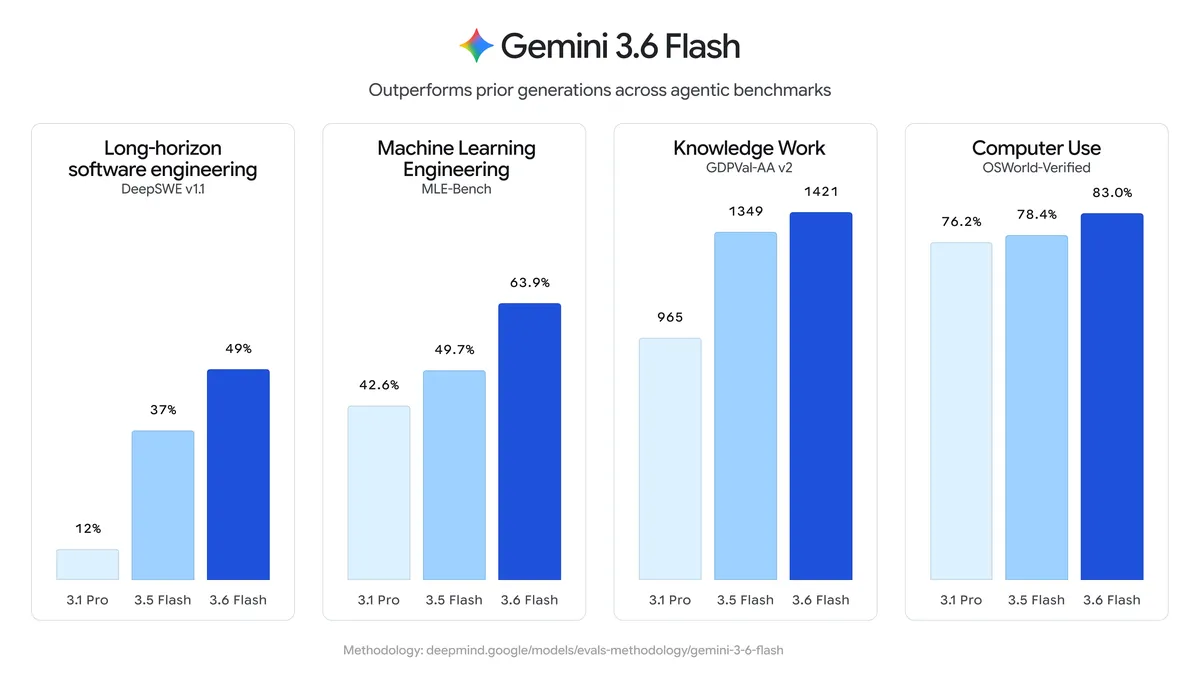
- 3.6 Flash delivers higher precision with fewer unwanted code edits and reduced execution loops, as seen in DeepSWE (49% vs. 37%), and shows significant improvement in ML Research, as seen in MLE Bench (63.9% vs. 49.7%).
- It has improved computer use capabilities as seen in OSWorld-Verified (83.0% vs. 78.4%). Computer use is now a built-in client side tool via the Gemini API and Gemini Enterprise.
- It outperforms 3.5 Flash in knowledge work, as shown by benchmarks like GDPval-AA v2 (1421 vs. 1349). Customers like Hebbia and Harvey have found it particularly capable at multimodal tasks like document parsing, chart and data analysis, and report drafting.
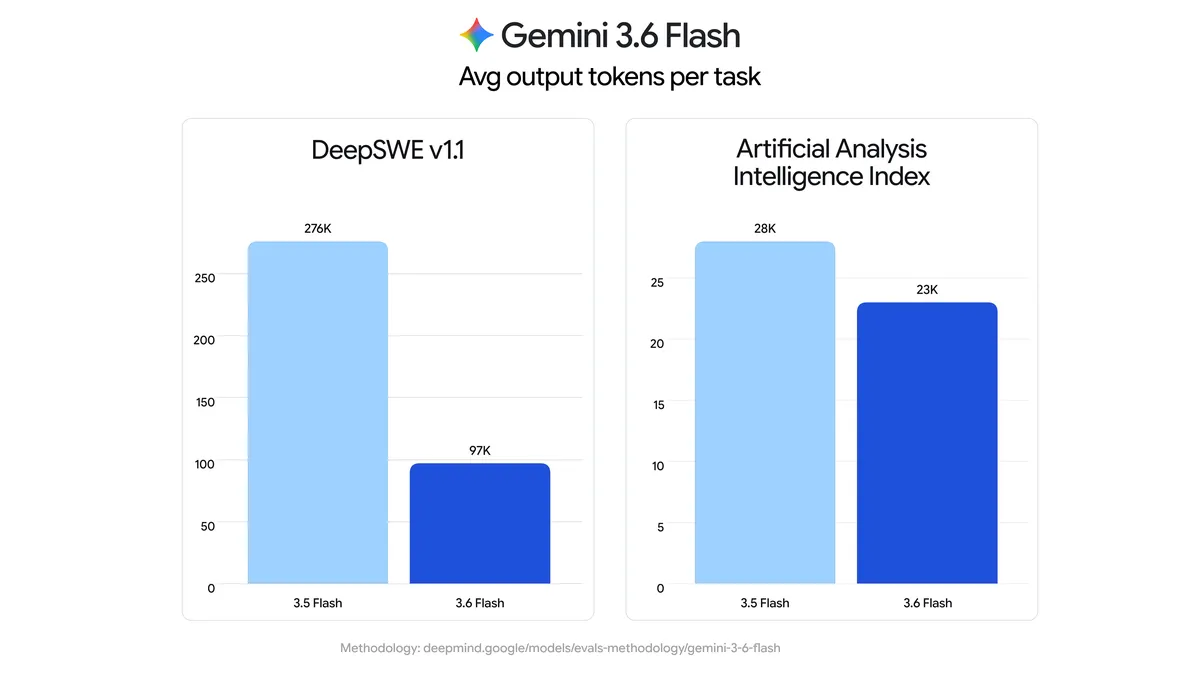
Customers report 3.6 Flash is a step forward in both cost and quality, balancing token efficiency, accuracy, and speed across complex workflows and knowledge-based tasks:


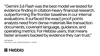

Built with safety
3.6 Flash is shipping with enhanced Frontier Safety safeguards in the domains of Chemical, Biological, Radiological, and Nuclear (CBRN) and cyber offense misuses. These safeguards make the model substantially more resistant to jailbreaks. At the same time, the model has been trained to minimize refusals for beneficial uses.
For more information, see the 3.6 Flash model card.
3.5 Flash-Lite: Built to scale agentic workflows
Beyond Flash, we’re also releasing Gemini 3.5 Flash-Lite, designed for both low-latency tasks and tasks where high throughput is critical for developers workflows, like agentic search and document processing.
3.5 Flash-Lite is the fastest model in the 3.5 series. As measured by Artificial Analysis, it runs at 350 output tokens/s. Priced at $0.3/1M input tokens and $2.5/1M output tokens and with significantly better quality than 3.1 Flash-Lite, 3.5 Flash-Lite offers a strong price-to-performance ratio for developers and customers running high throughput production traffic.
3.5 Flash-Lite executes high volume tasks at a lower latency than 3.5 Flash.
3.5 Flash-Lite enables efficient scaling for agentic systems. Across thinking levels, the model significantly outperforms 3.1 Flash-Lite. Depending on the workload, developers can configure the model to prioritize low-latency, low-cost execution for high-volume tasks with the minimal and low thinking levels, or engage higher thinking levels to process multi-step subagent workloads. The model now also has computer use as a built-in tool to reliably support these agentic tasks across surfaces.
It’s a significant step up in coding and agentic tasks as seen in Terminal-Bench 2.1 (54% vs 31%), long context as seen in GDM-MRCR v2 (72.2% vs. 60.1%), and real-world task execution as seen in GDPval-AA v2 (1140 vs. 642).
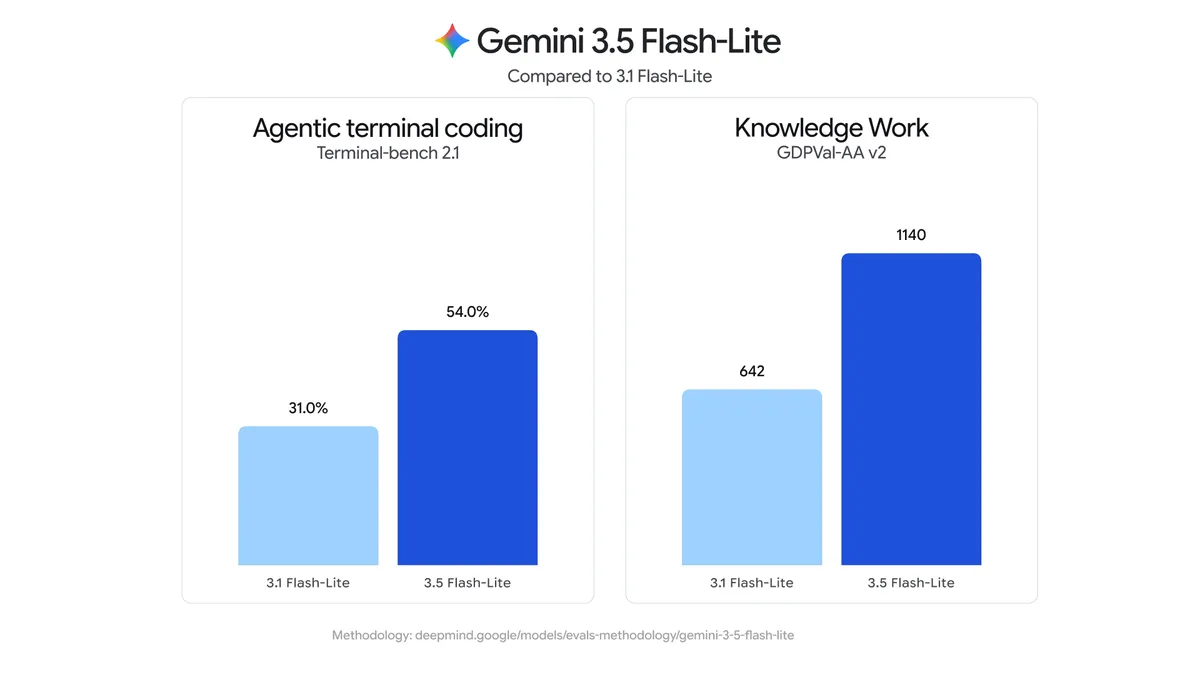
In fact, on many agentic and coding evals, 3.5 Flash-Lite even outperforms 3 Flash, including on SWE-Bench Pro (54.2% vs. 49.6%) and OSWorld-Verified (74.0% vs. 65.1%), making it a faster & more capable option for workloads on both 2.5 and 3 Flash.
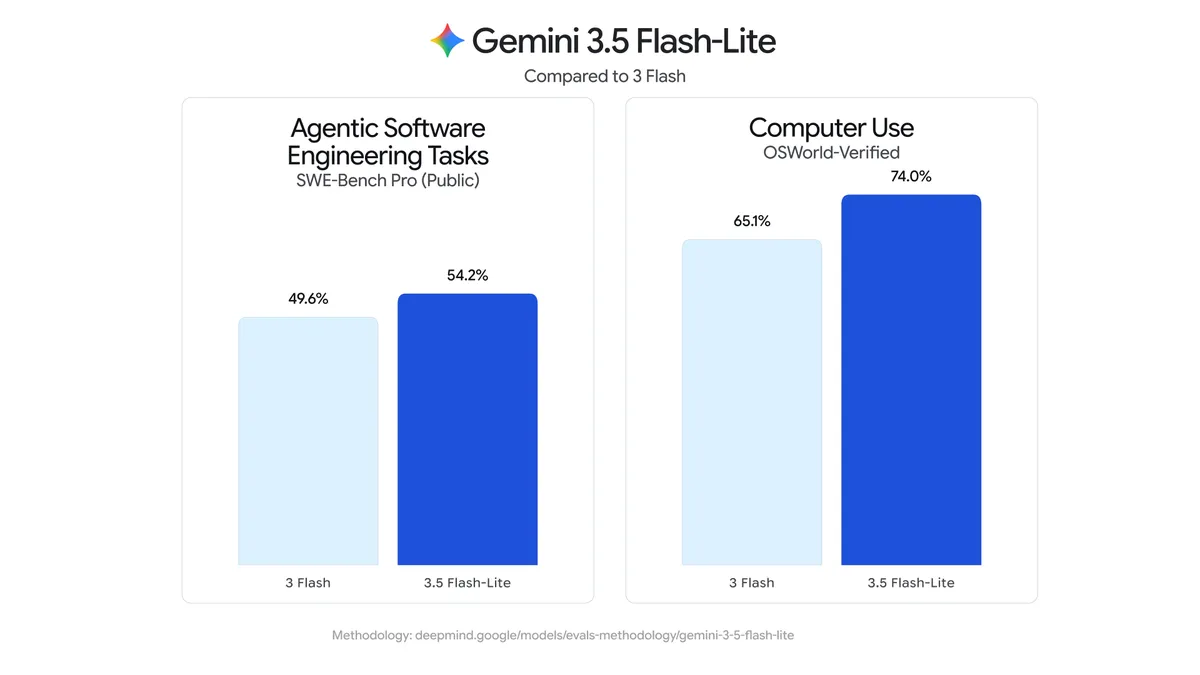
Early customers of 3.5 Flash-Lite are highlighting its unique combination of speed, intelligence, and cost efficiency for scaling agentic workflows and data processing tasks:

For more information about the model, see the 3.5 Flash-Lite model card.
3.5 Flash Cyber in CodeMender: finding and fixing vulnerabilities efficiently
AI models have become capable of finding security vulnerabilities faster than current systems can fix them. Tackling this growing threat requires an approach to securing software that is highly capable and efficient.
Flash’s performance and efficiency makes it an ideal foundation to detect, validate, and patch code security issues at scale. Gemini 3.5 Flash Cyber is built on top of 3.5 Flash, and fine-tuned for finding and fixing cybersecurity vulnerabilities at a lower price per token than larger models.
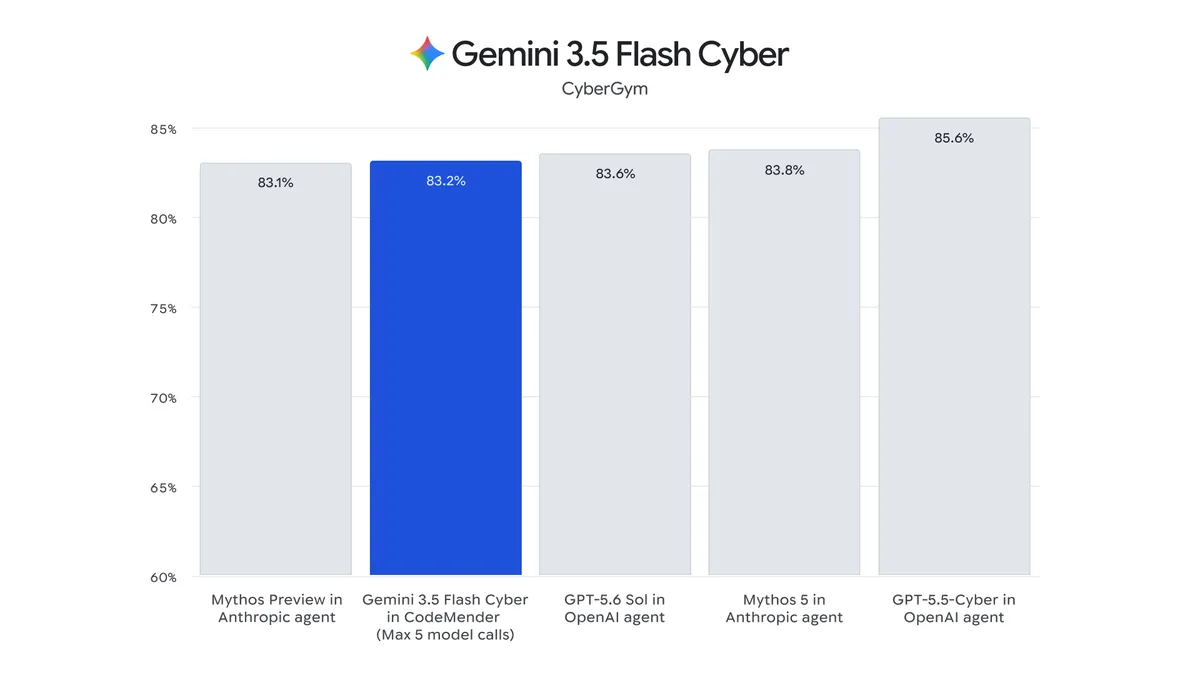
Within CodeMender, which uses multiple 3.5 Flash Cyber agents working together to produce a single combined report, 3.5 Flash Cyber reaches competitive performance at the frontier on the popular benchmark CyberGym.
Given the dual-use nature of this technology, we have taken an intentional approach to deploying 3.5 Flash Cyber. The model will be exclusively available to governments and trusted partners via CodeMender soon as part of a limited-access pilot program. This will give frontline defenders a head start in finding and fixing critical vulnerabilities before they can be exploited, while mitigating against broader misuse.
3.6 Flash and 3.5 Flash-Lite: Get started today
3.6 Flash and 3.5 Flash-Lite are available starting today:
- For developers in the Gemini API via Google AI Studio and Android Studio. 3.6 Flash is also available in Google Antigravity. Get started with the Developer Guide.
- For enterprises in Gemini Enterprise Agent Platform. 3.6 Flash is also available in the Gemini Enterprise app.
- For everyone via the Gemini app. 3.5 Flash-Lite is also rolling out in Google Search.
As you start building with 3.6 Flash and 3.5 Flash-Lite, we welcome your feedback to improve future Gemini models and look forward to releasing 3.5 Pro soon.
Get the latest news from Google in your inbox
Sign up for our newsletters with product updates, event information, special offers, and more.
Your information will be used in accordance with Google’s privacy policy. You may opt out at any time.