
At a glance
- StudentSim is a research system for evaluating and improving AI tutors before they are tested with real learners; it is not a product, is not deployed in classrooms, and is not intended to replace teachers
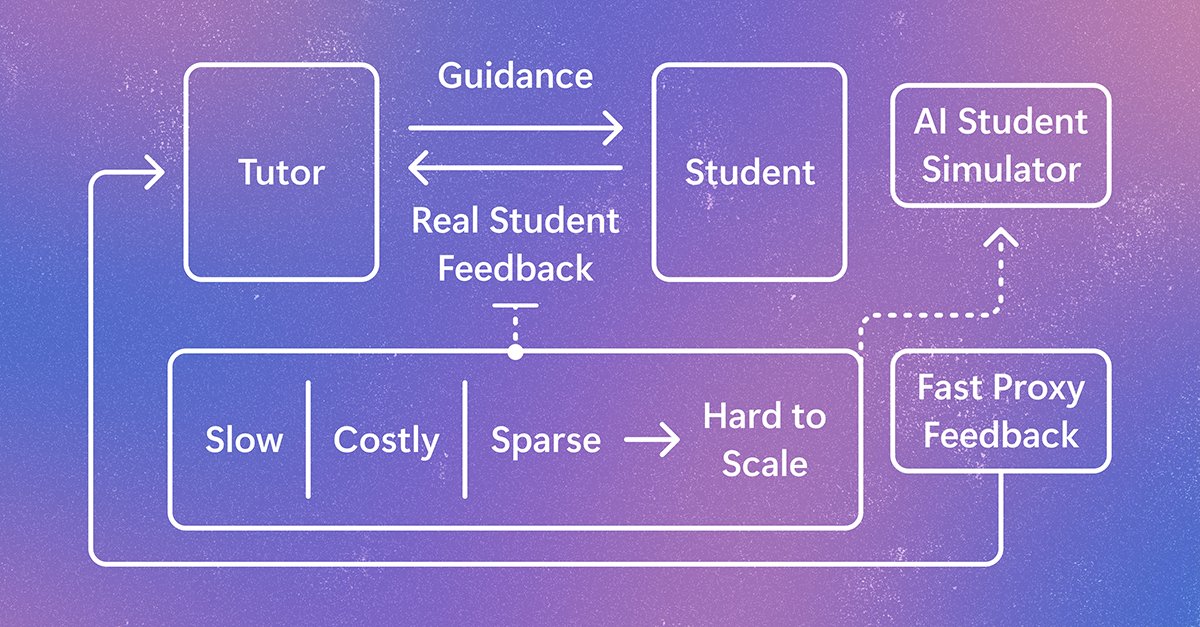
- AI tutoring tools need feedback from students to improve, but collecting that feedback through human studies is slow, costly, and difficult to scale
- StudentSim trains personalized AI student simulators from publicly available, de-identified learner records, with one simulator adapted to each student
- The work evaluates simulators along two education-grounded dimensions: whether they respond like a specific student, and whether they update after tutor guidance
- Across chess, second-language English writing, and mathematics, StudentSim outperforms leading baselines and provides a useful feedback signal for training an AI tutor
In research settings, teams are exploring how AI-powered tutoring systems can help explain a math problem, suggest an edit to a writing assignment, or guide a learner through a chess position. Yet the quality of teaching cannot be measured only from the tutor’s answer. A tutor needs to know what happens after the guidance reaches a student. Did the student correct the original mistake? Did the hint help them reason toward the answer, or did it give away too much? Would a different student need a different kind of support? In today’s AI tutor research, answering these questions often requires real learner studies. Those studies are valuable, but they are slow and costly to run, which makes it hard to use student feedback during fast model iteration.
StudentSim is an AI system that creates personalized simulators of individual students, modeling how they answer questions and how their answers change after receiving a tutor’s guidance. The goal is to make student feedback more available during AI tutor development. This research also introduces StudentSimEval, a benchmark and evaluation protocol spanning chess, second-language English writing, and mathematics.
Importantly, the goal is not to replace teachers or classroom learning. Instead, StudentSim helps researchers evaluate and improve AI tutoring systems during the research and development process before testing them with real learners. The research uses only publicly available learner datasets released for research use with de-identified records; no personally identifying information is used at any stage.

Measuring what a student simulator needs to do
A simple way to build a student simulator is to ask a large language model to role-play a learner. For example, a prompt might say, “You are an elementary-school student who struggles with math.” The model can change its tone and express uncertainty. The harder part is preserving the learner’s actual ability boundary. A model may speak in a young student’s voice while still relying on knowledge and reasoning far beyond that student’s level. For training an AI tutor, this can produce misleading feedback: the tutor may appear effective because the simulated student is too capable.
Traditional student modeling approaches face a different limitation. Knowledge tracing and behavior prediction models are grounded in real learning records and can estimate a student’s current knowledge, skills, and learning habits. Many of these models, however, were not designed to take natural-language tutor guidance as input. They can help describe what a student has done, but they do not always tell us how a student would respond to a particular explanation, hint, or Socratic question.
StudentSim defines the target through two dimensions inspired by education research. Educators often distinguish what a learner can do independently from what they can do with support. Vygotsky’s zone of proximal development captures this gap between current independent performance and performance with guidance. StudentSim turns this idea into two evaluation goals. Behavioral fidelity measures whether a simulator matches a specific student’s recorded responses on held-out problems. Guidance responsiveness measures whether the simulator updates its response after reading tutor guidance.

These two goals are complementary. A simulator that only matches past student behavior may be useful for prediction, but it does not show whether a teaching intervention helped. A simulator that always follows the tutor may respond fluently, but it may fail to represent a particular student’s strengths, weaknesses, and likely mistakes. AI tutor training needs both signals: the learner’s starting point and how guidance affects the learner’s performance.
Training personalized simulators from sparse student records
StudentSimEval is built entirely from publicly available learner datasets that are released for research use with de-identified records. The records carry no personally identifying information, and each personalized simulator is trained only on the de-identified records of the student it represents.
Real student data is often sparse at the individual level. A learner may contribute only a small number of essays, answers, or interactions. Training a separate simulator from scratch for each student would risk overfitting and would require each model to relearn common patterns in the domain.
StudentSim uses a two-stage training pipeline. In the first stage, the model trains on records pooled across many students in the same domain. This stage learns common response formats, common errors, and common ways students revise after guidance. In the second stage, the model is specialized on one student’s own records, producing a personalized simulator for that student.

The evaluation covers three domains with different response types. In chess, the simulator predicts a player’s next move and how that player may revise after coaching. In second-language English writing, it generates essays with error patterns matching a learner and predicts corrections after teacher feedback. In mathematics, it predicts a student’s multiple-choice answer and whether the student updates after an explanation. Across these domains, StudentSimEval uses the same principle: compare all methods on the same per-student training records and the same held-out evaluation records.
StudentSim outperforms leading baselines across the three domains. In chess, for example, StudentSim reaches behavioral fidelity of 0.5150 and guidance responsiveness of 0.9067. GPT-5.4 reaches 0.2316 and 0.7186, respectively. Maia2, a chess-specific human move prediction model, reaches 0.4535 and 0.2721. The comparison illustrates the difference between the baseline families: GPT-5.4 can respond to guidance but does not reliably match a specific student’s behavior, while Maia2 predicts human chess moves more closely but lacks a natural-language guidance pathway.

Using simulated feedback to improve AI tutors
The research also tests whether a trained student simulator can provide feedback for tutor optimization. In a chess tutor reinforcement learning study, the tutor receives a position and a real student’s previous wrong move, then generates guidance. The student simulator’s own parameters are held fixed during this process, and it reads the guidance and produces a revised move. The reward is based on the improvement in move quality from the student’s previous move to the simulator’s revised move, using Stockfish as an independent chess engine signal.

The study compares three conditions: a supervised fine-tuned tutor with no reinforcement learning, a tutor trained with GPT-5.4 as the simulated student reward source, and a tutor trained with StudentSim as the reward source. All conditions use the same tutor policy, supervised starting point, and reinforcement learning setup. Human chess experts then evaluate the tutor responses blind to condition.
The StudentSim reward produces the highest-rated tutor on all reported dimensions. The tutor trained with StudentSim reaches 90.5% accuracy, compared with 75.7% for the no-RL baseline and 71.6% for the GPT-5.4 reward condition. It also receives higher ratings for guidance quality and personalization. The result is a proof of concept that student simulators trained on real learner data can provide useful feedback for improving AI tutors.
Looking ahead
StudentSim does not remove the need for real learners in education research. Human studies remain essential for measuring learning outcomes, safety, usability, and classroom fit. The role of student simulators is earlier in the development process: they can help researchers test tutor strategies, compare models, and refine training signals before moving to more expensive studies with real students.
The broader direction is to build AI tutor systems that learn from student reactions, not only from expert-written explanations or static correctness labels. StudentSim shows one path: use real learning records to train personalized simulators, evaluate those simulators on both independent behavior and response to guidance, and use them as scalable feedback sources for tutor training. Future work can extend this approach to longer learning trajectories, additional subjects, richer student profiles, and studies that connect simulated feedback with real learning outcomes.
The paper and the StudentSim training and evaluation code, including the StudentSimEval protocol, are publicly available.