Gemini 3.8 Live with Live Avatar brings real-time visual presence to Gemini’s conversational AI. By natively coupling our live dialogue capabilities with low-latency streaming video, Live Avatar enables a more natural and intuitive conversational experience for enterprises and their users.
Shuo-yiin Chang
Research Scientist
CJ Zheng
Software Engineer, on behalf of the Gemini Audio Team
Building on the momentum of last week’s Gemini 3.8 Live launch, today we are excited to introduce Gemini 3.8 Live with Live Avatar — bringing near real-time visual presence to our native live dialogue models. By pairing near real-time video generation with speech, the Live Avatar feature creates an experience that listens, sees, and speaks with a dynamic visual persona.
With precise lip-syncing, natural expressions, and fluid turn-taking, Live Avatar enables enterprises to expand their virtual offerings more interactively. Whether providing engaging customer service or delivering interactive walkthroughs, it transforms digital exchanges into richer, more accessible experiences.
Starting today, Gemini 3.8 Live with Live Avatar is available in Gemini Enterprise.
See how Gemini 3.8 Live with Live Avatar supports a wide range of characters, each with a distinct look, voice, and expressive presence.
More natural and multimodal conversations
Conversation is inherently multimodal: we listen, look, speak, and use facial expressions to communicate. Live Avatar brings these capabilities to enterprise agents. By processing visual and audio inputs simultaneously, it generates enriching conversations for a more comprehensive experience.
Watch how Gemini 3.8 Live with Live Avatar takes in what it sees and hears in near real time, responding with expressive audio and video for a more natural conversation.
Asynchronous tool execution with continuous presence
Beyond visual presence, the feature is backed by Gemini’s advanced reasoning. With asynchronous tool calling, Live Avatar can trigger tool calls and fetch data in the background while continuing active dialogue, handling complex tasks while ensuring an uninterrupted conversational flow.
See how Gemini 3.8 Live with Live Avatar handles complex tasks like checking in a guest at a hotel. Calling tools in the background while the dialogue continues uninterrupted.
Conversational experiences built for global scale
Conversational presence should feel natural and not be limited by languages. Live Avatar features native multilingual speech-to-speech synchronization. The feature dynamically adapts its lip-sync and expressions and can seamlessly transition across 97 languages without degrading video fidelity or introducing visual drift.
Watch how Gemini 3.8 Live Avatar switches between languages mid-conversation, with lip-sync and expressions adapting seamlessly across 97 languages.
A Live Avatar to fit your brand needs
Organizations often need distinct visual identities to fit their brand. In addition to a library of diverse, preset avatars, organizations can customize their Live Avatars. From a high-quality reference image, developers can generate a fully animated, responsive avatar while preserving reference likeness, brand styling, or character identity. Custom avatar creation is currently available only through enterprise allowlisting.
Trust and transparency at its core
We built Live Avatar with strict safeguards designed to respect identity, and keep AI-generated content transparent. All output generated by our AI products is watermarked with SynthID. This imperceptible watermark is woven directly into the audio and video output, helping to ensure AI-generated content remains detectable to help minimise misinformation and misattribution. To explore our comprehensive approach to safety and responsible deployment, read our model card.
Challenges a core assumption in robotics AI: Our research shows that running physical AI inference exclusively on onboard GPUs can limit robot performance, battery life, and scalability, and that offloading inference to edge or cloud GPUs can offer significant advantages.
Demonstrates measurable benefits of inference offloading: Across representative mobile manipulation workloads, offloading improved task success rates, enabled larger AI models, and helped robots respond more effectively in dynamic, real-world environments.
Extends robot operating time: Replacing power-hungry onboard AI compute with lightweight onboard hardware and remote inference can substantially improve battery life, enabling robots to operate longer between charges.
Introduces a new capability in the Physical AI Toolchain: Developers can now containerize, deploy, and orchestrate robotics AI workloads across robots, edge infrastructure, and the cloud using Kubernetes-based tooling for distributed inference.
Readily-available physical AI, with robotics assisting users in manufacturing, home, and warehouses scenarios, holds immense potential to improve safety, productivity, and assistance across a wide range of tasks. In many ways, AI for the physical world represents a major frontier for AI . Physical AI must operate in open, unpredictable environments, interact with both other robots and people, and work with a diversity of embodiments. Realizing this vision requires advances along three dimensions: robot hardware, embodied AI models, and systems infrastructure for training and inference. While robot hardware and the AI models have advanced rapidly in recent years, we turn our focus on a relatively under-addressed aspect: inference infrastructure of physical AI. Enabling robots to effectively and safely operate in the physical world will require sophisticated systems to handle large volumes of distributed inference compute.
Today, the prevailing approach to physical AI is to provision a GPU onboard the robot, e.g., by wiring a GPU to the robot. In this model, the robot’s inference will be confined to the onboard GPU, and provide the robot with the necessary chunks and sequence of actions for the execution of its tasks. While higher-level planning may be performed in the cloud, task execution typically remains tied to the robot itself. We challenge this assumption. As physical AI models grow in size and sophistication, the constraints of onboard compute become increasingly apparent. GPUs consume significant power, reduce battery life, add cost and weight, and can limit the ability to run the latest generation of AI models.
To better understand the systems implications of physical AI, we conducted the first systematic study of robotics workloads. We focused on mobile robotic manipulation, with the canonical task such as “check for rubbish in the kitchen and put it in the trash.” Such a task involves planning the path to the kitchen, perceiving the environment to find rubbish, navigating to the rubbish, picking up the rubbish, and navigating back to the trash can for disposal. We evaluated representative models across three core capabilities: semantic mapping and planning, navigation, and manipulation, as summarized in Figure 2.
Figure 2: Details of the models used for the different components of mobile manipulation.
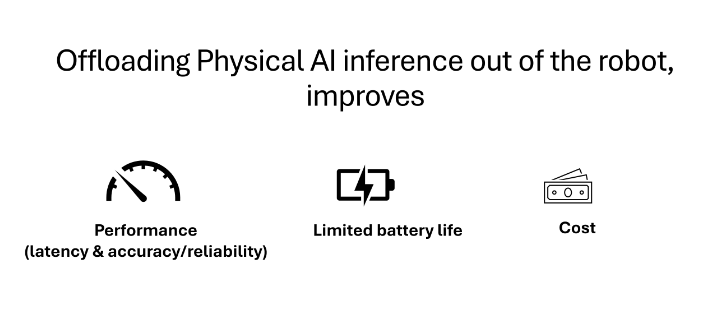
Offloading physical AI inference out of the robot improved its response time and accuracy, along with battery lifetime and cost. We evaluated the inference models across a range of onboard, edge, and cloud compute configurations. Details of the specific test hardware are available in our technical report.
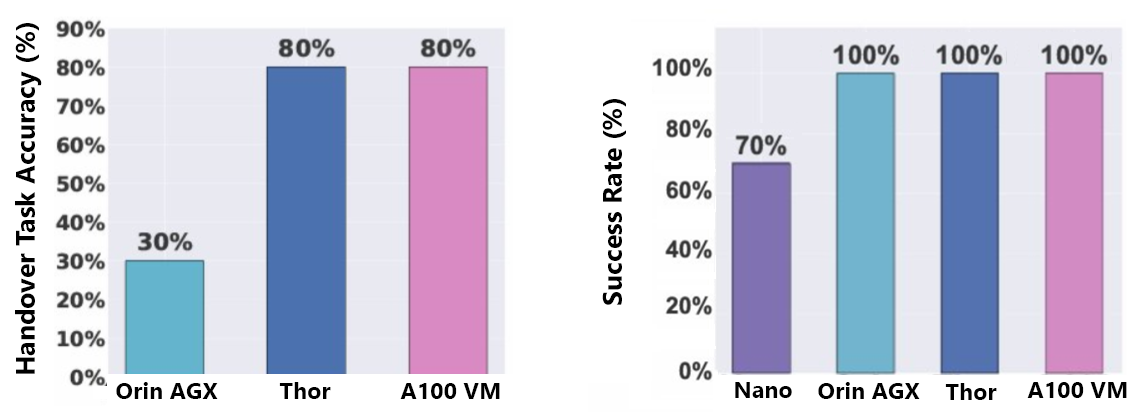
Benefits in task performance: Our evaluation shows offloading inference can significantly improve robot performance across mapping, planning, navigation, and manipulation workloads. Some smaller GPUs could not accommodate the mobile manipulation stack. On GPUs with sufficient memory, mapping and planning slowed by up to 383% compared to an A100, thus limiting the robot’s abilities in dynamic spaces. Navigation showed a 30% drop in its timely detection of obstacles with lighter GPUs. While the VLA models did not dramatically slow down with smaller GPUs, the slowdown was still sufficient to drop their accuracies by 50%. In other words, onboard GPUs limited the performance of the robots while offloading their inference to an on-premise or cloud GPU boosts their operations, as shown in the videos below and quantified in the graphs. As physical AI models continue to grow in size and complexity, the benefits of offloading are likely to become even more pronounced.
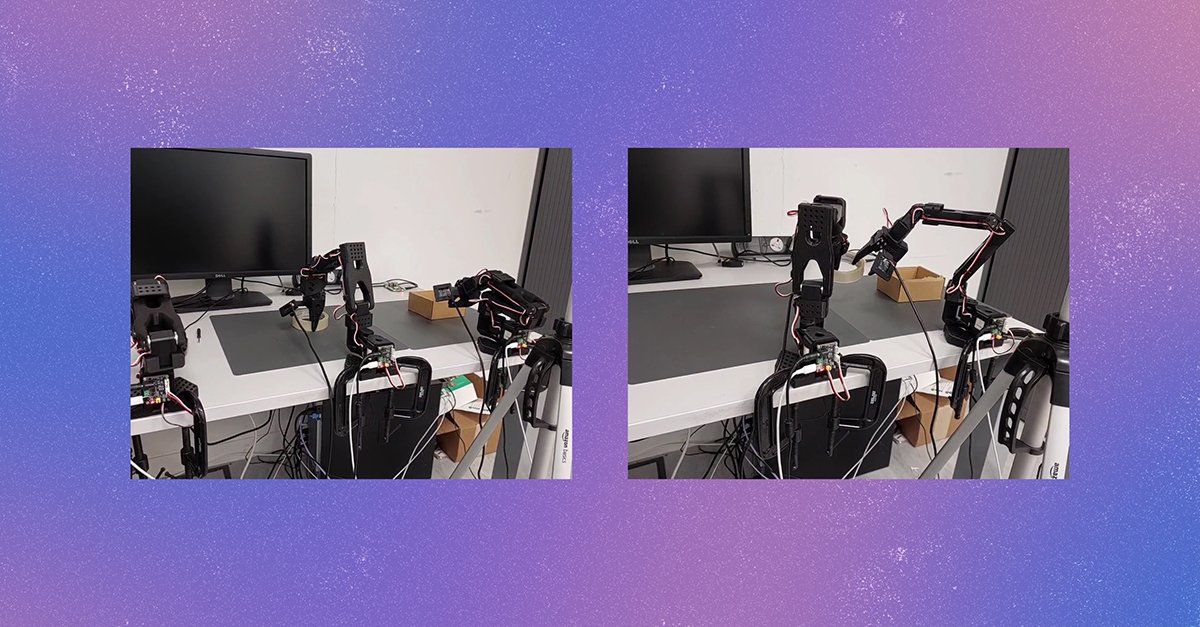
Figure 3a: The video shows the handover task with onboard GPUs.
Figure 3b: The video shows the handover task when the inference is offloaded.
Figure 4: Success rates of robot arms handing over objects to each other when inference is performed with different GPUs (some onboard, and some offloaded). Offloading improves success rates.
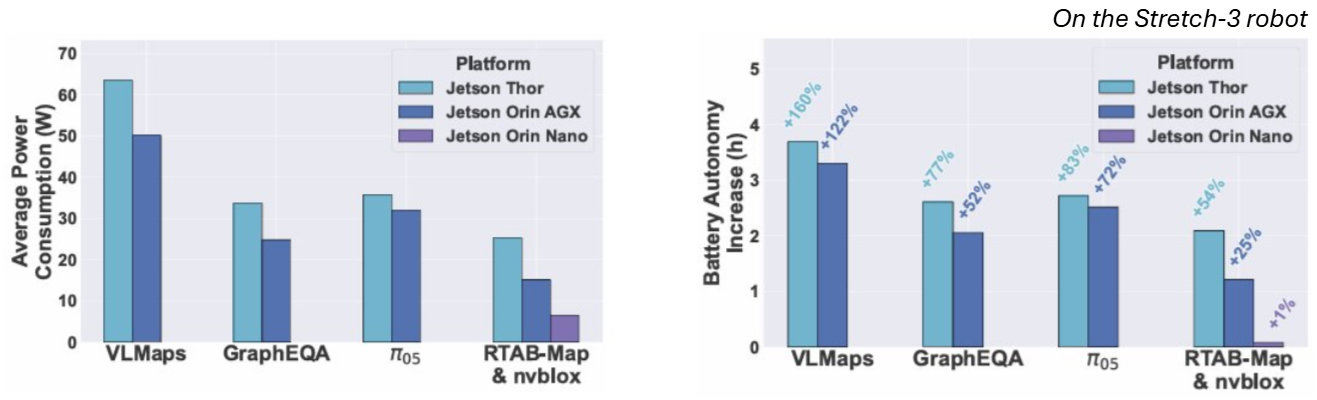
Benefits in battery lifetime: Beyond performance, onboard GPUs also significantly drained the battery life of the robot. We compared the increase in battery lifetime by replacing an onboard GPU with a Raspberry Pi-5 board and shipping all the data to the offloaded GPU. The larger onboard GPUs, such as Jetson Thor, drained robot batteries by up to 160% (or a few hours) for even the larger robots.
Figure 5: Impact of offloading GPU inference on the battery life of the robots; the above numbers are for the Stretch-3 robot.
The above results show that offloading GPU inference out of the robot is critical for functioning in the open world with large models and long battery lifetimes. Nonetheless, offloading inference out of the robot involves a complex tradeoff involving performance, network latency and bandwidth, and available GPU resources. We believe that our measurement study will inform the design of physical AI inference systems.
Spotlight: Event Series
Microsoft Research Forum
Join us for a continuous exchange of ideas about research in the era of general AI. Watch the latest episodes on demand.
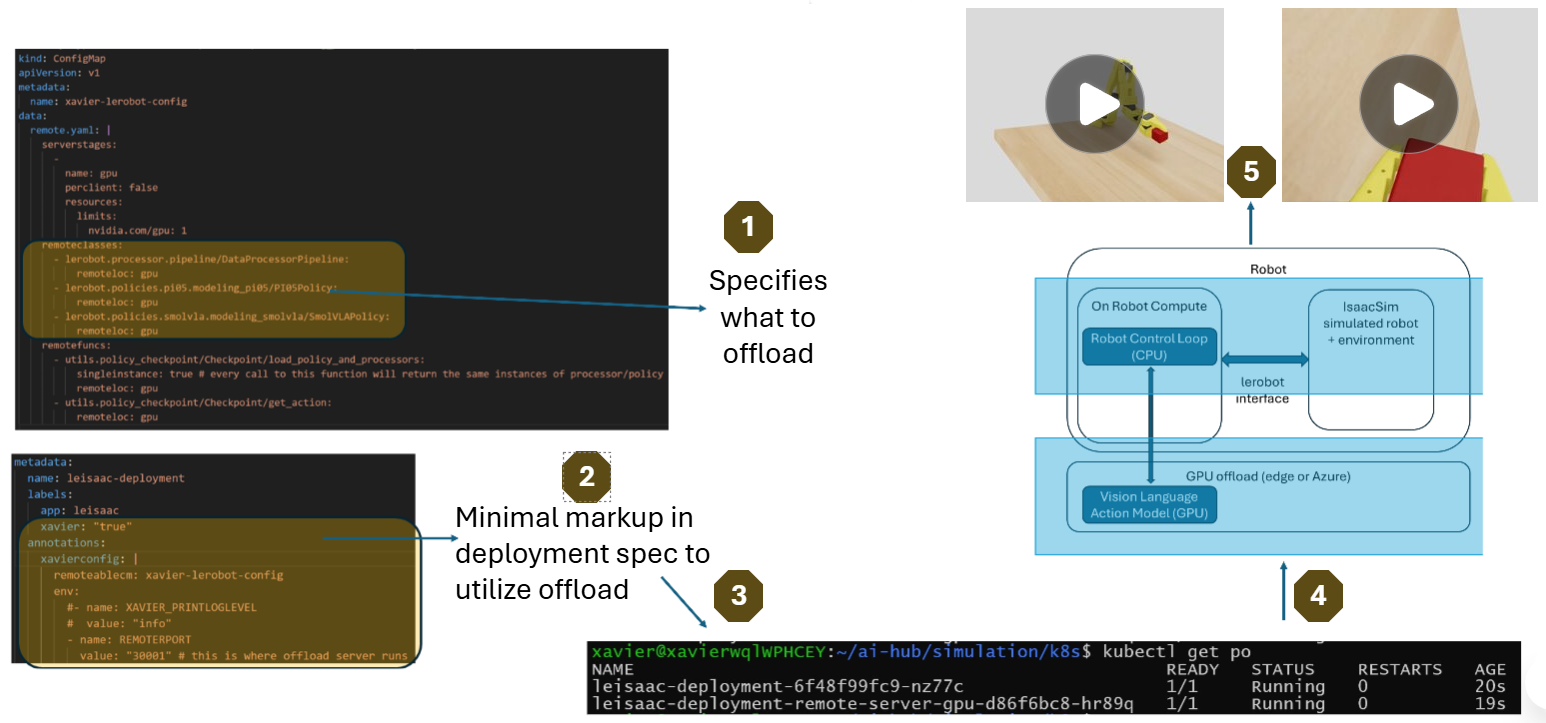
We have built a toolset for easy inference offloading out of the robot and distributing inference between the edge GPU and cloud. Kubernetes is a natural platform to provide a uniform abstraction to distribute robotic AI between the robot’s compute, edge GPU, and overflowing to the cloud. The toolset allows automatic containerization and offloading of robotics workloads using declarative specifications, distributes physical AI containers with smart policies using Kubernetes, and integrates with robotic simulators, LeRobot, and ROS2 for easy development. The sequence of steps below shows how the toolset can be prompted with what to offload, and how it creates a separate container for GPU inference and offloads the same.
Figure 6: Steps in the offloading toolset with containerization and deployment.
Microsoft has recently released the Physical AI Toolchain (opens in new tab) for operationalizing physical intelligence at scale. Physical AI Toolchain is an open-source, production-ready framework that integrates Microsoft Azure (opens in new tab) cloud services with NVIDIA’s (opens in new tab) physical AI stack, accelerating robotics and physical AI developers to automate and scale data curation, augmentation, and evaluation across perception, mobility, imitation learning, and reinforcement learning pipelines. We are announcing the addition of an industry-first capability for offloaded physical AI inference for robots as part of the Physical AI Toolchain. This release includes example projects for offloading inference of a SO-101 and a UR10e. The videos below show the offloading of the inference of Microsoft’s Rho model, targeted at dual-arm robots, to a Jetson Thor GPU, which controls the actions of the Mobile Aloha robot (opens in new tab).
Figure 7a: Offloading of GPU inference of Microsoft’s Rho model controlling the Mobile Aloha robot for interactions with the BusyBox to press the blue button.
Figure 7b: Offloading of GPU inference of Microsoft’s Rho model controlling the Mobile Aloha robot for interactions with the BusyBox to turn the knob to position 4.
Check out the inference offload feature, look into the source code, and let us know your feedback. We have already tested it with many real-world use cases, and look forward to hearing about your deployment experiences.
A technical update on our Private AI Compute architecture, which will enable persistent, cross-device AI memory with on-device privacy standards.
AI is becoming more capable and intuitive — remembering what matters, understanding the world around you, and acting at your direction. Privacy and trust are core to making that possible, ensuring your data stays private and protected as AI systems evolve to provide more continuous assistance across your devices.
Today, we are sharing how we will bring private, server-side memory to our Private AI Compute platform. This breakthrough resolves a longstanding dilemma in modern AI: how to give an assistant long-term continuity across devices while upholding the strict privacy standards typically limited to on-device processing.
Bringing on-device privacy to cloud-scale memory
With this new technical capability, a new persistent memory layer will be able to function like a secure digital vault in the cloud. Under this model, the information needed to assist you is sealed within dedicated, encrypted storage, while the cryptographic keys required to unlock it are held exclusively on your personal devices — ensuring your data is inaccessible to anyone else, even Google.
The diagram below shows how this update to Private AI Compute will work. When an AI model needs to access information to assist you, an authenticated, end-to-end encrypted channel connects your device to a protected, isolated environment in the cloud. That space, or “secure enclave,” temporarily decrypts your data in isolated memory to handle the request, saves any new context, and immediately encrypts it, keeping your information private as if it never left your device.
By combining hardware-enforced secure enclaves, encrypted channels, and per-user databases shielded by device-derived encryption keys, this architecture ensures your data stays fully private and under your control.
This evolution is necessary to meet the computing needs of the AI era. Local, on-device processing has historically been the gold standard for privacy — but frontier AI models often require far more computing power than any one device can provide. Bringing advanced AI to personal assistants means solving how to tap into the power of the cloud while ensuring personal data can remain as protected as if it never left your device.
To that end, we previously introduced our Private AI Compute platform, allowing users to process complex tasks in hardware-isolated cloud enclaves. Until now, that technology — along with similar solutions across the industry — was strictly “stateless,” meaning it wiped all context the moment a task ended. Workarounds, like having AI save a list of personal facts and preferences, aren’t enough to support the rich, continuous experiences people expect from personal AI. Making that level of assistance possible means engineering a way for cloud-scale AI to securely retain context over time and across devices.
Building trust, looking ahead
Imagine pulling up assembly instructions on your laptop that you previously viewed through smart glasses, or resuming complex conversations between mobile and web. Private AI Compute is designed to make that kind of seamless assistance possible – keeping the pieces it needs to remember safely locked away. But the user’s trust in that system’s privacy is also important.
Building that trust starts with transparency. That’s why, alongside our updated technical whitepaper, we’re publishing a tamper-proof public record of our server software. Devices running Private AI Compute will be able to verify that our software is authentic and unaltered before sending any personal data. In addition, we’re providing an update on our technical methods, including the results of an independent audit by a leading cybersecurity firm. By sharing these resources, we invite the broader privacy community to verify Private AI Compute’s protections.
Adding private, persistent memory to Private AI Compute shows how deeply personal assistance can be private by design. We invite the community to review the updated Private AI Compute Technical Brief and our system architecture, security proofs, and verification protocols.
Acknowledgements
This research was co-developed by Google DeepMind, Platforms & Devices, Core and Cloud teams. We would also like to thank Four Flynn, Jay Yagnik, and David Kleidermacher for their executive sponsorship of this work.
Piloting the world’s first double-blind AI evaluations
Gemini 3.8 Flash TTS and Gemini 3.8 Flash-Lite TTS are our most expressive audio generation models yet. Generate custom character voices and direct scene dialogue across Google AI Studio, Gemini API, Gemini Enterprise, Gemini Notebook, and Google Vids.
Leland Rechis
Group Product Manager
Alan Cowen
Director, Research Science, on Behalf of the Gemini Audio Team
Today, we’re introducing two new text-to-speech models to the Gemini family, transforming voice generation from static presets into a dynamic creative studio. These models enable creators, developers, and enterprises to create richer, more expressive audio experiences, while enabling improved user experiences in products like Gemini Notebook and Google Vids.
Gemini 3.8 Flash TTS: Built for deep creative direction and character design. Create entirely new voices from scratch using natural language prompts to bring characters to life across gaming, immersive audiobooks, podcasts, and interactive media. Direct every performance line by line with granular control over acting cues, pacing, dialect shifts, and backchanneling.
Gemini 3.8 Flash-Lite TTS: Built for high-volume, cost-efficient scale. Optimized for high-volume dubbing, audio content creation, and expressive voice agents with fine-grained control over tone, pacing, and expressive nuance.
Scale up from 30 original voices to an infinite library. Whether you need an entirely original character voice or a consistent brand ambassador, our 3.8 Flash TTS model powers a full vocal studio. This enables you to create and use expressive, natural-sounding voices for every moment, while empowering developers and enterprises to easily build custom audio experiences.
Generative voice design: With Gemini 3.8 Flash TTS, create bespoke voices from scratch by customizing role, accent and voice characteristics across more than 100 languages and dialects using natural language prompting — whether you’re bringing a dramatic, fire-breathing dragon to life or crafting a charismatic narrator with a distinct regional cadence.
Expansive voice library: Access 2,000+ production-ready voices with broad language coverage — including regional varieties like Mexican Spanish, Quebec French, and Scots English.
Voice replication: Recreate consistent vocal profiles from just a 30-second audio sample of your voice or a voice you have the rights to use, backed by built-in consent verification, SynthID watermarking, and C2PA credentials to protect both developers and their vocal talent.
Save and scale: Save and manage the custom voices you designed to ensure consistent performance and minimal drift across ongoing projects.
Voice remixing: Coming soon, pick a voice from our voice library and fine-tune timbre, pitch, pace, and accent. Use prompts to dial in characteristics (e.g. “add subtle Southern US accent” or “soften the delivery”).
Direct the performance, line by line
Once you’ve selected your voices, both TTS models give you precise control over how each line is delivered.
Direct performance line by line: Write your own stage directions or let Gemini steer delivery with natural script cues — from a calm customer service agent to a whispered suspense scene.
Long-form generation: Maintain high voice quality, natural pacing, and character timbre across hours of continuous audio with minimal speaker drift — ideal for podcasts and audiobooks.
Native two-speaker scene staging: Direct multi-turn conversations seamlessly from a single script —whether for a podcast or dramatic storytelling—while keeping both voices distinctly separated with natural conversational turn-taking.
Scripted vocal bursts & backchanneling: Add realistic conversational texture using non verbal cues (like , , and active-listening interjections (like |mhm| or|yeah|) for precise comedic timing and reaction beats.
Get expressive high-quality speech generation built for global scale
Gemini 3.8 Flash TTS delivers leading voice customization capabilities, securing the #1 overall spot on Hume AI’s Voice Design Benchmark (71.4) and also leading in accent modeling (60.8).
Gemini 3.8 Flash TTS and Gemini 3.8 Flash-Lite TTS enable truly expressive performances without sacrificing reliability, also securing the #1 and #2 spots respectively on Hume AI’s Overall Quality Index. The model shows major improvements on a wide range of use cases such as long-form content and dual-speaker screenplay control compared to Gemini 3.1 Flash TTS.
In blind human preference evaluations on Voice Arena, Gemini 3.8 Flash and Flash-Lite TTS secure top positions amongst competitors in key global languages, including Japanese, Brazilian Portuguese, Vietnamese, Modern Standard Arabic (MSA), Mexican Spanish and Hindi. With support for over 100 languages, these models empower creators, developers, and enterprises to build high-quality, multilingual voice experiences worldwide.
Build with trust, consent, and transparency
We built our voice creation and replication capabilities with strict safeguards to help protect voice talent, respect identity, and ensure content transparency. For voice replication our system leverages consent verification: users must provide a verbal consent recording from the voice owner that matches the reference speaker before a voice can be created.
More broadly, every audio clip generated by our Gemini Audio models is watermarked with SynthID. This imperceptible watermark is woven directly into the audio output, ensuring AI-generated speech remains detectable to help prevent misinformation. For more details on our approach to safety and responsibility, review the model card.
Try our new Google AI Studio audio playground
Starting today, developers can experience these new speech generation capabilities in Google AI Studio. Built like a voice design workspace, you can prompt entirely new vocal identities from scratch or replicate your own voice 1 , then bring them directly into a dual-speaker screenplay editor to direct line-by-line delivery.
Try voice replication in Google AI Studio.
Deploy high-performance voice interfaces with ease
By using the Gemini API, developer platforms such as Agora, LiveKit, Pipecat, Vercel enable developers to build and deploy high-performance speech generation experiences with ease.
We’re partnering with companies like Figma, HeyGen, Linguana, Wondercraft, 99.co, and Ollang, who are integrating our latest TTS models to help accelerate global dubbing, localize media with nuanced regional accents, and power conversational voice agents at scale.
Start using our latest Gemini Audio models:
Gemini 3.8 Flash TTS is rolling out starting today:
We report on the recent publication of our retrosynthesis model RetroChimera in the journal Nature (opens in new tab).
The paper describes the model’s architecture as well as extensive validation studies, including the model’s ability to recall rare reaction types, and successful zero-shot transfer and fine-tuning on proprietary datasets.
We open-source RetroChimera’s implementation and weights in the hope that it will enable researchers to accelerate development of new medicinally relevant molecules and advanced materials.
Developing new medicines and materials requires making new molecules but planning how to make them is still largely manual, time-consuming, and costly. RetroChimera automatically proposes high-quality synthesis routes. The model combines two strong models with complementary strengths, learning how to rank their proposals to produce better predictions than either alone. In blind tests, PhD-level chemists prefer RetroChimera’s individual reaction predictions over preceding models and recorded literature reactions.
Custom-made molecules are unlocking advances in modern medicine, smart materials, and sustainable agriculture. Yet, progress is slowed by chemical synthesis—the time-consuming process of making new molecules from simpler building blocks in the lab. In addition, synthesis is a significant driver of drug development costs. So even as computational methods make it possible to explore large numbers of novel molecules, finding practical ways to synthesize them remains a critical challenge.
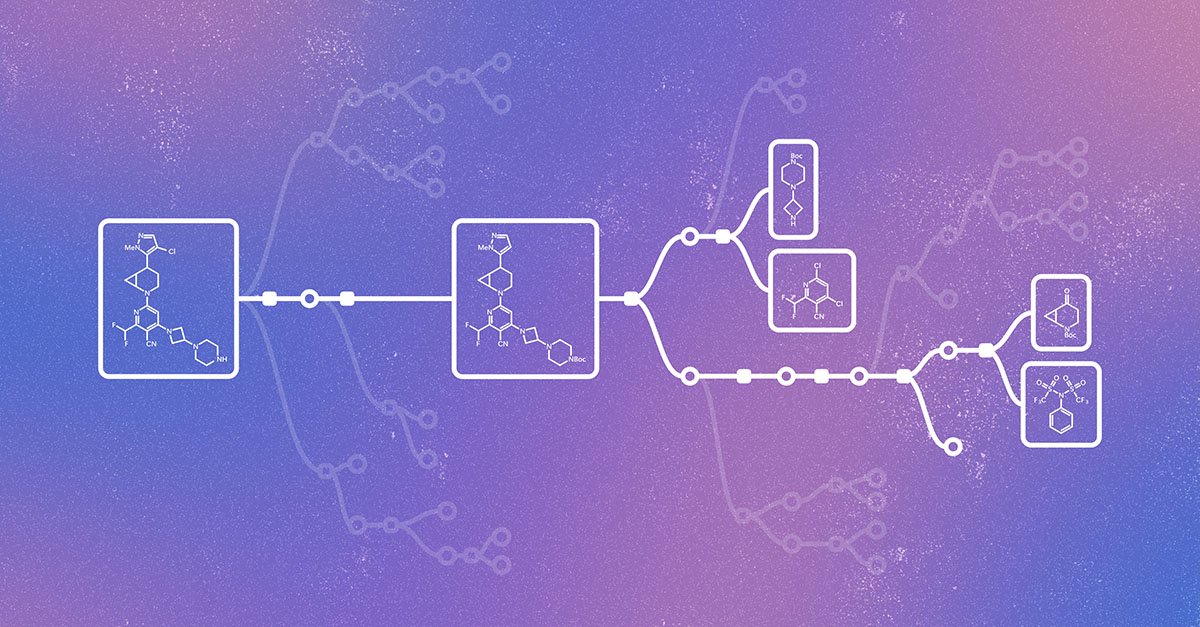
Figure 1: Planning a synthesis by working backward. Retrosynthesis starts with a target molecule and proposes successive disconnections into simpler precursors until purchasable building blocks are reached. The highlighted path shows a complete synthesis route; pale branches illustrate alternatives explored along the way. Circles represent molecules and squares represent reactions. For clarity, only a few branches are illustrated, with chemical structures shown for the target, one intermediate, and selected building blocks.
Retrosynthesis approaches this problem by working backwards from a target molecule, breaking it down step by step into simpler precursors (Figure 1). This process is comparable to playing strategic board games like chess and Go. It involves contemplating a wide range of possible immediate moves, or individual disconnections, while also requiring high-level strategic thinking to reach the end-to-end synthesis plan. However, the number of possible moves in retrosynthesis is much larger than in board games, and it is not obvious which moves would be available for a given molecule. Existing systems face major challenges, including recalling rare but strategically important reactions, robustness beyond the training distribution, and aligning with chemists’ expectations. As a result, retrosynthesis often requires highly specialized expertise, which hinders scaling and automation of scientific discovery.
Figure 2: Our framework for ensemble-based retrosynthesis with learned re-ranking which underpins RetroChimera. The ensemble receives a target molecule as the input, which is then processed by the sub-models. The model outputs are aggregated using a learning-to-rank strategy. While in this work we only investigate deep learning models as prediction sources (solid boxes), it is possible to add additional sources, for example calls to reaction databases or human-in-the-loop queries (dashed box).
In a paper recently published in the journal Nature (opens in new tab), we present RetroChimera (opens in new tab), a new framework for retrosynthesis prediction. It is built around two models (Figure 2). R-SMILES 2, a Transformer-based de-novo model, predicts precursor molecules directly from the input molecule. This gives it the flexibility to learn reaction patterns directly from data. However, its unconstrained generation can also make it prone to hallucination.
NeuralLoc, in contrast, is a graph neural network- (GNN) based model that encodes both the target molecule and reaction templates as graphs. It selects reaction templates and predicts where they should be applied to the target molecule. Its predictions are grounded in reaction patterns extracted from the training data, so it tends to produce more accurate and reliable outputs. But it’s more constrained when encountering reactions not covered by the template library.
These differences actually turn out to be a strength. Rather than making the same kinds of predictions, the two models capture complementary patterns in chemistry and specialize in different reaction types. R-SMILES 2 performs particularly well on reactions that involve large changes over the course of the reaction, while NeuralLoc excels in reactions of low precedence and those involving more localized changes.
RetroChimera combines the ranked predictions of both sub-models using a learned ensembling strategy. Each model assigns a learned, rank-dependent vote to each predicted reactant set, and votes are added when both models propose the same reaction. By learning how much to trust each model at different ranks, RetroChimera can leverage their complementary strengths, approximately matching the better-performing sub-model across reaction classes.
Figure 3: Expert assessment of multistep synthesis routes. Left: Ratings of individual reaction steps. Right: Complete routes accepted or rejected for ten challenging targets. RetroChimera succeeded on nine targets, versus five for the de novo model, four for the editing model, and two for NeuralSym, a strong baseline model.
As a result, RetroChimera performs strongly across both common and rare reaction classes and produces retrosynthesis predictions that better align with chemists’ judgment (Figure 3). In blind tests, expert chemists preferred disconnections of complex molecules suggested by RetroChimera over those obtained from its constituent sub-models, as well as those from more established approaches, and even from the test set itself.
We believe RetroChimera could help researchers identify promising synthesis route more efficiently, supporting faster design-make-test cycle across molecular science applications, including drug discovery and design of smart materials. RetroChimera could enable chemists to assess more—and more complex—candidate molecules at large scale. Paired with increasing levels of laboratory automation, we expect further acceleration toward closed-loop, self-improving systems for synthesis planning and execution.
We invite the broader chemistry community to experiment with RetroChimera, helping us identify its strengths and shortcomings so we can enhance it in the future. We are looking forward to hearing how it performs on various targets you care about!