Author: admin

  • Improved Gemini audio models for powerful voice experiences

    Improved Gemini audio models for powerful voice experiences


    Bibo Xu

    Director of Product Management

    Tara Sainath

    Distinguished Research Scientist


    Gemini Audio text logo

    Your browser does not support the audio element.

    Listen to article

    [[duration]] minutes

    This content is generated by Google AI. Generative AI is experimental

    Earlier this week, we introduced greater control over audio generation with an upgrade to our Gemini 2.5 Pro and Flash Text-to-Speech models.

    But generating expressive speech is only one side of the conversation. Today, we’re releasing an updated Gemini 2.5 Flash Native Audio for live voice agents. This update improves the model’s ability to handle complex workflows, navigate user instructions, and hold natural conversations.

    Gemini 2.5 Flash Native Audio is now available across Google products including Google AI Studio, Vertex AI, and has also started rolling out in Gemini Live and Search Live, bringing the naturalness of native audio to Search Live for the first time. This means you can more effectively brainstorm live with Gemini, get real-time help in Search Live, or build the next generation of enterprise-ready customer service agents.

    Beyond powering helpful agents, native audio unlocks new possibilities for global communication. We’re introducing live speech translation, a capability that enables streaming speech-to-speech translation for headphones. It preserves the speaker’s intonation, pacing and pitch. This beta experience is rolling out in the Google Translate app starting today.

    Live Voice Agents

    Gemini 2.5 Flash Native Audio is now enabling a wide spectrum of conversational experiences.

    ” video-id=”5eA5aZpVYbs” video-type=”video”>

    To enable the breadth of use cases across surfaces and products, we have improved Gemini 2.5 Native Audio in three key areas:

    • Sharper function calling: We’ve improved the model’s reliability when triggering external functions. It can now more accurately identify when to fetch real-time information during a conversation and seamlessly weave that data back into the audio response, without breaking the flow. On ComplexFuncBench Audio, an eval that captures multi-step function calling with various constraints, Gemini 2.5 Native Audio leads with a score of 71.5%.
    • Robust instruction following: The model is now better at handling complex instructions resulting in higher user satisfaction on content completeness. With a 90% adherence rate to developer instructions (up from 84%), it delivers more reliable outputs.
    • Smoother conversations: We’ve achieved significant gains in multi-turn conversation quality. Gemini 2.5 Flash Native Audio is able to retrieve context from previous turns more effectively, creating more cohesive conversations.

    The updated Gemini 2.5 Flash Native Audio’s performance against previous versions and industry competitors on ComplexFuncBench
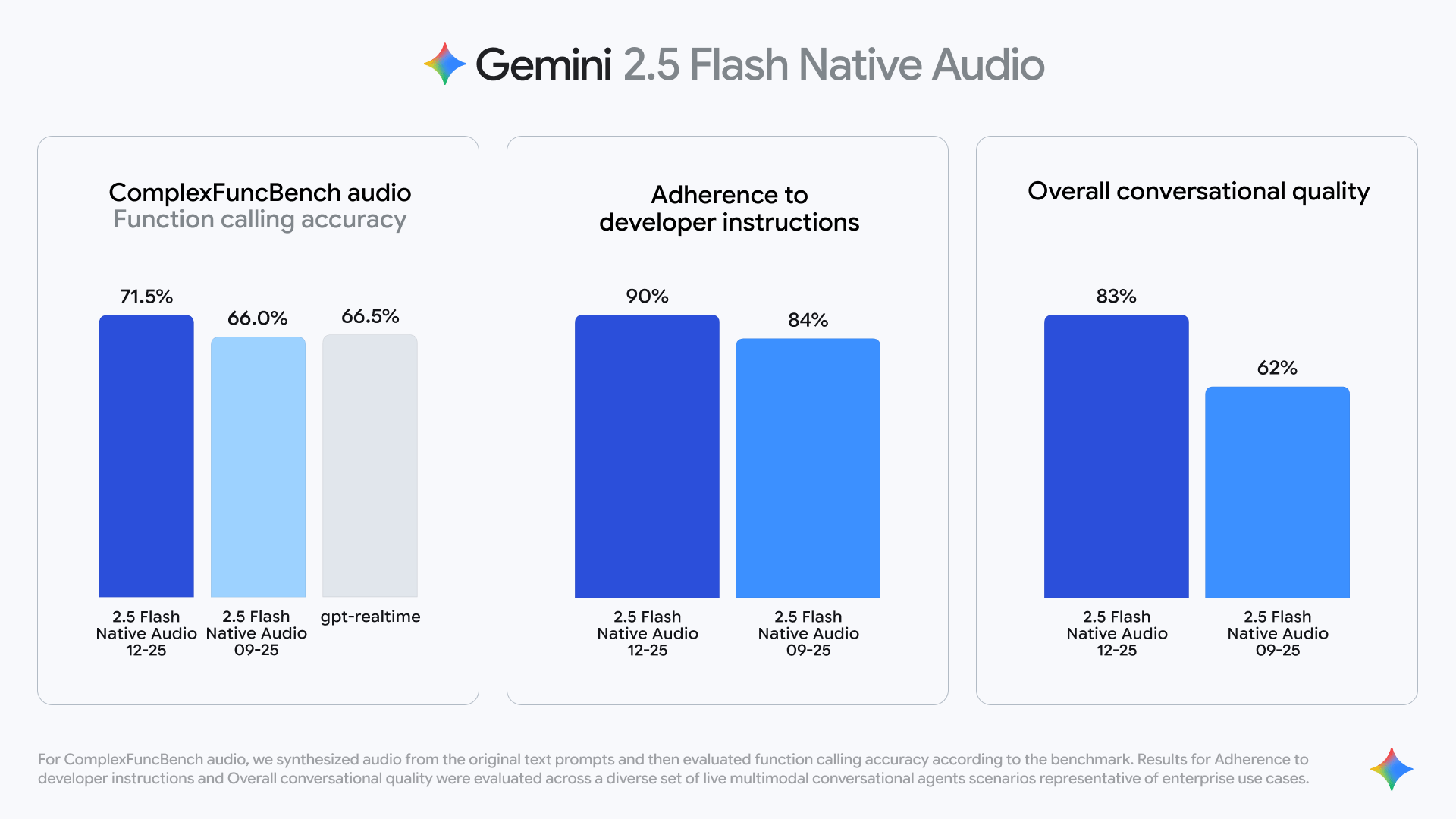
    updated Gemini 2.5 Flash Native Audio’s performance against previous versions and industry competitors

    What customers are saying

    Google Cloud customers are already using Gemini’s native audio capabilities to drive real business results, from mortgage processing to customer calls.

    • “Users often forget they’re talking to AI within a minute of using Sidekick, and in some cases have thanked the bot after a long chat…New Live API AI capabilities offered through Gemini [2.5 Flash Native Audio] empower our merchants to win.” – David Wurtz, VP of Product, Shopify
    • “By integrating the Gemini 2.5 Flash Native Audio model…we’ve significantly enhanced Mia’s capabilities since launching in May 2025. This powerful combination has enabled us to generate over 14,000 loans for our broker partners.” – Jason Bressler, Chief Technology Officer, United Wholesale Mortgage (UWM)
    • “Working with the Gemini 2.5 Flash Native Audio model through Vertex AI allows Newo.ai AI Receptionists to achieve unmatched conversational intelligence … .They can identify the main speaker even in noisy settings, switch languages mid-conversation, and sound remarkably natural and emotionally expressive.” – David Yang, Co-founder, Newo.ai

    Live Speech Translation

    Gemini now natively supports new live speech-to-speech translation capabilities designed to handle both continuous listening and two-way conversation.

    With continuous listening, Gemini automatically translates speech in multiple languages into a single target language. This allows you to put headphones in and hear the world around you in your language.

    For two-way conversation, Gemini’s live speech translation handles translation between two languages in real-time, automatically switching the output language based on who is speaking. For example, if you speak English and want to chat with a Hindi speaker, you’ll hear English translations in real-time in your headphones, while your phone broadcasts Hindi when you’re done speaking.

    Gemini’s live speech translation has a number of key capabilities that help in the real world:

    • Language coverage: Translates speech in over 70 languages and 2000 language pairs by combining Gemini model’s world knowledge and multilingual capabilities with its native audio capabilities
    • Style transfer: Captures the nuance of human speech, preserving the speaker’s intonation, pacing and pitch so the translation sounds natural.
    • Multilingual input: Understands multiple languages simultaneously in a single session, helping you follow multilingual conversations without needing to fiddle around with language settings.
    • Auto detection: Identifies the spoken language and begins translation, so you don’t even need to know what language is being spoken to start translating.
    • Noise robustness: Filters out ambient noise so you can converse comfortably even in loud, outdoor environments.

    Starting today, you can try it in a new beta experience in the Google Translate app for real-time translation in your headphones by connecting them to your device and tapping “Live translate.” This experience is rolling out to all Android devices in the US, Mexico and India with support for iOS and more regions coming soon.

    Based on feedback, we will continue to iterate on this experience and bring it to more Google products including the Gemini API in 2026.

    Get started today

    Start building voice agents today with Gemini 2.5 Flash Native Audio, now generally available on Vertex AI and as preview in the Gemini API. Try it out in Google AI Studio.

    Gemini 2.5 Flash and 2.5 Pro text-to-speech models are also available via the Gemini API in Google AI Studio. Get started with the speech generation docs, explore the prompting guide, or check out the Gemini API Cookbook to get started.


  • Deepening our partnership with the UK AI Security Institute

    Deepening our partnership with the UK AI Security Institute

    December 11, 2025 Responsibility & Safety

    William Isaac and Owen Larter

    Today, we’re announcing an expanded partnership with the UK AI Security Institute (AISI) through a new Memorandum of Understanding focused on foundational security and safety research, to help ensure artificial intelligence is developed safely and benefits everyone.

    The research partnership with AISI is an important part of our broader collaboration with the UK government on accelerating safe and beneficial AI progress.

    Building on a foundation of collaboration

    AI holds immense potential to benefit humanity by helping treat disease, accelerate scientific discovery, create economic prosperity and tackle climate change. For these benefits to be realised, we must put safety and responsibility at the heart of development. Evaluating our models against a broad spectrum of potential risks remains a critical part of our safety strategy, and external partnerships are an important element of this work.

    This is why we have partnered with the UK AISI since its inception in November 2023 to test our most capable models. We are deeply committed to the UK AISI’s goal to equip governments, industry and wider society with a scientific understanding of the potential risks posed by advanced AI as well as potential solutions and mitigations.

    We are actively working with AISI to build more robust evaluations for AI models, and our teams have collaborated on safety research to move the field forward, including recent work on Chain of Thought Monitorability: A New and Fragile Opportunity for AI Safety. Building on this success, today we are broadening our partnership from testing to include wider, more foundational, research in a variety of areas.

    What the partnership involves

    Under this new research partnership, we’re broadening our collaboration to include:

    • Sharing access to our proprietary models, data and ideas to accelerate research progress
    • Joint reports and publications sharing findings with the research community
    • More collaborative security and safety research combining our teams’ expertise
    • Technical discussions to tackle complex safety challenges

    Key research areas

    Our joint research with AISI focuses on critical areas where Google DeepMind’s expertise, interdisciplinary teams, and years of pioneering responsible research can help make AI systems more safe and secure:

    Monitoring AI reasoning processes

    We will work on techniques to monitor an AI system’s “thinking”, also commonly referred to as its chain-of-thought (CoT). This work builds on previous Google DeepMind research as well, and our recent collaboration on this topic with AISI, OpenAI, Anthropic and other partners. CoT monitoring helps us understand how an AI system produces its answers, complementing interpretability research.

    Understanding social and emotional impacts

    We will work together to investigate the ethical implications of socioaffective misalignment; that is, the potential for AI models to behave in ways which do not align with human wellbeing, even when they’re technically following instructions correctly. This research will build on existing Google DeepMind work that has helped define this critical area of AI safety.

    Evaluating economic systems

    We will explore the potential impact of AI on economic systems by simulating real-world tasks across different environments. Experts will score and validate these tasks, after which they will be categorised along dimensions like complexity or representativeness, to help predict factors like long-term labour market impact.

    Working together to realise the benefits of AI

    Our partnership with AISI is one element of how we aim to realise the benefits of AI for humanity while mitigating potential risks. Our wider strategy includes foresight research, extensive safety training that goes hand-in-hand with capability development, rigorous testing of our models, and the development of better tools and frameworks to understand and mitigate risk.

    Strong internal governance processes are also essential for safe and responsible AI development, as is collaborating with independent external experts who bring fresh perspectives and diverse expertise to our work. Google DeepMind’s Responsibility and Safety Council works across teams to monitor emerging risk, review ethics and safety assessments and implement relevant technical and policy mitigations. We also partner with other external experts like Apollo Research, Vaultis, Dreadnode and more, to conduct extensive testing and evaluation of our models, including Gemini 3, our most intelligent and secure model to date.

    Additionally, Google DeepMind is a proud founding member of the Frontier Model Forum, as well as the Partnership on AI, where we focus on ensuring safe and responsible development of frontier AI models and increasing collaboration on important safety issues.

    We hope our expanded partnership with AISI will allow us to build more robust approaches to AI safety for the benefit not just of our own organisations, but also the wider industry and everyone who interacts with AI systems.

  • Strengthening our partnership with the UK government to support prosperity and security in the AI era

    Strengthening our partnership with the UK government to support prosperity and security in the AI era

    December 10, 2025 Responsibility & Safety

    Demis Hassabis, Lila Ibrahim, Pushmeet Kohli and Owen Larter

    Listen to article 7 minutes

    AI presents an opportunity to build a more prosperous and secure world.

    The UK has already laid a strong foundation to seize this moment and is uniquely positioned to translate AI innovation into public benefit. That’s why we are excited to deepen our collaboration with the UK government to accelerate this work and offer a blueprint for other countries.

    Together we will focus on using AI to speed up progress in science and education, modernize public services and advance national security and resilience.

    Accelerating access to frontier AI in key sectors: Science & Education

    Our partnership will center on providing access to frontier AI in two areas foundational to the UK’s long-term success: scientific discovery and education.

    The UK has a rich history of applying new technologies to drive scientific progress, from Hooke’s microscope to Faraday’s electrical experiments. We aim to build on this heritage, and empower the next generation of scientists with AI tools that can unlock breakthroughs, transform the economy, and solve some of the major challenges facing humanity. We will provide priority access to our “AI for Science” models to UK scientists, including:

    • AlphaEvolve – a Gemini-powered coding agent for designing advanced algorithms
    • AlphaGenome – an AI model to help scientists better understand our DNA
    • AI co-scientist – a multi-agent AI system that acts as a virtual scientific collaborator
    • WeatherNext – a family of state-of-the-art weather forecasting models

    Like the microscope or telescope, these AI tools are designed to enhance scientific capacity, enabling researchers to tackle problems of unprecedented complexity and scale. For example, AlphaFold – our AI system for predicting protein structures – has already enabled almost 190,000 researchers in the UK alone to deepen their understanding of areas such as crop resilience, antimicrobial resistance and other critical biological challenges.

    Establishing Google DeepMind’s first automated science laboratory in the UK

    To help turbocharge scientific discovery, we will establish Google DeepMind’s first automated laboratory in the UK in 2026, specifically focused on materials science research. A multidisciplinary team of researchers will oversee research in the lab, which will be built from the ground up to be fully integrated with Gemini. By directing world-class robotics to synthesize and characterize hundreds of materials per day, the team intends to significantly shorten the timeline for identifying transformative new materials.

    Discovering new materials is one of the most important pursuits in science, offering the potential to reduce costs and enable entirely new technologies. For example, superconductors that operate at ambient temperature and pressure could allow for low cost medical imaging and reduce power loss in electrical grids. Other novel materials could help us tackle critical energy challenges by unlocking advanced batteries, next-generation solar cells and more efficient computer chips.

    Rowendale Integrated Primary School participating in the Northern Ireland Education Authority’s C2k program where teachers were able to save up to 10 hours per week with their use of tools like Gemini for Education.

    Enhancing teaching and learning

    AI can augment the classroom experience, especially when grounded in learning science.

    This impact was made clear in a successful pilot program in Northern Ireland, where Gemini helped save teachers an average of 10 hours per week by streamlining administrative work and brainstorming engaging lesson content.

    Beyond time savings, Eedi’s recent exploratory randomized controlled trial (RCT) with UK students indicates that AI can help drive effective student learning. Students who received short AI tutoring sessions (under supervision by teachers) were 5.5 percentage points more likely to solve novel problems on subsequent topics than students who worked with human tutors alone.

    To help scale this impact further across the UK, we are supporting research to understand how AI tools impact teaching and learning through a rigorous scientific approach, and exploring how to tailor our Gemini model – leveraging our longstanding commitment to pedagogy, including our LearnLM efforts – to complement England’s national curriculum. Our goal is to deliver state of the art educational experiences while also helping reduce educator workloads, freeing them to reclaim more time to focus on what they do best: helping every learner thrive.

    Modernizing public services

    AI also has tremendous potential to help build more effective and efficient public services. We are working directly with government teams to ensure they have the technical expertise and access to frontier models required to reimagine these services to better serve citizens. The UK Government’s AI Incubator team (i.AI) is currently trialling Extract – a tool for council planners that uses Gemini to transform old planning documents into clear, digital data. Currently, converting a single planning document takes up to 2 hours. Extract will transform these into digital data in just 40 seconds, significantly speeding up decision-making timelines.

    Advancing national security and resilience

    Our partnership will involve deeper collaboration with the UK AI Security Institute on critical safety research in explainability, alignment and societal impact, so these risks may be better understood and mitigated. Read more about this work here.

    AI can also be a powerful defender against security risks. We will work with the UK government to advance AI-enhanced approaches to national cyber resilience, exploring using tools like Big Sleep and CodeMender to identify vulnerabilities and automatically fix code, enabling a more secure future.

    National partnerships on AI

    We believe AI will be humanity’s most transformational technology, and we are committed to partnering with governments globally to turn its potential into real progress for people everywhere. By building on our collaboration with the UK government and important initiatives like the US-UK Tech Prosperity Deal, we aim to advance innovation, scientific discovery, and security for all.

    Deepening our partnership with the UK AI Security Institute

    AlphaEvolve: A Gemini-powered coding agent for designing advanced algorithms

    AlphaGenome: AI for better understanding the genome

    WeatherNext 2: Our most advanced weather forecasting model

    How AI is giving Northern Ireland teachers time back

    Introducing CodeMender: an AI agent for code security

  • FACTS Benchmark Suite: Systematically evaluating the factuality of large language models

    FACTS Benchmark Suite: Systematically evaluating the factuality of large language models

    December 9, 2025 Responsibility & Safety

    The FACTS team

    Large language models (LLMs) are increasingly becoming a primary source for information delivery across diverse use cases, so it’s important that their responses are factually accurate.

    In order to continue improving their performance on this industry-wide challenge, we have to better understand the types of use cases where models struggle to provide an accurate response and better measure factuality performance in those areas.

    The FACTS Benchmark Suite

    Today, we’re teaming up with Kaggle to introduce the FACTS Benchmark Suite. It extends our previous work developing the FACTS Grounding Benchmark, with three additional factuality benchmarks, including:

    • A Parametric Benchmark that measures the model’s ability to access its internal knowledge accurately in factoid question use-cases.
    • A Search Benchmark that tests a model’s ability to use Search as a tool to retrieve information and synthesize it correctly.
    • A Multimodal Benchmark that tests a model’s ability to answer prompts related to input images in a factually correct manner.

    We are also updating the original FACTS grounding benchmark with Grounding Benchmark – v2, an extended benchmark to test a model’s ability to provide answers grounded in the context of a given prompt.

    Each benchmark was carefully curated to produce a total of 3,513 examples, which we are making publicly available today. Similar to our previous release, we are following standard industry practice and keeping an evaluation set held-out as a private set. The FACTS Benchmark Suite Score (or FACTS Score) is calculated as the average accuracy of both public and private sets across the four benchmarks. Kaggle will oversee the management of the FACTS Benchmark Suite. This includes owning the private held-out sets, testing the leading LLMs on the benchmarks, and hosting the results on a public leaderboard. More details about the FACTS evaluation methodology can be found in our tech report.

    Benchmark overview

    Parametric Benchmark

    The FACTS Parametric benchmark assesses the ability of models to accurately answer factual questions, without the aid of external tools like web search. All the questions in the benchmark are “trivia style” questions driven by user interest that can be answered via Wikipedia (a standard source for LLM pretraining). The resulting benchmark consists of a 1052-item public set and a 1052-item private set.

    Distribution of context domain (left) and distribution of the answer type (right) as a percent of the total set of questions in the Parametric benchmark.

    A typical prompt from the public set would require the model to answer a simple question on a niche topic, e.g., “Who played harmonica on ‘The Rockford Files’ theme song?”

    Search Benchmark

    By contrast, the FACTS Search benchmark evaluates a model’s ability to use a web search tool for answering questions. This benchmark was designed to be challenging for LLMs even with access to the web, often requiring the retrieval of multiple facts sequentially to answer a single query. The same web search tool is being made available to all models, ensuring the model capabilities are tested in isolation without the confounding factor of custom web retrieval settings. FACTS Search consists of a 890-item public set and a 994-item private set.

    Distribution of context domain (left) and distribution of the task requested by the user (right) as a percent of the total set of prompts in the Search benchmark.

    The following example from the public set was included because it requires retrieving information from several web pages, “What is the sum of the birth years of the British boxer who defeated Vazik Kazarian at the 1960 Summer Olympics, the Moroccan boxer who also competed in the men’s light welterweight event at those same Olympics, and the Danish boxer who competed in both the 1960 and 1964 Summer Olympics?”

    Multimodal Benchmark

    The FACTS Multimodal benchmark evaluates the ability of models to generate factually accurate text in response to image-based questions, which is a critical capability for modern multimodal systems.

    This task requires the integration of visual grounding, i.e. its ability to accurately interpret and connect information from visual input, using its internal or “parametric” world knowledge. The evaluation framework is designed to ensure that a response is both correct and provides all necessary information to be complete. The benchmark consists of a 711-item public set and a 811-item private set.

    Distribution of image (left) and distribution of the question categories (right) as a part of the Multimodal benchmark.

    For example, the following image from the public set of the Multimodal benchmark appeared with the prompt: “What genus does this animal belong to?”

    An example of an image from the Multimodal benchmark (Photo credit: Image: Racta apella by desertnaturalist, CC BY 4.0)

    Results

    We evaluated leading LLMs on the FACTS Benchmark Suite, which includes the updated FACTS Grounding v2.

    The table below lists 15 leading models and their overall FACTS score (followed by the breakdown to the scores across the four individual benchmarks: Grounding, Multimodal, Parametric and Search).

    Gemini 3 Pro leads in overall performance, with a FACTS Score of 68.8%. In particular, we saw significant improvements from Gemini 2.5 Pro to Gemini 3 Pro in Search & Parametric slices, where the error rate was reduced by 55% on FACTS Search and 35% for FACTS Parametric. FACTS Multimodal saw the lowest scores, generally. All evaluated models achieved an overall accuracy below 70%, leaving considerable headroom for future progress.

    Beyond the FACTS Benchmark Suite, Gemini’s improvement in factuality is also reflected in another factuality benchmark, SimpleQA Verified, going from 54.5% accuracy on Gemini 2.5 Pro to 72.1% accuracy on Gemini 3 Pro. SimpleQA Verified tests LLMs’ parametric knowledge on short-form responses.

    Looking Ahead

    While LLM factuality is still an area of ongoing research, the FACTS Benchmark Suite and Gemini 3 Pro results are representative of Google’s long-term commitment towards making information universally accessible and useful. We hope this work encourages deeper research into LLM factuality, leading to better and more accurate models and products for the people that rely on them.

    FACTS Grounding: A new benchmark for evaluating the factuality of large language models

    A new era of intelligence with Gemini 3

    Evals

  • Engineering more resilient crops for a warming climate

    Engineering more resilient crops for a warming climate

    Scientists are using AlphaFold in their research to strengthen an enzyme that’s vital to photosynthesis, paving the way for more heat-tolerant crops.

    As global warming accompanies more droughts and heatwaves, harvests of some staple crops are shrinking. But less visible is what is happening inside these plants, where high heat can break down the molecular machinery that keeps them alive.

    At the heart of that machinery lies a sun-powered process that supports virtually all life on Earth: photosynthesis. Plants use photosynthesis to produce the glucose that fuels their growth via an intricate choreography of enzymes inside plant cells. As global temperatures rise, that choreography can falter.

    Berkley Walker, an associate professor at Michigan State University, spends his days thinking about how to keep that choreography in step. “Nature already holds the blueprints for lots of enzymes that can handle heat,” he says. “Our job is to learn from those examples and build that same resilience into the crops we depend on.”

    Walker’s lab focuses on a vital enzyme in photosynthesis called glycerate kinase (GLYK), an enzyme that helps plants recycle carbon during photosynthesis.One hypothesis is that, if it gets too hot, GLYK stops working, and photosynthesis fails.

    Walker’s team set out to understand why. Because the structure of GLYK has never been determined experimentally, they turned to AlphaFold to predict its 3D shape, not only in plants but also in a heat-loving algae that thrives in volcanic hot springs. By taking AlphaFold’s predicted shapes and plugging them into sophisticated molecular simulations, the researchers could watch as these enzymes flexed and twisted as the temperature rose.

    That’s when the problem came into focus: three flexible loops in the plant version of GLYK wobbled out of shape at high heat.

    Experiments alone could never deliver such insights, says Walker: “AlphaFold enabled access to experimentally unavailable enzyme structures and helped us identify key sections for modification.”

    Armed with this knowledge, the researchers in Walker’s lab made a series of hybrid enzymes that replaced the unstable loops in the plant GLYK with more rigid ones borrowed from the algae’s GLYK. One of these performed spectacularly, remaining stable at temperatures up to 65 °C.

  • AlphaFold: Five years of impact

    AlphaFold: Five years of impact

    November 25, 2025 Science

    Demis Hassabis, John Jumper, Pushmeet Kohli and Anna Koivuniemi on behalf of the AlphaFold team

    Since 2020, AlphaFold has accelerated the pace of science and fueled a global wave of biological discovery — an achievement recognized with a Nobel Prize

    Five years ago, AlphaFold 2 solved the protein structure prediction problem, unlocking new avenues of biological research and providing our first major proof point that AI can be a powerful tool to advance science.

    Proteins are the complex, microscopic machines that drive every process in a living cell. Composed of long, unique chains of amino acids, they precisely fold into a 3D structure that largely defines the protein’s function – making knowledge of this shape critical for drug discovery and understanding disease.

    p53 is a cellular tumor antigen related to diseases such as cancer. It is one of the most popular proteins in the AlphaFold Protein Database.

    If a protein misfolds, it can lose its function and lead to disease, like Alzheimer’s and Parkinson’s. For decades, determining these structures was a monumental task, often taking a year or more of expensive, painstaking experimental work.

    At the CASP 14 (Critical Assessment of protein Structure Prediction) competition in 2020, AlphaFold 2 predicted the structures of proteins based just on their amino acid sequences with astonishing accuracy – an achievement widely hailed as a solution to this 50-year-old grand challenge in biology. But the true, lasting impact of this breakthrough came when we put AlphaFold in the hands of the research community.

    A global engine for discovery

    In 2021, we launched the AlphaFold Protein Database in partnership with EMBL-EBI, which was a tipping point toward AlphaFold becoming a scientific tool adopted around the world. And one year later, we released AlphaFold 2’s predictions for more than 200 million protein structures, achieving what would take hundreds of millions of years to solve experimentally.

    The freely available AlphaFold Protein Database has accelerated science on a scale that was previously unimaginable. It has been used by over 3 million researchers in more than 190 countries, including over 1 million users in low- and middle-income countries. Over 30% of AlphaFold-related research is focused on better understanding disease, benefiting human welfare.

    The profound scientific and societal value of this work was recognized in 2024 with the Nobel Prize in Chemistry.

    For half a century, scientists struggled to predict how proteins fold. A puzzle at the heart of understanding life and curing disease. Then, five years ago, the AlphaFold team cracked the code.

    Real-world transformation

    AlphaFold has become a standard tool for scientists tackling some of the world’s most pressing issues, from conservation to heart health.

    Breeding healthier and stronger honeybees

    Scientists in Europe used AlphaFold to understand a key immunity protein in honeybees, Vitellogenin (Vg). These structural insights are now being applied to conservation efforts for endangered bee populations and guiding the development of AI-assisted breeding programs for healthier, more resilient pollinators.

    Revealing a key protein behind heart disease

    Atherosclerosis, caused by “bad cholesterol” (LDL), is the leading cause of global mortality. For decades, the structure of the central protein in LDL, apolipoprotein B100 (apoB100), remained elusive. AlphaFold 2 helped finally reveal its complex, cage-like shape. This long-awaited blueprint gives pharmaceutical researchers the atomic-level detail needed to design new preventative heart therapies.

    Revolutionizing Research

    AlphaFold is also transforming scientific research – broadening access, accelerating timelines and dramatically lowering the cost.

    Expanding access

    Turkish undergraduate students Alper and Taner Karagöl taught themselves structural biology during the pandemic using online AlphaFold tutorials – with no prior training. They’ve now published 15 research papers.

    This picture shows a water-soluble version of the EAAT1 protein. EAAT1 is a transporter in brain cells that normally sits in the membrane and helps clear the neurotransmitter glutamate. Here, the protein has been redesigned using the QTY method, which swaps water-repelling amino acids with water-friendly ones so it can dissolve in water. The blue coils are the protein, and the surrounding dots are water molecules and salt ions.

    Increasing speed of discovery

    Cyril Zipfel, professor of Molecular & Cellular Plant Physiology at the University of Zurich and Sainsbury Lab, saw research timelines shrink drastically. They used AlphaFold alongside comparative genomics to better understand how plants perceive changes in their environment, paving the way for more resilient crops.

    AlphaFold has been cited in more than 35,000 papers and more than 200,000 papers incorporated elements of AlphaFold 2 in their methodology. It’s also enhancing the quality of work being produced.

    An independent analysis of AlphaFold 2’s impact, carried out by the Innovation Growth Lab, suggests that researchers using AlphaFold 2 see an increase of over 40% in their submission of novel experimental protein structures. Those protein structures are more likely to be dissimilar to known structures, encouraging the exploration of uncharted areas of science. Also, research linked to AlphaFold 2 is twice as likely to be cited in clinical articles, and is significantly more likely to be cited by a patent, than typical works in structural biology.

    A new era of digital biology

    One of the most exciting examples of AlphaFold’s impact is Isomorphic Labs – an AI drug discovery company founded in 2021 when the breakthrough model proved to be powerful enough to be applied to rational drug design. Isomorphic Labs has since developed a unified drug design engine to dramatically change how it designs new medicines and speed up scientific discovery with an ambition to one day solve all diseases.

    Together with Isomorphic Labs, we developed AlphaFold 3, which offers an unprecedented view into cells that we expect to drive a transformation of the drug discovery process and usher in an era of “digital biology.”

    The model is designed to predict the structure and interactions of all of life’s molecules — not just proteins, but DNA, RNA, and ligands (the small molecules that make up most drugs). It can also generate the joint 3D structures of entire molecular complexes, allowing a holistic view of how a potential drug molecule binds to its target protein, or how proteins interact with genetic material.

    The AlphaFold Server is empowering non-commercial researchers globally to harness this technology, accelerating their ability to formulate and test new hypotheses. So far, it’s helped make more than 8 million folds – predictions of structures and interactions – for thousands of researchers around the world.

    John Jumper, one of the most instrumental scientists behind AlphaFold shares stories about his Nobel win, the tool’s unexpected applications, and the shift in architecture from AlphaFold 2 to the more comprehensive AlphaFold 3.

    The future of AI for science

    Inspired by AlphaFold, we’ve developed a new generation of models to solve problems across biology. AlphaMissense and AlphaGenome use AI to assess the genetic mutations that underpin disease. Our AlphaProteo model can design novel, high-strength protein binders that target diverse molecules – including those associated with cancer and diabetes. These models are deepening our understanding of complex diseases and ultimately driving the development of new treatments.

    Biology was our first frontier, but we view AlphaFold as the template for how AI can accelerate all of science to digital speed. From fusion and Earth sciences to scientific discovery as a whole, we’re pursuing the next AlphaFold-like breakthroughs. We’re excited to continue partnering with the global scientific community, empowering researchers everywhere to tackle the biggest challenges facing humanity.

    AlphaGenome: AI for better understanding the genome

    AlphaProteo generates novel proteins for biology and health research

    A glimpse of the next generation of AlphaFold

    A catalogue of genetic mutations to help pinpoint the cause of diseases

    AlphaFold reveals the structure of the protein universe

    AlphaFold: a solution to a 50-year-old grand challenge in biology

  • Revealing a key protein behind heart disease

    Revealing a key protein behind heart disease

    November 25, 2025 Science

    In a breakthrough powered by AlphaFold, scientists have mapped the structure of the large protein that gives “bad cholesterol” its form – a discovery that could help transform how researchers and clinicians treat the world’s leading cause of death

    The race to reveal a key protein behind heart disease has long been both an important public health goal and a stubborn scientific problem.

    For assistant professors Zachary Berndsen and Keith Cassidy at the University of Missouri (Mizzou), it was also personal. Both have a family history of heart disease – a reminder of what’s at stake in their work to better understand and ultimately help treat this deadly condition.

    “For 50 years, people have wanted to see what this protein looked like,” says Berndsen.

    That protein, apoB100, has defied mapping not only because it’s enormous (for a protein), but also because it connects to fats and other molecules in complicated ways. ApoB100 forms the molecular scaffold of “bad cholesterol”, which is known to scientists as low-density lipoprotein (LDL).

    LDL is the major carrier of fat through the bloodstream and a key risk factor for atherosclerotic cardiovascular disease (ASCVD), the world’s leading cause of death. Discovering the structure of its key protein promised to shed light on how bad cholesterol becomes harmful inside the body, giving scientists a better chance to develop ways to prevent and treat ASCVD. AlphaFold is playing a central role in this effort.

    At Mizzou, biochemist Berndsen first used cryo-electron microscopy (cryo-EM) to capture images of LDL particles. The images weren’t sharp enough to map the structure of apoB100 with atomic precision, so Berndsen’s physicist collaborator, Cassidy, turned to AlphaFold. He used it to generate atomic-resolution predictions of the protein’s structure and then refined those predicted shapes by comparing them against the cryo-EM image data.

    Coming at the problem using both cryo-EM microscopy and Alphafold is what unlocked this breakthrough, says Cassidy: “AlphaFold played a profound role in this discovery, providing the raw material to interpret our experimental structure in a way that was frankly impossible before.”

    The resulting model revealed bad cholesterol’s key protein in remarkable detail: a cage-like shell that wraps around each LDL particle, including a ribbon-like belt that keeps the particle intact in the bloodstream. Knowing this structure opens new possibilities for preventing, diagnosing and treating high cholesterol and ASCVD, including therapies that could target LDL more precisely. The potential benefit to global health is hard to overstate.

    While such applications will take time, revealing the structure of apoB100 is a landmark achievement, and a deeply satisfying one for Berndsen. “It was the first structure I ran through AlphaFold the week it became available, and the first protein I wanted to look at with our two-storey cryo-EM machine,” he says. “Solving the structure of apoB100 was a dream come true.”

  • Google DeepMind supports U.S. Department of Energy on Genesis: a national mission to accelerate innovation and scientific discovery

    Google DeepMind supports U.S. Department of Energy on Genesis: a national mission to accelerate innovation and scientific discovery

    December 18, 2025 Science

    Pushmeet Kohli and Tom Lue

    We stand at an inflection point where the convergence of advanced AI and scientific research promises to unlock a new golden age of discovery. Recognizing this, we’re pleased to support the White House’s Genesis Mission – a historic national effort to use AI to transform how scientific research is conducted and accelerate the speed of American science. The Genesis Mission will mobilize the U.S. Department of Energy’s (DOE) 17 National Laboratories, industry and academia to build an integrated discovery platform, accelerating breakthroughs across the nation’s most pressing challenges including energy, scientific discovery, and national security.

    At Google DeepMind, our mission is to build AI responsibly to benefit humanity. There is perhaps no clearer expression of this than the application of AI within science. Scientists today face significant obstacles of unprecedented scale and complexity — from shaping and simulating the intricate dynamics of fusion plasma, to exploring the vast search space of new materials, and finding a way to process and understand ever-growing volumes of data and literature. Modern deep learning methods are uniquely suited to address these challenges and compress the time new discoveries would otherwise require.

    To help realize the ambitious vision in the Genesis Mission, Google and the DOE are partnering to support the Administration’s goal of harnessing the AI and advanced computing revolution to dramatically expand the productivity and impact of American research and innovation within a decade. We see this as the beginning of an enduring partnership in AI for Science that we will look to grow and expand in the months and years ahead.

    Putting our advanced AI tools into the hands of American scientists

    Google DeepMind will provide an accelerated access program for scientists at all 17 DOE National Laboratories to our frontier AI for Science models and agentic tools, starting today with AI co-scientist on Google Cloud. AI co-scientist is a multi-agent virtual scientific collaborator built on Gemini, which is trained on Google’s world class TPUs. This system is designed to help scientists synthesize vast amounts of information to generate novel hypotheses and research proposals, and accelerate the pace of scientific and biomedical discoveries.

    AI co-scientist is already showing its potential across diverse biomedical applications. It proposed novel drug repurposing candidates for liver fibrosis that were validated through laboratory experiments and predicted complex antimicrobial resistance mechanisms that matched experiments before they were even published, demonstrating the potential to accelerate hypothesis development from years to days. It’s also showing early promise in additional fields like physics, chemistry, computer science, and more.

    In early 2026, we will expand our accelerated access program for National Laboratories to include:

    • AlphaEvolve – a Gemini-powered coding agent for designing advanced algorithms that is showing incredible promise for application across many areas in computing and math and, we believe, could be transformative across many more areas such as material science, drug discovery and energy. For example, AlphaEvolve enhanced the efficiency of Google’s data centers, chip design and AI training processes — including training the large language models underlying AlphaEvolve itself.
    • AlphaGenome – an AI model to help scientists better understand the non-coding part of DNA, speeding up research on genome biology and improving disease understanding. With more data on plant genomes, AlphaGenome could potentially be extended to help improve crop resistance and other applications including sustainable biofuels and advanced biomaterials.
    • WeatherNext – a state-of-the-art family of weather forecasting models. Our partnership with the U.S. National Hurricane Center already supports their cyclone forecasts and warnings, helping communities prepare for disasters earlier.

    DOE and all National Laboratories can also access Gemini for Government, which brings together the best of Google’s AI-optimized and accredited commercial cloud with our industry-leading Gemini models – including our most intelligent model Gemini 3 with state-of-the-art reasoning capabilities and multimodal understanding.

    We’re excited to see what America’s leading researchers will be able to do with our frontier AI models and agentic tools.

    A history of collaboration for scientific progress

    We’ve seen what’s possible when industry-leading technology can build upon the work of the National Laboratories. The foundational work by DOE’s Brookhaven National Laboratory on the Protein Data Bank was crucial for the development of AlphaFold, our AI system that can predict the 3D structure of proteins, the development of which was recognized through Demis Hassabis and John Jumper’s co-award of the 2024 Nobel Prize in Chemistry. The AlphaFold Protein Database has now been used by more than three million scientists in over 190 countries to accelerate research, from effective malaria vaccines to groundbreaking gene therapies.

    Looking ahead

    Through the Genesis Mission, we’ll be accelerating American scientific leadership by also exploring research collaborations with National Laboratories in areas including fusion energy, new materials discovery and earth science.

    The challenges facing our world—from energy to disease to security—demand unprecedented scientific innovation. By combining human ingenuity with advanced AI capabilities, we believe we can help America’s scientists achieve discoveries that would have seemed impossible just years ago.

  • How we’re bringing AI image verification to the Gemini app

    How we’re bringing AI image verification to the Gemini app

    We are increasing content transparency by introducing the ability to verify if an image was generated or edited by Google AI right in the Gemini app.


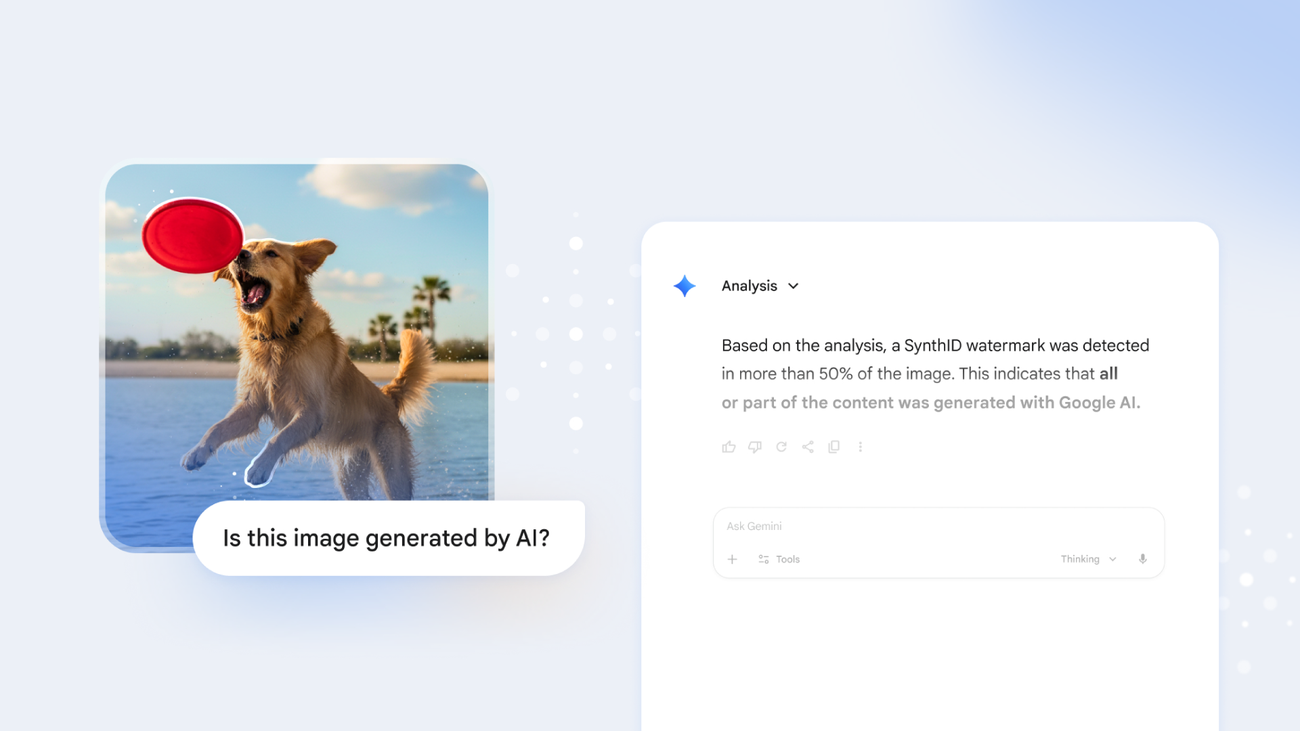
    Golden retriever catching frisbee over water. UI overlay shows Google AI watermark detected.

    At Google, we’ve long invested in ways to provide you with helpful context about information you see online. Now, as generative media becomes increasingly prevalent and high-fidelity, we are deploying tools to help you more easily determine whether the content you’re interacting with was created or edited using AI.

    Starting today, we’re making it easier for everyone to verify if an image was generated with or edited by Google AI right in the Gemini app, using SynthID, our digital watermarking technology that embeds imperceptible signals into AI-generated content.

    We introduced SynthID in 2023. Since then, over 20 billion AI-generated pieces of content have been watermarked using SynthID, and we have been testing our SynthID Detector, a verification portal, with journalists and media professionals.

    How it works

    If you see an image and want to confirm it has been made by Google AI, upload it to the Gemini app and ask a question such as: “Was this created with Google AI?” or “Is this AI-generated?”

    Gemini will check for the SynthID watermark and use its own reasoning to return a response that gives you more context about the content you encounter online.

    What’s next

    This launch builds on our history of providing context about images in Google Search and exploring new research innovations like Backstory from Google DeepMind. Looking ahead, we will continue to invest in more ways to empower you to determine the origin and history of content online. Soon, we’ll expand SynthID verification to support additional formats beyond images, such as video and audio, and bring these capabilities to more surfaces, such as Search.

    In addition to our own tools, we are collaborating with industry partners to advance content transparency and authenticity standards across our product ecosystem — including YouTube, Search, Pixel and Photos — through our role on the steering committee of the Coalition for Content Provenance and Authenticity (C2PA).

    As part of this, rolling out this week, images generated by Nano Banana Pro (Gemini 3 Pro Image) in the Gemini app, Vertex AI and Google Ads will have C2PA metadata embedded, providing further transparency into how these images were created. We look forward to expanding this capability to more products and surfaces in the coming months.

    Over time, we will also extend our verification approach to support C2PA content credentials, meaning you’ll be able to check the original source of content created by models and products that exist outside of Google’s ecosystem.

    This work is central to our commitment to bold and responsible AI. We look forward to further contributing to the future of AI transparency.

    Related stories

  • Build with Nano Banana Pro, our Gemini 3 Pro Image model

    Build with Nano Banana Pro, our Gemini 3 Pro Image model

    Here’s how developers can use Nano Banana Pro (Gemini 3 Pro Image), a powerful new image generation and editing model with advanced features and creative control.


    Alisa Fortin

    Product Manager, Google DeepMind

    Naina Raisinghani

    Product Manager, Google DeepMind


    Image with multiple input-output images with the text Build with Nano Banana Pro in the center

    Today, we’re releasing Nano Banana Pro (Gemini 3 Pro Image), a higher-fidelity model built on Gemini 3 Pro for developers to access studio-quality image generation. This follows our release of Nano Banana (Gemini 2.5 Flash Image) just a few months ago. Since then, we’ve loved seeing the community put its key features to work — from character consistency to photo restoration, and even using its capabilities to make local edits in an infinite canvas.

    This state-of-the-art image generation and editing model is starting to roll out in paid preview to build a new wave of intelligent, multimodal applications with the Gemini API in Google AI Studio and Vertex AI for enterprises. This model unlocks high-fidelity images with higher accuracy in text rendering and robust world knowledge, supercharged by the model’s ability to use grounding with Google Search to retrieve data based on the user’s prompt.

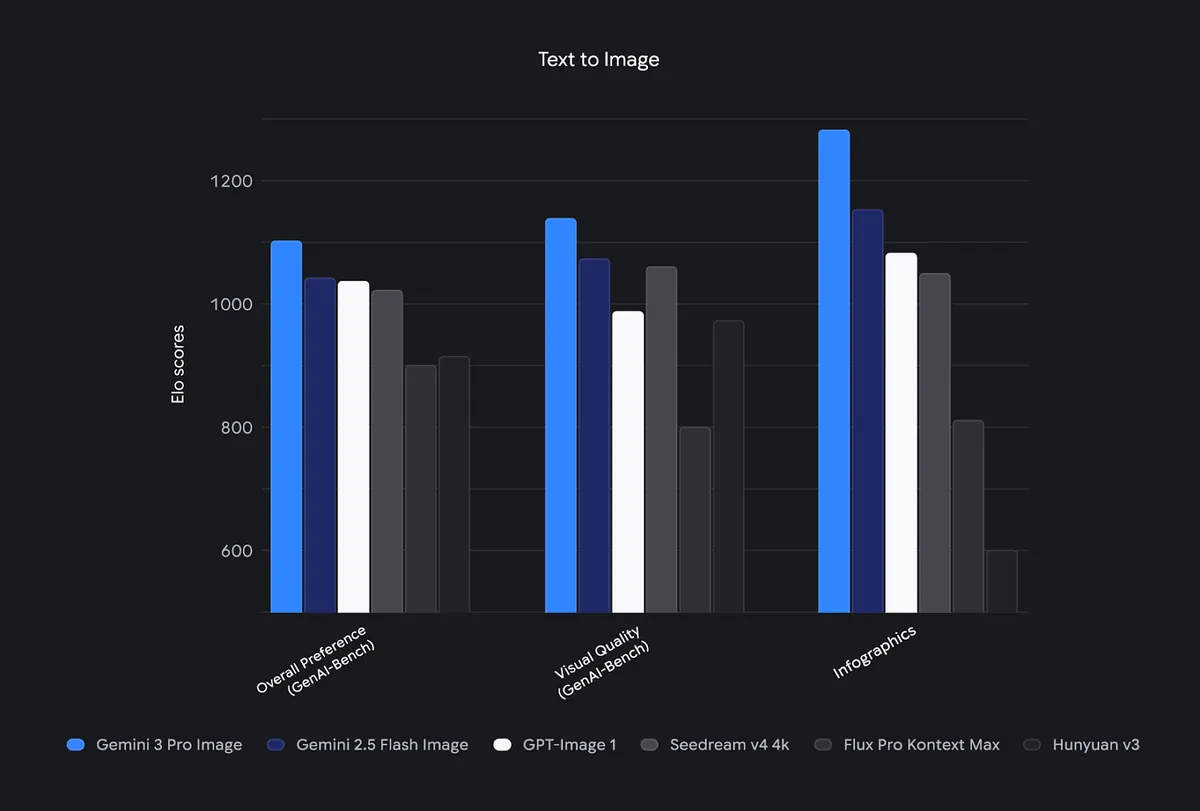
    Gemini 3 Pro Image excels on Text to Image AI benchmarks.

    Gemini 3 Pro Image Text to Image AI benchmark bar chart compared to other leading competitors

    We are also expanding the reach of Gemini 3 Pro Image across the developer ecosystem. In Google Antigravity — our new agentic development platform — coding agents can now directly leverage these image generation capabilities to generate detailed UI mockups for user review or even new visual assets before implementing in code. Additionally, leading creative platforms are integrating the model, including Adobe and Figma.

    High fidelity and controls

    If you’re building advanced tools that require precision, Gemini 3 Pro Image gives you control over the physics (lighting, camera, focus, color grading) and composition of the image to ensure professional-quality outputs.

    A silhouette lost in a sea of golden bokeh and morning mist.

    Prompt: Replace volumetric lighting with bokeh

    Image showing a side by side of an input image of the silhouette of a man with scattered sun rays and an output image where the same image with more volumetric lighting using AI

    With 2K and 4k resolution available, you can ensure outputs meet resolution standards required for professional production. Effortlessly create cohesive advertisements by combining diverse elements such as product images, logos, and references. Achieve consistent resemblance for up to five individuals, integrate six high-fidelity shots, or blend as many as fourteen standard inputs into a single, polished ad. Try our demo app that allows you to pair logos with products to create your own mockup designs.

    Demo app that brings product design to life with reference images. Sequences shortened.

    Improved text rendering and localization

    Gemini 3 Pro Image offers a significant leap forward from 2.5 Flash Image, transforming abstract image generation into functional assets. It excels in handling logic and language, and delivers state-of-the-art text rendering, producing clear, accurate text integrated in your images.

    Creative food photography where each word is artistically spelled out using the actual ingredients associated with that food.

    Prompt: Make 8 sophisticated minimalistic logos, each is a fun food word, and make letters from realistic food to express the meaning of this word. composition: a rendering of all logos on a single solid white background

    Image showing the words Mint, soup, taco, curry, sushi, pasta, apple and pizza rendered using food items with AI

    It’s also an ideal solution for developing marketing collateral, educational content and numerous other applications. Try the model’s capabilities in our comic book generator app in Google AI Studio, where you can create original multi-page comic books featuring you and a friend, complete with advanced text rendering and stylization.

    Demo app that creates a comic book in your chosen language based on photos and selected genre. Sequences shortened.

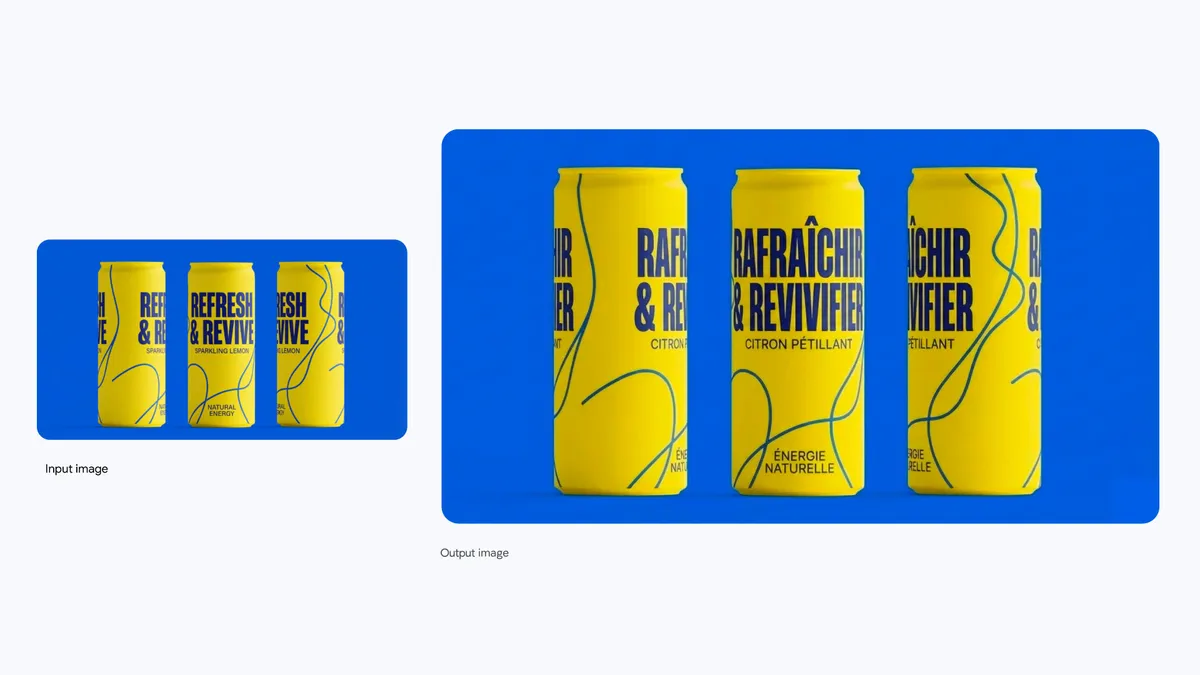
    With Gemini 3 Pro Image, we’ve removed the barrier between image generation and localization logic. This advanced model grasps the semantic context of an image, enabling effortless language changes on elements like menus, signs, or documents utilizing image-to-image generation keeping original artistic style or layout.

    A beverage campaign concept showcasing accurate translation and rendering of English text into French.

    Prompt: Translate to French

    Side by side of an input image of a set of cans with text and output image with text on can translated in French using AI

    Access to the world’s knowledge

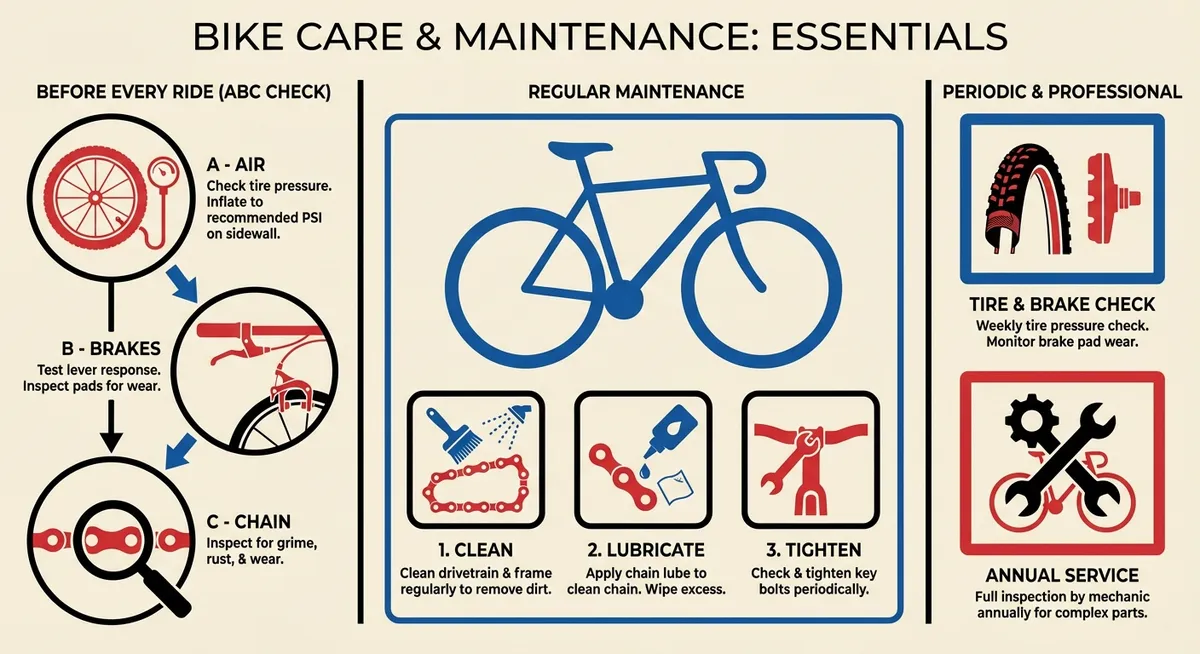
    Gemini 3 Pro Image connects a vast knowledge base to produce more factual assets over previous image generation models. Additionally, when enabled, grounding with Google Search connects the model to real-time web content for data-driven outputs. This is particularly valuable for applications requiring precise representations, such as biological diagrams or historical maps. Try this for yourself with our demo app where you can dynamically create infographics on any topic tailored to your audience.

    Bike care and maintenance infographic generated from a demo app that creates educational infographics.

    An infographic for bike care and maintenance essentials built with a simple text prompt using AI

    Go bananas and start building today

    This new model release incorporates much of the input you have already shared with us, but we aren’t stopping here. To ensure clear provenance in AI-generated media, we have integrated SynthID digital watermarks directly into every image created or edited with Gemini 3 Pro Image to denote its AI-generated or edited origin.

    Start by exploring our collection of apps that use Gemini 3 Pro Image to spark your imagination and see what’s possible. Once you’re inspired, remix these demo apps or integrate the model directly into your own projects via the Gemini API in Google AI Studio and Vertex AI for enterprise use. For technical details along the way, check out the documentation, prompt guide, cookbook or visit the developer forum to get help and share feedback.

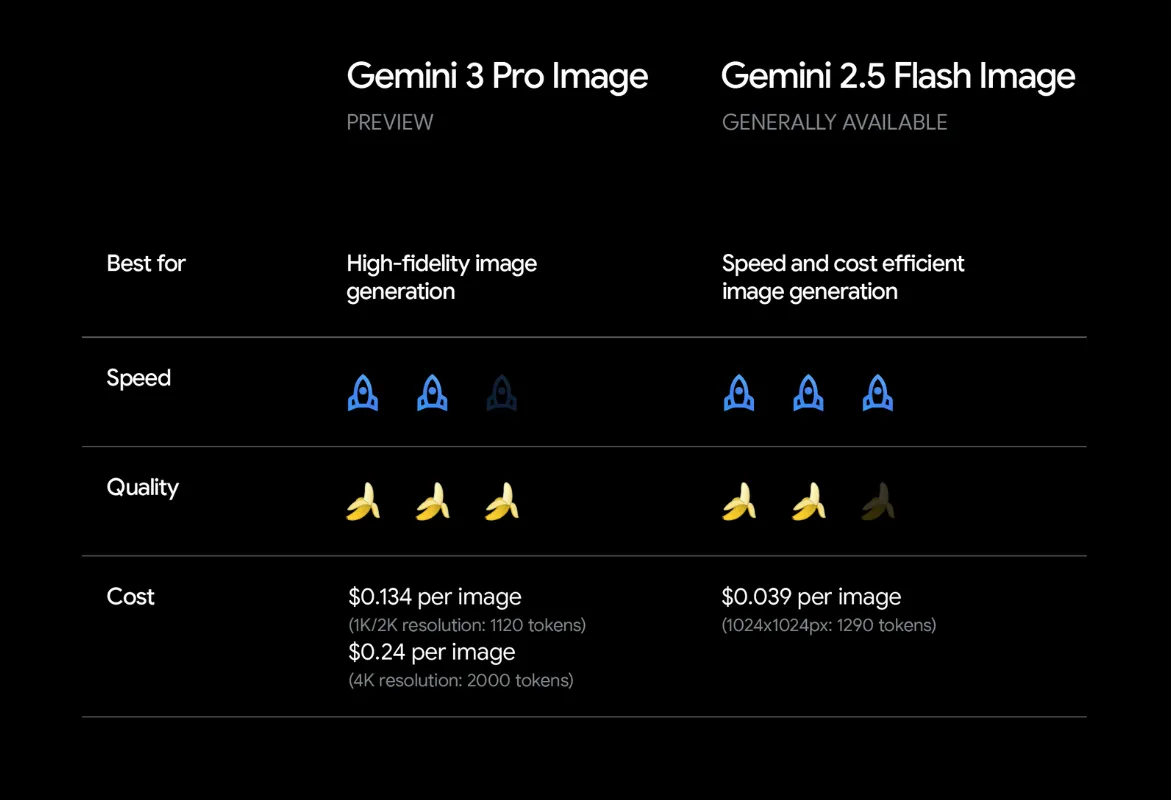
    Use Gemini 2.5 Flash Image for faster, lower cost image generation, or 3 Pro Image for higher quality image generation, with higher cost and latency.

    A table showing comparison between Gemini 2 Pro Image and Gemini 2.5 Flash Image models across speed, quality and cost