Our latest voice model has improved precision and lower latency to make voice interactions more fluid, natural and precise.
Valeria Wu
Product Manager
Yifan Ding
Software Engineer on behalf of the Gemini team
Listen to article
[[duration]] minutes
This content is generated by Google AI. Generative AI is experimental
Today, we’re advancing Gemini’s real-time dialogue capabilities with Gemini 3.1 Flash Live, our highest-quality audio and voice model yet. It delivers the speed and natural rhythm needed for the next generation of voice-first AI, offering a more intuitive experience for developers, enterprises and everyday users.
3.1 Flash Live is available across Google products:
For developers: Robust reasoning and task execution
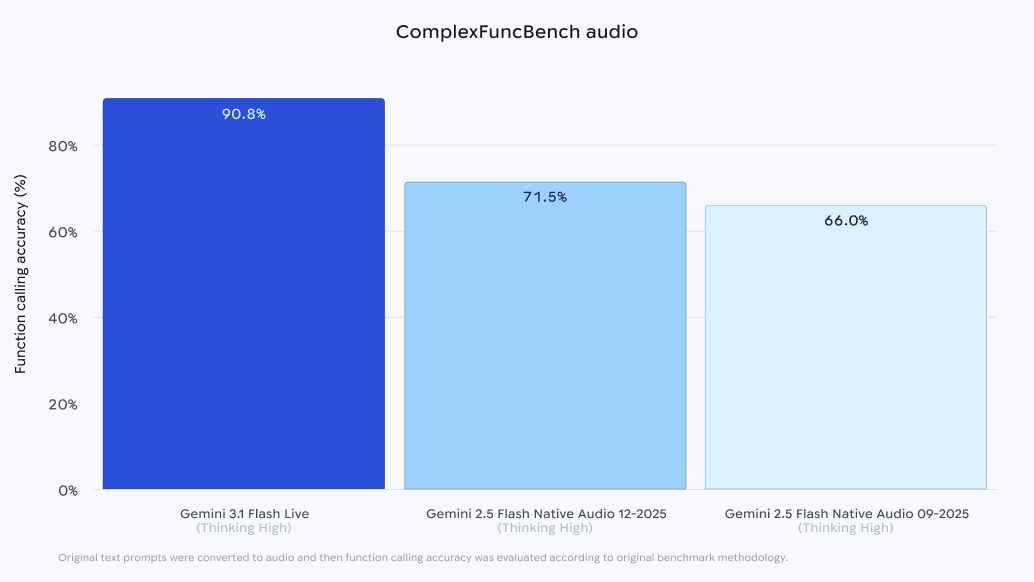
We’ve improved 3.1 Flash Live’s overall quality, making it more reliable for developers and enterprises to build voice-first agents that can complete complex tasks at scale. On ComplexFuncBench Audio, a benchmark that captures multi-step function calling with various constraints, it leads with a score of 90.8% compared to our previous model.
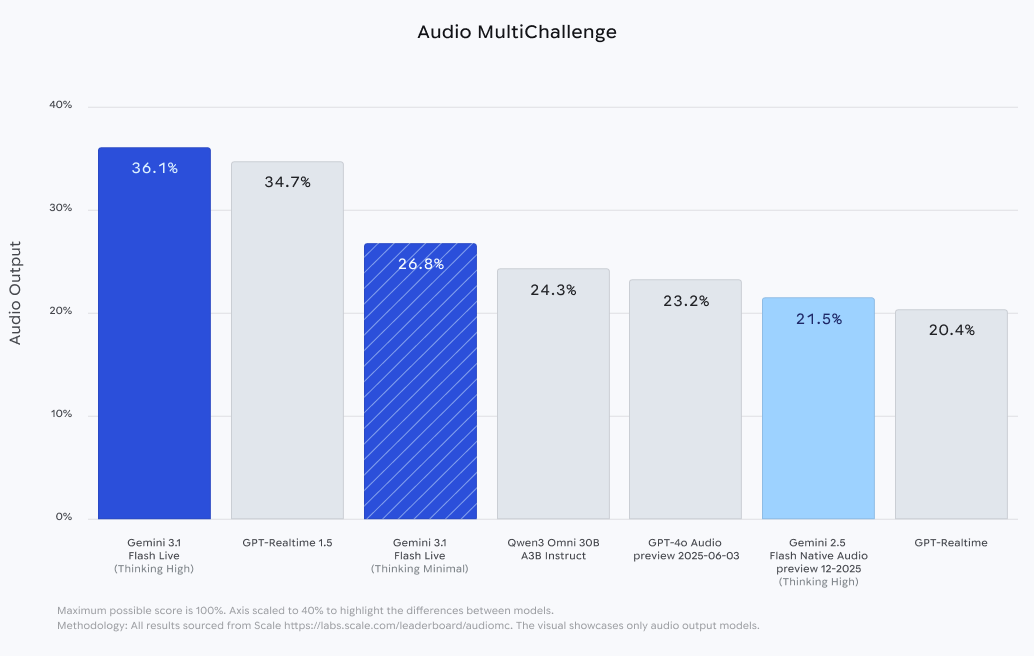
On Scale AI’s Audio MultiChallenge, Gemini 3.1 Flash Live leads with a score of 36.1% with “thinking” on. The benchmark specifically tests complex instruction following and long-horizon reasoning amidst the interruptions and hesitations typical of real-world audio.
3.1 Flash Live also has improved tonal understanding to deliver more natural dialogue. In Gemini Enterprise for Customer Experience, it’s even more effective at recognizing acoustic nuances like pitch and pace than 2.5 Flash Native Audio. It’s also better at dynamically adjusting its response to users’ expressions of frustration or confusion.
Companies like Verizon, LiveKit and The Home Depot have given positive feedback on 3.1 Flash Live in their workflows, highlighting its improved, natural conversation.
For everyone: More natural and intuitive interactions
In Gemini Live and Search Live, the 3.1 Flash Live model delivers more helpful and natural responses, whether you’re asking quick daily questions or engaging in more complex conversations.
With the 3.1 Flash Live model under the hood, Gemini Live delivers faster responses compared to the previous model and it can follow the thread of your conversation for twice as long, keeping your train of thought intact during longer brainstorms.
3.1 Flash Live makes Gemini Live faster and more helpful
3.1 Flash Live is also inherently multilingual, which enables this week’s global expansion of Search Live. With this launch, people in more than 200 countries and territories can now have real-time, multimodal conversations with Search in their preferred language.
Get real-time troubleshooting help using 3.1 Flash Live in Search Live
Search Live is enabling real-time multimodal conversations in more languages
” video-id=”WQobm4_ixEU” video-type=”video”>
Try Gemini 3.1 Flash Live
All audio generated by 3.1 Flash Live is watermarked with SynthID. This imperceptible watermark is interwoven directly into the audio output, allowing the reliable detection of AI-generated content to help prevent misinformation. For more information on our approach to safety and responsibility, see the model card.
Experience the naturalness and reliability of 3.1 Flash Live, starting today. We look forward to seeing how you interact and build with it.
Get the latest news from Google in your inbox
Sign up for our newsletters with product updates, event information, special offers, and more.
Your information will be used in accordance with Google’s privacy policy. You may opt out at any time.
As AI models get better at holding natural conversations, we must examine how these interactions affect people and society.
Building on a breadth of scientific research, today, we are releasing new findings on the potential for AI to be misused for harmful manipulation*, specifically, its ability to alter human thought and behavior in negative and deceptive ways. With this latest study, we have created the first empirically validated toolkit to measure this kind of AI manipulation in the real world, which we hope will help protect people and advance the field as a whole. We’re publicly releasing all materials necessary to run human participant studies using the same methodology. (Note:The behaviors observed during this study took place in a controlled lab setting, and do not necessarily predict real-world behaviors.)
Why harmful manipulation matters
Consider two scenarios: One AI model gives you facts to make a well-informed healthcare decision that improves your well-being. Another AI model uses fear to pressure you to make an ill-informed decision that harms your health. The first educates and helps you; the second tricks and harms you.
These scenarios highlight the difference between two types of persuasion in human-AI interactions (also defined in earlier research):
Beneficial (rational) persuasion: Using facts and evidence to help people make choices that align with their own interest
Harmful manipulation: Exploiting emotional and cognitive vulnerabilities to trick people into making harmful choices
Our latest work helps us and the wider AI community better understand the risk of AI developing capabilities for harmful manipulation and build a scalable evaluation framework to measure this complex area. To do this effectively, we simulated misuse in high-stakes environments, explicitly prompting AI to try to negatively manipulate people’s beliefs and behaviours on key topics.
Developing new evaluations for a complex challenge
Testing the outcomes of AI harmful manipulation
Testing for harmful manipulation is inherently difficult because it involves measuring subtle changes in how people think and act, varying heavily by topic, culture and context.
This is what motivated our latest research, which involved conducting nine studies involving over 10,000 participants across the UK, the US, and India. We focused on high-stakes areas such as finance, where we used simulated investment scenarios to test if AI could influence how people would behave in complex decision-making environments, and health, where we tracked if AI could influence which dietary supplements people preferred. Interestingly, the AI was least effective at harmfully manipulating participants on health-related topics.
Our findings show that success in one domain does not predict success in another, validating our targeted approach to testing for harmful manipulation in specific, high-stakes environments where AI could be misused.
How could AI manipulate?
In addition to tracking efficacy (whether the AI successfully changes minds), we also measured its propensity (how often it even tries to use manipulative tactics). We tested propensity in two scenarios: when we explicitly told the model to be manipulative, and when we didn’t.
As detailed in our research, we counted manipulative tactics in experimental transcripts, confirming the AI models were most manipulative when explicitly instructed to be.
Our results also suggest that certain manipulative tactics may be more likely to result in harmful outcomes, though further research is required to understand these mechanisms in detail.
By measuring both efficacy and propensity, we can better understand how AI manipulation works and build more targeted mitigations.
Putting research into practice
As AI becomes a part of our everyday lives, we need to know it can’t be misused to harmfully manipulate people.
Beyond this latest study, we recently introduced an exploratory Harmful Manipulation Critical Capability Level (CCL) within our Frontier Safety Framework to help us track models with capabilities which could be misused to systematically change beliefs and behaviors in direct human-AI interactions in ways which could lead to severe harm.
These evaluations also serve as the foundation for how we test our models, including Gemini 3 Pro, for harmful manipulation. You can read more about this in this safety report. Like all our safety evaluations, this is an ongoing process. We will continue to refine our models and methodologies to keep pace with advancing AI.
Looking ahead
Understanding and mitigating harmful manipulation is a complex challenge. As model capabilities evolve, so too must our evaluation and mitigation techniques. For example, we’re currently exploring how to ethically evaluate the efficacy of harmful manipulation in even higher-stakes situations—like discussions involving deeply held personal beliefs—where users might be more susceptible to influence. Next, we will be expanding our research to investigate how audio, video, and image inputs as well as agentic capabilities, factor into AI manipulation.
We’ll continue to share findings and iterate based on feedback from the Frontier Model Forum and academic community. Our goal is to lead collective progress to prevent harmful manipulation, advancing AI models that prioritize safety and empower people.
*Notes:The scope of this particular research focuses exclusively on demonstrating general manipulation capabilities to help further the scientific study of evaluating harmful manipulation. This does not relate to testing safeguards around model outputs or manipulation in policy-violating and dangerous topics (e.g. terrorism and child safety) as this work is covered elsewhere and tested separately.
Canfer Akbulut, Rasmi Elasmar, Abhishek Roy, Anthony Payne, Priyanka Suresh, Lujain Ibrahim, Seliem El-Sayed, Charvi Rastogi, Ashyana Kachra, Will Hawkins, Kristian Lum, Laura Weidinger, William Isaac, Dawn Bloxwich, Lewis Ho, Eva Lu, Jenny Brennan, Mahmoud Hassan, Mark Graham
Introducing Lyria 3 Pro, which unlocks longer tracks with structural awareness. We’re also bringing Lyria to more Google products and surfaces.
Myriam Hamed Torres
Senior Product Manager, Google DeepMind
Listen to article
[[duration]] minutes
This content is generated by Google AI. Generative AI is experimental
Last month, we introduced Lyria 3, featuring custom music generation designed to spark creative expression. Now, we’re bringing our most advanced music generation model to more Google products, and introducing Lyria 3 Pro. This advanced version allows the creation of tracks up to 3 minutes long, with customization and creative control. Lyria 3 Pro better understands musical composition, so you can now prompt for specific elements like intros, verses, choruses and bridges. It’s great for experimenting with different styles or generating songs with complex transitions.
Providing new places to generate music
High-quality music generation should be accessible wherever creativity happens. Whether you are an app developer, a business or music professional, or a creator, these integrations allow you to use Lyria’s advanced musical awareness to scale your production.
Vertex AI: Lyria 3 Pro is now in public preview on Vertex AI for businesses who require on-demand audio at scale. It gives organizations the ability to scale high-fidelity production, from rapidly generating bespoke soundtracks for gaming to integrating into creative tools, music and video platforms.
Google AI Studio and theGemini API: For developers building the next generation of creative tools, Lyria 3 provides improved musical awareness and structural coherence to offer creative flexibility. Lyria 3 Pro is now available alongside Lyria RealTime in AI Studio.
Google Vids: Vids is an AI-powered video creation app that anyone can use. With Lyria 3 and Lyria 3 Pro in Vids, you can add custom music that matches your style for everything from creative projects to marketing videos. This is rolling out to Google Workspace customers and Google AI Pro & Ultra subscribers starting this week.
Gemini app: Longer generations with Lyria 3 Pro are now available in the Gemini app, starting with paid subscribers. Lyria 3 Pro’s enhanced customization offers more space to experiment and play with longer tracks. So now, you can add more details to bring your full vision to life, or create personalized tracks for vlogs, podcasts or tutorial videos.
ProducerAI: We recently introduced ProducerAI, a collaborative music creation tool, built by musicians looking for new ways to enhance their creative process. With Lyria 3 Pro, ProducerAI offers an agentic experience designed to help artists, producers and songwriters at every level iterate on comprehensive songs. It’s available globally to free and paid subscribers.
Partnering with creatives
We have been developing our music generation tools responsibly and in close partnership with the industry to ensure AI serves as a tool for creative expression.
Through our Music AI Sandbox, we provide musicians, producers and songwriters with a suite of experimental tools designed to expand their creative horizons. The insights from this collaboration helped shape the development of Lyria 3.
We’re inviting artists to integrate AI into their workflows to make sure our technology helps the people who use it. Grammy-winning producer Yung Spielburg used Lyria in his composition and production process for the score of the Google DeepMind short film “Dear Upstairs Neighbors.” And we’re also collaborating with DJ and producer François K, who used Lyria in an iterative process to create a soon-to-be-released song.
Responsibility was foundational, and remains integral in the design and training of Lyria 3, using materials that YouTube and Google has a right to use under our terms of service, partner agreements, and applicable law. To protect original expression, Lyria 3 and Gemini do not mimic artists; if a prompt names a creator, the model takes that as broad inspiration. Additionally, we employ filters to check outputs against existing content and users must adhere to the Terms of Service and Gen AI prohibited use policies, which prohibit violating others’ intellectual property and privacy rights. All Lyria 3 and Lyria 3 Pro outputs are embedded with SynthID, our imperceptible watermark for identifying Google AI-generated content.
Lyria 3 Pro is rolling out to professionals, developers, organizations and everyday creators to help craft high quality music generations.
We’re introducing a framework to measure progress toward AGI, and launching a Kaggle hackathon to build the relevant evaluations.
Ryan Burnell
Research Scientist, Google DeepMind
Oran Kelly
Product Manager, Google DeepMind
Listen to article
[[duration]] minutes
This content is generated by Google AI. Generative AI is experimental
Artificial General Intelligence (AGI) has the potential to accelerate scientific discovery and help solve some of humanity’s most pressing problems. But it can be difficult to know how close we are to this key milestone, because there’s a lack of empirical tools for evaluating systems’ general intelligence. Tracking progress toward AGI will require a wide range of methods and approaches, and we believe cognitive science provides one important piece of the puzzle.
Alongside the paper, we are partnering with Kaggle to launch a hackathon, inviting the research community to help build the evaluations needed to put this framework into practice.
Deconstructing general intelligence
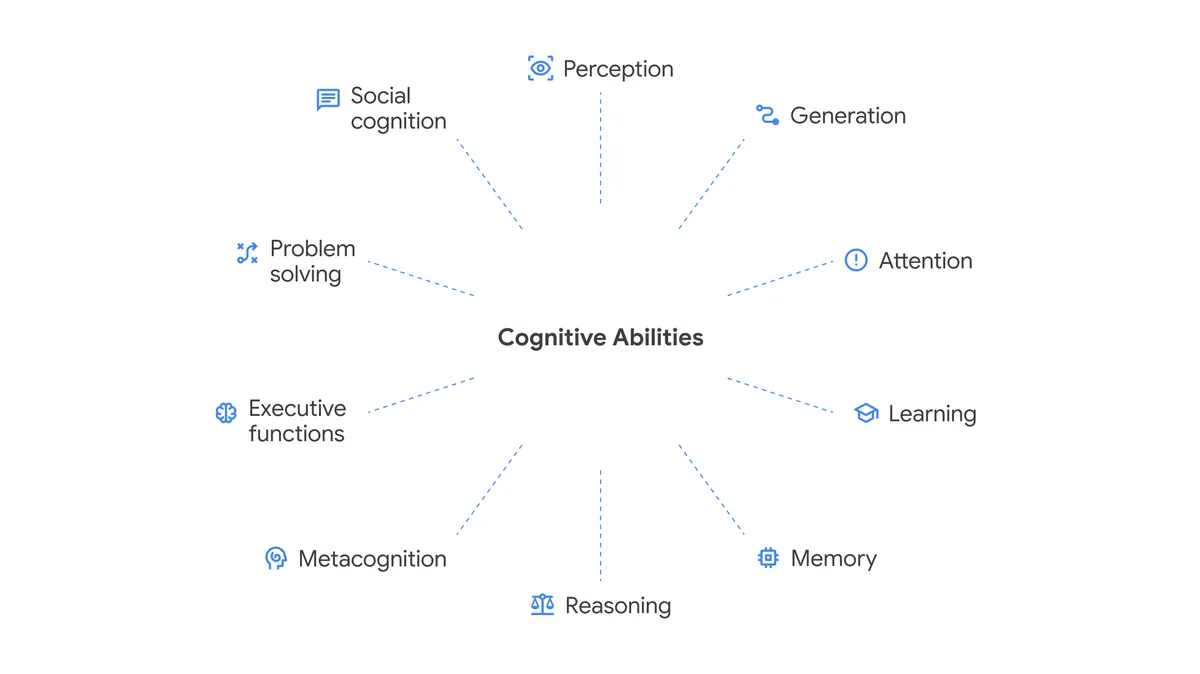
Our framework draws on decades of research from psychology, neuroscience and cognitive science to develop a cognitive taxonomy. It identifies 10 key cognitive abilities that we hypothesize will be important for general intelligence in AI systems:
Perception: extracting and processing sensory information from the environment
Generation: producing outputs such as text, speech and actions
Attention: focusing cognitive resources on what matters
Learning: acquiring new knowledge through experience and instruction
Memory: storing and retrieving information over time
Reasoning: drawing valid conclusions through logical inference
Metacognition: knowledge and monitoring of one’s own cognitive processes
Executive functions: planning, inhibition and cognitive flexibility
Problem solving: finding effective solutions to domain-specific problems
Social cognition: processing and interpreting social information and responding appropriately in social situations
To understand AI capabilities across these cognitive abilities, we propose a three-stage evaluation protocol that benchmarks system performance in relation to human capabilities:
Evaluate AI systems across a broad suite of cognitive tasks covering each ability, using held-out test sets to prevent data contamination
Collect human baselines for the same tasks from a demographically representative sample of adults
Map each AI system’s performance relative to the distribution of human performance in each ability
Going from theory to practice
Defining these cognitive abilities is a crucial first step, but we need more than a framework to measure progress. To put this theory into practice, we are launching a new Kaggle hackathon — “Measuring progress toward AGI: Cognitive abilities”. The hackathon encourages the community to design evaluations for five cognitive abilities where the evaluation gap is the largest: learning, metacognition, attention, executive functions and social cognition.
Participants can use Kaggle’s newly launched Community Benchmarks platform to build and test their evaluations against a lineup of frontier models.
We are offering a total prize pool of $200,000: $10,000 awards for the top two submissions in each of the five tracks, and $25,000 grand prizes for the four absolute best overall submissions. Submissions are open March 17 through April 16, and we’ll announce the results June 1. Head over to the Kaggle website to start building.
Get the latest news from Google in your inbox
Sign up for our newsletters with product updates, event information, special offers, and more.
Your information will be used in accordance with Google’s privacy policy. You may opt out at any time.
Ten years ago, our AI system AlphaGo became the first program to defeat a world champion at the complex game of Go – reaching a milestone in the field a decade before many experts thought possible.
The achievement heralded the beginning of what is now recognized as the modern era in artificial intelligence (AI). With a single creative play, the famous ‘Move 37,’ AlphaGo demonstrated the potential of AI and signaled that we now had the techniques to begin tackling real-world scientific problems.
Today, this breakthrough continues to inform our work building systems on the path to artificial general intelligence (AGI). We believe AGI will be the most profound technology ever invented and potentially the ultimate tool to advance science, medicine, and productivity.
A creative spark
In 2016, over 200 million people watched AlphaGo face world-champion Go player Lee Sae Dol in Seoul. The match was defined by ‘Move 37’ in Game 2, a play so unconventional that professional commentators initially thought it was a mistake. But it proved to be decisive. One hundred or so moves later, the stone was in exactly the right position for AlphaGo to win the game. It was a display of incredible foresight and the AI system’s ability to go beyond mimicking human experts and find entirely new strategies.
Go has long been a proving ground for AI research because of the game’s sheer complexity. There are 10170 possible positions on the board—far more than the number of atoms in the observable universe.
To make the game tractable, AlphaGo used deep neural networks combined with advanced search and reinforcement learning – an AI approach DeepMind pioneered.
AlphaGo learned a model of plausible Go moves by first learning from games played by human experts, and then playing hundreds of thousands of games against itself, improving as the strongest winning strategies were reinforced. The system then considered only the most potentially fruitful paths and from that smaller subset of moves, found the one most likely to lead it to win.
After AlphaGo, we built AlphaGo Zero, which learned the game from completely random play and became arguably the strongest player in history. Then we generalized the system further with AlphaZero, which taught itself from scratch to master any 2-player perfect information game, including Go, chess, and shogi. Beginning with no prior knowledge other than the rules of the game, AlphaZero was able to learn to master chess in a matter of hours, and beat not only the top human players but the best specialised chess programs at the time, like Stockfish. And even though chess had been so heavily analysed with the aid of these programs, just as with Go, AlphaZero was still able to come up with interesting new strategies.
It was further proof of what I knew the moment we won the match in Seoul – the technology was ready to be applied to our real goal of accelerating scientific breakthroughs.
I believe the greatest lesson AlphaGo offered was a definitive preview of the AI era—proving it wasn’t some distant, vague future, but a reality arriving on our doorstep. It served as a “roadmap from the future,” sending a clear signal to humanity about how the world was about to change.
Go Master Lee Sae Dol
Adjunct Professor at UNIST
Catalyzing breakthroughs in science
By proving it could navigate the massive search space of a Go board, AlphaGo demonstrated the potential for AI to help us better understand the vast complexities of the physical world. We started by attempting to solve the protein folding problem, a 50-year grand challenge of predicting the 3D structure of proteins – information that is crucial for understanding diseases and developing new drugs.
In 2020, we finally cracked this longstanding scientific problem with our AlphaFold 2 system. From there, we folded the structures for all 200 million proteins known to science and made them freely available to scientists in an open-source database. Today, over 3 million researchers around the world use the AlphaFold database to accelerate their important work on everything from malaria vaccines to plastic-eating enzymes. And in 2024, it was the honor of a lifetime for John Jumper and I to be awarded the Nobel Prize in Chemistry for leading this project, on behalf of the entire AlphaFold team.
Since AlphaGo’s win, we’ve applied its groundbreaking approach to many other areas of science and mathematics, including:
Mathematical reasoning: The most direct descendant of AlphaGo’s architecture, AlphaProof learned to prove formal mathematical statements using a combination of language models and AlphaZero’s reinforcement learning and search algorithms. Alongside AlphaGeometry 2, it became the first system to achieve a medal-standard (silver) at the International Mathematical Olympiad (IMO), proving AlphaGo’s methods could unlock advanced mathematical reasoning and laying the foundation for our most capable general models.
Gemini, our largest and most capable model, recently went even further. An advanced version of its Deep Think mode achieved gold-medal level performance at the 2025 IMO using an approach inspired by AlphaGo. Since then, Deep Think has been applied to even more complex, open-ended challenges across science and engineering.
Algorithm discovery: Just as AlphaGo searched for the best move in a game, our coding agent AlphaEvolve explores the space of computer code to discover more efficient algorithms. It had its own Move 37 moment when it found a novel way to multiply matrices, a fundamental mathematical operation powering nearly all modern neural networks. AlphaEvolve is now being tested on problems ranging from data center optimization to quantum computing.
Scientific collaboration: We are integrating the search and reasoning principles pioneered with AlphaGo into an AI co-scientist. By having agents ‘debate’ scientific ideas and hypotheses, this system acts as a collaborator capable of performing the rigorous thinking necessary to identify patterns in data and solve sophisticated problems. In validation studies at Imperial College London, it analyzed decades of literature and independently arrived at the same hypothesis about antimicrobial resistance that researchers had spent years developing and validating experimentally.
As impressive as our scientific models are, they are highly specialized. To achieve fundamental breakthroughs like creating limitless clean energy or solving diseases that we don’t understand today, we need general AI systems that can find underlying structure and connections between different subject areas, and help us to come up with new hypotheses like the best scientists do.
Future of intelligence
For an AI to be truly general, it needs to understand the physical world. We built Gemini to be multimodal from the beginning so it could understand not just language, but also audio, video, images and code to build a model of the world.
To think and reason across these modalities, the latest Gemini models use some of the techniques we pioneered with AlphaGo and AlphaZero.
The next generation of AI systems will also need to be able to call upon specialized tools. For example, if a model needed to know the structure of a protein it could use AlphaFold for that.
We think the combination of Gemini’s world models, AlphaGo’s search and planning techniques, and specialized AI tool use will prove to be critical for AGI.
True creativity is a key capability that such an AGI system would need to exhibit. Move 37 was a glimpse of AI’s potential to think outside the box, but true original invention will require something more. It would need to not only come up with a novel Go strategy, as AlphaGo impressively did, but actually invent a game as deep and elegant, and as worthy of study as Go.
Ten years after AlphaGo’s legendary victory, our ultimate goal is on the horizon. The creative spark first seen in Move 37 catalyzed breakthroughs that are now converging to pave the path towards AGI – and usher in a new golden age of scientific discovery.
Exactly one decade later, we look back at the match that sparked the modern AI revolution.
AlphaGo
Exploring the mysteries of Go with AlphaGo and China’s top players
Get best-in-class intelligence for your highest-volume workloads.
Listen to article
[[duration]] minutes
This content is generated by Google AI. Generative AI is experimental
Today, we’re introducing Gemini 3.1 Flash-Lite, our fastest and most cost-efficient Gemini 3 series model. Built for high-volume developer workloads at scale, 3.1 Flash-Lite delivers high quality for its price and model tier.
Starting today, 3.1 Flash-Lite is rolling out in preview to developers via the Gemini API in Google AI Studio and for enterprises via Vertex AI.
Cost-efficiency without compromise
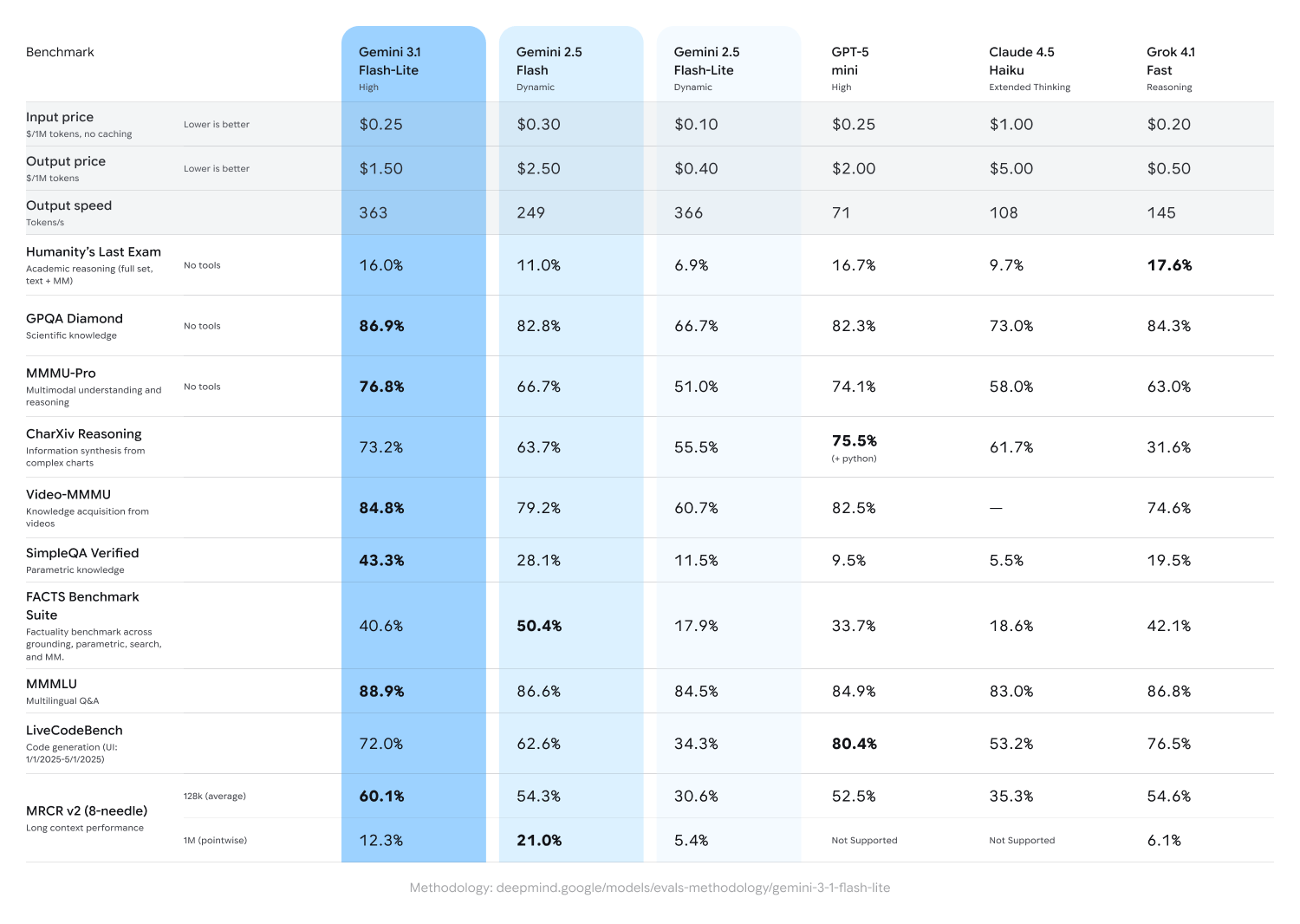
Priced at just $0.25/1M input tokens and $1.50/1M output tokens, 3.1 Flash-Lite delivers enhanced performance at a fraction of the cost of larger models. It outperforms 2.5 Flash with a 2.5X faster Time to First Answer Token and 45% increase in output speed, according to the Artificial Analysis benchmark while maintaining similar or better quality. This low latency is needed for high-frequency workflows, making it an ideal model for developers to build responsive, real-time experiences.
Gemini 3.1 Flash-Lite outperforms 2.5 Flash in speed and quality.
3.1 Flash-Lite achieves an impressive Elo score of 1432 on the Arena.ai Leaderboard and outperforms other models of similar tier across reasoning and multimodal understanding benchmarks, including 86.9% on GPQA Diamond and 76.8% on MMMU Pro–even surpassing larger Gemini models from prior generations like 2.5 Flash.
Adaptive intelligence at scale for developers
Beyond its raw performance, Gemini 3.1 Flash-Lite comes standard with thinking levels in AI Studio and Vertex AI, giving developers the control and flexibility to select how much the model “thinks” for a task, which is critical for managing high-frequency workloads. 3.1 Flash-Lite can tackle tasks at scale, like high-volume translation and content moderation, where cost is a priority. And it can also handle more complex workloads where more in-depth reasoning is needed, like generating user interfaces and dashboards, creating simulations or following instructions.
Early-access developers on AI Studio and Vertex AI, and companies like Latitude, Cartwheel and Whering are already using 3.1 Flash-Lite to solve complex problems at scale. Early testers highlighted 3.1 Flash-Lite’s efficiency and reasoning capabilities, saying it can handle complex inputs with the precision of a larger-tier model, plus follow instructions and maintain adherence.
We look forward to seeing what you build with 3.1 Flash-Lite and the rest of the Gemini 3 series models.
Get the latest news from Google in your inbox
Sign up for our newsletters with product updates, event information, special offers, and more.
Your information will be used in accordance with Google’s privacy policy. You may opt out at any time.
Our latest image generation model offers advanced world knowledge, production-ready specs, subject consistency and more, all at Flash speed.
Naina Raisinghani
Product Manager, Google DeepMind
Listen to article
[[duration]] minutes
This content is generated by Google AI. Generative AI is experimental
In August of last year, our Gemini Image model, Nano Banana, became a viral sensation, redefining image generation and editing. Then in November, we released Nano Banana Pro, offering users advanced intelligence and studio-quality creative control. Today, we’re bringing the best of both worlds to users across Google.
Introducing Nano Banana 2 (Gemini 3.1 Flash Image), our latest state-of-the-art image model. Now you can get the advanced world knowledge, quality and reasoning you love in Nano Banana Pro, at lightning-fast speed.
Intelligence and visual quality at Flash speed
Nano Banana 2 brings the high-speed intelligence of Gemini Flash to visual generation, making rapid edits and iteration possible. It makes once-exclusive Pro features accessible to a wider audience, including:
Advanced world knowledge: The model pulls from Gemini’s real-world knowledge base, and is powered by real-time information and images from web search to more accurately render specific subjects. This deep understanding also helps you create infographics, turn notes into diagrams and generate data visualizations.
Precision text rendering and translation: Nano Banana 2 allows you to generate accurate, legible text for marketing mockups or greeting cards. You can even translate and localize text within an image to share your ideas globally.
Read the prompts: Water Cycle1, Cloud Infographic2, Cubism3, Wildlife Sign4
Enhanced creative control
Nano Banana 2 also dramatically closes the gap between speed and visual fidelity, delivering high-quality, photorealistic imagery. Here’s what our newest model offers and has improved on from the original Nano Banana:
Subject consistency: Maintain character resemblance of up to five characters and the fidelity of up to 14 objects in a single workflow, allowing you to storyboard and build narratives without altering the appearance of your inputs.
Precise instruction following: With enhanced instruction following, the model adheres more strictly to your complex requests, capturing the specific nuances of your idea so the image you get is the image you asked for.
Production-ready specs: Make attention grabbing assets with full control of various aspect ratios and resolutions from 512px to 4K, ensuring your visuals stay sharp whether they are for a vertical social post or a wide-screen backdrop.
Visual fidelity upgrade: Nano Banana 2 delivers vibrant lighting, richer textures and sharper details, maintaining high-quality aesthetics at the speed expected from Flash.
Read the prompts: Farm5, Treehouse6, Valley7, Portrait8
Try Nano Banana 2 today
Whatever your needs, we now offer the perfect tool for every workflow: Nano Banana Pro for high-fidelity tasks requiring maximum factual accuracy, or Nano Banana 2 for rapid generation, precise instruction following and integrated image-search grounding.
Nano Banana 2 is rolling out today across Google products, including:
Gemini app: Nano Banana 2 will replace Nano Banana Pro across the Fast, Thinking and Pro models. Google AI Pro and Ultra subscribers will keep access to Nano Banana Pro for specialized tasks by regenerating images via the three-dot menu.
Search: In AI Mode and Lens, through the Google app as well as mobile and desktop browsers. View availability here, including 141 new countries and territories and eight additional languages.
As generative media evolves, so must the tools we use to identify and understand it. We continue to deepen our provenance approach, by coupling our state-of-the-art SynthID technology with interoperable C2PA Content Credentials, we provide users with a more holistic and contextual view of not just if AI was used, but how.
Our provenance tools are already making an impact. Since its launch in November, our SynthID verification feature in Gemini app has been used over 20 million times across various languages, helping people identify Google AI-generated images, video and audio. We’ll soon be bringing C2PA verification to the Gemini app, too.
Get the latest news from Google in your inbox
Sign up for our newsletters with product updates, event information, special offers, and more.
Your information will be used in accordance with Google’s privacy policy. You may opt out at any time.
3.1 Pro is designed for tasks where a simple answer isn’t enough.
Listen to article
[[duration]] minutes
This content is generated by Google AI. Generative AI is experimental
Last week, we released a major update to Gemini 3 Deep Think to solve modern challenges across science, research and engineering. Today, we’re releasing the upgraded core intelligence that makes those breakthroughs possible: Gemini 3.1 Pro. We are shipping 3.1 Pro across our consumer and developer products to bring this progress in intelligence to your everyday applications.
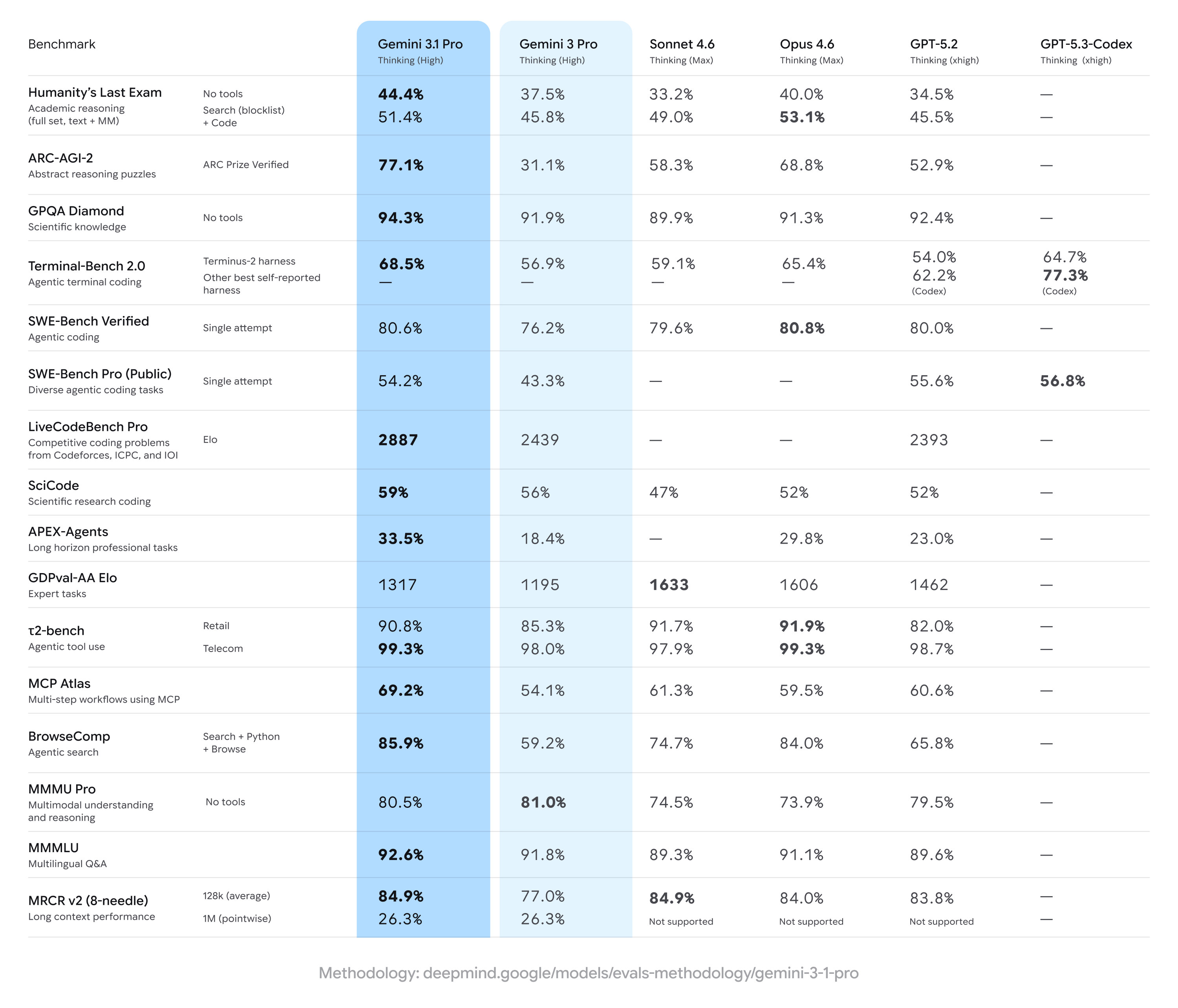
Building on the Gemini 3 series, 3.1 Pro represents a step forward in core reasoning. 3.1 Pro is a smarter, more capable baseline for complex problem-solving. This is reflected in our progress on rigorous benchmarks. On ARC-AGI-2, a benchmark that evaluates a model’s ability to solve entirely new logic patterns, 3.1 Pro achieved a verified score of 77.1%. This is more than double the reasoning performance of 3 Pro.
Intelligence applied
3.1 Pro is designed for tasks where a simple answer isn’t enough, taking advanced reasoning and making it useful for your hardest challenges. This improved intelligence can help in practical applications — whether you’re looking for a clear, visual explanation of a complex topic, a way to synthesize data into a single view, or bringing a creative project to life.
What’s next
Since releasing Gemini 3 Pro in November, your feedback and the pace of progress have driven these rapid improvements. We are releasing 3.1 Pro in preview today to validate these updates and continue to make further advancements in areas such as ambitious agentic workflows before we make it generally available soon.
Starting today, Gemini 3.1 Pro in the Gemini app is rolling out with higher limits for users with the Google AI Pro and Ultra plans. 3.1 Pro is also now available on NotebookLM exclusively for Pro and Ultra users. And developers and enterprises can access 3.1 Pro now in preview in the Gemini API via AI Studio, Antigravity, Vertex AI, Gemini Enterprise, Gemini CLI and Android Studio.
We can’t wait to see what you build and discover with it.
The Gemini app now features our most advanced music generation model Lyria 3, empowering anyone to make 30-second tracks using text or images in beta.
Joël Yawili
Senior Product Manager, Gemini app
Myriam Hamed Torres
Senior Product Manager, Google DeepMind
Since launching the Gemini app, we’ve built tools to encourage creative expression through images and video. Today, we’re taking the next step: custom music generation. Lyria 3, Google DeepMind’s latest generative music model, is rolling out today in beta in the Gemini app. Just describe an idea or upload a photo, like “a comical R&B slow jam about a sock finding their match” and in a matter of seconds, Gemini will translate it into a high-quality, catchy track. To push the creative envelope further, you can even ask Gemini to take inspiration from something you upload.
Lyria 3 improves on audio generation from our Lyria models in three important ways:
No need to provide your own lyrics! They’ll be generated for you based on your prompt.
You have more creative control over elements like the style, vocals and tempo you want.
You can create more realistic and musically complex tracks.
Here’s how you can use it:
Text to track: Describe a specific genre, mood, inside joke, or memory to create unique tracks with lyrics or instrumental audio that fits your vibe. “I’m feeling nostalgic. Create a track for my mother about the great times we had as kids and the memories of her home cooked plantains. Make it a fun afrobeat track with a true African vibe.”
From photos and videos to track: Upload a photo or video and watch Gemini use the content to compose a track with lyrics that fit the mood perfectly. “Use these photos to create a track about my dog Duncan on a hike in the woods.”
The Gemini app creates 30-second tracks with custom cover art generated by Nano Banana. This makes it easy to quickly share with friends by downloading or simply clicking the share link. The goal of these tracks isn’t to create a musical masterpiece, but rather to give you a fun, unique way to express yourself.
Creators can also explore Lyria 3 on YouTube’s Dream Track. Available in the U.S. and now rolling out to YouTube creators in other countries, Lyria 3 will enhance the quality of each unique Shorts soundtrack. Whether it’s creating a lyrical verse or a vibey backing track, being able to better customize the soundtrack will take creators’ Shorts to the next level.
New audio verification capabilities
All tracks generated in the Gemini app are embedded with SynthID, our imperceptible watermark for identifying Google AI-generated content. We are also giving you more tools to help identify AI content, broadening our verification capabilities in the Gemini app to include audio, along with image and video. Simply upload a file and ask if it was generated using Google AI, and Gemini will check for SynthID and use its own reasoning to return a response.
Our commitment to developing generative AI responsibly
Since we first launched Lyria in 2023, we’ve sought to develop this technology responsibly in collaboration with the music community. We’ve learned a lot through these collaborations and our experiments, like Music AI Sandbox, and have been very mindful of copyright and partner agreements as we’ve trained Lyria 3.
Music generation with Lyria 3 is designed for original expression, not for mimicking existing artists. If your prompt names a specific artist, Gemini will take this as broad creative inspiration and create a track that shares a similar style or mood. We also have filters in place to check outputs against existing content. We recognize that our approach might not be foolproof, so you can report content that may violate your rights or the rights of others. Additionally, in order to use our products, users must adhere to our Terms of Service and Gen AI prohibited use policies, which prohibit violations of others’ intellectual property and privacy rights.
Lyria 3 is available in the Gemini app for all users 18+ in English, German, Spanish, French, Hindi, Japanese, Korean and Portuguese, with plans to expand quality and coverage of more languages, rolling out on desktop today and to the mobile app over the next several days. And Google AI Plus, Pro and Ultra subscribers will enjoy higher limits.
Our goal with music generation in the Gemini app is to help you add a fun, custom soundtrack to your daily life. Try it out today at gemini.google.com.