SPONSOR CONTENT FROM SAMSARA
SPONSOR CONTENT FROM SAMSARA

November 5, 2026

By Sanjit Biswas
While much of the conversation around AI has focused on the future of knowledge work, the technology is quietly transforming the physical world, too. We’re now seeing industries that make up the infrastructure of our planet—construction, utilities, waste management, and field services—use AI to improve the daily experiences of the millions of frontline workers who keep the economy running.
These are industries and jobs that are asset-heavy and labor-intensive and cannot be replaced by software. Keeping these operations running is expensive: in an analysis of our 10 largest publicly traded customers, nearly 80% of revenue went toward their operating costs, including labor, vehicles, equipment, maintenance, and fuel. Using AI to reduce those costs by just a few percentage points can save those businesses hundreds of millions of dollars.
For decades, physical operations have used technology to manage costs and complexity, often through point solutions like field service scheduling, routing, and maintenance software. But when data is scattered across disconnected systems and dependent on manual entry, it is difficult for decision makers to see, understand, and act on what is happening across an operation.
Cameras, equipment sensors, and connected platforms can now bring this operational data together. AI can analyze it and take action, resulting in practical and significant changes to how operations run each day.
Like other executives of large-scale businesses, those running physical operations make technology decisions with a close eye on return on investment (ROI). The savings are clear and measurable. An IDC study recently commissioned by Samsara found that our customers achieved an eightfold ROI through better equipment utilization and maintenance, fuel savings, and lower accident costs. AI can build on those gains by helping teams turn their data into smarter decisions about where to focus their time, equipment, and budget.
Here’s what that looks like in practice.
Putting Equipment to Better Use
Think about maintenance, which accounts for about 10% of an organization’s operating budget. Bonnie Plants, the nation’s largest herb and vegetable plant producer, uses AI to process maintenance invoices 10 times faster, freeing staff to focus on repairs.
But what if teams could also understand what actually needs service? Two pieces of equipment might follow the same maintenance schedule even though one runs every day and the other is rarely used. By analyzing engine hours, usage, and diagnostic data, AI can help teams determine what needs attention now and what can safely wait. That means maintenance time and budget can go where they’ll make the biggest difference.
The same thinking applies to getting equipment where it needs to go. Consider a generator that sits unused for months and then becomes essential when a hurricane strikes. The City of St. Petersburg, Fla., uses asset tracking to find generators and other equipment in seconds rather than days. With that visibility, AI could help teams identify an available generator, assess where it’s needed most, and coordinate getting it there.
Making Faster, Smarter Decisions in the Field
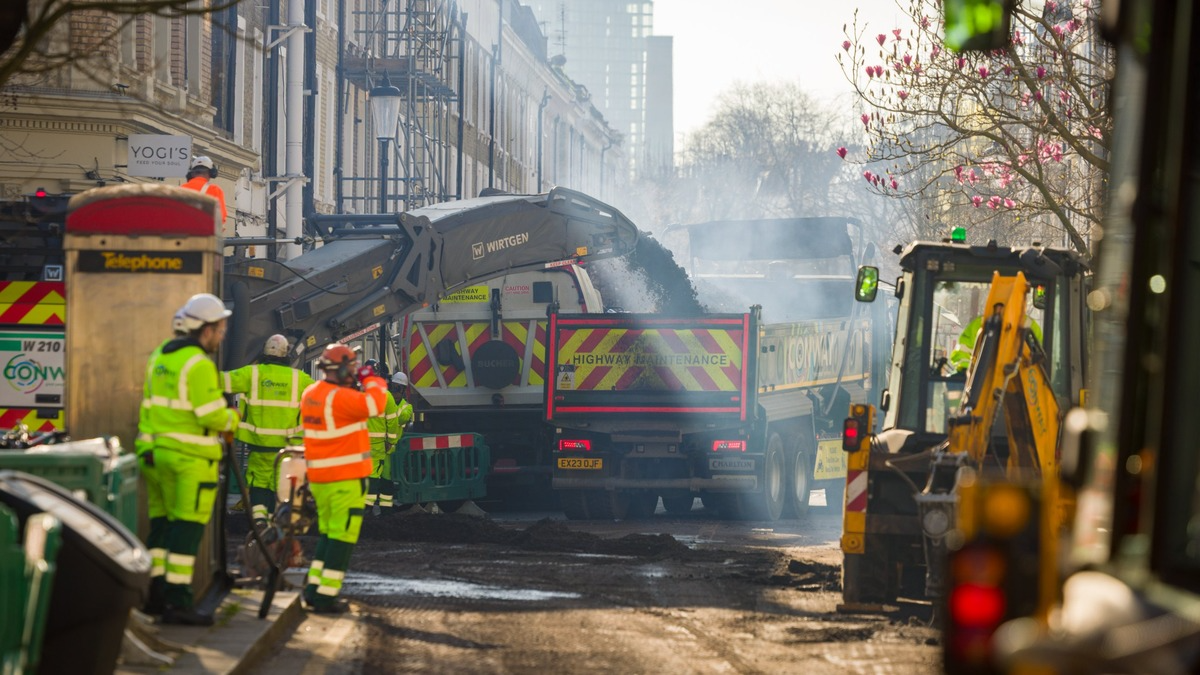
Thirty-nine percent of major U.S. roads are in poor or mediocre condition. For repair crews, the challenge is knowing where to start. The Road Commission of Kalamazoo County, Mich., uses AI to identify pavement defects across more than 1,200 miles of streets. Video, precise locations, and severity ratings help crews prioritize repairs and group nearby jobs, so they spend less time searching for potholes and more time fixing them.
Conditions on the road can also change in minutes. Physical operations teams navigate some of the most extreme weather: snowstorms, heavy rain, tornadoes. During Winter Storm Fern in 2026, Werner, one of the largest transportation and logistics companies in North America, used automatic weather alerts to get visual information about conditions to drivers faster while reducing manual messaging.
Now imagine taking that a step further. As a storm moves in, in-cab safety alerts for speeding or following other vehicles too closely are adjusted based on drivers’ routes and the equipment they’re operating. Managing this manually at scale would require a tremendous amount of work. With AI, this analysis can happen automatically, helping to keep drivers safe no matter how quickly conditions change.
These are just a few examples of how AI can help physical operations turn data into real-world impact and deliver hard savings in operating costs. When data comes together and is operationalized with AI, it unlocks value that wasn’t possible until now.
What was once a vision is becoming practical reality. For operations leaders, the time to put it to work is now.
Sanjit Biswas is CEO and Co-Founder of Samsara.
To see how tens of thousands of organizations are using AI to make better operational decisions, visit Samsara.com.