
We independently review every app we recommend in our best apps lists. When you click some of the links on this page, we may earn a commission. Learn more.
In marketing terms, landing pages are more than just stripped-down websites. They’re one-page sites with a specific focus, like promoting your product or getting customers to sign up for your newsletter. You can almost think of them as an interactive online business card or flyer for you or your business.
In particular, landing pages are a great way to target different customer segments with tailored information. I use one to list some of my best articles so that editors can see my work and reach out (though I recently upgraded it to a full website), and another to promote my tech writing newsletter to aspiring writers. I’m still me—but presented in different ways to different market segments.
While building a full website can be an involved process, even with AI, launching a great landing page can be quick and easy—provided you use the right tools and have things like your promotional images ready. Apps like Carrd, Kit, Instapage, Leadpages, and the others on this list can get you to a complete landing page in a matter of hours. Every landing page I’ve ever built has taken no more than an evening to put together.
The best landing page builder apps
-
Carrd for a free landing page builder
-
Kit for driving email newsletter signups
-
Instapage for businesses with a budget
-
involve.me for a funnel-based option
-
Leadpages for unlimited traffic
-
Landingi for small businesses using AI
What makes the best landing page builder?
How we evaluate and test apps
Our best apps roundups are written by humans who’ve spent much of their careers using, testing, and writing about software. Unless explicitly stated, we spend dozens of hours researching and testing apps, using each app as it’s intended to be used and evaluating it against the criteria we set for the category. We’re never paid for placement in our articles from any app or for links to any site—we value the trust readers put in us to offer authentic evaluations of the categories and apps we review. For more details on our process, read the full rundown of how we select apps to feature on the Zapier blog.
The lines between landing pages, single-page websites, and even single pages on larger websites can be a little blurry. In general: a landing page tells your visitors specific details about the product or service you provide and has a single call to action (CTA) that prompts them to do something, whether it be join your newsletter, give you a phone call, or purchase your new eBook; whereas a single-page website is less focused and just provides regular website information. Landing pages are a great way to tailor your marketing efforts by enabling you to capture leads and present targeted messages to specific audiences.
If you’ve got the technical chops, you could use a CMS like WordPress, but most people will do better with something simpler and more focused. In the past, I’ve used Carrd, one of the top picks here, for all my landing pages because it’s so fast, affordable, and easy to use. It just takes an hour or two to throw something simple and effective together. That changed this year because vibe coding is so powerful and my job is playing around with these kinds of things, but I still recommend a landing page builder for most people most of the time. Figuring out domains and hosting is not something you need to do for a quick marketing site.
So, what makes great landing page building software? As someone who’s been making sites for the last 20 years, writing about them for over a decade, and proselytizing about how good landing page builders are for more than six years, here’s what I was looking for when testing:
-
Apps that enable you to build one-page websites that are easy to tweak and customize without any serious coding. Using CSS to style your site should be an optional extra, not required to get it off the ground.
-
A good selection of landing page templates for common concepts or an AI builder that works well. More templates is good, but high quality and flexible templates trumped any number of dated or shady-looking sites. Similarly, AI builders had to actually follow your instructions, not just use the same template over and over again with different AI-generated text.
-
A way to integrate your CTA of choice, whether you want to collect email addresses, get customers to call your cell phone, or have them buy your product right there and then.
-
Some kind of analytics (or the ability to connect to third-party analytics), so you can track how your marketing efforts are doing.
-
The option to use a custom domain for your site.
For this article, I started with a list of more than 40 apps that claimed to be able to build landing pages. I first reviewed them all against the criteria above. Any app that obviously fell short or otherwise didn’t seem to meet my requirements was rejected out of hand.
From that shortlist (and from my knowledge reviewing this list for the past five years), I had a dozen or so apps that warranted further testing. For that, I simply built a landing page (or in many cases, my fourth, fifth, or sixth landing page) with each app to get a feel for how they worked. And that led me to these: the six best landing page builders.
Learn how to use Zapier to turn a contact form to drive business growth.
The best landing page builders at a glance
|
Best for |
Standout feature |
Pricing |
Website |
|
|---|---|---|---|---|
|
A free option |
Fast, easy to use, and lots of features available for free |
Free for 3 sites with basic features; paid plans from $9/year |
||
|
Driving email newsletter signups |
Built in to an email marketing tool |
Free for up to 10,000 subscribers; paid plans from $39/month |
||
|
Businesses with a budget |
AI-powered features, including split testing |
From $99/month |
||
|
Funnels |
Consumer-friendly sales funnels |
From $49/month |
||
|
Unlimited traffic |
Easy to integrate payments |
From $49/month |
||
|
Small businesses using AI |
Smart Sections for updating content at scale |
From $29/month |
Best free landing page builder
Carrd (Web)

Carrd pros:
-
Fast, easy to use, and lots of features available for free
-
Makes some of the nicest looking landing pages
Carrd cons:
-
Landing page editor is more limited than some other options
Carrd is one of the best landing page builders out there—and most of its core features are available for free. You don’t even need an account to start building a page. Just head to the Carrd website, select one of the themes, and get to it. When you’re ready to save or publish your site, that’s when you’ll need to sign up.
Carrd is really easy to get started with. Most of the editing tools are simple to use. Click an image block, and a sidebar opens where you can upload a new image and add alt text and a link. Editing text is a bit confusing since you can’t edit it inline—again, you click the text then edit it in the sidebar—but it does support Markdown formatting for a quick way to customize your copy. It takes a little getting used to, but the rest of the app is so easy to use that it’s not a major hurdle.
One of Carrd’s strengths is that its themes are quite restrictive with their layouts. You can create containers with columns so things appear side-by-side, but you can’t scatter images willy-nilly over the page. For the most part, your content appears one block after another. You have a headline, then some text, then some image, then a contact form.
With Carrd’s free Basic plan, you can launch three sites to .carrd.co domains. It’s the best way to make basic landing pages without paying a penny, though you miss out on some useful features. For example: you can’t use Carrd, Google, or other analytics; embed third-party widgets from Stripe, PayPal, and Gumroad (so you can take payments); or add forms to collect email addresses. To get more from it, you’ll need to upgrade to at least a Pro Standard account. The good news is it’s ridiculously affordable: plans with those features start at just $19/year. (Full disclosure: that plan is what I used for most of my websites before this year.) If you need more marketing-focused features than what it offers, continue on to the rest of the list for some Carrd alternatives.
Carrd price: Free for 3 sites with basic features; from $9/year for Pro Lite, which unlocks more templates. You need the $19/year Pro Standard plan to use advanced features like embeds, forms, custom domains, and analytics.
If you want a free option that allows you to use your own custom domain and analytics, check out Zoho Landing Pages. It integrates with Zoho’s full suite of apps and includes up to 5,000 visitors a month for free, though it gets pricier after that. Or, if you use Canva, its landing page builder is another solid option.
Best landing page builder for driving email newsletter signups
Kit (Web)
Kit pros:
-
Landing pages are an effective way to drive signups to your newsletter
-
Focused on creators, not businesses or marketing agencies
Kit cons:
-
Most email newsletter apps have fairly similar landing page builders
Almost every email newsletter service has a built-in landing page builder for collecting signups. Kit (formerly ConvertKit) has my favorite landing page builder of the lot—but if you’re already using Mailchimp, Benchmark, or any of the other great email newsletter services available, don’t rush to switch. Try the landing page builder you already have, and see if it meets your needs.
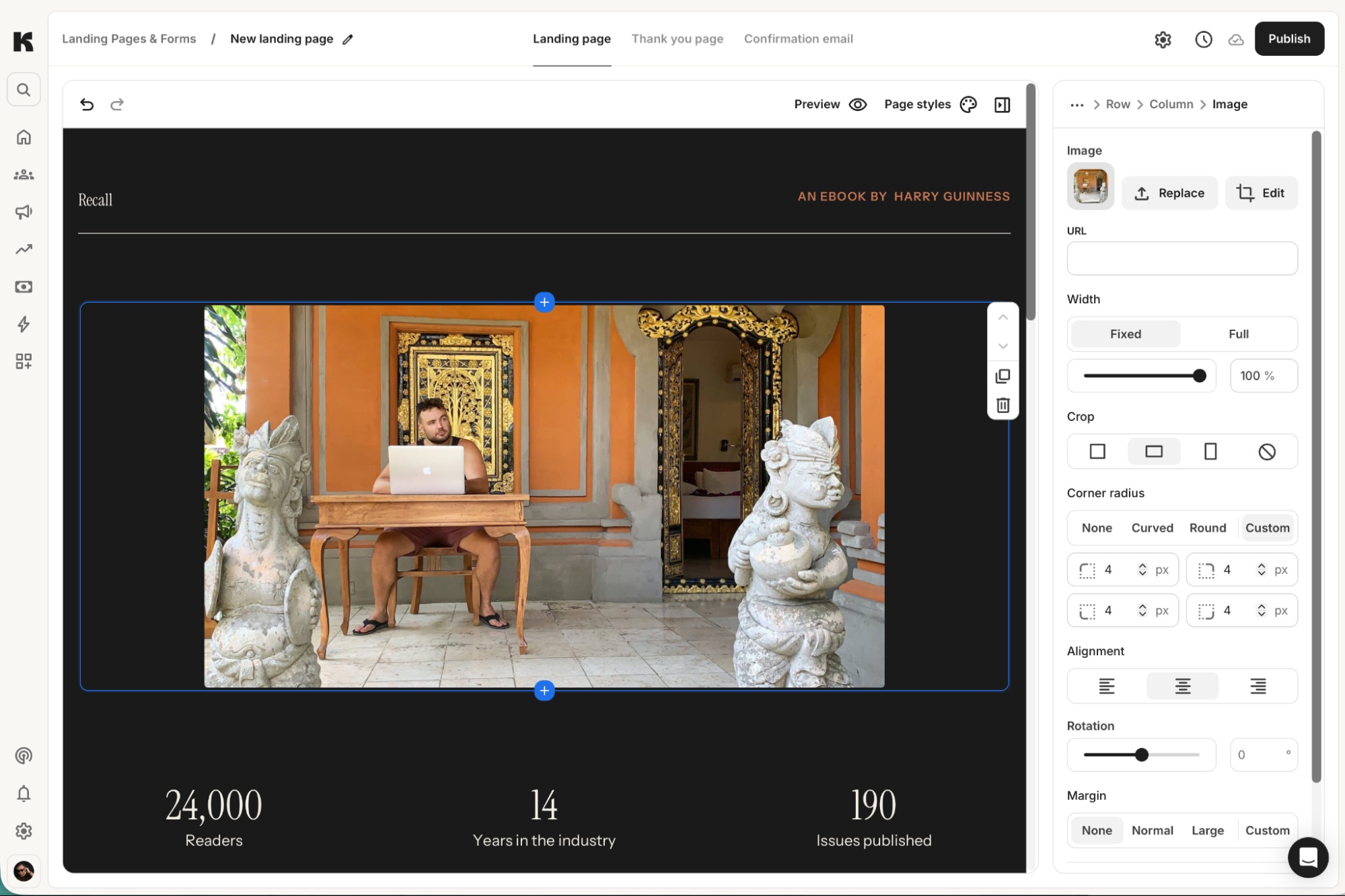
Otherwise, Kit is a great option. It’s designed for authors, bloggers, YouTubers, musicians, and other creators who want to monetize what they do, though it will work just as well for anyone looking to build an email list.
I liked the old page builder, but the new one is a substantial upgrade. Select from one of more than 25 base templates, then add your copy and images to customize it. You can also start with a blank template. While the old builder limited you in how you could place things, the new builder gives you more freedom with layouts and is just a bit more intuitive. You can probably create uglier sites with it, but for the most part, it’s the better choice. When you’re done, you can publish using the default .kit.page domain, though it’s a better idea to configure your own custom one.
Kit’s free plan is a good way to get started, but if you’re serious about building your newsletter, you’ll want to consider the Creator plan (from $39/month). It enables you to create more pre-scheduled email sequences and integrate Kit with other apps like Zapier without relying on the API. That means you can build sophisticated workflows across thousands of apps. For example, when someone fills out a form, you can use AI to automatically send a personalized follow-up, add them to your CRM, and add them to your newsletter email list. Learn more about how to automate Kit.
Kit price: Free for up to 10,000 subscribers; from $39/month for the Creator plan that removes Kit branding and adds more features, though pricing scales with the number of subscribers you have.
Kit isn’t the only newsletter service that offers landing pages. I also tested GetResponse, Mailchimp, Benchmark, Omnisend, AWeber, Moosend, and Brevo (among others), but I preferred Kit’s updated and well-designed app. However, if you already use a different email marketing tool that also has a landing page builder, I wouldn’t recommend switching apps just for that. Use the landing page builder included with your existing email marketing tool—they all do much the same thing.
Best landing page builder for businesses with a budget
Instapage (Web)
Instapage pros:
-
A powerful landing page builder
-
Great split-testing and targeting tools
Instapage cons:
-
Can be very expensive
Instapage is one of the best landing page builders available. For a while, its price crept north of $300/month, which made it impossible to recommend. The good news is that its entry plan is now back down to $99/month (and only $79/month if you pay for a year in advance). While still a serious investment, for businesses with the budget to invest in a premium landing page tool, it might be worth it. It’s also continued to improve over the last few years with great AI-powered tools, even as the price has held steady.
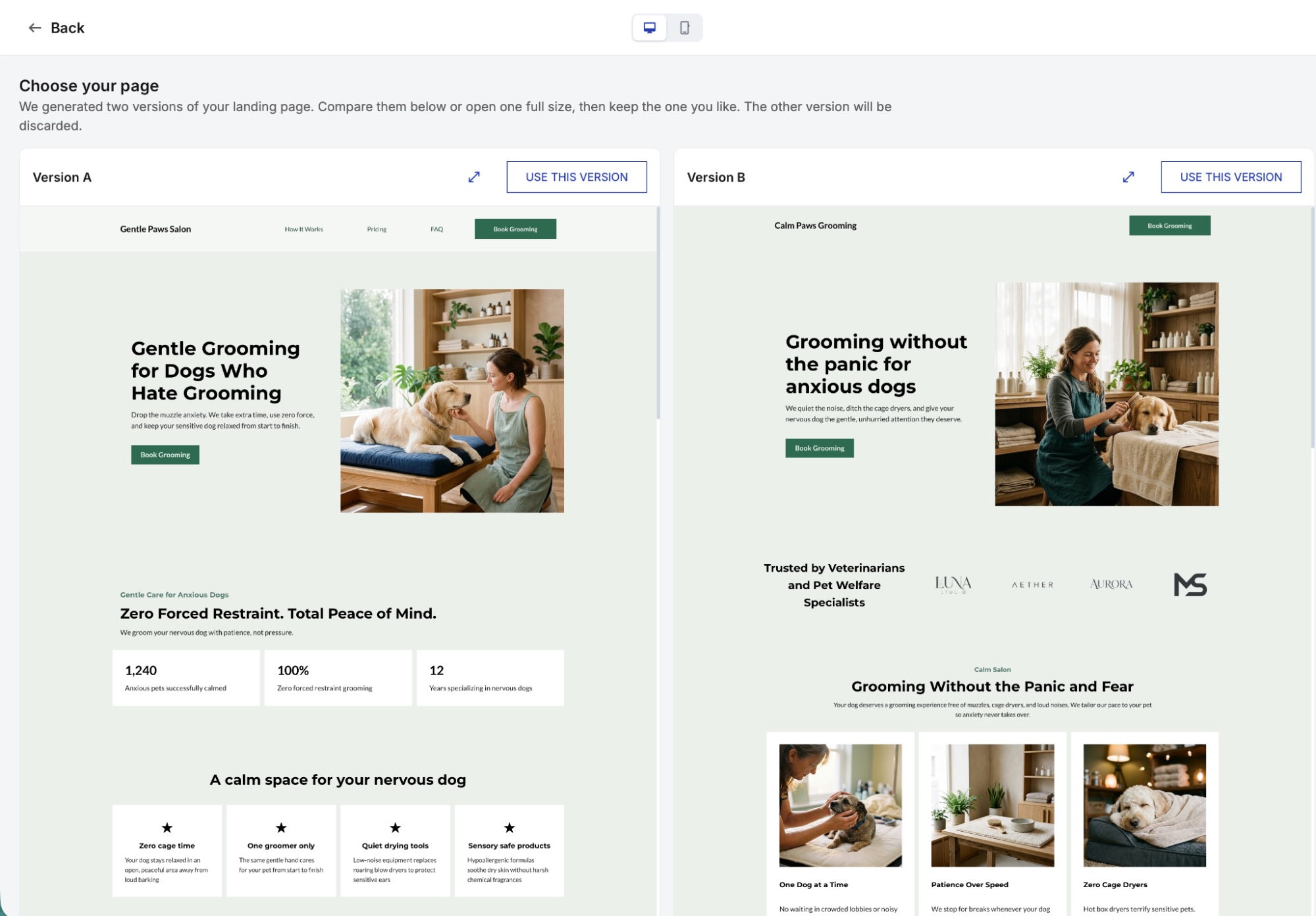
Instapage is about as polished as these apps come. The page builder is great, so it’s easy to tweak any of the default layouts or AI-generated options to meet your needs. You can set defaults for fonts and colors, upload brand assets, reuse forms, and apply the same scripts to every landing page to keep your marketing consistent. Even the integrated AI is handy for brainstorming copy tweaks.
On higher plans, Instapage allows you to run detailed experiments to optimize your landing pages, personalize the content so that it matches the paid ad that someone clicked on to get to it, schedule updates to go live at certain times—and a lot more.
All in all, Instapage offers a premium package—though at a premium price. And it integrates with Zapier, so you can orchestrate sophisticated, AI-assisted workflows that go far beyond simple form submissions. Automatically route new leads to your CRM, enrich data with AI, trigger personalized follow-ups, or feed insights into analytics tools—all without manual intervention.
Instapage price: From $99/month for the Create plan, for up to 15,000 monthly visitors and unlimited conversions
Unbounce is the other big premium landing page builder. It’s worth checking out—and it’s been on this list previously—but I preferred Instapage in my testing this year.
Best landing page builder for funnel-building
involve.me (Web)
involve.me pros:
-
The most customer-friendly funnel builder I tested
-
Easy-to-use drag-and-drop and AI funnel builders
involve.me cons:
-
Not the best tool for creating standalone landing pages
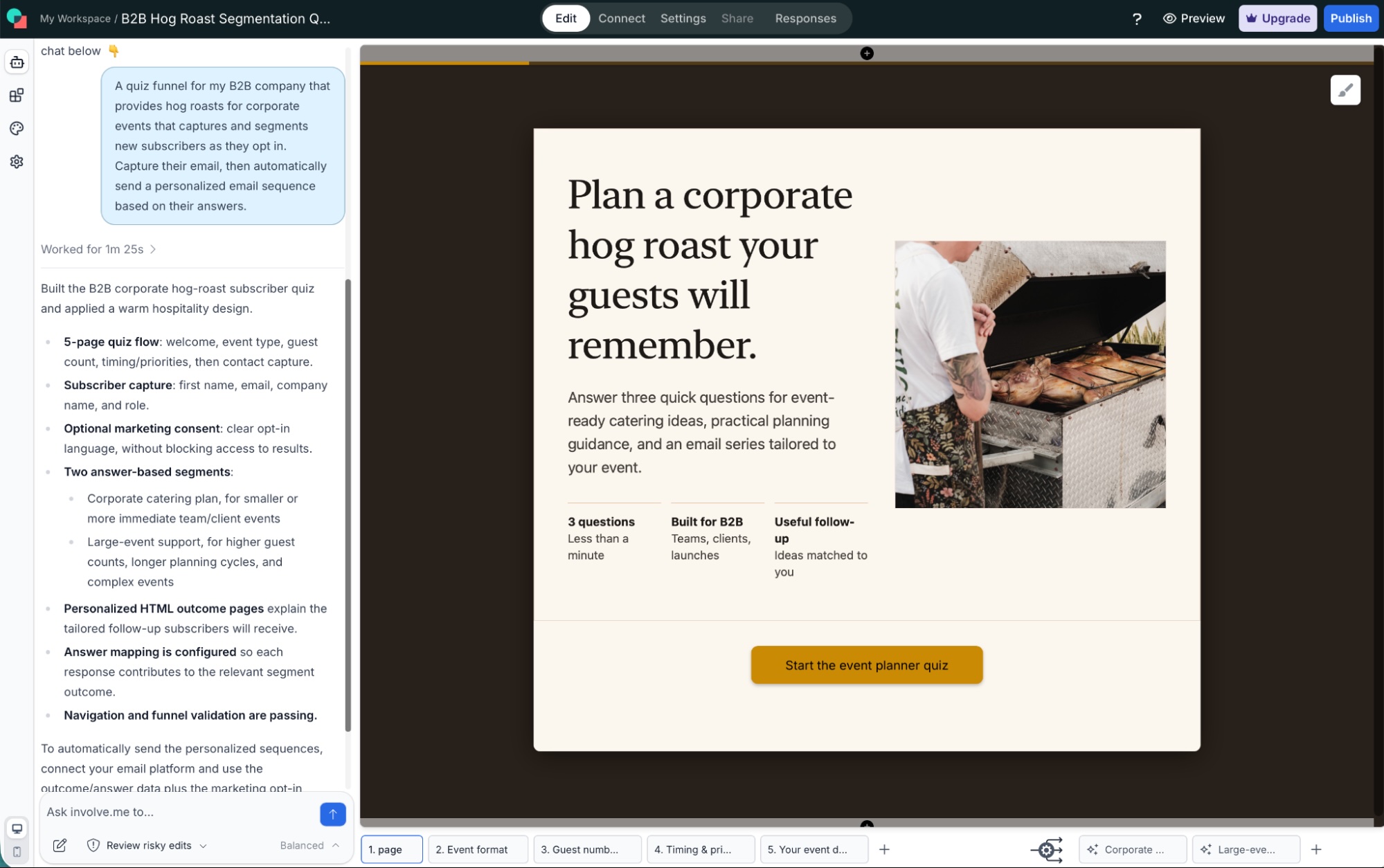
I’ll be honest, I really don’t like high-pressure sales funnels. You know the ones where you have to keep scrolling to see the price, everything comes with free gifts, and there’s pressure to act now? But I found involve.me to be the nicest and most customer-respecting sales funnel tool I tested. It’s more aimed at creating interactive sales funnels like quizzes and calculators.
involve.me’s drag-and-drop and AI builders allow you to create interactive sales funnels that collect information from your leads using forms, surveys, and quiz questions. For example, you can use a survey to find out what exact service your customer is interested in, have a quiz that helps them find the most appropriate option themselves, or have something like a pricing calculator. You can use the funnels to just gather leads or collect payments through Stripe or PayPal.
You can publish involve.me’s funnels to their own landing page or embed them in any website you like. Obviously, for this list I was most interested in publishing them directly to a landing page—but both options work well.
involve.me integrates with dozens of other apps, including Zapier, so you can orchestrate dynamic, automated workflows across your stack. For example, you can send leads directly to HubSpot, update a Google Sheet in real time, and trigger personalized follow-ups powered by AI, all without manual effort.
involve.me price: From $49/month for the Start plan with 3 live funnels
Best landing page builder for unlimited traffic
Leadpages (Web)
Leadpages pros:
-
One of the nicest AI and no-code landing page editors
-
No traffic limits
Leadpages cons:
-
More expensive than some of the other options
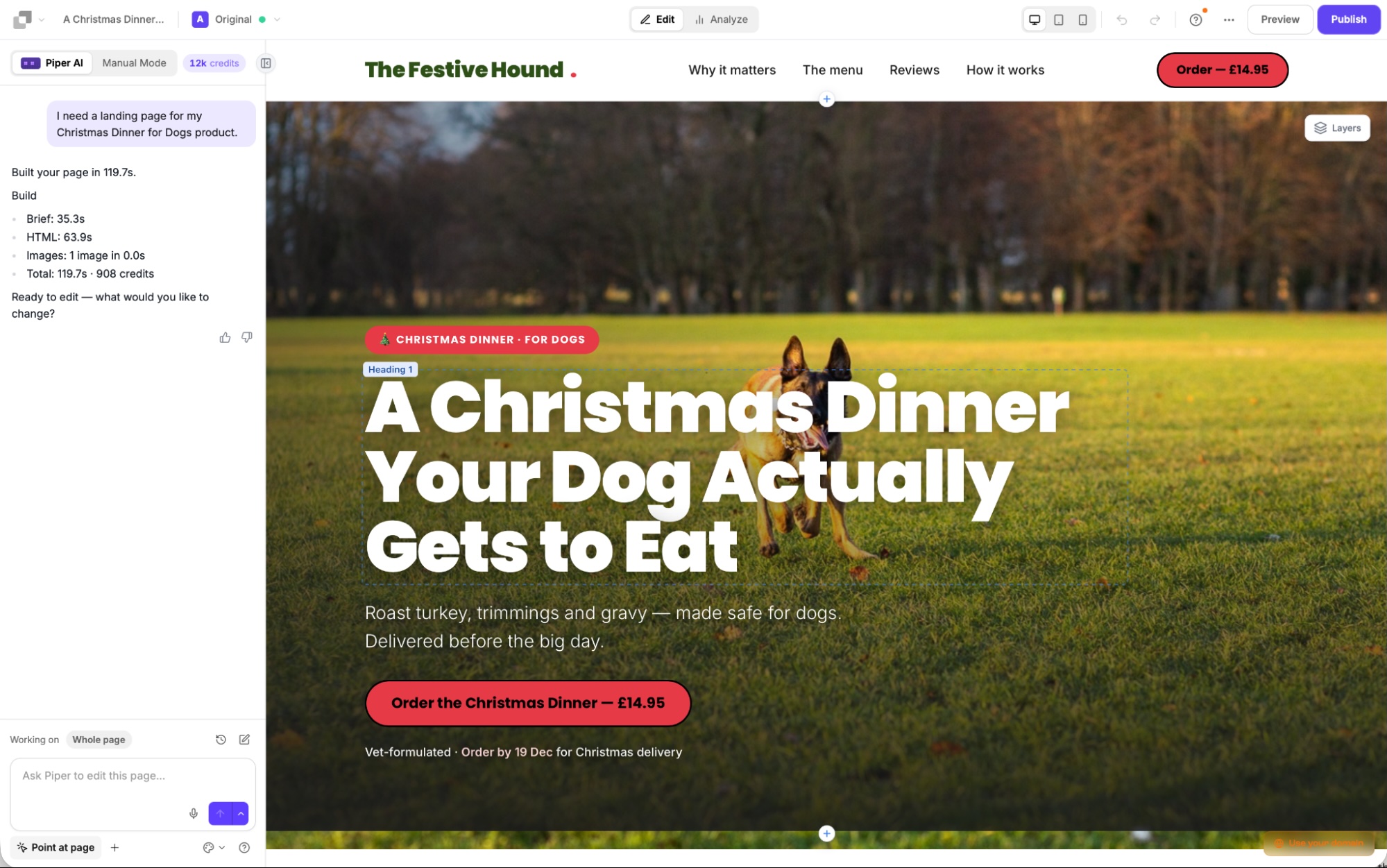
Many landing page builders have monthly traffic limits. Exceed them, and your landing page stops generating leads. If you want a great landing page builder that allows for unlimited traffic across every plan, then Leadpages is worth considering.
It’s worth noting that Leadpages is one of the best landing page builders regardless of price. Its AI-powered landing page builder works really well, and it’s easy to customize the results. (You can still start with a template if you want to.) But what sets it apart from some of its competitors is that if your landing page suddenly gets a lot more views than you anticipated, you’re not scrambling to upgrade your plan in case you miss out on valuable leads.
It’s also one of the best landing page builders for selling products. You can connect Stripe and enable one-click checkouts. Combined, it makes Leadpages especially powerful for small product businesses.
Plus, Leadpages integrates with Zapier, so you can orchestrate smart, automated workflows across your marketing stack. For example, you can automatically respond to new form submissions, add contacts to your email marketing tool, and send AI-generated follow-up messages. Learn more about how to automate Leadpages.
Leadpages price: From $49/month for the Business plan
Best landing page builder for small businesses using AI
Landingi (Web)
Landingi pros:
-
Landingi has been improving every year that I’ve been testing it
-
Good AI builder and integrates AI tools through its MCP server
Landingi cons:
-
AI-generated first drafts can be a bit bland looking
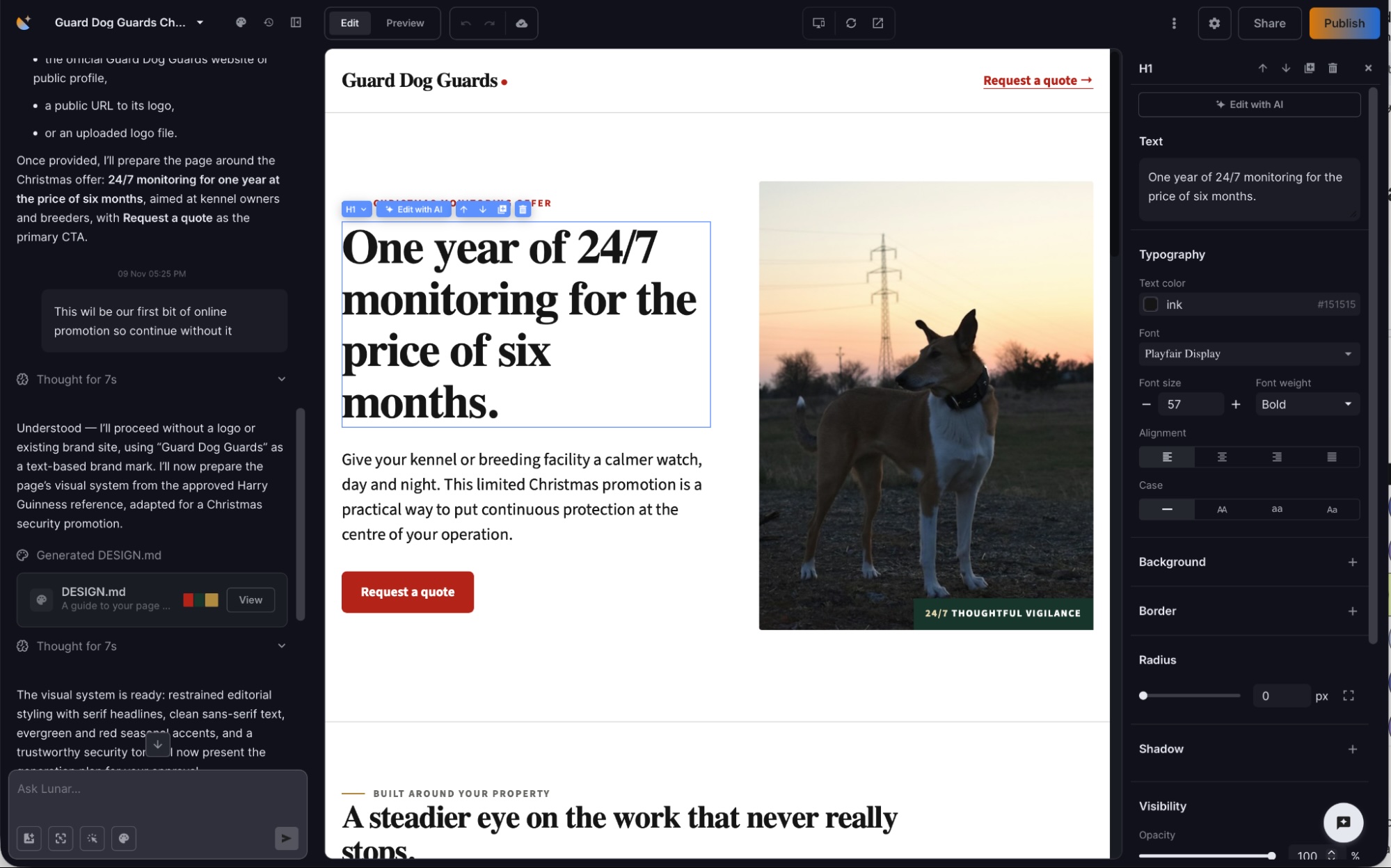
For a long time, Landingi was almost on this list. It fell short because it was too expensive, weirdly buggy, or just not quite there. Now, though, it’s improved to the point that I’m happy to recommend it. In fact, it’s probably one of my favorite tools.
Landingi has a good AI builder, coupled with one of the most powerful editors, especially if you know a little bit of HTML and CSS. It’s good because as much as I liked the AI editor, I found its first results tended to be a bit bland. This way, you’re able to customize them either with more AI prompts or a few tweaks through the different menus.
One of my favorite features is Landingi’s MCP server. You can connect it to ChatGPT, Claude, or any other AI tool and then have it create landing pages. If you’ve fully embraced AI in your business, it’s a feature you’ll likely love.
On top of all that, Landingi integrates with loads of apps, including payment gateways like Stripe, so you can sell products. It also integrates with Zapier, so you can orchestrate end-to-end automations across thousands of other apps. For example, you can send new leads to your CRM or spreadsheet, trigger tailored email sequences, and sync data across your marketing tools in real time.
Landingi price: From $29/month for the Build plan with 2,000 visits per month, 2,500 AI credits, and integrations.
What about AI landing page builders?
There’s now very little distinction between landing page builders and AI landing page builders. As you can see from the list above, most of the best landing page builders have now added AI-powered tools. The reality is it was easier for these apps to embrace AI, than for random startups to add all the deep landing page features like CTAs, analytics, heat maps, and A/B testing.
Can you vibe code a landing page?
You can absolutely use a vibe coding tool to create a landing page, but it’s almost certainly overkill. It will likely take you more time and cost you more money than using a dedicated landing page builder, and you’ll probably be missing key features like analytics and integrations.
Should you use a landing page builder or a website builder?
Landing page builders are a great tool if you really just want to build a single-page marketing site with a clear CTA. But if you know you’ll soon want to expand it to a full website, or even an online store, then you’re better off building your own site—even if it is just a single-page one to start. Other than Carrd, landing page creators can also come with quite steep monthly fees, so if you aren’t using the marketing features, a full website might even be cheaper.
There are lots of great website building options, from the more DIY-focused, like a self-hosted WordPress install, to quick and easy-to-use template-based options that have a lot in common with the landing page builders we’ve just looked at, like Wix, Squarespace, and Shopify. There are even lots of solid free website builders.
Related reading:
This article was originally published in April 2018 by Matthew Guay. The most recent update was in November 2026.