Astra is the first OpenAI model to meet the Critical cybersecurity capability threshold under the Preparedness Framework, with stronger safeguards for release.
Generative AI initiatives often stall not because of the board, vendors, or training, but because middle managers determine how AI is translated into day-to-day work. There are five distinct
The most common failure point in generative AI is not the boardroom, the vendor shortlist, or the training portal. It is the layer of managers who must turn executive ambition into everyday behavior. That is why Gen AI adoption keeps stalling even in organizations where senior leaders have approved the budget, picked the platform, and announced the mandate. Middle managers decide whether AI becomes a workflow, a side experiment, a compliance headache, or a quiet casualty of organizational avoidance.
In the August 31 edition of The Insider newsletter, managing editor Gretchen Gavett shares an argument for why organizational transformation should be a learning journey, a formula to gauge your
Most organizational transformations kick off with a detailed roadmap and a fixed destination due the complexity involved and coordination required. But you may be more likely to succeed if you admit you don’t entirely know where you’re headed.
How do you scale innovation in a fragmented system you don’t fully control? That is the challenge Highland Electric Fleets faced as it worked to replace diesel school buses with electric vehicles across the United States. While Highland provided financing, infrastructure, and fleet operations, success depended on external partners, including manufacturers, utilities, and districts. Delays and disruptions forced the company to stay nimble and deliver under pressure.
In this episode from 2025, Harvard Business School professor Rosabeth Moss Kanter and Highland Electric founder and CEO Duncan McIntyre join host Brian Kenny to discuss the Harvard Business School case, “‘The Wheels on the Bus’ Go Electric: Highland Electric Fleets and Partners,” and what it takes to scale a climate solution while sustaining momentum and coordinating across public and private sectors.
How much does a leader actually matter to an organization’s success? We tend to credit CEOs, founders, and other powerful figures with shaping the institutions they lead, but historian Jared Diamond argues that we often underestimate the role of timing, circumstance, industry, and plain luck. Diamond explains his “Hamlet test,” which asks whether someone else could have achieved the same outcome or whether the leader was uniquely qualified to do it, and how it applies to many business leaders. He also explains why some leaders are able to seize a fleeting moment of opportunity, why founders can have an outsized influence on institutions, and why boards may overestimate the impact of replacing a struggling CEO. Diamond is author of Prophets, Profits, Coaches, and Kings: (When) Do Leaders Matter?
See how Gilbert + Tobin combines CEO-led commitment, rigorous governance, and human accountability to scale ChatGPT Enterprise and Codex across the firm.
The Flash family extends GigaPath and GigaTIME with dramatically improved efficiency, making large-scale pathology research more accessible and practical.
A distilled pathology foundation model backbone reduces computational requirements without sacrificing performance, enabling repeated analyses across larger patient cohorts.
These open models support population-scale discovery, helping researchers investigate disease biology, biomarkers, and clinical outcomes across diverse cancer datasets.
GigaPath (opens in new tab) and GigaTIME (opens in new tab) demonstrated how foundation models can support whole-slide analysis and tumor microenvironment modeling from routinely collected pathology data. GigaPath-Flash and GigaTIME-Flash make these capabilities substantially more efficient, enabling researchers to analyze larger cohorts, run more experiments, and move toward population-scale discovery.GigaPath-Flash and GigaTIME-Flash are research models. They are not intended or validated for clinical use, including diagnosis, prognosis, treatment selection, or other patient-care decisions. Performance may vary across datasets, scanners, institutions, populations, and use cases.
The scale opportunity in computational pathology
Histopathology is among the richest and most widely available sources of information in cancer research. Every tissue biopsy produces a whole-slide image that captures cellular morphology at subcellular resolution — and hospitals generate millions of these slides each year. This data contains information relevant to diagnosis, prognosis, treatment selection, and the biology of the tumor microenvironment.
Foundation models have begun to unlock this information at scale. But whole-slide images are large — often exceeding a gigapixel — and applying a foundation model to even a single slide requires processing thousands of image tiles. When a research question involves tens of thousands of patients, the computational cost grows quickly. And population-scale discovery is not a single model run: it requires repeated cycles of feature extraction, statistical analysis, hypothesis testing, and validation across patient subgroups, biomarkers, and clinical endpoints.
Computational cost limits the number of patients, datasets, tasks, and hypotheses that researchers can study. To realize the full potential of pathology foundation models, we need models that can be applied repeatedly and affordably across large patient populations.
From GigaPath and GigaTIME to the -Flash family
GigaPath (Nature, 2024) (opens in new tab) is a whole-slide foundation model pretrained on large-scale real-world histopathology data from Providence. Unlike models that operate only at the tile level, GigaPath learns contextualized representations of entire slides, capturing both local cellular patterns and global tissue architecture.
GigaTIME (Cell, 2026) (opens in new tab) extends this line of work to tumor microenvironments. Trained on 40 million cells with paired H&E and multiplex immunofluorescence (mIF) data, GigaTIME translates routine H&E images into virtual spatial proteomics maps across 21 protein channels. Applied to over 14,000 cancer patients, it generated a virtual population that uncovered more than 1,200 statistically significant associations between immune cell states and clinical biomarkers.
GigaPath and GigaTIME addressed the scale of pathology data and biological discovery. And now, the Flash family of models addresses scale of experimentation.
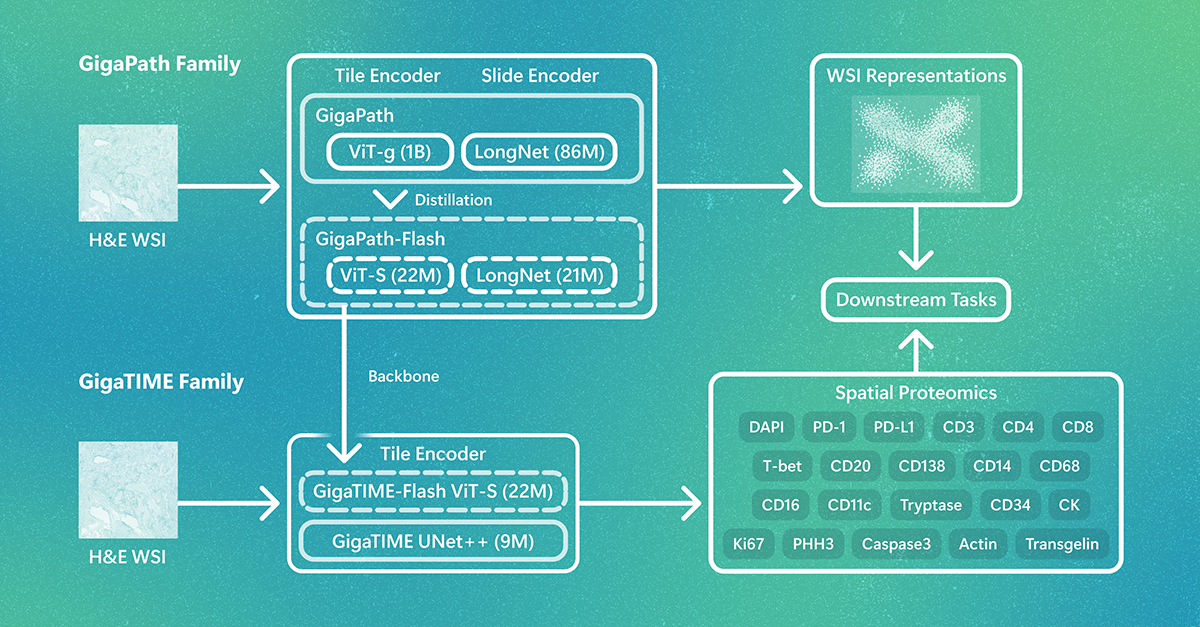
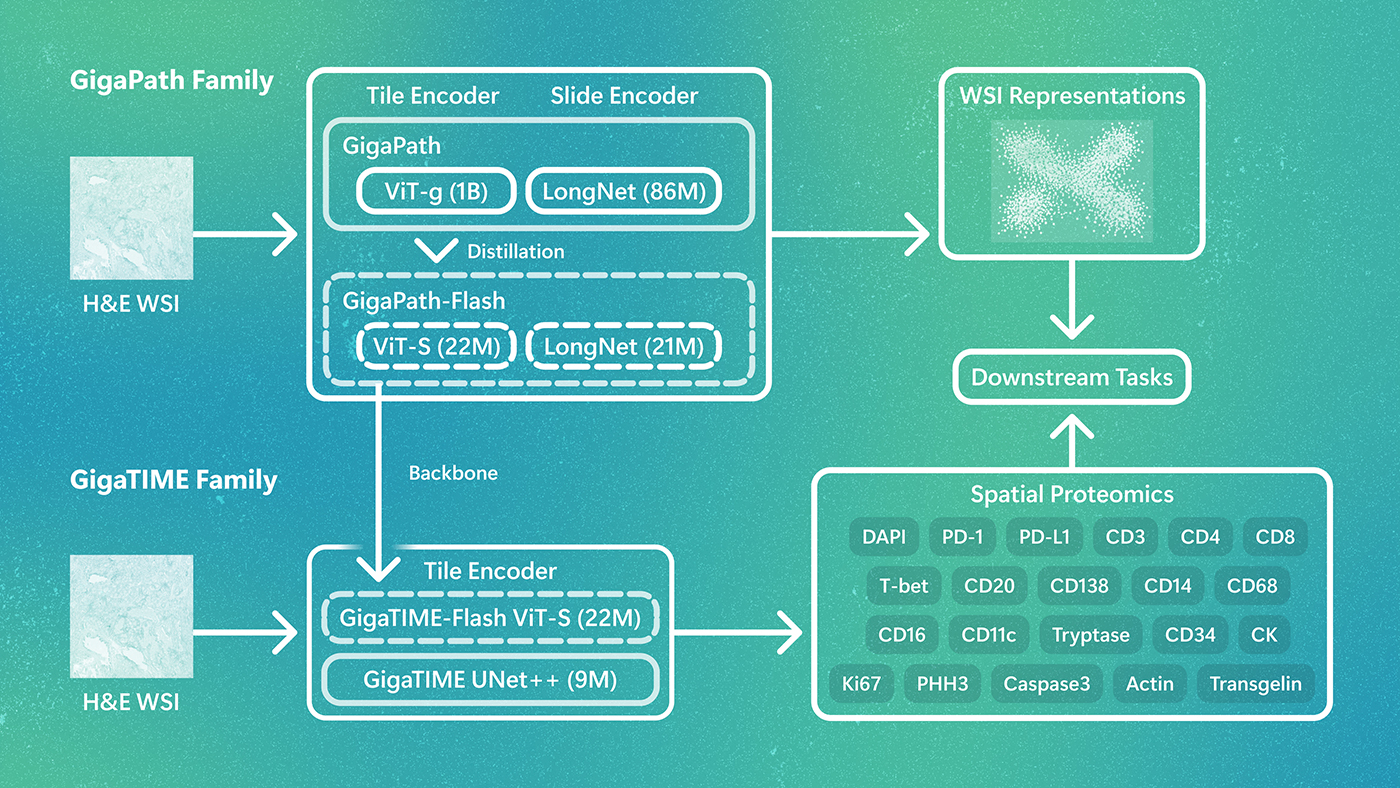
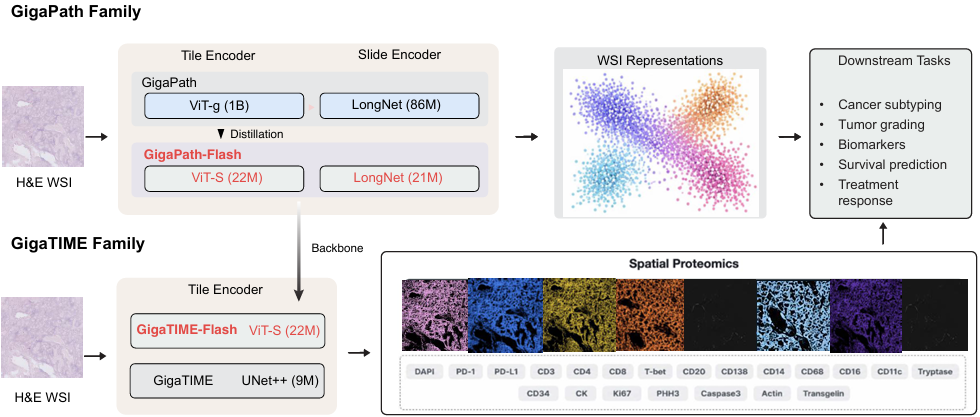
Figure 1: Overview of the GigaPath/GigaTIME model family. GigaPath-Flash provides efficient tile and slide encoders at 22M parameters. GigaTIME-Flash predicts spatial proteomics from H&E, replacing the CNN backbone with the distilled ViT-S encoder.
The Flash family shares a core design goal: preserving useful pathology representations while substantially reducing the computational resources required to generate and use them. Both models are built on a common efficient backbone — a compact ViT-S tile encoder distilled from the original billion-parameter GigaPath encoder — and both are released under the Apache 2.0 license.
GigaPath-Flash
GigaPath-Flash is an efficient foundation model for whole-slide representation learning. It combines a 22M-parameter ViT-S tile encoder with a 21M-parameter LongNet slide encoder. The tile encoder is distilled from the original GigaPath ViT-g teacher, transferring the representational capacity of a billion-parameter model into a backbone that is an order of magnitude smaller. The slide encoder contextualizes all tile embeddings via dilated attention, scaling linearly with the number of tiles.
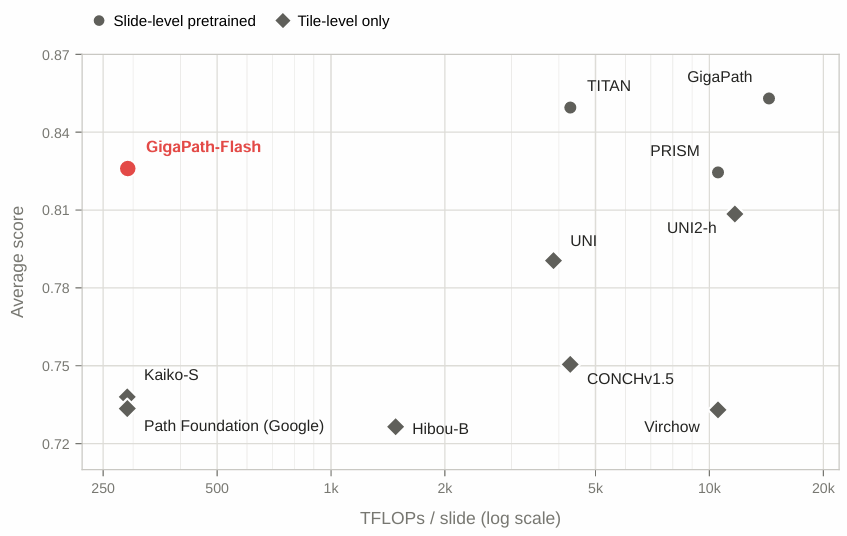
On slide-level classification benchmarks (PANDA prostate grading and EBRAINS brain tumor subtyping), GigaPath-Flash achieves the lowest inference cost among whole-slide pretrained models while retaining competitive performance — scoring within 3% of the original GigaPath at roughly 50 times less compute.
Figure 2: Efficiency–performance trade-off on whole-slide benchmarks. GigaPath-Flash (red, top-left) achieves competitive performance at substantially lower computational cost than other whole-slide pretrained models.
GigaTIME-Flash
GigaTIME-Flash replaces the CNN backbone of the original GigaTIME with the GigaPath-Flash ViT-S encoder, paired with a lightweight convolutional decoder for H&E-to-mIF translation. The model is fine-tuned using LoRA adapters, keeping the pretrained encoder weights largely frozen.
On both in-distribution and out-of-distribution cohorts spanning brain, breast, colon, and lung cancers, GigaTIME-Flash matches or improves upon the original GigaTIME in spatial protein prediction quality. The gains are particularly notable on out-of-distribution data, suggesting that the foundation model backbone improves generalization to previously unseen tissue types.
Figure 3: Mean windowed Pearson correlation for GigaTIME and GigaTIME-Flash on the GigaTIME test set and four out-of-distribution Prov-TMA cohorts. GigaTIME-Flash matches or improves upon the original across all cohorts.
Efficiency without giving up the foundation
The efficiency gains of the Flash models are substantial:
Model
Type
Efficiency gain
GigaPath-Flash
Whole-slide Foundation Model
~50× less compute, 97% of predictive performance compared to GigaPath
GigaTIME-Flash
Spatial Proteomics
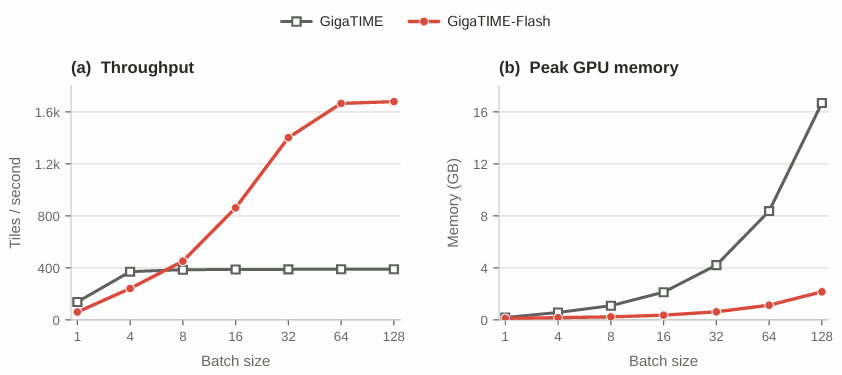
~6× faster, ~8× less memory, better predictive performance compared to GigaTIME
For a single slide, these differences reduce runtime and hardware requirements. Across tens of thousands of slides, they can determine whether an experiment is practical at all. To illustrate, we estimate the wall-clock time for generating virtual mIF across cohorts of different sizes on a single A100 GPU, assuming approximately 10,000 tiles per slide:
Model
1,000 slides
100K slides
1M slides
GigaTIME-Flash
~2 GPU-hours
~7 GPU-days
~70 GPU-days
GigaTIME
~7 GPU-hours
~30 GPU-days
~300 GPU-days
Estimates assume ~10,000 tiles per slide, batch size 128, single NVIDIA A100 GPU. Actual runtime depends on slide size, tiling resolution, and hardware.
Figure 4: GigaTIME efficiency scaling. Left: throughput (tiles/sec) vs. batch size. Right: peak GPU memory (GB) vs. batch size. GigaTIME-Flash scales to over 1,600 tiles/sec while using a fraction of the memory.
An open model release
Both GigaPath-Flash and GigaTIME-Flash are released as open-weight models under the Apache 2.0 license. Model weights and code are available on HuggingFace:
This is an early research release. Our current evaluations cover a limited set of benchmarks and cohorts, and broader validation across tasks, scanners, and patient populations is still needed. We expect the most valuable applications of these models to include scientific questions, cohorts, and use cases beyond those in our initial experiments. We welcome community evaluation, and we are equally interested in reports of where these models work well and where they fall short.
Downstream clinical applications will require additional multi-institutional and prospective validation.
Spotlight: Event Series
Microsoft Research Forum
Join us for a continuous exchange of ideas about research in the era of general AI. Watch the latest episodes on demand.
Efficiency as an enabler of discovery
GigaPath and GigaTIME demonstrated what pathology foundation models can learn from whole slides and tumor tissue. GigaPath-Flash and GigaTIME-Flash are a step toward making those capabilities usable across larger populations, more experiments, and a broader research community.
By making pathology foundation models more efficient, we hope to expand the scale of the scientific questions researchers can ask.
Acknowledgements
GigaPath-Flash and GigaTIME-Flash are joint work across Microsoft Research, the University of Washington, and Providence. For technical details, see the paper.
Paper co-authors: Naoto Usuyama, Jeya Maria Jose Valanarasu, Sicong Yao, Hanwen Xu, Jaspreet Bagga, Guanghui Qin, Robert E. Kramer, Cliff Wong, Soohee Lee, Hao Qiu, Theodore Zhengde Zhao, Racheli Ben Shimol, Angela Crabtree, Kevin Matlock, Eduardo Alejandro Lozano Garcia, Naiteek Sangani, Alberto Santamaria-Pang, Maximilian Rokuss, Yashna Hasija, Naisargi Manishkumar Patel, Jason Entenmann, Alexandra Q. Bartlett, Bill J. Wright, Bernard A. Fox, Brian Piening, Sheng Zhang, Sheng Wang, Tristan Naumann, Carlo Bifulco, Hoifung Poon
Over the past decade, we’ve seen big changes happening for enterprise artificial intelligence (AI). Organizations have invested in chatbots and copilots designed to help workers with productivity, but these ambitions have moved from assistance to autonomy. Leaders now want to deploy systems that can plan and launch complex workflows all on their own.
Today, organizations are moving toward an elastic enterprise model, designed to reshape tasks, systems, and teams in real time. In an elastic enterprise, business processes become fluid, bringing together services, data, and human expertise to resolve business outcomes.
Scaling Agentic Capacity with Extended Reasoning
One of the biggest drivers for this change is the evolution of frontier AI models. Early AI operated on a one-step, immediate-response model. But today’s models use extended reasoning, giving them the ability to plan, self-correct, and evaluate their work before final output.
Models allowed to think longer across multiple scenarios can simulate different paths and refine their strategies. This extended reasoning lets models automate processes without constant human intervention.
Establishing an AI Delegation Framework
As agents take on deep-reasoning tasks, the move from automation to delegation closely mirrors how we interact with teammates every day.
To scale this safely, leaders of elastic enterprises focus on key decisions and protocols:
Transfer of authority and boundaries: Define the authority, limits, and system permissions to identify when the agent needs to escalate decisions to a human.
Accountability and verifiability: Be deliberate about verifying data. Automate tasks like code generation but require reputation scores or human-in-the-loop reviews for sensitive tasks like client communications.
Dynamic cognitive friction: If instruction is ambiguous or risky, the agent must pause for human review.
Designing a Secure Agentic Architecture
Elastic enterprises use architectures that align throughout the organization. Before deploying workflows, companies establish capability models and maturity assessments across infrastructure, data, applications, security, and operations.
These support agentic work at scale by identifying core areas that may be in need of development, including:
Agent building: Design and architecture for individual AI agents and complex multi-agent systems.
AgentOps: Framework for deploying, monitoring, and optimizing agent performance.
Data readiness: Agents connect securely to enterprise data assets.
Security and governance: Guardrails that identify and control potential AI system risks before they escalate.
Clearing Up Disconnected Data
Organizations that adopt an elastic enterprise model often must reengineer their workflows and infrastructures. Data simplification becomes a top priority as well, providing resources for teams and clean data for large language models.
This groundwork helps teams drive transformation through three strategic pathways:
Plug-and-play integration: Connects agents directly to high-quality data architecture.
Pro-code necessity: Uses specialized agents to act as the bridge for modern agentic workflows.
Practicing Token Economics
When introducing AI agents, enterprises must develop a new approach to cloud FinOps that focuses on cost tracking and value governance. Because agents use token-based billing, organizations need a way to track total cost of ownership and value generated.
Working toward minimizing token waste and overall costs, elastic enterprises use specific methods for streamlining and refinement:
Speculative routing: Directing tasks and reasoning to fast models like Gemini Flash to handle high-frequency work at minimal cost.
Batching: Separating time-sensitive tasks from latency-tolerant workloads to use asynchronous batch application programming interfaces.
Guardian validation: Deploying specialized, low-cost agents to monitor outputs that break if they detect background looping or agent sprawl.
Inference pruning: Using research on deep-thinking tokens to prevent inefficient reasoning paths early on, matching premium model accuracy at half the token cost.
Adapting Elastic Talent and Human-over-the-Loop Collaboration
Agentic AI introduces a new category of digital talent into the workforce that requires new human roles and organizational culture. The relationship between workers and AI agents is a collaborative, elastic spectrum that evolves based on task, risk, and agent reliability.
In an elastic enterprise, human workers act as managers of digital talent through governance and boundaries. When a new agent is deployed, teams maintain human-in-the-loop oversight. As the agent builds trust and reputation score over many successful tasks, managers may scale back to human-over-the-loop involvement, monitoring as needed but focusing on actionable value instead.
The Path Forward
Moving beyond legacy architectures to address the opportunities of AI agents is what makes elastic enterprises unique. More than just a change in technology, this transition is a shift in mindset and culture, giving teams a way to build an organization that can learn and lead in real time. With the elastic enterprise model, leaders can now readily prioritize agentic AI for their organization, turning ambition into autonomy.
Carlo Giovine is the leader of Delta, Google Cloud Consulting’s Forward Deployment Engineers team.
Vasu Gupta is the leader of Google Cloud Consulting’s Architecture and Industries team.
With expertise from Google’s own at-scale AI deployments and product knowledge, Google Cloud Consulting acts as an extension of a customer’s team to advise and implement agentic use cases and platforms. Interested in your own agentic transformation toward an elastic organization? Google Cloud Consulting can assemble the right team for your specific challenges, combining Google’s expertise with the specialized skills of our trusted partners. Contact Google Cloud Consulting to learn how our personalized offerings can guide your AI transformation.
HBR Executive delivers trusted insights and actionable strategies to guide leaders through consequential decisions. Practical tools, and forward-looking perspectives cut through the noise to equip you to navigate uncertainty, stay ahead of emerging trends, and plan for a stable future.
Exclusive Benefits
Playbooks
Concrete strategies, tactics, and solutions to real challenges from your peers and other experts. Published every 2 weeks. All Playbooks (Opens a new page)
Masterclasses
Agenda
A weekly newsletter of timely insights that interpret today’s business climate and help you chart a path to what’s next. All Agenda (Opens a new page)