Author: admin

  • From Atari to EVE Online: Building on 15 Years of AI Research in Games

    From Atari to EVE Online: Building on 15 Years of AI Research in Games

    August 21, 2026 Research

    Alexandre Moufarek and Adrian Bolton

    From Atari to Go to StarCraft, games have driven some of the biggest breakthroughs in AI. Now, we’re partnering with game developers to prototype new gameplay experiences that push the frontiers of both gaming and AI.

    Since DeepMind’s foundation in 2010, the constrained yet rich worlds of games have played a critical role in understanding intelligence. They have driven some of our biggest AI breakthroughs, from mastering Atari to helping solve protein structure prediction – and they are still at the heart of what we do.

    Gaming is in GDM’s DNA. Demis Hassabis, one of Google DeepMind’s founders, is himself a former game developer, as are many of us in the GDM team. Together, we have decades of hands-on experience in game development and a deep respect for the craft of making games.

    We’ve always been clear that doing AI research with games requires deep partnership with game developers – like our major new research partnership with Fenris Creations and the EVE Universe that we unveiled earlier this year, and the work we’ve done together with acclaimed studios like Hello Games, Coffee Stain Studios, Foulball Hangover and others.

    Games as the engine of AI research

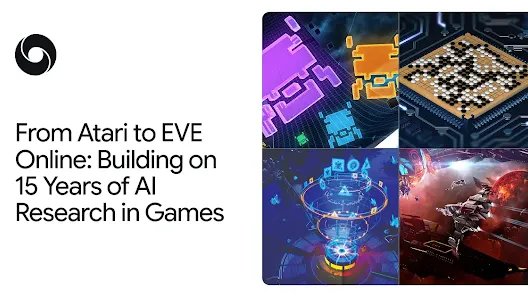
    Our journey began when a small team trained a deep neural network to play Atari 2600 games directly from raw pixels. The Deep Q-Network (DQN) learned to play 49 different games — from Pong to Breakout to Space Invaders — without any game-specific engineering. The 2015 Nature paper on DQN helped catalyze the modern era of deep reinforcement learning.

    From there, we attempted to master more complex games, with each milestone producing more capable and general systems. AlphaGo defeated world champion Go player Lee Sae Dol in 2016 — a feat many experts thought was still a decade away. AlphaGo Zero surpassed every previous version by learning entirely from self-play, with no human data at all. AlphaZero generalized this approach to master chess, shogi, and Go with one algorithm, while MuZero learned to play without even knowing the rules. In 2019, AlphaStar reached Grandmaster level in StarCraft II, navigating real-time complexity and imperfect information.

    For each game, AI enriched the playing experience. AlphaGo’s famous Move 37 was a play so unexpected that professional commentators initially thought it was a mistake, overturning centuries of received wisdom in Go and inspiring experts to explore new strategies. AlphaZero similarly inspired entirely new lines of play in chess. Crucially, the spirit of exploration that succeeded in games had profound impacts for other AI systems: AlphaFold applied these foundations to help solve the 50-year grand challenge of protein structure prediction, a breakthrough which was recognized with the 2024 Nobel Prize in Chemistry.

    From mastering games to understanding them

    Our earlier work demonstrated that AI could master any game given a clear objective and enough training. But the real world doesn’t come with scores and rule books — which led us to ask a fundamentally different question: can AI understand and interact with any game world the way a person would?

    This is the challenge behind SIMA, our Scalable Instructable Multiworld Agent. Rather than optimizing for a high score, SIMA is a generalist agent that ‘sees’ what a player would see on screen, understands natural language instructions, and acts through ordinary keyboard and mouse controls — requiring no APIs or source code access.

    Powered by Gemini, our frontier AI models, SIMA 2 acts as an interactive companion capable of real-time reasoning and conversation. It achieves human-like play across complex 3D research environments and video games including No Man’s Sky, Valheim, Hydroneer, and more.

    For game developers, a truly general gaming agent would unlock AI capabilities that work with existing games — no modifications to the game code required. This could power entirely new gameplay, from AI companions that genuinely understand the game world to Non-Player Characters (NPCs) that adapt and respond in ways that scripted systems never could.

    A general gaming agent could also transform how games are made. During development, when the game changes with every commit, such agents could enable truly robust QA testing. Post-launch, when new content is introduced or players behave unpredictably, they could adapt in real time — generalising to new situations without needing to be re-scripted.

    To develop SIMA agents safely and responsibly, we’ve partnered with acclaimed game studios and we are building a growing portfolio of games for AI research. This allows us to challenge our agents with ever more complex tasks that may one day transfer to solving problems in the real world.

    Exploring new frontiers of AI and games research, in partnership with game developers

    Game studios bring expert craft, extraordinary game worlds, and deep knowledge of their players. We bring frontier AI — from Gemini to research in generative interactive environments and embodied agents — research expertise, and our team’s unique game development background and years of experience building AI for interactive environments. Together, we focus on discovering breakthrough experiences — never-before-seen gameplay that wouldn’t be possible without AI.

    It’s not about the tech, it’s about fun experiences. So we take a ‘show, don’t tell’ approach with our partners. Our team works hand in hand with game developers, exploring new ideas and building playable prototypes to find the fun.

    Our latest research partnership with Fenris Creations, the independent studio behind the EVE Universe, represents a new chapter in our history of AI research in games.

    Fenris Creations has spent more than two decades building one of the most extraordinary persistent worlds in gaming. EVE Online, launched in 2003, is a massively multiplayer space simulation where thousands of players share a single universe that has evolved continuously for more than 20 years. Its player-driven economy features real supply-and-demand dynamics and trade networks spanning thousands of star systems. Its landscape — shaped by alliances, conflicts and diplomacy — is driven by human interaction.

    For AI research, this is a golden opportunity. It’s a living, evolving world that demands precisely the capabilities we believe are essential for frontier AI:

    • Continual learning: Acquiring new skills without forgetting what came before, in a constantly changing world.
    • Memory: Accumulating and retrieving knowledge across timescales that extend far beyond today’s model context windows.
    • Long-horizon planning: Reasoning over weeks, months, or even years.
    • Complex multi-agent dynamics: Navigating cooperation, competition, negotiation, economics, and emergent social behavior at scale.

    These challenges sit at the core of our broader research initiative to create systems that learn continuously from experience, with the rate of learning accelerating over time. We believe these frontier capabilities could unlock new gameplay experiences in the future.

    Our research partnership extends across Fenris Creations’ expanding universe, offering distinct environments for AI development. While EVE Online offers a large-scale single-shard persistent universe, EVE Vanguard is played from a first-person perspective, bringing ground-level, fast-paced tactical decision-making to the broader persistent world. This creates opportunities to study agents operating across multiple levels of abstraction, from twitch-level tactics to galaxy-spanning strategy.

    Furthermore, EVE Frontier — with its programmable “Smart Assemblies” and its open, extensible architecture — offers an open-ended environment where the very rules of the world can change, demanding agents that adapt to entirely new game mechanics.

    A “show, don’t tell” session during a workshop with Google DeepMind and Fenris Creations where our teams share playable prototypes, feedback and discuss ideas for new gameplay experiences

    Our collaboration has already delivered real player value: the Aura Guidance system uses Gemini to deliver player-generated knowledge, based on real Rookie Help questions and answers, to help new pilots.

    Our longer-term research program begins with an offline instance of EVE Online, which is a safe sandbox, separate from live players. It then progresses through EVE Frontier as a space to study how humans and agents can coexist in a persistent and open-ended world. Only when capabilities are mature would we consider bringing them to EVE Online and EVE Vanguard with the aim of enriching human play.

    The road ahead

    Games have always been a mirror for intelligence. As they become more complex, more persistent, and more open-ended, so do the AI systems we build to navigate them.

    We are aiming for the same ultimate goal we always have: AI as a catalyst, not a replacement. Our long-term ambition is to unlock breakthrough gameplay experiences, make games more accessible and more personalized, and — as we’ve seen from AlphaGo to AlphaFold — apply what we learn in games to problems in the real-world and to advance scientific discovery.

    We’re grateful to all of our game partners on this journey, and to Fenris Creations for joining us on this next chapter. We can’t wait to share what we discover.

    Acknowledgements

    We’d like to recognize the many teams across Google DeepMind for their contributions over the years to advancing AI research safely and responsibly in games.

    Special thanks to all of the game developers who partnered with us: Coffee Stain (Valheim, Satisfactory, Goat Simulator 3), Fenris Creations (EVE Online, EVE Vanguard, EVE Frontier), Foulball Hangover (Hydroneer), Hello Games (No Man’s Sky), Keen Software House (Space Engineers), RubberbandGames (Wobbly Life), Strange Loop Games (Eco), Thunderful Games (ASKA, The Gunk, Steamworld Build), Digixart (Road 96), and Tuxedo Labs & Saber Interactive (Teardown).
    SIMA 2: An Agent that Plays, Reasons, and Learns With You in Virtual 3D Worlds

  • Broadening access to Skala creates a faster path to predictive DFT 

    Broadening access to Skala creates a faster path to predictive DFT 

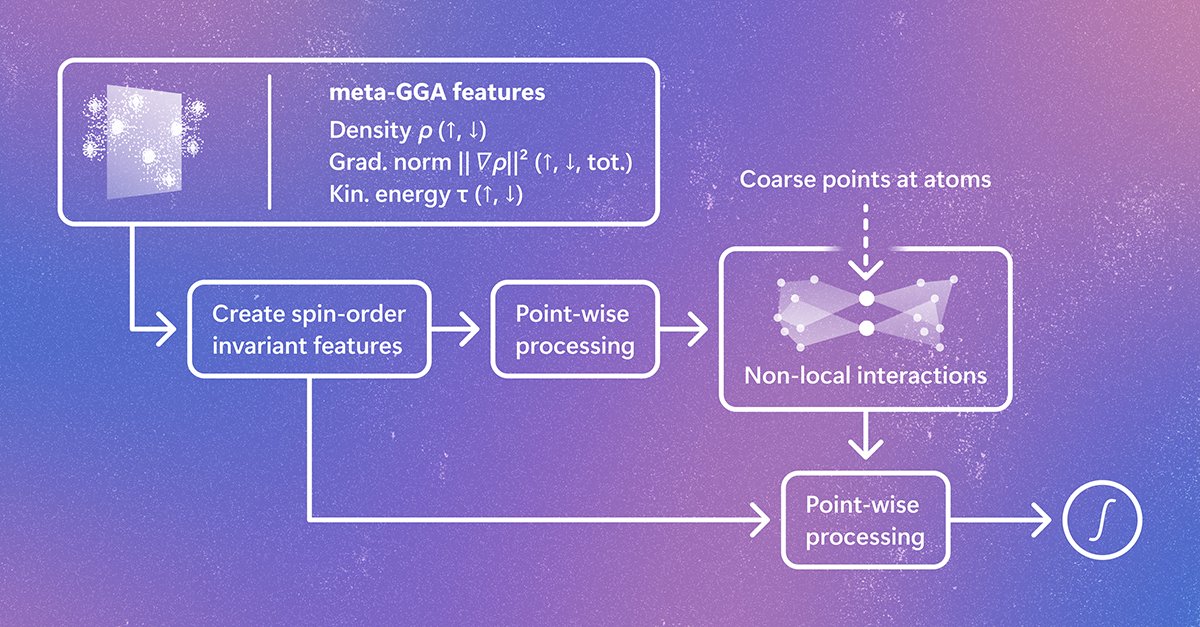
    Schematic of the Skala architecture, showing how meta-GGA electronic features are transformed through point-wise processing and non-local atomic interactions to predict density functional theory energies.

    At a glance

    • Skala 1.1 demonstrates the continuously improving nature of Microsoft Research’s deep-learning DFT approach: trained on 2.5× more data than its predecessor, it delivers substantially higher accuracy across key molecular simulation challenges, including thermochemistry, reaction kinetics, and molecular structure prediction.
    • Skala is now available in CP2K and is being integrated into Psi4, FHI-aims, ORCA and VASP, bringing next-generation DFT accuracy closer to the communities that rely on these codes every day.
    • Microsoft Research is also introducing a living benchmark that will track the computational performance of successive, increasingly optimized Skala releases to help the community measure and accelerate progress toward ever greater accuracy and efficiency.
    • Together, these developments mark another milestone toward a future in which computational chemistry simulations are both predictive and integrated in all relevant scientific and industrial workflows.

    Bringing density functional theory (DFT) to predictive accuracy is a journey, not a single breakthrough. Since introducing Skala, our deep-learning exchange-correlation functional, we have continued to advance along two complementary fronts: improving accuracy and expanding accessibility across the computational chemistry ecosystem.

    Fig. 1: Table of errors for Skala-1.1 and competing density functionals on the 55 subsets of GMTKN55. Skala-1.1 delivers the lowest error on 32 subsets, indicating broad and consistent accuracy across a wide range of chemical properties and reaction types.
    Figure 1: Accuracy of Skala-1.1 for thermochemistry, kinetics, and non-covalent interactions. At the computational cost of a meta-GGA functional, Skala 1.1 outperforms the best, most expensive global hybrid functionals, ranking first (earning gold medals) in 32 of the 55 categories of the widely used GMTKN55 benchmark, which spans a broad range of chemical problems.

    On the accuracy front, the release of Skala-1.1 (opens in new tab) provides the first demonstration of the continuous-improvement paradigm underlying Skala. Trained on 2.5x more data than the first public version of Skala, the updated  model delivers substantially improved performance across key challenges in molecular simulation, including main-group thermochemistry, reaction kinetics, and molecular structure prediction.

    But accuracy alone is not enough. DFT is the computational engine behind a vast range of scientific and industrial workflows, spanning chemistry, materials science, catalysis, energy technologies, and drug discovery. To have real-world impact, advanced functionals must be accessible where scientists already perform their calculations. That is why we are also expanding the Skala ecosystem through collaborations with leading electronic-structure software developers.

    Today, we are announcing that Skala is available in CP2K and is being integrated into Psi4, FHI-aims, ORCA and VASP,  bringing next-generation DFT accuracy closer to the communities that rely on these codes every day. Alongside these integration efforts, we are introducing a living benchmark that tracks the computational performance of successive, increasingly optimized Skala releases. By providing a transparent and continuously updated reference for implementations across software packages and hardware platforms, this resource will help the community measure and accelerate progress toward ever greater accuracy and efficiency. 

    Together, these developments mark another milestone toward a future in which computational chemistry simulations are both predictive and accessible across a broader range of relevant scientific and industrial workflows.

    Want to learn more about Skala and why DFT plays such an important role in in-silico discovery? Read also our first blog post (opens in new tab).

    Skala as a continuously improving functional

    Unlike the traditional “functional zoo”, where new functionals accumulate without replacing older ones, Skala follows a different philosophy: each release is designed to supersede the previous one. As new data, model architectures, and training strategies become available, the model improves while maintaining the same practical computational cost.

    Skala-1.1 is the latest demonstration of this approach. It achieves a weighted average error of 2.8 kcal/mol on GMTKN55, a widely used benchmark suite comprising 55 categories of chemistry, including thermochemistry, reaction barriers, and noncovalent interactions. This level of accuracy surpasses today’s leading global (range-separated) hybrid functionals while retaining the efficiency of a semi-local functional. Beyond energies, Skala-1.1 also provides highly accurate electron densities, dipole moments, and molecular geometries.

    These advances were enabled by major expansions of the Microsoft Research Accurate Chemistry Collection (opens in new tab) (MSR-ACC), our large-scale collection of high-accuracy quantum-chemistry reference data generated with expensive wavefunction methods. For Skala-1.1, we added new categories, including electron affinities and noncovalent clusters, increasing both the size and, crucially, the diversity of the training data. This data-driven approach allows Skala to improve systematically with each generation, moving us closer to a truly scalable and predictive DFT framework.

    Available where scientists work

    To fully realize the potential of Skala’s continuously evolving approach to DFT, we need dedicated infrastructure that allows new releases to be rapidly and seamlessly integrated into the major software packages used by scientists in industry and academia. In turn, this will establish the fast feedback loop essential for accelerating Skala’s ongoing development.

    We first made Skala available through our open-source community release (opens in new tab), built on (GPU4)PySCF (opens in new tab) and integrated with ASE (opens in new tab). This enables researchers to evaluate and apply Skala with minimal effort while benefiting from highly optimized CPU and GPU performance.

    But no single software package can meet the needs of every application or research community. Computational chemistry and materials science rely on a rich ecosystem of electronic-structure codes, each shaped over decades to tackle specific scientific and industrial challenges. Bringing Skala to this broader ecosystem has therefore been a major focus of the past year. We are fortunate to build on the remarkable foundations created by the DFT community and grateful to the many researchers and developers who are helping to make Skala available within the software platforms that scientists use every day.

    Spotlight: Event Series

    Research Forum | abstract background with colorful hexagons

    Microsoft Research Forum

    Join us for a continuous exchange of ideas about research in the era of general AI. Watch the latest episodes on demand.

    In collaboration with the team of Prof. Thomas D. Kühne at the Center for Advanced Systems Understanding (CASUS) (opens in new tab), Skala has been successfully integrated into the open-source CP2K (opens in new tab) package. With more than 25 years of development, CP2K is a powerhouse for DFT simulations, particularly for large-scale systems and long-timescale molecular dynamics, while also providing a rich portfolio of high-accuracy electronic-structure methods. Skala expands the frontiers of what is possible within CP2K, delivering a step change in DFT accuracy while preserving the computational efficiency needed for simulations at scale. We are excited to see how CP2K’s scale and versatility, combined with Skala’s continuously improving accuracy, will enable new scientific applications and discoveries in the years ahead.

    There is more to come. Together with its vibrant developer’s community , we are actively integrating Skala into the open-source Psi4 (opens in new tab) package, an essential platform for molecular electronic-structure research. Combined with the PySCF-based Skala Community Edition, this will make Skala available in three widely used open-source quantum chemistry packages.

    Beyond open-source software, we are working closely with leading developers behind FHI-aims (opens in new tab), ORCA (opens in new tab), and VASP (opens in new tab), with the goal of making Skala broadly accessible across the major software platforms used in computational chemistry and materials science.

    Validating accuracy across implementations: CP2K as case study

    Thorough testing is essential for any new implementation. We want to ensure that Skala delivers consistent accuracy across different codes and computational settings. Together with the CP2K team, we developed a comprehensive suite of integration tests to verify that Skala produces numerically correct and reliable results. We are particularly grateful to the CASUS team, whose deep expertise in the numerical verification of computational methods was instrumental in designing and validating this testing framework.

    Fig. 2: Plot comparing signed errors for Skala-1.1 using the CP2K and PySCF implementations on a representative subset of GMTKN55. The two implementations show nearly identical results, agreeing within 0.04 kcal/mol and confirming that the CP2K integration reproduces the accuracy of the community release.
    Figure 2: Signed errors relative to high-accuracy reference values for a representative subset of GMTKN55, comparing the CP2K and PySCF implementations of Skala-1.1 using as closely matched numerical settings as possible. The two implementations agree to within 0.1 kcal/mol MAD across the entire subset.

    A detailed discussion of the implementation, validation strategy, and testing infrastructure for Skala in CP2K can be found in our joint paper with the CASUS team: “Molecular Implementation of the Machine-Learned Skala Exchange-Correlation Functional in CP2K through GauXC.”

    A living performance report for Skala

    Accuracy and broad availability only translate into scientific impact if Skala is also fast. Today, Skala can deliver performance comparable to semi-local meta-GGAs on both CPU’s (with an overhead that disappears for molecules with more than 20-30 atoms) and GPUs, and we are committed to preserving that efficiency as it is integrated across the electronic-structure software ecosystem.

    But performance is not a fixed property. New Skala releases, improvements in libraries such as GauXC, and hardware-specific optimizations continuously improve efficiency and reveal new opportunities for further gains. Capturing this progress requires more than a single benchmark snapshot.

    To provide a transparent and up-to-date view of Skala’s performance, we are publishing a benchmarking harness together with a living performance report (opens in new tab) that will be updated as new optimizations become available. This report tracks performance across a range of tasks and hardware platforms, while the harness enables package developers to benchmark, validate, and improve their own Skala implementations.

    Fig. 3 (figure attached): Benchmark of the computational cost of Skala-1.1 relative to r2SCAN, B3LYP, and M06-2X on GPUs and CPUs. Skala-1.1 achieves performance comparable to r2SCAN on GPUs and approaches semilocal-functional cost on CPUs for larger systems, while remaining significantly less expensive than hybrid functionals.
    Figure 3: Computational cost of Skala on GPU and CPU, compared with a popular metaGGA functional (r2SCAN) and two hybrid functionals (B3LYP and M06-2X). On GPU, Skala 1.1 has the same cost as r2SCAN, and the hybrid functionals become more expensive for systems with more than ~1000 orbitals. On CPU, Skala has an overhead with respect to the other functionals for smaller systems, that disappears for systems with more than ~300 orbitals.

    Acknowledgments

    Skala is the product of a truly collaborative effort across AI for Science, and we thank our engineering, project management, and business operations teams for making this work possible. We also thank MSR Accelerator for their partnership in advancing data generation efforts and accelerating software integrations that help bring Skala to the broader scientific community.

  • Introducing Intelligence Age

    Introducing Intelligence Age, a new OpenAI blog exploring how transformative AI could reshape power, governance, the economy, and individual freedom.

  • Stampli cuts launch hours by 68% using ChatGPT Work

    With a fixed deadline and design resources committed elsewhere, Stampli used Codex and ChatGPT Work to compress weeks of launch production into days.

  • Offering Zero Data Retention for frontier models

    OpenAI reaffirms Zero Data Retention for eligible API customers and previews Private Safety Processing for advanced AI safety without compromising data privacy.

  • Sayscroll

    The AI Teleprompter that scrolls as you speak

    Discussion
    |
    Link

  • CSuite

    All-in-one suite for AI content creation, fully private.

    Discussion
    |
    Link

  • Replit expands access to software creation with GPT-5.6 Luna

    Replit introduces Free Mode, powered by GPT-5.6 Luna, so anyone can turn ideas into working software without worrying about token costs.

  • Claude Watermark Remover

    Find and remove every trace AI leaves in your text

    Discussion
    |
    Link

  • Marble MCP

    Manage your CMS content from Claude, Cursor, and Codex

    Discussion
    |
    Link