

Strength or cardio? Cardio or strength?
It’s an age-old conundrum faced by beginners and experienced exercisers alike, assuming you can’t improve one without undermining the other.
But hybrid training, the increasingly popular practice of developing strength and fitness side-by-side, flips this principle on its head.
New research suggests doing both could even add years to your life.
According to an observational study following 147,000 health professionals over three decades, mortality risk was lowest among participants who trained cardio and strength.
Compared with doing neither, combining one to two hours of resistance training with a hearty dose of aerobic activity (30-45 MET-hours per week) reduced mortality risk by 45%.
For context, 30 Metabolic Equivalent of Task (MET) hours per week is roughly three times the minimum physical activity guidelines for Americans, equating to several hours of brisk walking, running or other moderate-to-vigorous activity.
Strength training alone was also associated with a strong reduction in all-cause mortality (13%). As was aerobic exercise. But combining both led to the greatest results.
That’s no surprise to Charlie Marchon, Co-Founder and Head of MARCHON Training, who specializes in the field of hybrid training and devised this accessible seven-day plan.
“At MARCHON, hybrid training means developing multiple performance qualities side-by-side. Put simply: strength and conditioning,” he tells Tom’s Guide.
“The science lies in managing the interference effect, so that strength and endurance training don’t get in each other’s way.”
That, he explains, comes down to how sessions are ordered, how hard each one is, and how much recovery sits between them. “At beginner level the interference effect is small and sensible amounts of each will improve both.”
Here, you’ll find Marchon’s seven-day hybrid training plan, plus advice on how to measure improvement and progress the plan over the course of six weeks.

Charlie Marchon is Co-Founder and Head of MARCHON Training, the training app built around structured, coach-designed programmes for strength, conditioning and hybrid racing. A Strength and Conditioning coach with 10 years of experience, he has programmed for everyone from complete beginners to competitive athletes.
How to use this hybrid training plan to build strength and cardio
To complete this plan, you’ll need two pairs of dumbbells—one lighter for pressing movements and one heavier for squats, hinges and rows.
The week is divided up into three types of sessions:
- Strength: two full-body dumbbell workouts
- Conditioning: two to three runs, mostly at an easy, conversational pace
- Hybrid: one hybrid circuit, alternating running with dumbbell exercises
While suitable for beginners, exercising six days per week will be a big jump if coming from a standing start.
If you’re short on time or would rather ease in slowly, Marchon recommends stripping it back to just the Monday strength workout, Thursday intervals and Saturday hybrid circuit.
“That three-day version still covers strength, harder running and the hybrid link,” he says.
Monday: Strength A
1A Goblet squat
Sets: 3 Reps: 8-10
- Hold one dumbbell close to your chest.
- Keep your knees wide as you lower with control and drive up to stand.
Sets: 3 Reps: 10 each side
- Place one hand on a bench to create a stable base.
- Pull the weight off the floor in an arcing motion toward your hip.
Sets: 3 Reps: 10
- Tuck your chin as you sit, and move your hips back to slowly lower the weights to mid-shin.
- Feel the weight in your hamstrings, then drive your hips forward to stand.
2B Dumbbell floor press (or bench press if available)
Sets: 3 Reps: 8-10
- Position your elbows at roughly 45˚ to your body.
- Powerfully press the dumbbells straight up, then lower under control.
Sets: 3 Reps: 8 each side
- Step up onto a bench or sturdy chair and drive up to stand.
- Lower with control, completing all reps on one side before switching your leading leg.
3B Side plank
Sets: 3 Time: 20-30sec each side
- Stack your feet and rest on your forearm, then lift your hips while breathing normally.
- Drop to your knees if you can’t initially keep your hips lifted for the full 20-30sec.
Sets: 3 Time: 30-40 seconds
- Walk proud with control, moving in a figure-eight if space is limited.
- If your grip fails, drop the weights, pause for a moment, then go again.
Sets: 3 Reps: 12 each side
- Perform these on a step to work a greater range of motion.
- Lower slowly, drive up with power.
Take five to 10 minutes to warm up. Do a three-minute brisk walk or jog to raise your temperature, three minutes of bodyweight lunges, inchworms and glute bridges, then two lighter sets of your first superset before your first working set. For each superset, perform exercise A, rest for 30 seconds, then exercise B, rest for 60-90 seconds.
Marchon says: “A squat and a pull, then a hinge and a push. Every major muscle group gets worked without two exercises fighting for the same muscles back to back.”

Tuesday: Easy Run
20-40min run at an easy pace (3-4 out of 10 RPE)
Warm up with a brisk three-minute walk or easy jog. Swing your legs forward and back then side to side for 10 reps. Do 10 walking lunges, 20 small pogo hops on the balls of your feet, 20m of high knees and 20m of heel flicks. Then you’re good to go. Once complete, walk for five minutes then gently stretch your calves and hips.
Marchon says: “Easy running builds your aerobic base and lets you recover from Monday. The pace will feel slow. Don’t try to chase intensity. Hold a conversational pace throughout, meaning you can speak in full sentences without pausing for breath. If you can’t run that long yet, alternate two minutes of running with one minute of walking.”
Wednesday: Strength B
Sets: 3 Reps: 8 each side
- Step back, drop your back knee towards the floor, and drive up through your front heel.
- Hold a wall for balance at first to aid balance.
1B Half-kneeling one-arm overhead press
Sets: 3 Reps: 8 each side
- Kneel on the same side as the working arm and squeeze that glute to aid stability.
- Press the weight from your shoulder straight up without leaning to one side.
Sets: 3 Reps: 12
- Lie on the floor with one dumbbell across your hips and knees bent.
- Drive your hips high, pause, then lower slowly under control.
Sets: 3 Reps: 10
- Push your hips back to hinge forward to around 45˚ with your back flat.
- Retract your shoulder blades slightly then row both dumbbells to your lower ribs.
3A Single-leg dumbbell Romanian deadlift
Sets: 3 Reps: 8 each side
- Hinge forward with a flat back, allowing the other leg to counterbalance your weight.
- Hold a light dumbbell in the opposite hand to your standing leg, keeping hips square.
3B Push-up
Sets: 3 Reps: 6-10
- Place your hands on a bench or perform these kneeling if required when starting out.
- Maintain a straight line through your shoulders, hips and knees.
Sets: 3 Time: 20 seconds each side
- Hold one heavy dumbbell in one hand and walk proud.
- Don’t let the weight pull you sideways.
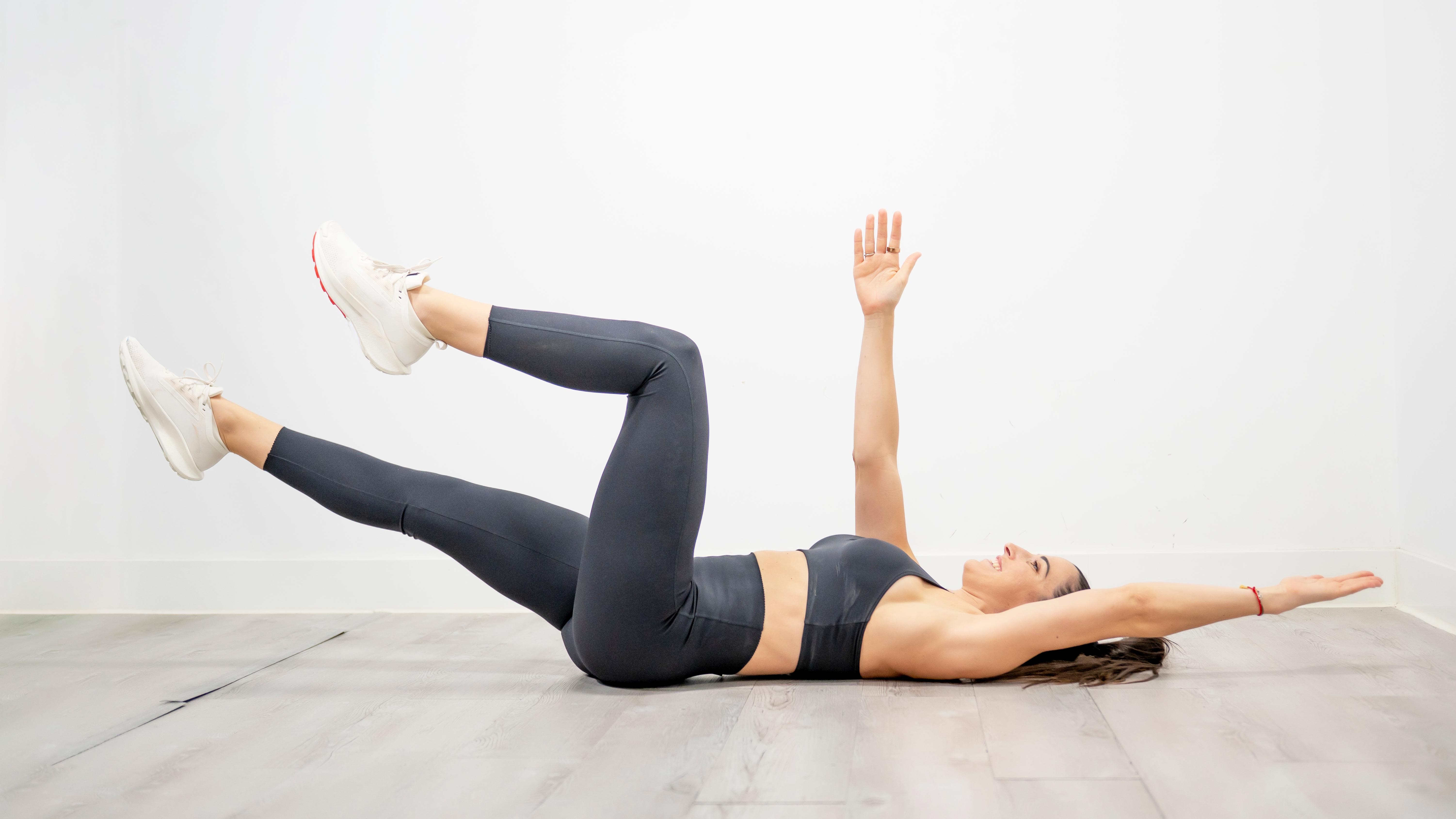
4B Dead bug
Sets: 3 Reps: 6 each side
- Engage your core to press your lower back into the floor throughout.
- Slowly alternate lowering one arm and the opposite leg toward the floor.
Warm up and cool down as per Monday’s strength workout. For each superset, perform exercise A, rest for 30 seconds, then perform exercise B, and rest for 60-90 seconds.
Marchon says: “This session swaps in single-leg and overhead work, so you’re challenged in different positions to Monday.”
Thursday: Run Intervals
- Warm-up: 10min easy jog at an effort level of 3-4/10
- Intervals: 6 x 1min at 7/10
- Recoveries: 2min easy jog after each interval at 2-3/10
- Cool-down: 5min easy jog or walk at 3/10
Warm up as per Tuesday’s run, finishing the 10min easy jog with three 10-second sprints to get ready for faster running. The intervals should feel comfortably hard, meaning you can utter a few words at a time, no more. Let your breathing settle during the two-minute recoveries before each next effort.
Marchon says: “The one harder run of the week. Short efforts improve your speed and your heart’s capacity without the strain of a long hard run. Aim to run every effort at the same pace. If the last one is much slower than the first, you started too fast.”
Friday: Rest

Walking, mobility, or a gentle yoga class is fine, but keep it light.
Marchon says: “Recovery is where the adaptation happens, so take this day seriously.”
Saturday: Hybrid Circuit
1 Run
Time: 3min
- Run at an effort level of 5-6/10.
- Keep breathing steady and controlled, aiming for the same pace each round.
Reps: 10
- Hinge at your hips, keeping your back flat.
- Grasp the weights and drive your hips forward to stand.
Reps: 8
- Hold the weights at shoulder height, palms facing each other.
- Bend your knees slightly, then explode up to power the weights overhead.
Reps: 16 (8 each side)
- Perform these with just your bodyweight or light dumbbells.
- Take a big step forward, lower yourself with control, then power forward.
5 Burpee
Reps: 8
- Drop your hands to the floor, jump or step your feet back.
- Jump or step your feet back to your hands, then stand tall with an optional jump.
Warm up as per Tuesday’s run, then perform one easy practice round of the stations above with light dumbbells before you start. Aim to complete four rounds, resting one minute between rounds. Use moderate weights. This is about moving continuously, not lifting heavy.
Marchon says: “This hybrid session ties the week together. You run, then lift, then run again while you’re still a little tired, which builds the ability to keep moving well under fatigue. Treadmill users can do the runs indoors. Outdoors, run an out and back route of 90 seconds each way and leave the dumbbells at your starting point.”
Sunday: Long Easy Run (optional)
30-40min run at an easy pace (3-4/10 RPE)
Warm up and cool down as per Tuesday’s easy run. Set a pace that means you finish feeling like you could have gone further.
Marchon says: “This long easy run is optional in week one; it becomes a key session as the plan progresses. You can use run-walk intervals if you need. If your legs feel heavy from the week, swap in a brisk walk for 45 minutes.”

How to progress this hybrid training plan after week one
This week-long hybrid training plan sets the template to build both strength and cardio in parallel. Marchon recommends sticking with it for a minimum of six weeks.
“Think long term,” he says. “The real aim is a lasting training habit that keeps improving your strength, fitness, health and longevity.”
That means challenging yourself with slightly heavier weights, running for slightly longer, or repeating an extra few reps, sets, or intervals as your strength and fitness improves.
If your sleep starts to suffer, you still feel sore 48 hours after a session, or something hurts rather than just feels worked, Marchon suggests repeating the week rather than moving on.
“Progress that holds beats progress that breaks,” he says.
After six weeks, Marchon suggests repeating the six-week plan starting with your new weights and run times.
“Minimal kit will take you a long way, but in time you’ll need heavier weights and more structured training to keep challenging yourself.”

Follow Tom’s Guide on Google News and add us as a preferred source to get our up-to-date news, analysis, and reviews in your feeds.
More from Tom’s Guide
Next Badge:
More Comments/Likes Until Your Next Badge