Author: admin

  • How AI Is Changing Strategy: Rethinking What Your Business Is Designed to Do

    How AI Is Changing Strategy: Rethinking What Your Business Is Designed to Do

    October 08, 2026

    AI is advancing so quickly that companies can’t afford to treat it as simply another productivity tool; it is fundamentally reshaping strategy. In this final episode of our special four-part series on how AI is changing leadership, Wharton professor and AI expert Ethan Mollick explains why leaders need to rethink what their organizations are designed to do—and how work gets done. He discusses how AI agents are changing the role of managers, why companies need to experiment rather than wait for proven playbooks, and how leaders can create competitive advantage when everyone has access to the same frontier models. Mollick is author of the forthcoming book Co-Existence: The Next Phase of AI.

    Plus:

    • Why AI-driven productivity gains can disappear if companies don’t change their processes and incentives
    • The four capabilities that will become increasingly valuable: deep knowledge, wide knowledge, taste, and agency
    • Why companies should build for what AI will be capable of, not just what it can do today

    In case you missed it, you can find the rest of our AI series below.

    How AI Is Changing Innovation: Why Speed Alone Isn’t a Strategy

    How AI Is Changing Communication: Weighing Efficiency with Efficacy

    How AI Is Changing Talent, Not Just Tasks: Rethinking Where Human Judgment Matters Most

  • AI breakthroughs in robotics won’t change your life any time soon

    AI breakthroughs in robotics won’t change your life any time soon

    The story is a collaboration between MIT Technology Review and Aventine, a non-profit research foundation that creates and supports content about how technology and science are changing the way we live.

    A robot shaped like a human—white with a black head and torso—has been popping up on video feeds. Perhaps you’ve seen it dance or pass popcorn, put trash in a bin, vacuum, or press the button of a microwave. Or maybe you’ve watched it fall backward while handing out water bottles or struggle to iron a shirt. 

    This would be Tesla’s Optimus, an AI-powered humanoid robot that Elon Musk, the company’s CEO, believes will be “not just Tesla’s biggest product ever, but probably the biggest product ever,” headed to work on factory floors and, later, in our homes. Eventually it “will have human and then superhuman dexterity,” he told shareholders in July. Optimus robots could automate almost all human labor—from hauling sheet metal to folding laundry—for as little as $20,000 each, Musk argues. Speaking at the World Economic Forum’s annual meeting in Davos, Switzerland, in January, he predicted they could be on sale to the public by the end of 2027.

    Musk is not alone in his evangelism. Marc Andreessen, cofounder and general partner of the Silicon Valley venture capital firm Andreessen Horowitz, has said that robotics could become the “biggest industry in the history of the planet.” In January, Jensen Huang, CEO of Nvidia, said that humanoid robots would match human-level ability this year. According to Morgan Stanley, the number of robots that “resemble and act like humans” is likely to reach nearly 1 billion by 2050, creating a market worth over $5 trillion. 

    Elon Musk predicts that Tesla’s Optimus humanoid could be one the world’s best-selling products. For now, it’s most often seen handing out food and drinks at Tesla events.

    SIPA VIA AP IMAGES

    Such proclamations are in large part fueled by the idea that the same AI advances behind tools like OpenAI’s ChatGPT and Anthropic’s Claude will enable a new generation of robots to imitate human movement the way chatbots imitate human language. But many robotics researchers are skeptical, arguing that such assumptions minimize the challenges of using an intelligence built on language and images to master the infinite variability of the physical world. “None of those companies [building humanoid robots]—absolutely none of them—has any idea how to make those robots smart enough to be useful,” Yann LeCun, often referred to as one of the godfathers of AI, said at another event during the January Davos conference.  

    Researchers also point out that the tendency to conflate humanoid robots made to resemble people with so-called generalist machines able to learn and perform multiple tasks is misleading. ”It’s very easy to make a robot that looks like a person,” explains Jonathan Hurst, cofounder and chief robot officer of Agility Robotics and professor of robotics at Oregon State University. “It is dramatically more difficult to make a machine that moves or behaves dynamically or physically like a person.”  

    These tensions—over whether all-purpose humanoid robots are just around the corner or nowhere in sight, and whether current forms of AI are all that’s needed to perfect them—are playing out in robotics labs across the country, where the hype over timelines is obscuring painstaking but meaningful progress.

    A decade or so ago, a series of breakthroughs led to a generative AI revolution that turned the long-imagined possibility of artificial intelligence into reality. Roboticists—though they disagree on exactly when this will happen—believe that an equally transformative revolution is possible in robotics, one that will endow machines with physical intuition and fluidity that has long been out of reach. As progress in robotics inches forward, the question is whether the same methods and tools that fueled advances in AI are enough to get there, or if an entirely new path is required.

    Robots meet advanced AI

    To see one of the smartest robot brains working today, it’s worth looking at what Google DeepMind can do with a piece of equipment called ALOHA 2, short for “A Low-cost Open-source Hardware System for Bimanual Teleoperation.” 

    Roboticists have long clashed over whether a humanlike form is necessary for generalist robots, with proponents arguing that it will help them slot into the world as it exists and detractors saying it’s not worth the trouble. ALOHA 2 reflects this second way of thinking. Not much to look at, it’s just a pair of arms, some grippers, and a couple of cameras. But despite its seeming simplicity, it is a workhorse for researchers at Google DeepMind, who use it to test their most advanced AI for robotics system, Gemini Robotics, in their various labs.

    When controlled by Gemini Robotics, ALOHA 2 becomes more of a generalist robot, in the sense that it can perform any number of tasks based on examples it’s been trained on. Ask it to pack a lunchbox and, as evidenced by a video of this exercise, it can use two pincer grippers to delicately place a piece of white bread into a Ziploc bag, close it, place a bunch of grapes in a Tupperware container, secure the lid, and then carefully move the items into a lunchbox before zipping it up. 

    It’s not a great lunch. But the fact that the robot can put it together represents an objective step forward from what was possible even, say, three years ago. 

    This is in large part due to AI and its impact on what are known as robot policies, which controls how a general-purpose robot will need to assess and understand its surroundings, plan how to move within them, and then perform its task correctly.

    Historically, these policies were based on rules developed by engineers who hard-coded them into the robot’s software—thousands of lines of code that would determine each millimeter of a robot’s movements in hundreds of tasks. What’s been happening for the last few years—and what is largely responsible for the optimism about generalist robots—is that robot policies are being handed over to advanced AI systems instead of being coded into the robot’s software. This first happened with VLMs, or vision-language models. These are similar to large language models, but they’re trained on images as well as words. Show a VLM a picture of a coffee spill and ask it to find a tool to clean up the mess, and it can identify a nearby cloth. This sort of immediate contextual understanding didn’t exist a couple of years ago when robot policies were hard-coded. 

    Next came vision-language-action models, which enable robots to assess their environment and take action within it. The models do this by adding yet another component: motion commands. VLAs are trained on a series of images or videos related to performing a given task along with associated data about how a robot arm moves to perform it. That movement data is typically collected through teleoperation, in which a human uses remote controls to lead a robot through an action. This sort of training allows the AI to learn how to command the robot to move and operate during a given task. Place a VLA-powered robot in front of a desk and tell it to “close a laptop” or “wrap up the headphone wire,” and it will survey the scene, identify the relevant object, plan a way to execute the request, and then swing its arms into action—at least if it has seen this task accomplished before. 

    The Gemini Robotics model is a VLA, trained on many hours of human demonstrations depicting a vast array of different actions. As a result, it can perform relatively complex tasks like picking up snow peas with kitchen tongs, doing origami, or putting together a simple lunch. It’s impressive, but there’s a glaring limitation: For now, if a robot controlled by a VLA is asked to perform a task that falls outside its training set, it’s highly likely to fail. 

    “Thinking about the space of all tasks, a real generalist policy would be able to do everything along that spectrum,” says Edward Johns, a robotics professor at Imperial College London. Today, though, a Gemini Robotics model can do only “a few things here and a few things there.”

    The search for true generality

    So how do we get robots to be able to do more things? The usual answer is probably not surprising: Train them on more data.  

    More data, the thinking goes, equals more examples, and more examples equals more generality. Google DeepMind, for instance, wants to pull together “as much data as possible,” says Pannag Sanketi, a former tech lead in robotics at the company who’s currently working on his own AI robotics project. But where to get it? Large language models had the benefit of oceans of existing text for training. There is no corresponding pool of high-quality physical demonstrations on which to train robots. Researchers have a few ways to make up for this, but all have flaws. One is to employ large numbers of people to create and collect teleoperation data (costly and time-consuming). Another is to train VLAs on videos of people performing activities (the resulting data quality is poor). Yet another is to deploy robots in the real world and use data collected from those experiences to further refine AI models (robots aren’t safe or reliable outside labs). Sanketi thinks a “multi-prong” approach that uses data collected from all these sources is the most likely path forward.

    But the belief that training data alone is the answer is far from universal. Agility’s Hurst describes it as “a fundamentally flawed premise.” 

    The issue is that tasks in the real world quickly explode in complexity. If you’re trying to, say, make coffee, there are myriad variables: No two kitchens are identical; coffee machines work in different ways; different cups require different grips; coffee grounds, hot water, and milk all need to be handled differently. Even this simple task requires understanding an ever-changing menu of possibilities. Achieving generality through VLAs, Hurst argues, would require “complete data coverage of all of the things that [a robot] could ever do.” Or, in other words, an almost infinite pool of training data. 

    LeCun is dismissive of the whole approach. “The [AI] approaches that have been successful for language do not work for high-dimensional, continuous, noisy data”—the kind of data that is commonplace in robotics, he said in Davos. “You have to use something else.”

    The leading contender for “something else” is the so-called world model—a form of AI trained less on text than on a combination of video, three-dimensional scans, and sensor data and built to predict the outcomes of actions in the real world. The aim is to build models that possess an internal representation of reality precise enough to capture how the physical world actually operates—how objects move, collide, fall, and deform. If roboticists could train machines in simulations faithful enough to real-world physics, development would become faster, cheaper, and safer, reducing the need for real-world testing. Even more transformative, robots equipped with world models could reason about their surroundings rather than merely reacting to them, helping them anticipate the consequences of an action before taking it.

    Companies like Nvidia and Google are working on the technology, and investor cash is pouring into high-profile startups. World Labs, cofounded by the Stanford AI researcher Fei-Fei Li, raised $1 billion in funding in February and was acquired by AMD at the end of September for $8.2 billion. AMI Labs, cofounded by LeCun (formerly Meta’s chief AI scientist), also raised $1 billion in March. Yet by their own admission, it is still early days. Late last year Li described the field as “nascent,” adding that “foundational approaches are still being established.” In a June Substack she described daunting challenges. For now, world models are a promising area of research rather than an immediate route to general-purpose robotics, but we are beginning to see glimmers of what they could achieve.

    One such glimpse came with a small but potentially significant leap forward that took place in a San Francisco robotics lab last April. 

    A breakthrough?

    In the heart of San Francisco’s Mission District, the startup Physical Intelligence—or PI (as in π), as it likes to be known—is focused on developing a universal brain that could, theoretically, turn any robot into a generalist. Using an everything-including-the-kitchen sink approach to training AI models for robots, the company recently observed a hint of what a robotic brain equipped with a world model could be capable of. 

    In 2024, PI published details of its first generalist robotics system, called π0, a VLA it claimed was the “most capable and dexterous generalist robot policy to date.” The model was initially trained on a 10,000-hour proprietary collection of human demonstrations gathered through teleoperation as well as several open-source robot datasets. A version released in spring 2025, π0.5, was trained on a wider variety of datasets, including labeled images from the web, lending it more versatility. A fall 2025 update, π0.6, added reinforcement learning to the model.  

    Each update yielded important improvements to the model’s performance, increasing its menu of abilities from slowly folding laundry to putting things away in new environments to completing tasks like folding boxes with a higher success rate. Then, in April 2026, π0.7 seemed to catapult PI into new territory. This version makes use of a less powerful world model that generates images of steps necessary to perform a task. As the robot undertakes the job, this “lightweight” model feeds it snapshots of what to do next. 

    The company claims that the model exhibits the first signs of compositional generalization, a term for AI systems’ ability to perform skills they’ve never been exposed to by recombining ones learned in their training data. One test involved asking a model to “load a sweet potato into the air fryer”—a task it had never previously encountered. In a demonstration video, the machine futzes around a little, makes a few false starts, and eventually manages a reasonable effort, though it doesn’t finish the task completely.

    Sergey Levine, a professor at the University of California, Berkeley, and a cofounder of PI, is excited by the potential: “It’s actually the first time that we’ve convincingly seen that kind of compositional generalization, where we can basically ask the model to do tasks that we did not specifically collect data for and train it to do, and it’ll actually make a passable attempt.” 

    The success led the team to wonder how the model was able to achieve such a feat. After some digging, they found snippets of relevant labeled teleoperation data lurking in the training material, including two examples of a human controller using the robot to push an air fryer basket into the fryer. Those shreds of data might have been enough to enable π0.7 to almost air-fry a sweet potato.

    For now, it remains unclear just how impressive π0.7’s abilities to generalize are. Still, given how fleeting the model’s exposure to air fryers had been, it offers a glimpse into how far cutting-edge research can currently take robots. 

    “70% success is like it doesn’t work”

    You might be sensing a disconnect between the halting baby steps robots are making in labs—“Look! It put a sweet potato into an air fryer!”—and the dazzling, lifelike nimbleness on view during many demonstrations and videos, where robots are seen doing everything from dancing on a stage to courteously serving drinks. Such demos often don’t clearly reveal a key fact: In many instances, humans are controlling the robot or have carefully scripted its actions. (The robot that appeared onstage with Nvidia CEO Jensen Huang in March 2025, for example, seemingly responding to his instructions and following him around, was remote-controlled by what its makers called “a puppeteer behind the scenes.”) 

    For now, fully autonomous motion planning so that a robot knows where it should go—especially in new, chaotic environments like a construction site or a unfamiliar home—remains a largely unsolved challenge. A bigger challenge still—albeit one that is often related—lies in getting robots to tackle larger, more ambiguous jobs that include multiple tasks and require decisions about how and in what order they’re done. This would be the difference between a robot that can put a plate into a microwave and one that can successfully respond to the prompt “Make dinner” by exploring the refrigerator, chopping ingredients, and firing up the stove. Google DeepMind’s best attempts at something like this—which involved asking its robot to survey a kitchen and pack all the ingredients for a mushroom risotto into a basket—have so far resulted in failure.

    Adding to the challenge, a practical robot must essentially get it right every time. With VLAs, “people are very excited when their result goes from 50% success to 70% success,” says Marc Raibert, founder of Boston Dynamics. “But 70% success is like it doesn’t work, right?”

    split screen of nine clips with different robots attempting tasks; some are teleoperated and a few have collided with objects or fallen.
    Demonstrations often make robots look useful, but the machines still mess up far too often to be used reliably in homes and factories.

    AP IMAGES, SHUTTERSTOCK, 1X, AGILITY ROBOTICS, GOOGLE DEEPMIND

    The few humanoids that are being tested in real-life settings are undertaking extremely limited tasks in tightly controlled environments. They’re far from generalists. Agility has hundreds of robots deployed across trials in facilities owned by GXO Logistics, Amazon, and Schaeffler, according to the company. But for now, Hurst says, the robots are targeting simple tasks such as moving bins and totes around. Even then, he adds, it took years to develop robots safe enough for logistics firms to even contemplate using them. For his part, Elon Musk claimed in May 2025 that “thousands” of his Optimus robots would be working at Tesla factories by the end of the year, but in January of this year he said that the company had only “some of the Tesla Optimus robots doing simple tasks in the factory.”

    While humanoids are starting to venture onto the factory floor, making the jump to households will be even more difficult. Right now, should you so desire, you can preorder the 1X Neo home robot, expected to be ready for delivery sometime later this year. Yours for $20,000, it promises to take on “the boring and mundane tasks around the house”—putting away dishes, answering the door, tidying the living room—“so you can focus on what matters to you.” The idea is for this five-foot-six-inch robot to one day perform all those tasks autonomously, but for now a remote human operator is needed for it to do most things. (Yes, a person would need permission to peer into your home through the robot’s cameras.) Asked how long it will be until fully autonomous robots are ready for domestic work, Hurst said, “If I had to pick a number, I’d say it’s 10 years before robots are … actually doing useful things in people’s homes.”

    When that happens, the robots might well be Chinese, as China is well ahead of the West in terms of production. Nearly 90% of the roughly 15,000 humanoid robots shipped in 2025 were made by Chinese companies, according to the market intelligence company Omdia and the Chinese robotics firm Unitree. One model produced by Unitree, which shipped more humanoid robots than any other company last year, costs less than $6,000. Such an affordable price could go a long way toward making robots more attractive to consumers, though the company expects its machines to be used in industrial applications first. (If you’re wondering who is buying all these Chinese robots, by the way, the AP recently reported that orders come predominantly from corporate and academic labs and state-owned enterprises.)

    We’ve been here before 

    The dream of building a humanoid robot runs deep: As far back as 1495, Leonardo da Vinci sketched out designs for a mechanical knight, controlled by cables and pulleys. Through the 20th century, machines of sci-fi fever dreams have come and gone. 

    Jeanne Dowling reaches up to light a cigarette for Elektro, a seven foot robot built by Westinghouse.
    Westinghouse’s Elektro was a sensation at the 1939 World Fair.

    GETTY IMAGES

    Westinghouse’s seven-foot-tall box on legs, Elektro, hit the New York World’s Fair in 1939, smoking a cigarette. WABOT-1, built by Waseda University in Japan in 1973, was the first full-scale, programmable humanoid robot. Honda’s ASIMO, unveiled in 2000, was probably the first such machine to prove at all competent—it could, at least to some degree, climb steps, recognize faces, and autonomously move through spaces. But the robot was discontinued in 2018, unable to advance far enough beyond what it could do in demonstrations to be useful. 

    All, at the time, were impressive—even jaw-dropping—feats of engineering. But none were ready to navigate the real world. Today’s robots, even with the transformative power of advanced AI, still face the same existential challenge.

  • Halo

    Notifications, dictation and AI agents in your Mac’s notch

    Discussion
    |
    Link

  • Edgee Mod for Claude Code

    Use any model inside Claude Code, keep your Claude plan

    Discussion
    |
    Link

  • Building a safer path to autonomous industrial AI

    Building a safer path to autonomous industrial AI

    Industrial AI is entering a new phase. After decades of predictive analytics and other specialized applications, advances in foundation models, physical AI, and agentic AI are making it possible to automate more complex tasks across industrial environments. But unlike AI that operates purely in the digital world, industrial AI can interact directly with physical systems, where an unexpected decision can have consequences for safety, reliability, and critical infrastructure.

    That makes responsible deployment central to the next wave of industrial automation. “How do we leverage these technologies while maintaining safety, while maintaining reliable operations, while still being able to deliver on the promises of the new capabilities?” asks Arti Garg, chief technologist at AVEVA. The challenge is particularly acute as newer AI systems become more capable but also harder to predict and explain.

    One foundation for making that transition work is data. Industrial systems often contain information across telemetry, service logs, engineering documents, and other disparate sources. Newer technologies can help connect and correlate that information more quickly, giving operators real-time support when diagnosing problems. AI-powered robots could take that a step further by gathering information in hazardous environments without requiring workers to enter them.

    But greater autonomy also requires new approaches to governance. AVEVA’s framework for responsible AI emphasizes security, efficiency, and human safety and oversight. Garg argues that AI should augment rather than replace people in critical decision loops, with guardrails determining where automated systems can act and where human supervisors remain responsible.

    Sustainability is another part of that equation. AI can help manage complex power systems as renewable generation grows, while organizations also need better ways to understand AI’s own environmental footprint. Garg is involved in an IEEE working group developing a standard methodology for measuring that impact across electricity, energy, resources, water, and carbon.

    The next phase could bring industrial AI further into the physical world, from autonomous robots and drones to AI-assisted coding that allows domain experts to build new applications. But realizing that potential will require more than deploying new technology, says Garg. Organizations will need to rethink business processes, establish appropriate safeguards, and give experienced workers new ways to apply their expertise, creating a model of automation that is not only more autonomous, but safer, more efficient, and more sustainable.

    “Autonomous systems, whether they’re robots or drones, are really going to change the way that we work in plants, in power systems, on mining sites,” says Garg. “In a way, that will make these types of operations more efficient, much safer for the human beings involved and more productive.”

    This episode of Business Lab is produced in partnership with AVEVA.

    Full Transcript

    Megan Tatum: From MIT Technology Review, I’m Megan Tatum, and this is Business Lab, the show that helps business leaders make sense of new technologies coming out of the lab and into the marketplace.

    Industrial AI may not be new, but it is developing at a breakneck pace. From modern predictive analytics that can preempt equipment failures, to autonomous robots tasked with inspecting high risk machinery, emerging applications have the potential to transform operational efficiencies. But often used in high consequence environments with minimal margin for error, industrial AI deployed without clarity, security, or accountability could also have catastrophic consequences for critical infrastructure over time. As industries rush to embrace the latest technologies, the goal should always be responsible AI designed to support, rather than replace that all important human judgment.

    Two words for you: sustainable automation.

    My guest today is Arti Garg, chief technologist at AVEVA.

    This podcast is produced in partnership with AVEVA.

    Welcome, Arti.

    Arti Garg: Thank you, Megan. It’s great to be here.

    Megan: Thank you so much for joining us. And just to start, if we could set some context for our discussion, can you share a bit about the current state of industrial AI and what AVEVA is working on at the moment as well?

    Arti: Yeah, more than happy to. And I want to go back to what you already stated, which is that in some ways, industrial AI is not new. It’s something that, even here at AVEVA, we’ve been working on for more than 20 years, really thinking about how AI can enhance applications in the industrial sector.

    But what has changed quite substantially in maybe the last few years is the type of AI. We’ve really moved to these general purpose foundation models, which enable a lot more people to leverage advanced AI technologies. In addition to that, in just the last couple of years, there’s been an explosion in what’s known as physical AI and the types of AI that can really accelerate the capabilities of robotics and autonomous systems. And also agentic AI, which also allows for automation at more of the software level.

    And what we’re seeing is that while in the past there has been some hesitancy to adopt models that don’t totally have predictable outcomes, there’s been a rapid acceleration in adoption of AI even in the industrial sector. One study suggests maybe that’s almost a 78% increase over the past just two years within the industrial sector. So yes, that’s an inflection point, but it’s almost like a step function if you think about it with respect to AI adoption.

    And what we’re really thinking about now at AVEVA is, how do we think about this? How do we think about incorporating these new and very powerful AI technologies in environments where customers have mission-critical operations, human safety is a significant factor? Those are some of the primary concerns that our customers have when they think about adopting any new technology. We’re doing that in narrow where these newer types of AI aren’t necessarily predictable, in terms of how they behave. That’s one of the areas we’re really thinking about is, how do we leverage these technologies while maintaining safety, while maintaining reliable operations, while still being able to deliver on the promises of the new capabilities?

    Megan: There’s so many things to consider at once, isn’t it? And you outlined there some of the huge developments we’ve seen in this space in recent years. What makes this such a pivotal moment for industrial AI specifically? What has changed to make some of those perhaps more out there hypotheticals much more plausible?

    Arti: Well, I think one of the big things, one of the big challenges within industrial AI, and this is something that as AVEVA, it’s in our blood, it’s in our core DNA, is that to really leverage any kind of digital technology in the industrial space, one of the first important things you often need to do is gather and correlate data from disparate systems, so that maybe I have telemetry coming off of a pump or a mixer, and I want to be able to correlate that with service logs so I know maybe the last time that someone had done some maintenance on that pump or mixer. And maybe I also want to be able to correlate that with the original design documentation and some of the original documentation on how to maintain that, so that if something is happening, I can do a better job diagnosing what’s going wrong and how to address it. This has always been a core challenge in the industrial space.

    I think that what’s happening now is that with newer technologies, even things like graph databases and being able to leverage AI to really match disparate data sets much faster, we’re able to get to the point where if something goes wrong, instead of an operator maybe needing to spend a little bit of time doing this research to really understand how do these different components fit together of information, they may have just an iPad with an AI that can very quickly go and fetch that information, correlate it and help in real time, almost, diagnose what is happening.

    Even a little bit more out there, but not as out there as you might think is, I still describe this with a human operator with potentially a mobile tablet, but imagine now I can also have a robot moving through that environment also gathering data and either with onboard computation or a quick connection to an operator who doesn’t necessarily now have to go out into a dangerous, potentially somewhat hazardous space, be able to gather data and enable that very quick diagnostic as well. And I think that’s really what’s exciting right now and what all of these new technologies that I’ve talked about are helping to enable.

    And I think then from our perspective, trying to really leverage all of those means that we have to think a lot now about our governance approach to this. How do we leverage AI in a way that keeps it contained, if you will?

    Megan: Yeah, absolutely. And on that governance point, how does AVEVA define responsible AI and what do you see as the primary benefits?

    Arti: Yeah, so I think for us, we think about a triple mandate around responsible AI, and that means that it’s secure, it’s efficient, and that includes environmentally efficient, and then it really preserves human safety and human oversight above all. And for us, that’s what some of our core pillars of responsible AI include. And for us, that means we think about internally as we build tools, a multi-layered governance approach where we’ve got both for how we use AI as a company and then how we deploy AI into our products. We’ve got a similar framework that we leverage across both, a kind of joint governance model, both around how we’re leveraging AI and also how we’re infusing AI into our products to allow our customers to leverage AI in their operations.

    But I would say one of the core foundational principles underneath all of these is that human beings still remain centered in how we think about how AI is leveraged. And so human judgment, human responsibility, human ethics are still core to how we think about where AI can add benefits, and we think about it more as augmenting rather than replacing human beings in critical decision loops, if you will.

    Megan: Right, which is such an important distinction, isn’t it? And in terms of the next phase of development, there’s growing sentiment that agentic AI will soon allow these industrial systems to operate much more autonomously. I wonder, what makes the risks in industrial settings different from AI risk in a purely digital context? And I suppose on the flip side, what are the benefits and opportunities of that same software defined automation?

    Arti: I think we can start with the risks and then go to the benefits. I think ultimately, I would say the biggest risk in the industrial setting is that we are interacting with real physical systems, often physical systems that are very capable of delivering important outcomes that keep our world running, whether that’s delivering power, whether that’s mining for natural resources. But usually. Those physical systems are also operating in hazardous environments, the equipment itself is capable of also having human safety implications. Anytime you’re interfacing software with a physical system that can have real world consequences, you have to be extra careful. And we’ve always had that, again, we’ve had that in our DNA at AVEVA from the beginning, being mindful of that end user and that end application, which is not just something on a computer screen.

    Even as we’ve deployed AI over the past few decades into our systems, we’ve typically leaned toward really trying to pick the best fit model, really understand that model’s behavior if we’re going to use, for example, we have a proprietary anomaly detection model that works in a lot of operational environments. Now, as we’re thinking about some of these newer AI capabilities, which by design are hard to understand how they behave, they’re not fundamentally explainable in the way we’ve thought about even AI or statistical models in the past, and actually their behavior can change over time as they learn and get tuned to new capabilities. That’s really the potential risk of automating a physical system based on capabilities that can evolve over time is one of the things that we have to be really mindful of and really thoughtful around, where are we willing to put some of that increased automation into practice?

    But at the same time, I think there’s a real opportunity there, because I glossed over this idea that, okay, well, models evolve, but so do human beings, and sometimes that’s a good thing. We talk about humans having expertise and they gain understanding over their careers of how a system works. If we can actually leverage the ability of some of these newer AI capabilities, these sort of reasoning models often have underlying agentic capabilities, to learn and gather experience faster, and potentially even more importantly or more valuably, take experience that’s learned at one site and apply it to another site, then that’s a real opportunity to take what we already know works for human beings, which is that sometimes you just have to learn by doing and be able to apply that and scale that through AI. That’s where I see potentially a real opportunity in this space.

    One of the things that we’re really aware of in the industrial sector is just the way that our workforce is changing. I think that almost half, not quite half, of the industrial workforce is set to retire in the next five years, and that’s a lot of expertise and experience that means that we’re going to lose in the sector. If there’s ways to make sure that we can capture that in ways that are actionable, in ways that can also help a newer generation of workers that are used to experience things in a different way, apply that expertise, apply that knowledge, then I think that’s a huge opportunity within the industrial space.

    Megan: Yeah, absolutely. Clearly, some huge opportunities there particularly against the backdrop of other market and workforce changes as you’ve outlined there. I suppose building on that, what is the potential for these autonomous industrial AI systems when built and deployed responsibly to facilitate even faster, more sustainable industrial processes?

    Arti: I think there’s a couple different ways to think about this. One is, what are the demands of potentially more environmentally sustainable processes? I’ll use one example of something that my team has been working on in partnership with Idaho National Laboratory here in the U.S. as part of their testing for AI grid resilience project.

    One of the challenges in the electric grid as we’re moving toward a future where we have a lot more intermittent renewable power generation sources, often distributed rooftop solar for example, is it’s becoming much more challenging to manage the grid both from really understanding where electric capacity is coming in, electric load is pulling off of the grid. In addition to that, being able to maintain just power quality because instead of having one spinning asset delivering the frequency of electricity that’s going across the grid, you’ve got a lot of smaller systems. AI is actually quite critical for being able to manage that grid of the future. And this is one of the things that we’ve been working in partnership is, how can we do that? How can we help grid operators better understand what’s happening across their system, identify where things might be behaving anomalously so they can detect that early and then remediate for it?

    At the same time though, I always talk about that’s an example of where AI can potentially help us accelerate the transition to a lower carbon energy future. At the same time, I think there’s a lot of conversation around the sustainability of AI itself. What are the power requirements? What are the resource requirements needed to run AI? And before I get into how do we think about that at AVEVA, because it is definitely something we think about and I think a lot of actors in the space are thinking about, I want to point out, is one of the challenges is that there’s really no agreed upon method to measure the environmental impact of AI. You see a lot of these stories, like one query on some kind of chat interface is X amount of gallons of water or this amount of electricity use. But the truth is that community-wide, there’s no agreed upon standard.

    One of the things that I’m involved with is a standards working group that was launched by the IEEE two years ago, a little over two years ago. I’m the chair of that working group, it’s called the P7100 Standards Working Group on measuring the environmental impact of AI. And one of the things we’re trying to do is really identify all the different areas over which we want to think about environmental sustainability associated with AI, and then having one standard methodology that works and that can be adopted both from a reporting perspective and potentially also from an oversight or regulatory perspective. That becomes really important for any sort of real understanding of how AI impacts the environment is just we have to know, what does it use? We want to look holistically at that. Our standards cover electricity and energy consumption, it covers resource usage, it covers water consumption, and it also covers carbon.

    But all of that said, I think it’s important for us to understand the footprint of AI, but I think it’s also important for us to simultaneously recognize that a bigger model uses more compute and more compute probably leverages more resources. The more that we can be intentional and pick the right size model for the right application, the more we can already start down that path of being more environmentally efficient in the AI that we run. One of the potentially nice side effects of that is the more purpose-built a model, the less likely it is to misbehave in unpredictable ways, if you choose correctly your architecture. There’s some sort of ancillary benefits that go beyond environmental sustainability.

    Megan: Fascinating. It’s really, really interesting to hear some of the work going on behind the scenes there, because I think we’ll all have heard some of the statistics around the environmental impact, as you say. So, it’s great to understand some of the work going on there to really clarify that.

    And we’ve talked a little bit about AI augmenting humans earlier. As systems gain greater autonomy, how should organizations think about that balance between closed loop automation, human in the loop accountability? What guardrails need to be in place? And how are governments and cross-border actors approaching those concerns as well?

    Arti: There’s a lot packed into that question, so I’ll try to answer it somewhat one by one. First, starting with that sort of balance between closed loop and human in the loop, automation and accountability. One of the things that we talk about in the industrial sector is from human operator to human supervisor of systems, of industrial systems. And if I’m honest about that, we’re still trying to figure that out. When a human’s in a loop in an automated system, you’re really thinking about a system may process all the data and then make a recommendation.

    We’ve got a solution that we’ve been working on more jointly with a few different customers where we’re able to take in a lot of their operational data, also some simulations of how their systems work, and be able to provide, say, recommendations around, you should now operate at this set point instead of that set point based on some of the other conditions that are changing in your plant. There’s a lot of interest in moving from having that be a recommended set point to have an automation that can automatically adjust the set point. And we’ve actually had some successful real-world pilots around that as well.

    But when you get into that, obviously it makes people very nervous if you’re changing set points on industrial equipment. That’s where you maybe continue to have some guardrails around like, you can’t go outside of a certain band, for example, of operations, or we only allow the automation in certain areas. That’s where the human supervisor, the same way a human supervisor might give employees a lot of bandwidth or a lot of flexibility to make decisions around certain things, around other things, they’re hard and fast, like this is the deadline or this is the sort of production target. It’s like that. So thinking about, how do you put the appropriate guardrails?

    The challenge is, AIs are not human beings, and so the guardrails look different, and I think that’s one of the things that there’s still to think about. That question of, what guardrails should be put in place? I think that it’s going to be probably dependent a little bit on the application, but over time I think we’re all going to learn, and so being really upfront and thoughtful about how we do this I think is important.

    But the opportunity though, potentially, is really great. I’ve already mentioned that AI can be very useful in synthesizing a lot of information and bringing to the forefront, this is what matters. That’s something that we do want to create some space to experiment around, but what’s then important is making sure that a human being understands the risk.

    I’ll give a little bit of a personal story because it might be illustrative. This weekend, I bought a little toy robot and decided I wanted to program it to do some stuff, and I found AI very, very helpful to get me started to read all the documentation. Putting the robot together was straightforward, they had nice instructions, but there’s a pretty heavy software developer kit that’s already there, but going through and reading all that documentation can take a while. AI was super helpful to help me surface, this is the function that does this, to help me get started. But occasionally, it made really bad recommendations on the best way to troubleshoot something.

    That’s where I think having the human being in the loop, being able to say, “I know that it’s not going to be the best software architect or the best troubleshooter,” is really helpful because I had the opportunity to leverage AI for what it’s good for, synthesizing and surfacing a lot of information, but being able to say, “I don’t think that’s the most efficient first step. Let’s try something else.” That’s where it’s a really different way of working, but it’s something that I think as humans get more comfortable with the power and limitations of AI, you can start to teach people how to work with it, and it’s very different from how you would work with other digital tools.

    One of the things that is important when it comes to AI is recognizing just the breadth of things that it touches and the breadth of impacts that it’s going to have, whether it’s on the environment, as we’ve discussed, whether it’s on productivity as sort of implicit in this entire discussion, whether it’s on labor force, whether it’s on just how economies work. From my eye, and I’m by no means a policy expert in this area, but from my eye, what I’m seeing is that different governments are prioritizing different aspects of that from how they’re thinking about regulatory and other kind of governance approaches.

    Megan: We’re absolutely seeing some really vastly different approaches to this, aren’t we, around the world? I wondered to illustrate some of this, if you could share perhaps some case studies you’ve seen, maybe talking us through what lessons they could hold for other organizations perhaps a little earlier in their own AI journeys.

    Arti: I think a lot of the key areas where we’re seeing very clear benefits of adopting AI in the industrial sector, the core to all of them is actually getting the data right and getting the right foundation of data so that you can build AI on top of it.

    One of our customers, SCG Chemicals, which is a petrochemical company in Thailand, they had this vision of producing a reliability platform for their operations that was as AI-driven as possible. But a core part of that was actually getting the data right, being able to have all of their information in the right place, leveraging some of AVEVA’s tools to do that. Bringing together operational data and also engineering data. And then putting on top of that AI capabilities, in this case, one of our capabilities called AVEVA Predictive Analytics that deploys some proprietary models to do things like detect anomalies, so that they could really much earlier identify potential operational risks. And instead of having unplanned downtime, translate that to planned downtime. When you translate unplanned downtime to planned downtime, you can get a huge improvement in plant reliability.

    At this point they’re targeting something like 99% plant reliability and a very, very high return on investment from the platform that they put in place. Again, in early pilot days, it was almost a 9x ROI, and so that’s really quite impressive. But what I want to emphasize is that it’s kind of a multi-layered problem to get it right.

    Megan: Those are some really striking results, though. I mean, for industrial leaders who perhaps are still hesitant to explore AI, I wonder, what do you think is the cost of taking a more wait and see approach?

    Arti: I think, again, this is an area where the industrial sector has a little bit of a different calculus to apply to this type of problem. In general, I think you would hear most business experts say that you can’t afford to take a wait and see approach to AI because it is so transformative across every sector of society and economy, and certainly in the industrial space, we’re not immune to that. But I do think that some of the challenges that I’ve outlined today also puts leaders in the industrial space into a mindset of sometimes potentially being a fast follower rather than the first adopter of newer technologies, just because the risk is so high.

    But that being said, I think one of the challenges is that the risks that we’ve covered today around infusing systems that don’t always behave predictably with physical systems is that I don’t know that there’s a lot of other sectors that are going to be solving those problems. That’s where what I’m seeing is actually a lot of interest and excitement in trying new things and willingness to do that because there’s a recognition that applied correctly and applied with the right guardrails and safeguards in place, these technologies really have truly transformative potential from a resource usage standpoint, from a human safety standpoint, from a productivity standpoint.

    I think the calculus has shifted a little bit in the sector to we want to actually try these things out. But then it becomes more, how do we try these things out in environments that we can make a little bit more sandboxed or safe to test out what some of the unique challenges we’re going to face in the industrial sector are?

    Megan: Yeah, absolutely. It’s just hard to ignore the potential nowadays, isn’t it? And just to close with a slightly future forward look, I suppose, what are you most enthusiastic about in terms of the long-term potential of responsible autonomous industrial AI systems?

    Arti: Yeah. Well, I think that there’s a couple of different trajectories. One of the things that I think within the next 18 months for sure, we’re going to see an increase of people with deep domain expertise who maybe didn’t grow up with a software background, be able to adopt AI assisted coding techniques to really be able to build the things that they weren’t able to build before.

    That’s really exciting in my career, which way back when I was actually an industrial data scientist, I would say I always felt the most energized and that I learned the most talking to the people that were on the front lines of operations, having to monitor a lot of different equipment and understanding how it all worked together. They really have a lot of expertise, and being able to put in their hands the ability to very quickly develop new applications is I think going to really lead to a lot of new ideas that many of us in the industrial software space maybe wouldn’t even have thought about and really understood how to put. I think that’s really exciting.

    I think then looking beyond that, I was a little bit of a, not to say a robotic skeptic, because clearly robotics and autonomous systems are going to be important, especially given the types of environments, whether they’re hazardous or remote, that industrial equipment operates in. But I just actually think things are moving a lot faster than I had anticipated. I’m really interested to see how these physical embodiments of AI systems start to really transform, again, how we think about operations.

    One of the things about any new technology in any environment is that to really gain value from it, you have to change the way you do things. I would say for close to 10 years now, I’ve been giving talks on AI adoption and I always say the biggest barrier to AI adoption is not anything to do with the technology. It’s not even to do with the data, although data are often the biggest sticking point, it’s really to do with, are you going to change your business processes to be able to work with the way this technology is good or not good at things?

    Autonomous systems, whether they’re robots or drones, are really going to change the way that we work in plants, in power systems, on mining sites. And I think that will make these types of operations more efficient, much safer for the human beings involved and more productive. So, I’m quite excited about that.

    I don’t know entirely what direction it will go, but one of the things that I think about a lot is that if you go back to I, Robot and Isaac Asimov’s book, the premise of those was that robotics would be the first broadly adopted AI, not computer-based systems. We went in the other direction and I think it’s really interesting to now see all of this converging.

    Megan: Yeah, absolutely. See robotics catches up a bit. So many exciting things on the horizon, that’s for sure. Thank you so much, for your time.

    That was Arti Garg, chief technologist at AVEVA, whom I spoke with from Brighton in England.

    That’s it for this episode of Business Lab. I’m your host, Megan Tatum. I’m a contributing editor at Insights, the custom publishing division of MIT Technology Review. We were founded in 1899 at the Massachusetts Institute of Technology, and you can find us in print, on the web, and at events each year around the world. For more information about us and the show, please check out our website at technologyreview.com.

    This show is available wherever you get your podcasts. And if you enjoyed us, we hope you’ll take a moment to rate and review us. Business Lab is a production of MIT Technology Review, and this episode was produced by Giro Studios. Thank you so much for listening. Goodbye.

    Learn more at aveva.com.

    This content was produced by Insights, MIT Technology Review’s custom content arm, not its editorial staff. It was researched and written by humans, with any AI tools that may have been used limited to production processes under human oversight.

  • Pine Computer

    A cloud computer built for AI to get jobs done

    Discussion
    |
    Link

  • Invited – AI Reminder Scanner

    AI reminder scanner for bills, invites & documents

    Discussion
    |
    Link

  • AI adoption: A practical guide from Zapier

    AI adoption: A practical guide from Zapier

    AI adoption is the thoughtful integration of artificial intelligence into your organization’s daily workflows. It helps teams save time on repetitive work, make smarter decisions faster, and scale output without the burnout.

    I have two voices in my head when it comes to new tech. One is the wide-eyed optimist who wants to try every tool and click every AI button. The other wants to delete every app on my phone, move to a cabin in the woods, and write by candlelight.

    There’s no doubt AI is exciting. It’s already helping teams save time, be more creative, and get through the workday with fewer repetitive headaches. But it’s also introducing new challenges: messy rollouts, tool overload, unclear guidelines, and real questions about what work even is now. And using AI just to use it doesn’t guarantee results. According to one survey, 75% of execs admit their AI strategy is “more for show” than real guidance—and not surprisingly, only 29% are seeing significant ROI from AI adoption.

    That’s the paradox. AI is both helpful and hard, useful and overwhelming. So this guide is here to help you walk that line: how to adopt AI in a way that’s thoughtful, strategic, and maybe even fun—without losing your mind (or your team’s trust) along the way.

    Table of contents:

    What is AI adoption?

    AI adoption isn’t just about slapping ChatGPT onto your workflows and calling it a day. It’s the process of thoughtfully integrating artificial intelligence into the way your business runs.

    At its core, AI adoption means making AI part of your organization’s everyday toolkit—just like email, spreadsheets, or your project management app of choice. That means choosing the right tools and orchestrating how they work together. Think: connecting AI across apps, automating decisions at scale, and ensuring teams don’t have to reinvent the wheel every time they try something new. You need to figure out where AI can actually make a difference, test and tweak workflows, and eventually trust it enough to take on real responsibility.

    For example, here’s how a few real Zapier customers are integrating AI into different departmental workflows:

    • Ops teams like Muck Rack’s have built 170+ workflows that run across GTM, product, People Ops, and enablement.

    • Marketing teams can get weekly reporting without the manual pulls. Gourmet Ads uses Zapier to connect Salesforce, Google Analytics, and email into a growth report that publishes to Confluence every week.

    • Support teams can speed up triage. One support engineer at ClickUp built an AI-powered Zendesk triage system that cut ticket research from 15 minutes to 4, saving 917+ hours a month.

    • HR teams can replace the shared inbox. Alma built a help desk on 180+ automations that routes every employee request.

    • Sales teams can respond faster. Vendavo cut lead response time by 90% with AI and automation.

    • Engineering teams can skip the one-off integrations. Mach 1, a four-person team, connects 25 customers’ tools to its AI agents through Zapier instead of building a custom integration for each.

    The best AI adoption stories start with an actual problem, and AI happened to be the best way to get there. 

    Generative AI adoption

    Generative AI adoption refers to the process of integrating tools that create new content—like text, images, summaries, or code—into everyday workflows. Unlike broader AI adoption, which can include automation, data analysis, or decision support, generative AI focuses specifically on systems that create new outputs based on natural language prompts.

    The magic of generative AI adoption is in how low-lift it can be to get started and how quickly it becomes second nature. Start by asking: “What’s a repetitive or annoying thing we do every week that involves writing, summarizing, or brainstorming?”

    From there, you can use Zapier to build generative AI helpers right into your existing processes, adding content creation steps directly into your workflows. You can even build in checks with human-in-the-loop review, so you don’t end up with AI workslop.

    What are the benefits of AI adoption?

    Is it really worth it to rethink your workflows, nudge your team toward new tools, and even trust an AI to write something that goes in front of a customer?

    Short answer: yes.

    Long answer: Here are some of the very real benefits teams—including ours at Zapier—are seeing when they adopt AI in a thoughtful, strategic way. These aren’t pie-in-the-sky possibilities; these are benefits I’ve seen firsthand.

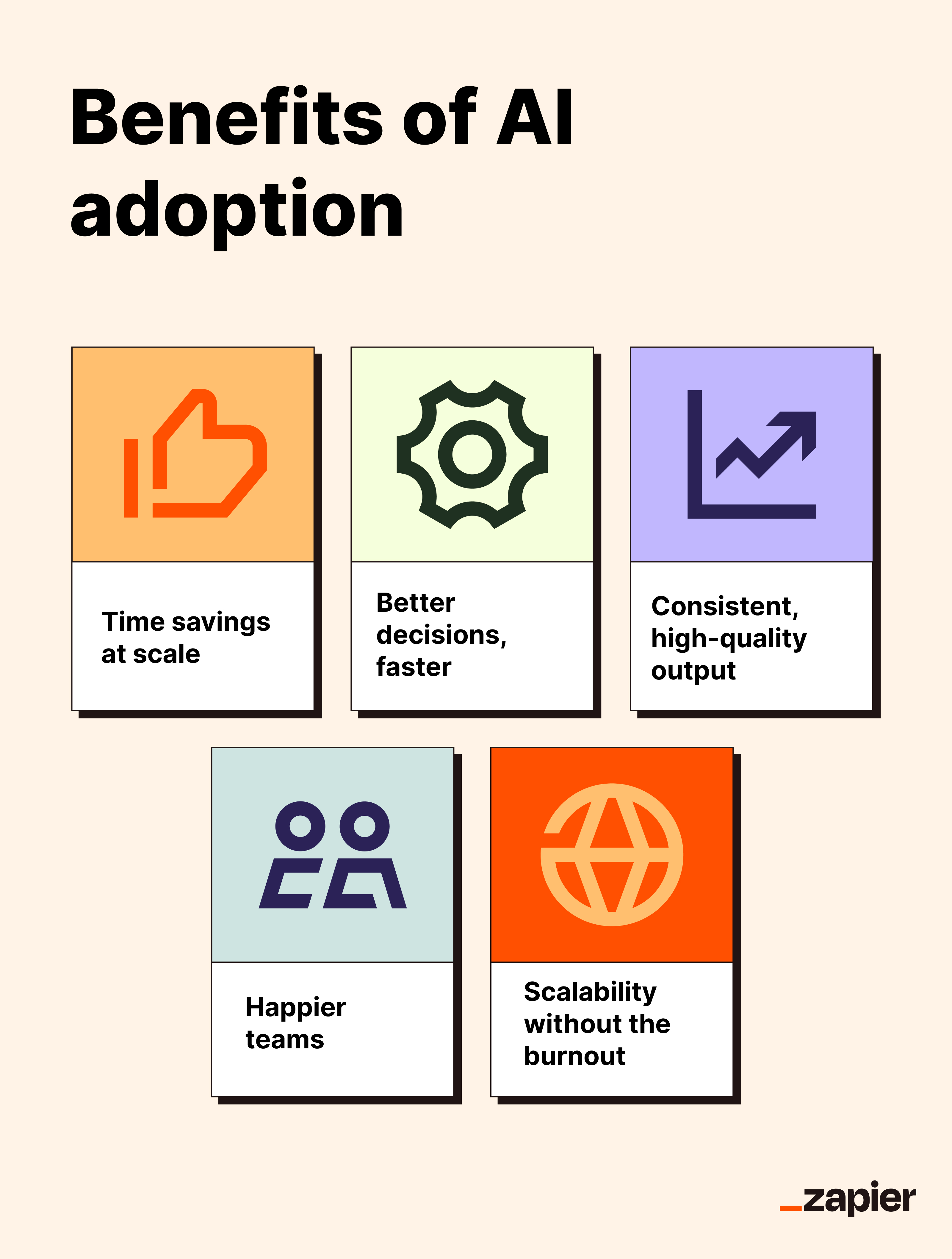
    An infographic summarizing the benefits of AI adoption

    Time savings 

    When AI takes over repetitive and time-consuming tasks like summarizing meeting notes, triaging support tickets, or writing first drafts, you get hours back. That’s time your team can spend on the work only they can do: building, creating, problem-solving, and strategizing.

    Better decisions, faster

    AI can sift through data in seconds, identify patterns, and surface insights you might’ve missed while trying to make sense of yet another spreadsheet. It can do things like forecast trends, prioritize leads, and identify customer churn signals with reliability and efficiency.

    Consistent, high-quality output

    People get tired. AI doesn’t. It can help teams deliver more consistent work and reduce human error. You can train AI on your style guide, process documentation, and knowledge base so that the output matches your brand guidelines, every time.

    Happier teams

    Nobody takes a job to spend a quarter of their time copy-pasting text between tools or rewriting the same status update five different ways. When you adopt AI to reduce busywork, you free up your team to focus on work that feels meaningful—and that’s a win for both morale and retention.

    Scalability without the burnout

    Need to onboard 200 new users a week, launch a campaign in five markets at once, or handle double the support volume without doubling the team? AI helps you grow without stretching your people too thin. Think of it as a bandwidth boost, not a team replacement.

    Common barriers to AI adoption

    AI might feel like the promised land of productivity—but getting there is a different story. Even at Zapier, where our team is all-in on being AI-first, we’ve run into blockers that stalled progress or killed momentum. The good news is that most of these barriers are solvable with the right mindset.

    Let’s break down what typically gets in the way.

    Not having the right tools

    You can’t adopt AI if you don’t have tools that support it—or if your current stack makes it a nightmare to integrate anything new.

    Some platforms are just starting to layer in AI features. Others expect you to bring your own model or write code to get started. And then there’s Zapier, which lets you plug AI into your workflows without needing an engineer on standby.

    Before you go big, ask yourself: can your current tools support lightweight experimentation with AI?

    Cost and resourcing

    AI isn’t free. Whether you’re paying for premium AI tools, hiring consultants, or investing in new infrastructure, the costs can stack up quickly. Even the time cost of learning new systems can be a barrier.

    The trick is to start small. Automate one high-impact task, prove the value, then scale. You don’t need a million-dollar budget to get meaningful ROI from AI. You just need to be strategic.

    Technical complexity or infrastructure

    Not every org has the backend setup (or IT capacity) to roll out complex AI systems. And unless you’ve got a team of machine learning engineers sitting around, you probably don’t want to build something from scratch.

    Luckily, AI has become a lot more accessible. Zapier, for example, makes it easy to add AI to your existing workflows and apps, even if your tech stack doesn’t have AI features built in. You don’t even need a separate AI account to make it happen.

    Employee resistance or change management

    Even the best AI tool is useless if no one wants to use it. Some employees worry AI will replace them, while others just don’t want to change how they work.

    When tapping into AI means opening a separate app, learning a new workflow, or figuring out how to write the perfect prompt, most employees will default to what already works. Even if AI could save them time, the mental tax of switching contexts, rethinking their process, or navigating a new interface is often too high—especially if they could otherwise be re-watching Season 10 of Married at First Sight: Australia.

    Successful AI adoption involves overcoming doubts and inertia to bring your team along for the ride. AI needs to feel less like a new initiative and more like a natural extension of existing workflows. Focus on transparency, and emphasize that AI is here to augment, not replace. And don’t just drop a tool in someone’s lap—show them how it makes their life easier.

    Data governance and privacy concerns

    Teams worry (rightfully) about where their data is going, how it’s being used, and whether it’s safe to feed customer info into third-party AI tools.

    The best solution is to use platforms like Zapier that offer transparency, control, and secure AI integrations. With Zapier, your app credentials stay out of the AI model’s hands, and each connection only gets the access you grant it.

    But tech alone isn’t enough—you also need clear, centralized guidelines. Define what’s ok and what’s not when it comes to prompts, data types, and tool access. Loop in legal and security teams early to create safe boundaries that still leave room to experiment. That way, teams can move fast without accidentally stepping on a landmine.

    The key is creating clear, centralized guidelines that still leave room to experiment. At Zapier, we worked closely with our legal, privacy, and security teams to define usage guardrails, route sensitive data through approved models, and ensure compliance without slowing teams down.

    AI hallucinations and missteps

    AI can “hallucinate” facts, misinterpret prompts, or make confident guesses that are completely off-base. And that’s scary if you’re using it for anything public-facing or business-critical.

    That’s why human review is key. Build in checkpoints, use narrow, well-scoped prompts, and educate your team on what AI can’t do yet—so no one ends up with a chatbot making promises your product can’t keep. For example, you might add a Slack “Request Approval” step to your Zapier workflow that lets a real person sign off on an action before it finishes running.  

    These barriers are real, but they’re not deal-breakers. With the right tools, education, and a healthy dose of patience, AI adoption doesn’t have to be a moonshot.

    How we adopted AI org-wide at Zapier

    Adopting AI at Zapier started with curiosity. A few of us were poking around with LLMs before ChatGPT was even a thing, but that casual experimentation turned into something more serious when GPT-4 dropped. 

    Our CEO called a company-wide “Code Red” because doing nothing felt riskier than jumping in. That executive signal created the urgency we needed to really shift gears. We didn’t over-engineer the rollout; we just said “This is big, it’s here, and we all need to engage with it.”

    From there, we went all in. We paused work, ran a full-company hackathon, and got every team—tech and non-tech—building with AI. We paired that with real scaffolding: clear usage guidelines, fast procurement paths, internal enablement hubs, and a few deeply curious folks who helped others get started. We built, shared, and learned in public. Throughout it all, leadership stayed deeply involved—sharing their own AI use cases, celebrating team wins, and reinforcing AI adoption as a company-wide priority in planning cycles and all-hands updates. 

    To keep ourselves honest (and measure progress), we also started tracking adoption over time. We asked folks in our twice-yearly engagement survey whether they use AI in their day-to-day work—and that’s how we know we’ve hit 97% org-wide adoption. Having clear metrics helps teams stay aligned and celebrate progress, whether it’s tracking active users, workflow usage, or department-level experiments.

    Over time, hackathons turned into habits, and AI is now helping us do things we couldn’t before. Workflows are being reimagined, headcount plans look different, and entire categories of “too tedious” work are now set to autopilot. It’s not always smooth or uniform, but the direction is clear: AI is part of how we think and operate.

    The key to success for our team was that we didn’t wait for a perfect plan. We gave people room to explore, made enablement easy, and repeated the message. And most importantly, we kept showing up—at hackathons, in Slack threads, and in demos. The momentum built from there. Now, our team has an 97% AI adoption rate—and we’ve made AI part of our hiring process to ensure all new team members are fluent in AI, too.

    Steal the playbook here

    Best practices for starting (or scaling) AI adoption

    So you’re ready to bring AI into your team—or take it beyond the early adopter crowd. Here’s what’s worked for us and what we’ve seen work for others.

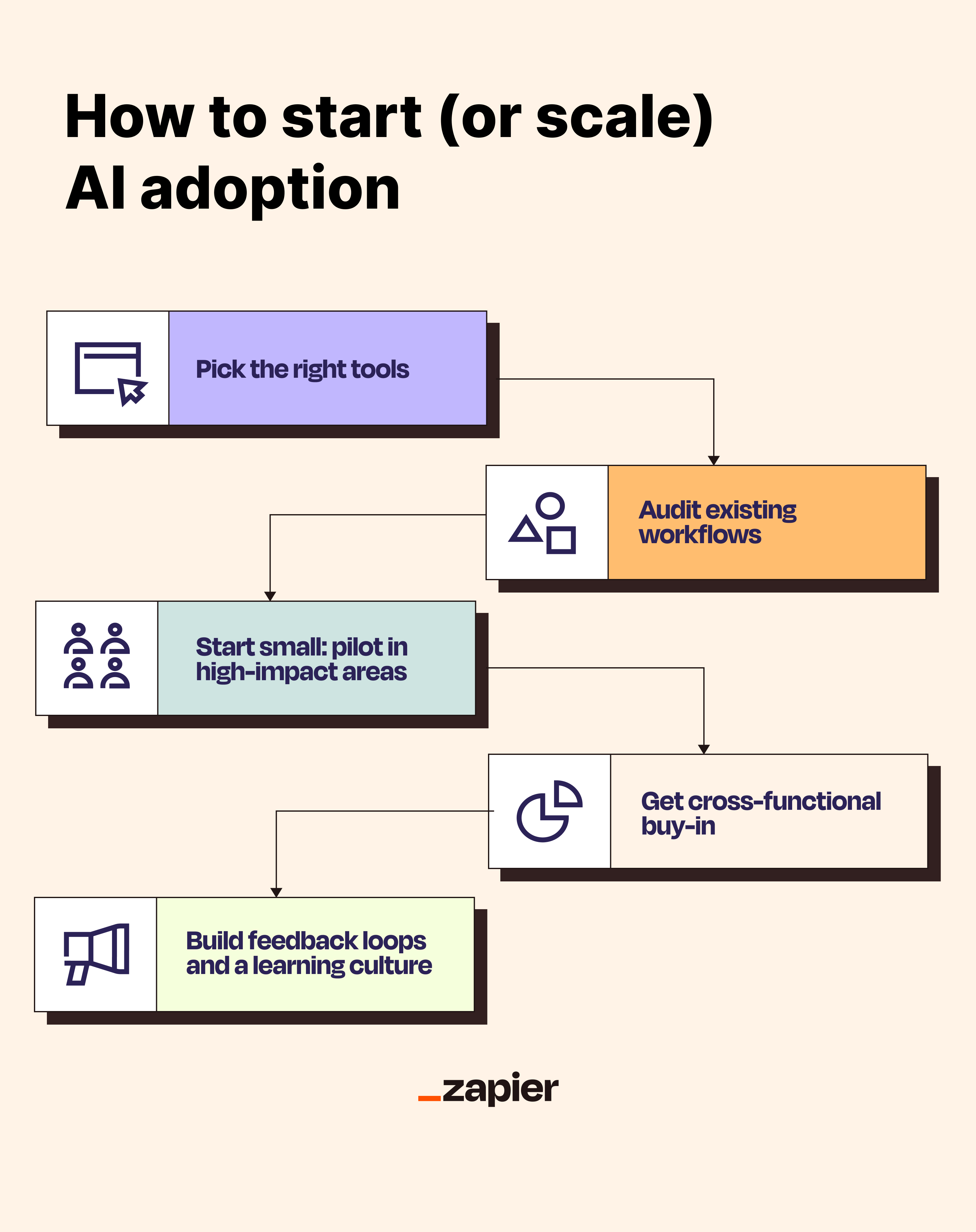
    An infographic summarizing how to start or scale AI adoption

    Pick the right tools

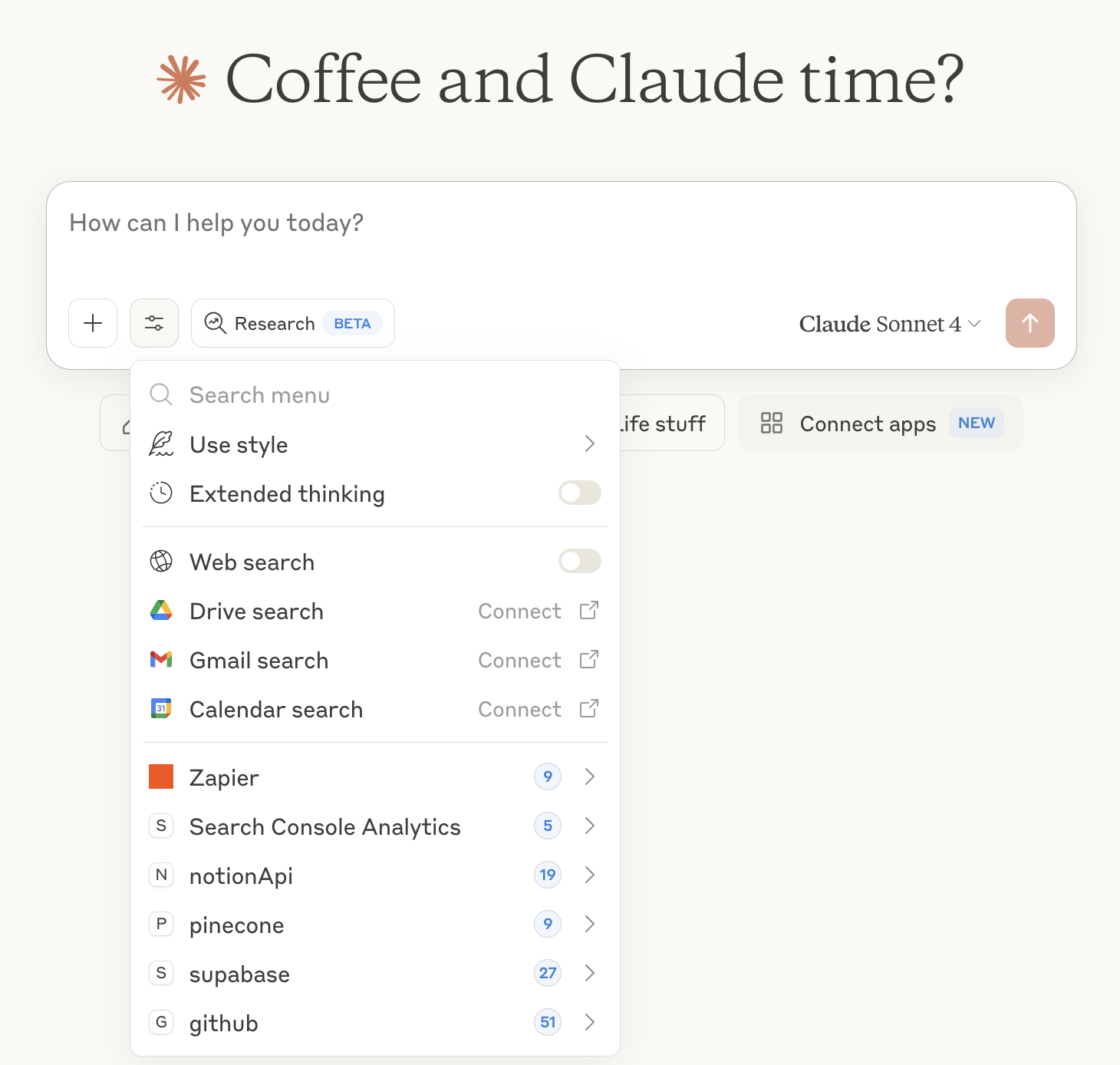
    For many teams, the quickest and most practical entry point is using an out-of-the-box tool like Zapier. It acts as an AI orchestration layer, connecting AI models from OpenAI, Anthropic, Google, and more directly to the apps you already use—no code required. That means you can start layering AI into your workflows without wrangling custom APIs or stitching together tools manually. Zapier even has AI built into the platform, so you won’t need to manage a separate AI account just to test things out. You can also go the other direction and install Zapier in your AI tool of choice, so AI assistants like Claude or ChatGPT can take action in the apps your team already uses.

    Of course, some use cases may require more advanced setups—like custom APIs, fine-tuned models, or access to internal data. If you’re working at that scale, you might need a deeper AIOps infrastructure with more control over how and where AI runs.

    As you evaluate your options, consider:

    • How is data stored, handled, and secured?

    • Are prompts or user inputs being used to train future models?

    • Can I monitor, audit, or version the AI logic I’m using?

    • Will this tool scale as the team—or the use case—grows?

    Look for tools that prioritize transparency, offer flexibility, and come with enough documentation to keep your team in control at every step.

    Audit existing workflows and opportunities

    When getting started with AI adoption, the best place to start is with tasks that are repetitive but still require a bit of thought or finesse. Think: triaging support tickets based on tone or topic, drafting initial versions of content, summarizing long blocks of customer feedback, or enriching lead records with contextual info. 

    These are the kinds of workflows that happen often enough to warrant automation, but involve just enough nuance that a simple if-then automated workflow probably won’t cut it. That’s where AI’s language skills and pattern recognition can really shine.

    There’s no need to rework your entire business overnight, either. Start by identifying a few areas where AI could step in to handle the mental heavy lifting behind routine tasks—reducing effort, speeding things up, or making outputs more consistent.

    Ask yourself:

    • Where are team members making the same judgment calls again and again?

    • What slows down progress because it involves reading, writing, or sorting information?

    • Where could faster decisions or insights make things better for customers—or less frustrating for your team?

    Start small: pilot projects in high-impact areas

    You don’t need to transform the entire org in one go (in fact, please don’t). Start with a few pilot projects in teams that are open to experimentation. Look for problems that are small enough to solve but big enough to matter.

    Then, run quick cycles. Build something, test it, and share the results widely. Those early wins will create momentum and give other teams permission to try their own experiments.

    Get cross-functional buy-in from IT, ops, leadership, and legal

    This part is easy to skip—and a mistake if you do. If your security or legal teams aren’t looped in early, you’ll hit blockers fast. The same goes for leadership: if execs aren’t bought in, it’s harder to get time, attention, or budget. And if IT or ops isn’t aligned, folks won’t get the tools they need.

    Build feedback loops and a learning culture

    AI is changing fast—and your org has to keep up. That means creating space to learn out loud. 

    At Zapier, Slack channels like #fun-ai became hubs for sharing use cases, failed experiments, and new tools. We’ve also held live demos, internal Q&As, and recurring hack weeks to keep the energy going. You need a place for people to ask questions, share wins, and learn from each other.

    Move from AI curiosity to AI adoption

    AI is going to be a part of your work. The challenge now is making it easier to use, easier to trust, and easier to fold into existing workflows. That’s where Zapier comes in. Install it in your AI assistant, and your team can send the email, update the record, or book the meeting from the chat window they already use, across 9,000+ apps. 

    You’ll want to start small, build visibly, and make room for a little mess as people learn. It’s all about reducing friction wherever possible, so AI becomes less of a Big New Thing and more of a teammate that’s just part of the process.

    So whether you’re leading AI adoption at scale or just trying to write fewer status updates by hand, remember: you don’t have to do it perfectly. You just have to get started, and the rest will follow.

    Try Zapier

    Related reading:

    This article was originally published in August 2025. The most recent update was in October 2026.
  • Which AI models can you automate on Zapier? (OpenAI, Anthropic, Google, Moonshot AI, Z.ai, and more)

    Which AI models can you automate on Zapier? (OpenAI, Anthropic, Google, Moonshot AI, Z.ai, and more)

    Staying up to date on the latest AI models is like trying to keep my house vacuumed in the height of my dog’s shedding season (a losing battle). New AI models drop practically every week, and it’s not exactly obvious which ones deserve a spot in your workflows. This guide is your cheat sheet, with every model you can automate on Zapier right now, sorted by provider.

    If you just want to cut to the chase and find out which model you should be using for which task, that’s what AutomationBench is for. It’s Zapier’s own benchmark for how these models handle real, messy business workflows, so you can pick based on performance instead of hype.

    Table of contents:

    There are two ways to bring AI models into your automated workflows: through Zapier’s built-in AI step (AI by Zapier) or by using direct integrations with the provider. 

    • AI by Zapier packages dozens of models from OpenAI, Anthropic, Google, and more into one step, with no separate account or token billing—you just pay in Zapier tasks. 

    • Direct integrations connect straight to a provider’s own account instead, trading that simplicity for a wider lineup. Think legacy GPT or DeepSeek models, billed by token through your own API key. 

    Or, if you want to kick off workflows directly from your AI assistant, Zapier MCP lets you install Zapier in any MCP-compatible tool and start taking actions across 9,000+ tools straight from your chat window.

    Build automations from wherever you work. Describe the outcome you want, and Zapier connects your tools, runs the steps, and stays on the job after you close the chat. Combine AI with reliable, deterministic automation across 9,000+ apps. Get started for free.

    Which AI models can you use with AI by Zapier?

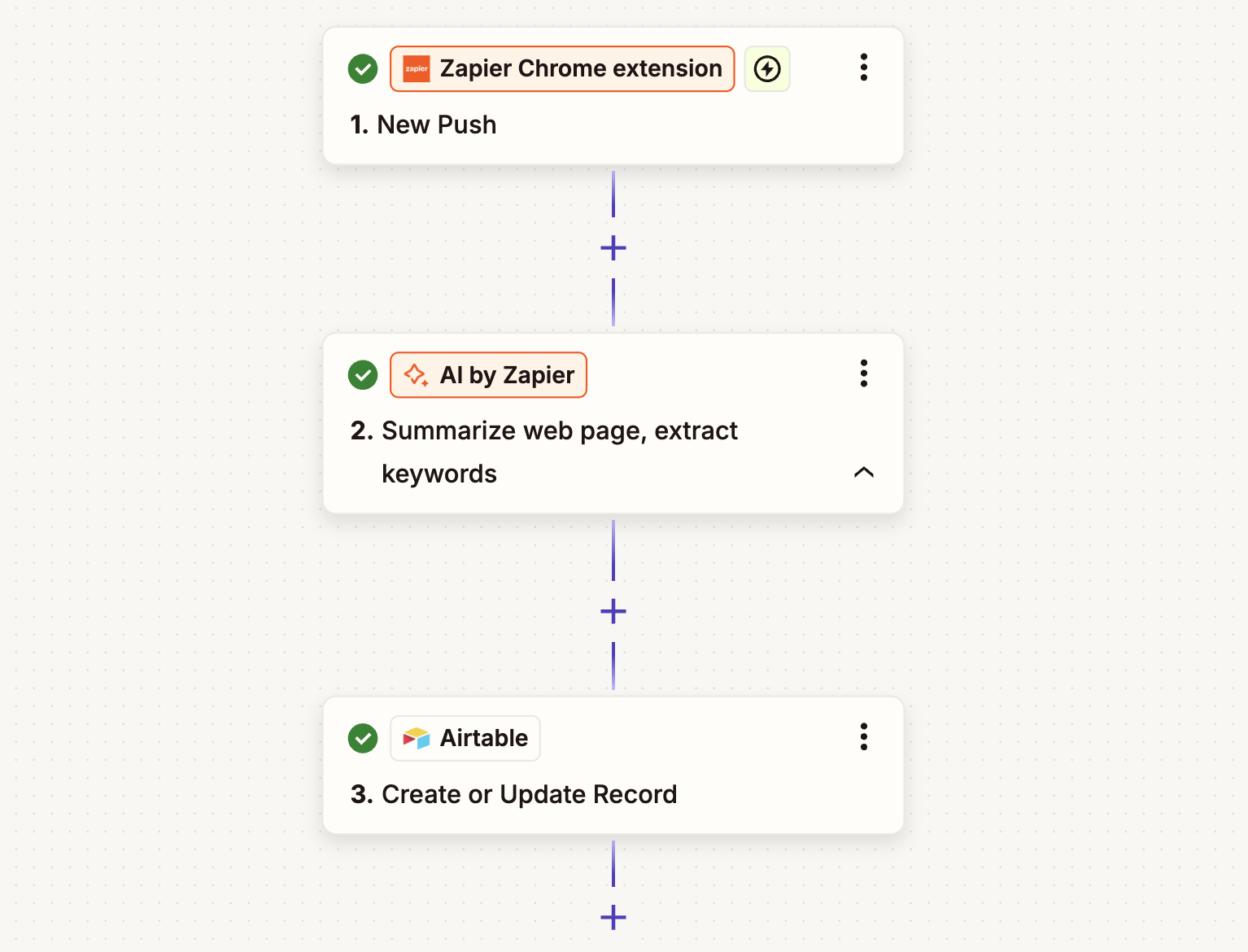
    A Zap with an AI by Zapier step

    An AI by Zapier step is your best option for adding AI into deterministic workflows. You get access to roughly 35 models from OpenAI, Anthropic, Google, Moonshot AI, and Z.ai with no separate account and no token billing. Whichever model you choose, you get structured output fields, knowledge sources, agentic tool calling, prompt templates, and one-click model swapping.

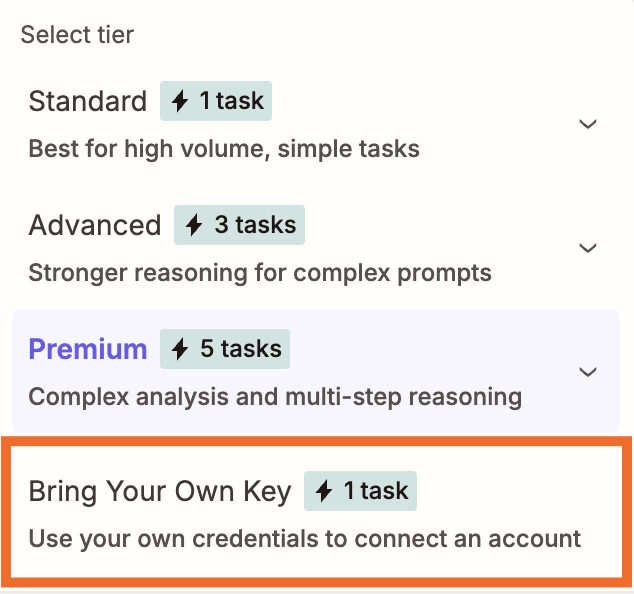
    You don’t even need a separate account to use these models—they’re built into Zapier, and you pay using Zapier tasks, not provider tokens. The models are sorted into task multiplier tiers based on the cost of the underlying model: Standard models use 1 task, Advanced models use 3 tasks, and Premium models use 5 tasks. 

    (If you prefer a model that isn’t included by default, you can also bring your own key [BYOK] for a wider set of options inside AI by Zapier—more on that below.)

    OpenAI

    Best for: General-purpose reasoning

    OpenAI models are the broadest lineup on Zapier, spanning everything from ultra-cheap classification models to frontier reasoning models. GPT-6 Astra is a strong benchmark performer across the board on Zapier’s official AutomationBench leaderboard, making OpenAI the safest default when you’re not sure which model a workflow needs.

    Model

    AI by Zapier

    GPT-4.1 nano

    1 task

    GPT-4.1 mini

    1 task

    GPT-4o mini

    1 task

    GPT-5 nano

    1 task

    GPT-5 mini

    1 task

    GPT-5.4 mini

    1 task

    GPT-5.4 nano

    1 task

    GPT-5.6 Luna

    1 task

    GPT-6 Luna

    1 task

    o3-mini

    3 tasks

    GPT-4.1

    3 tasks

    GPT-4o

    5 tasks

    GPT-5

    5 tasks

    GPT-5.2

    5 tasks

    GPT-5.4

    5 tasks

    GPT-5.6 Terra

    5 tasks

    GPT-5.6 Sol

    5 tasks

    GPT-6 Sol

    5 tasks

    o1

    BYOK only

    o3

    BYOK only

    o4-mini

    BYOK only

    GPT-5.5

    BYOK only

    GPT-6 Astra

    BYOK only

    GPT-6.1 Sol

    BYOK only

    Anthropic

    Best for: Coding and complex operations work 

    Claude is built to be careful and enterprise-safe, which is why companies like Slack, Notion, and Zoom have partnered with Anthropic directly. On Zapier’s official AutomationBench leaderboard, Claude Sonnet 5.5 ranks #3 overall, at $1.14 per task. I recommend reaching for Claude when a workflow needs careful multi-step judgment, not just speed.

    Model

    AI by Zapier

    Claude 4.5 Haiku

    3 tasks

    Claude 4.5 Sonnet

    5 tasks

    Claude 4.5 Opus

    5 tasks

    Claude 4.6 Sonnet

    5 tasks

    Claude 4.6 Opus

    5 tasks

    Claude 4.7 Opus

    5 tasks

    Claude 4.8 Opus

    5 tasks

    Claude 5 Opus

    5 tasks

    Claude 5.5 Opus

    5 tasks

    Claude 5 Sonnet

    5 tasks

    Claude 5.5 Sonnet

    5 tasks

    Claude Fable 5

    BYOK only

    Claude Fable 5.1

    BYOK only

    Claude 4.0 Sonnet

    BYOK only

    Claude 4.0 Opus

    BYOK only

    Claude 4.1 Opus

    BYOK only

    Claude 5.5 Haiku

    BYOK only

    Google

    Best for: High-volume workflows 

    Gemini models offer some of the lowest per-task costs on Zapier—while still competing with the other state-of-the-art models on power. That makes Gemini the default choice when you’re processing a lot of content and cost is the priority. Google’s newest model, Gemini 4 Argon, held the top two spots on Zapier’s official AutomationBench leaderboard when it launched, though at a higher cost per task.

    Model

    AI by Zapier

    Gemini 2.5 Flash

    1 task

    Gemini 2.5 Flash Lite

    1 task

    Gemini 3.5 Flash Lite

    1 task

    Gemini 3.5 Flash

    3 tasks

    Gemini 3.6 Flash

    3 tasks

    Gemini 3.7 Flash

    3 tasks

    Gemini 3.8 Flash

    3 tasks

    Gemini 2.5 Pro

    3 tasks

    Gemini 3.1 Pro

    5 tasks

    Moonshot AI

    Best for: Tool-heavy, agentic workflows

    Kimi (from MoonshotAI) is a mixture-of-experts model purpose-built for tool use and multi-step agent tasks, priced well below most proprietary frontier models. Kimi K3 currently ranks #33 overall on Zapier’s official AutomationBench leaderboard, at a fraction of the cost of most proprietary frontier models ($0.43 per task).

    Model

    AI by Zapier

    Kimi K3

    5 tasks

    Z.ai

    Best for: Cost-efficient agentic tasks 

    Z.ai’s GLM family is priced well below proprietary frontier models, which makes it a solid pick for straightforward, lower-stakes automation. GLM 5.2 lands at #87 on the official AutomationBench leaderboard—behind Kimi and the frontier proprietary models—so it’s a better fit for straightforward, lower-stakes automation than complex, multi-step work. At $0.22 per task, it’s one of the cheapest options on the board either way.

    Model

    AI by Zapier

    GLM 5.3 Fast

    1 task

    GLM 5.3

    3 tasks

    Meta

    Best for: Long-context tasks

    Meta’s Muse Spark models are the Facebook parent company’s response to OpenAI, Anthropic, and Google Gemini. Muse Spark 1.3 is designed to keep track of requirements as users change direction or go between projects. It also emphasizes efficient tool use and multimodal understanding, which helps it work through complex coding and real-world tasks with fewer unnecessary steps.

    Model

    AI by Zapier

    Muse Spark 1.3

    3 tasks

    DeepSeek

    DeepSeek is a cost-efficient open-weight model with strong coding and reasoning chops, popular for technical workflows on a budget.

    Model

    AI by Zapier

    DeepSeek V4.1 Flash

    1 task

    Amazon Bedrock

    Teams already running infrastructure in AWS often pick Bedrock so AI automation stays inside the security and compliance boundary their IT team has already vetted, with usage tracked under existing AWS access controls and spend commitments instead of a new vendor relationship.

    Bedrock uses the AI models your company has already set up in Amazon Bedrock. The exact models depend on what’s enabled in your AWS account and region. 

    Azure OpenAI

    Azure OpenAI is a common pick for regulated industries because it wraps the same underlying models in Microsoft’s enterprise-grade security and compliance certifications, so your data stays inside your company’s private Azure tenant instead of routing through a separate AI vendor.

    Azure uses the AI models you’ve already set up in your own Azure OpenAI account. The exact models depend on what your Azure admin has turned on.

    When should I use BYOK?

    If you want to use a model that isn’t built into AI by Zapier, you can also bring your own key (BYOK) for your preferred model. All of the models listed above can be used with BYOK—and some require it.

    Choosing Bring Your Own Key in an AI by Zapier step

    With BYOK, you’ll use your own API key and pay the provider directly for tokens. If you don’t know what that means, just pick one of the built-in models and move on. But if you’re considering BYOK, these are the main benefits:

    • Cost control on tool-heavy workflows. BYOK runs at a 1x task multiplier even when a step makes multiple tool calls, compared to 3x on built-in Advanced models or 5x on built-in Premium models. A BYOK step with 4 tool calls would cost 5 Zapier tasks (1 for the BYOK, 1 for each tool call), while the same workflow on Premium would cost 25 (5 for the BYOK, 5 for each tool call).

    • Access to models that aren’t in the default lineup, including newer models like GPT-6 Astra, Claude Fable 5.1, and Gemini 3.1 Pro, and legacy models like o1, o3, and GPT-5.5. 

    • Control over content moderation. You can also turn off Zapier’s built-in content moderation with BYOK, since the provider’s own data-handling terms take over once you’re paying with your own key.

    Which AI models can you use on Zapier via direct integrations?

    Instead of using AI by Zapier, you can also connect directly to your AI provider through its Zapier integration.

    A Zap with an OpenAI step

    I recommend trying AI by Zapier first, since direct integrations give you less flexibility inside the Zap editor. Both a direct integration and a BYOK step require you to use your own API key, but BYOK steps within AI by Zapier benefit from advanced features like structured outputs and knowledge sources. And when you BYOK, you can swap out a provider without rebuilding the whole step from scratch. 

    Like with BYOK, you’ll pay the provider directly, based on token usage, so your costs can vary a lot more than AI by Zapier’s straightforward task-based billing. But these integrations do open the door to more niche providers and legacy models. For example, you can access older OpenAI models still available through the API or more open-weight providers like DeepSeek. 

    You can visit Zapier’s app directory to see all of your options, but here are the most popular:

    • OpenAI (ChatGPT)—access legacy models like GPT-4, GPT-4 Turbo, and GPT-5.4 Thinking

    • Anthropic (Claude)

    • Gemini (Google Vertex AI)

    • Amazon Bedrock

    • Azure OpenAI

    • DeepSeek

    • Grok by xAI—xAI’s conversational model, with real-time access to web and X data and a more irreverent tone than most assistants

    • Mistral AI—Models with strong instruction-following and multilingual performance, ranging from fast lightweight options to larger frontier models

    • OpenRouter—A single integration that gives you access to models from dozens of providers, so you can mix and match without managing multiple connections

    • Groq—Not a model, but a hardware-accelerated inference engine for when speed is the priority and you need a near-instant response

    • AssemblyAI—Specializes in speech-to-text and audio intelligence, including transcription, speaker detection, and sentiment analysis

    Or bring your AI agent to the automation instead

    Everything above is about picking a model inside a Zap. But if you’re already living inside an AI agent harness, like Claude, ChatGPT, or Cursor, you don’t need to leave it to get things done. Zapier MCP connects your agent directly to 9,000+ apps, so it can send a Slack message, update a CRM record, or kick off an entire workflow without you switching tabs.

    A dropdown menu in Claude showing the Zapier MCP option

    If your team already has a favorite AI agent, Zapier MCP is how you bring your whole tech stack to meet it. Learn more about Zapier MCP.

    Try Zapier MCP

    Pick the best AI model for the job

    Whether you’re just getting started with AI automation or you’re deep into building multi-step workflows, Zapier gives you the flexibility to use the AI tools and models that actually fit your needs. The landscape keeps evolving, and so will this guide. Bookmark it and check back whenever a new model drops.

    Still not sure which model to reach for? Check AutomationBench to see how real models perform on real business workflows, not just clean prompts.

    See the leaderboard

    This article was originally published in March 2026 by Steph Spector. The most recent update was in October 2026.

  • Cue

    Put your AirPods in, your Mac starts focusing

    Discussion
    |
    Link