Enterprise AI is no longer a future ambition. It is in full operational flight. Model capabilities are advancing faster than most organizations can absorb, while the cost of performance continues to fall. Globally, AI investment is set to reach $2.5 trillion in 2026, up 44% from the previous year.
For many enterprises, this investment has produced fragmentation. Intelligence can accumulate in silos so that sales agents are unaware of open support tickets, for instance, or marketing systems are personalizing content without visibility into what finance already knows about a customer. Each function may perform well in isolation, but the enterprise as a whole learns little and has less information to act upon.
The shift from AI as a tool to AI as an operating model—what we call the “agentic shift” in this report—demands something more fundamental than better models or faster infrastructure. It requires connecting people, processes, and data in real time, along with the governance and control to act on that intelligence reliably.
This means rethinking both architecture and operating models simultaneously. First, rebuilding data infrastructure for accessibility rather than volume. Second, replacing fixed tech stacks with composable architectures that can evolve as models and tools change. And, lastly, resolving questions of AI sovereignty, including where intelligence runs, who controls it, and how it operates across organizational and jurisdictional boundaries.
Key findings include the following:
Enterprise AI’s scaling problem is structural. Process-first companies are pulling ahead. Global AI spending is rising sharply and model capabilities are advancing faster than most organizations can integrate them. Yet the majority of enterprises are still not growing revenue through AI or fundamentally rethinking how they operate. The companies generating sustained returns share a common discipline. They treat process redesign as the work that precedes model selection, building for how the technology will evolve rather than retrofitting roles and workflows after deployment. For them, the agentic shift begins with the operating model.
Data readiness, not data abundance, is what makes AI compoundable. Most enterprises discover too late that having data and having AI-ready data are very different things. A sovereign, composable foundation—one that queries and prepares data where it resides, without migration or centralization—can convert raw data estates into intelligence that AI agents can act upon. As data residency laws, multicloud environments, and structural complexity make centralization increasingly impractical, sovereign control over where models run and data lives is what keeps that adaptability intact.
This content was produced by Insights, MIT Technology Review’s custom content arm, not its editorial staff. It was researched and written by humans, with any AI tools that may have been used limited to production processes under human oversight.
On an afternoon in Seoul in March 2016, I watched a program I helped build put a stone on the fifth line of a Go board in what looked like a gift to its human opponent. Move 37 in game two of the five-game match looked so absurd that some commentators thought it was a programming glitch.
It wasn’t. AlphaGo won the game, ultimately triumphing 4-1 over Lee Sedol, one of the greatest professional Go players of all time. “I thought AlphaGo was based on probability calculation and that it was merely a machine,” Lee said afterwards. “But when I saw this move, I changed my mind. Surely, AlphaGo is creative.”
When Deep Blue defeated then reigning world chess champion Garry Kasparov in 1997, it did so by looking six to eight moves ahead per player and evaluating 200 million chess positions per second, using rules hard-coded by humans. Go is a vastly more complex game. A stone’s worth depends on how distant groups and territory unfold over dozens of moves. Computing even a fraction of the possible outcomes would take a supercomputer billions of years. To win, AlphaGo had to sense who was ahead at a glance and even invent moves no human had thought to play.
That is why many accounts of AlphaGo’s match against Lee portray move 37 as a flash of pure machine intuition. But that is a misunderstanding. It was actually AlphaGo’s powers of reasoning that made this creative choice—and these are powers that today’s AI lacks. If we want future AI systems to produce trustworthy results and really novel insights in fields like science and medicine, we need to equip them with genuine reasoning capabilities of this kind.
AlphaGo is made up of two systems. The first, its policy network, was trained to guess what move a strong human would play. This “intuitive” part regarded move 37 as nothing special—a play that had a roughly one in 10,000 chance of being made by an expert human player. What made AlphaGo choose it was the program’s search machinery, which looked beyond immediate plausibility and weighed the future consequences of proposed moves. It explicitly constructed and searched a game tree with thousands of branches, each representing a different possible future.
A well-known theory in the behavioral sciences, popularized by Daniel Kahneman, distinguishes between two modes of human thought: System 1 is fast, gut-level, effortless; system 2, slow, step-by-step, and deliberative. AlphaGo offered a striking machine analogue of that split. Its networks supplied the hunches—this move looks promising, this position looks won—and its search supplied the deliberation, testing those hunches against the moves and countermoves that would follow. As in human cognition, neither half works alone. Intuition alone would never have opted for move 37, and brute-force search would have struggled to sieve through all the many possible moves.
This is strikingly different from the way today’s AI models work. A large language model picks the next token, over and over. That amounts to system 1 in action—fast, associative, and surprisingly good pattern completion across almost every subject people write about.
Not long after ChatGPT debuted, the field realized that language fluency alone falls short of true usefulness. The apparent solution was to make models that deliberate: Instead of answering immediately, they can now generate intermediate steps that decompose a problem, carry forward partial results, and influence subsequent reasoning—a process known as chain of thought.
The gains have proved real, above all in mathematics and coding. But unlike AlphaGo’s search, this does not introduce a genuinely separate reasoning mechanism: The intermediate reasoning is still produced by the same next-token prediction process, iterated for longer before the model commits to an answer.
Three shortcomings prevent what chatbots do from qualifying as reasoning (in a way that a scientist might recognize). First, these models typically maintain no explicit, persistent, and inspectable epistemic state. There is no open ledger that lays out the hypotheses a model is considering, the confidence it has in various explanations, the evidence it’s weighing, and the unresolved questions it’s holding onto—all things that should be systematically revised as new information arrives.
Second, they lack a clean separation between what the system knows and how it manipulates that knowledge. Knowledge and reasoning are inextricably interwoven in the weights of the neural network—there is no independent, explicitly represented set of beliefs. Third, while the chains of thought chatbots produce look like deliberation, research has demonstrated that the bots often concoctthem after the fact, reaching an answer by one route but reporting another.
This is a problem because in the high-stakes applications we all care about, such as medicine, engineering, and scientific research, it matters not only what a system concludes but also how it arrives at its conclusion. When mistakes happen—for example, in medical diagnosis and treatment—we need to be able to pinpoint what went wrong: Was the system’s reasoning at fault, did it draw on invalid evidence, or did it make incorrect assumptions?
This is why I recently left my position at Google DeepMind. I believe we need a fresh approach to machine reasoning—one that draws on AlphaGo’s architecture. AlphaGo maintains a record of what it knows about a given position: the game tree. This data structure contains all the variations, the possible futures, that AlphaGo has considered, each move and position being annotated with judgments made by its neural networks. As its reasoning progresses, AlphaGo updates the game tree and eventually synthesizes the information in it to decide which move to make.
Similarly, for general reasoning a system should maintain an epistemic state that represents what the system holds as settled, what it doubts, what it has ruled out, which questions stay open. Reasoning can then be understood as a sequence of moves that change the epistemic state to advance knowledge and reduce uncertainty: deducing consequences, breaking problems into parts, and—crucially—deciding what question to ask, calculation to perform, or experiment to run next.
Of course, open-world reasoning is harder than playing a board game such as Go or chess. In the real world the current state of affairs is only partially known, the set of available actions is large and variable, and the consequences of actions are stochastic or unknown.
But recent advances in LLMs and other neural models now give us the capability to take on such general reasoning problems. For example, LLMs can suggest ways of tackling a problem on the basis of what is known and what resources are available. They can interact with tools via APIs or code and help assess whether a claim is supported by available evidence.
Most important, to keep the system honest, an independent part of the system must evaluate each move by how much it actually resolves uncertainty, updating beliefs only when the change is backed by evidence. Once these rules are enforced, the model can accumulate certified knowledge and improve its reasoning policy by learning from past reasoning experiences. You can think of such a system as the scientific method on steroids, with the purpose of producing knowledge that can withstand scrutiny.
I do not think we reach trustworthy machine intelligence by making system 1 bigger. Scale sharpens intuition, but it does not make intuition more deliberative. Move 37 mattered because a machine held a position, weighed the possible futures, and chose the move its artificial instincts would likely have rejected.
Society needs such creative moves in drug discovery, materials, climate, diagnosis—fields where the board looks nothing like a Go board and nobody hands us the rules. We will get such insights only from systems that reason—systems whose conclusions arise from an auditable sequence of evidence, inference, and belief revision rather than from a convincing story told after the fact.
Thore Graepel is chair of machine learning at University College London. He was a core member of the AlphaGo team at DeepMind and works to ensure that AI benefits human flourishing.
Gemini 4 Argon delivers frontier performance in complex workflows across real-world software engineering, enterprise knowledge work like legal and finance, and cybersecurity defense.
Today, we’re announcing our new frontier model, Gemini 4 Argon, which is rolling out to a set of trusted cyber defenders through our Fairwind Program. Built to sustain deep reasoning across complex, long-horizon workflows, Argon is fundamentally changing the way we work and build at Google. It delivers frontier performance in complex workflows across real-world software engineering, enterprise knowledge work like legal and finance, and cybersecurity defense.
Safely releasing frontier capabilities at this level requires a phased approach. We are actively engaged in the U.S. government’s voluntary process for pre-release model access while we gradually expand access. We’ll continue to gather feedback from early testers as we iterate on guardrails before making Argon available to developers, enterprises, and consumers as soon as possible.
Argon will launch at an introductory price 1 of $2 per million input tokens and $10 per million output tokens, with cached input tokens priced at 95% off input token price.
Changing how we work and build at Google
Gemini 4 Argon is already powering our internal workflows, with thousands of Googlers highlighting the model’s strengths in specialized coding tasks, conducting deeper research, and writing quality. It’s helping teams build faster and push the boundaries of engineering productivity and accelerating breakthroughs:
Quantum algorithmic optimization: Argon is helping our quantum computing researchers optimize the spacetime resources (qubits × gates) of subroutines that bottleneck important applications. In one example, it beat the published baseline by 40% in a matter of minutes.
Memory efficiency: A team of Argon agents analyzed fleet-wide profiling telemetry to autonomously identify and apply memory optimizations across Google’s data centers, freeing up over 300 TiB of memory once rolled out, with an estimated 500 TiB to 1 PiB in total savings.
Large Scale Codebase Migrations and Optimizations: Argon agents are working on migrating C/C++ codebases to Rust across Google — scaling from tens of thousands of lines in core libraries like re2, libgav1 up to 800K+ lines for the Fuchsia Zircon kernel. Given the criticality of many of these systems, such large-scale rewrites are undergoing rigorous automated and manual auditing, emulation testing, and review before rolling out to production.
For libgav1, Google’s open source software for decoding video, Argon agents took an existing Rust port and replaced 32K lines of SIMD code by running many rounds of profile-guided experiments, studying the compiler’s output, producing safe Rust so the compiler would vectorize it automatically. The end result is a memory-safe video decoder that runs 2.7x faster than the Rust port, with identical video output, bringing it closer to the optimized C++.
Working harder on your most complex problems
To support Gemini 4 Argon’s capabilities across longer, more complex use cases, we are significantly expanding the model’s output token limit to an industry-leading 1M tokens, up from the previous 64K tokens. When the model has the headroom to think deeply and generate hundreds of thousands of tokens in a single trajectory, it adds a new level of depth in reasoning to solve tough problems in one go.
Enabling coding and enterprise workflows across domains
Gemini 4 Argon’s capabilities across coding, reasoning, and multimodality and its ability to sustain long, multi-step tasks enable it to excel across a range of enterprise workflows.
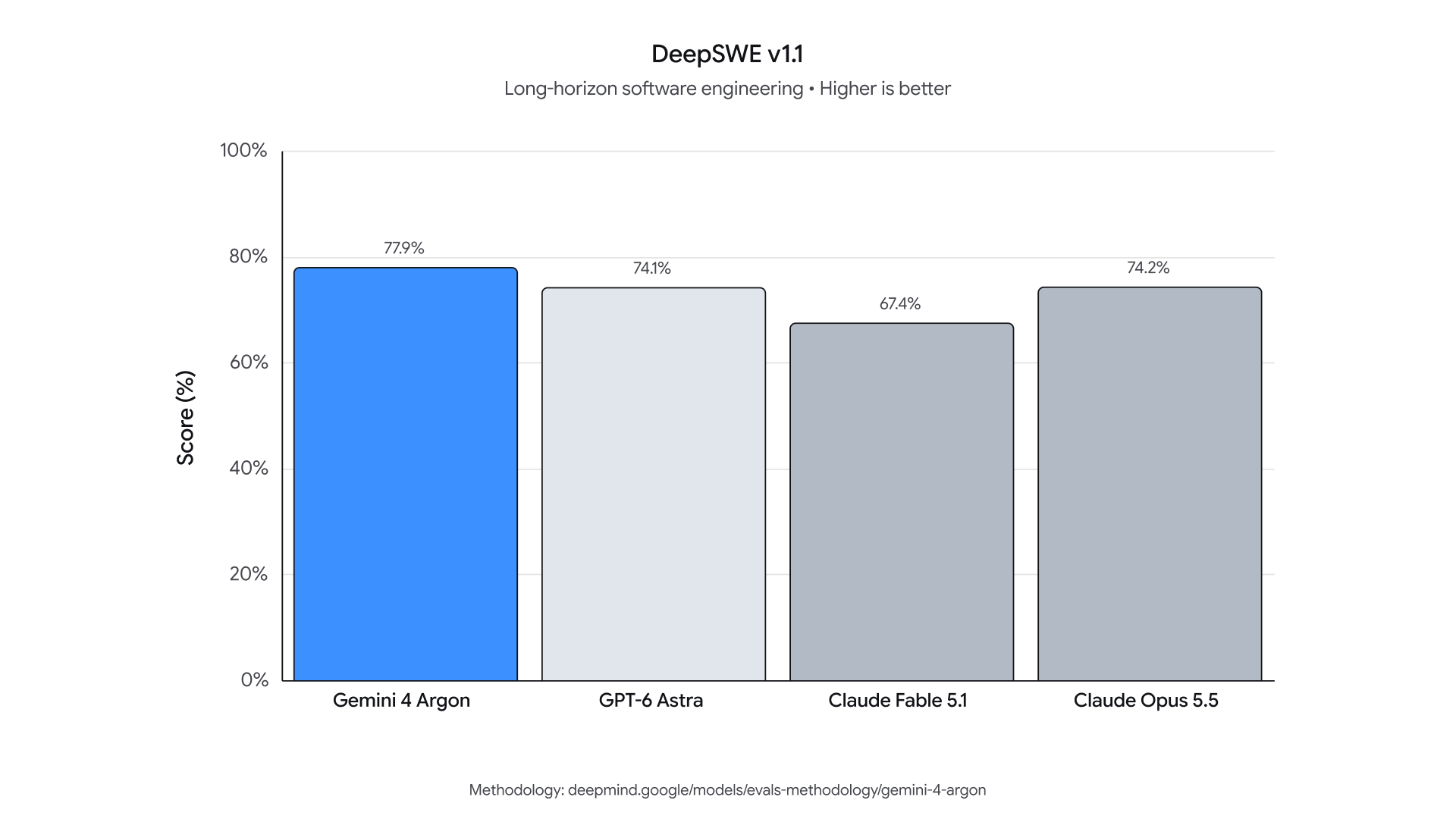
Google engineers have been using Argon for their daily tasks, from everyday debugging to large-scale codebase migrations and algorithm designs. It sets a new state of the art on DeepSWE v1.1 (77.9%), which measures a model’s performance in real-world long-horizon software engineering tasks.
Beyond coding, Argon is the leading model on the Vals Index, which measures economic impact across finance, coding, legal, and tax work, with every sector weighted by its contribution to U.S. GDP. We see similarly leading performance across other domain specific evaluations, like Vals Finance Agent v2 (multi-step financial research) and Harvey’s Legal Agent Benchmark (legal research and drafting). On AutomationBench, Zapier’s benchmark measuring end-to-end execution across core business functions, Argon ranks #1 with a score of 51.3%.
Argon is also uniquely strong when knowledge work requires visual understanding. It’s able to drive professional chart analysis, identify details from long videos, and take action based on a series of documents. For example, on LVBench, which measures long video understanding, Argon is state of the art with a score of 91.7%.
Leading in defensive cybersecurity
To better equip cyber defenders for the new era of cyberattacks, we trained Gemini 4 Argon to be highly capable at cybersecurity defense. Argon can autonomously find, validate, and patch critical software vulnerabilities. For trusted defenders and our own internal teams at Google, we’ll be releasing Argon without cyber guardrails so they can leverage its full frontier-level cybersecurity defense capabilities.
Wiz is already using Argon for cybersecurity defense through its Scan for Good initiative – a program dedicated to protecting critical public infrastructure for free by finding and remediating high-risk exposures. In an early demonstration of its impact, the model uncovered a critical vulnerability exposing sensitive personal information across healthcare software used by hospitals worldwide, identifying a severe risk that previous frontier models had missed.
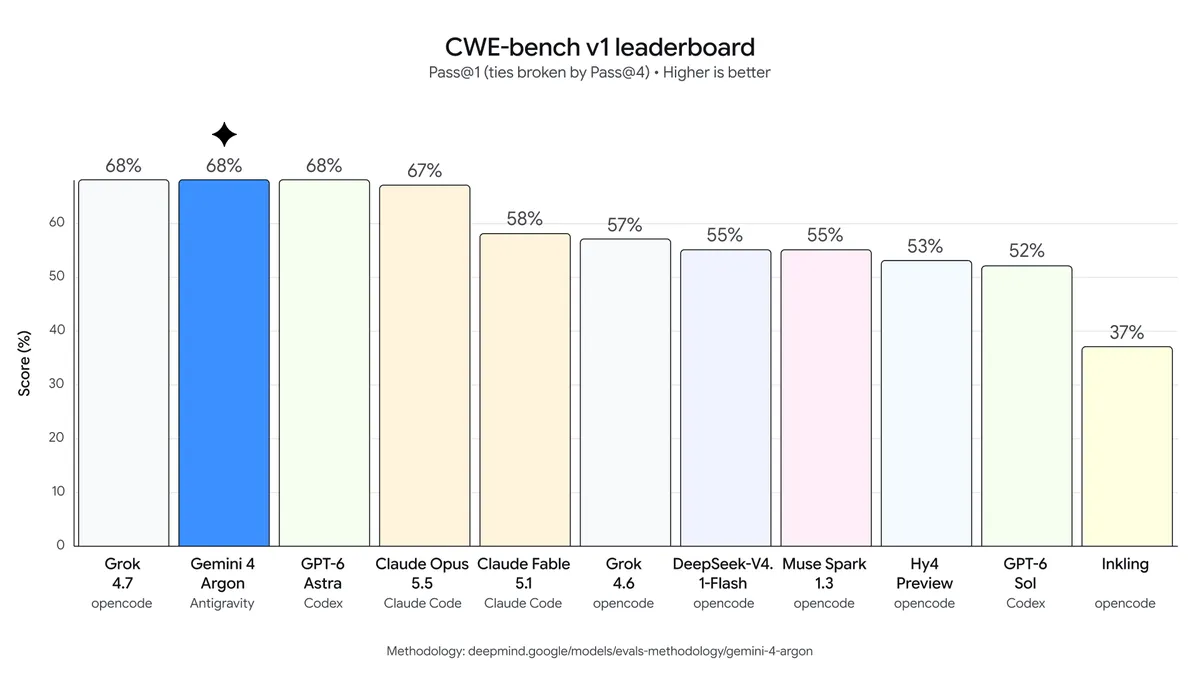
On CWE-bench v1, which evaluates the model’s ability to remediate security vulnerabilities, Argon ties for first place with a top score of 68%, building on 3.8 Flash Cyber’s frontier performance on CWE-bench v0.
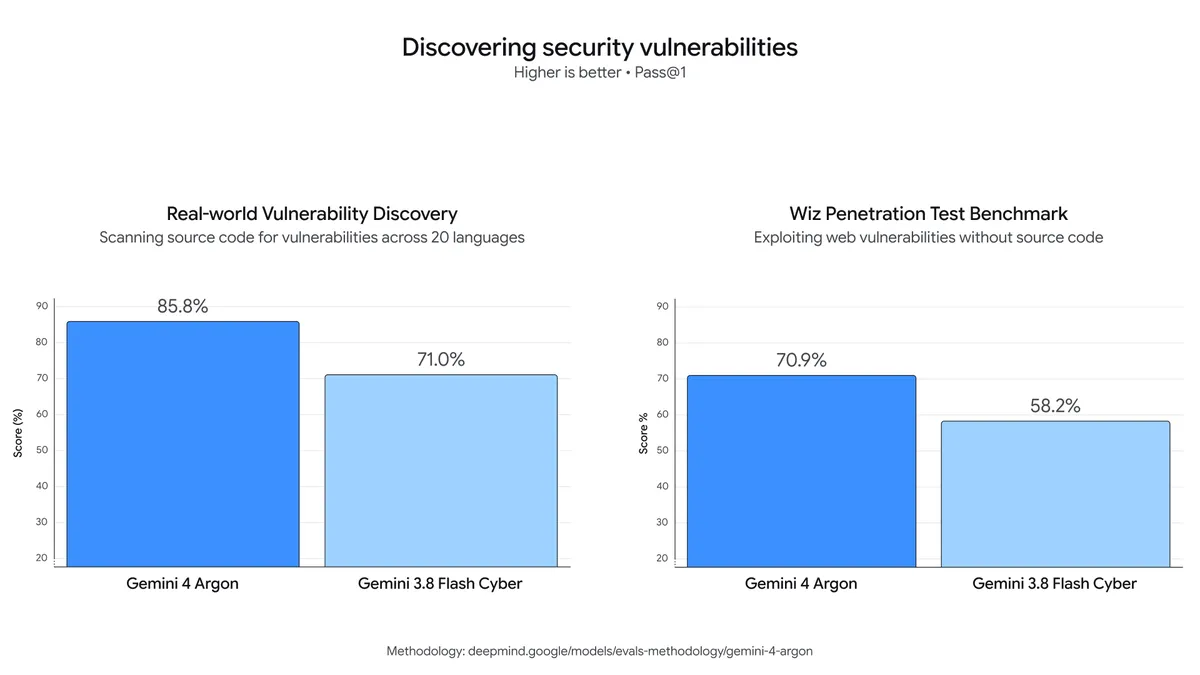
Gemini 4 Argon demonstrates impressive leaps in vulnerability discovery over 3.8 Flash Cyber. For example:
On Google’s internal comprehensive vulnerability benchmark, Argon uncovered a wide range of exposures across complex codebases spanning 20 programming languages.
On Wiz’s internal black-box penetration testing benchmark, which tests a model’s ability to analyze live web systems without source code, Argon outperforms 3.8 Flash Cyber in discovering the attack surface, identifying vulnerabilities, and producing proof-of-concept evidence to validate them.
Strengthening frontier safeguards before broad availability
Before rolling out Gemini 4 Argon broadly, we’re continuing to strengthen critical frontier safeguards across four main areas:
Defending against misuse: To prevent bad actors from using Argon for cyber or chemical, biological, radiological, and nuclear (CBRN) attacks, the model is designed to refuse harmful requests while preserving legitimate, dual-use scientific research, as per our Frontier Safety Framework. We are strengthening the robustness of our safeguards for this launch, including improving our techniques to monitor the model’s internal activations to spot misuse. These safeguards underwent robustness testing by internal and external red teams using a combination of manual and automated attack methods.
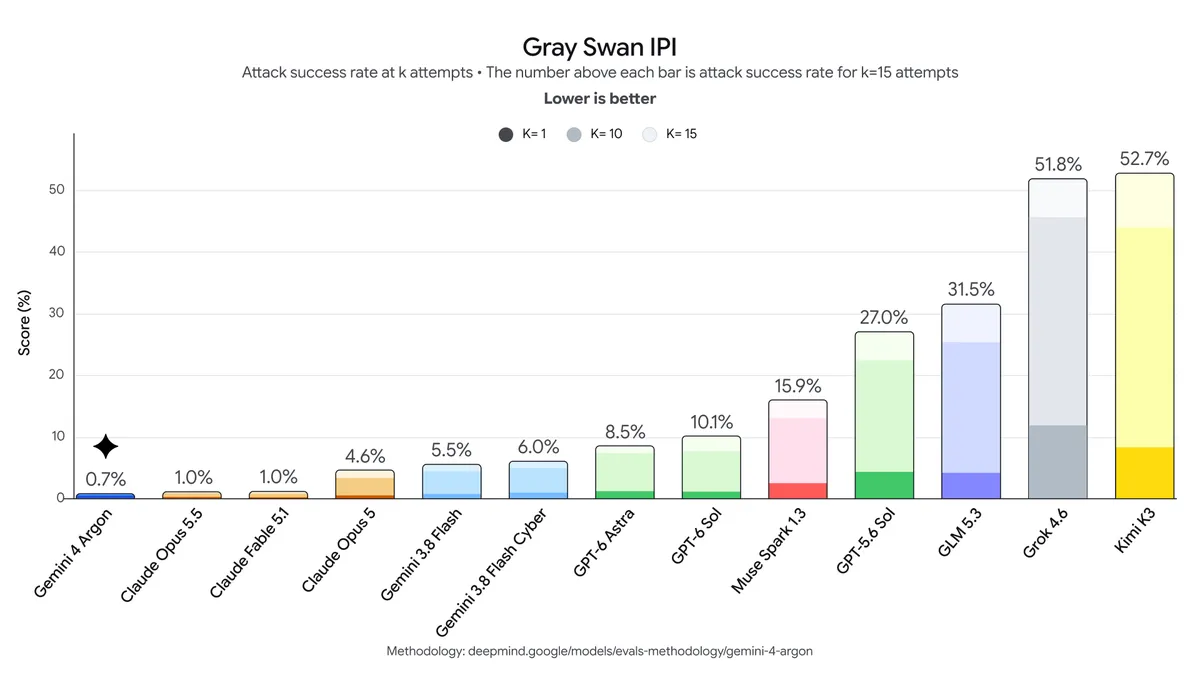
Defending against prompt injection attacks: Argon is also our most resilient model yet against indirect prompt injections, where malicious instructions or context are used to hijack a model’s behavior. These are complex attacks that require constant vigilance and multiple layers of defense. Through automated red teaming and adversarial training, Gemini 4 Argon is leading in prompt injection robustness on the Gray Swan’s Indirect Prompt Injection (IPI) benchmark.
Monitoring for misalignment: In order to prevent Argon from stepping out of bounds to try to accomplish a task in a way that goes beyond the user’s intentions, we are deploying misalignment mitigations that monitor Argon’s chain-of-thought and actions and stop execution when necessary.
We used a similar system to monitor our training runs and send alerts to a dedicated incident response team, taking careful precautions against feeding the findings back into training so as to not risk shaping Argon’s reasoning to evade our monitoring. We strongly encourage the rest of the industry to preserve reasoning transparency in these pivotal moments of increased capabilities while navigating alignment risks, so that model thoughts remain helpful in identifying and diagnosing misalignment.
Hardening systems: As frontier models grow increasingly capable, safely testing them requires secure environments that can keep up with the systems themselves. In line with our agent control roadmap, we are hardening our sandboxed environments by isolating and sealing them before high-risk training or evaluations begin. We’re committed to sharing these agent security best practices with our partners to improve security across the ecosystem.
Rolling out soon
We built Gemini 4 Argon with frontier-level capabilities on coding, knowledge work, cybersecurity defense, and creative writing to be a partner for developers, professionals, and enterprises while they tackle the most difficult problems. We’re grateful for the initial cohort of cyber defenders and trusted testers whose real-world evaluations and feedback will help us strengthen our systems before we release to developers, enterprises, and consumers, starting with paid API customers and Google AI Ultra subscribers.
End-to-end forecasting: A machine learning pipeline uses forecast-time solar-wind information to generate location-specific risk estimates for 66,935 substations in the continental United States.
Physics and place: The system combines Auroral Electrojet (AE) and Disturbance Storm Time (Dst) forecasts with local latitude, geology, and ground conductivity.
Advance warning: The pipeline detected nearly 80% of major space-weather events during the evaluation period and can warn grid operators 30 to 60 minutes before a specific risk appears.
Forecasting a threat to critical infrastructure
During the May 2024 geomagnetic storm, utilities across North America prepared for possible impacts as auroras extended far beyond their usual range. The storm would degrade GPS accuracy and satellite operations, impacting farm operations in North America and Europe. Modern society depends on reliable electric power, yet extreme space-weather events can induce currents in transmission networks that damage equipment and increase operational risk. The challenge is not only knowing that a storm is approaching, but estimating when and where its effects could be most severe with enough warning for grid operators to respond.
During my summer internship at Microsoft Research, I developed a machine learning system that forecasts space-weather risk across 66,935 substations in the continental United States. The system measures how the sun’s activity can affect the earth’s magnetic field and, ultimately, the power grid. It combines solar-wind observations, forecasts of the Auroral Electrojet (AE) and Disturbance Storm Time (Dst) indices, physics-informed constraints, local geological conductivity, and grid-infrastructure data to produce location-specific risk estimates 30-60 minutes ahead of potential impact.
Building an end-to-end prediction pipeline
Space-weather prediction is difficult because it spans several coupled systems. The solar wind changes rapidly, its interaction with Earth’s magnetosphere is irregular, and the resulting ground effects depend on local conditions. Regions with resistive bedrock can experience stronger geomagnetically induced currents (GICs) than regions with more conductive geology. Transmission-line orientation, latitude, and other power-system characteristics further influence the exposure of individual assets.
Microsoft Research at BUILD 2026
Giving developers a hands-on look at some of the many AI-based models and tools they can use to accelerate innovation, enhance their capabilities, and quickly transform ideas into prototypes.
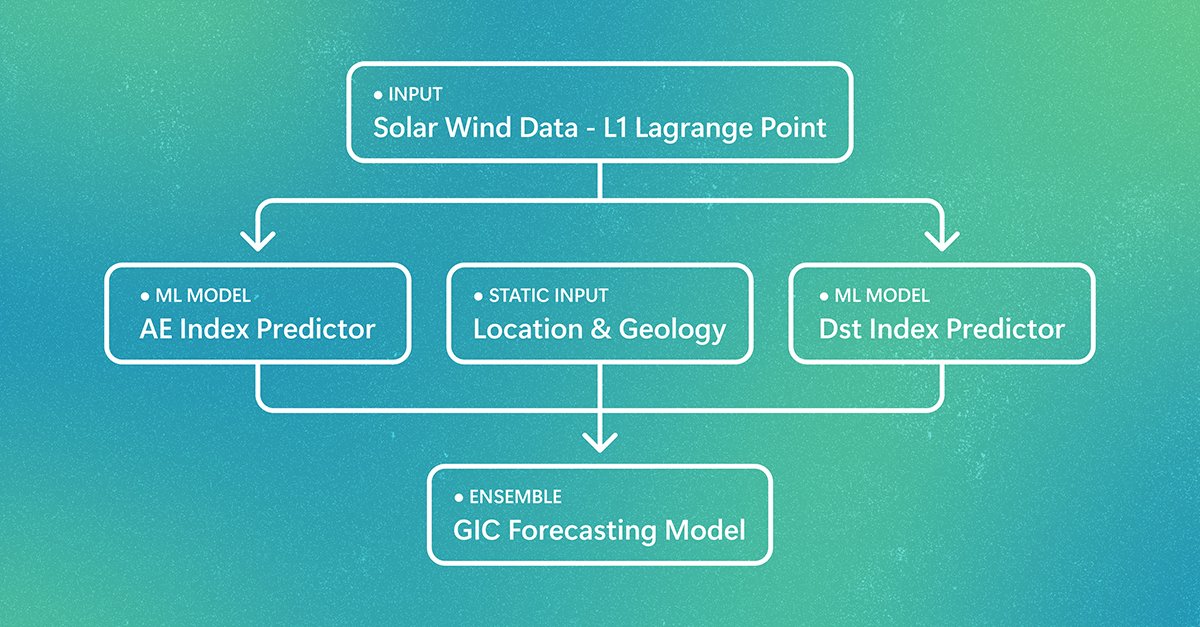
The pipeline addresses this complexity in three stages, shown in Figure 1. First, solar-wind measurements from the L1 Lagrange point are used to generate forecasts of the AE and Dst indices, while geological conductivity and location features are assembled for each substation. Second, a gradient-boosting model combines these forecasted and location-specific inputs to estimate dB/dt, the rate of magnetic-field change associated with GIC risk. Finally, the resulting predictions are converted into location-specific risk estimates and aggregated into a continental risk assessment. A system of 50 AI agents helped explore features, validation strategies, and model configurations across the pipeline. Only public data sources were used, included NASA OMNI and NASA-aggregated Kyoto World Data Center data, INTERMAGNET and U.S. Geological Survey magnetometer observations, and GridSFM-derived grid data.
Figure 1. End-to-end forecasting pipeline from L1 solar-wind measurements to location-specific risk estimates across 66,935 U.S. substations.
Evaluating geomagnetic forecasts and infrastructure risk
The AE predictor was designed to forecast rare, high-intensity geomagnetic activity that drives infrastructure risk. In the 2020-2026 evaluation period, the model produced forecasts spanning nearly the full observed range of AE activity and outperformed several empirical solar-wind-based approaches. The Dst predictor provided an additional signal describing large-scale geomagnetic storm strength. During the most geomagnetically active periods of the 2020-2026 evaluation period, the machine-learning model outperformed the Burton equation on 62.2% of individual hours. The model also produced a substantially wider prediction range than Burton-style approaches and improved severe-event detection in the end-to-end forecasting system by 1.2 percentage points when combined with AE forecasts.
Predictor
Result
Baseline comparison
Impact
AE
410.2 nT RMSE
Lower RMSE than empirical and solar-wind-only baselines
Captures extreme-event activity used by the GIC forecasting system
Dst
7.2 nT RMSE
Outperformed Burton on 62.2% of peak-activity hours and provided wider prediction range
+1.2pp severe storm detection when integrated into final GIC system
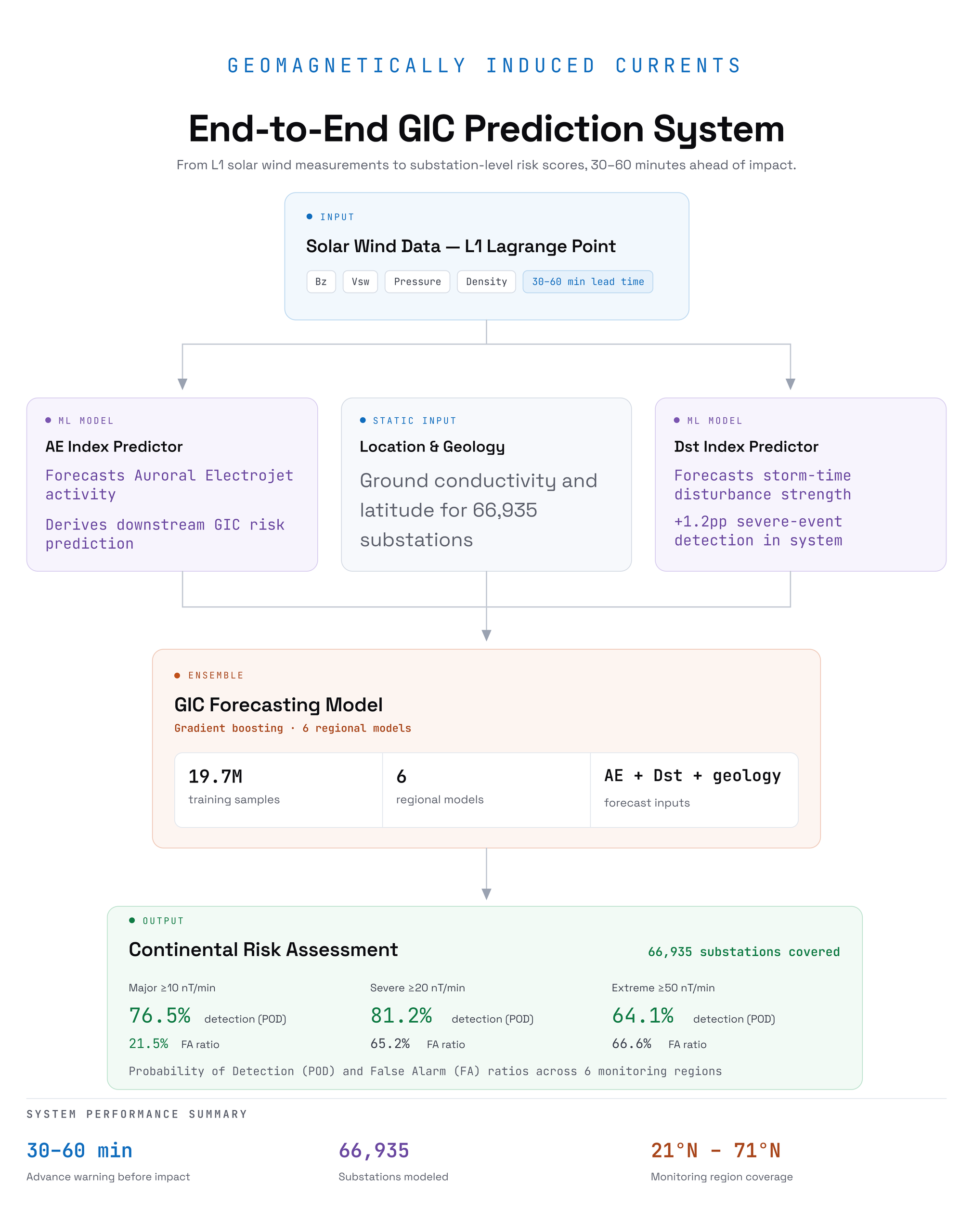
The GIC risk stage was evaluated differently. There is no equivalent widely deployed operational system that provides a direct industry benchmark for this calculation, so the machine learning model was compared with simple linear regression. As Figure 2 shows, the system achieved detection rates of 76.5% for major events (≥10 nT/min), 81.2% for severe events (≥20 nT/min), and 64.1% for extreme events (≥50 nT/min). False-alarm rates increased with storm severity, reflecting the trade-off between missed events and cautious alerts. Performance varied by latitude, with the highest detection rates at northern stations where geomagnetic activity is strongest.
Figure 2. Detection rates across storm-severity thresholds for regionally different substations, with a comparison between the average POD for each severity tier.
Translating predictions into continental risk assessments
The final stage translates predicted geomagnetic activity into location-specific estimates of dB/dt, the rate of magnetic-field change associated with GIC exposure. Rather than issuing a single alert for the continental United States, the system combines storm conditions with each substation’s latitude and geological factor. This produces continuous risk estimates that can distinguish lower-risk locations from areas where resistive geology can amplify ground-level effects.
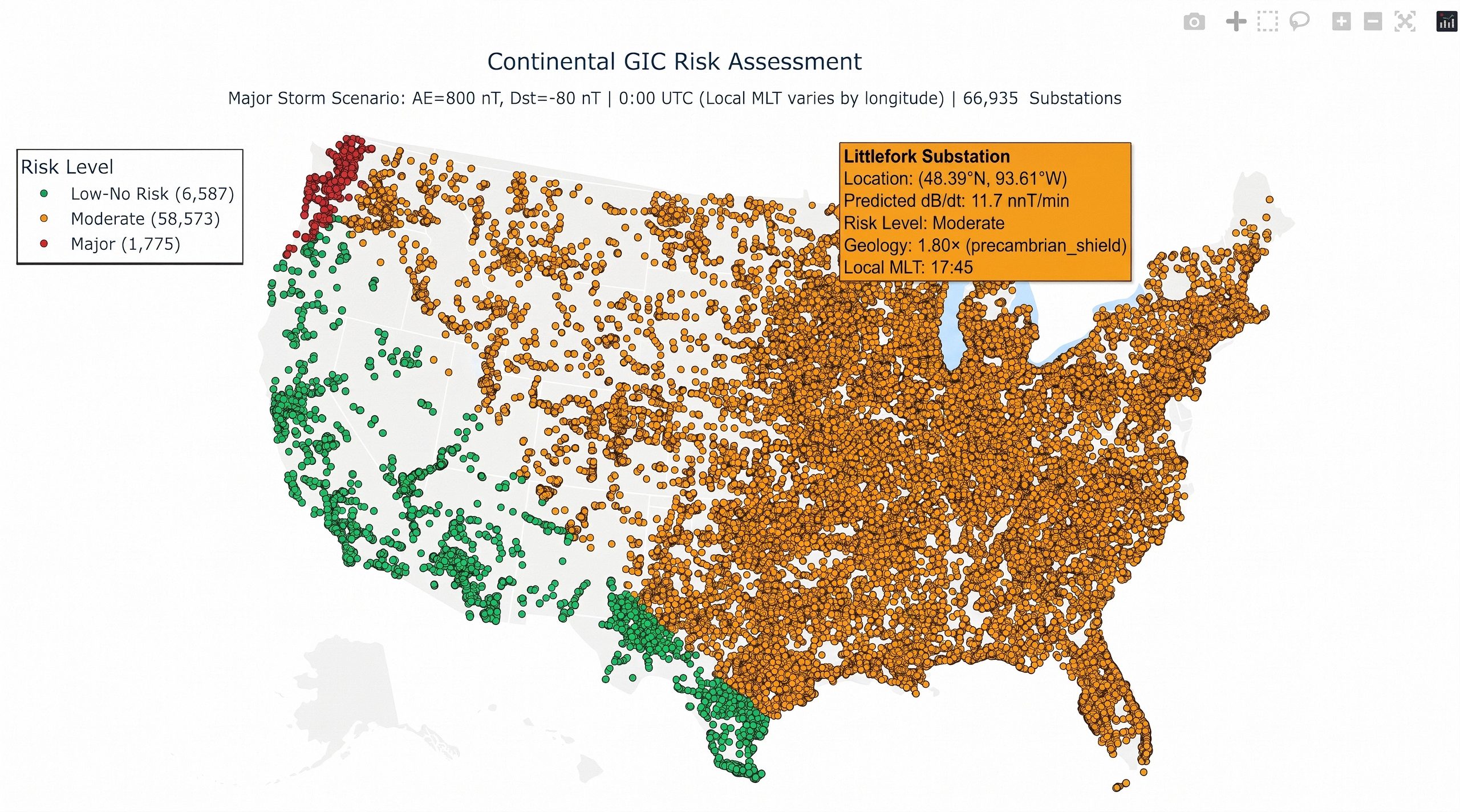
Figure 3 illustrates the output for a representative major-storm scenario. The map is a demonstration of the model’s continental-scale output, not a record of a live operational event. It shows how a grid operator or planner could move from a broad space-weather warning toward a more targeted view of which locations may warrant closer analysis. The current pipeline produced estimates for all 66,935 substations in approximately 333 milliseconds during measured inference, allowing many scenarios to be evaluated quickly.
Figure 3. Demonstration of a continental GIC risk assessment under a representative major-storm scenario. Colors indicate modeled risk levels across 66,935 substations.
Implications and looking forward
This work demonstrates how physics-grounded machine learning could support more specific and timely assessment of space-weather exposure. Earlier, location-specific information could help utilities prioritize engineering review and consider targeted protective actions, such as adjusting reactive-power reserves or temporarily reconfiguring parts of the network. Further validation with utilities and operational data would be needed before the system could be used in grid operations.
The project also connects with broader Microsoft Research work on AI for power systems. The open grid-data pipeline provided realistic U.S. transmission models, while GridSFM applies deep learning to AC optimal power flow for fast scenario analysis. Together, these efforts point toward richer planning and resilience workflows that combine hazard forecasts, grid topology, and power-flow analysis.
Extend forecast horizons: Explore temporal-transformer approaches that capture longer-range patterns in solar-wind data and move beyond the current 30-60-minute window.
Scale internationally: Adapt the system to additional regions while accounting for different geological conditions and grid topologies.
Integrate with grid operations: Evaluate how forecasts could support existing decision-making and engineering-review workflows before considering higher levels of automation.
Provide transformer-level risk: Add asset-specific characteristics to move from substation-level estimates toward more granular assessments of critical equipment.
Acknowledgements
Special thanks to my mentors Weiwei Yang and Spencer Fowers for their guidance throughout this project, and to Amber Hoak, Weishung Liu, and Andrea Britto for their editorial and technical feedback.
Pushmeet Kohli, David Stutz, Ali Cowen-Rivers and Jeremy Ratcliff
Proof of concept for watermarking AI-generated proteins while preserving biological function.
Today, we’re introducing SynthID Bio to bring watermarking technology to synthetic biology. SynthID Bio embeds an imperceptible signature directly into the biological code, ensuring the watermark is verifiable not just on a digital model but on the synthesized, physical protein itself – all while preserving its biological function in laboratory testing.
Generative AI is helping scientists address critical biological challenges, from predicting the structure of proteins (AlphaFold) to designing entirely new proteins (AlphaProteo, and ProteinMPNN), and more recently, developing new bacteriophages, viruses that infect bacteria. Yet these tools also present new challenges: novel AI designs can bypass traditional DNA synthesis screening, while mislabeled synthetic 3D structures risk polluting public databases and misleading downstream research.
How SynthID Bio works
SynthID Bio is a family of watermarking methods developed specifically for synthetic biology to strengthen biosecurity and scientific integrity.
It adapts its approach depending on the type of data, subtly guiding the choice of amino acids for sequences and adjusting atomic coordinates for predicted 3D structures, creating a reliable signal for detection.
In experiments, these adjustments did not compromise the protein’s biological function, which is essential to effectively treat disease and advance scientific research.
Visualization of the predicted structure of our watermarked VEGF-A protein binder with watermark signal indicated by color for each amino acid.
We verified our approach for watermarking protein binders, i.e. molecules built to selectively latch onto other proteins, by using our binder design method AlphaProteo alongside a SynthID Bio-enabled version of ProteinMPNN, the commonly used protein sequence generation method.
In wet-lab testing across three target proteins (VEGF-A, the SARS-CoV-2 spike protein RBD, and PD-L1), our watermarked designs matched the hit rate, binding affinity, and natural sequence diversity of unwatermarked versions, successfully creating the first-ever watermarked and biologically functional protein binders.
Binding affinity, measured as KD, comparing non-watermarked and watermarked protein designs across three targets. Lower indicates stronger binders.
For protein folding, SynthID Bio fine-tunes a small part of AlphaFold 3’s diffusion network, building the ability to watermark directly into the model’s weights. This ensures that the predicted 3D coordinates inherently carry a detectable signature regardless of who runs the model. SynthID Bio preserves AlphaFold 3 prediction accuracy while offering near-perfect detectability, maintaining key structural feature distributions, and holding up against digital noise or minor coordinate changes.
On 7PPA, we show the AF3 predicted structure (left), the ground truth structure (middle), and the watermarked structure (right).
Strengthening biosecurity and information integrity
Biosecurity relies on layered defenses – think of it like a “Swiss cheese” defense model, where multiple independent safety measures work in tandem to cover each other’s blind spots. Safeguards like model-level mitigations and customer vetting each represent critical layers with potential gaps. As a part of our broader vision for bioresilience, SynthID Bio’s watermarking approach serves as an important, tangible verification layer embedded in the biological design itself.
“SynthID Bio is an important piece of the puzzle for tracking the provenance of biological designs,” said Sarah Carter, a biosecurity policy expert and Principal at Science Policy Consulting who reviewed the work. “By linking designs to the model developer, these watermarks empower developers to lead on safety and allow synthesis providers to streamline screening for customers who have used those models.”
That layer is especially vital to DNA synthesis screening, which sits on the frontlines of biosecurity. Converting digital protein designs into physical molecules requires placing an order with DNA synthesis providers, who screen requests against databases of known threats. For example, historically, an unfamiliar sequence may have been safely assumed to be an undiscovered natural organism. But because AI can create entirely new sequences with little resemblance to known hazards, screeners can no longer make that assumption. Verifying that an unfamiliar order isn’t an engineered threat requires exhaustive manual reviews that can stall vital research. Here, SynthID Bio can provide an automated verification signal, proving an order originated from a trusted model with built-in safeguards.
“AI is expanding what scientists can design, and DNA synthesis companies have an important role in helping that innovation scale responsibly,” said James Diggans, Vice President, Policy and Biosecurity at Twist Bioscience, who provided early feedback on the paper. “For Twist, watermarking offers a promising new addition to the biosecurity toolbox that could strengthen screening, focus resources on sequences that warrant closer review and make biosecurity more efficient as AI-designed biology continues to advance.”
Similarly, SynthID Bio could help maintain the integrity of databases such as the Protein Data Bank, UniProt, and GenBank. These databases, many of which are open to public submission, play a vital role in scientific advancements – but mislabeled entries can have an outsized negative impact in biosecurity decision-making, a challenge that may only grow with the addition of AI-generated biological data. As a part of the submission process, SynthID Bio could help ensure synthetic entries are properly labeled or flagged for further review.
Looking ahead
While no single biosecurity intervention is a silver bullet, SynthID Bio brings SynthID, our tried and tested watermarking tool, to synthetic biology. It’s an important first step toward reliably identifying and tracking AI-generated biological sequences and structures.
Moving forward, key challenges include making the watermark more robust against deliberate tampering. SynthID Bio can also be paired with provenance metadata approaches – similar to C2PA for digital media – or central repositories of AI-generated biological data to better identify and track AI-generated proteins.
To match the growing capabilities of frontier AI technology, we’re also researching how to apply watermarking to more complex biological objects. In ongoing work with the Hie lab at Stanford University and Arc Institute, we integrated SynthID Bio into Evo 2, an advanced genomic model, to watermark the genome of an Evo 2 designed bacteriophage. Early laboratory testing in bacteria cultures has confirmed these watermarked bacteriophages are functional. We believe this work has the potential to address some of the biosecurity risks associated with genome design and will share more details in a technical manuscript soon.
Realizing the full biosecurity benefits of this work will require community collaboration and further research. As part of our commitment to responsible innovation, we are publishing our methods paper and open-sourcing the code and in vitro data, and releasing the weights to the research community, so we can build on this work. By working openly with partners across biosecurity, gene synthesis, and policy, we can ensure safety and responsibility keeps pace with AI-driven discovery.
To reach out about partnering with us on this important topic, please contact us atsynthidbio@google.com with a high level proposal. Please do not disclose any confidential or proprietary information.
Acknowledgements
This project was initiated by Pushmeet Kohli. The research and technical development was led by Alexander I. Cowen-Rivers and David Stutz and was advised by Pushmeet Kohli. Key engineering and research contributions were made by Guillermo Ortiz-Jimenez, Jeremy Ratcliff, Vinicius Zambaldi, Lindsay Willmore, Josh Abramson, Harshnira Patani, Christina Kouridi, Florian Stimberg, Mel Vecerik, Alex Chu, Sukhdeep Singh, Sumanth Dathathri, Eliseo Papa, Valentin De Bortoli, Arnaud Doucet, Jue Wang, and Sven Gowal. We thank Adaptyv Bio for help with in vitro validation.
The extension of this work to watermark DNA of bacteriophages is a collaboration between Google DeepMind and the Hie lab at Stanford and Arc Institute with key contributions from Jeremy Ratcliff, Aleks Petrov, Alexander I. Cowen-Rivers, David Stutz, Elisa L. H. Wong, Victor Martin Palacios, Francesca Pietra, Alfred Piccioni, Tristan Oliver Kwan, Tor Lattimore, Sumanth Dathathri, and Pushmeet Kohli from Google DeepMind and Brian Hie, Samuel King, and Aditi Merchant from Arc Institute and Stanford.
We further thank Rudy Bunel, Anna Cupani, Rob Fergus, Thomas Frerix, Sahra Ghalebikesabi, John Jumper, Jacob Kelly, David La, Victor Martin, Sebastian Nowozin, Stig Petersen, Aleks Petrov, Uchechi Okereke, Sylvestre-Alvise Rebuffi, Rosalia Schneider, Armin Senoner, Richard Shuai, Ashok Thillaisundaram, Elisa L. H. Wong, Zachary Wu, and Augustin Žídek for their contributions to the research article, and Julien Bergeron for contributions to the 3D rendering. Finally, we thank Demis Hassabis for his encouragement and support of this project.
AlphaProteo generates novel proteins for biology and health research
Watermarking AI-generated text and video with SynthID
Identifying AI-generated images with SynthID
AlphaProteo generates novel proteins for biology and health research