Author: admin

  • Research: Sleep Deprivation Is a Leadership Problem

    Research: Sleep Deprivation Is a Leadership Problem

    Harvard Business Review Logo

    moodboard/Getty Images

    Sleep deprivation remains widespread among leaders, and many leaders underestimate how much fatigue affects their performance. A new survey of 1,009 U.S. managers and executives suggests that the

    At 8:40 a.m. on a Friday, a leadership team gathers to make the biggest call of its quarter. The CEO hasn’t had enough sleep all week, but nobody knows that, because she arrived energized, with a coffee in her hand, performing alertness the way many senior leaders learn to do. She’s far from the only one in the room performing alertness, though. Many of the others in the room are hiding their own sleep deprivation—which means the decision they’re all about to make may be shaped as much by the sleep they’ve lost this week as by the analysis in front of them.

  • Featherweight Dictation

    Dictation that weighs nothing, for Mac and Windows

    Discussion
    |
    Link

  • How Jump Trading is scaling quant research with ChatGPT

    Jump Trading uses OpenAI to expand quantitative research. See how longer-running AI workflows combine multiple data sources with human review.

  • Sharing AI progress in mathematics

    OpenAI publishes new results on open problems in mathematics from an internal frontier model and shares Lean proof formalizations and research details on GitHub.

  • Getting Your Boss to Buy into Your Strategy (from “Coaching Real Leaders”)

    Getting Your Boss to Buy into Your Strategy (from “Coaching Real Leaders”)

    October 06, 2026

    You have a strategy you believe in. But what happens when your boss doesn’t? Cold Call presents this bonus episode from the podcast Coaching Real Leaders, where host and executive coach Muriel Wilkins works with an ambitious leader whose plan to drive growth is at risk because she hasn’t been able to get the alignment she needs from her boss. They explore what’s behind the resistance and how she can approach the relationship, and the strategy, differently. The conversation illustrates a key challenge at the heart of strategy execution: getting the people who need to support your idea on board.

    Find more from the Coaching Real Leaders podcast here.

  • Optimism Is Now an Essential Leadership Skill

    Optimism Is Now an Essential Leadership Skill

    October 06, 2026

    Optimism isn’t about ignoring problems or pretending everything will work out. It’s about acknowledging challenges while believing that your actions can still make a difference. Psychologist and researcher Michelle Gielan says leaders can cultivate that mindset in themselves and their teams and argues that, when they do, it creates a powerful performance advantage. Drawing on an 11-year dataset of more than 25,000 business professionals, she shares research linking optimism to higher productivity, sales, engagement, and lower burnout. She explains how leaders can use techniques like “power leads” to help teams focus on progress and possibility without losing sight of difficult realities. Gielan wrote the book Resilient Optimism: The Science of Sustaining a Positive Mindset in Tough Times and the HBR article “How Leaders Counter Pessimism in Trying Times.“

  • Advancing computer use with Ironclad

    Learn how OpenAI and Ironclad are training and evaluating AI agents on complex contracting workflows to advance computer use for professional work.

  • Introducing Video Editor in Manus 2.0

    Anyone Can Now Make A Video Worth Posting

    Discussion
    |
    Link

  • Gemini automation: How to use the Zapier Gemini integration (Gemini 3.8 Flash, Gemini Enterprise, and more)

    Gemini automation: How to use the Zapier Gemini integration (Gemini 3.8 Flash, Gemini Enterprise, and more)

    Anyone who lives in the Google ecosystem has probably used Gemini for a quick draft or a fast answer. (Or if you’re like me, you’ve been driven to your limit by the Google Docs popups encouraging you to use AI whenever your cursor strays too close to the bottom of the screen.) But a chat window is just the beginning of what Gemini can do. Its real power shows up when you connect it to the rest of your apps and let it do work on your behalf.

    All of Gemini’s models are available in Zapier, so you can add Gemini-powered steps to your existing workflows. And Zapier is also live as a connector inside Gemini Enterprise, which means teams can securely access and take action in 9,000+ apps directly from the Gemini chat window, too.

    Here’s how it works.

    Table of contents:

    Add Gemini’s brain to your existing workflows (AI by Zapier)

    Zapier is built for automating complex workflows, and some of those workflows benefit from AI reasoning along the way. AI by Zapier lets you drop a Gemini step directly into a workflow wherever it’s useful, without a separate Google AI Studio account.

    That means AI only shows up when it’s needed, which helps you save tokens (and avoid unnecessary hallucinations). For example, if you just need to log form responses into a spreadsheet, deterministic automation handles that fine on its own. You shouldn’t spend tokens on a step that doesn’t need a model. But when you’re classifying hundreds of support tickets a day, scanning competitor pages for keyword opportunities, or summarizing a pile of customer reviews, that’s when Gemini is worth bringing in.

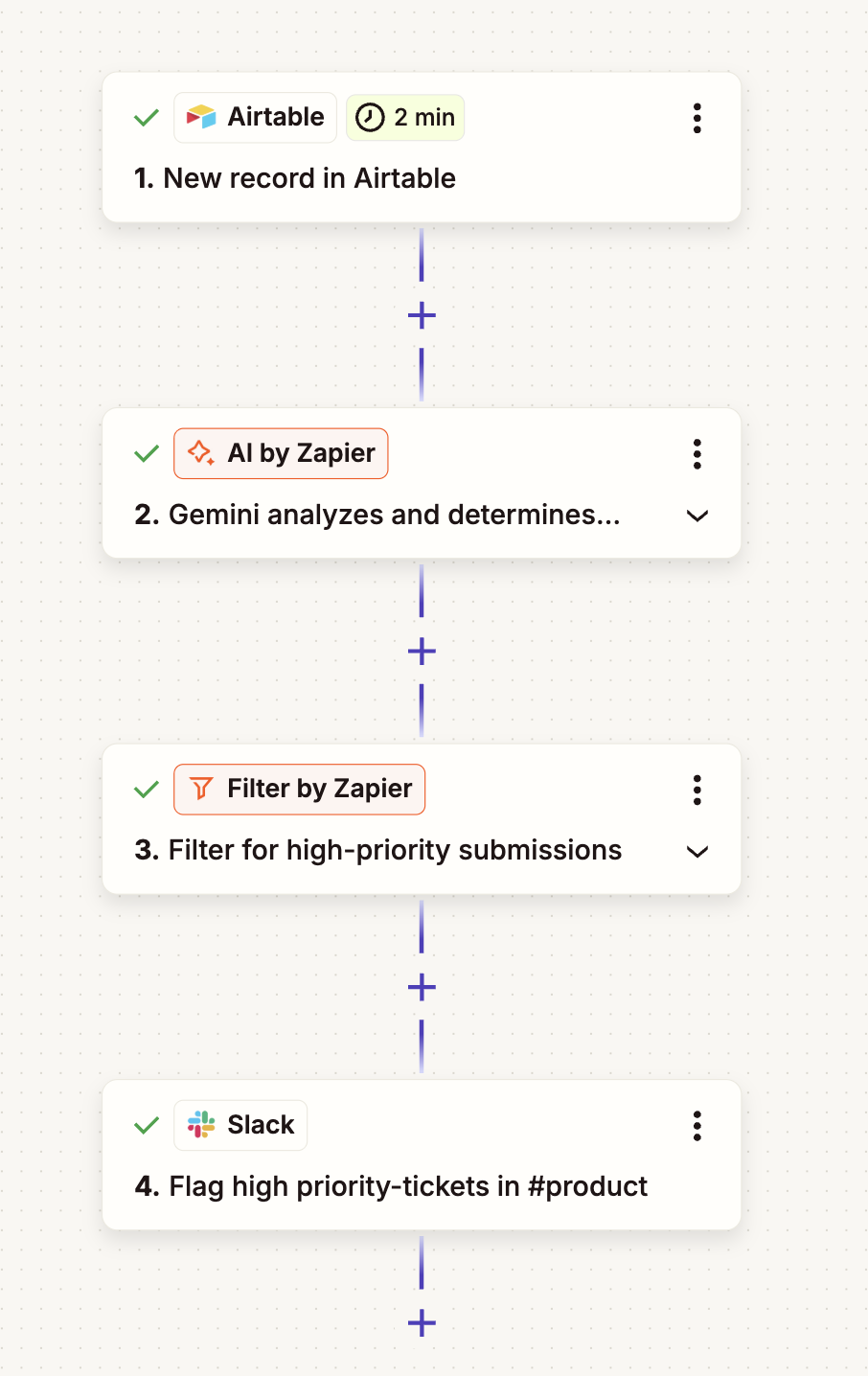
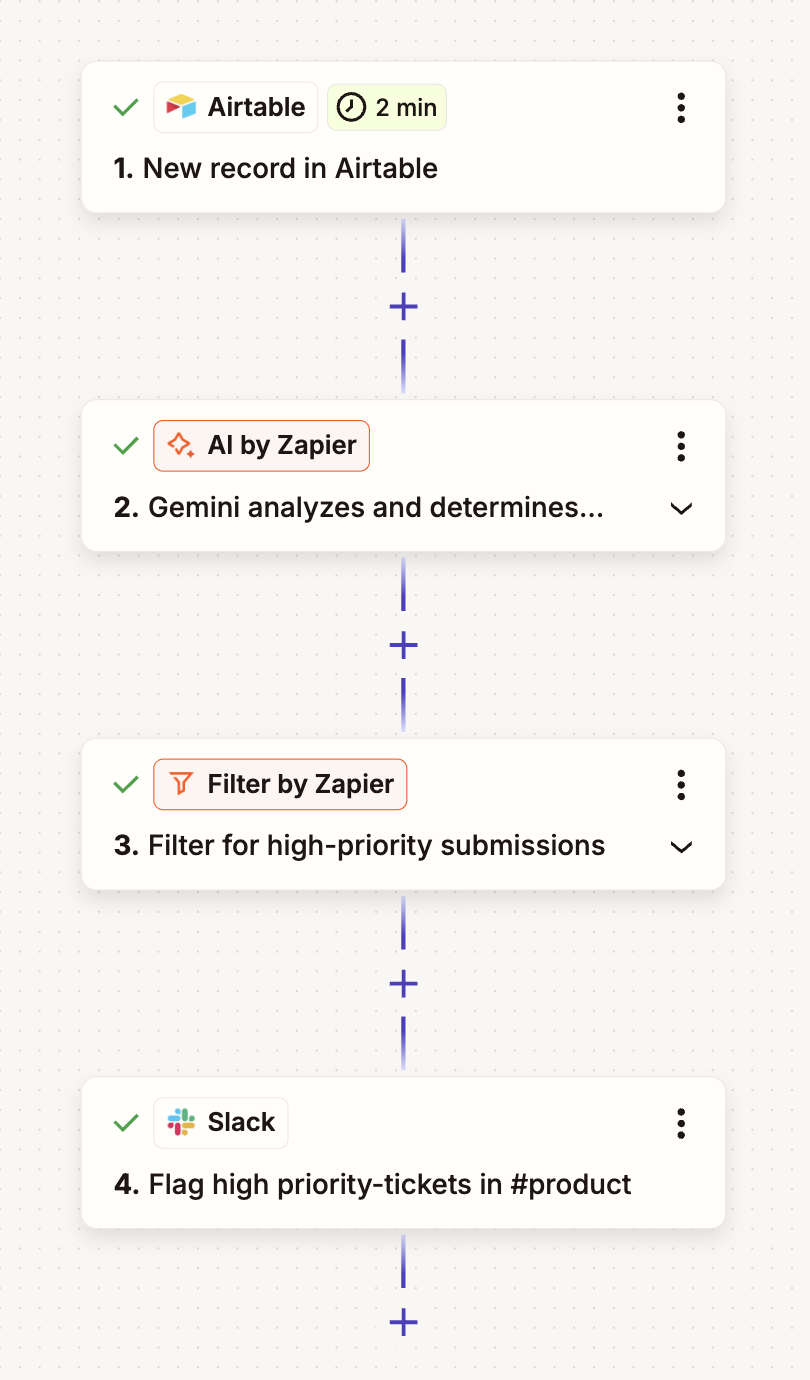
    Say your team collects feedback through a form throughout the week. Instead of someone manually reading the results, including the ones that aren’t valuable, you can build a Zap that triggers on new submissions. It can then send the response to a Gemini model with a prompt like “decide if this response needs attention from the product team,” then send any submissions that were flagged to Slack. Gemini only runs when there’s a new submission to check, and your team gets notified for anything that matters.

    In the Zapier editor, an automated workflow that includes an AI step using Gemini

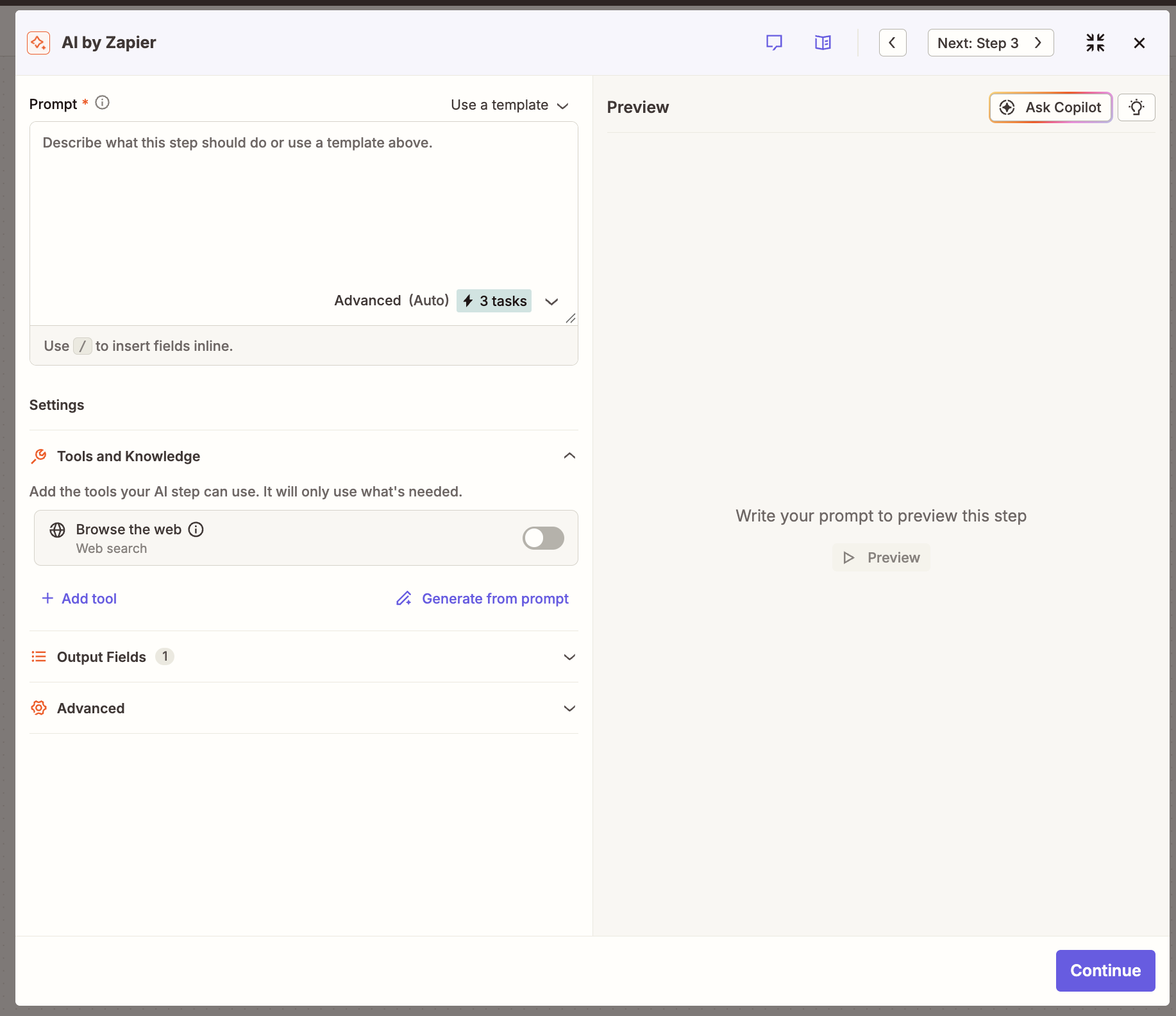
    You stay in control of the step itself: just tune the prompt, attach knowledge sources, turn on agentic tool calling, and test until the output looks right.

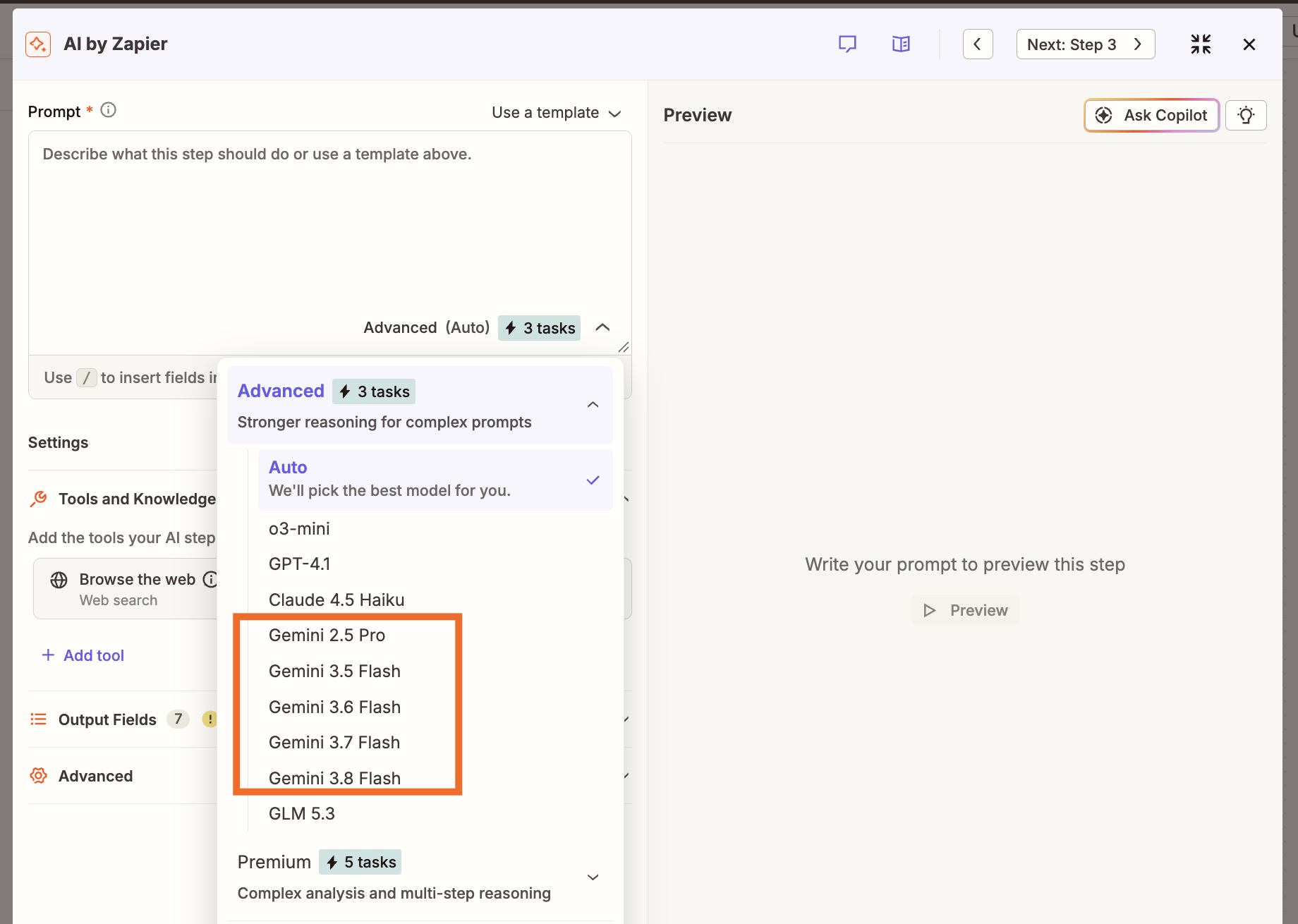
    Pick whichever Gemini model fits the job from a dropdown in the visual workflow editor, and the cost comes out of your Zapier task count instead of a separate Google bill.

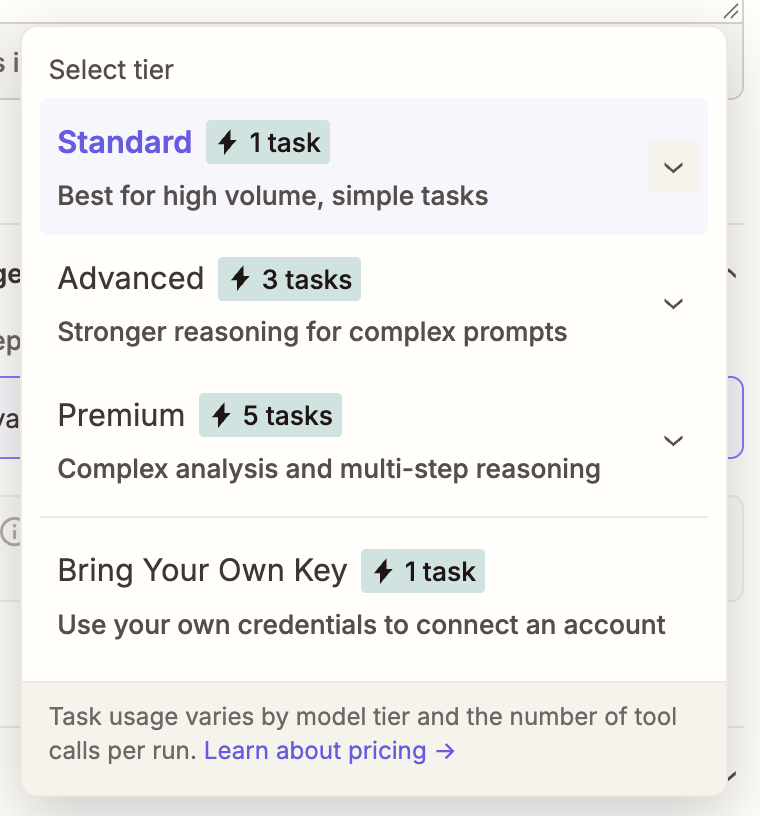
    The model picker in an AI by Zapier step, highlighting the available Gemini models

    Here’s the current Gemini lineup in AI by Zapier. New models get added as soon as Google ships them. (You can also bring your own key [BYOK] if you want a Gemini model that isn’t built into AI by Zapier—in that case, you pay Google directly.)

    Model

    AI by Zapier

    Gemini 2.5 Flash

    1 task

    Gemini 2.5 Flash Lite

    1 task

    Gemini 3.5 Flash Lite

    1 task

    Gemini 3.5 Flash

    3 tasks

    Gemini 3.6 Flash

    3 tasks

    Gemini 3.7 Flash

    3 tasks

    Gemini 3.8 Flash

    3 tasks

    Gemini 2.5 Pro

    3 tasks

    Gemini 3.1 Pro

    5 tasks

    If you’re not sure which model to reach for, check AutomationBench, Zapier’s benchmark for how AI models handle real business workflows. It’ll show you how Gemini stacks up against other models for the specific task you’re automating.

    See the leaderboard

    You can also use the dedicated Google AI Studio (Gemini) integration to add a Gemini step with your own Google account. But I recommend using AI by Zapier if you can, since you get prompt testing, knowledge sources, and agentic tool calling built in, and you can swap models later without rebuilding the Zap.

    Gemini automation use cases

    Here’s a look at how teams use AI by Zapier to bring Gemini into their workflows:

    • Triage high-volume requests. Send every new support ticket, inbound lead, or form submission to Gemini for classification and priority scoring, then route the output to the right queue, person, or channel automatically.

    • Summarize meetings and calls. When a new recording lands in Fathom, tl;dv, or Zoom, have Gemini pull out the key takeaways and action items, then post the summary to Slack so no one has to re-watch the call.

    • Analyze images and files. Gemini is trained on more than text. You can send it visual files, like a chart from a sales deck or a screenshot from a bug report, and get back a plain-language summary of what’s in it.

    • Draft and label emails. Route new Gmail messages to Gemini for a draft reply, a summary, or an automatic label, so your inbox sorts itself before you open it.

    • Research and tag content at scale. Pair Gemini with Zapier’s Chrome extension to parse competitor pages or articles as you browse, and let Gemini extract keywords, themes, or sentiment into a running Google Sheet or Table.

    Start building

    Automate workflows directly from Gemini (Zapier MCP)

    Gemini Enterprise is Google’s admin-managed, enterprise edition of Gemini (previously known as Agentspace). If your organization has a Gemini Enterprise license, you can use Zapier’s connector to kick off automations from inside Gemini itself. It gives Gemini governed access to all 9,000+ apps in Zapier’s library, and you decide exactly which apps and actions it can touch.

    Your admin can configure Gemini Enterprise connectors by following these steps:

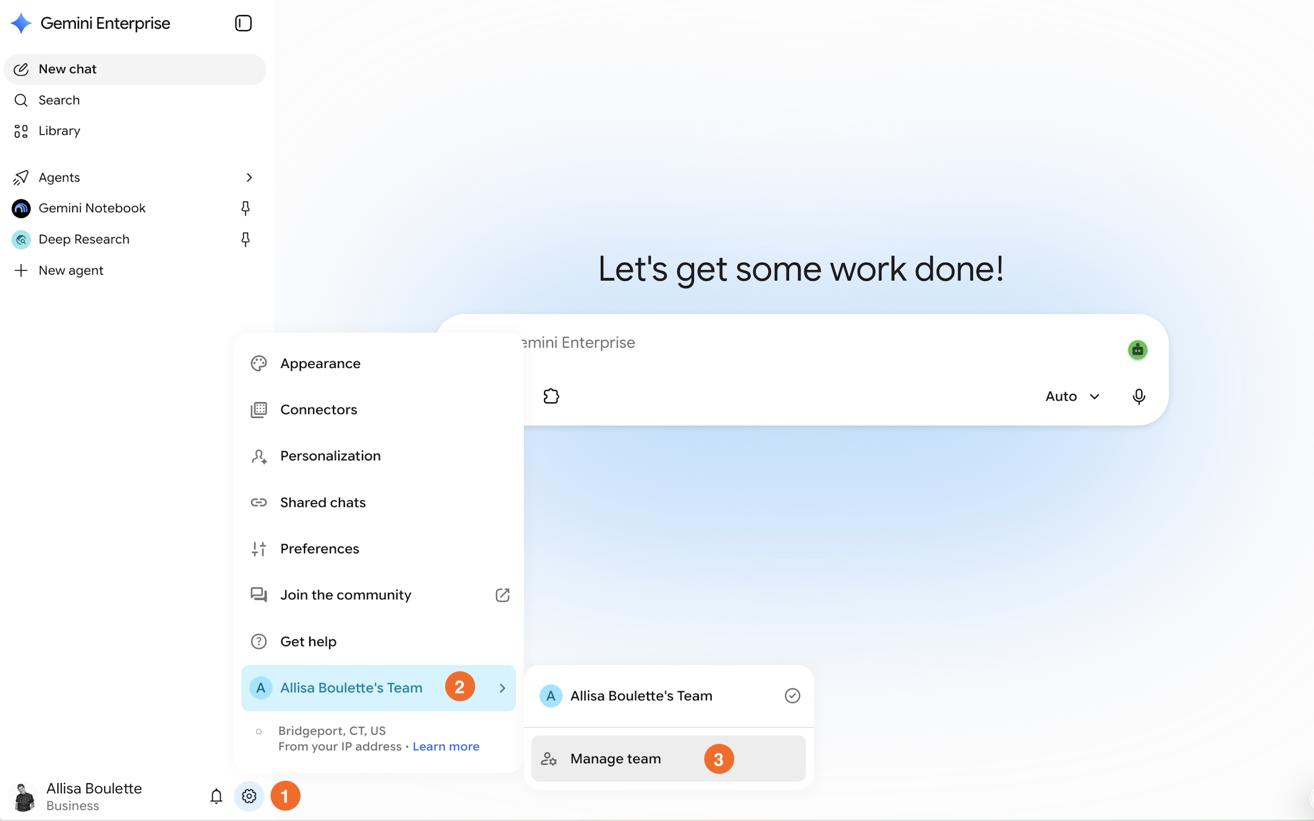
    1. In the Gemini Enterprise app admin console, click Settings & help (cog icon).

    2. Click your team name, then select Manage team. 

      Navigating to Manage team in Gemini Enterprise
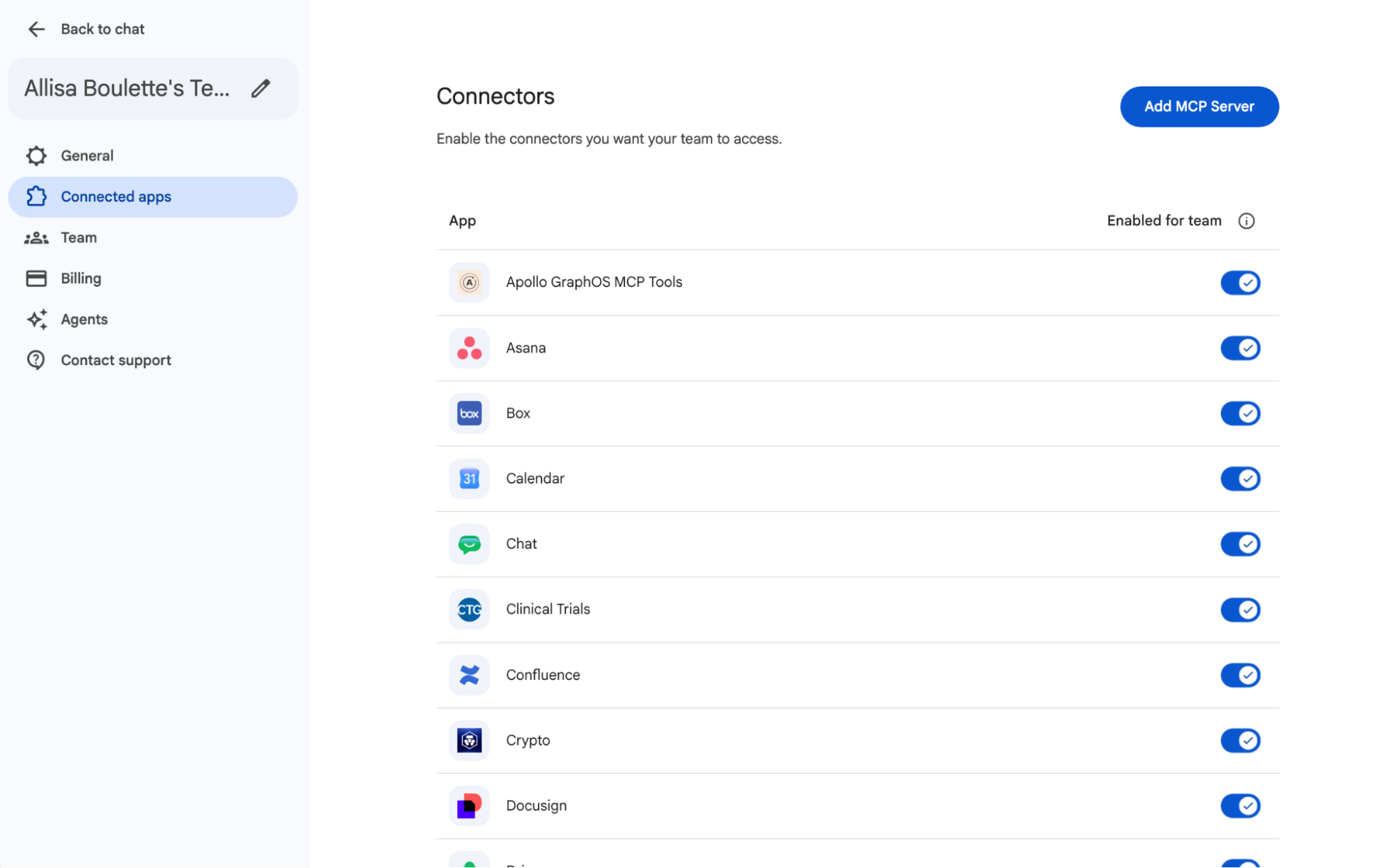
    3. Click Connected apps.

    4. Look for Zapier in the connector list and toggle it on. (If it’s not showing up yet, click Add MCP Server instead, and paste in your Zapier MCP URL.)

      The toggles to connect Gemini Connectors
    5. Follow the steps to authenticate through Zapier when prompted.

    Once it’s on, anyone on your team can access Zapier’s app library through the Gemini Enterprise app interface, within whatever permissions your admin has set.

    Here’s what you might ask Gemini to do once Zapier MCP is connected:

    • “Pull my last five HubSpot opportunities, calculate weighted pipeline, and send a summary to Slack.”

    • “Check my Gmail for anything I missed this morning, flag what needs a response, and add follow-ups to my Todoist list.”

    • “Pull the notes from yesterday’s customer call in our CRM and draft a recap email to the account team.”

    None of that requires opening a separate app. It all runs from the Gemini chat window.

    Zapier adds thousands of apps on top of Gemini Enterprise’s 100+ native connectors, all governed from one place. And that governance travels with you: Zapier works the same way across Gemini, Claude, ChatGPT, and any other agent harness that supports MCP, so you and your team can use whichever AI tool works best for each job.

    Try Zapier MCP

    Gemini automation FAQ

    How do I automate Gemini with Zapier?

    If you want AI reasoning inside an existing workflow, use AI by Zapier to add a Gemini step to a Zap. It runs automatically whenever the Zap triggers, and you pay in Zapier tasks instead of a Google bill. If you want to kick off work directly from the Gemini chat window, have your enterprise admin configure the Zapier connector in Gemini Enterprise. Then, just tell Gemini what you want done, like “pull my last five opportunities from HubSpot and send a summary to the team Slack channel.”

    How do I connect Zapier to Gemini Enterprise via MCP?

    Have an admin open the Gemini Enterprise admin console, go to Settings & help > Manage team > Connected apps, and either select Zapier from the connector list or add it manually with Add MCP Server using your Zapier MCP URL. Once an admin turns it on and sets permissions, everyone on the team can use it from the Gemini Enterprise interface.

    Is Zapier MCP available on personal Gemini, or only Gemini Enterprise?

    As of now, Zapier MCP is only live inside Gemini Enterprise, which is the paid, admin-managed edition built for organizations. Personal accounts can still use Gemini inside Zaps.

    Automate Gemini with Zapier

    Whether you want AI reasoning running helpfully in the background or you’d rather direct your tech stack from the Gemini chat window, Zapier gives you a governed way to bring Gemini into the rest of your work.

    Either way, the connection runs through Zapier’s managed authentication, so Gemini never has to ask for an API key, your credentials stay safely governed in one place, and every action follows the same permissions you’d apply anywhere else in your stack.

    Try Zapier

    Related reading:

    This article was originally published in July 2024, and has also had contributions from Elena Alston and Steph Spector. The most recent update was in October 2026.

  • Zapier Agents is now AI by Zapier

    Zapier Agents is now AI by Zapier

    Everything your agent can do on Zapier and where it lives in a Zap

    By Ruchira Kulkarni · October 6, 2026

    The AI by Zapier logo

    Every capability that made Zapier Agents powerful—tool calling, reasoning, autonomous action—now lives inside a single AI step in the Zap editor, using AI by Zapier. Here, I’ll map each Zapier Agents feature to its equivalent in AI by Zapier, so if you’re coming from Zapier Agents, you know exactly where to click.

    What’s changed between Zapier Agents and AI by Zapier

    Zapier Agents consisted of four things: a prompt, a set of tools, a trigger, and permission to act. That bundle worked, but it sat outside the platform, so your agent couldn’t use, for example, Zapier’s triggers, filters, paths, or run history.

    The same four ingredients now live in a step you drop into any Zap, running on the infrastructure that already executes millions of tasks a day and lets you access the rest of the Zapier platform.

    Moving from Zapier Agents to AI by Zapier

    The AI by Zapier interface

    What you built in Agents

    Where it lives now

    Agent instructions

    The prompt field on the AI by Zapier step

    Tools the agent could use

    The tools picker inside the AI by Zapier step—add as many as the job needs

    Agent trigger (schedule, webhook)

    The Zap trigger—any of 9,000+ apps, not just a handful

    Chat / on-demand agent

    A webhook trigger

    One agent calling another

    Sub-Zap by Zapier as the trigger on the child Zap

    Granular Human Intervention

    Require approval before running, set per tool. (New: Agents were all-or-nothing; now you set approval granularity per action)

    Model choice

    Standard, Advanced, and Premium tiers—or name a specific model. (New: Agents didn’t let you pick; now you control cost and capability per step)

    Agent run history

    Zap History, alongside every other automation you run

    Agent cost

    Tasks, on the same task-based pricing as the rest of Zapier; no more guessing what an activity is—we now have a universal task billing system.

    Knowledge sources

    The knowledge sources your AI step can reference while reasoning (not yet supported in AI by Zapier: HubSpot, Asana, Zendesk, Zoom, and Jira)

    5 things you can do with AI by Zapier that you couldn’t do with Zapier Agents

    AI by Zapier gives you all sorts of combinations that were impossible when agents lived on their own island.

    Mix agentic and deterministic steps

    AI by Zapier in a series of steps

    Let the AI decide which record to update, then use a normal Zapier action to send the confirmation email exactly the way it should read every time. That means you get reasoning where it adds value and predictability everywhere else. This allows you to have better control of your workflow and reduce costs over time.

    Read more: How Zapier can help you with valuemaxxing, not tokenmaxxing

    Gate risk per tool, not per agent

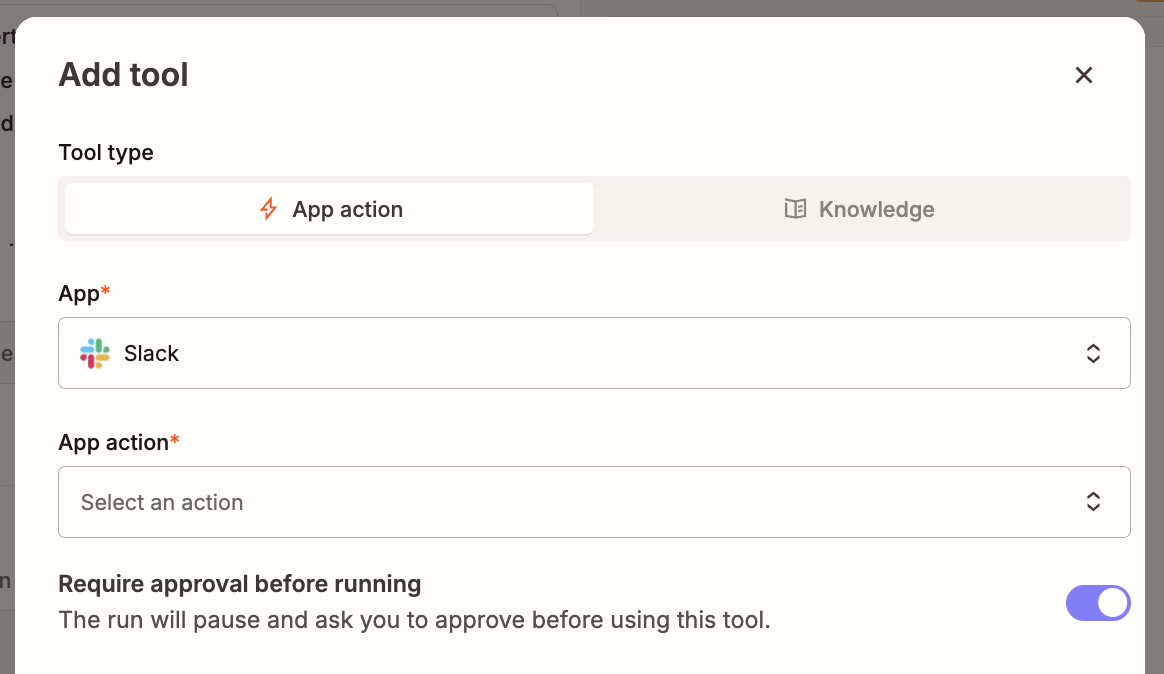
    The Require approval before running toggle in AI by Zapier

    Reading data from a spreadsheet doesn’t carry the same weight as messaging a client. With Require approval before running toggles, you control the granularity—letting your agent read data to reason autonomously, while forcing a human check before taking action that can’t be undone.

    Get structured output you can actually map

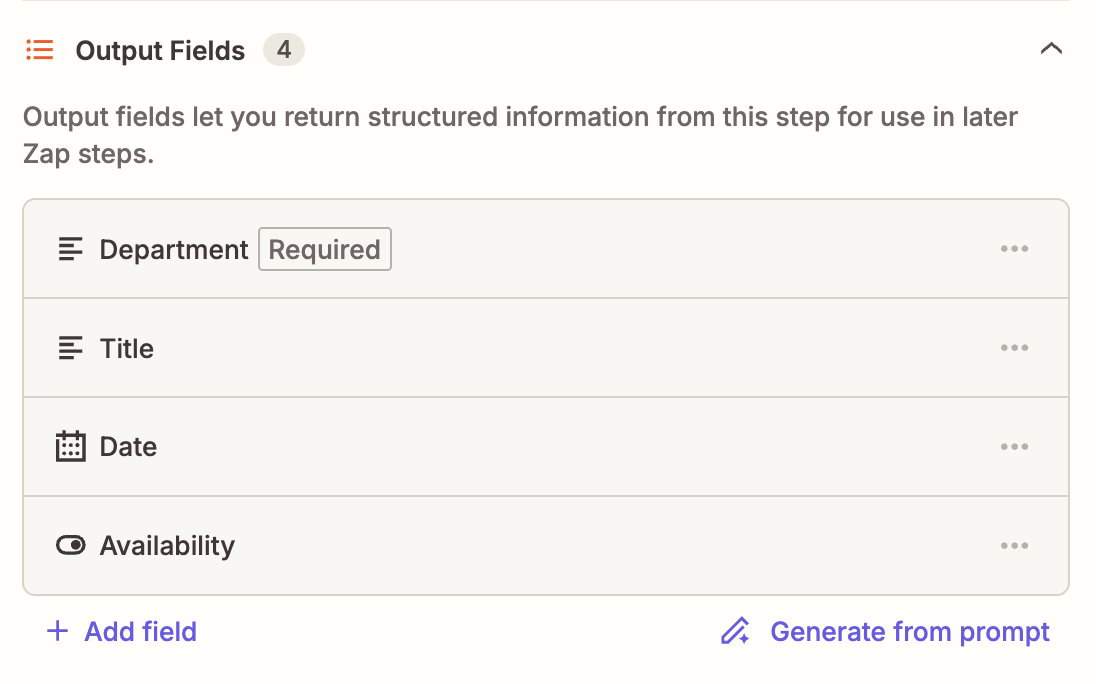
    Mapping output fields in AI by Zapier

    Define the fields you want back—things like a category, a sentiment score, or a subject line—and they arrive as clean, mappable outputs. You won’t need to parse a paragraph of prose in a downstream step.

    Remove the guesswork

    Let AI automatically detect when you might need to add tools for the agent and add them to your step. This removes the guesswork of what’s needed for your agent to operate and takes the work off your plate. You can always manually add or edit yourself if the output isn’t quite right.

    See what happened

    Every run lands in your Zap History with the tools that were called, the inputs and outputs, the model tier used, and the tasks consumed. It’s the same interface you already use for the rest of your Zaps.

    Understand your AI costs before you pay

    The model picker in AI by Zapier, with tasks attached

    With AI by Zapier, AI steps bill as tasks. You can use default models for free, and other model tiers carry different multipliers, so an AI step can cost 1 task, 3 tasks, or 5 tasks. You can see the breakdown per run in your Zap History rather than discovering it on an invoice.

    You can also cap it. Set a limit on tasks per run, and if a single run crosses 75 tasks (this will be adjustable in future), it pauses for a human instead of looping quietly. We know runaway agents were a concern with Zapier Agents, and this is our solution.

    Already using Zapier Agents? Migrate to AI by Zapier

    You don’t have to rebuild your agents from scratch or from memory. The migration is to recreate your agent as an AI by Zapier step: it’s the same goal and same tools, now living inside a Zap where you can wrap deterministic guardrails around it. Most of what you had carries over—and you gain the control and observability the standalone product couldn’t offer.

    A few capabilities are still rolling out. Where something isn’t available yet, there’s usually a clean workaround (for example, you can mimic an on-demand run today by triggering the agent from a webhook).

    If your Zapier Agent is eligible for migration, you’ll see a banner at the top of the agent that will lead you to step-by-step guide into the new product. See this help article to learn more.

    Get productivity tips delivered straight to your inbox

    We’ll email you 1-3 times per week—and never share your information.

    Related articles

    • An abstract image representing Zapier's end-to-end capabilities

    Improve your productivity automatically. Use Zapier to get your apps working together.

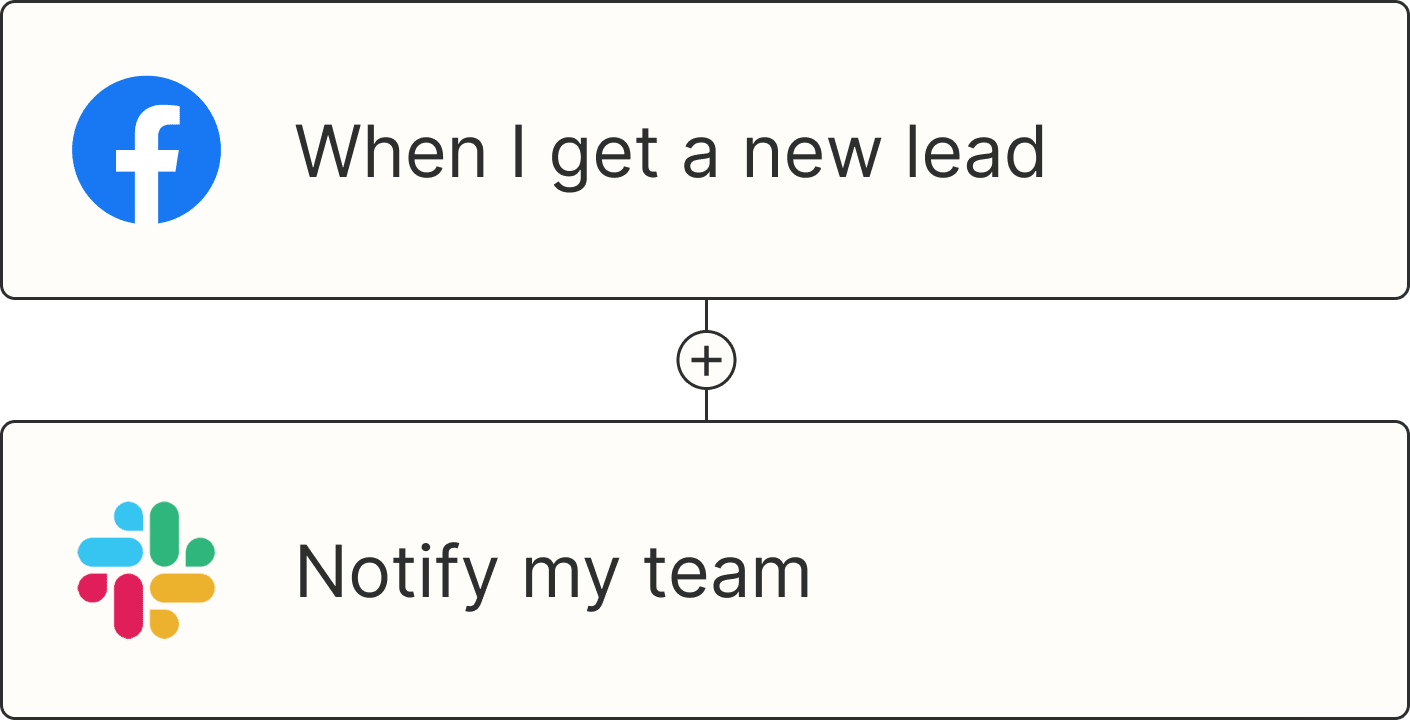
    A Zap with the trigger 'When I get a new lead from Facebook,' and the action 'Notify my team in Slack'