Author: admin

  • Clueso MCP

    Create and edit videos by chatting

    Discussion
    |
    Link

  • How workers are unlocking new ways of working

    New OpenAI Economic Research shows how workers use AI beyond traditional roles and which new activities become recurring parts of their work.

  • Introducing Gemini 3.8 Live and 3.8 Live Extended Thinking

    Introducing Gemini 3.8 Live and 3.8 Live Extended Thinking

    Gemini 3.8 Live and Gemini 3.8 Live Extended Thinking are our most advanced live dialogue models yet. Major upgrades in intelligence and parallel reasoning make them more intuitive to collaborate with and use to execute complex tasks using your voice.


    Tom Ouyang

    Principal Engineer

    Malini Jaganathan

    Member of Technical Staff, on behalf of the Gemini Audio Team


    Text

    Your browser does not support the audio element.

    Listen to article

    [[duration]] minutes

    This content is generated by Google AI. Generative AI is experimental

    Updated September 17, 2026

    Today, we’re introducing two new models that bring advancements in near real-time reasoning to more effectively enable voice agents and make conversing with AI feel more intuitive and intelligent.

    • Gemini 3.8 Live: Built for scale and cost efficiency, combining conversational intelligence with fluid dialogue and visual grounding.
    • Gemini 3.8 Live Extended Thinking: Built for high-complexity tasks, with increased intelligence and multi-step reasoning.

    For developers and enterprises, these models deliver the building blocks for reliable, production-ready voice agents. They also make speaking with Gemini across the Gemini app, Google Workspace, and Search more fluid and collaborative — helping you tackle complex tasks using just your voice.

    Experience more fluid, intelligent conversations

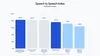
    Gemini 3.8 Live Extended Thinking provides enterprise-grade task completion and intelligence, capturing the #1 overall spot on Artificial Analysis’ Speech to Speech Quality Index (82.6), and leads in agentic task completion with 68.6% on τ-Voice and 35.1% on Sierra’s τ-Voice-banking benchmark. It also provides strong reasoning capabilities, scoring 97.7% on Big Bench Audio, while maintaining a highly competitive price point compared to other frontier models.

    Gemini 3.8 Live has shown a high preference among users, securing a second place in the Speech Agent Arena. In addition to this performance, it remains highly cost-effective — providing developers and enterprises with a capable and efficient model built for scale.

    a chart showing Artificial Analysis Speech to Speech Index

    A chart showing Artificial Analysis agentic performance

    A chart showing Sierra

    A chart showing Artificial Analysis cost per hour of input audio

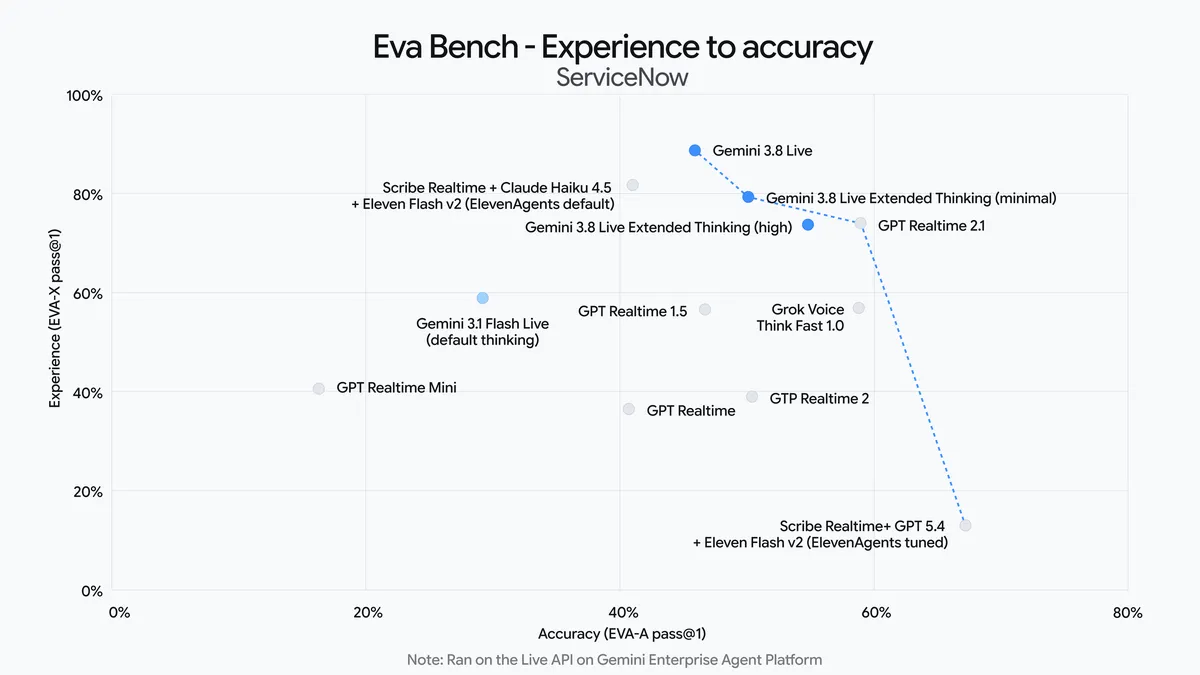
    On ServiceNow’s EVA-Bench, a benchmark for evaluating voice agents, our models push the Pareto Frontier for complex workflows by successfully balancing accuracy with conversational quality.

    Note: This was run on the Live API on Gemini Enterprise Agent Platform.

    A chart showing EVA Bench Experience to Task Completion

    Gemini 3.8 Live processes visual inputs in near real-time, enriching conversations with context for more helpful responses. It automatically detects and transitions between 97 supported languages mid-conversation. It executes tools and API calls in the background while continuing the conversation, so the model can acknowledge requests and keep chatting while tasks finish in the background.

    For tasks that require deeper reasoning, 3.8 Live Extended Thinking reasons and speaks simultaneously. It delivers increased intelligence for complex workflows while maintaining an uninterrupted conversational flow — using early verbal cues like “Let me check that…” to acknowledge prompts naturally, and live progress narration to walk users through multi-step background tasks as they progress.

    Across Google Workspace, Search, and the Gemini app, our Live models deliver more intuitive, collaborative experiences — especially when tackling your most complex tasks.

    Empowering the developer and enterprise voice ecosystem

    By using the Gemini Live API, developer platforms such as Agora, Fishjam, LangChain, LiveKit, Pipecat, Vercel, and Vision Agents enable developers to build and deploy high-performance voice-driven interfaces with ease. These platforms manage complex real-time media streaming infrastructure behind the scenes, allowing developers to focus entirely on crafting the user experience.

    We’re also partnering with companies like Salesforce, Genspark, and Lumeris who are excited about 3.8 Live and 3.8 Live Extended Thinking, highlighting its impressive latency, fluidity, and tool-calling capabilities.

    Salesforce quote

    11Sight Quote

    Equal AI Quote

    ServiceNow quote

    Genspark quote

    Lenskart quote

    Lumeris quote

    Agora quote

    Ambr AI quote

    LiveKit Quote

    Casuu quote

    Ensure transparency with SynthID watermarking

    All audio generated by our AI products is watermarked with SynthID. This imperceptible watermark is woven directly into the audio output, ensuring AI-generated content remains detectable to help prevent misinformation. For details on our approach to safety and responsibility, review the model card.

    Start using our latest Gemini Audio models:

    3.8 Live is rolling out starting today:

    3.8 Live Extended Thinking is rolling out starting today:

    Get the latest news from Google in your inbox

    Sign up for our newsletters with product updates, event information, special offers, and more.

    Your information will be used in accordance with Google’s privacy policy. You may opt out at any time.

  • Post

  • Share

  • Annotate

  • Save

  • Print

By Eugene Amigud, Chief Product & Innovation Officer, Infios

Traditionally, supply chain planning has been based on stable assumptions about demand, lead times, and costs. But despite heavy investment in AI forecasting, demand sensing, and predictive analytics, unplanned supply chain incidents still cost businesses $184 billion annually, according to the J.S. Held Global Risk Report 2025.

Many leaders assume the problem stems from flawed data and inaccurate models. But recent risk analyses show disruptions are the norm, not the exception.

The first major challenge to the forecasting framework was COVID-19, which wreaked havoc with the global supply chain for everything from flour to semiconductors. In 2025, the sudden implementation of tariffs by the U.S. upended the board yet again. In 2026, the closing of the Strait of Hormuz due to hostilities between the U.S. and Iran has disrupted the transport of multiple commodities, hurting many sectors in global trade, including energy, agriculture, and manufacturing.

In this unpredictable environment, even the most sophisticated forecasting models fall short. Forecasts depend on patterns. Geopolitical conflict, climate events, regulatory change, and cyber attacks have little historical precedent to model against, which is exactly what makes them so hard to forecast.

In addition, supply chains are now subject to several layers of risk at the same time. One disruption is enough to test a system, but these events often interact, creating a cascade of failures that is difficult, if not impossible, to recover from.

Most companies are running on technology infrastructure that was never designed for this degree of chaos. Their operating models were built for linear plans instead of nonlinear shocks. And even the most sophisticated forecasting model produces insights no one can act on fast enough: Decision-making is slow, execution is fragmented, and the gap between knowing that something changed and doing something about it is too wide.

Meanwhile, changes continue to unfold at all times, keeping teams stuck in reactive mode as they try to keep up. And as the burden of making decisions and synchronizing action falls on overwhelmed operators, risks and costs increase. Nearly 60% of supply chain leaders say manual workflows and interventions are the biggest source of inefficiency in their operations.

Their mistake is to treat these disruptions as surprises instead of assuming they will happen. That shift from prediction-led planning to execution-led adaptability is the real opportunity. This mindset moves resilience to the center of any solution, asking not “What will happen?” but “How fast can we respond when it does?”

A New Model for Performance

With traditional forecasting, by the time businesses catch up with major disruptions, inventory has already been delayed, orders have been rerouted, and customer commitments are at risk. Supply chain leaders are clear on the better strategy: 79% say the biggest advantage comes from how quickly and dynamically they can adjust their execution and plans. The key performance metric today is not forecast accuracy but time to adapt: measuring how long it takes your company to detect disruption, respond to it, and recover from it.

Managing this resilience means moving to a new operating model—intelligent supply chain execution—that supports:

  • Real-time data integration and shared operational context instead of static forecasts. Incorporating information about what is actually happening, instead of relying on point-in-time planning or historical patterns, creates a continuously updated planning environment that enables more-informed decisions.
  • AI decision making at the execution layer. Instead of focusing AI solely on forecasting or analytics, companies should embed it directly into operational workflows. Beyond the ability to anticipate disruptions, this enables intelligence that understands the full impact of sudden shocks across the supply chain, and the capability to take autonomous action across systems, with guidance and oversight from operational teams.
  • Cross-functional workflows that can adjust while conditions are in motion. Companies need technology that connects and coordinates execution across orders, warehousing, and transportation as one system. Businesses gain the ability to respond to disruptions holistically, eliminating the need for inefficient manual interventions and disconnected, ineffective problem-solving efforts.

Intelligent supply chain execution depends on a foundation of governance that holds control while increasing speed—with policy-driven frameworks and guardrails for AI autonomy.

From Forecasts to Data-Driven Action

When disruption is constant, forecasting, no matter how advanced, and traditional supply chains that rely on fragmented systems operating independently cannot keep up. Intelligent supply chain execution supports this shift by turning disconnected components into a coordinated system of action.

Forecasts will always be useful, but they are no longer enough on their own to keep an organization online. As disruption remains a permanent feature of the global economy, organizations need systems that can continuously sense, decide, act, and learn from each disruption, in real time.

Businesses that incorporate this model won’t just weather uncertainty; they’ll be poised to thrive in an increasingly unpredictable environment. And only by designing for constant surprise can they close that $184 billion gap.


Infios AI connects orders, warehousing, and transportation, turning fragmented signals into coordinated action—sensing disruption as it happens, deciding the right response and executing it in real time, and then learning from every outcome to improve the next one. That intelligence operates inside existing workflows, with the governance and guardrails leaders need to move from manual firefighting to continuous controlled execution.

Ready to move from prediction to action? Learn more about how Infios can build execution-led adaptability into your supply chain.

  • Is Your Strategy Ambitious Enough?

    Is Your Strategy Ambitious Enough?

    Summary.   

    In the September 14th edition of The Insider newsletter, managing editor Gretchen Gavett explores how leaders can calibrate their strategic ambition, finding the right balance between goals

    Leer en españolLer em português

    Crafting and executing strategy is both the most routine part of running a business and one of the hardest things to get right. Among the many ways strategic decision-making can trip up leaders is a question raised by a new article:

  • You Think You’re a Good Collaborator. Do the People You Manage Agree?

    You Think You’re a Good Collaborator. Do the People You Manage Agree?

    Harvard Business Review Logo

    Dadan/Getty Images

    Summary.   

    Senior leaders often pride themselves on listening and empowering others—but the people around them may experience something quite different. Research with more than 10,000 professionals and

    Most of the senior leaders we work with tell us that they are effective collaborators, and that they emphasize listening and empowerment in their interactions with others. Yet data from the people they interact with tells a different story.

  • How GEO Is Changing the Role of Brand Manager

    How GEO Is Changing the Role of Brand Manager

    September 15, 2026

    AthenaHQ, a startup that helps brands monitor, protect, and optimize their visibility across conversational AI engines like ChatGPT, Claude, and Gemini was founded in 2025. The company, co-founded by Andrew Yan, built a platform that enables major consumer brands, B2B software companies, and marketing agencies to track their share of voice, correct factual errors in AI responses, and manage their reputation across generative answer engines.

    In the case, “AthenaHQ: Building Brands for AI Search,” Yan faces a call with a global automaker after its newest vehicle has quietly vanished from chatbot recommendations. He must evaluate the platform’s expansion as he confronts core industry dilemmas: how AI disintermediates traditional marketing, who should own generative engine optimization (GEO) inside an organization, and how to prove value on an unattributable channel.

    In this episode, Harvard Business School associate professor Julian De Freitas and AthenaHQ co-founder and CEO Andrew Yan join host Brian Kenny to discuss the case, exploring how marketers are navigating the new world of GEO, the so-called “dark funnel” of customer engagement, and the need for brand managers to optimize for brand sentiment and accuracy not just search rankings.

  • What It Takes to Make Progress When the Future Feels Out of Control

    What It Takes to Make Progress When the Future Feels Out of Control

    September 15, 2026

    When the future feels increasingly out of our control, how can leaders and organizations make progress? University of Pennsylvania psychologist Martin Seligman, a pioneer in the study of optimism, resilience, and human flourishing, argues that the answer is agency: the belief that we can influence outcomes and create positive change. He defines agency as a combination of three capabilities: efficacy—the belief that you can achieve a goal now; optimism—the belief that you can achieve it in the future; and imagination—the ability to envision possibilities that don’t yet exist. And he explains how leaders can cultivate these qualities in themselves and their organizations, how managers can help employees overcome catastrophizing, and what AI can—and can’t—do when it comes to one of the most important human capabilities: imagination. Seligman is the author of Agency: The Psychological History of Human Progress.

  • MosMos

    Voice writing that works before, during, and after meetings

    Discussion
    |
    Link

  • Powermove

    The video editor that rewrites itself around your work

    Discussion
    |
    Link