Author: admin

  • From games to biology and beyond: 10 years of AlphaGo’s impact

    From games to biology and beyond: 10 years of AlphaGo’s impact

    March 10, 2026 Research

    Demis Hassabis

    Ten years ago, our AI system AlphaGo became the first program to defeat a world champion at the complex game of Go – reaching a milestone in the field a decade before many experts thought possible.

    The achievement heralded the beginning of what is now recognized as the modern era in artificial intelligence (AI). With a single creative play, the famous ‘Move 37,’ AlphaGo demonstrated the potential of AI and signaled that we now had the techniques to begin tackling real-world scientific problems.

    Today, this breakthrough continues to inform our work building systems on the path to artificial general intelligence (AGI). We believe AGI will be the most profound technology ever invented and potentially the ultimate tool to advance science, medicine, and productivity.

    A creative spark

    In 2016, over 200 million people watched AlphaGo face world-champion Go player Lee Sae Dol in Seoul. The match was defined by ‘Move 37’ in Game 2, a play so unconventional that professional commentators initially thought it was a mistake. But it proved to be decisive. One hundred or so moves later, the stone was in exactly the right position for AlphaGo to win the game. It was a display of incredible foresight and the AI system’s ability to go beyond mimicking human experts and find entirely new strategies.

    Go has long been a proving ground for AI research because of the game’s sheer complexity. There are 10170 possible positions on the board—far more than the number of atoms in the observable universe.

    To make the game tractable, AlphaGo used deep neural networks combined with advanced search and reinforcement learning – an AI approach DeepMind pioneered.

    AlphaGo learned a model of plausible Go moves by first learning from games played by human experts, and then playing hundreds of thousands of games against itself, improving as the strongest winning strategies were reinforced. The system then considered only the most potentially fruitful paths and from that smaller subset of moves, found the one most likely to lead it to win.

    After AlphaGo, we built AlphaGo Zero, which learned the game from completely random play and became arguably the strongest player in history. Then we generalized the system further with AlphaZero, which taught itself from scratch to master any 2-player perfect information game, including Go, chess, and shogi. Beginning with no prior knowledge other than the rules of the game, AlphaZero was able to learn to master chess in a matter of hours, and beat not only the top human players but the best specialised chess programs at the time, like Stockfish. And even though chess had been so heavily analysed with the aid of these programs, just as with Go, AlphaZero was still able to come up with interesting new strategies.

    It was further proof of what I knew the moment we won the match in Seoul – the technology was ready to be applied to our real goal of accelerating scientific breakthroughs.

    I believe the greatest lesson AlphaGo offered was a definitive preview of the AI era—proving it wasn’t some distant, vague future, but a reality arriving on our doorstep. It served as a “roadmap from the future,” sending a clear signal to humanity about how the world was about to change.

    Go Master Lee Sae Dol

    Adjunct Professor at UNIST

    Catalyzing breakthroughs in science

    By proving it could navigate the massive search space of a Go board, AlphaGo demonstrated the potential for AI to help us better understand the vast complexities of the physical world. We started by attempting to solve the protein folding problem, a 50-year grand challenge of predicting the 3D structure of proteins – information that is crucial for understanding diseases and developing new drugs.

    In 2020, we finally cracked this longstanding scientific problem with our AlphaFold 2 system. From there, we folded the structures for all 200 million proteins known to science and made them freely available to scientists in an open-source database. Today, over 3 million researchers around the world use the AlphaFold database to accelerate their important work on everything from malaria vaccines to plastic-eating enzymes. And in 2024, it was the honor of a lifetime for John Jumper and I to be awarded the Nobel Prize in Chemistry for leading this project, on behalf of the entire AlphaFold team.

    Since AlphaGo’s win, we’ve applied its groundbreaking approach to many other areas of science and mathematics, including:

    Mathematical reasoning: The most direct descendant of AlphaGo’s architecture, AlphaProof learned to prove formal mathematical statements using a combination of language models and AlphaZero’s reinforcement learning and search algorithms. Alongside AlphaGeometry 2, it became the first system to achieve a medal-standard (silver) at the International Mathematical Olympiad (IMO), proving AlphaGo’s methods could unlock advanced mathematical reasoning and laying the foundation for our most capable general models.

    Gemini, our largest and most capable model, recently went even further. An advanced version of its Deep Think mode achieved gold-medal level performance at the 2025 IMO using an approach inspired by AlphaGo. Since then, Deep Think has been applied to even more complex, open-ended challenges across science and engineering.

    Algorithm discovery: Just as AlphaGo searched for the best move in a game, our coding agent AlphaEvolve explores the space of computer code to discover more efficient algorithms. It had its own Move 37 moment when it found a novel way to multiply matrices, a fundamental mathematical operation powering nearly all modern neural networks. AlphaEvolve is now being tested on problems ranging from data center optimization to quantum computing.

    Scientific collaboration: We are integrating the search and reasoning principles pioneered with AlphaGo into an AI co-scientist. By having agents ‘debate’ scientific ideas and hypotheses, this system acts as a collaborator capable of performing the rigorous thinking necessary to identify patterns in data and solve sophisticated problems. In validation studies at Imperial College London, it analyzed decades of literature and independently arrived at the same hypothesis about antimicrobial resistance that researchers had spent years developing and validating experimentally.

    We’ve also used AI to better understand the genome, advance fusion energy research, improve weather prediction and more.

    As impressive as our scientific models are, they are highly specialized. To achieve fundamental breakthroughs like creating limitless clean energy or solving diseases that we don’t understand today, we need general AI systems that can find underlying structure and connections between different subject areas, and help us to come up with new hypotheses like the best scientists do.

    Future of intelligence

    For an AI to be truly general, it needs to understand the physical world. We built Gemini to be multimodal from the beginning so it could understand not just language, but also audio, video, images and code to build a model of the world.

    To think and reason across these modalities, the latest Gemini models use some of the techniques we pioneered with AlphaGo and AlphaZero.

    The next generation of AI systems will also need to be able to call upon specialized tools. For example, if a model needed to know the structure of a protein it could use AlphaFold for that.

    We think the combination of Gemini’s world models, AlphaGo’s search and planning techniques, and specialized AI tool use will prove to be critical for AGI.

    True creativity is a key capability that such an AGI system would need to exhibit. Move 37 was a glimpse of AI’s potential to think outside the box, but true original invention will require something more. It would need to not only come up with a novel Go strategy, as AlphaGo impressively did, but actually invent a game as deep and elegant, and as worthy of study as Go.

    Ten years after AlphaGo’s legendary victory, our ultimate goal is on the horizon. The creative spark first seen in Move 37 catalyzed breakthroughs that are now converging to pave the path towards AGI – and usher in a new golden age of scientific discovery.

    Exactly one decade later, we look back at the match that sparked the modern AI revolution.
    AlphaGo

    Exploring the mysteries of Go with AlphaGo and China’s top players

    Innovations of AlphaGo

    AlphaGo’s next move

  • Gemini 3.1 Flash-Lite: Built for intelligence at scale

    Gemini 3.1 Flash-Lite: Built for intelligence at scale

    Get best-in-class intelligence for your highest-volume workloads.


    Gemini 3.1 Flash Lite logo

    Your browser does not support the audio element.

    Listen to article

    [[duration]] minutes

    This content is generated by Google AI. Generative AI is experimental

    Today, we’re introducing Gemini 3.1 Flash-Lite, our fastest and most cost-efficient Gemini 3 series model. Built for high-volume developer workloads at scale, 3.1 Flash-Lite delivers high quality for its price and model tier.

    Starting today, 3.1 Flash-Lite is rolling out in preview to developers via the Gemini API in Google AI Studio and for enterprises via Vertex AI.

    Cost-efficiency without compromise

    Priced at just $0.25/1M input tokens and $1.50/1M output tokens, 3.1 Flash-Lite delivers enhanced performance at a fraction of the cost of larger models. It outperforms 2.5 Flash with a 2.5X faster Time to First Answer Token and 45% increase in output speed, according to the Artificial Analysis benchmark while maintaining similar or better quality. This low latency is needed for high-frequency workflows, making it an ideal model for developers to build responsive, real-time experiences.

    The image shows two bar charts titled

    Gemini 3.1 Flash-Lite outperforms 2.5 Flash in speed and quality.

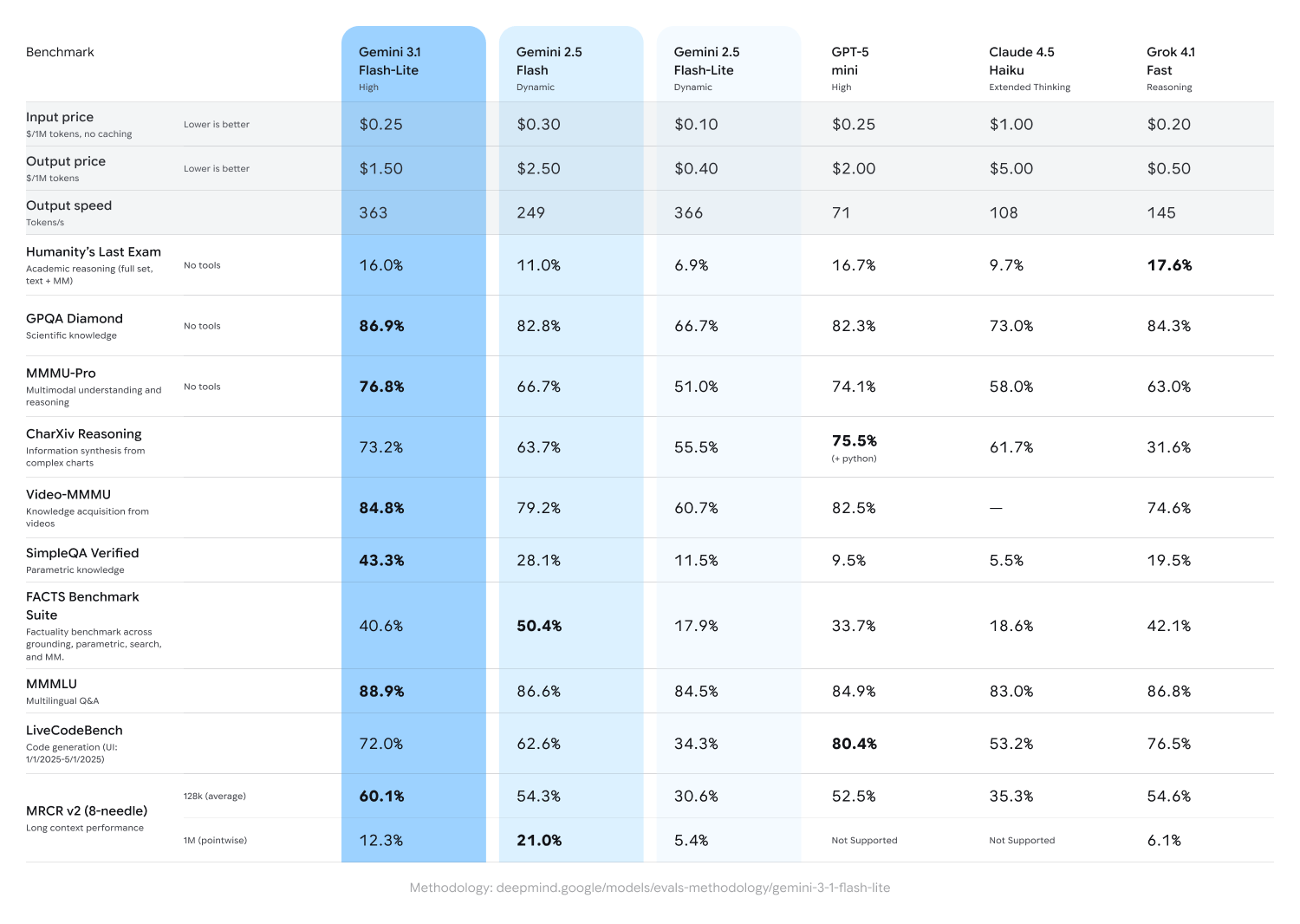
    3.1 Flash-Lite achieves an impressive Elo score of 1432 on the Arena.ai Leaderboard and outperforms other models of similar tier across reasoning and multimodal understanding benchmarks, including 86.9% on GPQA Diamond and 76.8% on MMMU Pro–even surpassing larger Gemini models from prior generations like 2.5 Flash.

    The image displays a comparison table of several AI models, including

    Adaptive intelligence at scale for developers

    Beyond its raw performance, Gemini 3.1 Flash-Lite comes standard with thinking levels in AI Studio and Vertex AI, giving developers the control and flexibility to select how much the model “thinks” for a task, which is critical for managing high-frequency workloads. 3.1 Flash-Lite can tackle tasks at scale, like high-volume translation and content moderation, where cost is a priority. And it can also handle more complex workloads where more in-depth reasoning is needed, like generating user interfaces and dashboards, creating simulations or following instructions.

    Early-access developers on AI Studio and Vertex AI, and companies like Latitude, Cartwheel and Whering are already using 3.1 Flash-Lite to solve complex problems at scale. Early testers highlighted 3.1 Flash-Lite’s efficiency and reasoning capabilities, saying it can handle complex inputs with the precision of a larger-tier model, plus follow instructions and maintain adherence.

    Quote from Kolby Nottingham at Latitude regarding the instruction-following capabilities and speed of Google's model.

    Quote from Andrew Carr at Cartwheel highlighting the speed and multimodal labeling capabilities of 3.1 Flash-Lite.2

    Quote from Bianca Rangecroft at Whering about using 3.1 Flash-Lite for consistent item tagging and data labeling

    Quote from Kaan Ortabas at HubX detailing the performance metrics and cost efficiency of Gemini 3.1 Flash-Lite.

    We look forward to seeing what you build with 3.1 Flash-Lite and the rest of the Gemini 3 series models.

    Get the latest news from Google in your inbox

    Sign up for our newsletters with product updates, event information, special offers, and more.

    Your information will be used in accordance with Google’s privacy policy. You may opt out at any time.

  • Nano Banana 2: Combining Pro capabilities with lightning-fast speed

    Nano Banana 2: Combining Pro capabilities with lightning-fast speed

    Our latest image generation model offers advanced world knowledge, production-ready specs, subject consistency and more, all at Flash speed.


    Naina Raisinghani

    Product Manager, Google DeepMind


    Nano Banana 2 text with AI generated images around it

    Your browser does not support the audio element.

    Listen to article

    [[duration]] minutes

    This content is generated by Google AI. Generative AI is experimental

    In August of last year, our Gemini Image model, Nano Banana, became a viral sensation, redefining image generation and editing. Then in November, we released Nano Banana Pro, offering users advanced intelligence and studio-quality creative control. Today, we’re bringing the best of both worlds to users across Google.

    Introducing Nano Banana 2 (Gemini 3.1 Flash Image), our latest state-of-the-art image model. Now you can get the advanced world knowledge, quality and reasoning you love in Nano Banana Pro, at lightning-fast speed.

    Intelligence and visual quality at Flash speed

    Nano Banana 2 brings the high-speed intelligence of Gemini Flash to visual generation, making rapid edits and iteration possible. It makes once-exclusive Pro features accessible to a wider audience, including:

    • Advanced world knowledge: The model pulls from Gemini’s real-world knowledge base, and is powered by real-time information and images from web search to more accurately render specific subjects. This deep understanding also helps you create infographics, turn notes into diagrams and generate data visualizations.
    • Precision text rendering and translation: Nano Banana 2 allows you to generate accurate, legible text for marketing mockups or greeting cards. You can even translate and localize text within an image to share your ideas globally.

    High-quality flat lay photography of a DIY infographic explaining the water cycle on a clean, light gray textured background with hand-drawn black arrows to guide the viewer through the process

    A three-panel comic-style infographic in 16:9 aspect ratio comparing Cumulus, Stratus, and Cirrus clouds, each shown in a dramatic sky with a bold label

    A 16:9 aspect ratio image of Museum Clos Lucé rendered in the style of bright-colored Synthetic Cubism without any text

    2 images on a white background: First, A cinematic close-up of an intricately illustrated sign made of recycled material featuring local birds and flowers and text that reads

    Read the prompts: Water Cycle 1 , Cloud Infographic 2 , Cubism 3 , Wildlife Sign 4

    Enhanced creative control

    Nano Banana 2 also dramatically closes the gap between speed and visual fidelity, delivering high-quality, photorealistic imagery. Here’s what our newest model offers and has improved on from the original Nano Banana:

    • Subject consistency: Maintain character resemblance of up to five characters and the fidelity of up to 14 objects in a single workflow, allowing you to storyboard and build narratives without altering the appearance of your inputs.
    • Precise instruction following: With enhanced instruction following, the model adheres more strictly to your complex requests, capturing the specific nuances of your idea so the image you get is the image you asked for.
    • Production-ready specs: Make attention grabbing assets with full control of various aspect ratios and resolutions from 512px to 4K, ensuring your visuals stay sharp whether they are for a vertical social post or a wide-screen backdrop.
    • Visual fidelity upgrade: Nano Banana 2 delivers vibrant lighting, richer textures and sharper details, maintaining high-quality aesthetics at the speed expected from Flash.

    A silly and joyful image showing 14 consistent characters and items having fun together in a farm setting

    A 16:9 story sequence showing three fluffy characters building a treehouse, with various expressions and angles across multiple panels

    A moody and atmospheric high-angle aerial view of a misty valley with lush green hills, a winding road, and a dark blue-grey body of water reflecting an overcast sky

    A vibrant pop-art style image of an individual in a striking suit with blue swirling patterns and pink circles, wearing heart-shaped sunglasses, posed against a solid cerulean blue background, in different aspect ratios

    Read the prompts: Farm 5 , Treehouse 6 , Valley 7 , Portrait 8

    Try Nano Banana 2 today

    Whatever your needs, we now offer the perfect tool for every workflow: Nano Banana Pro for high-fidelity tasks requiring maximum factual accuracy, or Nano Banana 2 for rapid generation, precise instruction following and integrated image-search grounding.

    Nano Banana 2 is rolling out today across Google products, including:

    • Gemini app: Nano Banana 2 will replace Nano Banana Pro across the Fast, Thinking and Pro models. Google AI Pro and Ultra subscribers will keep access to Nano Banana Pro for specialized tasks by regenerating images via the three-dot menu.
    • Search: In AI Mode and Lens, through the Google app as well as mobile and desktop browsers. View availability here, including 141 new countries and territories and eight additional languages.
    • AI Studio + API: Available in preview in AI Studio and Gemini API. Pricing here. Also available in Google Antigravity.
    • Google Cloud: Available in preview with the Gemini API in Vertex AI.
    • Flow: Nano Banana 2 is the new default image generation model in Flow, available to all Flow users for zero credits.
    • Google Ads: Nano Banana 2 is available now, powering suggestions while creating campaigns in Google Ads.

    A user interface for the Gemini app template feature labeled,

    A side-by-side comparison of two graphite pencil sketches showing different interpretations of a pufferfish nest: one a less accurate, textured, shell-lined crater and the other a more accurate geometric, scientific diagram in a field notebook with handwritten annotations.

    A four-panel collage featuring a whimsical kangaroo on vacation: steering a small blue boat at sea, sipping espresso at a Parisian cafe, lounging in a white bathrobe on a bed, and jumping in a colorful bouncy castle.

    Read the prompts: AI Mode in Search 9 , Flow 10

    Robust provenance: marking and verification

    As generative media evolves, so must the tools we use to identify and understand it. We continue to deepen our provenance approach, by coupling our state-of-the-art SynthID technology with interoperable C2PA Content Credentials, we provide users with a more holistic and contextual view of not just if AI was used, but how.

    Our provenance tools are already making an impact. Since its launch in November, our SynthID verification feature in Gemini app has been used over 20 million times across various languages, helping people identify Google AI-generated images, video and audio. We’ll soon be bringing C2PA verification to the Gemini app, too.

    Get the latest news from Google in your inbox

    Sign up for our newsletters with product updates, event information, special offers, and more.

    Your information will be used in accordance with Google’s privacy policy. You may opt out at any time.

  • Gemini 3.1 Pro: A smarter model for your most complex tasks

    Gemini 3.1 Pro: A smarter model for your most complex tasks

    3.1 Pro is designed for tasks where a simple answer isn’t enough.


    Gemini 3.1 Pro

    Your browser does not support the audio element.

    Listen to article

    [[duration]] minutes

    This content is generated by Google AI. Generative AI is experimental

    Last week, we released a major update to Gemini 3 Deep Think to solve modern challenges across science, research and engineering. Today, we’re releasing the upgraded core intelligence that makes those breakthroughs possible: Gemini 3.1 Pro. We are shipping 3.1 Pro across our consumer and developer products to bring this progress in intelligence to your everyday applications.

    Starting today, 3.1 Pro is rolling out:

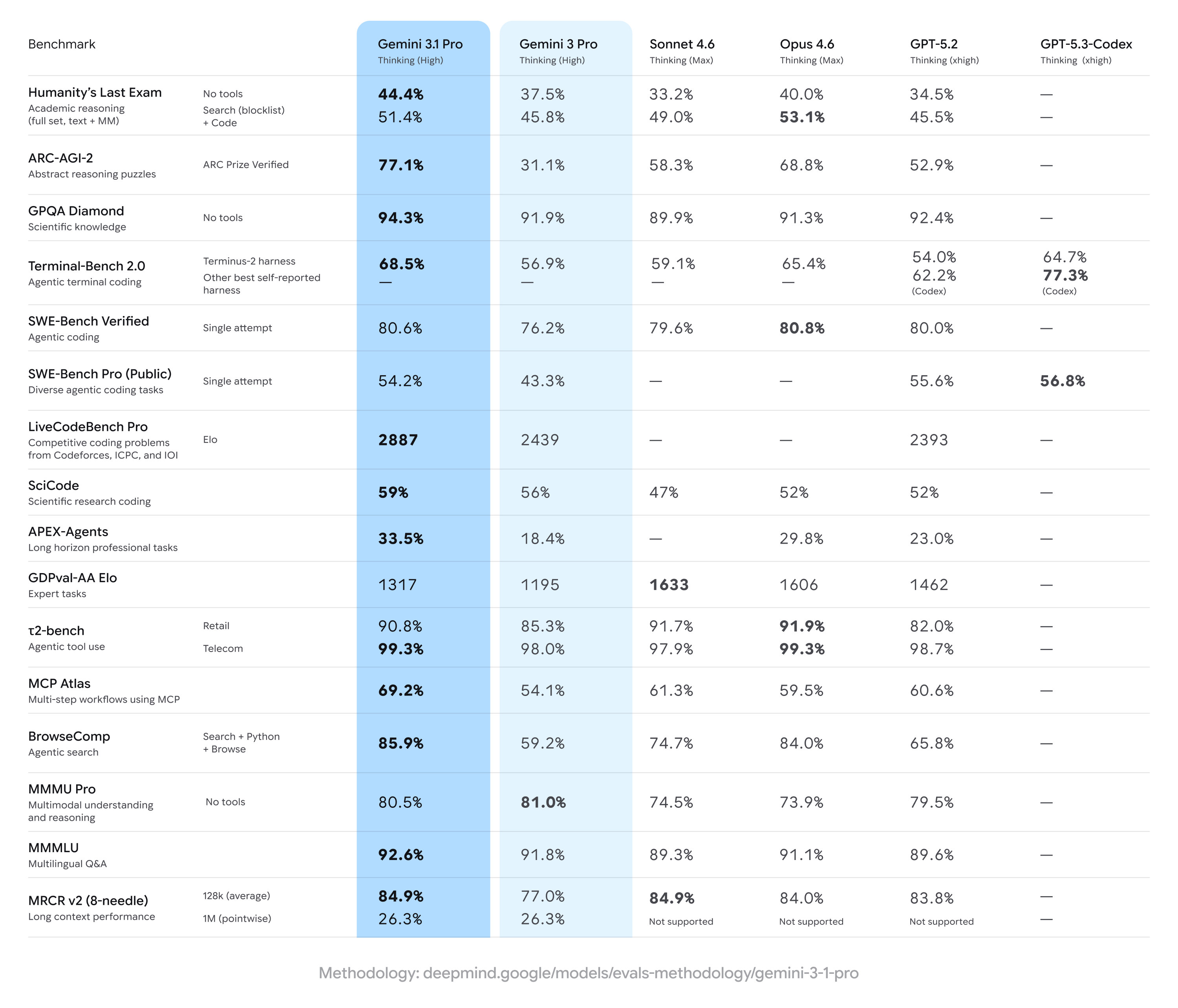
    Building on the Gemini 3 series, 3.1 Pro represents a step forward in core reasoning. 3.1 Pro is a smarter, more capable baseline for complex problem-solving. This is reflected in our progress on rigorous benchmarks. On ARC-AGI-2, a benchmark that evaluates a model’s ability to solve entirely new logic patterns, 3.1 Pro achieved a verified score of 77.1%. This is more than double the reasoning performance of 3 Pro.

    Side-by-side comparison of different benchmarks for AI models.

    Intelligence applied

    3.1 Pro is designed for tasks where a simple answer isn’t enough, taking advanced reasoning and making it useful for your hardest challenges. This improved intelligence can help in practical applications — whether you’re looking for a clear, visual explanation of a complex topic, a way to synthesize data into a single view, or bringing a creative project to life.

    What’s next

    Since releasing Gemini 3 Pro in November, your feedback and the pace of progress have driven these rapid improvements. We are releasing 3.1 Pro in preview today to validate these updates and continue to make further advancements in areas such as ambitious agentic workflows before we make it generally available soon.

    Starting today, Gemini 3.1 Pro in the Gemini app is rolling out with higher limits for users with the Google AI Pro and Ultra plans. 3.1 Pro is also now available on NotebookLM exclusively for Pro and Ultra users. And developers and enterprises can access 3.1 Pro now in preview in the Gemini API via AI Studio, Antigravity, Vertex AI, Gemini Enterprise, Gemini CLI and Android Studio.

    We can’t wait to see what you build and discover with it.

  • A new way to express yourself: Gemini can now create music

    A new way to express yourself: Gemini can now create music

    The Gemini app now features our most advanced music generation model Lyria 3, empowering anyone to make 30-second tracks using text or images in beta.


    Joël Yawili

    Senior Product Manager, Gemini app

    Myriam Hamed Torres

    Senior Product Manager, Google DeepMind


    Since launching the Gemini app, we’ve built tools to encourage creative expression through images and video. Today, we’re taking the next step: custom music generation. Lyria 3, Google DeepMind’s latest generative music model, is rolling out today in beta in the Gemini app. Just describe an idea or upload a photo, like “a comical R&B slow jam about a sock finding their match” and in a matter of seconds, Gemini will translate it into a high-quality, catchy track. To push the creative envelope further, you can even ask Gemini to take inspiration from something you upload.
    Lyria 3 improves on audio generation from our Lyria models in three important ways:

    1. No need to provide your own lyrics! They’ll be generated for you based on your prompt.
    2. You have more creative control over elements like the style, vocals and tempo you want.
    3. You can create more realistic and musically complex tracks.

    Here’s how you can use it:

    • Text to track: Describe a specific genre, mood, inside joke, or memory to create unique tracks with lyrics or instrumental audio that fits your vibe. “I’m feeling nostalgic. Create a track for my mother about the great times we had as kids and the memories of her home cooked plantains. Make it a fun afrobeat track with a true African vibe.”
    • From photos and videos to track: Upload a photo or video and watch Gemini use the content to compose a track with lyrics that fit the mood perfectly. “Use these photos to create a track about my dog Duncan on a hike in the woods.”

    The Gemini app creates 30-second tracks with custom cover art generated by Nano Banana. This makes it easy to quickly share with friends by downloading or simply clicking the share link. The goal of these tracks isn’t to create a musical masterpiece, but rather to give you a fun, unique way to express yourself.

    Your browser does not support the audio element.

    Creators can also explore Lyria 3 on YouTube’s Dream Track. Available in the U.S. and now rolling out to YouTube creators in other countries, Lyria 3 will enhance the quality of each unique Shorts soundtrack. Whether it’s creating a lyrical verse or a vibey backing track, being able to better customize the soundtrack will take creators’ Shorts to the next level.

    New audio verification capabilities

    All tracks generated in the Gemini app are embedded with SynthID, our imperceptible watermark for identifying Google AI-generated content. We are also giving you more tools to help identify AI content, broadening our verification capabilities in the Gemini app to include audio, along with image and video. Simply upload a file and ask if it was generated using Google AI, and Gemini will check for SynthID and use its own reasoning to return a response.

    Our commitment to developing generative AI responsibly

    Since we first launched Lyria in 2023, we’ve sought to develop this technology responsibly in collaboration with the music community. We’ve learned a lot through these collaborations and our experiments, like Music AI Sandbox, and have been very mindful of copyright and partner agreements as we’ve trained Lyria 3.

    Music generation with Lyria 3 is designed for original expression, not for mimicking existing artists. If your prompt names a specific artist, Gemini will take this as broad creative inspiration and create a track that shares a similar style or mood. We also have filters in place to check outputs against existing content. We recognize that our approach might not be foolproof, so you can report content that may violate your rights or the rights of others. Additionally, in order to use our products, users must adhere to our Terms of Service and Gen AI prohibited use policies, which prohibit violations of others’ intellectual property and privacy rights.

    Lyria 3 is available in the Gemini app for all users 18+ in English, German, Spanish, French, Hindi, Japanese, Korean and Portuguese, with plans to expand quality and coverage of more languages, rolling out on desktop today and to the mobile app over the next several days. And Google AI Plus, Pro and Ultra subscribers will enjoy higher limits.

    Our goal with music generation in the Gemini app is to help you add a fun, custom soundtrack to your daily life. Try it out today at gemini.google.com.

  • Accelerating discovery in India through AI-powered science and education

    Accelerating discovery in India through AI-powered science and education

    February 18, 2026 Responsibility & Safety

    Demis Hassabis, Lila Ibrahim and Pushmeet Kohli

    Introducing our National Partnerships for AI and collaboration in India

    We believe AI will be the most transformative technology in human history and that it should be deployed in ways that benefit all of humanity. This requires deep, strategic collaboration between frontier AI labs, governments, academia, and civil society.

    To fully realise AI’s potential, Google DeepMind is working with governments through our National Partnerships for AI initiative to broaden access to our frontier AI capabilities, helping ensure they are deployed to serve citizens and meet national priorities in science, education, resilience, and public services.

    Building on our collaborations with the US and UK governments, we are establishing a new partnership with Indian government bodies and local institutions. In the global AI transformation, India is showing exceptional leadership in applying the technology to tackle its own biggest challenges. But India is going even further, playing a critical international role by convening this week the fourth global AI summit of governments, companies and civil society. International dialogue and collaboration will guide positive impacts and create the global frameworks required to prepare society for a future with AI.

    Partnership in India to broaden AI access

    Our partnerships are designed to accelerate the pace of progress across India. Here are a few ways we are working together to unlock new possibilities in science and education.
    Advancing scientific breakthroughs

    Google DeepMind, Google Research and Google.org are partnering with the Anusandhan National Research Foundation (ANRF) to facilitate the adoption of AI models to advance science. We’re providing access to our frontier AI for Science models, supporting hackathons and community contests, and enabling training and mentorship to students, researchers, and those in the early stages of their careers.

    Researchers and engineers in India will be able to use our AI tools, including:

    • AlphaGenome: An AI model to help scientists better understand how mutations in human DNA sequences impact a wide range of gene functions
    • AI Co-scientist: A multi-agent AI system that acts as a virtual scientific collaborator
    • Earth AI: A collection of models built on Gemini’s advanced reasoning that are helping enterprises, nonprofits, and cities with everything from environmental monitoring to disaster response

    Scientists around the world are already using AlphaFold – our AI system capable of accurately predicting the structure and interactions of proteins, DNA, RNA, ligands and more – to accelerate discoveries. India stands as the fourth largest adopter of AlphaFold globally, with over 180,000 researchers using it today. We hope to see Indian scientists benefit even more from using AlphaGenome and the other AI systems we are now providing.

    We’re also working to support AI for science at a global level. This is why, today at the India Summit, we announced the $30 million Google.org Impact Challenge: AI for Science, an open call for researchers, nonprofits, and social enterprises in India, and around the world, using AI to achieve scientific breakthroughs. Selected awardees will also have the opportunity to participate in a Google.org Accelerator, receiving engineering support, expert mentorship, and infrastructure from Google DeepMind and Google Research to turn their concepts into scalable discoveries.

    Empowering India’s Students and Teachers with an AI-powered Future

    Our recent survey with Ipsos has shown that learning is the top motivation for using AI globally. This is especially true in India, which now leads the world in daily Gemini usage by students. We’re seeing AI can drive profound comprehension and critical thinking when it is purpose-built for learning and implemented as a supportive partner to educators.

    At City Montessori School in Lucknow, teachers are integrating Guided Learning into math classes for Grade 8-9 students and seeing a positive response. An early analysis of a randomized control study conducted by Fab AI shows that students are demonstrating a desire for deeper learning, not just quick answers: in almost three out of every four conversations on Gemini, students sought to develop their understanding rather than a quick answer or shortcut.

    That’s why we’re expanding efforts with additional partners to supercharge the potential of learning for more Indian students and teachers:

    • Powering innovation hubs with GenAI assistants: Together with Atal Tinkering Labs, which serves more than 10,000 Indian schools and 11 million students, we will help incorporate robotics and coding into local curricula, integrate Gemini thoughtfully into teacher workflows, and build a safely guardrailed AI assistant for students grounded in national curriculum standards that can act as an educational partner. Teachers can access real-time tips to help students fix a robot missing a part with readily available materials or mend a broken circuit design by simply pointing a camera to it or asking Gemini in chat.
    • Transforming textbooks into interactive digital journeys: In a first-of-its-kind partnership with PM Publishers Pvt. Ltd., a K-12 textbook publisher in India, Gemini will be used to transform two million static textbooks into AI-powered interactive journeys across more than 250 titles and 2,000 schools. Each book features a QR code that can be scanned by students to access a custom Gem (specialized versions of the Gemini AI model), that acts as an expert assistant on the subject, providing summaries and responses on the contents of the respective book.
    • Serving India’s linguistic diversity: There is incredible potential for AI to make a positive impact on education when built in close partnership with experts and grounded in local language and culture. Building on Google.org’s recent $2 million founding contribution to establish the new Indic Language Technologies Research Hub at IIT Bombay, we’ll help incorporate India’s linguistic diversity into AI as it advances globally.

    These efforts build on the global success of existing AI literacy programs like Experience AI, a joint partnership developed by Google DeepMind with Raspberry Pi Foundation, which has already reached up to 300,000 students and 8,000 teachers in India.

    AI solutions for India’s agriculture and energy sectors

    Our new partnerships in science and education build on our ongoing collaboration with local Indian organizations to tackle global challenges in agriculture and energy security. Working with Indian startups, institutions like Council on Energy, Environment and Water (CEEW), and Indian state and central government entities are using the APIs of our freely available Agri AI models to enhance agricultural resilience, crop productivity and farmer incomes. TerraStack is also using Google AI to combine satellite, crop, and weather data, into hyper-local insights that help farmers make better agricultural decisions.

    We also recently announced a growing collaboration with Open Climate Fix to integrate our WeatherNext AI models into India’s electricity grid operations. We’re aiming to significantly improve the accuracy of renewable energy forecasts in India, help grid operators manage volatility, and support the country’s ambitious clean energy targets. When we tested the integration of WeatherNext into OCF’s wind generation forecast, results showed up to 8% accuracy improvement in forecast performance.

    This partnership comes as India rapidly scales its renewable capacity, becoming the third largest generator of solar energy globally in 2023, with an ambitious target of installing 500 GW of renewable capacity by 2030. Working together on energy solutions has never been more important – we remain committed to working with experts in India to progress this effort together to prepare for the future.

    Preparing for the future together

    AI’s global impact is inevitable, but its success is not. To turn potential into prosperity, we are committing to deep, local collaboration with India’s government bodies and institutions to ensure AI delivers tangible results across the subcontinent–and the world.

  • Gemini 3 Deep Think: Advancing science, research and engineering

    Gemini 3 Deep Think: Advancing science, research and engineering

    Our most specialized reasoning mode is now updated to solve modern science, research and engineering challenges.


    Gemini 3 Deep Think logo

    Your browser does not support the audio element.

    Listen to article

    [[duration]] minutes

    This content is generated by Google AI. Generative AI is experimental

    Today, we’re releasing a major upgrade to Gemini 3 Deep Think, our specialized reasoning mode, built to push the frontier of intelligence and solve modern challenges across science, research, and engineering.

    We updated Gemini 3 Deep Think in close partnership with scientists and researchers to tackle tough research challenges — where problems often lack clear guardrails or a single correct solution and data is often messy or incomplete. By blending deep scientific knowledge with everyday engineering utility, Deep Think moves beyond abstract theory to drive practical applications.

    The new Deep Think is now available in the Gemini app for Google AI Ultra subscribers and, for the first time, we’re also making Deep Think available via the Gemini API to select researchers, engineers and enterprises. Express interest in early access here.

    Here is how our early testers are already using the latest Deep Think:

    Elevating reasoning with mathematical and algorithmic rigor

    Last year, we showed that specialized versions of Deep Think could successfully navigate some of the toughest challenges in reasoning, achieving gold-medal standards at math and programming world championships. More recently, Deep Think has enabled specialized agents to conduct research-level mathematics exploration.
    The updated Deep Think mode continues to push the frontiers of intelligence, reaching new heights across the most rigorous academic benchmarks, including:

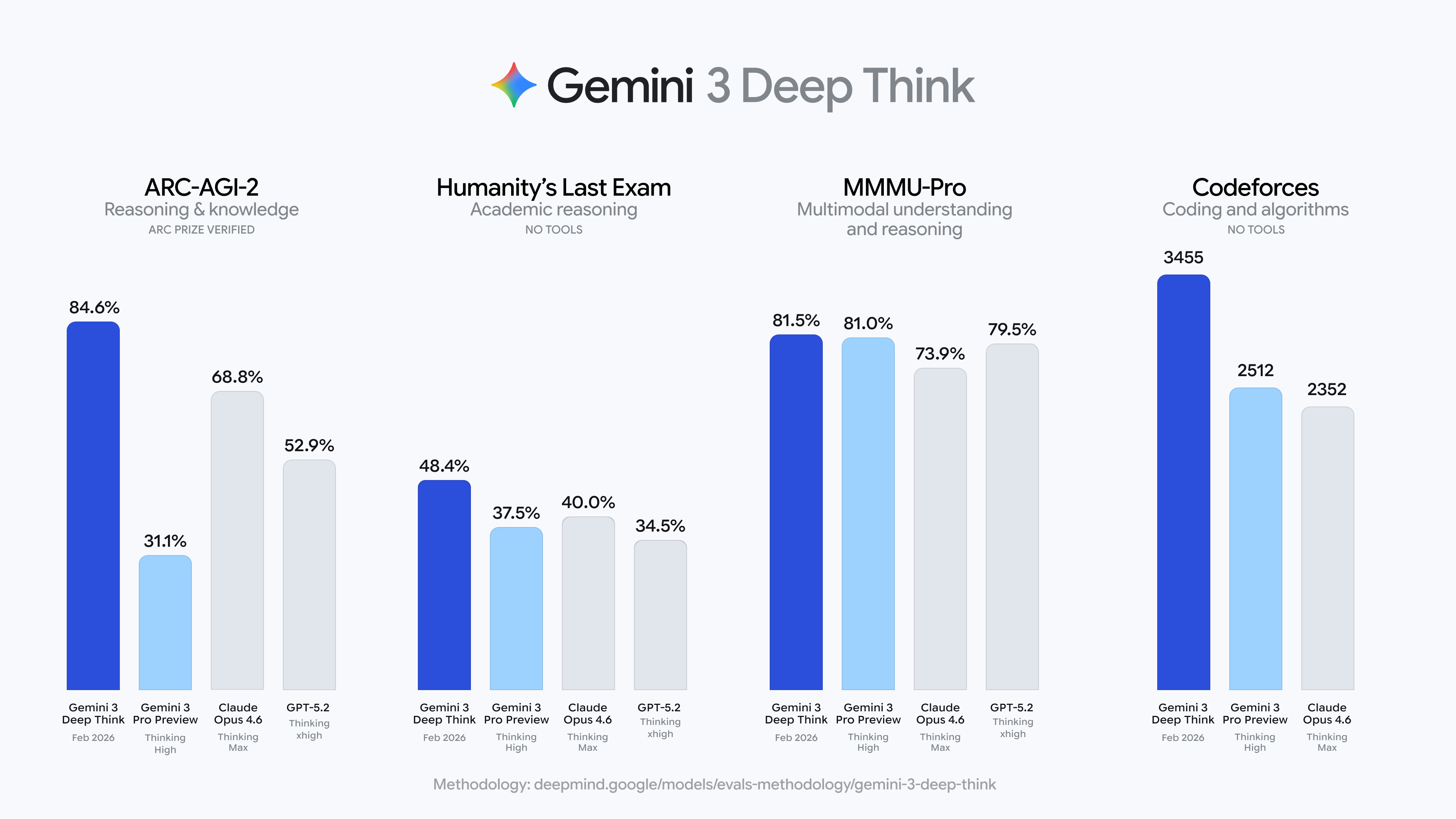
    • Setting a new standard (48.4%, without tools) on Humanity’s Last Exam, a benchmark designed to test the limits of modern frontier models
    • Achieving an unprecedented 84.6% on ARC-AGI-2, verified by the ARC Prize Foundation
    • Attaining a staggering Elo of 3455 on Codeforces, a benchmark consisting of competitive programming challenges
    • Reaching gold-medal level performance on the International Math Olympiad 2025

    Gemini 3 Deep Think evaluations charts

    Navigating complex scientific domains

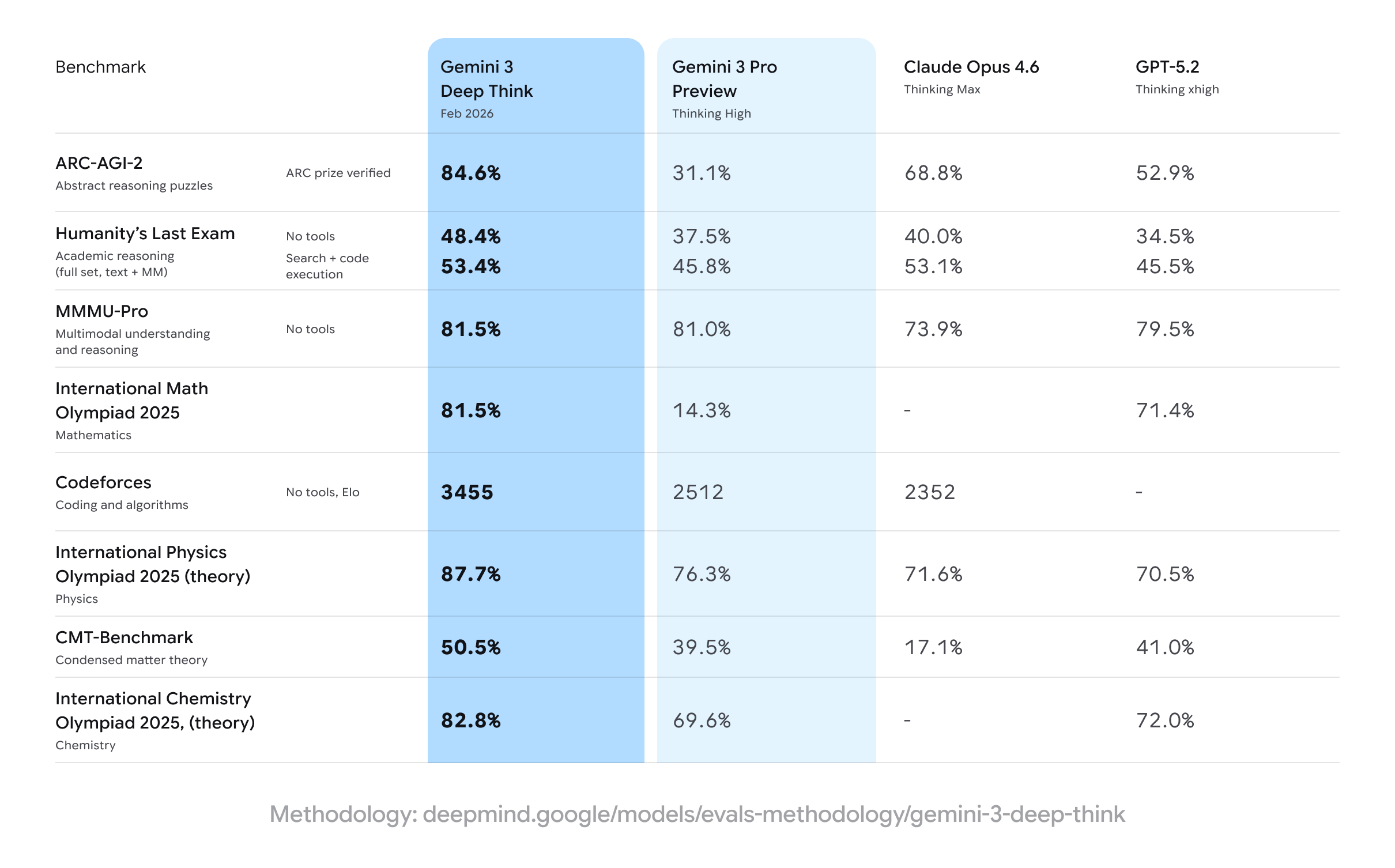
    Beyond mathematics and competitive coding, Gemini 3 Deep Think now also excels across broad scientific domains such as chemistry and physics. Our updated Deep Think mode demonstrates gold medal-level results on the written sections of the 2025 International Physics Olympiad and Chemistry Olympiad. It also demonstrates proficiency in advanced theoretical physics, achieving a score of 50.5% on CMT-Benchmark.

    Gemini 3 Deep Think evaluation table

    Accelerating real-world engineering

    In addition to its state-of-the-art performance, Deep Think is built to drive practical applications, enabling researchers to interpret complex data, and engineers to model physical systems through code. Most importantly, we are working to bring Deep Think to researchers and practitioners where they need it most — beginning with surfaces such as the Gemini API.

    With the updated Deep Think, you can turn a sketch into a 3D-printable reality. Deep Think analyzes the drawing, models the complex shape and generates a file to create the physical object with 3D printing.

    Available to Google AI Ultra Subscribers and the Gemini API via our Early Access Program

    Google AI Ultra subscribers will be able to access the updated Deep Think mode starting today in the Gemini app. Scientists, engineers and enterprises can also now express interest in our early access program to test Deep Think via the Gemini API.

    We can’t wait to see what you discover.

  • Mock Magic: Video Presets

    Use saved presets to quickly get a branded device video

    Discussion
    |
    Link

  • Accelerating Mathematical and Scientific Discovery with Gemini Deep Think

    Accelerating Mathematical and Scientific Discovery with Gemini Deep Think

    February 11, 2026 Research

    Thang Luong and Vahab Mirrokni

    Listen to article 10 minutes

    Under direction from expert mathematicians and scientists, Gemini Deep Think is solving professional research problems across mathematics, physics, and computer science

    In the summer of 2025, an advanced version of Gemini Deep Think achieved Gold-medal standard at the International Mathematics Olympiad (IMO) and later, an updated version, obtained similar results at the International Collegiate Programming Contest. These results demonstrated the model could reason through some of the most challenging math and programming problems designed for students. Since then, Gemini Deep Think mode has moved into science, engineering and enterprise workflows to tackle more complex, open-ended challenges.

    In the last week, our teams published two papers (1, 2) detailing a cross-disciplinary effort to solve professional research problems using Gemini Deep Think mode. These results stem from deep collaboration between mathematicians, physicists, and computer scientists.

    The Frontier of Pure Mathematics

    Unlike IMO problems, research-level mathematics requires advanced techniques from vast literature. While foundation models have large knowledge bases, data scarcity often leads to superficial understanding and hallucinations in advanced subjects.

    To solve this, we built a math research agent (internally codenamed Aletheia), powered by Gemini Deep Think mode. It features a natural language verifier to identify flaws in candidate solutions and enable an iterative process of generating and revising solutions. Crucially, this agent can admit failure to solve a problem, a key feature that improved the efficiency for researchers.

    Additionally, the research agent uses Google Search and web browsing to navigate complex research, preventing spurious citations and computational inaccuracies when synthesizing published literature.

    Flowchart titled Flowchart titled

    Overview of Aletheia, a math research agent powered by Deep Think that can iteratively generate, verify, and revise for research-level math problems.

    Since achieving IMO Gold-medal standard in July 2025, Gemini Deep Think has progressed rapidly, scoring up to 90% on the IMO-ProofBench Advanced test as inference-time compute scales. We demonstrated that the scaling law continues to hold as we progress beyond Olympiad level into PhD-level exercises (per our internal FutureMath Basic benchmark). Notably, Aletheia demonstrated that higher reasoning quality can be achieved at a lower inference-time compute.

    For research-level math, Aletheia has already enabled several advancements, produced via varying levels of autonomous research:

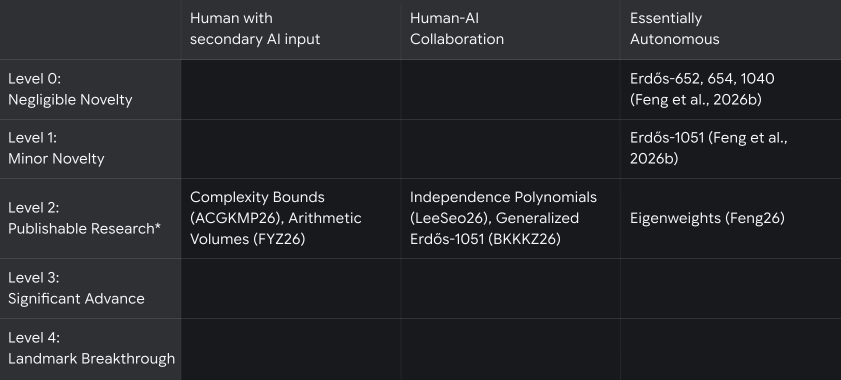
    • Reliable autonomous research. A research paper (Feng26) generated by AI without any human intervention, which calculates certain structure constants in arithmetic geometry called eigenweights.
    • AI-guided collaboration. A research paper (LeeSeo26) demonstrating human-AI collaboration in proving bounds on systems of interacting particles called independent sets.
    • An extensive semi-autonomous evaluation (Feng et al., 2026b) of 700 open problems on Bloom’s Erdős Conjectures database, including autonomous solutions to four open questions listed there. On Erdős-1051, our model autonomously solved and helped lead to a generalization reported in a research paper (BKKKZ26).

    The agent also contributed intermediate propositions on two further papers, (FYZ26) and (ACGKMP26). It is also of note that there has been prior work using Gemini for research-level math at a smaller scale in terms of collaborations and the number of problems tackled.

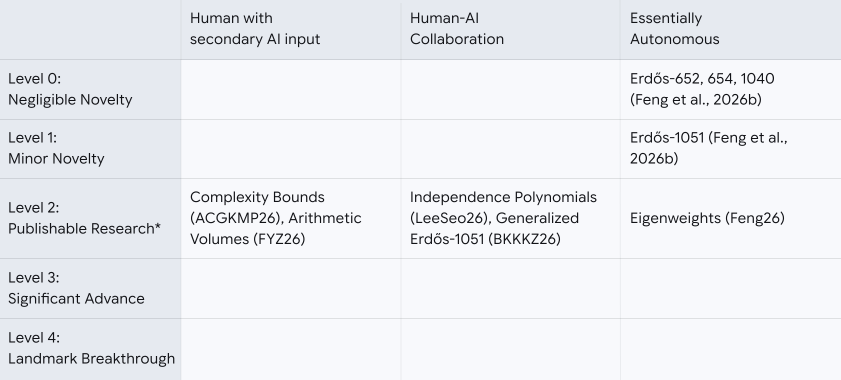
    Following extensive discussions with the mathematical community, we suggest a taxonomy to classify AI-assisted mathematics research by significance and degree of AI contribution – contributing to the wider discussion on responsible documentation, evaluation and communication of AI-generated results. Level 2 (“publishable quality”) works have been submitted to reputable journals. Currently, we do not claim any Level 3 (“Major Advance”) and Level 4 (“Landmark Breakthrough”) results.

    A table titled A table titled

    Classification of all AI-assisted mathematics results encompassed in this work. *Works listed as Level 2 in this table have been submitted for publications.

    Prompts and model outputs are available here. For discussions on AI contributions, our “Human-AI Interaction card”, and community impact, see our paper.

    Expanding to Physics and Computer Science

    Gemini Deep Think mode has also demonstrated promise in computer science and physics. The second paper builds on similar agentic reasoning ideas, and identifies effective “recipes” for collaboration, specifically the “Advisor” model, where humans guide AI through iterative “Vibe-Proving” cycles to validate intuition and refine proofs. We also detail tactical techniques like “balanced prompting” —requesting simultaneous proof or refutation to prevent confirmation bias—and code-assisted verification. These methods, combined with the model’s ability to bridge disparate scientific fields through deep structural connections, are transforming how theoretical research is conducted. This work builds upon our successful deployment of an advanced version of Gemini Deep Think to assist in reviewing CS theory papers for STOC’26 conference.

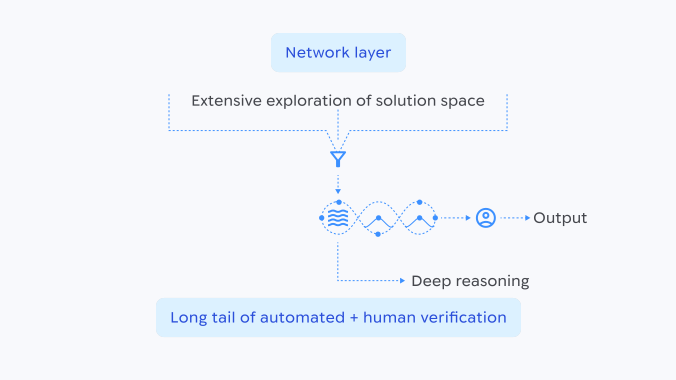
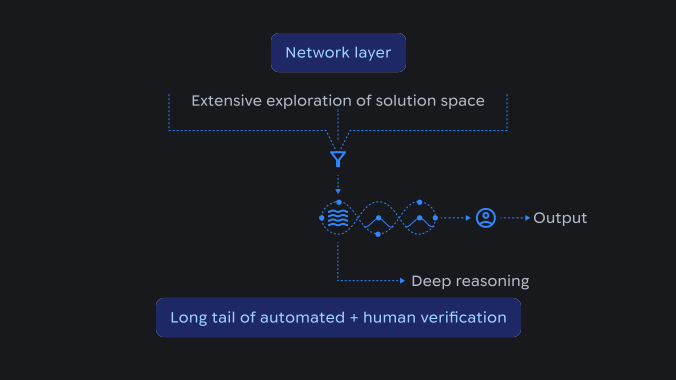
    A flow diagram titled A flow diagram titled

    A schematic overview of the AI reasoning pipeline, illustrating how extensive solution space exploration at the network layer is funneled into structured reasoning and validated by automated and human verification.

    Collaborating with experts on 18 research problems, an advanced version of Gemini Deep Think helped resolve long-standing bottlenecks across algorithms, ML and combinatorial optimization, information theory, and economics. Highlights from our “Accelerating Research with Gemini” paper include (corresponding section numbers in paper):

    1. Crossing mathematical borders for network puzzles: Progress on classic computer science problems like “Max-Cut” (efficiently splitting networks) and the “Steiner Tree” (connecting high-dimensional points) had slowed down. Gemini broke both deadlocks by thinking outside the box. It solved these discrete algorithmic puzzles by pulling advanced tools—like the Kirszbraun Theorem, measure theory, and the Stone-Weierstrass theorem—from entirely unrelated branches of continuous mathematics. See Sections 4.1 and 4.2.
    2. Settling a decade-old conjecture in online submodular optimization: A 2015 theory paper proposed a seemingly obvious rule for data streams: making a copy of an arriving item is always less valuable than simply moving the original. Experts struggled for a decade to prove this. Gemini engineered a highly specific three-item combinatorial counterexample, rigorously proving the long-standing human intuition false. See Section 3.1.
    3. Machine learning optimization: Training AI to filter out noise usually requires engineers to manually tune a mathematical “penalty.” Researchers created a new technique that did this automatically, but couldn’t mathematically explain why. Gemini analyzed the equations and proved the method succeeds by secretly generating its own “adaptive penalty” on the fly. See Section 8.3.
    4. Upgrading economic theory for AI: A recent ‘Revelation Principle’ for auctioning AI generation tokens only worked mathematically when bids were restricted to rational numbers. Extending the domain to continuous real numbers invalidated the original proof. Gemini employed advanced topology and order theory to extend the theorem, accommodating real-world, continuous auction dynamics. See Section 8.4.
    5. Physics of cosmic strings: Calculating gravitational radiation from cosmic strings requires finding analytical solutions to tricky integrals containing “singularities.” Gemini found a novel solution using Gegenbauer polynomials. This naturally absorbed the singularities, collapsing an infinite series into a closed form, finite sum. See Section 6.1.

    Spanning diverse fields—from information and complexity theory to cryptography and mechanism design—the results demonstrate how AI is fundamentally shifting research. For details, see our paper.

    Given computer science’s fluid, conference-driven publication pipeline, we describe these results by academic trajectory rather than a rigid taxonomy. About half target strong conferences—including an ICLR ’26 acceptance—while most remaining findings will form future journal submissions. Even when course-correcting the field by identifying errors (Section 3.2) or refuting conjectures (Section 3.1), these outcomes highlight AI’s value as a high-level scientific collaborator.

    The Future of Human-AI Collaboration

    Building on Google’s previous breakthroughs (1, 2, 3, 4, 5), this work demonstrates that general foundation models – leveraged with agentic reasoning workflows – can act as a powerful scientific companion.

    Under direction from expert mathematicians, physicists, and computer scientists, Gemini Deep Think mode is proving its utility across fields where complex math, logic and reasoning are core.

    We are witnessing a fundamental shift in the scientific workflow. As Gemini evolves, it acts as “force multiplier” for human intellect, handling knowledge retrieval and rigorous verification so scientists can focus on conceptual depth and creative direction. Whether refining proofs, hunting for counterexamples, or linking disconnected fields, AI is becoming a valuable collaborator in the next chapter of scientific progress.

    Acknowledgements

    We thank the community of expert mathematicians, physicists, and computer scientists for their help and advice on this project

    This project was a large-scale collaboration across Google and its success is due to the combined efforts of many individuals and teams. Thang Luong and Vahab Mirrokni led the overall research directions with deep technical expertises from Tony Feng and David Woodruff.

    Authors of the first paper “Towards Autonomous Mathematics Research” include: Tony Feng, Trieu H. Trinh, Garrett Bingham, Dawsen Hwang, Yuri Chervonyi, Junehyuk Jung, Joonkyung Lee, Carlo Pagano, Sang-hyun Kim, Federico Pasqualotto, Sergei Gukov, Jonathan N. Lee, Junsu Kim, Kaiying Hou, Golnaz Ghiasi, Yi Tay, YaGuang Li, Chenkai Kuang, Yuan Liu, Hanzhao (Maggie) Lin, Evan Zheran Liu, Nigamaa Nayakanti, Xiaomeng Yang, Heng-Tze Cheng, Demis Hassabis, Koray Kavukcuoglu, Quoc V. Le, Thang Luong. We thank the following experts for feedback and discussions on the work: ​​Jarod Alper, Kevin Barreto, Thomas Bloom, Sourav Chatterjee, Otis Chodosh, Michael Hutchings, Seongbin Jeon, Youngbeom Jin, Aiden Yuchan Jung, Jiwon Kang, Jimin Kim, Vjekoslav Kovač, Daniel Litt, Ciprian Manolescu, Mona Merling, Agustin Moreno, Carl Schildkraut, Johannes Schmitt, Insuk Seo, Jaehyeon Seo, Terence Tao, Cheng-Chiang Tsai, Ravi Vakil, Zhiwei Yun, Shengtong Zhang, Wei Zhang, Yufei Zhao.

    Authors of the second paper “Accelerating Scientific Research with Gemini: Case Studies and Common Techniques” include David P. Woodruff, Vincent Cohen-Addad, Lalit Jain, Jieming Mao, Song Zuo, MohammadHossein Bateni, Simina Branzei, Michael P. Brenner, Lin Chen, Ying Feng, Lance Fortnow, Gang Fu, Ziyi Guan, Zahra Hadizadeh, Mohammad T. Hajiaghayi, Mahdi JafariRaviz, Adel Javanmard, Karthik C. S., Ken-ichi Kawarabayashi, Ravi Kumar, Silvio Lattanzi, Euiwoong Lee, Yi Li, Ioannis Panageas, Dimitris Paparas, Benjamin Przybocki, Bernardo Subercaseaux, Ola Svensson, Shayan Taherijam, Xuan Wu, Eylon Yogev, Morteza Zadimoghaddam, Samson Zhou, Yossi Matias, Jeff Dean, James Manyika, Vahab Mirrokni. This list includes Google researchers building the agentic reasoning on top of Gemini, and our academic expert collaborators verifying and collaborating with Gemini. We also thank Corinna Cortes for her careful review of the paper.

    We are grateful for the foundational support from the rest of the DeepThink team: Anirudh Baddepudi, Michael Brenner, Irene Cai, Kristen Chiafullo, Paul Covington, Rumen Dangovski, Chenjie Gu, Huan Gui, Vihan Jain, Rajesh Jayaram, Melvin Johnson, Rosemary Ke, Maciej Kula, Nate Kushman, Jane Labanowski, Steve Li, Pol Moreno, Sidharth Mudgal, William Nelson, ​​Ada Maksutaj Oflazer, Sahitya Potluri, Navneet Potti, Shubha Raghvendra, James Roggeveen, Siamak Shakeri, Archit Sharma, Xinying Song, Mukund Sundararajan, Qijun Tan, Zak Tsai, Erik Wang, Theophane Weber, Winnie Xu, Zicheng Xu, Junwen Yao, Shunyu Yao, Adams Yu, Lijun Yu, and Honglei Zhuang.

    We’d like to thank the Gemini Post-Training team for building the foundational model for Deep Think: Arash Ahmadian, Ankesh Anand, Charles Chen, Yong Cheng, Kedar Dhamdhere, Philipp Fränken, Justin Gilmer, Elena Gribovskaya, Luheng He, Yangsibo Huang, Rishabh Joshi, Ajay Kannan, Arvind Kannan, Guangda Lai, Robert Leland, Hanzhao (Maggie) Lin, Yingjie Miao, Bryce Petrini, Corbin Quick, Vikash Sehwag, Yue Song, Pranav Talluri, Ankur Taly, George Tucker, Michael Voznesensky, Manish Reddy Vuyyuru, Yiming Wang, Jinliang Wei, Qiao Zhang, Yuan Zhang, Zizhao Zhang.

    We thank Quoc Le, Koray Kavukcuoglu, Demis Hassabis, James Manyika, Yossi Matias, and Jeff Dean for sponsoring this project.

    Last but not least, we thank Divy Thakkar, Adam Brown, Vinay Ramasesh, Alex Davies, Thomas Hubert, Eugénie Rives, Pushmeet Kohli, Benoit Schillings for feedback and support of the project.

    Advanced version of Gemini with Deep Think officially achieves gold-medal standard at the International Mathematical Olympiad

    Gemini achieves gold-medal level at the International Collegiate Programming Contest World Finals

  • Project Genie: Experimenting with infinite, interactive worlds

    Project Genie: Experimenting with infinite, interactive worlds

    Google AI Ultra subscribers in the U.S. can try out Project Genie, an experimental research prototype that lets you create and explore worlds.


    Diego Rivas

    Group Product Manager, Google DeepMind

    Elliott Breece

    Product Manager, Google Labs

    Suz Chambers

    Director, Google Creative Lab


    Your browser does not support the audio element.

    Listen to article

    [[duration]] minutes

    This content is generated by Google AI. Generative AI is experimental

    In August, we previewed Genie 3, a general-purpose world model capable of generating diverse, interactive environments. Even in this early form, trusted testers were able to create an impressive range of fascinating worlds and experiences, and uncovered entirely new ways to use it. The next step is to broaden access through a dedicated, interactive prototype focused on immersive world creation.

    Starting today, we’re rolling out access to Project Genie for Google AI Ultra subscribers in the U.S (18+). This experimental research prototype lets users create, explore and remix their own interactive worlds.

    How we’re advancing world models

    A world model simulates the dynamics of an environment, predicting how they evolve and how actions affect them. While Google DeepMind has a history of agents for specific environments like Chess or Go, building AGI requires systems that navigate the diversity of the real world.

    To meet this challenge and support our AGI mission, we developed Genie 3. Unlike explorable experiences in static 3D snapshots, Genie 3 generates the path ahead in real time as you move and interact with the world. It simulates physics and interactions for dynamic worlds, while its breakthrough consistency enables the simulation of any real-world scenario — from robotics and modelling animation and fiction, to exploring locations and historical settings.

    Building on our model research with trusted testers from across industries and domains, we are taking the next step with an experimental research prototype: Project Genie.

    How Project Genie works

    Project Genie is a prototype web app powered by Genie 3, Nano Banana Pro and Gemini, which allows users to experiment with the immersive experiences of our world model firsthand. The experience is centred on three core capabilities:

    1. World sketching

    Prompt with text and generated or uploaded images to create a living, expanding environment. Create your character, your world, and define how you want to explore it — from walking to riding, flying to driving, and anything beyond.

    For more precise control, we have integrated “World Sketching” with Nano Banana Pro. This allows you to preview what your world will look like and modify your image to fine tune your world prior to jumping in. You can also define your perspective for the character — such as first-person or third-person — giving you control over how you experience the scene before you enter.

    2. World exploration

    Your world is a navigable environment that’s waiting to be explored. As you move, Project Genie generates the path ahead in real time based on the actions you take. You can also adjust the camera as you traverse through the world.

    3. World remixing

    Remix existing worlds into new interpretations, by building on top of their prompts. You can also explore curated worlds in the gallery or by selecting the randomizer icon for inspiration, or build on top of them. And once you’re done, you can download videos of your worlds and your explorations.

    How we’re building responsibly

    Project Genie is an experimental research prototype in Google Labs, powered by Genie 3. As with all our work towards general AI systems, our mission is to build AI responsibly to benefit humanity. Since Genie 3 is an early research model, there are a few known areas for improvement:

    • Generated worlds might not look completely true-to-life or always adhere closely to prompts or images, or real-world physics
    • Characters can sometimes be less controllable, or experience higher latency in control
    • Limitations in generations to 60 seconds

    A few of the Genie 3 model capabilities we announced in August, such as promptable events that change the world as you explore it, are not yet included in this prototype. You can find more details on model limitations and future updates on how we’re improving the experience, here.

    Building on the work we have been doing with trusted testers, we are excited to share this prototype with users of our most advanced AI to better understand how people will use world models in many areas of both AI research and generative media.

    Access to Project Genie begins rolling out today to Google AI Ultra subscribers 1 in the U.S. (18+), expanding to more territories in due course. We look forward to seeing the infinitely diverse worlds they create, and in time, our goal is to make these experiences and technology accessible to more users.