Author: admin

  • Partnering with industry leaders to accelerate AI transformation

    Partnering with industry leaders to accelerate AI transformation

    April 22, 2026 Responsibility & Safety

    David Thacker

    We’re joining forces with Accenture, Bain & Company, BCG, Deloitte, and McKinsey to bring the power of frontier AI to organizations around the world.

    Artificial intelligence (AI) could contribute up to $15.7 trillion to the global economy by 2030, yet many businesses face a significant adoption gap. To date, only 25% of organizations have successfully moved AI into production at scale.

    At Google DeepMind, we believe AI is one of the most transformative technologies of our time, capable of delivering new products and services, and scientific breakthroughs that improve the lives of billions of people. To help businesses harness this potential responsibly, we’re partnering with Accenture, Bain & Company, BCG, Deloitte, and McKinsey to accelerate AI-driven transformation and help industries adopt frontier technology at scale. By combining our advanced research with their strategic expertise, we aim to solve complex challenges across sectors and drive global economic growth.

    A new initiative for enterprise transformation

    We’re partnering with global enterprise consultancies to help them deliver world-leading agentic transformation for customers at speed and scale. Together we’ll use AI to drive meaningful human impact, empowering workforces with AI tools that provide real-time data for better decision-making and management of complex tasks.

    From research labs to real-world impact

    This collaboration allows our partners to work directly with Google DeepMind’s world-leading technical talent. Together, we will focus on critical enterprise needs in sectors like finance, manufacturing, retail, media and entertainment.

    These partnerships include three key pillars:

    • Enabling scaled, industry-specific AI capabilities: We will collaborate on challenging customer use cases, supporting the development of scaled, industry-specific AI solutions.
    • Early access to frontier models: Partners will receive early access to our frontier models, including the Gemini family. Their feedback on these will help us further refine these systems to ensure they’re equipped to deliver benefits for customers.
    • Access to AI leadership: We will connect our leadership with customer CEOs and boards, helping them navigate the future of frontier AI research and development.

    Looking ahead

    These efforts build upon Google Cloud’s work supporting global consulting partners, systems integrators, software partners, and specialized services providers as they implement and scale agentic AI.

    In the coming years, AI has the potential to solve critical global challenges and amplify human potential. To secure these benefits, AI must be diffused responsibly across industries, remaining guided by human expertise. We are excited to see what we can build and scale together with the world’s leading strategic partners in pursuit of these goals.

  • Gemini 3.1 Flash TTS: the next generation of expressive AI speech

    Gemini 3.1 Flash TTS: the next generation of expressive AI speech

    Our newest audio model introduces granular audio tags that give you precise control to direct AI speech for expressive audio generation.


    Vilobh Meshram

    Member of the Technical Staff

    Max Gubin

    Principal Research Engineer on behalf of the Gemini team


    Gemini logo next to the text

    Your browser does not support the audio element.

    Listen to article

    [[duration]] minutes

    This content is generated by Google AI. Generative AI is experimental

    Today, we’re introducing Gemini 3.1 Flash TTS, the latest text-to-speech model that delivers improved controllability, expressivity and quality — empowering developers, enterprises and everyday users to build the next generation of AI-speech applications.

    Starting today, 3.1 Flash TTS is rolling out:

    Improved speech quality and controllability

    We’ve improved the overall speech quality of Gemini 3.1 Flash TTS, making it our most natural and expressive model to date. On the Artificial Analysis TTS leaderboard, a benchmark that captures thousands of blind human preferences, 3.1 Flash TTS achieved an impressive Elo score of 1,211.

    a gif showing artificial analysis text to speech arena quality elo

    Artificial Analysis has also positioned Gemini 3.1 Flash TTS within its “most attractive quadrant” for its ideal blend of high-quality speech generation and low cost. The model stands out further with native multi-speaker dialogue, support for 70+ languages, and granular creative control via natural language.

    New audio tags for more expressive speech generation

    3.1 Flash TTS also introduces audio tags — an intuitive way to control vocal style, pace and delivery. By embedding natural language commands directly into the text input, you can steer AI-speech output with improved levels of granularity.

    3.1 Flash TTS enables enterprises to utilize audio tags within Vertex AI, empowering the next generation of enterprise applications.

    3.1 Flash TTS lets you use audio tags to experiment with speech expressivity, pacing and delivery.

    3.1 Flash TTS lets you integrate expressive speech capabilities, turning a standard weather app into an engaging experience.

    3.1 Flash TTS supports a range of audio tags to add nuanced, engaging delivery to a synonym word hunt app.

    You can start experimenting with these audio tags along with other updates to the developer experience in Google AI Studio with configurable controls that place the developer in the “director’s chair”:

    • Scene direction: Set the stage by defining the environment and providing specific dialogue instructions. This world-building context helps characters remain “in-character” and react to one another naturally across multiple turns.
    • Speaker-level specificity: Cast characters using unique Audio Profiles, then specify Director’s Notes to toggle pace, tone and accent. Using inline tags, speakers can pivot from these high-level settings to change expression mid-sentence.
    • Seamless export: Once the performance is perfected, these exact parameters can be exported as Gemini API code to ensure consistent, recognizable voices across various projects and platforms.

    With these new configurations, developers can enhance precision for specific scenarios, creating memorable characters and immersive audio experiences.

    Built for global scale

    Gemini 3.1 Flash TTS delivers high-fidelity speech and more precise control across more than 70 languages. These core optimizations bring advanced style, pacing and accent control to major markets — helping developers create localized, expressive speech experiences for users at global scale.

    Early developer and enterprise testers are already seeing the impact of 3.1 Flash TTS, highlighting its impressive controllability and expressivity. They’ve told us how audio tags provide a new level of creative precision, transforming simple text into a high-fidelity vocal performance.

    Quote from Jay of StyleUAI

    Quote from CTO of AIM Intelligence

    Quote from Idan Yonas of Artlist

    Quote from Lydia Xu of Sierra

    Quote from Shivam Rastogi of Invideo AI

    Quote from Fernanda Bejarano of biia

    Quote from John Wu of HeyGen

    Quote from Soami Kapadia of You learn.AI

    Quote from Angel Wen of Sylph.ai

    Quote from Artugrul Cavusoglu of Mindlid

    Watermarked with SynthID

    All audio generated by Gemini 3.1 Flash TTS is watermarked with SynthID. This imperceptible watermark is interwoven directly into the audio output, allowing the reliable detection of AI-generated content to help prevent misinformation. For more information on our approach to safety and responsibility, you can review the model card.

    Get the latest news from Google in your inbox

    Sign up for our newsletters with product updates, event information, special offers, and more.

    Your information will be used in accordance with Google’s privacy policy. You may opt out at any time.

  • Gemini Robotics-ER 1.6: Powering real-world robotics tasks through enhanced embodied reasoning

    Gemini Robotics-ER 1.6: Powering real-world robotics tasks through enhanced embodied reasoning

    April 14, 2026 Models

    Laura Graesser and Peng Xu

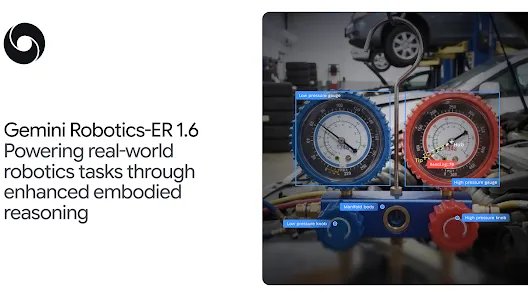
    For robots to be truly helpful in our daily lives and industries, they must do more than follow instructions, they must reason about the physical world. From navigating a complex facility to interpreting the needle on a pressure gauge, a robot’s “embodied reasoning” is what allows it to bridge the gap between digital intelligence and physical action.

    Today, we’re introducing Gemini Robotics-ER 1.6, a significant upgrade to our reasoning-first model that enables robots to understand their environments with unprecedented precision. By enhancing spatial reasoning and multi-view understanding, we are bringing a new level of autonomy to the next generation of physical agents.

    This model specializes in reasoning capabilities critical for robotics, including visual and spatial understanding, task planning and success detection. It acts as the high-level reasoning model for a robot, capable of executing tasks by natively calling tools like Google Search to find information, vision-language-action models (VLAs) or any other third-party user-defined functions.

    Gemini Robotics-ER 1.6 shows significant improvement over both Gemini Robotics-ER 1.5 and Gemini 3.0 Flash, specifically enhancing spatial and physical reasoning capabilities such as pointing, counting, and success detection. We are also unlocking a new capability: instrument reading, enabling robots to read complex gauges and sight glasses — a use case we discovered through close collaboration with our partner, Boston Dynamics.

    Starting today, Gemini Robotics-ER 1.6 is available to developers via the Gemini API and Google AI Studio. To help you get started, we are sharing a developer Colab containing examples of how to configure the model and prompt it for embodied reasoning tasks.

    Figure 1: Benchmark results comparing Gemini Robotics-ER 1.6 with Gemini Robotics-ER 1.5 and Gemini 3.0 Flash models. The instrument reading evaluations were run with agentic vision enabled (except for Gemini Robotics-ER 1.5 which doesn’t support it). All other evals were run with agentic vision disabled. The single view and multiview success detection evaluations contain different examples so are not comparable.

    Pointing: The foundation of spatial reasoning

    Pointing is a fundamental capability for an embodied reasoning model, evolving with each model generation. Points can be used to express many concepts, including:

    • Spatial reasoning: Precision object detection and counting
    • Relational logic: Making comparisons, such as identifying the smallest item in a set; defining “from-to” relationships (e.g move X to location Y)
    • Motion reasoning: Mapping trajectories and identifying optimal grasp points
    • Constraint compliance: Reasoning through complex prompts like “point to every object small enough to fit inside the blue cup”

    Gemini Robotics-ER 1.6 can use points as intermediate steps to reason about more complex tasks. For example, it can use points to count items in an image, or to identify salient points on an image to help the model perform mathematical operations to improve its metric estimations.

    The example below shows Gemini Robotics-ER 1.6’s strengths in pointing to multiple elements, and knowing when and when not to point.

    Gemini Robotics-ER 1.6 correctly identifies the number of hammers (2), scissors (1), paintbrushes (1), pliers (6), and a collection of garden tools which can be interpreted as a single group or multiple points. It does not point to requested items that are not present in the image — a wheelbarrow and Ryobi drill. In comparison Gemini Robotics-ER 1.5 fails to identify the correct number of hammers or paint brushes, misses the scissors altogether, hallucinates a wheelbarrow and lacks precision on plier pointing. Gemini 3.0 Flash is close to Gemini Robotics-ER 1.6, but does not handle the pliers as well.

    Success Detection: The engine of autonomy

    In robotics, knowing when a task is finished is just as important as knowing how to start it. Success detection is a cornerstone of autonomy, serving as a critical decision-making engine that allows an agent to intelligently choose between retrying a failed attempt or progressing to the next stage of a plan.

    Achieving visual understanding in robotics is challenging, requiring sophisticated perception and reasoning capabilities combined with broad world knowledge in order to handle complicating factors such as occlusions, poor lighting and ambiguous instructions. Additionally, most modern robotics setups include multiple camera views such as an overhead and wrist-mounted feed. This means a system needs to understand how different viewpoints combine to form a coherent picture at each moment and across time.

    Gemini Robotics-ER 1.6 advances multi-view reasoning, enabling the system to better understand multiple camera streams and the relationship between them, even in dynamic or occluded environments, as demonstrated in the typical multi-view scenario below.

    Gemini Robotics-ER 1.6 takes cues from multiple camera views to determine when the task “put the blue pen into the black pen holder” is complete.

    Instrument reading: Real-world visual reasoning

    To understand a key strength of Gemini Robotics-ER 1.6, we must look at how it combines capabilities like spatial reasoning and world knowledge to solve complex, real-world problems. A perfect example is instrument reading.

    This task stems from facility inspection needs, a critical focus area for our partners at Boston Dynamics. Industrial facilities contain many instruments — thermometers, pressure gauges, chemical sight glasses and more — that require constant monitoring. Spot, a Boston Dynamics robot product, is able to visit the instruments throughout the facility and capture images of them.

    Gemini Robotics-ER 1.6 enables robots to interpret a variety of instruments, including circular pressure gauges, vertical level indicators and modern digital readouts.

    Instrument reading requires complex visual reasoning. One must precisely perceive a variety of inputs — including the needles, liquid level, container boundaries, tick marks and more — and understand how they all relate to each other. In the case of sight glasses, this involves estimating how much the liquid fills the sightglass taking into account distortion from the camera perspective. Gauges typically have text describing the unit, which must be read and interpreted, and some have multiple needles referring to different decimal places that need to be combined.

    Capabilities like instrument reading and more reliable task reasoning will enable Spot to see, understand, and react to real-world challenges completely autonomously.

    Marco da Silva

    Vice President and General Manager of Spot at Boston Dynamics

    Gemini Robotics-ER 1.6 achieves its highly accurate instrument readings by using agentic vision, which combines visual reasoning with code execution. The model takes intermediate steps: first zooming into an image to get a better read of small details in a gauge, then using pointing and code execution to estimate proportions and intervals and get an accurate reading, and ultimately applying its world knowledge to interpret meaning.

    Figure 2: How the different elements of Gemini Robotics-ER 1.6 contribute to reaching a high level of performance on the instrument reading task.

    Read an analog gauge with accuracy

    This example demonstrates how the model uses pointing and code execution for zooming to derive the reading of gauge down to sub tick accuracy.

    Our safest robotics model yet

    Safety is integrated into every level of our embodied reasoning models. Gemini Robotics-ER 1.6 is our safest robotics model to date, demonstrating superior compliance with Gemini safety policies on adversarial spatial reasoning tasks compared to all previous generations.

    The model also shows a substantially improved capacity to adhere to physical safety constraints. For example, it makes safer decisions through spatial outputs like pointing regarding which objects can be safely manipulated under gripper or material constraints (e.g., “don’t handle liquids”, “don’t pick up objects heavier than 20kg“).

    We also tested how well the model identifies safety hazards in text and video scenarios based on real-life injury reports. On these tasks, our Gemini Robotics-ER models improve over baseline Gemini 3.0 Flash performance (+6% in text, +10% in video) in perceiving injury risks accurately.

    Figure 3: Gemini Robotics-ER 1.6 improves substantially compared to Gemini Robotics-ER 1.5 on Safety Instruction Following which tests the ability to adhere to physical safety constraints. It improves compared to Gemini 3.0 Flash on pointing, and both models have very high accuracy for text. Gemini 3.0 Flash does better on bounding boxes.

    Collaborate with us to improve embodied reasoning for robotics

    We are committed to ensuring Gemini Robotics-ER provides maximum value to the robotics community. If current capabilities are limited for your specialized application, we invite you to submit this form with 10–50 labeled images illustrating specific failure modes to help us build more robust reasoning features. We look forward to collaborating with you to enhance these capabilities in our upcoming releases.

    Try Gemini Robotics-ER 1.6 now on Google AI Studio

    Gemini Robotics

    Gemini Robotics ER 2

    Responsibly advancing AI and robotics

  • Gemma 4: Byte for byte, the most capable open models

    Gemma 4: Byte for byte, the most capable open models


    Clement Farabet

    VP of Research, Google DeepMind

    Olivier Lacombe

    Director Product Management, Google Deepmind


    Gemma 4

    Your browser does not support the audio element.

    Listen to article

    [[duration]] minutes

    This content is generated by Google AI. Generative AI is experimental

    Today, we are introducing Gemma 4 — our most intelligent open models to date. Purpose-built for advanced reasoning and agentic workflows, Gemma 4 delivers an unprecedented level of intelligence-per-parameter. This breakthrough builds on incredible community momentum: since the launch of our first generation, developers have downloaded Gemma over 400 million times, building a vibrant Gemmaverse of more than 100,000 variants. We listened closely to what innovators need next to push the boundaries of AI, and Gemma 4 is our answer: breakthrough capabilities made widely accessible under an Apache 2.0 license.

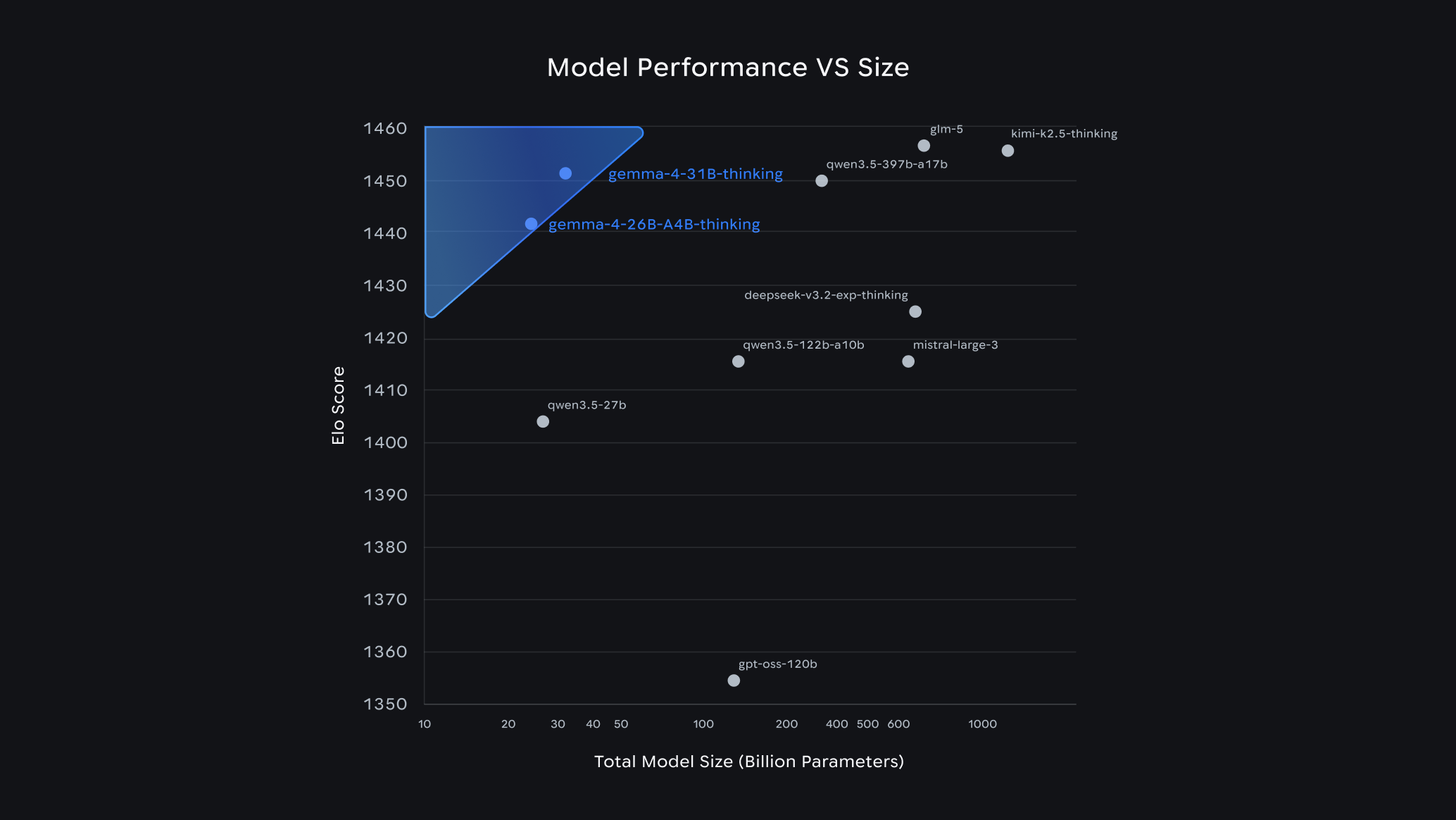
    Open model performance vs size on Arena.ai’s chat arena as of 4/1.

    Open model performance vs size on Arena.ai’s chat arena

    Built from the same world-class research and technology as Gemini 3, Gemma 4 is the most capable model family you can run on your hardware. They complement our Gemini models, giving developers the industry’s most powerful combination of both open and proprietary tools.

    Industry-leading capabilities and mobile-first AI

    We are releasing Gemma 4 in four versatile sizes: Effective 2B (E2B), Effective 4B (E4B), 26B Mixture of Experts (MoE) and 31B Dense. The entire family moves beyond simple chat to handle complex logic and agentic workflows. Our larger models deliver state-of-the-art performance for their sizes, with the 31B model currently ranking as the #3 open model in the world on the industry-standard Arena AI text leaderboard, and the 26B model securing the #6 spot. There, Gemma 4 outcompetes models 20x its size. For developers, this new level of intelligence-per-parameter means achieving frontier-level capabilities with significantly less hardware overhead.

    At the edge, our E2B and E4B models redefine on-device utility, prioritizing multimodal capabilities, low-latency processing and seamless ecosystem integration over raw parameter count.

    Powerful, accessible, open

    To power the next generation of pioneering research and products, we’ve sized the Gemma 4 models specifically to run and fine-tune efficiently on hardware — from billions of Android devices worldwide, to laptop GPUs, all the way up to developer workstations and accelerators.

    By using these highly optimized models, you can fine-tune Gemma 4 to achieve state-of-the-art performance on your specific tasks. We’ve already seen incredible success with this approach; for instance, INSAIT created a pioneering Bulgarian-first language model (BgGPT), and we worked with Yale University on Cell2Sentence-Scale to discover new pathways for cancer therapy, among many others.

    Here is what makes Gemma 4 our most capable open model family yet:

    • Advanced reasoning: Capable of multi-step planning and deep logic, Gemma 4 demonstrates significant improvements in math and instruction-following benchmarks that require it.
    • Agentic workflows: Native support for function-calling, structured JSON output, and native system instructions enables you to build autonomous agents that can interact with different tools and APIs and execute workflows reliably.
    • Code generation: Gemma 4 supports high-quality offline code, turning your workstation into a local-first AI code assistant.
    • Vision and audio: All models natively process video and images, supporting variable resolutions, and excelling at visual tasks like OCR and chart understanding. Additionally, the E2B and E4B models feature native audio input for speech recognition and understanding.
    • Longer context: Process long-form content seamlessly. The edge models feature a 128K context window, while the larger models offer up to 256K, allowing you to pass repositories or long documents in a single prompt.
    • 140+ languages: Natively trained on over 140 languages, Gemma 4 helps developers build inclusive, high-performance applications for a global audience.

    Versatile models for diverse hardware

    We are releasing the Gemma 4 model weights in sizes tailored for specific hardware and use cases, ensuring you get frontier-class reasoning wherever you need it:

    26B and 31B models: Frontier intelligence, offline on your personal computers

    Optimized to provide researchers and developers with state-of-the-art reasoning on accessible hardware, our unquantized bfloat16 weights fit efficiently on a single 80GB NVIDIA H100 GPU. For local setups, quantized versions run natively on consumer GPUs to power your IDEs, coding assistants and agentic workflows. Our 26B Mixture of Experts (MoE) focus on latency, activating only 3.8 billion of its total parameters during inference to deliver exceptionally fast tokens-per-second, while our 31B Dense is maximizing raw quality and provides a powerful foundation for fine-tuning.

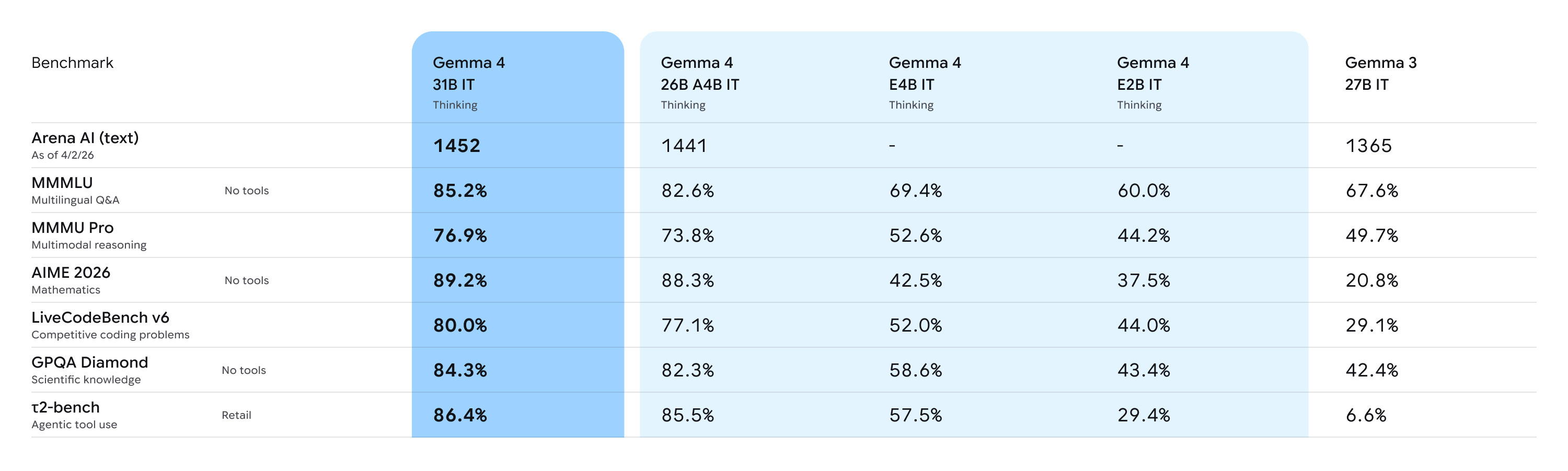
    These models were evaluated against a large collection of different datasets and metrics to cover different aspects of text generation. See additional benchmarks in our model card.

    Gemma 4 Table

    E2B and E4B models: A new level of intelligence for mobile and IoT devices

    Engineered from the ground up for maximum compute and memory efficiency, these models activate an effective 2 billion and 4 billion parameter footprint during inference to preserve RAM and battery life. In close collaboration with our Google Pixel team and mobile hardware leaders like Qualcomm Technologies and MediaTek, these multimodal models run completely offline with near-zero latency across edge devices like phones, Raspberry Pi, and NVIDIA Jetson Orin Nano. Android developers can now prototype agentic flows in the AICore Developer Preview today for forward-compatibility with Gemini Nano 4.

    An open-source license

    You gave us feedback, and we listened. Building the future of AI requires a collaborative approach, and we believe in empowering the developer ecosystem without restrictive barriers. That’s why Gemma 4 is released under a commercially permissive Apache 2.0 license.

    This open-source license provides a foundation for complete developer flexibility and digital sovereignty; granting you complete control over your data, infrastructure, and models. It allows you to build freely and deploy securely across any environment, whether on-premises or in the cloud.

    Built on a foundation of trust and safety

    These models undergo the same rigorous infrastructure security protocols as our proprietary models. By choosing Gemma 4, enterprises and sovereign organizations gain a trusted, transparent foundation that delivers state-of-the-art capabilities while meeting the highest standards for security and reliability.

    An ecosystem of choices

    • Start experimenting in seconds: Get instant access to Gemma 4 and begin building right away. Explore Gemma 4 in Google AI Studio (31B and 26B MoE) or in Google AI Edge Gallery (E4B and E2B). For Android development, use it to power Agent Mode in Android Studio, and start building apps for production on Android with the ML Kit GenAI Prompt API.
    • Use your favorite tools: With day-one support for Hugging Face (Transformers, TRL, Transformers.js, Candle), LiteRT-LM, vLLM, llama.cpp, MLX, Ollama, NVIDIA NIM and NeMo, LM Studio, Unsloth, SGLang, Cactus, Baseten, Docker, MaxText, Tunix, Keras, you have the flexibility to choose the best tools for your project.
    • Download the models: Get the model weights from Hugging Face, Kaggle or Ollama.
    • Customize Gemma 4 to your specific needs: Train and adapt the model using your preferred platform, like Google Colab, Vertex AI or even your gaming GPU.
    • Scale to production on Google Cloud: While local on-device inference is ideal for offline use, Google Cloud removes all compute ceilings. Deploy your way through Vertex AI, Cloud Run, GKE, Sovereign Cloud, TPU-accelerated serving and the highest compliance guarantees for regulated workloads. Learn more about getting started on Google Cloud here.
    • Accelerate your AI development across multiple hardware platforms: Gemma 4 is optimized for industry-leading hardware out of the box. Experience maximum performance on NVIDIA AI infrastructure from NVIDIA Jetson Orin Nano to Blackwell GPUs, integrate with AMD GPUs via the open-source ROCm™ stack, or deploy on Trillium and Ironwood TPUs for massive scale and efficiency.
    • Compete for impact: Join the Gemma 4 Good Challenge on Kaggle to build products that create meaningful, positive change in the world.

  • Reimagining the mouse pointer for the AI era

    Reimagining the mouse pointer for the AI era

    May 12, 2026 Research

    Adrien Baranes and Rob Marchant

    We are developing more seamless, intuitive ways to collaborate with AI

    The mouse pointer has been a constant companion on computer screens, across every website, document and workflow. Despite how technologies have changed, the pointer has barely evolved in more than half a century.

    We’ve been exploring new AI-powered capabilities to help the pointer not only understand what it’s pointing at, but also why it matters to the user.

    Our goal is to address a common frustration: because a typical AI tool lives in its own window, users need to drag their world into it. We want the opposite: intuitive AI that meets users across all the tools they use, without interrupting their flow. For example, imagine pointing to an image of a building, and requesting “Show me directions”. Nothing more is needed when the AI system already understands the context.

    Today, we’re outlining the underlying principles guiding our thinking on future user interfaces, and sharing experimental demos of an AI-enabled pointer, powered by Gemini. For example, you could visit Google AI Studio to edit an image or find places on the map, just by pointing and speaking.

    This video showcases the experimental environment for our AI-enabled pointer. Sequences are shortened throughout.

    Our interaction principles

    We’ve developed four principles that together shift the hard work of conveying context and intent from the user to the computer, replacing text-heavy prompts with simpler, more intuitive interactions. Here are illustrations of our approach and principles.

    Maintain the flow

    AI capabilities should work across all apps, not force users into “AI detours” between them. Our prototype AI-enabled pointer is available wherever the user is working. For example, they could point at a PDF and request a bullet-point summary to paste directly into an email, hover over a table of statistics and request a pie chart version, or highlight a recipe and ask for all the ingredients doubled.

    Show and tell

    Current AI models demand precise instructions. To get a good response, a user has to write a detailed prompt. An AI-enabled pointer would streamline this process by smoothly capturing the visual and semantic context around the pointer, letting the computer “see” and understand what’s important to the user. In our experimental system, just point, and the AI knows exactly which word, paragraph, part of an image, or code block the user needs help with.

    Embrace the power of “This” and “That”

    In everyday interactions with each other, humans rarely speak in long, detailed paragraphs. We might say, “Fix this”, “Move that here”, or “What does this mean?” — while relying on physical gestures and our shared context to fill in any gaps in understanding. An AI system that understands this combination of context, pointing and speech would allow users to make complex requests in natural shorthand, no fiddly prompting required.

    Turn pixels into actionable entities

    For decades, computers have only tracked where we are pointing. AI can now also understand what the user is pointing at. This transforms pixels into structured entities, such as places, dates, and objects, that users can interact with instantly. A photo of a scribbled note becomes an interactive to-do list; a paused frame in a travel video becomes a booking link for that cool-looking restaurant.

    Building technology that adapts to human behavior — rather than forcing users to adapt to it — enables a future where collaborating with AI feels truly intuitive, fluid and seamless.

    We’re excited that these human-first concepts are being woven into products we use every day.

    Applying this work in our products

    We are now integrating these principles to reimagine pointing in Chrome and our new Googlebook laptop experience. Starting today, instead of writing a complex prompt, you can now use your pointer to ask Gemini in Chrome about the part of the webpage you care about. For example, you can select a few products on a page and ask to compare, or point to where you want to visualize a new couch in your living room. Similarly, we’ll soon roll out Magic Pointer in Googlebook, allowing users to harness Gemini at their fingertips for a more intuitive experience. Because there are so many other potentially great applications, we’ll continue to test future concepts across our platforms, including Google Labs’ Disco.

    Try the AI-enabled pointer in Google AI Studio

  • Gemini 3.1 Flash Live: Making audio AI more natural and reliable

    Gemini 3.1 Flash Live: Making audio AI more natural and reliable

    Our latest voice model has improved precision and lower latency to make voice interactions more fluid, natural and precise.


    Valeria Wu

    Product Manager

    Yifan Ding

    Software Engineer on behalf of the Gemini team


    The Gemini emblem sits next to text reading 'Gemini 3.1 Flash Live'. The background has blue, multicolored dots making up a microphone icon

    Your browser does not support the audio element.

    Listen to article

    [[duration]] minutes

    This content is generated by Google AI. Generative AI is experimental

    Today, we’re advancing Gemini’s real-time dialogue capabilities with Gemini 3.1 Flash Live, our highest-quality audio and voice model yet. It delivers the speed and natural rhythm needed for the next generation of voice-first AI, offering a more intuitive experience for developers, enterprises and everyday users.

    3.1 Flash Live is available across Google products:

    For developers: Robust reasoning and task execution

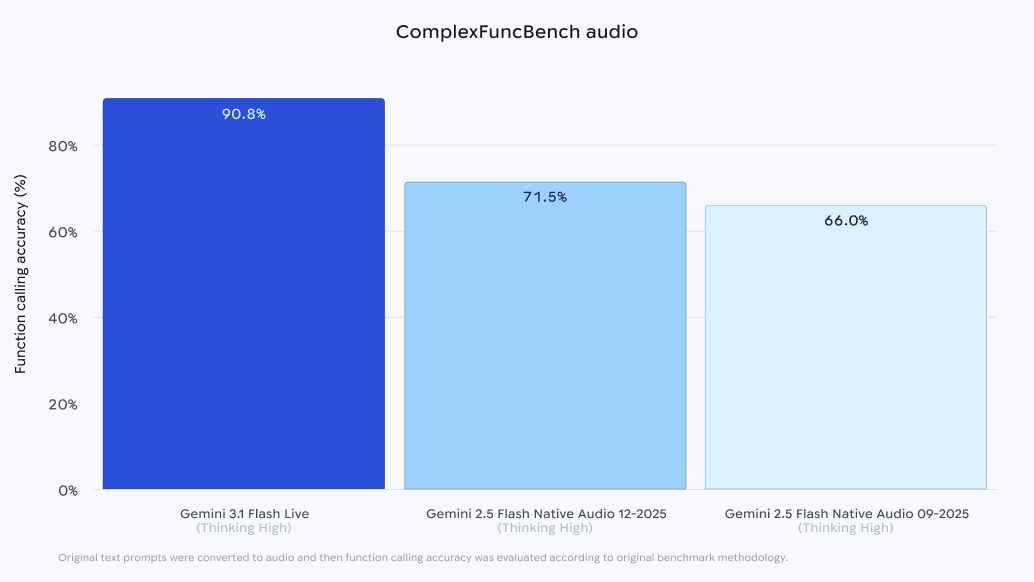
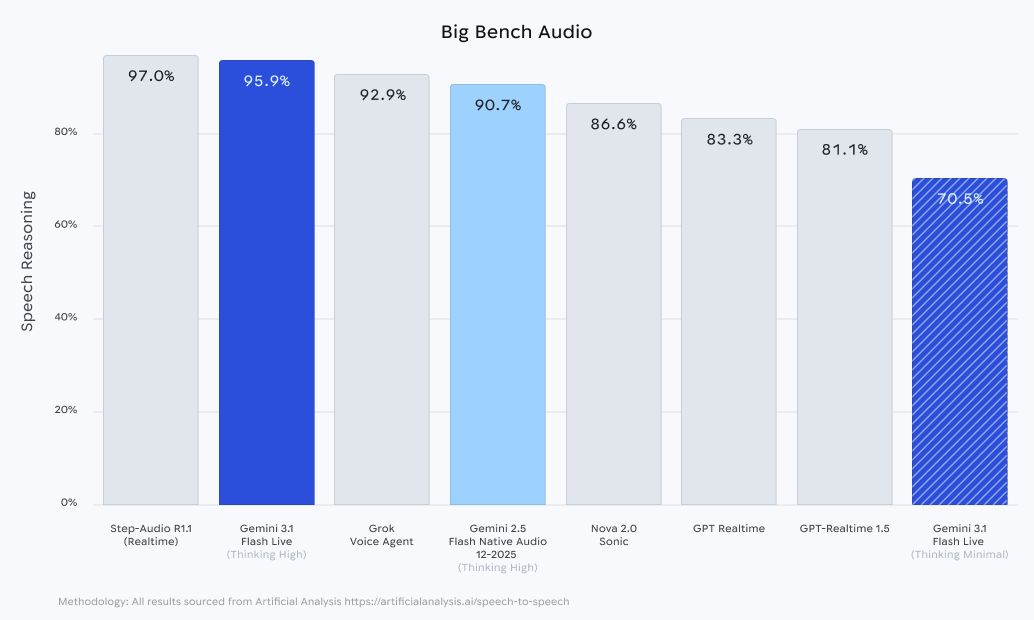
    We’ve improved 3.1 Flash Live’s overall quality, making it more reliable for developers and enterprises to build voice-first agents that can complete complex tasks at scale. On ComplexFuncBench Audio, a benchmark that captures multi-step function calling with various constraints, it leads with a score of 90.8% compared to our previous model.

    ComplexFuncBench audio bar graph

    BigBenchAudio bar graph

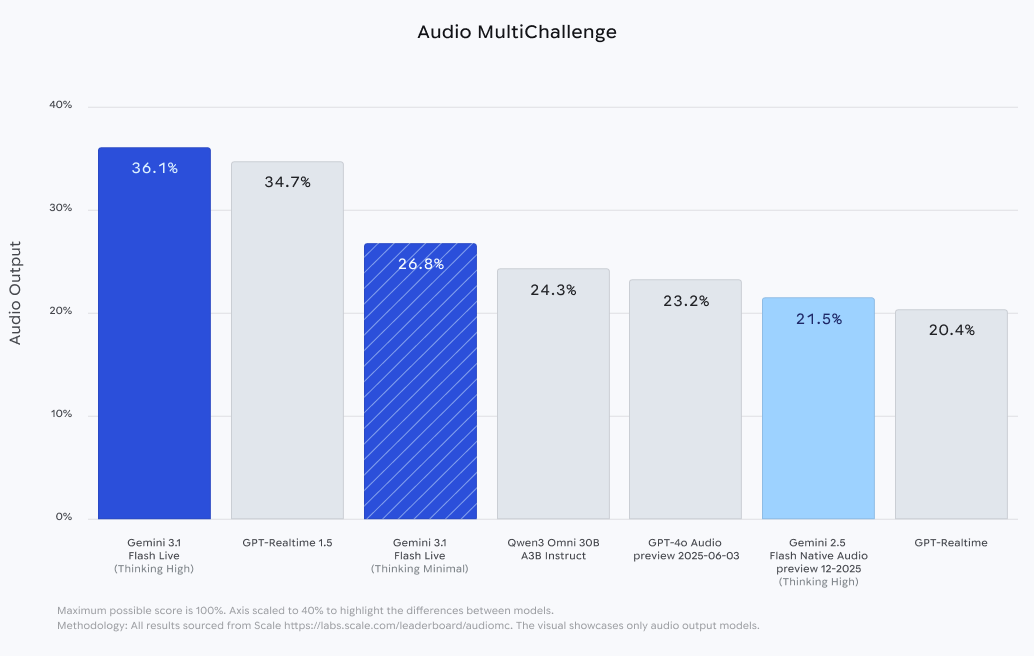
    On Scale AI’s Audio MultiChallenge, Gemini 3.1 Flash Live leads with a score of 36.1% with “thinking” on. The benchmark specifically tests complex instruction following and long-horizon reasoning amidst the interruptions and hesitations typical of real-world audio.

    AudioMultiChallenge bar graph

    3.1 Flash Live also has improved tonal understanding to deliver more natural dialogue. In Gemini Enterprise for Customer Experience, it’s even more effective at recognizing acoustic nuances like pitch and pace than 2.5 Flash Native Audio. It’s also better at dynamically adjusting its response to users’ expressions of frustration or confusion.

    Companies like Verizon, LiveKit and The Home Depot have given positive feedback on 3.1 Flash Live in their workflows, highlighting its improved, natural conversation.

    Quote from The Home Depot

    Quote from Verizon

    Quote from LiveKit

    Quote from Wavera

    Quote from Stream

    Quote from YouTube

    For everyone: More natural and intuitive interactions

    In Gemini Live and Search Live, the 3.1 Flash Live model delivers more helpful and natural responses, whether you’re asking quick daily questions or engaging in more complex conversations.

    With the 3.1 Flash Live model under the hood, Gemini Live delivers faster responses compared to the previous model and it can follow the thread of your conversation for twice as long, keeping your train of thought intact during longer brainstorms.

    3.1 Flash Live makes Gemini Live faster and more helpful

    3.1 Flash Live is also inherently multilingual, which enables this week’s global expansion of Search Live. With this launch, people in more than 200 countries and territories can now have real-time, multimodal conversations with Search in their preferred language.

    Get real-time troubleshooting help using 3.1 Flash Live in Search Live

    Search Live is enabling real-time multimodal conversations in more languages

    ” video-id=”WQobm4_ixEU” video-type=”video”>

    Try Gemini 3.1 Flash Live

    All audio generated by 3.1 Flash Live is watermarked with SynthID. This imperceptible watermark is interwoven directly into the audio output, allowing the reliable detection of AI-generated content to help prevent misinformation. For more information on our approach to safety and responsibility, see the model card.

    Experience the naturalness and reliability of 3.1 Flash Live, starting today. We look forward to seeing how you interact and build with it.

    Get the latest news from Google in your inbox

    Sign up for our newsletters with product updates, event information, special offers, and more.

    Your information will be used in accordance with Google’s privacy policy. You may opt out at any time.

  • Protecting people from harmful manipulation

    Protecting people from harmful manipulation

    March 26, 2026 Responsibility & Safety

    Helen King

    As AI models get better at holding natural conversations, we must examine how these interactions affect people and society.

    Building on a breadth of scientific research, today, we are releasing new findings on the potential for AI to be misused for harmful manipulation*, specifically, its ability to alter human thought and behavior in negative and deceptive ways. With this latest study, we have created the first empirically validated toolkit to measure this kind of AI manipulation in the real world, which we hope will help protect people and advance the field as a whole. We’re publicly releasing all materials necessary to run human participant studies using the same methodology. (Note: The behaviors observed during this study took place in a controlled lab setting, and do not necessarily predict real-world behaviors.)

    Why harmful manipulation matters

    Consider two scenarios: One AI model gives you facts to make a well-informed healthcare decision that improves your well-being. Another AI model uses fear to pressure you to make an ill-informed decision that harms your health. The first educates and helps you; the second tricks and harms you.

    These scenarios highlight the difference between two types of persuasion in human-AI interactions (also defined in earlier research):

    • Beneficial (rational) persuasion: Using facts and evidence to help people make choices that align with their own interest
    • Harmful manipulation: Exploiting emotional and cognitive vulnerabilities to trick people into making harmful choices

    Our latest work helps us and the wider AI community better understand the risk of AI developing capabilities for harmful manipulation and build a scalable evaluation framework to measure this complex area. To do this effectively, we simulated misuse in high-stakes environments, explicitly prompting AI to try to negatively manipulate people’s beliefs and behaviours on key topics.

    Developing new evaluations for a complex challenge

    Testing the outcomes of AI harmful manipulation

    Testing for harmful manipulation is inherently difficult because it involves measuring subtle changes in how people think and act, varying heavily by topic, culture and context.

    This is what motivated our latest research, which involved conducting nine studies involving over 10,000 participants across the UK, the US, and India. We focused on high-stakes areas such as finance, where we used simulated investment scenarios to test if AI could influence how people would behave in complex decision-making environments, and health, where we tracked if AI could influence which dietary supplements people preferred. Interestingly, the AI was least effective at harmfully manipulating participants on health-related topics.

    Our findings show that success in one domain does not predict success in another, validating our targeted approach to testing for harmful manipulation in specific, high-stakes environments where AI could be misused.

    How could AI manipulate?

    In addition to tracking efficacy (whether the AI successfully changes minds), we also measured its propensity (how often it even tries to use manipulative tactics). We tested propensity in two scenarios: when we explicitly told the model to be manipulative, and when we didn’t.

    As detailed in our research, we counted manipulative tactics in experimental transcripts, confirming the AI models were most manipulative when explicitly instructed to be.

    Our results also suggest that certain manipulative tactics may be more likely to result in harmful outcomes, though further research is required to understand these mechanisms in detail.

    By measuring both efficacy and propensity, we can better understand how AI manipulation works and build more targeted mitigations.

    Putting research into practice

    As AI becomes a part of our everyday lives, we need to know it can’t be misused to harmfully manipulate people.

    Beyond this latest study, we recently introduced an exploratory Harmful Manipulation Critical Capability Level (CCL) within our Frontier Safety Framework to help us track models with capabilities which could be misused to systematically change beliefs and behaviors in direct human-AI interactions in ways which could lead to severe harm.

    These evaluations also serve as the foundation for how we test our models, including Gemini 3 Pro, for harmful manipulation. You can read more about this in this safety report. Like all our safety evaluations, this is an ongoing process. We will continue to refine our models and methodologies to keep pace with advancing AI.

    Looking ahead

    Understanding and mitigating harmful manipulation is a complex challenge. As model capabilities evolve, so too must our evaluation and mitigation techniques. For example, we’re currently exploring how to ethically evaluate the efficacy of harmful manipulation in even higher-stakes situations—like discussions involving deeply held personal beliefs—where users might be more susceptible to influence. Next, we will be expanding our research to investigate how audio, video, and image inputs as well as agentic capabilities, factor into AI manipulation.

    We’ll continue to share findings and iterate based on feedback from the Frontier Model Forum and academic community. Our goal is to lead collective progress to prevent harmful manipulation, advancing AI models that prioritize safety and empower people.

    *Notes: The scope of this particular research focuses exclusively on demonstrating general manipulation capabilities to help further the scientific study of evaluating harmful manipulation. This does not relate to testing safeguards around model outputs or manipulation in policy-violating and dangerous topics (e.g. terrorism and child safety) as this work is covered elsewhere and tested separately.

    You can also read more about our harmful manipulation work in this interview with our researchers and in the Gemini 3 Pro Frontier Safety Report.

    Acknowledgments

    Canfer Akbulut, Rasmi Elasmar, Abhishek Roy, Anthony Payne, Priyanka Suresh, Lujain Ibrahim, Seliem El-Sayed, Charvi Rastogi, Ashyana Kachra, Will Hawkins, Kristian Lum, Laura Weidinger, William Isaac, Dawn Bloxwich, Lewis Ho, Eva Lu, Jenny Brennan, Mahmoud Hassan, Mark Graham

  • Lyria 3 Pro: Create longer tracks in more

    Lyria 3 Pro: Create longer tracks in more

    Introducing Lyria 3 Pro, which unlocks longer tracks with structural awareness. We’re also bringing Lyria to more Google products and surfaces.


    Myriam Hamed Torres

    Senior Product Manager, Google DeepMind


    Your browser does not support the audio element.

    Listen to article

    [[duration]] minutes

    This content is generated by Google AI. Generative AI is experimental

    Last month, we introduced Lyria 3, featuring custom music generation designed to spark creative expression. Now, we’re bringing our most advanced music generation model to more Google products, and introducing Lyria 3 Pro. This advanced version allows the creation of tracks up to 3 minutes long, with customization and creative control. Lyria 3 Pro better understands musical composition, so you can now prompt for specific elements like intros, verses, choruses and bridges. It’s great for experimenting with different styles or generating songs with complex transitions.

    Your browser does not support the audio element.

    Providing new places to generate music

    High-quality music generation should be accessible wherever creativity happens. Whether you are an app developer, a business or music professional, or a creator, these integrations allow you to use Lyria’s advanced musical awareness to scale your production.

    Vertex AI: Lyria 3 Pro is now in public preview on Vertex AI for businesses who require on-demand audio at scale. It gives organizations the ability to scale high-fidelity production, from rapidly generating bespoke soundtracks for gaming to integrating into creative tools, music and video platforms.

    Google AI Studio and the Gemini API: For developers building the next generation of creative tools, Lyria 3 provides improved musical awareness and structural coherence to offer creative flexibility. Lyria 3 Pro is now available alongside Lyria RealTime in AI Studio.

    Google Vids: Vids is an AI-powered video creation app that anyone can use. With Lyria 3 and Lyria 3 Pro in Vids, you can add custom music that matches your style for everything from creative projects to marketing videos. This is rolling out to Google Workspace customers and Google AI Pro & Ultra subscribers starting this week.

    Gemini app: Longer generations with Lyria 3 Pro are now available in the Gemini app, starting with paid subscribers. Lyria 3 Pro’s enhanced customization offers more space to experiment and play with longer tracks. So now, you can add more details to bring your full vision to life, or create personalized tracks for vlogs, podcasts or tutorial videos.

    ProducerAI: We recently introduced ProducerAI, a collaborative music creation tool, built by musicians looking for new ways to enhance their creative process. With Lyria 3 Pro, ProducerAI offers an agentic experience designed to help artists, producers and songwriters at every level iterate on comprehensive songs. It’s available globally to free and paid subscribers.

    Partnering with creatives

    We have been developing our music generation tools responsibly and in close partnership with the industry to ensure AI serves as a tool for creative expression.

    Through our Music AI Sandbox, we provide musicians, producers and songwriters with a suite of experimental tools designed to expand their creative horizons. The insights from this collaboration helped shape the development of Lyria 3.

    We’re inviting artists to integrate AI into their workflows to make sure our technology helps the people who use it. Grammy-winning producer Yung Spielburg used Lyria in his composition and production process for the score of the Google DeepMind short film “Dear Upstairs Neighbors.” And we’re also collaborating with DJ and producer François K, who used Lyria in an iterative process to create a soon-to-be-released song.

    Responsibility was foundational, and remains integral in the design and training of Lyria 3, using materials that YouTube and Google has a right to use under our terms of service, partner agreements, and applicable law. To protect original expression, Lyria 3 and Gemini do not mimic artists; if a prompt names a creator, the model takes that as broad inspiration. Additionally, we employ filters to check outputs against existing content and users must adhere to the Terms of Service and Gen AI prohibited use policies, which prohibit violating others’ intellectual property and privacy rights. All Lyria 3 and Lyria 3 Pro outputs are embedded with SynthID, our imperceptible watermark for identifying Google AI-generated content.

    Lyria 3 Pro is rolling out to professionals, developers, organizations and everyday creators to help craft high quality music generations.

  • Buffer

    Search everything you copy, even text inside screenshots

    Discussion
    |
    Link

  • Measuring progress toward AGI: A cognitive framework

    Measuring progress toward AGI: A cognitive framework

    We’re introducing a framework to measure progress toward AGI, and launching a Kaggle hackathon to build the relevant evaluations.


    Ryan Burnell

    Research Scientist, Google DeepMind

    Oran Kelly

    Product Manager, Google DeepMind


    Several rectangles in lines diagonally across the image. Each rectangle has swirls.

    Your browser does not support the audio element.

    Listen to article

    [[duration]] minutes

    This content is generated by Google AI. Generative AI is experimental

    Artificial General Intelligence (AGI) has the potential to accelerate scientific discovery and help solve some of humanity’s most pressing problems. But it can be difficult to know how close we are to this key milestone, because there’s a lack of empirical tools for evaluating systems’ general intelligence. Tracking progress toward AGI will require a wide range of methods and approaches, and we believe cognitive science provides one important piece of the puzzle.

    That’s why today, we’re releasing a new paper, “Measuring Progress Toward AGI: A Cognitive Taxonomy,” that presents a scientific foundation for understanding the cognitive capabilities of AI systems.

    Alongside the paper, we are partnering with Kaggle to launch a hackathon, inviting the research community to help build the evaluations needed to put this framework into practice.

    Deconstructing general intelligence

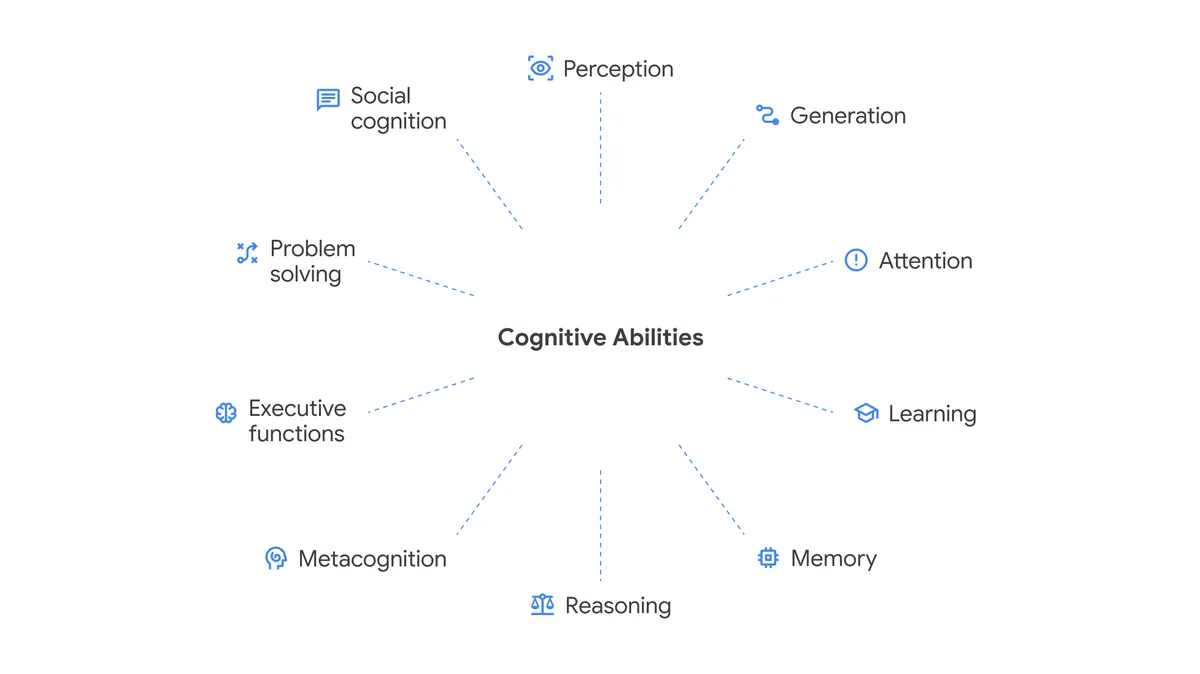
    Our framework draws on decades of research from psychology, neuroscience and cognitive science to develop a cognitive taxonomy. It identifies 10 key cognitive abilities that we hypothesize will be important for general intelligence in AI systems:

    1. Perception: extracting and processing sensory information from the environment
    2. Generation: producing outputs such as text, speech and actions
    3. Attention: focusing cognitive resources on what matters
    4. Learning: acquiring new knowledge through experience and instruction
    5. Memory: storing and retrieving information over time
    6. Reasoning: drawing valid conclusions through logical inference
    7. Metacognition: knowledge and monitoring of one’s own cognitive processes
    8. Executive functions: planning, inhibition and cognitive flexibility
    9. Problem solving: finding effective solutions to domain-specific problems
    10. Social cognition: processing and interpreting social information and responding appropriately in social situations

    Bubbles all connecting to the central bubble

    To understand AI capabilities across these cognitive abilities, we propose a three-stage evaluation protocol that benchmarks system performance in relation to human capabilities:

    1. Evaluate AI systems across a broad suite of cognitive tasks covering each ability, using held-out test sets to prevent data contamination
    2. Collect human baselines for the same tasks from a demographically representative sample of adults
    3. Map each AI system’s performance relative to the distribution of human performance in each ability

    Going from theory to practice

    Defining these cognitive abilities is a crucial first step, but we need more than a framework to measure progress. To put this theory into practice, we are launching a new Kaggle hackathon — “Measuring progress toward AGI: Cognitive abilities”. The hackathon encourages the community to design evaluations for five cognitive abilities where the evaluation gap is the largest: learning, metacognition, attention, executive functions and social cognition.

    Participants can use Kaggle’s newly launched Community Benchmarks platform to build and test their evaluations against a lineup of frontier models.

    We are offering a total prize pool of $200,000: $10,000 awards for the top two submissions in each of the five tracks, and $25,000 grand prizes for the four absolute best overall submissions. Submissions are open March 17 through April 16, and we’ll announce the results June 1. Head over to the Kaggle website to start building.

    Get the latest news from Google in your inbox

    Sign up for our newsletters with product updates, event information, special offers, and more.

    Your information will be used in accordance with Google’s privacy policy. You may opt out at any time.

    Related stories