Author: admin

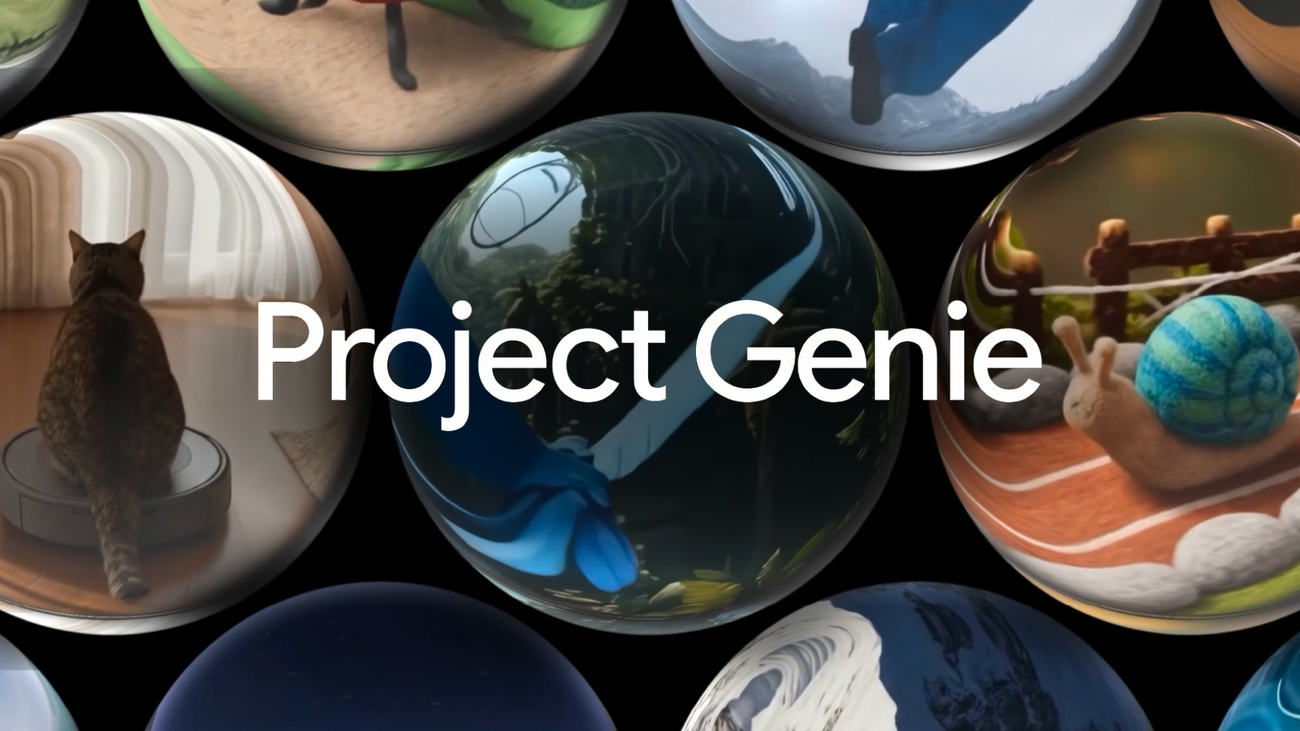
  • Simulate real-world places with Project Genie and Street View

    Simulate real-world places with Project Genie and Street View

    We’re expanding access to Google AI Ultra subscribers globally and introducing a new capability powered by Street View.


    Diego Rivas

    Group Product Manager, Google DeepMind

    Jonathan Herbert

    Principal Product Manager, Maps

    Nicole Segaran

    Associate Product Manager, Google Labs


    Your browser does not support the audio element.

    Listen to article

    [[duration]] minutes

    This content is generated by Google AI. Generative AI is experimental

    Genie is our general-purpose world model capable of generating diverse, interactive environments. Since launching, Genie has become a foundational tool for research, enabling agents to learn and reason in complex virtual settings and even helping Waymo simulate hyper-realistic road environments.

    Now, we’re taking a leap forward by connecting Genie’s generative power with the real-world imagery of Google Street View, allowing our models to anchor themselves in reality. This expansion of Genie’s capabilities can provide a virtual environment for AI agents or robots to navigate and interact with the complexities of the real world.

    Today, we’re launching this new Street View grounding capability within Project Genie, our experimental prototype. With this upgrade, you’ll be able to leverage real-world imagery to explore your favorite spots, or reimagine them with a creative twist. We’re also expanding access to Project Genie to more people around the globe.

    Select the “Ocean World” style to scuba dive with schools of fish around places grounded in the real world.

    Street View: ground your worlds in real places

    When creating imaginative worlds in Project Genie, you can now also base them on real places. Just tap the Maps pin to choose a place in the U.S. and optionally select a style for your world, like “Desert Sands” or “Stone Age.” Then, describe your character — like your favorite animal, comic book hero or even a claymation monster — and Genie will use this information to create an imaginative world with its starting location tied to Street View’s real-world imagery. This capability is powered by Maps Imagery Grounding, the same technology developers use to create stunning AI visuals with Street View.

    Want to see the Golden Gate Bridge under the sea? Select the “Ocean World” style to scuba dive with schools of fish around the bridge. Or, if you want to explore what the iconic Fort Worth Stockyards in Texas might have looked like in the 1920s, select the “B&W film” style to see a world with saloons, vintage cars and trading posts.

    Street View imagery in Project Genie is available now for places in the U.S. with plans to expand to more places over time.

    Project Genie: now available with Google AI Ultra

    Starting today, Project Genie — including the new Street View capability — is gradually rolling out to all eligible Google AI Ultra $200 subscribers globally (18+). Try creating today with Project Genie.

    Project Genie is still an experimental research prototype in Google Labs, so we’re working behind the scenes to make the details even sharper and more accurate. You can read more about our progress and current limitations on our website.

    Collection

    I/O 2026

    Here’s a look at everything we announced at Google I/O 2026.
    See more

    The image shows a colorful abstract design with the Google I/O 2026 logo.

    Get the latest news from Google in your inbox

    Sign up for our newsletters with product updates, event information, special offers, and more.

    Your information will be used in accordance with Google’s privacy policy. You may opt out at any time.
  • Introducing Gemini Omni

    Introducing Gemini Omni

    Gemini Omni Flash is a model that can create anything from any input – starting with video.


    Last year, Nano Banana brought Gemini’s intelligence to image generation and editing. Since then, it’s helped millions of people restore old photos, design from sketches and visualize ideas in ways that weren’t possible before. From the start we built Gemini to be natively multimodal from the ground up, and now we’re taking the next step.

    We’re introducing Gemini Omni, where Gemini’s ability to reason meets the ability to create. Omni is our new model that can create anything from any input — starting with video. With Omni, you can combine images, audio, video and text as input and generate high-quality videos grounded in Gemini’s real-world knowledge. You can also easily edit your videos through conversation.

    Today, we’re rolling out the first model in the Omni family: Gemini Omni Flash, to the Gemini app, Google Flow and YouTube Shorts. In time we will support output modalities like image and audio. Here’s some of what makes Omni special:

    Edit your videos through conversation

    Gemini Omni gives you an easier way to edit video — with natural language. Every instruction builds on the last. Your characters stay consistent, the physics hold up and the scene remembers what came before.

    Transform the world around you. Change specific things, or change everything. Your video becomes the starting point for something you never could have filmed yourself.

    Prompt: Make the sculpture out of bubbles.

    Reimagine the action. Take a video you shot and just ask Omni to change what’s happening. Edit the action, add in new characters or objects, or transform a moment into something unexpected.

    Refine your videos across multiple turns. Change the environment, angle, style or even specific details, without ever losing the thread of your original scene. Scroll through the carousel to see how edits build on each other.

    Bring ideas to life, grounded in Gemini’s world knowledge

    Gemini Omni doesn’t just build scenes that look real, it reasons about what should happen next. It combines an intuitive understanding of physics with Gemini’s knowledge of history, science and cultural context, bridging the gap from photorealism to meaningful storytelling.

    Create visuals with more accurate physics. Omni has an improved intuitive understanding of forces like gravity, kinetic energy and fluid dynamics, allowing you to create more realistic scenes.

    Prompt: A marble rolling fast on a chain reaction style track, continuous smooth shot.

    Blend knowledge and creativity. Omni draws on Gemini’s knowledge to connect language, imagery and meaning in ways that go far beyond pattern matching.

    Prompt: The video shows items of the alphabet. An unusual item starting with each letter is shown sitting on a table (like a Capybara for C, disco globe for D and Lava Lamp for L). All 26 letters must be represented by 26 items with matching lower thirds displaying the letter. Only one item and lower third at a time. Each lower third must look like a black marker written on a slip of paper in the bottom left. Rapid fire, roughly 9 frames per item at 24FPS. Last frame is a slip of paper “THE END”. The whole video is accompanied by calm smooth music.

    Complex ideas made visual. Omni can create compelling explainers from short prompts, generating visuals that break down more complex ideas.

    Prompt: claymation explainer of protein folding, everything is made out of clay, no hands, stop motion, accurate

    Create videos from any combination of inputs

    Reference anything. Omni turns any reference — image, text, video or audio — into a single, cohesive output. While only voice references will be supported for audio to start, we’ll roll out other types of audio inputs soon.

    Start from what you have. With input references, you can use images of characters, scenes or drawings to create in a way that matches your vision.

    Apply styles, motion or effects. Define the visual language by using input references, or just describe it with natural language. Omni blends the input references to create a cohesive clip.

    Create videos with your own digital avatar

    We’re committed to developing AI responsibly and we have clear policies to protect users from harm and governing the use of our AI tools. To start, you can create videos with your own voice by using Avatars, which create a digital version of yourself so you can generate videos that look and sound like you. Beyond the avatar feature, in terms of editing videos to change audio and speech, we are still working to test this and better understand how we can bring this capability to users responsibly.

    All videos created with Omni include our imperceptible SynthID digital watermark. You can easily verify that videos were generated with Gemini Omni through the Gemini app, Gemini in Chrome and Google Search. You can find out more about how we’re expanding our content transparency and verification tools to help you understand how content was created and edited across the web in our blog post.

    Try Gemini Omni now

    Today, we’re launching the first model in the Omni family — Gemini Omni Flash. Gemini Omni Flash is rolling out today to all Google AI Plus, Pro and Ultra subscribers globally through the Gemini app and Google Flow. It’s also rolling out at no cost to users on YouTube Shorts and YouTube Create App starting this week.

    In the coming weeks, we’ll also be rolling it out to developers and enterprise customers via APIs.

    Collection

    I/O 2026

    Here’s a look at everything we announced at Google I/O 2026.

    See more

    The image shows a colorful abstract design with the Google I/O 2026 logo.

    Get the latest news from Google in your inbox

    Sign up for our newsletters with product updates, event information, special offers, and more.

    Your information will be used in accordance with Google’s privacy policy. You may opt out at any time.
  • Gemini for Science: AI experiments and tools for a new era of discovery

    Gemini for Science: AI experiments and tools for a new era of discovery

    Explore the future of discovery with new Science Skills in Google Antigravity and three new experimental tools on Google Labs. These tools are designed to help accelerate core steps of the scientific method, built with Co-Scientist, AlphaEvolve, Empirical Research Assistance and NotebookLM.


    Person using a microscope with

    Your browser does not support the audio element.

    Listen to article

    [[duration]] minutes

    This content is generated by Google AI. Generative AI is experimental

    For centuries, the scientific method has been the greatest engine of human progress. At Google, our mission is deeply rooted in building tools to accelerate it. We believe that a new era of discovery won’t come from narrow, specialized models, but general agents that empower researchers across every scientific field.

    That’s why we are introducing Gemini for Science, a collection of science tools and experiments designed to expand the scale and precision of scientific exploration.

    A force multiplier for human ingenuity

    Today science faces a paradox: our collective knowledge is growing so fast that it’s becoming harder for individual scientists to see the full picture. Scientific breakthroughs often rely upon making creative connections between data, but the time required to do this manually can take weeks or even months. AI can help eliminate this bottleneck and serve as a force multiplier for scientific work by handling complex tasks. This allows researchers to focus on identifying and tackling the most impactful scientific problems and directions that would drive progress.

    Gemini for Science experimental tools on Google Labs include three primary prototypes designed to handle such tasks.

    1. Hypothesis Generation, built with Co-Scientist: Ideation is the heartbeat of science, but no human can synthesise the millions of papers published annually. Hypothesis Generation bridges this gap by simulating the scientific method: it collaborates with researchers to define a research challenge, then uses a multi-agent “idea tournament” to generate, debate and evaluate hypotheses. To ensure absolute rigor, claims are deeply verified and supported by clickable citations.
    2. Computational Discovery, built with AlphaEvolve and ERA (Empirical Research Assistance): Scientific progress is often limited by the number of hypotheses we can realistically test with computational experiments. Computational Discovery, an agentic research engine, is a prototype that solves this by generating and scoring thousands of code variations in parallel. This allows scientists to test novel modeling approaches — for complex fields like solar forecasting or epidemiology — that would take months to navigate manually.
    3. Literature Insights, built with Google NotebookLM: Understanding scientific literature is a core part of all research journeys. Literature Insights searches scientific literature and structures results into tables with custom, searchable attributes for side-by-side analysis. Researchers can use chat to uncover nuances grounded in their curated corpus, and create high-fidelity artifacts such as reports, slide decks, infographics and audio and video overviews. With the power of NotebookLM, Literature insights helps synthesize findings across papers, identify research gaps and uncover areas of opportunity.

    Starting today, we’ll begin gradually opening access to these experiments. Visit labs.google/science to register your interest.

    Beyond the individual experiments, we’re also bringing these advanced AI capabilities to enterprise organizations through Google Cloud. Our enterprise-grade solutions for scientific and industrial R&D are already being used by a range of partners in private preview to drive real-world impact. Companies like BASF are using AlphaEvolve to optimize their supply chains, and Klarna is leveraging it to enhance their machine learning models. In parallel, organizations like Daiichi Sankyo, Bayer Crop Science and the U.S. National Labs (as part of the U.S. Department of Energy’s Genesis Mission) are using Co-Scientist to accelerate their research and tackle fundamental scientific challenges. These enterprise-grade tools are demonstrating significant value in their current preview phase. We are excited about the breakthroughs our partners are unlocking and look forward to expanding access to more organizations in the coming months.

    Several validation papers have been already published based on these and other tools. The ERA and Co-Scientist research papers are published today in Nature.

    A scientific workbench on your desktop

    As part of Gemini for Science, we are also launching Science Skills, a specialized bundle that integrates insights from over 30 major life science databases and tools including UniProt, AlphaFold Database, AlphaGenome API and InterPro. Using these skills on agentic platforms like Google Antigravity allows researchers to perform complex and often manual workflows like structural bioinformatics and genomic analyses in minutes rather than hours.

    Our research teams using Science Skills have already seen this speedup in practice. In early testing, our team used Science Skills to perform a complex analysis that normally takes hours in minutes. This led to novel insights about potential mechanisms for a rare genetic disease caused by mutations in the AK2 gene.

    To learn more on how to use Science Skills in Google Antigravity visit antigravity.google/use-cases/science.

    A collaborative effort with the scientific community

    Our commitment to responsibly develop and deploy tools for science begins with the scientific ecosystem. We are collaborating with over 100 institutions — including Stanford University on liver fibrosis, Imperial College London on antimicrobial resistance and a multi-year effort with The Crick Institute — to validate our new systems and tools. To ensure the integrity of AI-generated insights, we’ve built a trusted tester community — ranging from PhD students to industry researchers to Nobel laureates — to stress test our systems against complex real-world challenges.

    In addition, we’ve also created dedicated pilots with leading scientific conferences like ICML, STOC and NeurIPS to develop pioneering tools for agentic peer review and scientific validation such as our experimental Paper Assistant Tool (PAT) and ScholarPeer.

    All of this work builds on a long history of AI advancements. Our specialized AI models are already accelerating progress: AlphaFold has helped over 3 million researchers tackle malaria vaccines and plastic-eating enzymes; and AlphaGenome is helping scientists identify the drivers of disease. These sit alongside everyday tools researchers rely on — from Google Scholar and Earth Engine to Colab, MedGemma, Earth AI and Gemini Deep Research. With our latest Gemini Deep Think release, we continue to improve our core model capabilities on complex scientific tasks. Together, these tools have already become essential parts of the scientific ecosystem, helping researchers organize information and perform complex data analysis at scale.

    As we explore the future of agentic research together, we continue to work towards a future where AI accelerates scientific progress and helps solve our most pressing societal challenges.

    Collection

    I/O 2026

    Here’s a look at everything we announced at Google I/O 2026.

    See more

    The image shows a colorful abstract design with the Google I/O 2026 logo.

    Get the latest news from Google in your inbox

    Sign up for our newsletters with product updates, event information, special offers, and more.

    Your information will be used in accordance with Google’s privacy policy. You may opt out at any time.
  • Making it easier to understand how content was created and edited

    Making it easier to understand how content was created and edited

    We’re expanding our tools to help you understand how content was created and edited across the web.


    A chat input box mockup featuring an uploaded thumbnail of dog-themed latte art, the text

    As generative media becomes more advanced and accessible, it’s helpful to know where content comes from, and whether it’s been altered. Today, we’re expanding our content transparency and verification tools in Search, Gemini, Chrome, Pixel and Cloud, and deepening our partnership with the broader industry.

    Scaling our technology

    Three years ago, we introduced SynthID, our industry-leading digital watermarking technology that embeds imperceptible signals into AI-generated content. Since then, we’ve integrated SynthID into our generative media models and products, watermarking over 100 billion images and videos and 60,000 years of audio.

    Across a growing number of our generative media tools, we use C2PA Content Credentials, the industry standard that shows how media was created and modified, with or without AI. Pixel 10 was the first smartphone to provide Content Credentials for images in its native camera app, and we are expanding this technology to include video on Pixel 8, 9 and 10 phones in the coming weeks.

    By using this technology at the point of capture, Pixel documents when content has been captured by a camera. In an era of generative media, we believe that identifying authentic, unedited content can be just as important as knowing when a file was made or edited using AI.

    Providing more ways to verify content

    Our goal is to make it easier to learn more about the content you encounter online. That’s why we recently added SynthID verification for image, video and audio to the Gemini app. Already, it’s been used 50 million times globally, and we’re expanding this verification capability to Search today and Chrome over the coming weeks.

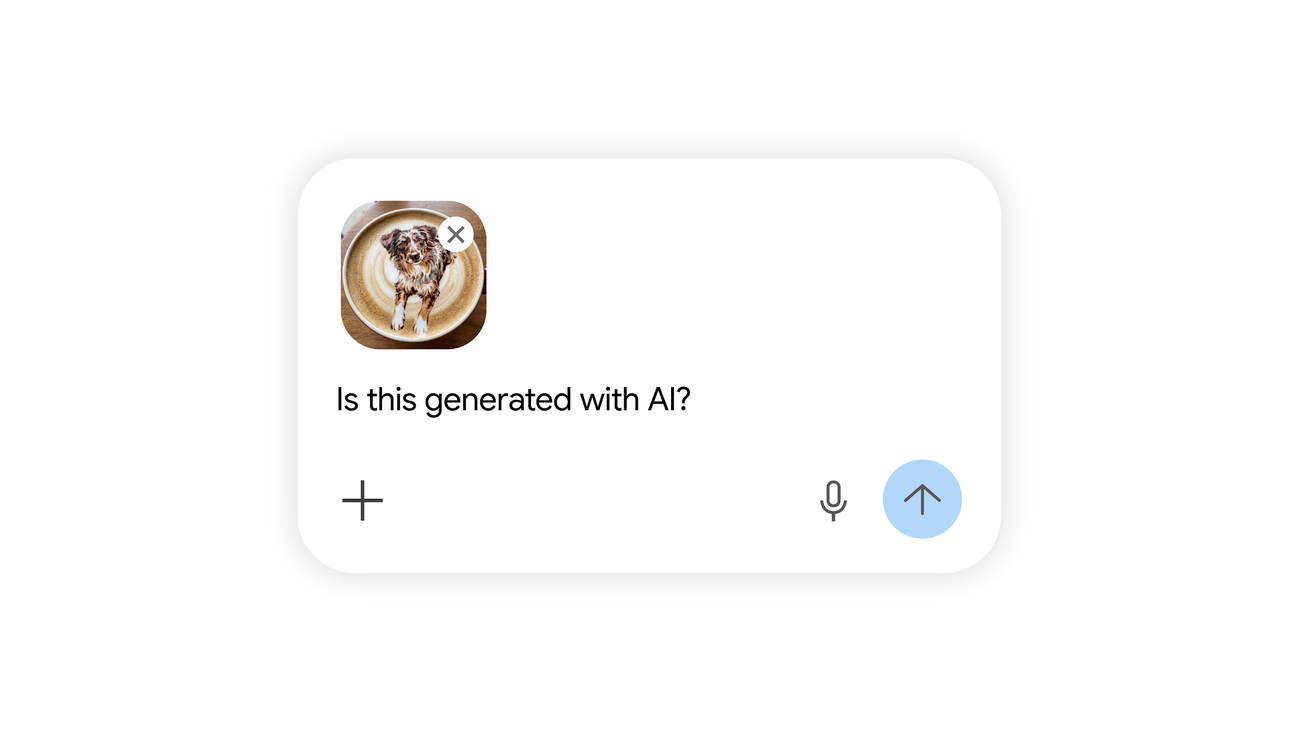
    You can learn about an image’s origin by using Search features like Lens, AI Mode and Circle to Search, as well as Gemini in Chrome. Just ask, “Is this made with AI?” or “Is this AI generated?”

    We’re also adding verification for C2PA Content Credentials, to easily check if content is an unaltered original from a camera or if it has been modified, and by what tools. This feature is rolling out in the Gemini app starting today, and it will come to Search and Chrome in the coming months. This builds on features like the labels on YouTube that identify AI-generated content and our work with trusted testers on Backstory to make detection tools faster and more reliable.

    Partnering across the industry

    Because digital media travels across many platforms, industry-wide partnership and adoption of robust, interoperable tools is essential. More content across the web will soon carry these imperceptible watermarks, as companies like OpenAI, Kakao and ElevenLabs are bringing SynthID technology to more of their AI-generated content. This builds on our ongoing work to make content origins clearer, like open-sourcing our SynthID text watermarking technology and partnering with NVIDIA to watermark AI-generated video from their Cosmos world foundation models.

    To help more organizations identify AI-generated media, we’re launching a new AI Content Detection API on Google Cloud’s Gemini Enterprise Agent Platform. This gives businesses a powerful way to spot AI content made by both Google and other popular models, helping them decide how to evaluate and manage media across their own platforms — whether that’s for backend operations like sorting feeds and preventing insurance fraud, or for user-facing content like fact-checking and labeling synthetic media. We’re launching with a group of trusted partners and will continue to refine the API based on their feedback.

    We also continue to advocate for global standards for provenance technology as a member of the C2PA steering committee. This ensures that transparency tools built into our devices work seamlessly across the platforms you use every day. For example, Meta — a fellow C2PA Steering Committee member — will start labeling camera-captured media with Content Credentials on Instagram. This means authentic photos and videos shot natively on Pixel phones will soon be recognized and labeled as such when you share them on Instagram.

    Quote from Attestiv

    Shutterstock quote

    Snap quote

    Fox Sports quote

    Nectar Social quote

    Canva quote

    Avid quote

    We’ve long invested in providing helpful context about the information you find online. Content transparency is a complex challenge, but we’ll keep developing ways to push the technology forward and set a high bar for the industry. Our goal is to empower you with the tools needed to determine the history of any content you encounter.

    Collection

    I/O 2026

    Here’s a look at everything we announced at Google I/O 2026.

    See more

    The image shows a colorful abstract design with the Google I/O 2026 logo.

    Get the latest news from Google in your inbox

    Sign up for our newsletters with product updates, event information, special offers, and more.

    Your information will be used in accordance with Google’s privacy policy. You may opt out at any time.

    About the authors

    Laurie Richardson

    Laurie Richardson

    Vice President, Trust and Safety, Google

    Laurie Richardson is VP for Trust & Safety at Google. In this role, she leads the global team responsible for protecting our users and platforms from abuse by developing the policies and technology that keep Google products safe and reliable.

    Read less

    Pushmeet Kohli

    Pushmeet Kohli

    Chief Scientist, Google Cloud and Vice President, Google DeepMind

  • Strengthening Singapore’s AI Future: A New National Partnership

    Strengthening Singapore’s AI Future: A New National Partnership

    May 20, 2026 Responsibility & Safety

    Google DeepMind

    Partnering to apply frontier AI to advance health and life sciences, reimagine classrooms and support the workforce of the future.

    At Google DeepMind, we believe frontier AI can be a powerful force for good. Last year, we opened a new research lab in Singapore to expand the impact of our work across the Asia-Pacific region. Today, we are taking a major step forward. As part of our National Partnerships for AI initiative, we are launching new programmes in the country, while driving a key pillar of Google’s new National AI partnership with the Singapore Government.

    Through our work with multiple organisations, we are partnering to support public sector transformation, foster business growth and empower workers to thrive in an AI-first world. The partnership focuses on addressing real-world challenges—including improving healthcare, accelerating scientific discovery and reimagining education—to ensure these technological breakthroughs translate into meaningful progress across Singapore’s diverse communities. Together, we are strengthening Singapore’s National AI Strategy to responsibly deploy AI at scale for economic growth and public benefit. Ultimately, by accelerating science and innovation, AI could create an additional S$ 3.3 billion (US$2.5 billion) in economic value through faster R&D by 2040.

    Addressing complex societal challenges

    At the heart of this partnership is a shared commitment to accelerating local research and development that turns frontier AI potential into real, inclusive progress. Our team on the ground in Singapore is working alongside local experts to apply frontier AI responsibly to areas where it can have the most meaningful impact for and with the community, starting with healthcare and life sciences.

    • Augmenting care with AI co-clinician: We are exploring a collaboration with public health clusters as part of our global AI co-clinician research initiative. This work explores how AI can augment and support a doctor’s expertise to deliver higher quality care. It also looks into the evolution of healthcare to “triadic care,” where AI agents support patients throughout their care journeys under the clinical authority of their physician, with systems providing information sourced from clinical guidelines and scientific literature.
    • Advancing pandemic preparedness: With Google.org, we will support initiatives that advance infectious disease research and pandemic preparedness. Using frontier AI like AlphaFold and Google Earth and other latest AI for Science tools, we are working to accelerate our understanding of outbreaks across Southeast Asia. This is part of Google.org’s $7 million funding contribution to the Philanthropy Asia Alliance’s Health for Human Potential coalition.
    • Innovating for inclusivity: We are developing a Gemma-powered running assistant designed for blind and low vision athletes. By using spatial reasoning that provides real-time environmental understanding, this tool helps the athletes run independently without physical lines or human guides. We are partnering with SG Enable—Singapore’s focal agency for disability and inclusion—to test and iterate the product so it meets the real-world needs of vision-impaired runners.
    • Accelerating scientific discovery: We are partnering with the National Research Foundation to train local researchers on agentic AI for science tools like Hypothesis Generation built with Co-Scientist, which are already showing promise in a range of biomedical applications. We will also host workshops to help Singapore’s local scientific community use these frontier tools to unlock new breakthroughs.

    Enhancing education and building a future-ready workforce

    As we navigate the transition to an AI-driven economy, our goal is to ensure that communities across Singapore have the opportunity to thrive. We are partnering with the ecosystem to co-design programs that empower educators and learners to navigate new technologies responsibly.

    We have provided Gemini for Education to all educators from primary schools to junior colleges and will provide training on these pedagogically grounded AI tools. This will help teachers plan lessons, and tailor course material, freeing up precious time to focus on what matters: teaching. We will continue to collaborate with the Ministry of Education to strengthen its AI capabilities across teaching and learning, including educator training and upskilling programmes.

    Driving innovations for sustainability

    Building a truly prosperous future requires a responsible and collaborative approach to global sustainability. We are launching the ‘Google DeepMind Accelerator: AI for the Planet’ in the Asia-Pacific region to partner with the next generation of climate visionaries. This program is designed to support startups, research teams and nonprofits using frontier AI to unlock new approaches to complex environmental challenges in areas like energy, water, agriculture and more. Selected organizations will receive expert mentorship, tailored support and help integrate frontier AI into their work, helping turn visionary ideas into meaningful progress.

    Pioneering responsible AI together

    To ensure that innovation serves as a true force for good, we believe it must be grounded in a shared foundation of responsibility. Google DeepMind is collaborating with the Infocomm Media Development Authority (IMDA) and MLCommons to research multimodal and multilingual safety benchmarks. This collaboration is focused on supporting the safe and responsible deployment of AI that respects the nuance of local languages and cultures, helping to ensure that the digital future we build is one that is designed for and with everyone.

    Shaping a prosperous future for all

    This partnership is a significant milestone in our journey with Singapore. By combining frontier research with local expertise, we can address complex societal challenges together and create new opportunities for growth.

    We look forward to working with researchers, doctors, educators and students to help ensure AI serves the diverse needs of communities across Singapore.

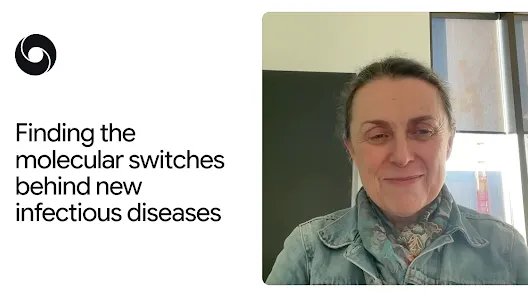
  • Finding the molecular switches behind new infectious diseases

    Finding the molecular switches behind new infectious diseases

    The majority of emerging infectious diseases are caused by pathogens that jump from animals to humans, such as Ebola, HIV, flu and Covid-19. Professor Clare Bryant at the University of Cambridge is using Co-Scientist to hunt for the molecular switches that cause severe diseases, like sepsis, in humans when pathogens leap between species, and find new approaches to prevent this happening.

    Testing Co-Scientist, Bryant fed it a summary of one of her grant proposals studying flu in birds and humans outlining her lab’s research questions. The tool generated and ranked a set of promising hypotheses — some she’d already considered, some she hadn’t. The unfamiliar ones were the most thought-provoking.

    When the grant was funded, Bryant fed in the full, detailed proposal. Later, reading through the output on a train to Brussels, she had an “a-ha!” moment: Co-Scientist had prioritised a protein that hadn’t been on her radar, connected to several signalling pathways she was already interested in. She spent the rest of the week itching to give it more data.

    Back at her lab, she added unpublished material, kept confidential within Co-Scientist. With each back-and-forth, the hypotheses sharpened, moving from candidate proteins down to the specific amino acids her lab could focus its experiments on.

    Bryant’s team is now building cell lines containing the amino acid mutations to test the refined hypotheses. To get to the point of identifying precise amino acids would normally have taken two to three years of experimental work. But her lab is now on track to complete it in six months, she says, if the work with Co-Scientist has led them to the right targets.

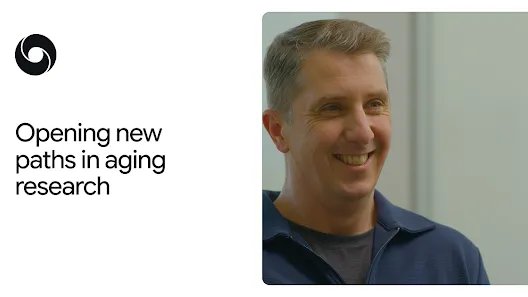
  • Opening new paths in aging research

    Opening new paths in aging research

    Few problems in medicine are more complex or consequential than aging. Its overlapping biological processes often determine how long people can live in good health. At Calico Life Sciences, head of AI/ML Matt Onsum and principal scientist Katherine Labbé are using Co‑Scientist to help connect scattered findings across the biology of aging and turn them into hypotheses worth testing.

    That is no small task, because the biology literature is full of mixed-quality findings, dead ends, and results that do not replicate. Onsum says Co-Scientist impressed Calico’s experts with its scientific discernment, helping cut through that noise to help them identify new ideas genuinely worth exploring.

    One example came from Calico’s work on the integrated stress response (ISR), a protective cellular mechanism that can also contribute to disease when persistently turned on. The Calico team used Co-Scientist to generate a novel yet plausible hypothesis about how the ISR is regulated by metabolism, which is known to change with age and in various diseases. Researchers also interacted with Co-Scientist to refine the experimental design to test the hypothesis and feed in new information as results emerged. The experiments led to new findings that have important implications for the role of ISR in health and disease and the team plans to publish the results.

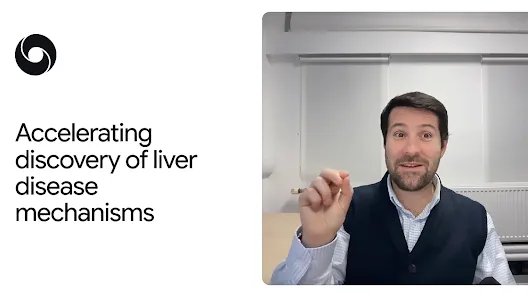
  • Accelerating discovery of liver disease mechanisms

    Accelerating discovery of liver disease mechanisms

    Biomedical research produces a flood of information that no scientist can realistically absorb. At the University of Edinburgh, bioengineer Filippo Menolascina is using Co-Scientist to comb the literature for overlooked links and generate new hypotheses.

    His team focused on a common liver disease called metabolic dysfunction‑associated steatohepatitis (MASH). Developing treatments is challenging because MASH involves intertwined biological processes, including liver inflammation and metabolism, meaning single‑target drugs fall short. That pushes researchers toward combination treatments, but the number of potential drug pairings is overwhelming.

    Faced with that combinatorial explosion, Menolascina used Co‑Scientist to narrow the search. In his hands, Co‑Scientist synthesised evidence across liver biology and pharmacology, highlighted mechanisms worth focusing on, and flagged candidate combination therapies that his team could test.

    In one emblematic case, Co‑Scientist tackled a live, practical question: Why does the drug resmetirom – a recently approved treatment prescribed for a specific stage of MASH – only help a narrow slice of those eligible patients? The system produced a hypothesis pinpointing the NLRP3 inflammasome as the specific molecular bridge coupling inflammation and metabolism in the disease — a connection never previously pulled together into a single, actionable explanation. The hypothesis, later experimentally verified, could pave the way for targeted dual-therapies.

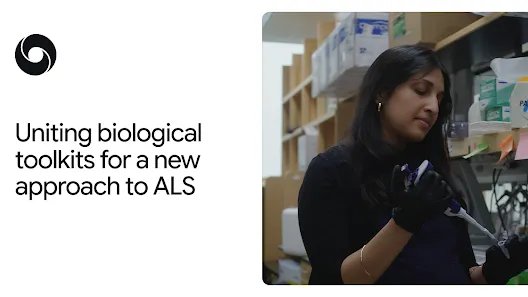
  • Uniting biological toolkits for a new approach to ALS

    Uniting biological toolkits for a new approach to ALS

    Ritu Raman at MIT and Ryan Flynn at Boston Children’s Hospital approach human biology with very different toolkits, but Co-Scientist is bridging their labs. Raman, a mechanical engineer, builds living nerve and muscle tissues to model diseases that affect voluntary movement. Her husband Flynn, a chemical biologist, maps RNA on the surface of cells to see how it influences cellular communication and how pathogens invade.

    When Raman decided to investigate ALS, which was outside of her usual domain, she faced a sprawling, contradictory literature that would usually take months to grasp. Co-Scientist compressed that work, quickly helping Raman interrogate the evidence in relation to her tissue model, turn ideas into testable hypotheses, and rank potential directions in accordance with the trade-offs labs actually face, such as feasibility and potential risk–reward.

    But Co-Scientist’s best leads came with a catch: they involved what happens at the surface of cells, where much of their communication is mediated. Raman could manipulate tissues and measure outcomes, but decoding the molecular interactions driving those signals was outside her area of expertise.

    That gap became the catalyst for collaboration. Raman brought her new research directions to Flynn, and the pair used Co-Scientist iteratively, combining its best ideas into creative research pathways that united their distinct toolkits. To develop new therapies, their hunt is now on for novel RNA-based mechanisms—and potentially RNA-based drugs—that could be used to target ALS.